
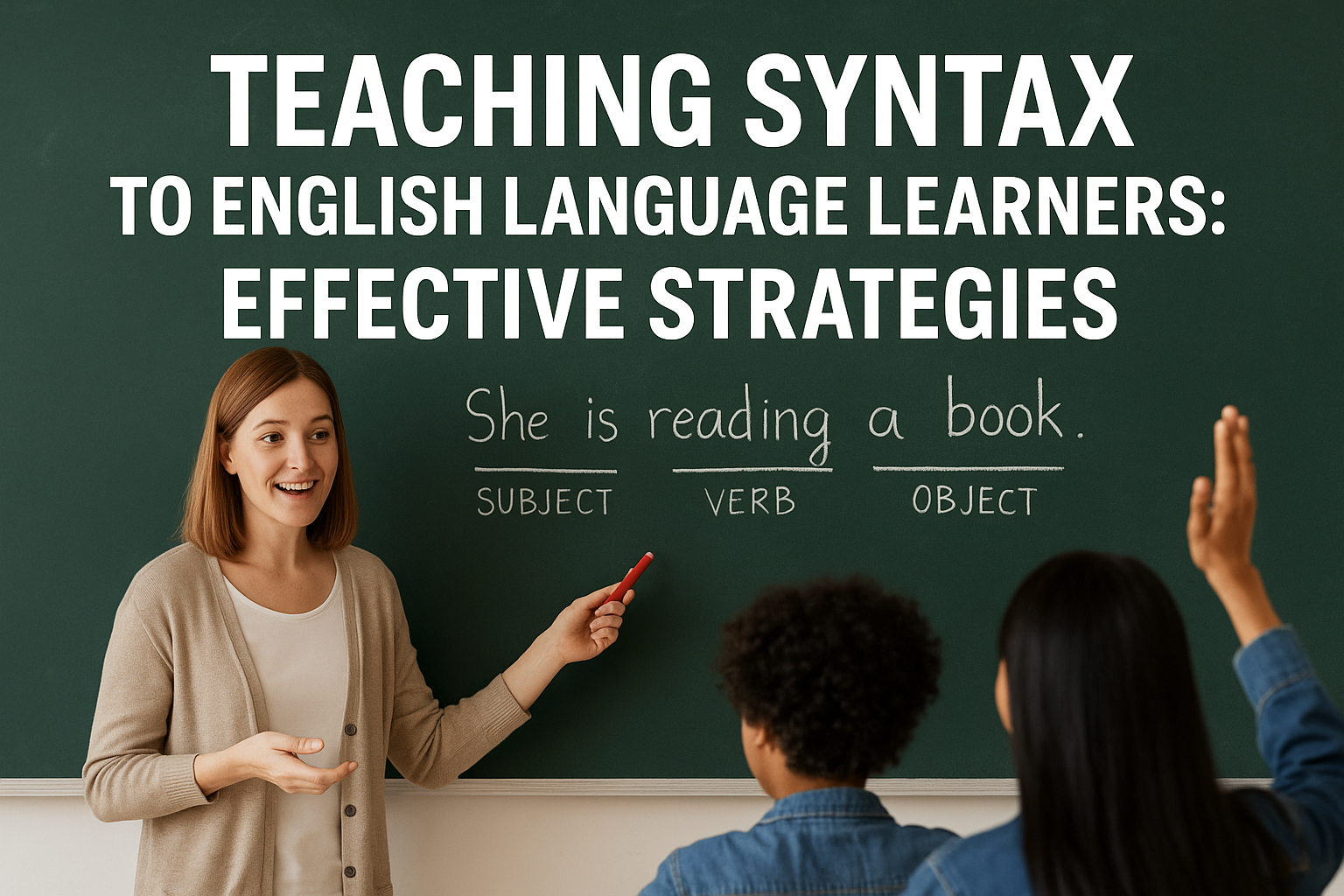

“`html
Teaching syntax to English language learners (ELLs) is a crucial aspect of language acquisition that can significantly impact their overall understanding and use of the English language. Syntax, the arrangement of words and phrases to create well-formed sentences, can be particularly challenging for learners from diverse linguistic backgrounds. Understanding the complexities of syntax not only helps ELLs improve their grammatical accuracy but also enhances their reading comprehension and writing skills. In this article, we will explore effective strategies for teaching syntax to English language learners, with a focus on practical insights and current relevance.
The Importance of Syntax in Language Learning
Before diving into strategies, let’s establish why syntax is important for English language learners. Syntax is the backbone of any language, shaping how meaning is constructed and conveyed. For ELLs, mastering English syntax can affect their ability to communicate effectively. Mistakes in syntax can lead to misunderstandings and hinder interaction with peers and teachers, making it essential to prioritize this area in language instruction.
Research supports that a strong grasp of syntax correlates with improved academic performance. A study published by the National Literacy Panel on Language Minority Children and Youth found that students with a solid foundation in syntax tended to excel in reading and writing tasks across content areas. Thus, when we focus on teaching syntax to English language learners, we’re not just teaching them how to construct sentences; we’re equipping them with the tools necessary for academic success.
1. Integrating Syntax Instruction with Vocabulary Development
One effective strategy in teaching syntax to English language learners is to integrate it with vocabulary development. Research shows that vocabulary knowledge and syntactic capability are intertwined. When learners expand their vocabulary, they also need to understand how to use these words correctly in sentences. exploring semantics and syntax offers useful background here.
For instance, when teaching new vocabulary words, present them within the context of sentences. Instead of simply providing definitions, demonstrate how words function grammatically. Use visuals and context clues to illustrate how different words can change the meaning of a sentence based on their placement. Activities such as sentence creation using target vocabulary can reinforce both syntax and vocabulary skills.
2. Use of Sentence Frames
Sentence frames can be an effective tool for teaching syntax to English language learners. A sentence frame provides a structured template that students can use to form correct sentences. This approach is particularly helpful for beginners who may feel overwhelmed by the complexities of English syntax.
For example, you might provide a frame like, “I like to _____,” where students can insert verbs of their choice. As students become more confident, you can introduce more complex frames that require them to use additional grammatical elements, such as conjunctions or adjectives. Encouraging students to use these frames in speaking and writing tasks can help solidify their understanding of sentence structure and syntax.
3. Modeling and Scaffolding
Modeling and scaffolding are two interconnected strategies that can greatly aid in teaching syntax to English language learners. Modeling involves demonstrating correct syntactic structures in context, while scaffolding provides support to learners as they acquire new skills.
Begin by modeling sentences that include various syntactic structures during lessons. For example, you might read a passage aloud, highlighting different sentence types—declarative, interrogative, imperative, and exclamatory. Engage students by asking them to identify the structures or to rewrite sentences in different forms.
Scaffolding comes in when you gradually remove supports as learners become more proficient. Initially, provide sentence starters, and then as students gain confidence, encourage them to generate their own sentences without prompts. This gradual release of responsibility helps build independence in language use. (See: Teaching reading and language skills.)
4. Incorporating Interactive Activities
Interactive activities play a vital role in teaching syntax to English language learners. Activities that involve collaboration and active participation can help students practice syntax in a meaningful context. Consider using games, group work, or technology-based tools that encourage interaction.
For instance, a “Sentence Scramble” game where students receive mixed-up sentence parts can be both fun and educational. They must work together to arrange the parts correctly, fostering teamwork while practicing syntax. Online platforms like Padlet can facilitate collaborative sentence-building exercises, allowing students to visually see their peers’ contributions and learn from each other.
5. Providing Constructive Feedback
Constructive feedback is essential in the process of teaching syntax to English language learners. Feedback should be specific, actionable, and timely, focusing on the syntactic errors rather than just the overall content. This approach helps ELLs understand where they are making mistakes and how they can correct them.
Instead of simply stating that a sentence is incorrect, explain why. For example, if a student says, “She go to the store,” you might respond with, “Great effort! But remember, we say ‘She goes to the store.’ Let’s look at why we add ‘-es’ to ‘go’ when we talk about he, she, or it.”
Consider using rubrics to assess students’ syntax in writing assignments. This method allows students to see their progress over time and understand where they need to improve.
6. Connecting Syntax to Culture
Finally, it’s vital to connect syntax instruction to the cultural backgrounds of your English language learners. Different cultures often have distinct syntactic structures, which can influence how students produce English sentences. Acknowledging and discussing these differences can help students understand why certain English structures may feel unfamiliar or challenging.
For example, if a student’s first language uses a different word order, it can be beneficial to explicitly compare that structure to English syntax. Activities that involve culturally relevant texts can also provide context, making the learning process more relatable and engaging.
Encourage students to share examples from their first languages, fostering a classroom environment that values diversity while teaching English syntax. This not only helps with syntax but also builds confidence and a sense of belonging.
7. Strategies for Advanced Learners
While many strategies focus on beginners, it’s equally important to consider advanced English language learners. These students may have a good grasp of basic syntax but struggle with more complex structures. Teaching advanced syntax can enhance their writing sophistication and comprehension skills in academic settings.
An effective method for advanced learners is to introduce them to varied sentence structures, such as compound-complex sentences. Teach them how to combine independent and dependent clauses effectively. Activities like peer-review sessions can help them notice and analyze the syntactic choices of their peers, fostering a collaborative learning environment. They might analyze how authors use syntax to convey tone or emotion in literature, providing a real-world application of what they are learning. (See: Teaching English language learners.)
8. The Role of Technology in Syntax Instruction
In today’s digital age, leveraging technology can greatly enhance the process of teaching syntax to English language learners. There are numerous online tools and applications that provide interactive and engaging ways to practice syntax. For instance, apps like Grammarly can help students identify and correct syntax errors in real-time as they write, providing immediate feedback.
Furthermore, using educational platforms such as Quill or NoRedInk allows instructors to create customized exercises that target specific syntactic structures. These platforms adapt to learners’ progress, offering personalized challenges that can keep students motivated. Incorporating these digital tools can make learning syntax not only effective but also fun.
9. The Influence of Syntax on Reading Comprehension
Understanding syntax is closely tied to reading comprehension. The ability to parse sentences correctly can change how students understand the material they read. Research indicates that students who struggle with syntax often face difficulties in making inferences and understanding nuances in texts. For example, if a student misinterprets the structure of a sentence in a reading passage, it can lead to incorrect conclusions about the content.
To address this, teachers can incorporate sentence parsing exercises while reading. Ask students to break down complex sentences into their components, identifying subjects, verbs, and objects. Discussing how sentence structure affects meaning can deepen comprehension and enhance analytical skills. Regular practice with diverse texts will also help students become more adept at navigating various syntactic structures they encounter in literature and academic writing.
10. Frequently Asked Questions (FAQ)
What is the best age to start teaching syntax to ELLs?
It’s beneficial to begin teaching syntax as early as possible, ideally in elementary school. However, older students can also successfully learn syntax. Tailor the complexity of the instruction to the learners’ age and proficiency level for maximum effectiveness.
How can I assess students’ understanding of syntax?
Use formative assessments like sentence construction exercises and writing samples to evaluate students’ understanding of syntax. Additionally, consider peer reviews and group discussions as informal assessment tools that can provide insights into their grasp of syntactic concepts.
Are there specific resources recommended for teaching syntax?
Yes, resources such as grammar workbooks, online platforms like Grammarly and NoRedInk, and educational games can provide valuable support. Additionally, consider using children’s books that feature varied sentence structures to illustrate syntax in context.
How can I support ELLs who struggle with syntax?
Provide additional scaffolding, such as sentence frames and modeling. One-on-one support can also help identify specific challenges they face with syntax. Ensure you give constructive and specific feedback that focuses on improvement.
Can teaching syntax impact other areas of language learning?
Absolutely! A strong understanding of syntax can lead to improvements in reading comprehension and writing skills. It enables learners to express themselves more clearly and understand others more effectively, enhancing overall communication skills.
11. The Impact of First Language on Syntax Learning
One essential factor to consider when teaching syntax to English language learners is the influence of their first language. Learners often carry over syntactic rules and structures from their native languages, which can either assist or hinder their acquisition of English syntax. For example, a student whose first language structures sentences differently may initially struggle with English grammar rules.
Understanding these influences allows educators to tailor their instruction. For instance, a Spanish speaker might find it challenging to grasp English word order, as Spanish syntax can be more flexible. By addressing these specific challenges, teachers can provide targeted support that makes learning more effective.
Incorporating contrastive analysis—comparing students’ first languages with English—can shed light on common pitfalls and help clarify concepts that may seem confusing. This approach not only aids in understanding but also promotes a deeper appreciation for linguistic diversity.
12. Encouraging Peer Learning and Collaboration
Peer learning can be a powerful strategy in teaching syntax to English language learners. Collaborating with classmates allows ELLs to practice and reinforce their syntax skills in an authentic context. Pairing students with different proficiency levels can encourage more advanced learners to mentor their peers, creating a supportive learning environment.
Group activities such as collaborative writing projects can provide practical contexts for practicing syntax. As students draft and edit together, they can discuss sentence structure choices, prompting each other to consider the syntactic aspects of their writing. This not only enhances their understanding but also builds critical thinking and communication skills.
Conclusion: The Path Forward
Teaching syntax to English language learners is a multifaceted task that requires patience, creativity, and a deep understanding of both language and learner needs. By integrating vocabulary development, using sentence frames, modeling, incorporating interactive activities, providing constructive feedback, connecting to students’ cultural backgrounds, and utilizing technology, educators can create a rich learning environment that fosters syntactic skills.
As classrooms continue to diversify, the need for effective syntax instruction will only grow. By employing these strategies, teachers can empower their English language learners to communicate more effectively and succeed academically. Remember, the journey of language acquisition is not just about learning rules; it’s about expressing thoughts, sharing ideas, and building connections.
“`
Trending Now This builds on understanding syntax in language development.
Frequently Asked Questions
What are effective strategies for teaching syntax to English language learners?
Effective strategies for teaching syntax to English language learners include integrating syntax instruction with vocabulary development, using visual aids, employing sentence-building activities, and providing explicit grammar instruction. These approaches help ELLs understand sentence structure and improve their overall language skills.
Why is understanding syntax important for English language learners?
Understanding syntax is crucial for English language learners as it enhances their ability to construct meaningful sentences, improves grammatical accuracy, and boosts reading comprehension. A strong grasp of syntax also correlates with better academic performance across various subjects.
How does syntax affect communication for English language learners?
Syntax significantly impacts communication for English language learners because errors in sentence structure can lead to misunderstandings. Mastering syntax enables ELLs to convey their thoughts more clearly and interact effectively with peers and teachers.
What role does vocabulary development play in learning syntax?
Vocabulary development plays a vital role in learning syntax, as a strong vocabulary foundation supports the ability to form grammatically correct sentences. Integrating vocabulary with syntax instruction helps English language learners make connections between word meanings and sentence structures.
How can teaching syntax improve academic performance for ELLs?
Teaching syntax can improve academic performance for English language learners by providing them with the tools to construct well-formed sentences, leading to better writing and reading comprehension. Research indicates that ELLs with a solid understanding of syntax excel in various academic tasks.
What did we miss? Let us know in the comments and join the conversation.



