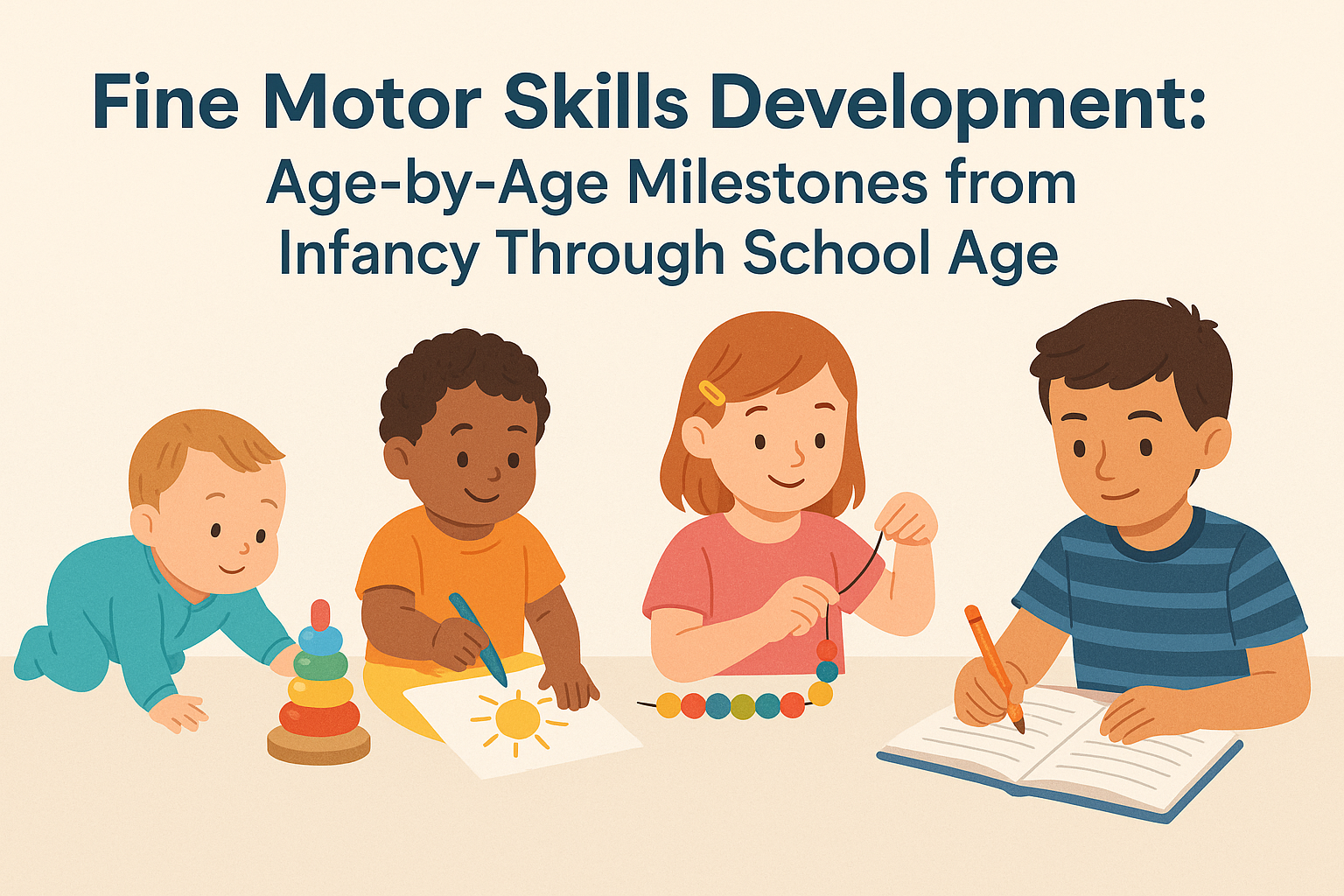

As parents and caregivers, we often find ourselves marveling at the growth and development of our children. One aspect that is crucial yet sometimes overlooked is their fine motor skills development. These skills are essential for tasks that require hand-eye coordination and the use of small muscle groups in the hands and fingers. Understanding the milestones associated with fine motor skills can help you support your child’s growth effectively, fostering independence and confidence as they reach each new stage. This article will provide you with an in-depth look at the age-by-age milestones of fine motor skills development from infancy through school age.
What Are Fine Motor Skills?
Fine motor skills refer to the precise movements that involve the smaller muscles of the hands, fingers, and wrists. These skills are crucial for a variety of everyday tasks, including writing, buttoning clothing, and using cutlery. Unlike gross motor skills, which involve larger movements like running and jumping, fine motor skills are about coordination and dexterity.
These skills develop over time, and each stage of growth presents unique opportunities for children to refine their abilities. Activities that promote fine motor skills can range from playing with blocks to engaging in arts and crafts. Understanding when to introduce these activities according to developmental milestones can significantly enhance a child’s progress.
Infancy: 0-12 Months
The early stages of fine motor skills development begin in infancy, typically around the age of 2-3 months. At this stage, you might notice your baby starting to grasp objects placed in their hands. This reflexive grasp is the foundation upon which more complex skills will build.
As infants grow, they transition through several key milestones:
- Grasp Reflex (0-2 months): Newborns exhibit a strong grasp reflex when something touches their palm. This is a natural instinct aimed at survival.
- Voluntary Grasp (3-6 months): Around 3 to 4 months, babies can intentionally grasp objects, often moving them to their mouth for exploration.
- Transfer Objects (5-7 months): By 5 to 7 months, infants can transfer objects from one hand to another, showcasing an emerging sense of control.
- Pincer Grasp (9-12 months): At about 9 months, babies develop the ability to pick up small items using their thumb and forefinger, known as the pincer grasp. This skill is pivotal for more complex tasks later.
Engaging in activities like placing colorful objects within reach or providing textured toys can significantly enhance your baby’s fine motor skills during this period.
Toddlers: 1-3 Years
As children enter the toddler phase, their fine motor skills begin to flourish in tandem with their increasing independence. This is a critical time for fine motor skills development, as toddlers are eager to explore and manipulate their environment.
During this stage, you can expect to see the following milestones: (See: CDC Milestones for Child Development.)
- Stacking Blocks (12-18 months): Most toddlers can stack two to three blocks by 18 months. This activity not only promotes fine motor development but also encourages cognitive skills such as problem-solving.
- Using Utensils (2-3 years): By age 2, many toddlers begin to use spoons and forks, although they might not be proficient yet. This is a great time to allow them to practice during meal times.
- Drawing (2-3 years): Children start to scribble and make marks with crayons or markers. While initially unrefined, this activity lays the groundwork for future writing skills.
- Turning Pages (2-3 years): Toddlers will begin to turn pages in a book, which helps strengthen their pincer grasp and hand-eye coordination.
Encouraging your toddler to engage in activities like stacking toys, simple puzzles, and drawing can support their fine motor skills development during this essential period.
Preschoolers: 3-5 Years
By the time children reach preschool age, their fine motor skills become more refined, allowing them to engage in increasingly complex tasks. This stage is marked by greater dexterity and coordination, which are essential for school readiness.
The following milestones are typical for preschoolers:
- Advanced Drawing (3-4 years): Children can begin to create recognizable shapes and figures, such as circles and squares. They may also start to draw simple stick figures.
- Cutting Skills (4-5 years): With practice, preschoolers can use child-safe scissors to cut along straight lines, an essential skill for arts and crafts activities.
- Buttoning and Zipping (4-5 years): By this age, many children can manage simple fasteners, such as buttons and zippers, fostering independence in dressing.
- Using Tools (4-5 years): More complex tools, such as paintbrushes or glue sticks, are often used effectively. Children may engage in activities like painting, gluing, and other crafts that require precise hand movements.
Encouragement and practice are key. Activities like drawing, playing with clay, and using scissors can significantly enhance fine motor skills during these formative years.
Early Elementary: 6-8 Years
As children transition into early elementary school, their fine motor skills should be becoming more refined, allowing them to tackle the tasks presented in school with relative ease. At this stage, fine motor skills development is crucial for academic success.
Key milestones during this period include:
- Writing Skills (6-7 years): Children will begin to write their names and simple sentences. Their grip on writing instruments should become more controlled.
- Fine Manipulation (6-8 years): The ability to manipulate small objects, like beads or buttons, improves, allowing for more complex crafts or activities such as sewing.
- Keyboarding (7-8 years): Many children are introduced to computers and learn to type at a basic level, further developing their fine motor capabilities.
- Artistic Activities (6-8 years): Drawing becomes more detailed, with children able to represent more complex ideas and images. They may also become interested in activities like model-building, which require precise hand movements.
To support fine motor skills development, consider providing opportunities for your child to engage in activities like writing, crafting, or simple cooking tasks that demand precise hand movements.
Middle Childhood and Beyond: 9-12+ Years
Fine motor skills continue to evolve even after the early elementary years, becoming increasingly specialized and refined as children enter middle childhood and adolescence. While the foundational skills are typically established, these later years involve perfecting precision, speed, and endurance, especially for specific activities. (See: NIH Learning and Development Resources.)
- Advanced Writing and Drawing (9-12 years): Handwriting becomes more legible and consistent. Children can write for longer periods without fatigue. Artistic skills blossom, with more detailed drawings, painting with different mediums, and potentially even intricate calligraphy or sketching.
- Musical Instrument Play (9+ years): Learning instruments like the piano, guitar, or violin demands exceptional fine motor control, finger dexterity, and coordination. This is a fantastic way to continue challenging and strengthening these skills.
- Crafts and Hobbies (9+ years): Activities like knitting, crocheting, model-making, jewelry design, or even complex LEGO builds require sustained fine motor precision and planning.
- Sports and Gaming (9+ years): While many sports rely on gross motor skills, activities like shooting hoops, playing darts, or even competitive video gaming involve significant fine motor coordination and reaction time.
- Technology Proficiency (9+ years): Beyond basic keyboarding, children learn to navigate complex digital interfaces, use precision tools in design software, or even engage in coding which often involves meticulous input.
At these ages, children often choose activities based on their interests, which naturally helps them hone specific fine motor skills. Encouraging these passions can lead to mastery and a sense of accomplishment.
The Connection Between Fine Motor and Cognitive Development
It’s important to recognize that fine motor skills development isn’t an isolated process. It’s deeply intertwined with cognitive development. When a child manipulates objects, draws, or writes, they’re not just moving their hands; they’re also engaging their brains in problem-solving, spatial reasoning, planning, and memory.
- Problem-Solving: Building a tower with blocks or completing a puzzle requires a child to think about how pieces fit together and anticipate outcomes.
- Spatial Awareness: Drawing shapes or cutting along lines helps children understand relationships between objects in space.
- Cognitive Flexibility: Adapting grip or pressure for different tools (e.g., a crayon versus a paintbrush) demonstrates cognitive flexibility.
- Memory and Sequencing: Tasks like stringing beads in a pattern or following steps to build a model reinforce memory and sequencing skills.
- Language Development: Writing helps solidify the connection between spoken words and their written form, boosting literacy.
This strong link means that supporting fine motor skills development also indirectly nurtures cognitive growth, creating a powerful feedback loop for overall learning.
Factors Influencing Fine Motor Skills Development
While the milestones outlined provide a general framework for fine motor skills development, several factors can influence a child’s progress. These include:
- Individual Differences: Each child develops at their own pace. Some may excel in fine motor skills sooner, while others may take more time to catch up.
- Environment: A child’s environment can significantly impact their opportunities for practice. Accessible toys, arts and crafts materials, and activities can promote fine motor skill development.
- Parental Engagement: Active involvement from parents or caregivers can encourage practice and exploration, greatly enhancing a child’s skill set.
- Health Factors: Motor skills can also be affected by a child’s overall health. Conditions such as developmental coordination disorder can hinder fine motor skills development, requiring additional support.
Recognizing and understanding these factors can help tailor the approach you take to support your child’s fine motor skills development.
Encouraging Fine Motor Skills Development: Practical Strategies
Supporting fine motor skills development isn’t just about waiting for milestones to be reached. There are plenty of practical strategies you can incorporate into your child’s daily routine to enhance their skills:
- Play with Playdough: Manipulating playdough can strengthen hand muscles and improve dexterity.
- Arts and Crafts: Engage your child in drawing, coloring, cutting, and gluing activities. This not only promotes fine motor skills but also encourages creativity.
- Use Puzzles: Simple jigsaw puzzles can help improve hand-eye coordination and problem-solving skills.
- Practice Self-Care Skills: Allow your child to dress themselves, use utensils during meals, and assist with simple household chores.
- Incorporate Technology: Introduce age-appropriate apps or games on tablets that require tapping, swiping, or dragging, which can enhance fine motor coordination.
By integrating these activities into your child’s routine, you can create a supportive environment that fosters fine motor skills development, laying the groundwork for their future success in school and beyond.
When to Seek Professional Help
While every child develops at their own speed, there are instances when a delay in fine motor skills development might warrant professional attention. It’s important not to panic, but to be observant and consult with your pediatrician if you notice persistent concerns.
Some red flags that might indicate a need for further evaluation include:
- Significant Delays: If your child is consistently missing several age-appropriate fine motor milestones, for example, a 2-year-old who still isn’t scribbling or a 4-year-old who struggles with basic cutting.
- Extreme Frustration: If your child gets overly frustrated or avoids fine motor tasks that their peers enjoy.
- Unusual Hand Preference: If a child consistently uses only one hand for all tasks before 18 months, or doesn’t show a hand preference by age 3-4.
- Poor Grip or Tremors: If your child has a very weak grip, drops objects frequently, or exhibits tremors when trying to perform fine motor tasks.
- Difficulty with Daily Tasks: If they struggle significantly with self-care activities like feeding themselves, dressing, or buttoning.
A pediatrician can assess the situation and, if necessary, refer you to an occupational therapist. Occupational therapists are experts in fine motor skills development and can provide targeted interventions and strategies to help your child catch up or manage specific challenges. Early intervention is often key to positive outcomes.
Conclusion: The Lifelong Impact of Fine Motor Skills
Fine motor skills are a vital component of a child’s overall development. From infancy through early childhood, children reach critical milestones that shape their ability to interact with the world around them. By understanding these milestones and actively promoting fine motor skills development, you can empower your child to achieve independence and competence in daily tasks.
Remember that while each child develops at their own pace, providing opportunities for practice and engagement can make a significant difference. Fine motor skills are not just about precision; they’re foundational for learning, creativity, and growth. So, as you watch your child explore and learn, consider how you can support their journey through the lens of fine motor skills development.
Trending Now
Frequently Asked Questions
What are fine motor skills?
Fine motor skills are precise movements that involve the smaller muscles of the hands, fingers, and wrists. They are essential for everyday tasks like writing, buttoning clothes, and using utensils, distinguishing them from gross motor skills that involve larger movements.
At what age do fine motor skills develop?
Fine motor skills begin to develop in infancy, typically around 2-3 months. Milestones continue to progress through early childhood, with significant advancements occurring as children engage in various activities that promote coordination and dexterity.
What are the milestones for fine motor skills in infants?
In infants, key milestones include the grasp reflex seen in newborns (0-2 months) and the voluntary grasp that develops between 3-6 months. As they grow, they refine these skills through play and interaction with their environment.
How can I help my child develop fine motor skills?
You can support your child's fine motor skills development by providing activities that promote hand-eye coordination, such as playing with blocks, engaging in arts and crafts, or simple tasks like buttoning clothes and using cutlery.
Why are fine motor skills important?
Fine motor skills are crucial for fostering independence and confidence in children. They enable children to perform everyday tasks, enhancing their ability to interact with their environment and aiding in their overall development.
Agree or disagree? Drop a comment and tell us what you think.