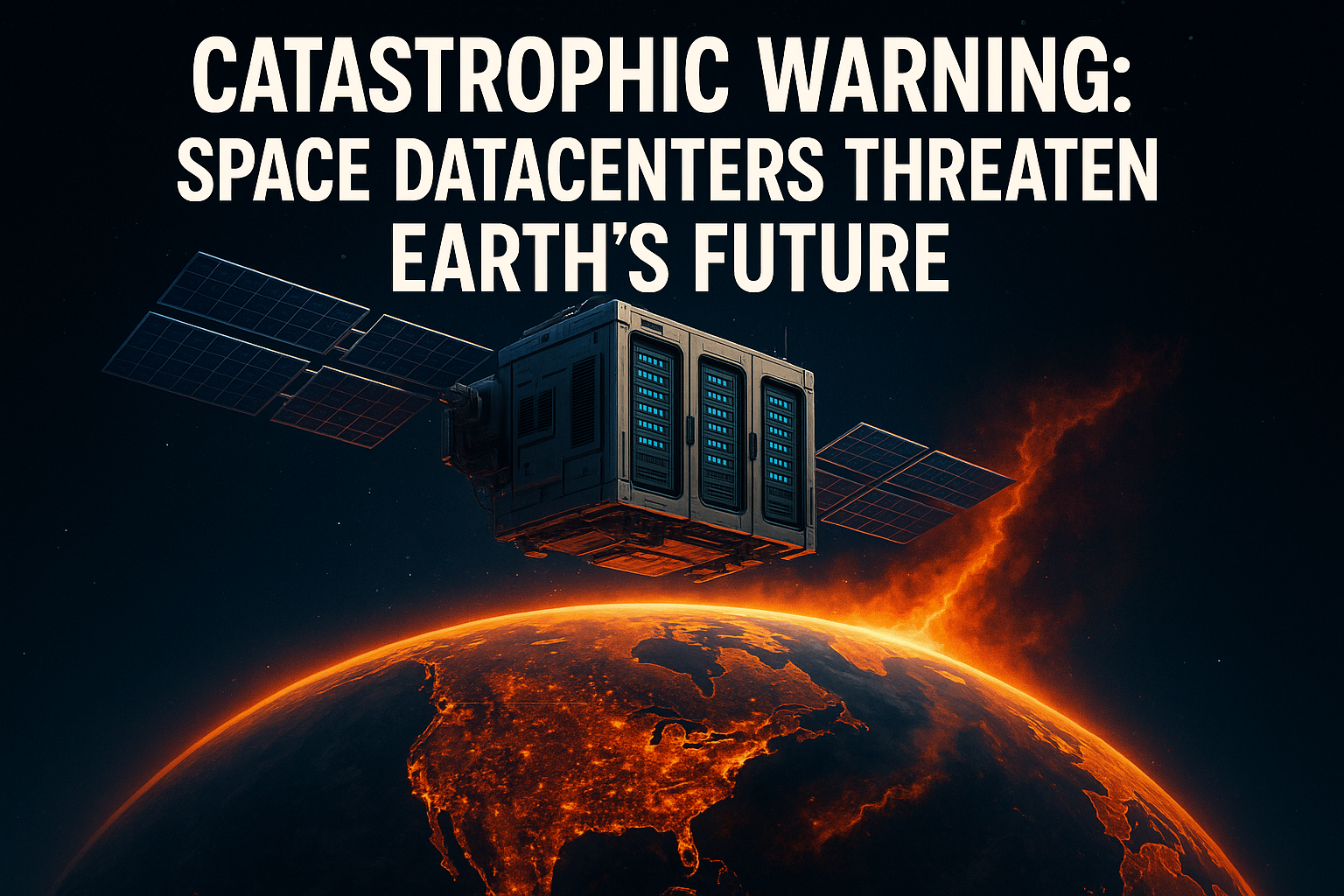

Imagine a future where the internet, our daily digital lifeline, isn’t just hosted in server farms on Earth but in vast data centers orbiting hundreds of miles above us. It sounds like something out of a sci-fi novel, doesn’t it? Yet, this vision is rapidly becoming a tangible prospect, championed by tech titans like Elon Musk and Jeff Bezos. Their companies, SpaceX and Blue Origin, are at the forefront of an ambitious push to launch millions of ‘orbital datacenters’ into space, promising unprecedented connectivity and computational power. But what if this futuristic dream comes with a nightmarish cost for our planet?
Experts and environmental groups are sounding a dire alarm, warning that the environmental impact of space datacenters could be nothing short of catastrophic. They argue that the very act of launching and maintaining these vast constellations of satellites will unleash a torrent of pollution and ecological damage, pushing our already fragile Earth further into crisis. It’s a high-stakes debate, pitting the boundless ambitions of Silicon Valley against the pressing realities of climate change and environmental preservation. And frankly, we all need to understand what’s at stake.
The Unseen Pollution: What Goes Up Must Come Down (and Burn)
When you think about space exploration, you probably picture sleek rockets soaring into the sky, carrying astronauts or sophisticated scientific instruments. What you might not immediately consider is what happens when those rockets, or the satellites they deploy, eventually fall back to Earth. This isn’t some harmless, ethereal return. It’s a fiery re-entry, and it’s leaving a growing trail of environmental concern.
The problem, according to scientists, is that as satellites and rocket stages burn up in the upper atmosphere, they’re not just disappearing into thin air. They’re releasing a cocktail of pollutants directly into the stratosphere, a critical layer of our atmosphere. We’re talking about black soot, fine particles of rare metals, and aluminum oxides. These aren’t benign substances; their accumulation at such high altitudes is an entirely new phenomenon, one we don’t fully understand.
Think about it: every launch, every de-orbiting satellite, contributes to this unseen atmospheric dump. And with plans for millions more satellites in orbit – Starlink alone aims for tens of thousands – this isn’t a trickle; it’s rapidly becoming a flood. What are the long-term consequences of constantly injecting these materials into the delicate balance of our stratosphere? That’s the billion-dollar question, and the answers we’re starting to get are deeply worrying.
Ozone Layer Under Siege: A Critical Shield at Risk
Perhaps the most alarming concern related to the environmental impact of space datacenters is the potential threat to the ozone layer. For decades, we’ve worked tirelessly to protect this vital shield, which absorbs harmful ultraviolet (UV) radiation from the sun, safeguarding life on Earth. Remember the global effort to ban CFCs? It was a triumph of international cooperation, and it allowed the ozone layer to begin its slow, arduous recovery. (See: NASA's Launch Operations.)
Now, experts fear that the very materials being released by re-entering satellites could undo all that progress. Black soot, for instance, is known to have a warming effect, but its impact in the stratosphere could be more complex, potentially accelerating chemical reactions that deplete ozone. Aluminum oxides, another byproduct of satellite incineration, are also a concern. Their presence at altitude could alter atmospheric chemistry in ways we haven’t fully modeled or understood, with potentially disastrous effects on ozone concentrations.
If the ozone layer is damaged, the consequences for life on Earth would be profound. Increased UV radiation exposure leads to higher rates of skin cancer, cataracts, and immune system suppression in humans. It also damages crops, harms marine ecosystems, and can disrupt entire food chains. To put it bluntly, compromising the ozone layer is a non-starter. It’s a risk too great to take, especially when we’re still grappling with a global climate crisis that already threatens our planetary stability.
Light Pollution and the Astronomical Cost
Beyond the chemical and atmospheric threats, the sheer number of proposed orbital datacenters presents another significant problem: light pollution. Each of these satellites, designed to reflect sunlight, becomes a tiny, moving star in the night sky. While individually they might seem insignificant, multiply that by tens of thousands, or even millions, and you quickly have a significant problem.
For astronomers, this is already a major headache. Observations of distant galaxies and faint cosmic phenomena are increasingly being marred by streaks of bright satellites passing through their fields of view. This isn’t just an inconvenience for scientists; it’s a fundamental threat to our ability to understand the universe. Astronomy has always relied on dark, pristine skies, and these mega-constellations are rapidly eroding that crucial resource.
But the impact isn’t limited to professional observatories. Think about the cultural and spiritual significance of the night sky. For millennia, humans have looked up at the stars, found inspiration, navigated, and developed cosmologies. What happens when that natural wonder is obscured by a man-made grid of blinking lights? It diminishes our connection to the cosmos, and perhaps, a part of our shared humanity. This light pollution is a tangible part of the environmental impact of space datacenters that many people can already see for themselves.
Regulatory Loopholes and the Race to Orbit
One of the most frustrating aspects of this burgeoning issue is the apparent lack of robust regulatory oversight. While there are regulations governing terrestrial pollution, the ‘wild west’ of space has largely operated with fewer environmental constraints. Companies are rushing to deploy these vast constellations, driven by commercial imperatives and the promise of a global, high-speed internet.
This rapid deployment is happening faster than our regulatory frameworks can adapt. Environmental groups and concerned scientists have highlighted that the current licensing processes, particularly within bodies like the Federal Communications Commission (FCC) in the United States, don’t adequately account for the cumulative environmental impact of space datacenters. They argue that licenses are being granted without a thorough assessment of the long-term ecological risks, potentially violating federal environmental laws. (See: Health Effects of Pollution.)
This has led to a crucial legal challenge: a petition has been filed with the FCC, urging them to halt new licenses for these projects until a comprehensive environmental impact study can be conducted. This isn’t about stopping innovation; it’s about ensuring that innovation doesn’t come at an irreversible cost to our planet. We need a ‘precautionary principle’ applied here, demanding that potential harms are thoroughly understood and mitigated before we commit to a path that could have devastating consequences.
The Climate Crisis Context: A Dangerous Bet
It’s vital to view the proposed expansion of orbital datacenters through the lens of the ongoing climate crisis. We are already in a precarious position, grappling with rising global temperatures, extreme weather events, and rapidly disappearing biodiversity. Every new source of pollution, every new disruption to our atmosphere, adds another layer of risk to an already unstable system.
Scientists have repeatedly warned that we are nearing critical tipping points, beyond which certain changes become irreversible. Introducing unknown atmospheric contaminants, potentially damaging the ozone layer, and increasing the overall heat burden on our planet feels like a dangerous gamble at a time when we should be doing everything in our power to stabilize Earth’s climate. The environmental impact of space datacenters isn’t an isolated problem; it’s another stressor on an already stressed planet.
The argument from proponents of these systems often centers on the benefits of global connectivity and the advancement of technology. And yes, these are important goals. But are they so important that we should risk fundamentally altering our atmosphere and compromising the very systems that sustain life? Many experts would argue that this is a false dichotomy. We can pursue technological advancement responsibly, with a clear understanding of its environmental footprint, rather than blindly charging ahead.
Towards a Sustainable Space Future: What Can Be Done?
So, if the environmental impact of space datacenters is such a serious concern, what’s the path forward? Simply halting all space activity isn’t a realistic or desirable solution for many. The benefits of space technology, from weather forecasting to navigation, are undeniable. However, we absolutely need a more responsible and sustainable approach to space utilization.
International Cooperation and Regulation
First and foremost, there needs to be a robust international framework for regulating space activities, particularly those involving mega-constellations. Individual national agencies cannot adequately address a problem that transcends borders and affects the global commons. We need treaties and agreements that establish clear environmental standards for satellite design, launch emissions, and de-orbiting procedures. This would include mandating technologies for cleaner re-entry, or perhaps even developing methods for retrieving defunct satellites without atmospheric incineration. (See: The Issue of Space Pollution.)
Research and Transparency
Second, we need significantly more research into the long-term effects of stratospheric pollution from re-entering objects. This research must be transparent, peer-reviewed, and independent of the commercial entities involved. We cannot afford to operate in the dark when the stakes are this high. This means funding scientific studies, deploying atmospheric monitoring systems, and openly sharing data so that the true environmental impact of space datacenters can be accurately assessed.
Design for De-orbit and Sustainability
Third, satellite and rocket manufacturers must be held accountable for the entire lifecycle of their products. This means designing satellites for more controlled, less polluting de-orbiting, or even for potential on-orbit servicing and recycling. The ‘throwaway’ mentality that has often characterized early space exploration is simply not sustainable in an era of massive constellations. Innovation should also focus on developing propulsion systems that produce fewer harmful emissions during launch.
Public Awareness and Advocacy
Finally, public awareness and advocacy are crucial. The average person might not be aware of these hidden environmental costs of space exploration. By understanding the risks, we can collectively demand greater accountability from both corporations and governments. Supporting initiatives like the petition to the FCC sends a clear message that environmental protection must be prioritized alongside technological advancement.
The vision of a future powered by orbital datacenters is certainly compelling, but the warnings from experts are stark and undeniable. We stand at a critical juncture, where the choices we make about space utilization today will profoundly shape the health of our planet for generations to come. Ignoring the potential catastrophic environmental impact of space datacenters would be a reckless gamble, one that we simply cannot afford to lose.
Trending Now
Frequently Asked Questions
What are orbital datacenters and how do they work?
Orbital datacenters are advanced data storage facilities located in space, designed to provide enhanced connectivity and computational power. Companies like SpaceX and Blue Origin aim to launch these datacenters into orbit, utilizing satellites to manage and process vast amounts of data remotely.
What environmental impact do space datacenters have?
Experts warn that space datacenters could lead to significant environmental damage. The process of launching and maintaining these structures can generate substantial pollution, particularly as rocket stages and satellites re-enter the atmosphere, releasing harmful pollutants into the stratosphere.
Are there risks associated with launching satellites into space?
Yes, launching satellites comes with risks, including pollution from rocket launches and the potential for debris. As satellites burn up during re-entry, they can emit harmful substances into the atmosphere, raising concerns about long-term environmental effects.
Who is leading the development of space datacenters?
Tech giants like Elon Musk's SpaceX and Jeff Bezos's Blue Origin are at the forefront of developing orbital datacenters. Their ambitious projects aim to revolutionize internet connectivity and data processing by utilizing space-based infrastructure.
What are the concerns of environmental groups regarding space datacenters?
Environmental groups express concerns that the proliferation of space datacenters could exacerbate climate change. They argue that the pollution generated from rocket launches and satellite re-entries poses a serious threat to Earth's already fragile ecosystem.
Have you experienced this yourself? We'd love to hear your story in the comments.