
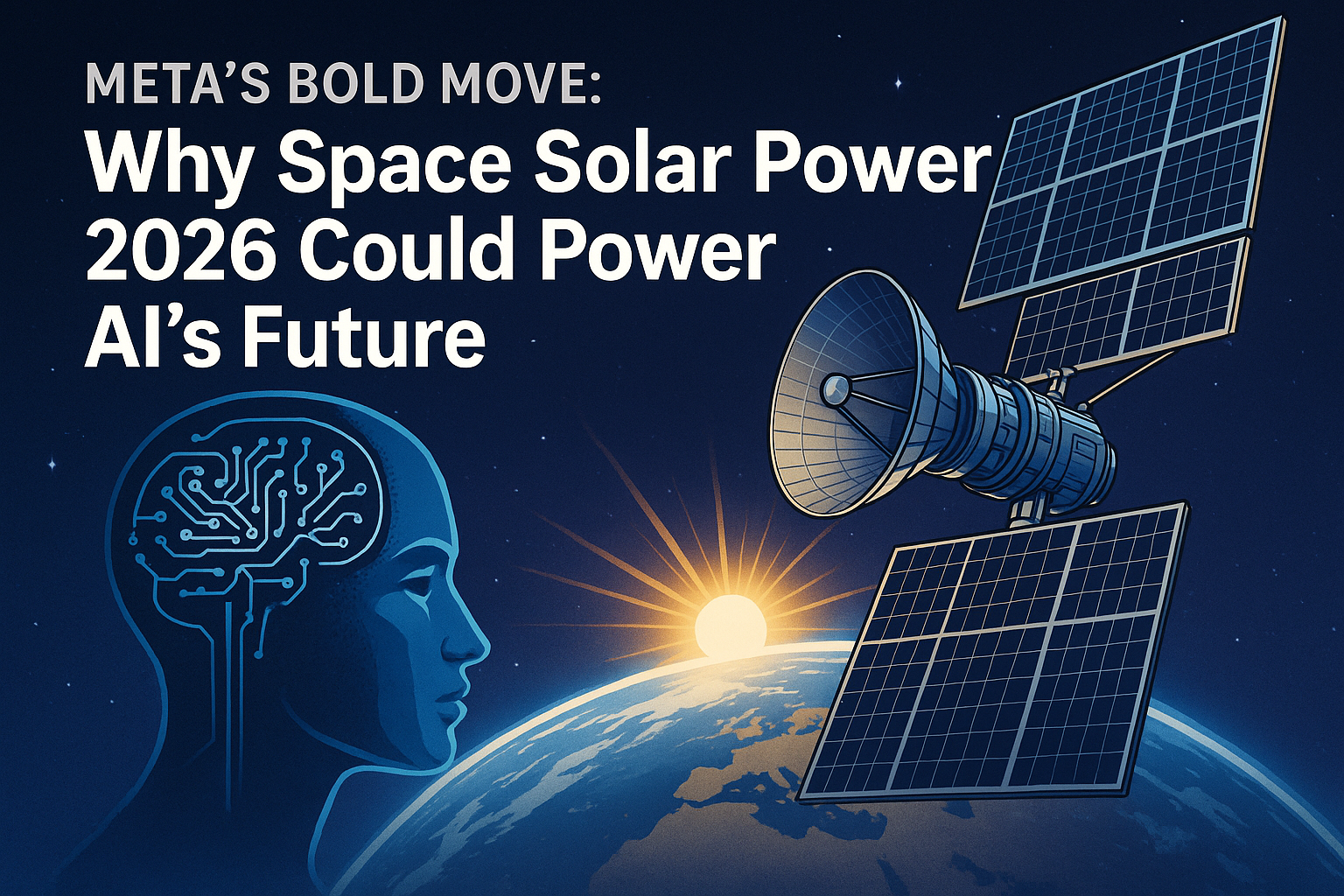

Imagine a future where the sun never sets on our energy supply, where clean power flows continuously, day and night, rain or shine. For decades, this vision of space-based solar power (SBSP) felt like science fiction, a distant dream confined to government labs and academic papers. But what if I told you that dream is rapidly becoming a commercial reality, with a major tech giant like Meta leading the charge? That’s right, we’re talking about a groundbreaking shift, and it’s all centered around the ambitious timeline for space solar power 2026.
Meta, the company behind Facebook and Instagram, has just made an astonishing move, signing the very first commercial capacity reservation agreement for space solar power. This isn’t just a research grant or a speculative investment; it’s a concrete deal, securing up to a full gigawatt of orbital solar capacity from a startup called Overview Energy. Their target? Powering Meta’s hungry, AI-driven data centers by 2030. If you’ve been following the energy demands of artificial intelligence, you know this isn’t a small problem. AI models require immense computational power, and that translates directly into colossal energy consumption. Meta’s decision isn’t just about sustainability; it’s about securing a reliable, scalable energy future for its rapidly expanding AI infrastructure.
This development is far more than a blip on the radar; it’s a crucial inflection point. For infrastructure investors, energy executives, and anyone interested in the future of renewables, this signals a profound shift. Decades of government-funded research and theoretical models are finally translating into tangible demand, complete with a major, credit-worthy buyer and a defined delivery timeline. The concept of space-sourced energy, once dismissed as too complex or too costly, is now firmly on the commercial map, promising to revolutionize how we think about power generation. The implications, both technological and economic, are truly immense.
The Dawn of Commercial Space Solar Power 2026
The significance of Meta’s agreement with Overview Energy cannot be overstated. It marks the formal entry of space solar power into the commercial arena, moving it out of the exclusive domain of national space agencies and into the hands of private enterprise. Think about it: a company is now committing to buy power generated literally in outer space. This isn’t just a pilot project; it’s a reservation for significant, utility-scale power, with the goal of being online by the end of the decade. The ambition inherent in this timeline, particularly for space solar power 2026, is a clear signal of serious intent and technological confidence.
Overview Energy’s plan is both elegant and audacious. They intend to deploy satellites into geostationary orbit, some 36,000 kilometers above the Earth. From this vantage point, these satellites will have a constant, unobstructed view of the sun, 24 hours a day, seven days a week, unimpeded by weather, atmospheric conditions, or the Earth’s rotation. The energy collected by vast solar arrays on these satellites will then be converted into near-infrared light – a spectrum that passes relatively easily through our atmosphere – and beamed down to existing terrestrial photovoltaic installations. The genius here is that it leverages existing infrastructure on the ground, meaning we won’t need to build massive, dedicated receiving stations from scratch.
This approach offers a compelling advantage: continuous, baseload solar power. Unlike ground-based solar, which is inherently intermittent (no sun at night, reduced output on cloudy days), space solar power promises a steady, predictable supply. This ‘always on’ capability is what makes it so attractive for energy-intensive operations like data centers, which require unwavering power. Furthermore, by beaming light to existing solar farms, Overview Energy aims to maximize efficiency and minimize the need for new land acquisition, addressing a growing concern with large-scale renewable projects on Earth.
Overcoming the Skeptics: From Theory to Tangible Demand
For years, the biggest hurdle for space solar power wasn’t just the technology itself, but the perceived lack of commercial viability. Who would pay for it? How could it ever compete with terrestrial energy sources? Meta’s deal provides a definitive answer to those questions. It creates a robust demand signal, demonstrating that there’s a serious buyer willing to invest in this futuristic energy source. This move effectively de-risks the concept for other potential investors and customers, opening the floodgates for further commercial exploration.
The commitment to 2030, with significant progress expected by space solar power 2026, also provides a crucial deadline, forcing the pace of innovation and deployment. This isn’t just about theoretical R&D anymore; it’s about meeting a contractual obligation to deliver gigawatts of power. This commercial pressure can often accelerate technological development faster than government programs alone. Moreover, the involvement of a tech giant like Meta lends immense credibility to the entire endeavor, transforming SBSP from a niche topic into a mainstream energy conversation. (See: NASA's Space Solar Power Research.)
The AI Energy Crisis and the Need for Novel Solutions
Artificial intelligence is reshaping our world at an astounding pace, but this transformation comes with a hidden cost: immense energy consumption. Training and running large language models (LLMs) and other advanced AI applications demand staggering amounts of electricity. Data centers, the physical homes of AI, are already among the most energy-intensive facilities on the planet, and their power requirements are projected to skyrocket in the coming years. This growing energy appetite is creating a significant challenge for tech companies, who are simultaneously facing pressure to reduce their carbon footprint.
Consider the scale: a single advanced AI model can consume as much electricity as a small town during its training phase. As AI becomes more sophisticated and ubiquitous, the aggregate demand will become truly staggering. Traditional energy sources, whether fossil fuels or even intermittent renewables, are struggling to keep up with this exponential growth while maintaining reliability and sustainability goals. This looming ‘AI energy crisis’ is precisely what makes solutions like space solar power so incredibly attractive. See also Googles solar project deal.
Meta’s investment isn’t just about PR; it’s a strategic necessity. By securing a gigawatt of continuous, clean energy from space, they are proactively addressing a fundamental bottleneck for their future growth. This move underscores a broader trend: as AI accelerates, innovative, high-capacity, and sustainable energy solutions will become non-negotiable. Space solar power 2026, with its promise of uninterrupted power, could very well be the answer many tech companies are desperately seeking.
Why Conventional Renewables Fall Short for AI
While ground-based solar and wind power are vital components of our renewable energy transition, they present inherent limitations for operations that require constant, high-power input like AI data centers. The intermittency of these sources means that even with battery storage, achieving 24/7 baseload power can be challenging and incredibly expensive at scale. You need massive battery banks to smooth out the fluctuations, which adds complexity, cost, and a significant environmental footprint of its own.
Nuclear power is another option for baseload, but it comes with its own set of regulatory, public perception, and waste disposal challenges that make it a difficult fit for rapidly expanding private sector needs. Geothermal is excellent where available, but its geographical limitations prevent widespread deployment for every data center. This leaves a significant gap that space solar power is uniquely positioned to fill: providing clean, continuous, and geographically independent power. The ability to bypass terrestrial weather patterns and the day-night cycle is a game-changer for critical, always-on infrastructure.
The Technology Behind Space Solar Power 2026
Let’s dive a bit deeper into the mechanics. The core concept of space solar power involves three main stages: collection, transmission, and reception. In orbit, large solar arrays, similar to those found on the International Space Station but vastly larger, collect sunlight. Because there’s no atmosphere to filter the light, these arrays receive significantly more energy than their terrestrial counterparts, and they do so around the clock.
Once collected, this solar energy is converted into electricity, which is then used to power a transmitter. Overview Energy specifically mentioned using near-infrared light for transmission. Why near-infrared? Because it has several advantages: it can pass through the atmosphere with minimal absorption and scattering, even through clouds, making it more reliable than microwaves which can be affected by rain. It’s also safer for humans and wildlife than other parts of the electromagnetic spectrum, and the technology for generating and receiving near-infrared is well-understood and relatively mature, drawing on fiber optics and laser communication advancements.
On Earth, existing photovoltaic (PV) installations will be equipped to receive this beamed near-infrared light. This is a crucial point: it means we don’t necessarily need to build entirely new infrastructure. Instead, we can augment and enhance existing solar farms, turning them into 24/7 power hubs. This hybrid approach significantly reduces the upfront investment and environmental impact on the ground. The scalability of this system, with the ability to add more orbital power stations as demand grows, makes it an incredibly appealing long-term solution.
Geostationary Orbit: The Sweet Spot
The choice of geostationary orbit (GEO) is strategic. At an altitude of approximately 35,786 kilometers (22,236 miles) above the Earth’s equator, a satellite in GEO appears to remain fixed over a single point on the surface. This allows for continuous beaming of power to a specific terrestrial receiving station without complex tracking mechanisms on the ground. While launching to GEO is more energy-intensive than to lower orbits, the benefits of constant power transmission and simplified ground infrastructure make it the preferred choice for baseload space solar power. (See: U.S. Department of Energy on Space Solar Power.)
The satellites themselves will likely be modular, allowing for assembly in space or phased deployment. The sheer scale of these orbital power stations will be immense, potentially kilometers across, requiring significant advancements in in-space manufacturing and robotics. However, the foundational technologies for solar collection, power conversion, and beam forming are largely mature, having been refined over decades of space exploration and communication satellite development. The challenge now lies in scaling these technologies to a commercial level, a hurdle that Meta’s investment is helping to clear, with the aim of significant operational capability by space solar power 2026.
Investment Opportunities and Economic Impact of Space Solar Power 2026
Meta’s deal is more than a technological breakthrough; it’s an economic catalyst. This first commercial contract creates a tangible market for space solar power, sending a clear signal to infrastructure investors and energy executives worldwide. It transforms SBSP from a speculative ‘what if’ into a concrete ‘when,’ with a defined roadmap and a major customer. This is precisely the kind of demand signal that can unlock significant private capital, accelerating development and deployment.
The monetization potential within high-CPC (cost per click) niches like solar/energy and investing is enormous. As news of Meta’s involvement spreads, it will undoubtedly attract further commercial interest in space technology and renewable energy investments. We can expect to see a surge in venture capital funding for other space solar startups, as well as increased R&D spending from established aerospace and energy companies. This isn’t just about Overview Energy; it’s about validating an entire industry.
Think about the ripple effects: new jobs in aerospace engineering, advanced materials science, robotics, and energy management. The development of reusable heavy-lift rockets, like those from SpaceX and Blue Origin, is also making the economics of launching large-scale infrastructure to orbit increasingly feasible, further bolstering the case for SBSP. This convergence of technological readiness, escalating energy demand, and private sector investment creates a fertile ground for a new energy paradigm, with space solar power 2026 as a critical milestone.
The Broader Energy Landscape Shift
This development will inevitably influence national energy policies and international collaborations. Governments that have historically funded SBSP research may now find themselves competing with private entities, or, more likely, forming partnerships to accelerate deployment. The promise of continuous, clean energy could alleviate geopolitical tensions over fossil fuel supplies and provide energy security for nations without abundant terrestrial resources.
Moreover, the ability to beam power anywhere on Earth could have profound implications for disaster relief, remote communities, and developing nations that lack robust grid infrastructure. Imagine a modular, deployable receiving station that could bring power to a region devastated by a hurricane or an isolated village without access to conventional electricity. The long-term economic benefits, both direct and indirect, could be truly transformative, creating entirely new markets and economic opportunities that we can only begin to imagine today.
Addressing the Challenges and the Road Ahead
While the excitement around space solar power 2026 is warranted, it’s crucial to acknowledge the challenges that still lie ahead. Scaling this technology from proof-of-concept to a gigawatt-level commercial operation is no small feat. The sheer size and mass of the orbital infrastructure will require continued innovation in launch capabilities and in-space construction techniques.
Cost remains a significant factor. While reusable rockets are driving down launch expenses, the capital expenditure for building and deploying a fleet of geostationary power satellites will be substantial. However, the long-term operational costs, fueled by free solar energy, could make it highly competitive with other baseload power sources, especially as carbon taxes and environmental regulations make fossil fuels more expensive. The initial investment is high, but the potential returns in terms of clean, reliable energy are immense. (See: Scientific Analysis of Space Solar Power.)
Regulatory frameworks also need to evolve. Who owns orbital real estate? How will international agreements govern the beaming of power across borders? What are the safety protocols for beam transmission, both in space and on Earth? These are complex questions that will require careful consideration and international cooperation. The good news is that these aren’t insurmountable technical hurdles, but rather policy and governance challenges that can be addressed through proactive engagement.
Public Perception and Environmental Considerations
Another important aspect is public perception. The idea of beaming energy from space might conjure images of science fiction ‘death rays’ for some. Transparent communication about the safety of near-infrared transmission and the environmental benefits of clean, continuous energy will be vital to build public trust and acceptance. Demonstrating that the technology is safe, reliable, and beneficial will be key to its widespread adoption.
Environmental concerns also need careful scrutiny. While space solar power offers a clean energy source, the manufacturing and launch processes still have an environmental footprint. Companies like Overview Energy will need to prioritize sustainable manufacturing practices and minimize space debris. However, when weighed against the climate impact of fossil fuels or the land footprint of other renewables, the environmental calculus for space solar power often leans favorably, especially for achieving global decarbonization goals. The journey to a fully operational space solar power system by 2030, with significant progress by space solar power 2026, will be a testament to human ingenuity and our collective commitment to a sustainable future.
The Future is Bright: A New Era of Energy Independence
Meta’s pioneering agreement with Overview Energy marks a truly pivotal moment in the history of energy. It’s not just about powering AI; it’s about demonstrating the commercial viability of an energy source that promises continuous, clean, and virtually limitless power. The target of space solar power 2026 as a significant waypoint towards a 2030 operational date is incredibly ambitious, yet it speaks to the urgency and the potential of this technology.
This development validates decades of research and investment, bringing space solar power from the fringes of scientific speculation to the forefront of our energy future. As the energy demands of our increasingly digital and AI-driven world continue to grow, innovative solutions like SBSP won’t just be desirable; they will become essential. We are witnessing the birth of a new industry, one that could fundamentally reshape our relationship with energy, offering a pathway to true energy independence and a sustainable future for generations to come. The sun, it seems, is finally rising on space solar power.
Trending Now
Frequently Asked Questions
What is space solar power and how does it work?
Space solar power (SBSP) involves collecting solar energy in space using satellites and transmitting it back to Earth. This technology allows for continuous energy generation, unaffected by weather or day-night cycles, promising a sustainable and reliable energy source for various applications, including powering AI-driven data centers.
Why is Meta investing in space solar power?
Meta is investing in space solar power to secure a reliable energy supply for its expanding AI infrastructure. With the increasing energy demands of artificial intelligence, this investment ensures sustainable and scalable energy solutions, crucial for powering their data centers by 2030.
What are the benefits of space-based solar power?
The benefits of space-based solar power include continuous energy availability, reduced reliance on terrestrial energy sources, and the potential for significant reductions in carbon emissions. This technology addresses the growing energy needs of modern applications, including AI, while promoting environmental sustainability.
How does space solar power impact renewable energy?
Space solar power represents a significant advancement in renewable energy by providing a constant energy supply, which traditional renewable sources like wind and solar cannot guarantee. Its commercial viability, as demonstrated by Meta's recent agreement, could reshape the energy landscape and accelerate the transition to sustainable solutions.
What is Meta's timeline for space solar power?
Meta aims to utilize space solar power to meet its energy needs by 2030. The company has secured a commercial capacity reservation agreement with Overview Energy for up to one gigawatt of orbital solar capacity, marking a significant step toward integrating this technology into its operations.
Agree or disagree? Drop a comment and tell us what you think.






