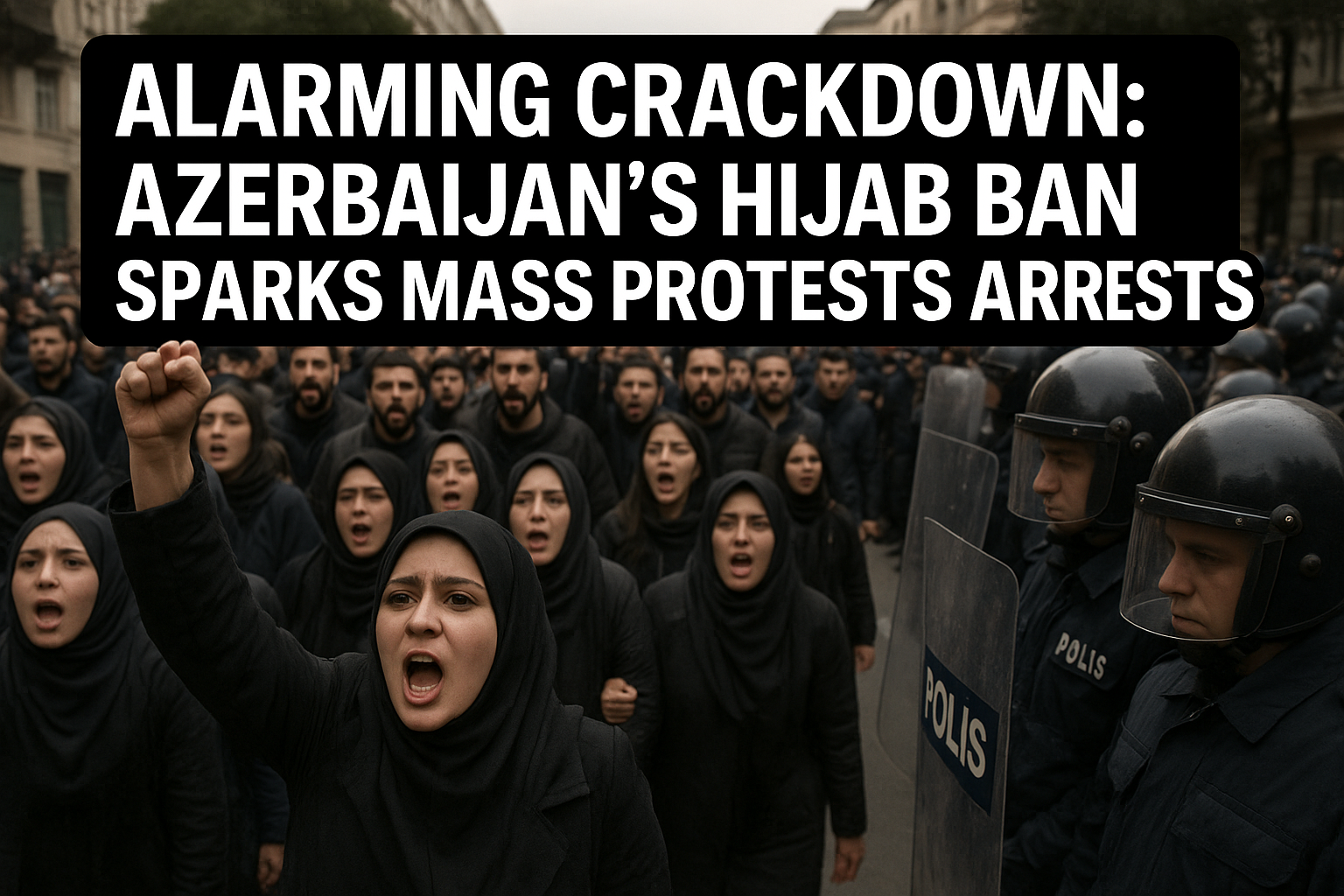

Imagine waking up one morning, ready for school, only to be turned away at the gates simply because of what you’re wearing – specifically, a hijab. That’s precisely what happened to countless young women in Azerbaijan, igniting a firestorm of protests and raising serious questions about religious freedom, human rights, and the very right to an education. On October 12, 2026, students across the country began widespread boycotts and demonstrations after new dress code regulations, implemented just weeks earlier on September 21, effectively barred girls wearing hijabs from attending school. This isn’t just a minor policy change; it’s a deeply contentious issue that has put the spotlight firmly on the Azerbaijan hijab ban.
The situation escalated quickly. The Interior Ministry confirmed a staggering 37 arrests in Baku as police moved to quell the demonstrations. What really fanned the flames of public outrage, though, was the distressing video footage that rapidly went viral across social media. These clips showed female students, some visibly distressed and in tears, being denied entry to their educational institutions. It’s hard to watch a young person, eager to learn, be turned away for something so personal. As if to compound the problem, reports surfaced that social media platforms like Instagram and TikTok were restricted in the country during the protests, leading many to suspect a deliberate attempt to stifle dissent and control the narrative. This emotionally charged issue isn’t new, but the recent crackdown has reignited critical debates that cut to the very core of Azerbaijani society.
The Spark: A New Dress Code and the Azerbaijan Hijab Ban
The roots of this crisis lie in the new dress code regulations that quietly took effect on September 21, 2026. While the specifics of the new rules haven’t been fully detailed by authorities, their impact was immediate and undeniable: girls wearing hijabs were no longer allowed inside school premises. For many, this felt less like a dress code and more like a targeted prohibition. The hijab, a headscarf worn by Muslim women, is a deeply personal and religious symbol for millions worldwide. To suddenly declare it incompatible with school attendance is to directly challenge a fundamental aspect of many students’ identities and beliefs.
This isn’t a minor fashion dispute; it’s a direct confrontation with religious freedom. Azerbaijan, while officially a secular state, has a predominantly Muslim population. The idea that students could be denied an education based on their religious attire strikes many as a profound injustice, especially when that attire is a deeply held expression of faith. Parents, community leaders, and human rights advocates have all voiced their alarm, seeing the new regulations as a clear violation of basic rights. What message does it send when a country tells its young women that their faith is an impediment to their education? It creates an impossible choice for many families, forcing them to prioritize either religious observance or academic opportunity.
The timing of these new regulations is also worth scrutinizing. Why now? Why such a seemingly abrupt and strict enforcement? Critics suggest that this move could be part of a broader push towards a more secular public sphere, or perhaps an attempt to assert greater state control over personal expression. Whatever the underlying motivations, the immediate consequence has been widespread discontent and a palpable sense of injustice among a significant portion of the population.
Viral Outrage: The Power of Social Media in the Face of the Azerbaijan Hijab Ban
The demonstrations on October 12, 2026, weren’t just a physical gathering; they were amplified exponentially by the digital world. Distressing video footage, capturing the raw emotion of the moment, quickly spread across social media platforms. Imagine seeing a young girl, perhaps your daughter or niece, standing outside her school, tears streaming down her face because she’s not allowed to learn. These aren’t abstract policy debates; they’re intensely personal stories that resonate deeply with anyone who values dignity and fairness. (See: Understanding the hijab and its significance.)
One particular video, showing a girl being gently but firmly turned away by a male administrator, then walking away sobbing, became a powerful symbol of the entire movement. It humanized the issue in a way that news reports alone often can’t. These images, shared and re-shared thousands of times, transcended linguistic and cultural barriers, drawing international attention to the plight of these students. Social media, in this instance, acted as an unfiltered conduit for truth, bypassing state-controlled narratives and showcasing the undeniable human cost of the new regulations.
However, the state’s response to this digital outcry was swift and, for many, predictable. Reports quickly emerged that access to Instagram and TikTok was restricted across Azerbaijan during the protests. This move, widely interpreted as an attempt to suppress further organization and information sharing, only served to deepen public suspicion and anger. When governments restrict communication channels during times of unrest, it often backfires, suggesting they have something to hide. It transforms what might have been seen as a localized issue into a broader concern about freedom of expression and access to information, fundamental tenets of any open society. The digital battleground became as crucial as the physical one.
The State’s Response: Arrests and Allegations of Overreach
The Interior Ministry’s announcement of 37 arrests in Baku sends a clear message: the authorities are not taking these protests lightly. While governments always have a right to maintain public order, the sheer number of arrests, particularly in response to what were largely peaceful student demonstrations, raises serious questions about proportionality and human rights. Who were these individuals? Were they all actively involved in disruptive behavior, or were some simply expressing their solidarity?
Historically, governments that face dissent often use legal means to suppress it, and arrests are a primary tool. In this case, the image of students being arrested for protesting a policy that denies them education is particularly jarring. It suggests a prioritizing of state control over the fundamental rights of its citizens, especially its youth. For many observers, both within Azerbaijan and internationally, these arrests signal a concerning trend towards authoritarianism and a shrinking space for civil liberties.
Furthermore, the restriction of social media platforms during such a sensitive period only exacerbates concerns about state overreach. It creates an information vacuum, making it difficult for citizens to understand the full scope of events and for the international community to monitor the situation accurately. This tactic is often employed by regimes seeking to control public perception and prevent the spread of information that might fuel further opposition. When a government silences its citizens, it rarely fosters trust or resolves underlying grievances; more often, it breeds resentment and a deeper sense of injustice.
A Broader Context: Religious Freedom and Secularism in Azerbaijan
The Azerbaijan hijab ban isn’t an isolated incident; it’s deeply embedded in the country’s complex relationship with religion and secularism. Azerbaijan, like many post-Soviet states, has a constitutionally enshrined secular framework. This means a separation of church and state, where religious institutions and practices are generally kept out of public education and state affairs. On one hand, this can be seen as a progressive move, ensuring equality for all citizens regardless of their faith and preventing religious dogma from dictating public policy. (See: BBC coverage of protests in Azerbaijan.)
However, the interpretation and application of secularism can vary wildly. For some, secularism means neutrality towards all religions, allowing individuals to practice their faith freely in their private lives and, where appropriate, in public spaces as long as it doesn’t infringe on others’ rights. For others, a stricter interpretation of secularism can lead to policies that actively discourage or even prohibit the display of religious symbols in public institutions, including schools. This stricter approach often argues that religious attire in schools can be seen as divisive, promoting one faith over others, or even as a symbol of cultural or political movements rather than just personal piety.
The current controversy highlights this tension. Many who oppose the ban argue that wearing a hijab is a fundamental expression of religious freedom and that denying access to education based on this expression is a violation of human rights. They might point to international conventions on human rights, which often protect the right to manifest one’s religion or belief in worship, observance, practice, and teaching. Conversely, those who support the ban might argue they are upholding the principles of secularism, ensuring that public education remains neutral and inclusive for all students, regardless of their religious background. They might also express concerns about potential pressures on non-hijab-wearing students or the perceived politicization of religious symbols. This isn’t just a local squabble; it’s a microcosm of a global debate about how secular societies should accommodate religious diversity.
The Human Cost: Education Denied and Future Implications
Beyond the legal and political arguments, the most heartbreaking aspect of the Azerbaijan hijab ban is its direct impact on the lives of young women. Education is not just about acquiring knowledge; it’s about empowerment, opportunity, and the foundation for a better future. When girls are denied access to schooling, the consequences ripple far beyond the individual, affecting families, communities, and the nation as a whole. Imagine being a bright, ambitious student, ready to pursue your dreams, only to have that path blocked because of a personal choice regarding your attire.
Forcing students to choose between their faith and their education is a cruel dilemma. Some may choose to forgo their education, potentially leading to increased rates of early marriage, limited economic opportunities, and a diminished role in public life. Others might reluctantly remove their hijabs, feeling coerced and alienated from their religious identity, leading to psychological distress and a sense of betrayal. Neither outcome is conducive to a healthy, inclusive society. It undermines the very principles of equality and individual agency that education is supposed to foster.
Moreover, the long-term implications for Azerbaijan could be severe. A nation that limits access to education for any segment of its population is effectively limiting its own human capital and potential. When women are denied full participation in the educational system, it has a cascading effect on economic development, social progress, and civic engagement. It creates a divided society, where a significant portion of the population feels marginalized and undervalued. This isn’t just about a headscarf; it’s about the future of a generation and the fundamental promise of equal opportunity.
Looking Ahead: What Does This Mean for Azerbaijan?
The events of October 12, 2026, represent a critical moment for Azerbaijan. The widespread boycotts, the viral video footage, the arrests, and the alleged social media restrictions have shone an intense spotlight on the country’s policies regarding religious freedom and human rights. This isn’t a problem that will simply fade away; it has ignited a passionate debate that demands a thoughtful and equitable resolution. How the Azerbaijani government chooses to respond in the coming weeks and months will largely define its commitment to democratic values and the well-being of its citizens.
Will the authorities double down on their strict interpretation of secularism, potentially leading to further arrests and alienation? Or will they engage in dialogue, seeking a more accommodating approach that respects both the principles of secularism and the fundamental right to religious expression and education? International human rights organizations are undoubtedly watching closely, and the global community will be assessing Azerbaijan’s actions through the lens of universal human rights standards. The pressure, both internal and external, is mounting.
For the students and families affected by the Azerbaijan hijab ban, the stakes couldn’t be higher. They are fighting not just for the right to wear a headscarf, but for the right to an education, for dignity, and for the freedom to express their identity without fear of discrimination. Their courage in the face of adversity is a powerful reminder that fundamental rights are often won through persistent struggle. The path forward is uncertain, but one thing is clear: this issue has unearthed deep societal fault lines that can no longer be ignored. Azerbaijan stands at a crossroads, and its choices today will shape its future for generations to come.
Trending Now
Frequently Asked Questions
Why has Azerbaijan banned hijabs in schools?
Azerbaijan's hijab ban in schools, implemented on September 21, 2026, is part of new dress code regulations that prohibit girls from wearing hijabs on school premises. This policy change has sparked widespread protests, raising concerns about religious freedom and human rights.
What happened during the protests in Azerbaijan?
During the protests against the hijab ban, students across Azerbaijan organized mass demonstrations, leading to significant unrest. The Interior Ministry reported 37 arrests in Baku as police responded to the protests, which were fueled by distressing videos of students being denied entry to schools.
How did social media play a role in the Azerbaijan hijab protests?
Social media was crucial in spreading awareness about the hijab ban protests, with videos of distressed students going viral. However, reports indicate that platforms like Instagram and TikTok were restricted during the protests, suggesting a government effort to control the narrative and stifle dissent.
What are the implications of the hijab ban in Azerbaijan?
The hijab ban in Azerbaijan raises significant questions about religious freedom and the right to education. It has ignited debates on human rights within the country, highlighting the tension between government policies and individual freedoms.
What sparked the mass protests in Azerbaijan?
The mass protests in Azerbaijan were sparked by the implementation of a hijab ban in schools, which began to take effect on September 21, 2026. The ban led to widespread outrage among students and the public, culminating in demonstrations and calls for change.
Have you experienced this yourself? We'd love to hear your story in the comments.