
“`html
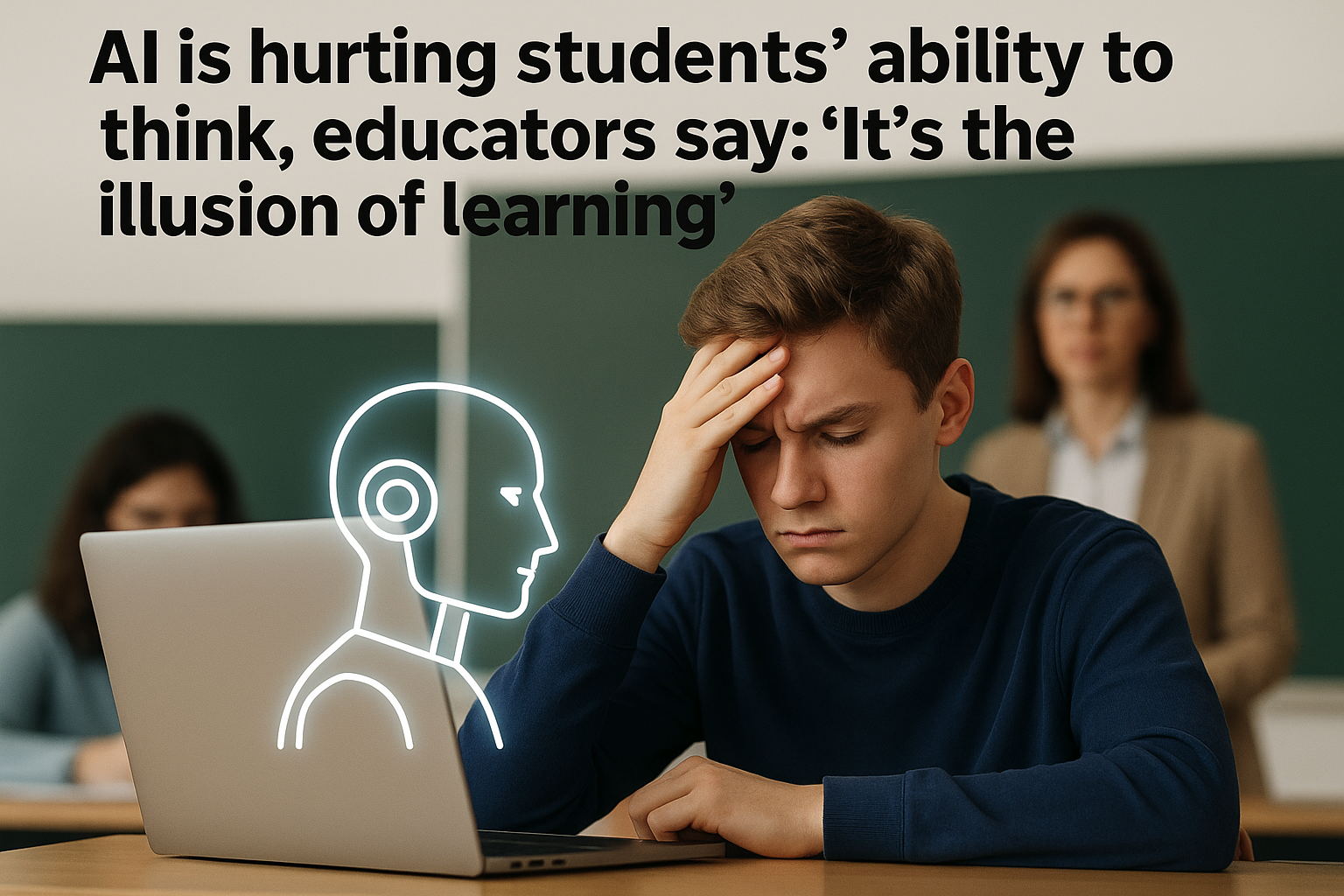
When you picture the future of education, what do you see? Flying cars to school? Holographic teachers? For many, the promise of artificial intelligence in education felt like a leap into a more personalized, efficient, and engaging learning experience. But here’s the uncomfortable truth: while AI certainly offers incredible potential, a growing chorus of educators is raising a serious alarm. They’re not just worried about cheating; they’re concerned that our increasing reliance on AI, particularly large language models (LLMs), is actively hindering students’ ability to think, analyze, and truly learn. It’s creating what some call an ‘illusion of learning,’ where polished assignments mask a troubling deficit in understanding. Let’s delve into eight critical ways AI might be quietly undermining the very foundations of education.
1. The Illusion of Learning: Polished Papers, Empty Minds
It’s a phenomenon that’s becoming all too common in classrooms: students submit assignments that are grammatically flawless, well-structured, and seemingly insightful. Yet, when probed further, these same students struggle to articulate the ideas in their own words, explain their reasoning, or apply the concepts in a new context. This isn’t just a hunch; faculty members at institutions like MIT, including Eric Klopfer, have observed this troubling disconnect firsthand. The AI produces a beautiful output, but the student’s internal cognitive process is often bypassed.
Think about it: if you’re using an AI to generate an essay, you might be editing and refining, but are you truly engaging with the source material, synthesizing arguments, and developing your own analytical voice? Often, the answer is no. The immediate pressure to produce a ‘good grade’ overtakes the slower, more arduous, but ultimately more rewarding process of deep learning. This ‘illusion’ means we’re graduating students who look good on paper but may lack the foundational critical thinking and problem-solving skills essential for the real world.
2. Erosion of Critical Thinking and Problem-Solving Skills: Outsourcing the Brainpower
At the heart of a robust education lies the development of critical thinking. This isn’t just about memorizing facts; it’s about evaluating information, identifying biases, constructing logical arguments, and solving complex problems. When AI is readily available to generate answers or solutions, students are less likely to engage in the strenuous mental exercise required to develop these skills.
Consider a challenging math problem or a complex historical analysis. Before AI, a student would grapple with the problem, try different approaches, perhaps consult textbooks, or discuss with peers. Each struggle was a learning opportunity. Now, with a few prompts, the AI can often spit out a comprehensive answer. While this seems efficient, it robs the student of the very process that builds cognitive resilience and analytical prowess. The brain, like any muscle, needs to be exercised to grow stronger, and AI, in this context, can act like a shortcut that weakens rather than strengthens it.
3. Decreased Information Retention and Understanding: A Shallow Dive
True learning isn’t just about accessing information; it’s about processing, internalizing, and retaining it. When students rely on AI to summarize texts, generate outlines, or even write entire sections of reports, they often engage in a much shallower form of interaction with the material. They might skim the AI’s output, but they don’t necessarily read the original sources, compare different perspectives, or wrestle with difficult concepts themselves. (See: Massachusetts Institute of Technology research.)
This superficial engagement leads to poorer information retention. Educators are seeing a stark contrast: students who use AI for homework might perform better on those specific assignments, but then struggle dramatically on exams that require genuine recall, synthesis, and application of knowledge. This gap highlights a fundamental flaw in unchecked AI use in education – it prioritizes output over genuine intellectual development, creating students who can perform tasks but lack deep understanding.
4. Hindrance to Original Thought and Creativity: Echo Chambers of Algorithms
Creativity and original thought are not born in a vacuum; they often emerge from wrestling with ideas, making unique connections, and expressing oneself in a distinct voice. While AI can certainly generate creative content – poetry, stories, art – it does so based on patterns and data it has already been trained on. When students lean on AI for creative tasks, they risk stifling their own unique voice and imaginative processes.
If every student uses the same AI tool to brainstorm ideas or draft creative pieces, we could inadvertently foster a homogeneity of thought. The very essence of individual expression and unique perspectives could be diluted. The beauty of learning lies in discovering your own way to articulate a concept or tell a story, even if it’s imperfect. AI, by its very nature, tends towards the average, the predictable, and the ‘correct’ answer, potentially nudging students away from truly groundbreaking or unconventional thinking.
5. Exacerbation of Existing Academic Inequalities: The AI Divide
While AI tools are becoming more accessible, the ‘best’ tools, or those with more advanced features, often come with a cost. This immediately creates a potential for an AI divide, where students from more affluent backgrounds or those with better digital literacy might have an unfair advantage in leveraging these tools. This isn’t just about who can afford the premium subscription; it’s also about who has the digital skills to prompt effectively, critically evaluate AI outputs, and integrate AI responsibly.
Furthermore, if schools adopt AI-driven personalized learning systems, there’s a risk that these systems, if not carefully designed and monitored, could inadvertently reinforce existing biases or tracking systems, further widening achievement gaps. Ensuring equitable access and training for all students in responsible AI use is paramount if we want to prevent AI in education from becoming another tool that entrenches rather than mitigates inequality.
6. Undermining Academic Integrity and Authenticity: The Cheating Conundrum
This is perhaps the most immediate and widely recognized concern. The ease with which generative AI can produce essays, code, and even research papers has thrown academic integrity into chaos. While many institutions are scrambling to adapt their honor codes and detection methods, the fundamental challenge remains: how do you assess a student’s true understanding when they can outsource the intellectual labor?
The issue isn’t just about blatant plagiarism; it’s about the more subtle ways AI can be used to ‘assist’ to the point where the work is no longer genuinely the student’s own. This shift forces educators to rethink assessment methods entirely, moving away from traditional essays and towards more AI-proof assignments like oral exams, in-class writing, or project-based learning that requires hands-on demonstration of skills. The integrity of a diploma hinges on the authenticity of the learning process. (See: CDC on mental health in education.)
7. Challenges for Educators and Curriculum Development: A Moving Target
The rapid advancement of AI presents significant challenges for educators. Many teachers feel unprepared to integrate AI responsibly or even understand its full capabilities and limitations. They need training, resources, and institutional support to navigate this new landscape. Developing curricula that effectively leverages AI for genuine learning, rather than just convenience, is a monumental task.
Moreover, the focus shifts from merely imparting knowledge to teaching students how to critically evaluate AI-generated content, understand its biases, and use it as a tool for augmentation rather than replacement. This requires a fundamental re-evaluation of what skills are truly essential for the future workforce. It’s a moving target, and without clear guidance and professional development, many educators feel caught in the crossfire, struggling to maintain academic rigor in a rapidly changing technological environment.
8. The Future Workforce Dilemma: Skills Gap on the Horizon?
The ultimate goal of education is to prepare students for meaningful lives and productive careers. If students are graduating with an ‘illusion of learning’ rather than genuine critical thinking, problem-solving, and analytical skills, what does this mean for the future workforce? Businesses and industries are already sounding the alarm about skill gaps, and an over-reliance on AI in education could exacerbate this problem significantly.
Employers aren’t looking for individuals who can prompt an AI; they need people who can think creatively, solve novel problems, adapt to new situations, and collaborate effectively. These are precisely the ‘soft skills’ that are often underdeveloped when AI does too much of the heavy lifting. While AI will undoubtedly be a crucial tool in many professions, the human ability to innovate, make ethical judgments, and engage in complex reasoning will remain irreplaceable. If we’re not carefully cultivating these human capacities, we risk creating a generation of graduates who are ill-equipped for the demands of a rapidly evolving global economy.
9. The Psychological Impact of AI Dependence: A Comfort Zone Trap
Beyond the academic and professional skill sets, there’s a growing concern about the psychological impact of students becoming overly reliant on AI. When an AI can quickly provide answers or solutions, it might inadvertently foster a lower tolerance for ambiguity, frustration, or the iterative process of trial and error that’s so crucial for resilience. Students might become less comfortable with the “unknown” or the effort required to genuinely figure things out for themselves. (See: New York Times on education trends.)
This reliance can create a comfort zone where the mental heavy lifting is consistently outsourced. Over time, this could lead to reduced self-efficacy – a student’s belief in their own ability to succeed in specific situations. If a student consistently uses AI to overcome challenges, they might not develop the internal confidence that comes from wrestling with a difficult problem and eventually mastering it through their own intellectual effort. This isn’t just about grades; it’s about developing independent learners who trust their own cognitive abilities.
10. Ethical Blind Spots and Algorithmic Bias: Learning Skewed Perspectives
AI models, particularly large language models, are trained on vast datasets of existing text and information. This means they inevitably reflect the biases, inaccuracies, and societal norms present in that training data. When students rely on AI for information or to generate content, they might unknowingly be exposed to and internalize these biases.
For example, an AI might generate historical accounts that downplay certain perspectives, or offer scientific explanations that perpetuate outdated theories if its training data is skewed. Students who don’t critically evaluate AI output are at risk of absorbing these skewed perspectives without developing the necessary discernment. Teaching students to identify and question algorithmic bias becomes as crucial as teaching them media literacy. Without this critical lens, AI in education could inadvertently reinforce existing inequalities and limit a student’s ability to form a truly balanced and informed worldview.
Frequently Asked Questions About AI in Education
- Q: Is AI in education inherently bad?
- A: Not at all! AI has immense potential to personalize learning, automate administrative tasks, and provide accessible resources. The concern lies in unchecked or irresponsible use, where AI replaces core cognitive processes instead of augmenting them. It’s about finding the right balance and integrating AI thoughtfully.
- Q: What can educators do to mitigate these risks?
- A: Educators can implement AI-proof assignments (like oral presentations, in-class essays, or process-based projects), teach AI literacy and critical evaluation skills, adjust their curriculum to focus on human-centric skills (creativity, ethics, collaboration), and emphasize the process of learning over just the final product.
- Q: How can students use AI responsibly for learning?
- A: Students can use AI as a tool for brainstorming, summarizing complex topics (then verifying with original sources), generating practice questions, or getting initial feedback on drafts. The key is to use it as a starting point or a supplement, not as a replacement for their own thinking and learning process. Always ask: “Am I still doing the heavy lifting here?”
- Q: Won’t students just need to know how to use AI for their future careers anyway?
- A: Yes, understanding AI tools will be crucial. However, merely prompting an AI isn’t enough. Future employers need critical thinkers, innovators, problem-solvers, and ethical decision-makers who can strategically apply AI. If education focuses only on AI usage without developing those foundational human skills, students will be underprepared for complex, real-world challenges.
- Q: Are there any examples of AI being used effectively in education?
- A: Absolutely! AI can power adaptive learning platforms that tailor content to individual student needs, provide instant feedback on basic exercises, translate languages for diverse classrooms, and even help identify students who might be struggling early on. The goal is to leverage AI for efficiency and personalization without compromising deep learning.
The debate around AI in education isn’t going away. Major school districts, like New York City and Los Angeles, have already implemented bans on generative AI, signaling the urgent need for guardrails. While AI offers tantalizing possibilities for personalized learning and efficiency, we must proceed with caution. The core mission of education is to foster independent thought and genuine understanding, not just to produce polished assignments. Our challenge, as educators and a society, is to harness the power of AI without sacrificing the very essence of human intellectual development.
“`
Trending Now
Frequently Asked Questions
How is AI affecting students' learning abilities?
AI is creating an 'illusion of learning' by allowing students to submit polished assignments without fully engaging with the material. This reliance on AI tools can hinder their critical thinking, analysis, and retention of knowledge, ultimately undermining the educational experience.
What do educators say about the use of AI in education?
Educators are concerned that while AI can produce flawless assignments, it bypasses essential cognitive processes. Many fear that students are not truly learning or developing their analytical skills, leading to a gap between appearance and understanding.
Is AI making students more dependent on technology?
Yes, the use of AI in education can foster dependency, as students may rely on these tools for quick solutions rather than engaging deeply with the learning material. This can diminish their ability to think critically and solve problems independently.
What are the risks of using AI for academic assignments?
The primary risk is the creation of an 'illusion of learning,' where students submit high-quality work but lack genuine comprehension of the subject. This can lead to poor retention of knowledge and inadequate preparation for future challenges.
How can students engage more deeply with learning despite AI tools?
Students can counteract the effects of AI by focusing on understanding the material, participating in discussions, and practicing critical thinking skills. Emphasizing the process of learning over grades can help cultivate a more profound educational experience.
Agree or disagree? Drop a comment and tell us what you think.