
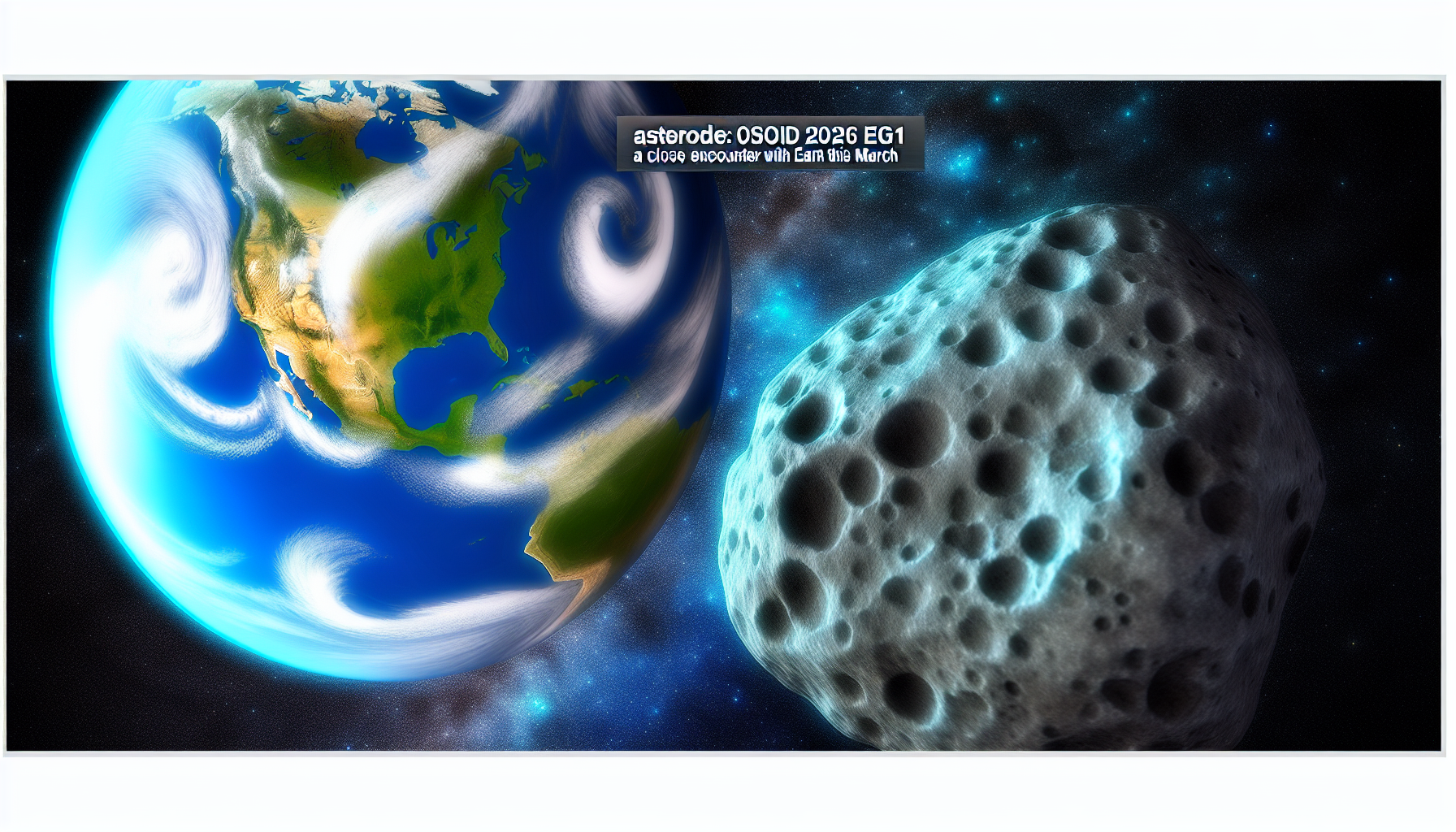

In a remarkable display of cosmic timing, a newly discovered bus-sized asteroid is set to make a close approach to Earth on the evening of March 12, 2026. This asteroid, designated 2026 EG1, is not only a fresh find but also an exciting opportunity for astronomers and space enthusiasts alike to witness a celestial event from the comfort of our planet. With its dimensions ranging from 32 to 72 feet (10 to 22 meters) wide, 2026 EG1 will pass safely at a distance of approximately 197,466 miles (317,791 kilometers) from Earth, which is less than one lunar distance.
Details of the Approach
The asteroid will reach its closest point to Earth at precisely 11:27 p.m. EDT on March 12, 2026 (or 03:27 GMT on March 13). Traveling at an impressive speed of 21,513 mph (34,621 km/h), it will glide beneath Antarctica after performing a distant flyby of the Moon. Fortunately, astronomers confirm that 2026 EG1 poses no threat to our planet during this encounter.
Significance of the Discovery
2026 EG1’s discovery is significant given that it was identified just days before its close approach. This rapid detection underlines the advancements in our monitoring systems for near-Earth objects (NEOs). NASA’s Center for Near Earth Object Studies (CNEOS) plays a pivotal role in tracking these celestial bodies, ensuring that potential threats are identified in a timely manner.
Understanding Near-Earth Objects
NEOs are defined as asteroids or comets whose orbits bring them within 1.3 astronomical units (AU) of the Sun, with 1 AU being the average distance from the Earth to the Sun, approximately 93 million miles (150 million kilometers). The study of these objects is crucial as they can provide insights into the formation of our solar system and the potential risks they pose to Earth.
Monitoring and Planetary Defense
NASA’s ongoing efforts in planetary defense encompass not just monitoring NEOs like 2026 EG1 but also preparing for potential future threats. The agency has implemented various strategies, including:
- Mock Scenarios: Simulating asteroid impact scenarios to assess response strategies.
- Redirect Missions: Developing technologies to deflect or redirect asteroids on a collision course with Earth.
- International Collaboration: Working with global partners to share data and strategies for planetary defense.
These initiatives aim to bolster our readiness for any potential asteroid threats and enhance our understanding of how to manage them effectively.
The Future of Asteroid Observation
As technology continues to improve, the ability to detect and track asteroids is becoming increasingly sophisticated. Space agencies around the world are investing in advanced telescopes and observational techniques to ensure that we remain vigilant against potential threats from above. For instance, NASA’s upcoming missions, such as the Double Asteroid Redirection Test (DART), are designed to test our ability to alter the trajectory of asteroids.
What to Expect During the Flyby
For those interested in witnessing this event, the flyby of 2026 EG1 will not be visible to the naked eye, as it will be traveling far too quickly and at a significant distance from Earth. However, astronomers and amateur sky watchers can follow the event through live streams and social media updates from various space organizations. This approach will allow enthusiasts to engage with the event, learn more about asteroids, and appreciate the dynamic nature of our solar system.
Educational Opportunities
The approach of 2026 EG1 presents an excellent opportunity for educational outreach. Schools, universities, and science centers can utilize this event to teach students about asteroids, space science, and the significance of planetary defense. Engaging students with hands-on activities, discussions, and observation sessions can foster a greater interest in the sciences and inspire the next generation of astronomers.
The Broader Context of Asteroids
Asteroids like 2026 EG1 are remnants from the early solar system, providing clues about the materials that formed the planets. Studying them can yield valuable information about chemical compositions, which may even relate to the origins of water and life on Earth. The ongoing exploration of asteroids through missions like Japan’s Hayabusa2 and NASA’s OSIRIS-REx highlight the importance of these celestial bodies not just as potential threats but as crucial pieces of our cosmic puzzle.
Conclusion
As we prepare for the close passage of 2026 EG1 on March 12, 2026, it serves as a reminder of the dynamic and often unpredictable nature of our solar system. While this particular asteroid poses no threat to Earth, its discovery and upcoming flyby are testaments to our increasing capabilities in monitoring near-Earth objects. As we continue to advance our understanding of the cosmos, we remain vigilant and prepared for whatever the universe may bring our way.






