Uncategorized

Madison: Survey shows 88 percent of students do not have Internet access

Many school districts are working working to provide every student with a technology device when needed – but what if students don’t have Internet access to utilize these devices from home?

On examples of this challenge is playing out in Madison, Wisconsin. A Tableau survey of over 27,000 students found that around 88 percent of students in the Madison Metropolis School District do not have access to the Internet.

Of the elementary through high school surveyed, 97 percent of white students and 93 percent of Asian students have access to the Internet – but only 74 percent of African American students and 79 percent of Hispanic students have access.

Similarly, 78 percent of low-income students have access to the Internet, compared with 98 percent of students that did not fall into the low-income category.

The school is hoping to improve the equity of access for all students.

I think it’s really important to remember that not all students are fortunate enough to have access to the Internet. Providing technology devices is a great start and I think it’s terrific that Madison Metropolis School District is able to do this for its students. However, if not everyone has the ability to get online from home, it hinders the potential good of the devices.

It sounds like Madison needs to make sure students without Internet access at home can find locations to take advantage of their devices, such as ensuring the school campus has open Wi-Fi. I hope that we can find ways to overcome the issue in Madison and other school districts out there facing the same challenges in an effort to keep minority and low-income students from falling further behind their peers.

Brown v. Board Fails: Resegregation is Accidentally on Purpose

By Julian Vasquez Heilig, Ph.D., @professorjvh on Twitter

Since it’s inception the United States has enacted and supported racially discriminatory policies. On May 17, 1954, the US Supreme Court handed down a unanimous decision in Brown v. Board of Education, outlawing racial segregation in our nation’s schools. Brown overturned the doctrine of “separate but equal,” which the Court had established in the 1896 case of Plessy v. Ferguson. Brown marked a turning point…

Fast forward to May 17, 2014… it was the 60th anniversary of Brown v. Board of Education…

Nevada “rancher” Cliven Bundy and current L.A. Clippers owner Donald Sterling are not racist. At least that would they would have you believe. Cliven Bundy stated to CNN:

“At least a half-dozen (black) people sitting on the porch, they didn’t have nothing to do.

Because they were basically on government subsidy, so now what do they do?” he added in comments first reported by The New York Times and later seen on video. “They abort their young children, they put their young men in jail, because they never learned how to pick cotton.

And I’ve often wondered, are they better off as slaves, picking cotton and having a family life and doing things, or are they better off under government subsidy?   They didn’t get no more freedom. They got less freedom.”

Bundy’s “apology” to CNN was:

“Maybe I sinned, and maybe I need to ask forgiveness, and maybe I don’t know what I actually said, but when you talk about prejudice, we’re talking about not being able to exercise what we think. … If I say Negro or black boy or slave, if those people cannot take those kind of words and not be (offended), then Martin Luther King hasn’t got his job done yet. We need to get over this prejudice stuff.”

Donald Sterling, LA Clippers owner, also has been in the news in the past year. The conversation that his mistress taped included some incendiary comments.

” In your lousy f***ing Instagrams, you don’t have to have yourself with — walking with black people Yeah, it bothers me a lot if you want to … broadcast that you’re associating with black people. Do you have to?”

There is more. But you have probably already read and seen it. Then, in Sterling’s Anderson Cooper CNN “apology” he stated:

“That’s one problem I have. Jews, when they get successful, they will help their people — and some of the African-Americans, maybe I’ll get in trouble again, they don’t want to help anybody.”

He continued with racialized comments about Magic Johnson:

“I think he should be ashamed of himself. I think he should go in the background. But what does he do for the black people? He doesn’t do anything … I just don’t think he’s a good example for the children of Los Angeles. He would go and do what he did. And then get AIDS. I mean come on.” (In fact, Johnson has HIV, not AIDS.)

Sterling is “consistent.” CNN reported:

A top [LA Clippers] executive accused Sterling of running the Clippers with a “plantation” mentality. Federal prosecutors accused his rental company of                             refusing to lease Beverly Hills apartments to African-Americans. And a group of tenants accused him of “numerous discriminatory statements and housing                      practices.

“Actions speak louder than words, and Mr. Sterling’s actions have been consistent,” former NBA star Kareem Abdul-Jabbar told CNN’s “The Lead with Jake Tapper.”

Abdul-Jabbar, who coached the Clippers for about three months in 2000, said Sterling has “a bad reputation.”

So why lead a post about accidental on purpose segregation with Cliven Bundy and Donald Sterling?! I’ll come back to them to conclude…

Photo source

So what is the status of segregation 60 years post Brown v. Board of Education of Topeka? In the post How can we desegregate re-segregated public schools? (again) we wrote:

“Landmark legal victories over de jure segregation in the wake of Brown v. Board of Education of Topeka[1] helped to secure dramatic decreases in the racial and ethnic segregation of schools in subsequent decades, especially in the formerly segregated American South[2]. The promise of the post-Brown era proved ephemeral, however; nearly sixty years after the Supreme Court ruled that segregation was inherently unequal, American schools remain remarkably segregated by race and ethnicity.[3] Since the 1980s, the de facto segregation of schools has rapidly intensified, especially in the South and for Hispanic/Latino populations.[4] Indeed, during the 1990s the proportion of Black students in majority-White schools decreased 13 percentage points, to a level not seen since 1970.[5] This re-segregation of schools has been facilitated by weak executive enforcement of civil rights provisions and continued judicial retrenchment on school integration, exemplified by Board of Education of Oklahoma City v. Dowell[6] andFreeman v. Pitts,[7] which diminished desegregation standards and resulted in the release of hundreds of districts from their court-imposed desegregation orders.

In 2007, the U.S. Supreme Court in Parents Involved in Community Schools v. Seattle School District No. 1[8] dealt another blow to integration efforts, rendering unconstitutional school assignment plans that use individual student race or ethnicity as the sole factor in school assignment, punctuating the steady decline in support for school desegregation policies.[9] In the case, which was decided with Meredith v. Jefferson County Board of Education, [10]the Court ruled that the racial balancing efforts of the Seattle and Louisville school districts, which were undertaken voluntarily in the absence of evidence that either district had deliberately practiced de jure racial discrimination, were impermissible and unconstitutional violations of the Equal Protection Clause.[11] Consequently, districts that had been using such policies to achieve and maintain racial and socioeconomic balance across campuses were denied the primary weapon with which they had historically combated racial and socioeconomic segregation.

In the Seattle student assignment plan, which was challenged under Parents Involved, students were permitted to apply to any high school in the district. However, if the demographics of any school deviated from the demographics of the district as a whole (within a specified percentage), a racial “tiebreaker” was used to determine which students were admitted to the school. Thus, if a school had too many whites, admission might be restricted to only non-whites (including Asians, Latinos, Native Americans, or African Americans); if a school had too few whites, admission might be restricted to only whites. As the foregoing illustrates, the Seattle plan was concerned only with racial balance among “whites” and “non-whites,” not with the racial distribution within non-white populations. In the Jefferson County, Kentucky plan, which was challenged under the Meredith case, students were classified as either “black” or “other,” with students assigned to schools in such a way as to ensure that schools were no less than 15 percent and no more than 50 percent black.

While acknowledging the pernicious effects of segregation, the Court held in Parents Involved that the use of racial classifications in Seattle and Louisville were not “narrowly tailored” to achieve a “compelling” government interest. First, the Court held that there was not a compelling interest that justified the use of race in their student assignment processes.[16] In the plurality opinion, Roberts argued that while racial diversity is a compelling interest in higher education, the ruling in Grutter v. Bollinger[17] and Gratz v. Bollinger[18] did not apply to primary and secondary education, because the districts in question (i.e., Seattle and Louisville) did not use an individualized consideration of students and utilized a very limited racial perspective on diversity (i.e., “white” vs. “non-white”).Moreover, the cases of Seattle and Louisville did not constitute a compelling interest because neither district had a legacy of past discrimination that the plans were designed to remedy.[20] In addition, the Court ruled that the plans of Seattle and Louisville were not sufficiently “narrowly tailored” to constitutionally justify the use of race.[21] Indeed, Roberts notes that both plans were exclusively focused on achieving demographic goals, and not towards achieving any benefit of racial diversity.[22] Moreover, the Court ruled that neither district had made a “serious, good faith consideration of workable race-neutral alternatives,” as required under Grutter.[23] Indeed, the Court held that the districts failed to show that the use of race was necessary to meet its diversity objectives, arguing that similar effects could have been achieved without race-conscious means.”

A look at resegregation in our schools

So what has been the result of a series of cases ending busing, desegregation orders, and ban on the use of race in Parents Involved? Together they have led to the re-segregation of public schools. Dr. Gary Orfield and The Civil Rights Project/Proyecto Derechos Civiles at UCLA released a series of studies this week analyzing the most recent data on segregation. Here is a sample of what they have found:

Changing U.S. Demographics and SCOTUS Transform School Segregation Landscape 60 Years After Brown v Board of Education Segregation Increases after Desegregation Plans Terminated by Supreme Court

North Carolina’s Black Students Increasingly Isolated in Schools after Many Desegregation Plans Dissolved Racial and Economic Isolation Intensifies Despite an Increasingly Multiracial Enrollment.

New York Schools Most Segregated in the Nation UCLA report identifies alarming trends throughout the Empire State.

My selfie with UCLA’s Gary Orfield after his AERA Brown lecture in DC

Latina/os and Segregation

What is that state of segregation for Latina/os and more specifically immigrant students? The Civil Rights project found that California is the most segregated state for Latino students and has little to Celebrate 60 Years After Brown v. Board of Education. In the post Breaking News: School Segregation Study Strikes A Nerve, I discussed a peer-reviewed study we authored last year that focused specifically on Latina/os. I wrote:

Our study Expansive School Segregation in Texas: Predicts Accountability Rating has caused a stir. (Click here for study) The Spanish media was first on the story when Univision produced Study Shows Triple Segregation Persists in Texas Schools. Then the AP picked up the story and the study went national.

Photo Source

The AP story reported:

The study by education professors at The University of Texas at Austin found that minorities, English language learners and poor kids have become concentrated into low-performing schools and districts, decreasing their chances to overcome these impediments. In two-thirds of the schools that are intensely poor, English language learners are the majority of students.

“Our research revealed that schools where students are segregated by race/ethnicity, (socio-economic status) and language are overwhelmingly rated as low-performing,” said Julian Vasquez Heilig, associate professor in the College of Education. Those schools also are staffed with some of the lowest-skilled teachers turnover tends to be high, he added.

In conclusion, we have a Sterling/Bundy court system and legislatures in the United States. Our legislative and judicial bodies claim that their policies are race neutral, but they are well aware of the disparate impact of segregation in the data, and they continually shrug their shoulder in denial (ala Bundy and Sterling) that their action or lack of action is racist or without racial intent (similar to the argument being used to suppress voting), when in fact, prima facie, they do. The powerful legislative and judicial bodies in the US accidentally on purpose fomented resegregation. As I have written about previously on Cloaking Inequity, this accidentally on purpose intent is the case with segregation, criminal justice, college access, and even high-stakes testing . The American judicial system and legislatures have taken an overt Jim Crow system of racial prejudice and discrimination and just moved it underground to a covert system that continues to have disparate impact.


This post originally appeared on Cloaking Inequality, and was republished with permission. Follow Julian Vasquez Heilig on Twitter: @professorjvh. 

Teachers: How to Use Google Drive

By Catlin Tucker

For teachers who are just getting started with Google, Google Drive can be intimidating! In preparation for a Google training, I’ve put together a short explanation of Google Drive and its basic features. Although an increasing number of people have a Gmail account, I run into teachers all the time who are not sure what Google Drive is or how it works.

Google Drive is like a big virtual bucket! It’s where everything you create with Google apps–documents, forms, sheets, slides, drawing–are stored. And unlike a traditional word processing document, you never need to click “Save”…EVER.  Your work is automatically saved every 5 seconds (or so).

Google Drive comes with 15 GB of free storage, so you can save files, photos, and videos. You can access any file in your Google Drive from any device as long as you have internet access. This means you are no longer tethered to a piece of hardware. You can open, edit and share files from any device that can get online.

For those with unreliable internet access, you can also install Google Drive onto your devices and work offline. Then when you are back online, your devices will sync and store your work!

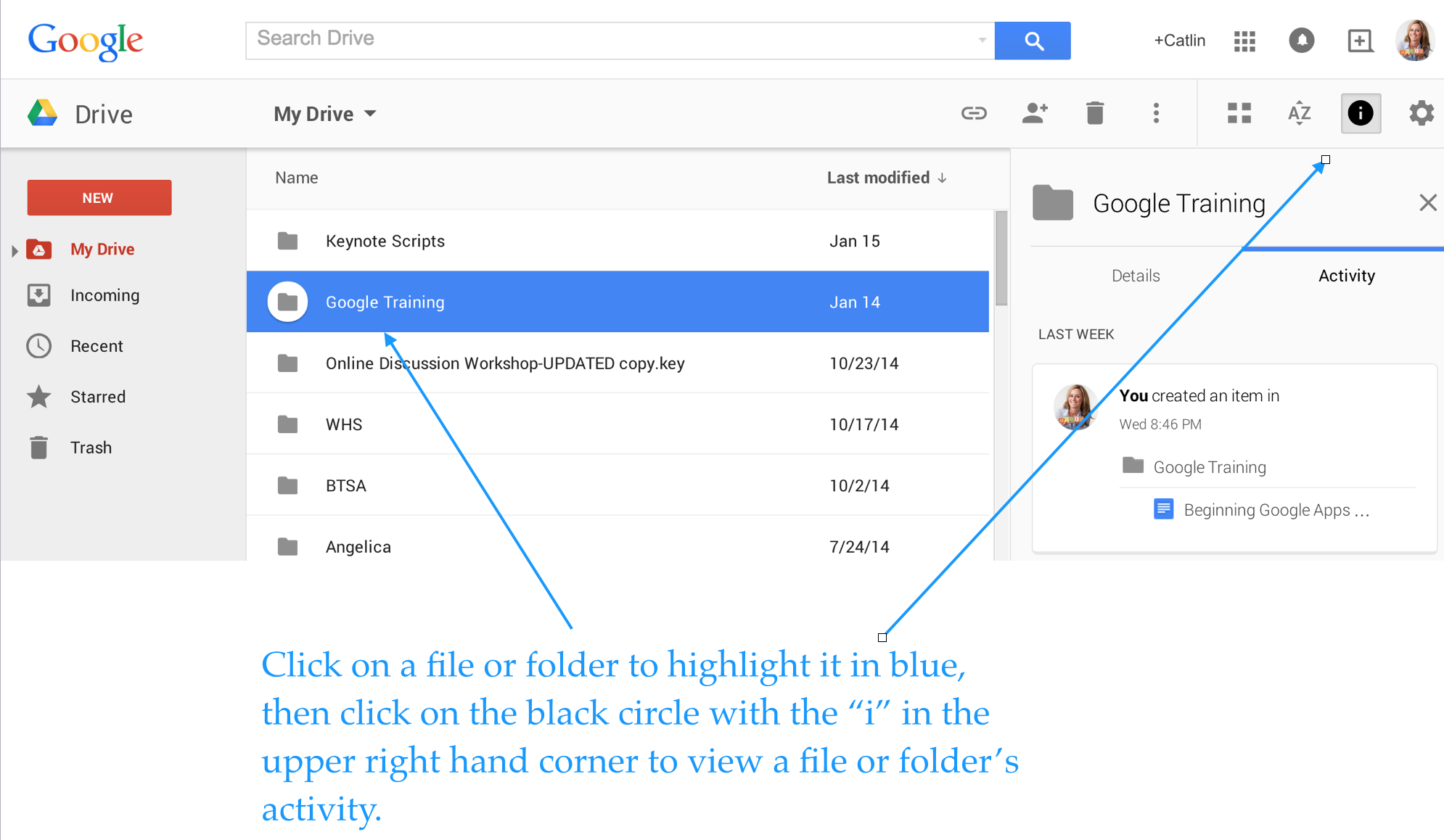
Here are some screenshots to help you navigate your Google Drive.

Organize your files in whatever order makes sense to you. You can limit your view to the files you’ve created, the files that have been shared with you or the files that have been most recently edited. This makes it easy to locate the files you’re looking for.

Screen Shot 2015-01-20 at 2.47.26 PM


Click on a file or folder and check out the “More actions” icon (3 vertical dots) to manage your documents more easily.

Screen Shot 2015-01-20 at 3.28.31 PM


Enjoy total transparency with the “View Details” icon (black circle with the letter “i” in the middle). Simply click on a file or folder and see all of the activity associated with it. You can see when documents were created, when they were edited, and who edited them!

Screen Shot 2015-01-20 at 4.06.24 PM


Last, but not least, you can insert files, photos and videos directly from Google Drive into your emails.

Screen Shot 2015-01-20 at 1.34.37 PM


If you use Google Drive and have tips to share, please post a comment!


This post originally appeared on Catlin Tucker: Blended Learning & Technology in the Classroom and was republished with permission. 

Read all of our posts about EdTech and Innovation by clicking here. 

Zucker Donations Mark Largest Gift from Single Donor

Philanthropist Anita Zucker, chief executive officer of the InterTech Group in North Charleston, has become a mainstay on Forbes list of its 400 wealthiest Americans.

Her net worth was estimated to be around $2.4 billion, but it was Zucker’s inclination to share the wealth among educational institutions that was touted in 2014.

A former public school teacher herself, education has always been a top cause for Zucker. This year, she donated over $14 million to educational programs.

In October of 2014, she donated $5 million to the University of Florida, her alma mater. The money was used to improve its College of Education’s early childhood education program, and was the largest contribution ever from an individual donor.

Just a few weeks later, Zucker donated $4 million to the School of Education at The Citadel. She took education courses at the college in the 1970s and the school is where her oldest son earned his master’s degree.

Her son was also named chairman of the S.C. Aquarium board in 2014, and the family donated $5 million to build a new sea turtle hospital and to improve the nonprofit aquarium’s educational programs. Once again, the donation was the largest gift the organization had ever received.

InterTech Group, started by the philanthropist’s late husband Jerry, includes a chemical company, real estate, manufacturing and aerospace parts production.

Zucker said in a 2o12 interview that she brings her Jewish values to work daily. The daughter of Holocaust survivors said, “Tikkun olam (fixing the world) is very much a part of our business platform,” referring to InterTech Group.

Zucker’s intentions to better our country and its education show her generosity and love of eduction. I find her intentions refreshing and appreciate that she is using her wealth to benefit the lives of others.

Newest Louisiana Education Board Member Against Common Core

Mary Harris, the newest Louisiana Board of Elementary and Secondary Education member, stated earlier this week that she opposes Common Core academic standards. She is also against the related PARCC test.

“I would like to see something replace Common Core that’s more beneficial to our students,” said Harris, former kindergarten teacher and principal of an arts magnet elementary school in Shreveport, Louisiana.

This is the second year the Common Core Standards have been in effect in Louisiana schools. This spring, third- through eighth-graders are set to take a test comprised of questions developed by the multi-state partnership.

Governor Bobby Jindal appointed Harris to fill the 4th District seat until a special election is held this spring. Jindal, who was once a Common Core supporter, has called for “Louisiana standards and a Louisiana test,” which goes along with a national push by conservative Republicans against the standards.

Harris said she opposes Common Core standards because “some of it is not developmentally appropriate for our students.”

Due to a poor implementation, some children didn’t have the skills they need to succeed, continued Harris. She believes the state could do a “good job of coming up with their own standards.”

Harris has been in education for 26 years.

Our country needs Common Core standards to help us monitor the progress of each individual student from year to year. It is obvious that Governor Jindal appointed Harris because she also opposes the standards. I hope that the rest of the Louisiana Education Board members can hold strong and keep Common Core standards in Louisiana schools.

Mississippi education ranks last on annual state rankings

Public education in Mississippi ranked last, yet again, on Education Week’s Quality Counts report that was released last week. The state received a “F” grade for academic achievement, and a “D” for the chance of success for students.

The silver lining? Mississippi received a grade of “B” for its early childhood programs, compared to a national average of “D+.” Mississippi’s early childhood initiatives are certainly progressive and the state ranks second nationally when it comes to Head Start enrollment (third nationally when it comes to Kindergarten enrollment and access to full-day Kindergarten programs). Getting kids signed up for early childhood programs is just the start of course. These children need to learn enough while in those classrooms, but getting them started as early as possible is definitely a step in the right direction when it comes to the future academic success of students in the state.

There is no easy fix for Mississippi. Even academic programs targeted for at-risk students can only go so far. With a poverty rate of 24 percent in the state, the problems that impact student success in classrooms extend far beyond it. To really see a difference in student outcomes, the state needs economic initiatives that boost the life quality of residents and give more opportunities to students once they are done with school. Recognizing that these outside factors go hand-in-hand with student outcomes in classrooms is the first step toward moving Mississippi out of last place and putting it on course to be a P-12 leader in the country.

Florida Bill Would Pay Starting Teachers $50K

Last week Florida lawmaker Senator Darren Soto introduced a bill that would raise the minimum salary for teachers to $50,000 a year.

The Florida Teacher Fair Pay Act, or Senate Bill 280, calls for the Legislature to fund the Florida Education Finance Program in a manner that guarantees the $50,000 minimum starting salary for teachers with union representation.

In addition, the bill would prevent school districts from setting their own lower salary, and would leave base pay negotiation with teachers unions to be decided upon by each individual district. Teachers’ salaries would also require adjustment each year after based on inflation from the year prior.

Soto hopes to help teachers after hearing from many who are threatening to walk away from their careers in the Sunshine State unless something changes. He believes that the minimum starting salary for teachers will help.

A study obtained last month ranked Florida’s Orange County teachers as some of the lowest-paid in the country. The starting salary in Orange county is around $38,000.

“Even if we don’t get to the $50,000 mark, this is part of a larger debate of getting teacher salaries up from where they are now,” said Soto.

An increase in workload has resulted in veteran teachers retiring earlier, while others teachers are relocating to different states to continue their teaching career.

Teachers across the country are grossly underpaid despite the long hours they invest in their students, and teachers in the state of Florida are no exception. Senator Soto’s proposed bill to pay all starting teachers $50,000 is a smart way to recruit the best teaching talent possible into the Sunshine State.

Why Mississippi Must Fully Fund the Adequate Education Program

It’s no secret that education and its funding has never been a top priority in Mississippi. Even last week’s news that the state ranks dead last in the nation when it comes to educational opportunities and success for its students is not enough to cause a legitimate uproar. The news is really just more of the same for my home state that has grown so accustomed to these types of rankings being the standard that it is almost numb to them.

Case in point: The House Constitution Committee in the state has developed an alternative to the Mississippi Adequate Education Program — the latter being legislation that calls for full funding of a “mid-level” public education for the state’s K-12 students.  Supporters of the group Better Schools, Better Jobs are pushing for the Mississippi legislature to pass the original MAEP but legislators are trying to kill it instead. The MAEP has been around since 1997 and has only been fully funded twice in that time period (both times were election years). Only two groups of legislators felt that the students in Mississippi deserved a “mid-level” education? If that isn’t a rallying cry for education advocates, teachers and parents alike, I’m not sure what is.

Fully-funding the MAEP is the first step to committing to better educational opportunities for the students of the state. The success of students in Mississippi will not turn completely around overnight, but there needs to be a dedicated effort from lawmakers down to the teachers in the classroom to make that happen. It starts with, at the very least, adequate funding.

Vans Kicks Off Competition for Art Students

Vans Brand is calling all original and innovative high school students to join in the sixth annual Vans Custom Culture competition, a nationwide competition among high school art students.

High school art teachers can register their classes to compete with thousands of other students to see who can create the most artistic designs using blank Vans shoes as their canvas.

The top five finalists will get the opportunity to travel to New York City to showcase their creations. Celebrity judges will select an overall winner who will receive a $50,000 cash prize for their school’s art program. The winner will also get the chance to see their masterpiece for sale at Vans retail locations and online.

Vans will donate $4,000 to each of the four runner-up schools. An extra $50,000 will go to non-profit partner Americans for the Arts, the nation’s leading organization for advancing the arts and art education.

The competition is intended to inspire high school students to embrace creativity through art and design and to raise awareness for the nation’s suffering art programs.

In its inaugural year in 2010, the competition had just 326 schools participate. This year, it is estimated that around 3,000 schools will participate. Vans hopes to see the competition continue to grow and afford high school students this wonderful opportunity.

The arts help encourage creativity and confidence, and boost problem-solving skills and fine-tune the ability to focus and persevere. This competition is the perfect way to engage and excite students around our country to follow their artistic dreams. I appreciate Vans and its dedication to helping art students and programs around the U.S.

Read all of our posts about EdTech and Innovation by clicking here. 

Career and Technology Building Opens in San Antonio

The San Antonio School District in Texas is giving its students a one-of-a-kind experience to take career courses and earn trade certifications after high school.

Renovations at Brackenridge High School in San Antonio include a new Career and Technology Education Building, or CATE, that gives students training in a number of career fields. This is in thanks to a $21 million bond in 2010.

Courses are taught inside the state-of-the art CATE building on campus and it offers training from cosmetology to graphic design to broadcast journalism.

Senior executive director of Academic Support for the district said that the goal was to provide students with space that doesn’t look like they are going to school, but looks more like they are going to work.

For instance, the cosmetology area within the CATE building is set up similar to what one would see in professional salons and the equipment utilized in the broadcasting classes is the same as in professional studios.

The new building has generated an increase of over 20 percent of students enrolled in career courses. Numbers have risen drastically from 70 to over 90 percent at Brackenridge, and are anticipated to continually climb.

I hope more schools have the ability to offer career courses in a similar fashion to those in San Antonio. These courses have countless benefits because they immerse and engage students in a way the typical classroom setting cannot, and encourage students to learn through daily, concrete experiences. I do hope that high school graduates still choose to attend college – but this is an excellent way to test out particular careers at an even younger age.

Read all of our posts about EdTech and Innovation by clicking here.