Looking for amazing strategies to teach writing to your students? Look no further. Below we are sharing a graph that will help get you started.



Looking for amazing strategies to teach writing to your students? Look no further. Below we are sharing a graph that will help get you started.

With the increased importance of technology in society, digital literacy is gaining recognition as the most valuable tool for lifelong learning. What does this mean? Essentially, as citizens of a global society, the influence of social media, technology, and online resources is massive. For children, the access to a home computer with internet increases their likelihood of college attendance exponentially. For adults, the ever evolving tech world can either help them succeed or hold them back.
Society has changed over the last 15 years. It has become increasingly important to continue education after entering the workforce. The influence of technology on business is the main reason for this new mandate. In early learning through adulthood, digital literacy is showing the most promise for success. The edtech industry has long-focused on the value of digital competency for children. It’s time digital literacy was incorporated into adult education in the same way.
How do you accomplish this? Easy. The graphic below list 27 ways to teach your students be good digtial citizens.

When I was an educator, I hated faculty meetings. They were boring and often used to push out things that could be disseminated via email or memo. Also, if the time was used for professional development, it was usually something I was already well versed in. I often spent my time wishing I was somewhere else. As an education administrator, how can you change the narrative on faculty meetings? I am glad you asked. I found a fantastic graphic that lists 27 ways to spice up a faculty meeting. I hope this helps.

While conceptualizing this article, I reminisced about my first teaching job. It was as a fifth-grade social studies teacher in my hometown. To be honest, my first year wasn’t necessarily a stellar one. In some ways, I felt overwhelmed, even inadequate in the classroom, especially when it came to classroom management. But with the help of veteran teachers and an understanding principal, I completed that year and became a master teacher by my third year.
My experiences are not at all uncommon. Ask any teacher what their biggest challenge is on a daily basis, and most will say classroom management. Consider, the following classroom scenario. You are a fifth grade English teacher who has just started a lesson on action verbs, but your students have other plans. Matthias interrupts you with a question or an opinion about an unrelated topic, Rebecca is talking to her friend while you are attempting to redirect Matthias, and Susie, who is worried about her mother in the hospital, starts to cry incessantly. On top of that, while you are distracted, Alfred is posting hurtful comments about Rebecca on Facebook. This episode is just the tip of the iceberg, as sometimes these scenes get even more convoluted.
Are you struggling to manage your classroom? Don’t panic, as it happens to the best of us. So how do you get your class back under control? I am glad you asked. Below I am sharing a graphic that lists 27 ideas about how to manage your classroom.

In this day and age, educators are expected to be tech-savvy and possess 21st-century teaching skills. Those that do not are thought of as relics of the past, ready to be put out to pasture. Why? Because teachers that are not tech-savvy or do not possess 21st-century teaching skills are ill-equipped to prepare students for the future.
If you are a teacher that is stuck in the 20th century and want move into the 21st century of pedagogy, all it takes is hard work and commitment. You don’t have to go on this journey alone as your peers, and higher-ups will be more than happy to be your guides. When every teacher in the building lives up to their potential, everyone wins. To help you get started, below, we have placed a graphic that lists 27 ways to be a better 21st-century educator. Good luck!

As a parent, you are your child’s first teacher, and the education that you give them lays the foundation for the future. However, many parents take a hands-off approach once their child enters formal schooling. I suspect that many parents believe that their child is better off in the hands of experts, and they can take a backseat. Well, this is a myth that we need confront. When your child enters formal schooling, your role as your child’s first teacher does not end; it gets more intense. Why? Because as the years pass, your child will be exposed to an increasingly tougher curriculum.
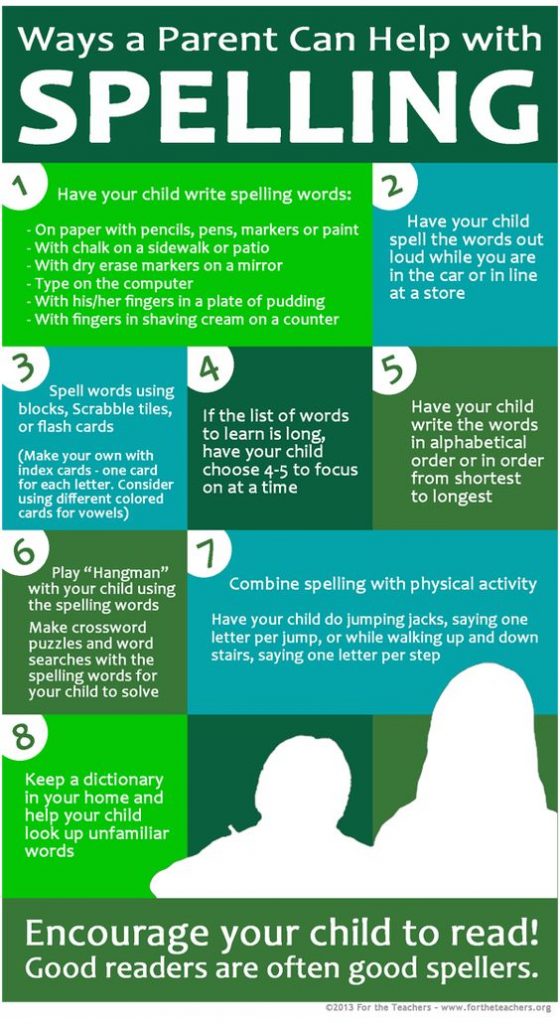
You may think to yourself, “I am not a trained educator.” That doesn’t matter. You have to become assertive and seek out resources that will make you the best parent-educator that you can be. Take spelling for instance. In the elementary grades, your child will be expected to learn how to spell a plethora of words. To assess how well they are doing, their teacher will usually have weekly spelling tests. Parents are expected to help their child prepare for these tests. You don’t have to be a trained educator for this, and there are plenty of resources that will help you choose the best strategies. For instance, we found this fantastic graphic that lists 8 ways parents can help their child with spelling. These tips and strategies will turn you into a world class spelling coach and may turn your child into a spelling bee champion.
As you can see, helping your child academically is not as hard as it seems. Remember, you don’t have to be perfect, you have to be committed.
To teach a child, you must first show that child that you care about them and their well-being. How to accomplish this? I am glad you asked. Below you will find a cool graphic that lists 10 easy ways to show students that you care.

What does the teaching and learning process look like? I am asked this question about 30 times a year, and I always give the same verbal response. Recently, I found a graphic representation of what I think the teaching and learning process looks like, and decided to share it with you all. I hope this helps.
What, if anything, would you change about this diagram?

What happens when you pair “Bloom’s Taxonomy” with “Depth of Knowledge”? The author of the graphic below has figured it out.

I get asked to explain what special education is, all the time. I tell them that special education is a federally mandated program that is meant to meet the needs of students with disabilities. It provides them with the supports, resources, programs, and accommodations that they need to be successful in an academic setting.
When I discuss the topic, I speak from the heart. This is because I was a special education teacher for three years, working with students who had mild to moderate disabilities. The one misconception that I layman and educators hold about special education is that it is a service that students will need for the rest of their K-12 careers. While this may be true in some cases, it is not in them all.
The purpose of special education is to help students who are functioning below grade to perform at grade level eventually. Once this happens, they can be transitioned out of special education, and participate totally in the regular education program. As a caveat, we all know that for some students, this may not be possible. This includes students with severe intellectual disabilities, behavioral disabilties, physical disabilities, or traumatic brain injuries. Because of the severity of their conditions, special education would be a long-term placement for them
To further explain special education, I am sharing the graphic below. I hope it helps.


Pedagogue is a social media network where educators can learn and grow. It's a safe space where they can share advice, strategies, tools, hacks, resources, etc., and work together to improve their teaching skills and the academic performance of the students in their charge.
If you want to collaborate with educators from around the globe, facilitate remote learning, etc., sign up for a free account today and start making connections.
Pedagogue is Free Now, and Free Forever!