Uncategorized

Madison: Survey shows 88 percent of students do not have Internet access

Many school districts are working working to provide every student with a technology device when needed – but what if students don’t have Internet access to utilize these devices from home?

On examples of this challenge is playing out in Madison, Wisconsin. A Tableau survey of over 27,000 students found that around 88 percent of students in the Madison Metropolis School District do not have access to the Internet.

Of the elementary through high school surveyed, 97 percent of white students and 93 percent of Asian students have access to the Internet – but only 74 percent of African American students and 79 percent of Hispanic students have access.

Similarly, 78 percent of low-income students have access to the Internet, compared with 98 percent of students that did not fall into the low-income category.

The school is hoping to improve the equity of access for all students.

I think it’s really important to remember that not all students are fortunate enough to have access to the Internet. Providing technology devices is a great start and I think it’s terrific that Madison Metropolis School District is able to do this for its students. However, if not everyone has the ability to get online from home, it hinders the potential good of the devices.

It sounds like Madison needs to make sure students without Internet access at home can find locations to take advantage of their devices, such as ensuring the school campus has open Wi-Fi. I hope that we can find ways to overcome the issue in Madison and other school districts out there facing the same challenges in an effort to keep minority and low-income students from falling further behind their peers.

Brown v. Board Fails: Resegregation is Accidentally on Purpose

By Julian Vasquez Heilig, Ph.D., @professorjvh on Twitter

Since it’s inception the United States has enacted and supported racially discriminatory policies. On May 17, 1954, the US Supreme Court handed down a unanimous decision in Brown v. Board of Education, outlawing racial segregation in our nation’s schools. Brown overturned the doctrine of “separate but equal,” which the Court had established in the 1896 case of Plessy v. Ferguson. Brown marked a turning point…

Fast forward to May 17, 2014… it was the 60th anniversary of Brown v. Board of Education…

Nevada “rancher” Cliven Bundy and current L.A. Clippers owner Donald Sterling are not racist. At least that would they would have you believe. Cliven Bundy stated to CNN:

“At least a half-dozen (black) people sitting on the porch, they didn’t have nothing to do.

Because they were basically on government subsidy, so now what do they do?” he added in comments first reported by The New York Times and later seen on video. “They abort their young children, they put their young men in jail, because they never learned how to pick cotton.

And I’ve often wondered, are they better off as slaves, picking cotton and having a family life and doing things, or are they better off under government subsidy?   They didn’t get no more freedom. They got less freedom.”

Bundy’s “apology” to CNN was:

“Maybe I sinned, and maybe I need to ask forgiveness, and maybe I don’t know what I actually said, but when you talk about prejudice, we’re talking about not being able to exercise what we think. … If I say Negro or black boy or slave, if those people cannot take those kind of words and not be (offended), then Martin Luther King hasn’t got his job done yet. We need to get over this prejudice stuff.”

Donald Sterling, LA Clippers owner, also has been in the news in the past year. The conversation that his mistress taped included some incendiary comments.

” In your lousy f***ing Instagrams, you don’t have to have yourself with — walking with black people Yeah, it bothers me a lot if you want to … broadcast that you’re associating with black people. Do you have to?”

There is more. But you have probably already read and seen it. Then, in Sterling’s Anderson Cooper CNN “apology” he stated:

“That’s one problem I have. Jews, when they get successful, they will help their people — and some of the African-Americans, maybe I’ll get in trouble again, they don’t want to help anybody.”

He continued with racialized comments about Magic Johnson:

“I think he should be ashamed of himself. I think he should go in the background. But what does he do for the black people? He doesn’t do anything … I just don’t think he’s a good example for the children of Los Angeles. He would go and do what he did. And then get AIDS. I mean come on.” (In fact, Johnson has HIV, not AIDS.)

Sterling is “consistent.” CNN reported:

A top [LA Clippers] executive accused Sterling of running the Clippers with a “plantation” mentality. Federal prosecutors accused his rental company of                             refusing to lease Beverly Hills apartments to African-Americans. And a group of tenants accused him of “numerous discriminatory statements and housing                      practices.

“Actions speak louder than words, and Mr. Sterling’s actions have been consistent,” former NBA star Kareem Abdul-Jabbar told CNN’s “The Lead with Jake Tapper.”

Abdul-Jabbar, who coached the Clippers for about three months in 2000, said Sterling has “a bad reputation.”

So why lead a post about accidental on purpose segregation with Cliven Bundy and Donald Sterling?! I’ll come back to them to conclude…

Photo source

So what is the status of segregation 60 years post Brown v. Board of Education of Topeka? In the post How can we desegregate re-segregated public schools? (again) we wrote:

“Landmark legal victories over de jure segregation in the wake of Brown v. Board of Education of Topeka[1] helped to secure dramatic decreases in the racial and ethnic segregation of schools in subsequent decades, especially in the formerly segregated American South[2]. The promise of the post-Brown era proved ephemeral, however; nearly sixty years after the Supreme Court ruled that segregation was inherently unequal, American schools remain remarkably segregated by race and ethnicity.[3] Since the 1980s, the de facto segregation of schools has rapidly intensified, especially in the South and for Hispanic/Latino populations.[4] Indeed, during the 1990s the proportion of Black students in majority-White schools decreased 13 percentage points, to a level not seen since 1970.[5] This re-segregation of schools has been facilitated by weak executive enforcement of civil rights provisions and continued judicial retrenchment on school integration, exemplified by Board of Education of Oklahoma City v. Dowell[6] andFreeman v. Pitts,[7] which diminished desegregation standards and resulted in the release of hundreds of districts from their court-imposed desegregation orders.

In 2007, the U.S. Supreme Court in Parents Involved in Community Schools v. Seattle School District No. 1[8] dealt another blow to integration efforts, rendering unconstitutional school assignment plans that use individual student race or ethnicity as the sole factor in school assignment, punctuating the steady decline in support for school desegregation policies.[9] In the case, which was decided with Meredith v. Jefferson County Board of Education, [10]the Court ruled that the racial balancing efforts of the Seattle and Louisville school districts, which were undertaken voluntarily in the absence of evidence that either district had deliberately practiced de jure racial discrimination, were impermissible and unconstitutional violations of the Equal Protection Clause.[11] Consequently, districts that had been using such policies to achieve and maintain racial and socioeconomic balance across campuses were denied the primary weapon with which they had historically combated racial and socioeconomic segregation.

In the Seattle student assignment plan, which was challenged under Parents Involved, students were permitted to apply to any high school in the district. However, if the demographics of any school deviated from the demographics of the district as a whole (within a specified percentage), a racial “tiebreaker” was used to determine which students were admitted to the school. Thus, if a school had too many whites, admission might be restricted to only non-whites (including Asians, Latinos, Native Americans, or African Americans); if a school had too few whites, admission might be restricted to only whites. As the foregoing illustrates, the Seattle plan was concerned only with racial balance among “whites” and “non-whites,” not with the racial distribution within non-white populations. In the Jefferson County, Kentucky plan, which was challenged under the Meredith case, students were classified as either “black” or “other,” with students assigned to schools in such a way as to ensure that schools were no less than 15 percent and no more than 50 percent black.

While acknowledging the pernicious effects of segregation, the Court held in Parents Involved that the use of racial classifications in Seattle and Louisville were not “narrowly tailored” to achieve a “compelling” government interest. First, the Court held that there was not a compelling interest that justified the use of race in their student assignment processes.[16] In the plurality opinion, Roberts argued that while racial diversity is a compelling interest in higher education, the ruling in Grutter v. Bollinger[17] and Gratz v. Bollinger[18] did not apply to primary and secondary education, because the districts in question (i.e., Seattle and Louisville) did not use an individualized consideration of students and utilized a very limited racial perspective on diversity (i.e., “white” vs. “non-white”).Moreover, the cases of Seattle and Louisville did not constitute a compelling interest because neither district had a legacy of past discrimination that the plans were designed to remedy.[20] In addition, the Court ruled that the plans of Seattle and Louisville were not sufficiently “narrowly tailored” to constitutionally justify the use of race.[21] Indeed, Roberts notes that both plans were exclusively focused on achieving demographic goals, and not towards achieving any benefit of racial diversity.[22] Moreover, the Court ruled that neither district had made a “serious, good faith consideration of workable race-neutral alternatives,” as required under Grutter.[23] Indeed, the Court held that the districts failed to show that the use of race was necessary to meet its diversity objectives, arguing that similar effects could have been achieved without race-conscious means.”

A look at resegregation in our schools

So what has been the result of a series of cases ending busing, desegregation orders, and ban on the use of race in Parents Involved? Together they have led to the re-segregation of public schools. Dr. Gary Orfield and The Civil Rights Project/Proyecto Derechos Civiles at UCLA released a series of studies this week analyzing the most recent data on segregation. Here is a sample of what they have found:

Changing U.S. Demographics and SCOTUS Transform School Segregation Landscape 60 Years After Brown v Board of Education Segregation Increases after Desegregation Plans Terminated by Supreme Court

North Carolina’s Black Students Increasingly Isolated in Schools after Many Desegregation Plans Dissolved Racial and Economic Isolation Intensifies Despite an Increasingly Multiracial Enrollment.

New York Schools Most Segregated in the Nation UCLA report identifies alarming trends throughout the Empire State.

My selfie with UCLA’s Gary Orfield after his AERA Brown lecture in DC

Latina/os and Segregation

What is that state of segregation for Latina/os and more specifically immigrant students? The Civil Rights project found that California is the most segregated state for Latino students and has little to Celebrate 60 Years After Brown v. Board of Education. In the post Breaking News: School Segregation Study Strikes A Nerve, I discussed a peer-reviewed study we authored last year that focused specifically on Latina/os. I wrote:

Our study Expansive School Segregation in Texas: Predicts Accountability Rating has caused a stir. (Click here for study) The Spanish media was first on the story when Univision produced Study Shows Triple Segregation Persists in Texas Schools. Then the AP picked up the story and the study went national.

Photo Source

The AP story reported:

The study by education professors at The University of Texas at Austin found that minorities, English language learners and poor kids have become concentrated into low-performing schools and districts, decreasing their chances to overcome these impediments. In two-thirds of the schools that are intensely poor, English language learners are the majority of students.

“Our research revealed that schools where students are segregated by race/ethnicity, (socio-economic status) and language are overwhelmingly rated as low-performing,” said Julian Vasquez Heilig, associate professor in the College of Education. Those schools also are staffed with some of the lowest-skilled teachers turnover tends to be high, he added.

In conclusion, we have a Sterling/Bundy court system and legislatures in the United States. Our legislative and judicial bodies claim that their policies are race neutral, but they are well aware of the disparate impact of segregation in the data, and they continually shrug their shoulder in denial (ala Bundy and Sterling) that their action or lack of action is racist or without racial intent (similar to the argument being used to suppress voting), when in fact, prima facie, they do. The powerful legislative and judicial bodies in the US accidentally on purpose fomented resegregation. As I have written about previously on Cloaking Inequity, this accidentally on purpose intent is the case with segregation, criminal justice, college access, and even high-stakes testing . The American judicial system and legislatures have taken an overt Jim Crow system of racial prejudice and discrimination and just moved it underground to a covert system that continues to have disparate impact.


This post originally appeared on Cloaking Inequality, and was republished with permission. Follow Julian Vasquez Heilig on Twitter: @professorjvh. 

Teachers: How to Use Google Drive

By Catlin Tucker

For teachers who are just getting started with Google, Google Drive can be intimidating! In preparation for a Google training, I’ve put together a short explanation of Google Drive and its basic features. Although an increasing number of people have a Gmail account, I run into teachers all the time who are not sure what Google Drive is or how it works.

Google Drive is like a big virtual bucket! It’s where everything you create with Google apps–documents, forms, sheets, slides, drawing–are stored. And unlike a traditional word processing document, you never need to click “Save”…EVER.  Your work is automatically saved every 5 seconds (or so).

Google Drive comes with 15 GB of free storage, so you can save files, photos, and videos. You can access any file in your Google Drive from any device as long as you have internet access. This means you are no longer tethered to a piece of hardware. You can open, edit and share files from any device that can get online.

For those with unreliable internet access, you can also install Google Drive onto your devices and work offline. Then when you are back online, your devices will sync and store your work!

Here are some screenshots to help you navigate your Google Drive.

Organize your files in whatever order makes sense to you. You can limit your view to the files you’ve created, the files that have been shared with you or the files that have been most recently edited. This makes it easy to locate the files you’re looking for.

Screen Shot 2015-01-20 at 2.47.26 PM


Click on a file or folder and check out the “More actions” icon (3 vertical dots) to manage your documents more easily.

Screen Shot 2015-01-20 at 3.28.31 PM


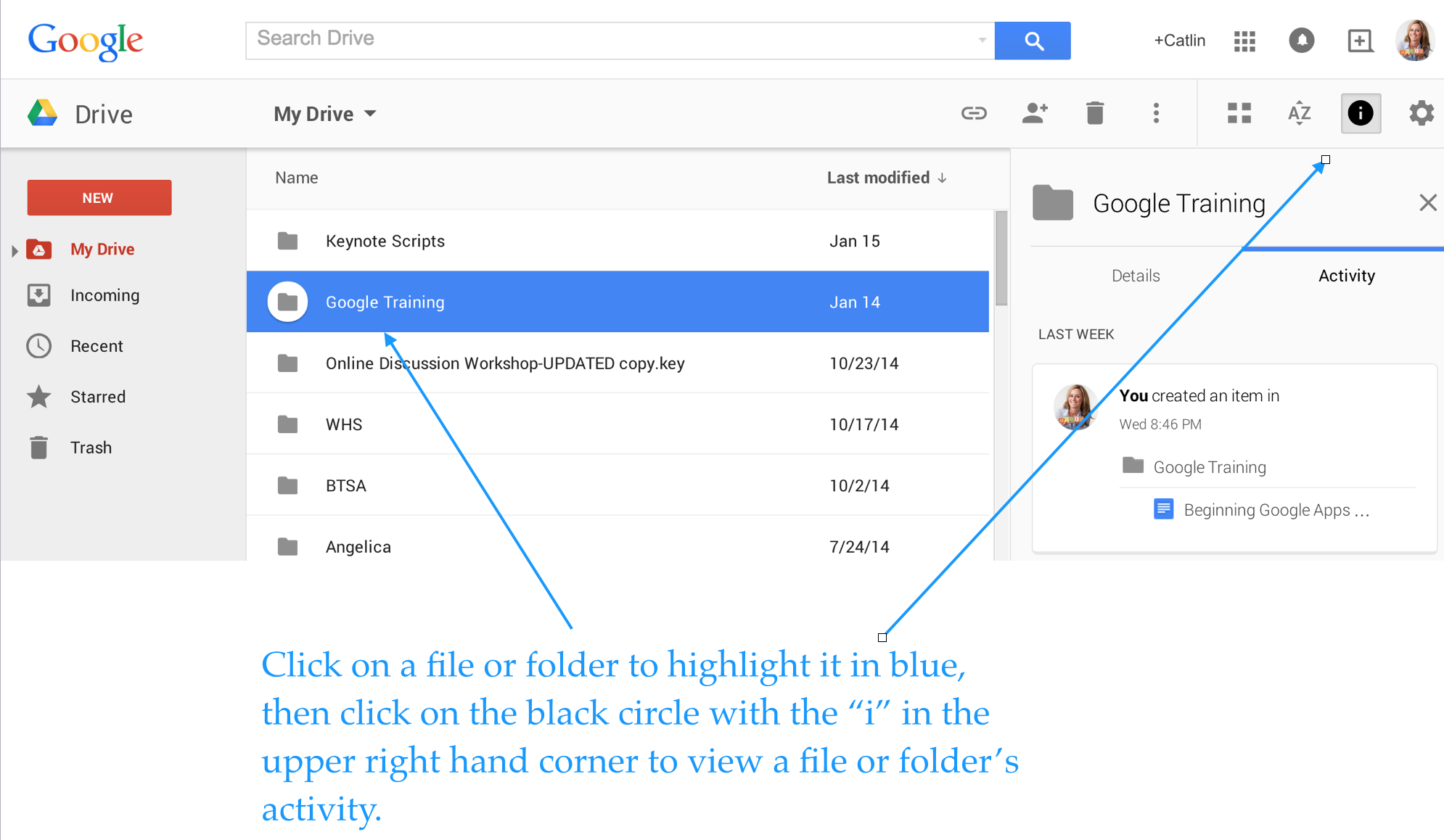
Enjoy total transparency with the “View Details” icon (black circle with the letter “i” in the middle). Simply click on a file or folder and see all of the activity associated with it. You can see when documents were created, when they were edited, and who edited them!

Screen Shot 2015-01-20 at 4.06.24 PM


Last, but not least, you can insert files, photos and videos directly from Google Drive into your emails.

Screen Shot 2015-01-20 at 1.34.37 PM


If you use Google Drive and have tips to share, please post a comment!


This post originally appeared on Catlin Tucker: Blended Learning & Technology in the Classroom and was republished with permission. 

Read all of our posts about EdTech and Innovation by clicking here. 

Guest Post: American History is not Black History; Black History is not America’s

A guest post by Leonce Gaiter

As taught in mainstream culture, American history propagates this nation as the womb of freedom, justice, and liberty.  There are American creation myths as exemplified by the “Founding Fathers.”  There are founding documents as revered as biblical texts for their promise of “Life, Liberty, and the pursuit of Happiness.”

That is why the argument that ‘black history is American history’ is naïve to the point of insipidity.  For most of this nation’s history, blacks were not ‘Americans.’  First, we were owned, and then we were barred from exercising the rights of citizenship.  That’s why our history puts the lie to American history’s mainstream myths.  Almost half of the delegates to the Constitutional Convention, some of whom wrote so eloquently of freedom, owned other men as slaves.  For most of its history, this country profited immensely from forcibly denying us freedom and liberty, by keeping us in chains, and from our labor as sub-citizens.  Our history puts the lie to America’s history as popularly told.

Do we want to continue to teach our children black history through a white racial frame?  That is the practical effect of stating, “black history is American history.”  It states that the majority veil should be placed on the history that we teach our children.  It states that we should forego the right that every other culture assumes—the right to teach our history from our own point-of-view, and to be the heroes of our own stories—and instead, subsume our history within the majority’s. It states that we do not have the right to express our rage at the barbarities we endured, for those are histories that the majority has little willingness to accept and examine, and for good reason: they put the lie to treasured American myths.

To pronounce that “black history is American history” says that every black child should learn that after Vernon Dahmer’s home was firebombed in Mississippi and Dahmer died from his wounds, the outraged white community worked to rebuild the Dahmer home.  It says that black children needn’t learn that in Brookhaven, Mississippi in 1955, Lamar Smith was shot dead on the courthouse lawn in broad daylight by a white man for the crime of organizing blacks to vote, and that the known killer was never indicted because, per the Southern Poverty Law Center, “no one would admit they saw a white man shoot a black man.”

To say “black history is American history” approves the endless repetition of a Martin Luther King quote like:

I refuse to accept the view that mankind is so tragically bound to the starless midnight of racism and war that the bright daybreak of peace and brotherhood can never become a reality… I believe that unarmed truth and unconditional love will have the final word.”

It says black children needn’t bother with another strand of King’s thinking:

“It is an unhappy truth that racism is a way of life for the vast majority of white Americans, spoken and unspoken, acknowledged and denied, subtle and sometimes not so subtle—the disease of racism permeates and poisons a whole body politic.

To insist that black history is American history says that the majority should be allowed to use our history to paint themselves in the warmest light, but that we should not be allowed to do the same.  The two are often mutually exclusive.  To understand the challenges and triumphs of the American descendants of African slaves, it is imperative to understand that almost every aspect of the might of this nation was used to cripple us.  To understand how far we’ve come, the battles we fought, the blood we shed and the triumphs and defeats we suffered, you must understand the weight of the spiked boot that was placed on our necks.  To do that, you must indict America for crimes she would rather forget.

American history is not black history, and our history is not America’s to dictate.  Until we understand that, and begin teaching our history to ourselves in ways that serve our own cultural needs instead of the majority’s, we will continue to internalize this nation’s prejudices against us, instead of arming ourselves to appropriately demonize and deflect them.


Leonce Gaiter is a prolific African American writer and proud Harvard Alum. His writing has appeared in the NYTimes, NYT Magazine, LA Times, Washington Times, and Washington Post, and he has written two novels.  His newly released novel, In the Company of Educated Men, is a literary thriller with socio-economic, class, and racial themes. You can find the book at these retailers:

AMAZON

B&N  

APPLE 

Are black girls being pushed out of school?

A study released by law researchers at Columbia University shows evidence that of all groups, black K-12 female students are kicked or pushed out of school more than their peers. Altercations that may just call for a suspension or mediation for other students, for example, turn into expulsion or arrests in the case of black girls at rates that are alarmingly high.

The report,  Black Girls Matter: Pushed Out, Overpoliced and Underprotected, points to a school culture where young women of color are routinely looked over when it comes to providing a safe, nurturing environment for their learning. Things like “zero tolerance” policies appear to be interpretive for some K-12 students, but are almost always followed to the letter of the law with black young women.

This trend points to the larger issue of equality in our K-12 classrooms. If, as a body of educators, we truly are trying to graduate as many American kids as possible and find ways to reach them on an individual basis, how can stats like these be tolerated? Our culture of arresting first, and asking questions second, when it comes to all students of color is troubling because it changes the self-perception of these students.

Other research has shown that students who are considered “bad” or kicked out of classrooms at a young age are more likely to head to prison eventually. What good does this type of cycle do for anyone? Black female students are not the ones who need to change; the way we teach and treat them needs to change if we ever plan to reverse this trend.

Mississippi act aims to help special education students graduate

Only 23 percent of special needs K-12 students in Mississippi graduate from high school, but a proposal that is being sent to the state House of Representatives aims to change that. Already passed by the State Senate, the Equal Opportunity for Students with Special Needs Act would give teachers raises and provide more financial resources for families who seek private care.

To put this number in perspective, the Clarion-Ledger reports that in 1997 just 18 percent of Mississippi special needs students graduated from high school. With all of the advances in special education over the past two decades, a graduation rate increase of just 5 percent is clearly not enough. Technological advances alone should be enough to raise this number even higher, let alone paradigm shifts in what is presented in the classroom and how special education students learn.

In a state where poverty plagues public school students and academic achievement ranks at the bottom in the entire nation, it is easy to see how special education students are falling through the cracks.  These students are not receiving the special attention that they should in school, and parents are unable to afford private help. The passage of the Equal Opportunity for Students with Special Needs Act would hopefully change all of that and make high school graduation a reality for many of the students in the state.

The more special needs students who graduate, the better the economic outlook for everyone in the state. I hope the Mississippi House passes this act unanimously so the special education youth in the state can start achieving what they are capable of academically.

Schools gravitating toward healthy fundraising

Fun runs are popular these days and bake sales are taking the back seat, partly  thanks to the changes from a “smart snacks” provision in the Healthy, Hunger-Free Kids Act of 2010. In addition, regulations that ban the sale of junk food during school hours went into effect last summer as part of a nationwide push by Michelle Obama.

The result of this push means that schools are gravitating toward healthy fundraising too.

Many parents appreciate this, especially in a society where sugary snacks and sodas seem to plague child-centered social events.

However, some states aren’t taking the news without a fight. South Carolina’s state superintendent of education Molly Spearman points out that fundraisers provide vital income and wants waivers from the smart-snack requirements for fundraisers.

Similarly, Ted Poe of Texas is working to push a bill to keep the “federal food police” from schools. His bill would prevent nutrition standards under the 2010 law from being applied to fundraisers.

I like that the First Lady recognizes the importance of good nutrition in schools and surrounding school events. Teaching and supporting healthy eating from a young age sets children up for healthy eating for the rest of their lives. I think that fundraisers that sell unhealthy, sugary-and calorie-laden snacks do not help students really, even if they do raise money. Selling these treats really doesn’t help anyone.

The last few years have been a period of change in public school meal programs with Michelle Obama in the driver’s seat. She has been instrumental in making changes for the better and I hope we see acceptance of the requirements around the country.

Delaware students rally for more African American teachers

This week, local students in Sussex County, Delaware took a stand to rally for more African American teachers and discuss issues they have faced at school, as reported in the News Journal.

The forum hosted by the local League of Women Voters to mark Black History Month included three adult speakers — but three high school students generated the biggest uproar.

Many students only have one or two African American teachers throughout their entire K-12 experience and feel that they could better identify with teachers who look more like them.

One example given in the News Journal is Sussex Tech, in which is 90.3 percent of teachers are white, 7.5 percent of teachers are black, and one teacher is Hispanic.  In the school, 66.5 percent of students are white, 17.9 percent are black and 12.4 percent are Hispanic. The percentages clearly do not add up and it is clear that students are not seeing an accurate representation of their student population in their teachers.

I agree with the students in Sussex County, Delaware: we need more African American teachers in our schools. Teachers in our country are simply not as diverse as its students. Students will perform better when they can identify with and relate to their teachers — and I believe we could narrow and even close achievement gaps by recruiting more black educators.

In addition, I think increasing the number of teachers of color will help students who are not of color too. Putting black teachers in front of children who are not black could prevent stereotyping and promote acceptance of diversity and equity.

Click here to read all our posts concerning the Achievement Gap.

Mississippi education budget proposal still $256 million short

Mississippi’s Lieutenant Governor Tate Reeves announced a plan last week that would raise K-12 state spending by $110 million over last year — but would still not fully fund the public schools in the state. Even with the requested rise in money allocated for K-12 schools, more than $256 million would still be unfunded based on the Mississippi Department of Education’s $2.8 billion budget proposal.

An amendment initiative in the state known as Initiative 42 would require state legislators to fully fund the Mississippi Adequate Education Program, also known as MAEP, every year. Since the MAEP passed in 1997, it has only been completely funded twice. That would change if Initiative 42 passes when it appears on the general election ballot in November.

I appreciate the Lt. Governor’s stance to try to funnel more funds to public schools but clearly, there is still too big a deficit in what is needed and what is being provided. Lt. Gov. Reeves says that once Mississippi’s economy improves, so will the funding to the schools — but at what point do we make our K-12 funding THE priority, and not just something that happens after every other state bill has been paid?

Underfunding the state’s education budget by $256 million is certainly not the way to improve public school classrooms and bring Mississippi up from the bottom of the nation’s student achievement rankings. With citizens with less resources and higher poverty levels than other states, it is more important than ever to fully fund what is needed in the public schools and support real change in the lives of this generation of K-12 students.

Indiana judge: Stop locking up students

An Indianapolis-area judge has sent a letter to district superintendents that insists school administrators stop having so many students arrested. The letter says that 1,500 Indy kids are sent to juvenile detention centers annually, but that 80 percent of those are never charged. What happens instead is that the juvenile centers simply send the kids back, but they have the stigma of being arrested attached.

“Locking up kids is not the right way to solve this problem,” Moores said in her letter that also said she had no intention of processing kids who were not appropriate for a detention center. ““We have to draw the line because we don’t want to make major criminals out of rowdy kids.”

The trend to arrest first, and ask questions later, throughout schools districts in the nation is troubling. Judge Moores hit the nail on the head when she pointed out that sometimes having a child arrested makes even more trouble and I believe it can even be the catalyst that pushes some kids into the criminal lifestyle. Yes, we want to keep all our students safe and violent actions or threats on school campuses must be taken seriously. There needs to be more resolution inside schools, though, instead of always turning to the criminal justice system — particularly for non-violent, minor issues.

We need more support within schools to handle the behavior issues that arise, whether that be for more training for teachers or better equipped school counselors and administrators. Keeping “bad” kids in school benefits us all – not just the student otherwise facing arrest.