Uncategorized

The Neuroscience of Writing

“Writing is, by nature, an opportunity for creativity and personal expression. When writing is incorporated in learning and assessment, there is increased opportunity to produce the ideal situation for active, attentive learning” – J. Willis, “Writing and the Brain: Neuroscience Shows the Pathways to Learning”

The written word is everything to our brains. It is the intake of information, the passing of ideas. It’s no surprise that there is a type of science behind the writing, supporting everything you say and how you write.

Think about how sometimes a paragraph simply flows, the ideas connect and the whole passage just makes sense. Oppositely, you can find yourself reading the same sentence over and over again without fully comprehending exactly what is being said. According to Yellowless Douglas, the sensation does not only affect the reader but the writer as well. Our understanding is based on the idea of clarity, continuity, coherence, concision, and cadence.

Why does this matter? Well when you write a book, you want it to be understood. You want to leave an impact on your reader, make them remember what you wrote.

Writing something memorable takes more than simply hoping for your paragraphs to flow, it takes the precise placement and creation of a connection.

What happens exactly? Where you place your important information will affect when, and if, the reader remembers it. We have to work with an idea called “recency,” that the last thing mentioned is what we will remember the best. That’s why whatever you tell them in the middle of the paragraph should not be as important as what you mention in the end.

It comes in handy when describing a bad situation. Put the worst information, or situation, in the middle of the paragraph. When you do this and then end the paragraph with something a little less offensive, like a petty insult. Ending with the insult takes the brunt of the negative reaction caused by the middle of the paragraph.

How do we create the connection? The same way we connect everything else. Cause and effect. We don’t want to skip straight to the result, we want to know how we got there. Mention the reason for the failure, let the reader understand why and connect to those experiences.

When they understand the reason, they’re more likely to accept the explanation of the situation. It’s when you jump straight into the failure you get them all riled. Then instead of reason, all you have is an excuse.

Stay engaged. If you want your readers to follow your writing, you need to write in a way they understand. As the University of Florida puts it, “we expect the order of items in a sentence to reflect the order in which they occurred in the world” and when the sentence fits this order, the brain of the reader shows more activity.

The way we think affects the way we read, the way we read affects how writers should write. When the brain is engaged by the content, the reader takes away information efficiently and effectively.

Renaissance Acquires Student-Centered, Teacher-Driven Math Solution

The edtech leader has acquired Freckle Education to enhance its offerings with differentiated math, science and social studies solutions

(WISCONSIN RAPIDS, Wis.) May 20, 2019 — Renaissance®, a global leader in pre-K–12 education technology, today announced that it has acquired Freckle Education, a company that provides a differentiation platform for all four core subjects: math, social studies, science and English language arts. This acquisition will expand and enhance educators’ opportunities to accelerate student learning, especially in the critical math skills students need to be college and career ready.

“We chose Freckle for its innovative approach to student-centered practice, instructional design and teacher tools,” said Todd Brekhus, chief product officer at Renaissance. “So many personalized learning programs suggest students should just put the headphones on, let the computer take over and wait for the learning to happen without the teacher’s involvement. With Freckle, we’re bringing educators a tool that puts them in control of targeting instruction and differentiating practice for students. The acquisition of Freckle is another step forward in our mission to continually extend and expand the impact of our solutions.”

Freckle helps teachers differentiate instruction quickly and effectively deliver guided practice to students at their own academic level. The platform includes interactive student practice activities aligned to state standards, teacher resources such as progress reports and inquiry-based lesson plans and an administrator dashboard. With Freckle’s wide variety of high-quality teacher lessons and student activities, educators can differentiate not just what students learn, but how they learn it, engaging students in topics that already interest them and guiding them to learn in ways most effective for them individually.

The move is the third major acquisition for Renaissance in the last year and a half, coming just weeks after the company’s April acquisition of myIGDIs™, and mirrors the company’s previous purchase of myON®. A student-centered digital literacy platform, myON by Renaissance® has proven to be a strategic complement to Star Reading® assessment and Accelerated Reader® literacy programs, which provide educators with data-fueled insights into student progress and growth for effective differentiated learning.

Similarly, combining Freckle’s differentiated lessons with the robust insights educators gain with Renaissance’s Star Math® K–12 assessment solution will help deepen the learning connection between teacher and student.

“We know that, when we combine best-in-class solutions, it can have an incredible effect on student learning,” said Renaissance’s CEO Chris Bauleke. “When we introduced teachers and administrators to myON, we saw increased usage of both Accelerated Reader and myON and, more to the point, an increase in student reading. We believe the same thing will happen as educators work with Star Math, Accelerated Math and Freckle, combining powerful tools for uncovering student data and the resources to put those insights to work to strengthen student math learning.”

Founded five years ago as Front Row Education, Freckle has rapidly grown into a teacher favorite, with many adoptions championed by teachers. Today, more than 700,000 teachers use Freckle to differentiate learning for over 10 million students across 75,000 schools. Multiple research studies have found that students who use Freckle see greater learning gains than those who do not.

“We launched Freckle because we believe every student deserves a world-class education, and the best way to deliver that is by empowering teachers to differentiate instruction for their students,” said Sidharth Kakkar, Freckle co-founder and CEO. “We’ve been honored to help hundreds of thousands of educators all across the country, and we couldn’t be more excited to see Freckle improve learning for so many more students with the expanded reach Renaissance will provide.”

Freckle customers will continue to receive the support and service they have come to expect and love from the company. Existing Renaissance customers can look forward to being introduced to Freckle.

Vista Point Advisors, a San Francisco-based boutique investment bank, acted as the exclusive financial advisor to Freckle.

About Renaissance

Renaissance® is a global leader in pre-K–12 educational technology, enabling teachers, curriculum creators and educators to drive phenomenal student growth. Renaissance’s solutions help educators analyze, customize and plan personalized learning paths for students, allowing time for what matters: creating energizing learning experiences in the classroom. Founded by parents, upheld by educators and enriched by data scientists, Renaissance knows learning is a continual journey—from year to year and for a lifetime. Our data-driven, personalized solutions are currently used in over one-third of U.S. schools and more than 90 countries around the world. For more information, visit Renaissance.com.

About Freckle Education

Freckle Education provides an innovative differentiation platform that allows teachers to provide every student with instruction and practice at the level that’s best for them, especially in the three-quarters of classrooms with students whose reading levels span across more than four grade levels. With instructional resources and practice activities for all four core subject areas—math, social studies, science and English language arts—Freckle helps educators provide students with rich, engaging learning experiences that accelerate growth. Originally founded as Front Row Education in 2013, Freckle currently serves more than 700,000 teachers and 10 million students across 75,000 schools. For more information, visit Freckle.com.

Press Contact:
Ken Stoflet
Communications Specialist
Renaissance
(715) 424-3636 ext. 2332
[email protected]

The Psychology of Academic Achievement

If you’ve taken any Psychology 101 course, the age-old “nature vs. nurture” debate was likely covered. While the debate has yet to be settled (spoiler alert: it will never be settled), we can apply the same principles to the psychology of academic achievement and why some individuals are apt for more success in the classroom.

While the process of education has evolved tremendously over time, and varies widely from nation to nation, it seems obvious that environmental factors – the nurture side of the debate – play an incredibly large role in predicting achievement.

When looking at schools with historically low achievement, studies cited in this Psychology Today article, noticed that poor infrastructure and appalling classroom conditions indicate higher dropout rates across the board. On the flipside, when we think about the campuses of Ivy League schools and other elite educational institutions, it’s not only the state-of-the-art facilities and that predict achievement, but also the amount of greenery outside the classrooms, access to natural light and other happiness-inducing and stress-relieving factors that contribute to academic success.

Further supporting the nurture perspective, learned biases and stereotypes can both improve and put staggeringly low limits on a child’s ability to achieve, depending on which side of the narrative a child falls.

Take the classic, “boys are better at math and science” stereotype. Though this claim is far from factual, what really makes a difference is whether or not a child believes it to be true. Research noted by the National Science Foundation shows that stereotypes like these affect girls as early as six years old. By learning such false notions and believing them to be fact, children perceive them as insurmountable limits that are out of their control, thus subconsciously stunting their ability to achieve academically.

However, when we eliminate these biases and teach children that they are capable of achieving, the playing field is level for boys, girls and children of all races and socioeconomic backgrounds, as indicated by minority students studied by researchers at Stanford and the University of Wisconsin-Madison.

Though there seems to be more research to back the nurture side of the psychology of academic achievement, it could be because studying genes – indicators of our inherent psychological nature – is a more challenging process. However, researchers cited in BBC Education used DNA tests to identify a child’s likelihood of developing reading problems. Tests like these make it possible for educators to identify children or groups of children who could benefit from early intervention programs, thus preventing early setbacks to longer-term academic success.

With all of this information – and much more available to teachers and educators – we can’t necessarily settle the “nature vs. nurture” debate. However, we can better understand the nuances that exist in human psychology and perhaps focus more of our energy on creating curriculum and classrooms that show students what’s possible and help them to believe in their ability to achieve.

A Discussion of Incarceration and the Importance of Higher Education

Benjamin Franklin once said, “An investment in knowledge pays the best interest.” His thoughts are shared by many elected officials who believe education is the key to reducing the United States prison population.  Over the past thirty years, significant research has been conducted to assess if attending college courses during incarceration reduces recidivism.  

Over 2.2 million people are incarcerated in the United States, and almost 95 percent of inmates will be released back into communities. However, 41 percent of all United States prisoners have less than a high school diploma. A study conducted in 2016 by RAND  revealed when education classes of any level were offered within correctional facilities, there was a 43 percent reduction of individuals returning to prison after their release. Acclimation into society is difficult when inmates are released without an education and expected to enter the current job market. The research discovered offering classes allows inmates to work toward, or obtain, two or four-year degrees. The higher education classes present an opportunity for individuals to gain employment once released from prison. It is proven that employment after release reduces repeat offenses.

Many advocates for providing higher education in prisons not only point to a lower rate of recidivism, but also to the likelihood of a safer community. For example, within correctional facilities where higher education classes are offered, inmates who are enrolled in an education program are less likely to engage in altercations and drug trafficking. This creates a safer environment for guards and inmates. Also, once prisoners are released, they re-enter society with a higher sense of purpose and are equipped with skills to contribute positively. The results are communities with less crime, and an economy boosted by a capable workforce.

A significant concern for correctional facilities is the cost of providing higher education classes for prisoners. At one time, inmates could receive a Pell Grant to pay for classes, but in 1994, Congress repealed this funding. Once states saw the federal government withdraw the Pell Grant from prisoners, they were quick to drop their state funding as well. Taxpayers often complained about criminals receiving tax dollars to further their education. In recent years, this argument has been counteracted with the fact that providing educational opportunities to inmates actually lowers costs for taxpayers. Research shows for every dollar spent on higher education classes in prisons, it reduces the taxpayers’ burden approximately five dollars since it lowers recidivism rates.

Providing higher education courses within prison walls results in a positive effect on inmates and communities. Access to classes which contribute toward a two or four-year degree directly correlates to less tendency to commit future crimes. However, the debate continues about funding college classes in prisons, although it is has been shown that educating prisoners is more cost effective than simply housing them. Benjamin Franklin’s words continue to be proven true; “an investment in education provides great returns.”

Is Educational Tracking Productive or Does it Produce Academic Inequity?

In all phases of K-12 education: elementary school, middle school, and high school, it has become the norm to group students together based on their perceived academic aptitude. This is what is known as “educational tracking.” It began in the 1920s. With most schools, there was a temporary break from this in the 1960s and early 1970s, because they believed that minorities were being wrongly classified in the public-school system.

How students are classified

Classifying students into specific groups is done in various ways. Children are tested regularly in the classrooms and through standardized tests and IQ tests, starting as early as Kindergarten. These tests are used to determine if the student should blend placed in the general classroom or if they should partake in something considered to be more at their speed, such as special needs classes, college prep, vocational, and honors courses.

In some schools, the classification of students is based on teacher recommendations and a student’s motivation. However, if the student and teacher do not get along, the child can be judged unfairly.

In schools today, they have what is called “leveling systems.” This was developed to help students who struggle to receive additional instruction to help them catch up with their peers. For example, while some students will take algebra in 9th grade, others will have to take pre-algebra first. A student who is considered advanced enough to go straight to algebra may find themselves in class with older students.

The real dangers of educational tracking

Though there is still the open question of whether students are being placed in the correct groups. Many believe that minority children and those from low economic classes are unjustly discriminated against and placed in lower groups based on anything but their education level. This was proven by the Personality and Social Psychology Bulletin. They posted the results of three studies that looked into the groups that students were placed in.

What the teachers in the study did not realize is that all of the children had the same grades. They were learning and testing at the exact same level. They were told that some of the children, including minorities, came from a lower socioeconomic background.

In the end, the teachers did as the researchers theorized, the minorities and those seen as a part of the lower class were grouped together and considered to be operating at a lower level academically, and their Caucasian or middle-class peers were grouped together and considered to be operating at a higher level academically. All three of those studies showed the same results. This has proven that educational tracking can produce the wrong results out of bias.

KinderLab Robotics Announces New Extension Set for Advanced Coding with KIBO

The KIBO Advanced Coding Extension Set unlocks new coding options to allow users of the robot kit to design their own programming blocks, create their own games, and explore complex coding concepts

(Waltham, MA) May 30, 2019 – KinderLab Robotics today expands its KIBO™ line by announcing its newest product, the Advanced Coding Extension Set, and an accompanying curriculum guide, Ask and Imagine. The Advanced Coding Extension Set supports children who are experienced with KIBO’s core concepts and offers them the next step along their computer science pathways. The Advanced Coding Extension Set creates a bridge between KIBO’s core pre-K to 2nd-grade curriculum and the computer science and engineering work students will do in upper elementary and beyond. Children can explore advanced computer science concepts such as subroutines, randomness, and conditionals, while staying rooted in KIBO’s familiar screen-free, hands-on coding environment.

KIBO is a robot kit specifically designed for children ages 4–7 years old. KIBO is entirely screen-free, as children program their robots with “tangible code” made of wooden programming blocks. Through these physical materials, children engage with a range of powerful ideas found in STEAM, computer science, and design thinking, all while integrating directly with literacy and art curricula.

The Advanced Coding Set allows children—and their teachers—to extend this exploration to computer science concepts that in the past were only accessible by older children. The new programming blocks unlock new powerful ideas: modularity and reusability with subroutines, complex conditional behavior, and randomness.

Carmella Hughes, a technology integration specialist at Nathaniel Morton Elementary School in Plymouth, MA, has used the new blocks with her KIBO students. She said, “These new blocks really extend students’ programming choices. My students set up a race for two KIBOs using the RANDOM parameter block. This was a favorite! This let me lead them through a very natural integration of math and engineering standards. Students could record their distances given 5, 10, 20, etc. tries. What happens with probability as the number of attempts increases? These new options really expand the boundaries of what we can do with KIBO in the classroom.”
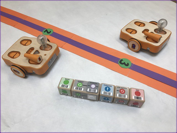
Creativity and personal expression remain at the heart of this new Extension Set and the Ask and Imagine curriculum booklet. Jason Innes, the manager of training and curriculum development at KinderLab Robotics, Inc., said, “At KinderLab, we focus on creative coding and robotics experiences for early childhood. Anyone familiar with KIBO can have fun with this new Extension Set, creating their own programming blocks and inventing new games. At the same time, we see KIBO as a vital on-ramp to a comprehensive computer science pathway for all students that extends into upper elementary and beyond. With the Advanced Coding Extension Set, we give students the ability to go beyond the computer science standards typically associated with the pre-K–2nd grade range.”

The new Advanced Coding Extension Set unlocks three new programming options:

Subroutines: A subroutine is like a miniature program within a program. With KIBO’s subroutines, children create their own programming block by defining a sequence of commands then assigning that sequence to a subroutine block. To personalize their creation, children can even use an included erasable marker to draw their own icon right onto the programming block sticker. The set includes multiple blocks to call the subroutines, allowing students to dive into the powerful ideas of modularity and reusability.

Random Parameter: This new card makes KIBO’s repeat loop run a random number of times. Kids can teach KIBO to play “Duck, Duck, Goose”—spin KIBO a random number of times, and who knows who will be “it”?

If Not: Children can already design programs that respond to light, sound, and distance using KIBO’s conditional programming. The new “If Not” block lets children tell KIBO to do one thing if a sensor is triggered, and something else if it’s not. This foundational concept in computer science expands the expressive possibilities for KIBO while deepening students’ understanding of conditional programming.

The Advanced Coding Extension Set is available for pre-order now for $80. During the pre-order period, KinderLab is offering a special: order two or more sets and receive the Advanced Coding Curriculum Guide Ask and Imagine (a $25 value) at no cost (limit one free Curriculum Guide per customer). The sets and curriculum will ship on June 24, 2019.

About KIBO – The Playful STEAM Robot

KIBO is a robot kit that allows children aged 4–7 to build, program, decorate, and bring their own robot to life without requiring any screen time on a smartphone, tablet, or computer. It is an open platform on which students can envision and create their own robot. With art and engineering, students transform KIBO into imagined animals, vehicles, storybook characters, and more. Students plan a coding sequence using wooden programming blocks, then scan their sequence with the built-in barcode scanner, press its button—and the robot comes alive. KIBO is a Winner in the Technology/Preschool category in the 2018 Seriously STEM awards, as well as numerous other awards.

When children build, code, and decorate their own robot, they perceive it as play, but they are learning invaluable STEAM skills. Not only are these hands-on experiences inherently rewarding, but they help children understand the technology in their world, and can even improve their future job prospects.

About KinderLab Robotics, Inc.

KinderLab Robotics is the creator of the award-winning KIBO, a playful educational STEAM robot kit based on 20 years of child development research with thousands of children, teachers, and parents. Developed specifically for teachers by Dr. Marina Umaschi Bers at Tufts University, KIBO is currently used in 57 countries and has proven efficacy in helping kids learn STEAM—and getting them excited about it! KinderLab offers a complete suite of teaching materials that help integrate STEAM elements into a wide range of curricula, including art, cultural studies, and reading literacy.

For more information, please visit KinderLabRobotics.com.

Press Contact

Chris Piehler

PR with Panache!

[email protected]

Examining the Three Most Research-Validated Reading Comprehension Approaches

Reading comprehension is a challenge for many students. Reading comprehension is not a standalone skill, nor can it be acquired without repetition or practice. Educators continue to find ways to address reading difficulties.

Teacher Read-Aloud

Teacher Read-Aloud is a method used to teach students different elements of reading. Students learn from this method through the teacher’s voice. While listening, students learn to decode punctuation and use tone, pitch, and inflection correctly for different characters and moods. Differentiating reading with varying structures of text and leveled readings teaches students how to decipher meanings of words and phrases in context, how to create different connections with the text, why there is such variety in story-telling techniques and the purpose of different writing styles.

When using read-alouds, varying texts also give students a chance to see stories in different formats. When changing story types, students are able to comprehend the story from different perspectives because they are actively using their skills rather than participating in rote activities. Active engagement from the teacher makes students are more likely to engage in conversation and ask questions pertaining to the work to further their comprehension of the story and its elements.

Think-Aloud Model

The Think-Aloud Model gives students a chance to think as they read. In doing so, students learn that reading is a process and sometimes takes more than one reading to comprehend an idea. Students practice rereading sentences to find context clues quietly while the teacher reads the story to the class. Think-Alouds give students the opportunity to slow down their reading pace in order to grasp concepts. While using this approach, students learn to stop at different points in the reading to make sense of the information presented. Allowing students to ask necessary questions allows them to assess their understanding of the story.

High 5 Model

The High 5 Model breaks reading into different steps; before, during, and after. The steps occur in the following sequence: Accessing Prior Knowledge, Questioning, Analyzing Text Structure, Visualization, and Summarizing.

Prompting students to access prior knowledge creates a relationship with the reading even before they come in contact with the content. The knowledge can be from personal experiences, other school subjects, and can include emotions about specific topics. When accessing prior knowledge, students may also acknowledge that their previous understanding of a topic was incorrect or incomplete. Being aware gives students the opportunity to improve or change their understanding of an idea.

Questioning ideas and concepts gives students the opportunity to digest new material or manipulate existing knowledge into new understandings. Questioning also encourages students to go beyond the required reading to find out more about a topic. When students question a piece of writing, they analyze the different elements of the work from its theme, use of figurative language, or incorporation of primary sources. Students engage with the reading and dissect each piece to create a full understanding.

Analyzing text structure shows students how to follow patterns and decipher the meaning to different words and phrases in a given context. For example, the adage “killing two birds with one stone” may be figurative or literal depending on the type of text structure. In a fictional reading, this would mean achieving two goals with one action, whereas in a survivalist guide, this may be literal. If the student cannot decipher between the different text structures, he may interpret the information in the wrong context.

Visualization is not limited to mere pictures. Visualization can include picturing a concept map, cause and effect chart, or connections between characters. Readers are able to create their idea of what the story is attempting to convey whether the content is realistic or fictional. Visualization can also be concrete or abstract depending on the work. In either case, accessing the ability to see ideas in the form of diagrams or pictures creates a more meaningful understanding of the text.

Summarizing provides a way for students to eliminate unnecessary details of a story while focusing on relevant key ideas. Summaries can be in the form of student-created projects, visual presentations, written explanation, or video recordings to showcase the purpose of the reading. In order to summarize a piece of work, a student needs to have a good understanding of what occurred in the reading and the elements that helped convey underlying messages and themes.

Each model provides different tools and strategies to help students comprehend different texts. None of the strategies work for everyone. For some students, one strategy will work well and for another student, a combination of each strategy will work just as well. Finding the right strategy (or strategies) will take time, but once a student finds success, he will continue to use the method for the future and refine his skills even further.

Four Activities to Increase Student Engagement in Higher Education

Professors are finding it harder to engage their students in today’s world. When students enroll in higher education institutions, they are looking for a meaningful and contemporary education to prepare them for the ever-changing job market. However, students feel their education is lacking and find it hard to connect and engage in work. Engaging higher education students does not have to be tedious, nor does it require extreme approaches.

Encourage Individuality and Teamwork

Students need time to digest information and mold their understanding of ideas in their way. This does not mean giving students independent reading and asking questions at the end. Not every student that enters a classroom is completely invested in the content or the subject, but these students still need an opportunity to showcase understanding and develop a relationship with the material.

A way to find out the different learning styles and personalities that make up a classroom is to have students take a learning style self-assessment. When taking this approach, students are more self-aware of how they learn, and the professor can find ways to work with strengths while also finding ways to embed activities that develop weaknesses into strengths. Once students know their strengths, they can find ways to use them in group assignments. Additionally, students get a chance to find ways to strengthen their weaknesses in groups because their weakness may be a group member’s strength. Students can improve their weaknesses by as sharing work with other students, taking the time to go back and edit materials, or creating a physical model of an idea.

Chunk It!

Chunking is nothing new. Chunking material is breaking information into smaller chunks. Through various studies, the number seven seems to be the magic number. George Miller, a Harvard psychologist in the 1950’s, concluded that humans could not retain more information after seven segments were presented. (Hence why phone numbers — before the necessity of area codes — were only seven numbers long!)

Humans use this technique in everyday life whether or not they realize it. People use this to create shopping lists, daily routines, run errands, etc. Chunking, in education, gives students a chance to internalize concepts, find patterns and connections, and successfully manage ideas and topics. Chunking material allows students to prioritize different components at their own pace. Each piece of an assignment may not take the same amount of time or the same amount of effort. When chunking material, students can also find small successes throughout a larger assignment or find success when conquering massive amounts of information in small bits. Breaking the material down into more manageable pieces reduces stress and increase success rates.

Embracing Technology

Technology is not going away, nor should it. Previously, instructors utilized archaic information that came from outdated textbooks. Access to literature was contingent on the operating hours of a library. For some that were lucky, external access to digital media came in the form of the Encarta CD Encyclopedia set. However, students now have access to relevant, groundbreaking news and international advancements at a moment’s notice. For example, in February 2018, the world was finally able to see an atom suspended. This specific example would not be found in a textbook. Instead of viewing technology as a distraction and the demise of society, educators should continue to find ways to incorporate its uses in the classroom.

Bring the World to Students

When students can share their experiences outside their classroom, learning becomes more meaningful. The world is now connected through technology. Applications like Skype, Google Maps, and Google Expeditions bring the world to the classroom. Study abroad opportunities also brings the world closer to students. In recent years, there has been an increase in participation in study abroad. Interestingly, there is an increase in student participation in a study abroad that are focused on volunteering or internships without academic credit. Any opportunity, inside or outside the classroom that promotes student learning from firsthand or real-life experiences intensifies learning and engages more senses in the learning process, making the learning more meaningful.

Increasing student engagement in higher education does not need to be taxing. Students in post-secondary institutions are looking to advance their skills while also fine tuning and acquiring new ones to be prepared for life after graduation.

For Education Accountability To Work, It Has To Evolve

Schools are being watched more closely than ever and are being held more accountable for the education of their students. But, what does this accountability mean and who is responsible?

In America, every child has the right to attend school from kindergarten through high school. American children are supposed to have access to quality education, but this is not always the case. Who should be responsible for the shortcomings of the education system: teachers? Administrators? State education departments? Or is it the federal education department? In some facet, each one owns responsibility for the educational career of its students and children.

Federal Mandates

Federal mandates attempt to bring quality education to all children in America and level the playing field, yet falls short with addressing major issues such as internet access, school budgets, and socioeconomic situations of different regions of the country. The government continues to find ways to address the concerns of student growth and school success, but there has yet to be a plan that fully addresses all issues.

No Child Left Behind Act: A Step In the Right Direction

Under the No Child Left Behind Act (NCLB), there was a push for schools to have high proficiency rates on standardized tests and reach a mark that deemed students’ learning as adequate, yet many other factors that affect a child’s education were not considered. There are methods that students can learn to pass a test. However, these methods do not teach the student to retain and understand information. The methods model how to eliminate incorrect answers and determine a relationship between the question and the correct answer. Being able to use this methodology does not mean students truly understand the ideas and concepts that were put forth that particular year and years prior.

Every Student Succeeds Act: Still Falls Short

In more recent years, the Every Student Succeeds Act has replaced NCLB by taking into account more factors than just proficiency testing. The shortfall here has been the squeezing out of creative outlets that foster student growth and development. These courses include the arts, music, physical education, and many other “elective type” classes. Immersive opportunities are also being cut and take away from firsthand experiences students were afforded in the past. A drastic decrease in the number of time students engage in non-tested subjects such as History and Science also takes away from students’ education. However, other factors, such as student absenteeism, are taken into account when assessing the school.

Responsibility In Our Local Schools

Teachers and administrators should be held accountable for their students’ education because promotion and retention depend on the skills children learn every year. Many prominent psychologists have completed research on the development of children and on the ability of the human brain to retain information. Many times the window to learn a skill is very small, and specific skills need to be acquired before the window closes. If the skills, such as speech, are not acquired by a specific age, they cannot be learned later on. Famous, and unfortunate, cases such as Genie Wiley, the feral child, gave doctors and psychologists grounding evidence that language and skill acquisition are fragile skills that have a very short timeframe in which they can be developed. If teachers and administrators are not held accountable for these skills and overall student development, students can lose a year of progress, if not more.

While intentions are in the right place to hold schools accountable, the education system does not address accountability appropriately and misses a few targets. There should be no shortage of quality teachers, unattainable goals for educators to reach, or new teachers are thrown into classrooms with the most vulnerable students. There needs to be continued work on different legislation and said legislation should be fluid. Just as school districts, teachers, and administrators need to evolve with new trends and breakthroughs in education, accountability, in and of itself, should evolve.

Four Ideas For Reforming Higher Education Policy-Making

College students are looking for fresh perspectives, schools with their best interest in mind, and a place to grow academically and professionally in higher education. While many institutions have been serving students for decades (even centuries!), there is always room for improvement.

Contemporary Curriculum

Some skills are necessary for any profession and are usually embedded in first-year seminars, but is this enough? Are institutions giving future professionals the current and up-to-date skills required to enter the ever-changing job market?

In today’s global market, more skills are needed by entry-level professionals than ever before. These skills include sensitivity to different cultures, understanding new technologies, and marrying trends from different fields and applying the blended approach appropriately. When developing the curriculum, institutions need to focus on the here and now, while keeping characteristics of tried and true practices as part of instruction.

Academics and Workplace Experience

Many times students will question why they need to take a specific class, and the answer is usually “because it is a requirement.” That does not seem like a valid enough reason to take a particular course. Instead, classes should make sense and contribute to the student’s academic progression. Having a variety of courses in a program is necessary because of the different patterns of thinking and different skills that are ignited in various classes; however, a student looking to focus their study on Mathematics should not be required to take courses such as a foreign language or dance.

While both would be good to take for variation, the overall skill gain is minimal because the student does not see value in either course. Time would be better spent on a course that included information such as the history of numbers as it directly correlates to the subject matter, yet looks at it from a different perspective and deepens the understanding of Mathematics as a whole.

To supplement the in-class learning, students also need varied exposure to the job market. Not all students who major in Mathematics end up in a math-based career, not all pre-law students end up in law school, and not all History majors become historians. The question then becomes, “What do I do with this degree?” Without different real-world exposure, many students do not find the answer when they enter the job market. Higher education institutions can alleviate this stress by providing students with varying types of workforce experience embedded in programs.

Attainable Accountability Measures

Without accountability, students lose. Instructors should be responsible for the content that is delivered and should also be held accountable for making the information relevant. To give their students the best opportunities to succeed, instructors should foster ingenuity and encourage innovation in a given field. Too many times, students are graded and rewarded on their compliance rather than obtaining necessary information.

Instead of rewarding instructors for high scores on end of semester assessments, add in other factors such as student absenteeism, end-of-semester professor ratings from students, and comments put forth by students. A professor amassing numerous student complaints is not serving the students in a reasonable capacity and, thus, should be held accountable for his teaching.

Improving Quality of Instructors

When deciding to take a class of any sort, participants and students expect the instructor to be of the highest quality. However, this is not always true. Some instructors are out of touch with current trends, others are learning who they are as a professor, and others may not necessarily have a propensity to be an instructor but are in the profession. No matter the circumstance, improving the quality of instruction not only gives the professional a better understanding of his position but also allows students to grow along with the instructor.

One way to improve the quality of instructors is with reward. Instructors are currently not rewarded for building relationships with the surrounding community. If they were, there would be a positive impact in the classroom, in the city, and on students’ learning. Students can, in turn, create a connection between the classroom, the experience, and their future. Some of these community-based connections may give students career opportunities post-graduation.

Small changes in policy can lead to massive gains for instructors, students, and the reputation of the school. Extending beyond the classroom encourages students to bridge the gap between rote school memorization to pass a test and implementation of the skills acquired during instruction.
