The right education technology can increase student engagement, enhance student learning, and save valuable instructional time. But with countless ed tech options available, finding the best tools isn’t easy.
That’s why we’ve put together a list of our favorite ed tech apps, tools, and resources for the upcoming school year.
Edmodo is a learning management system that can be used to connect with students, parents, and colleagues.
You can use Edmodo to facilitate discussions, make class announcements, share resources, and post and grade assignments and quizzes. Edmodo even allows you to search for and use quality educational content from around the web.
If you want to make learning fun, Kahoot! Is a fast and easy way to do it.
Students answer multiple choice questions on their own devices as they appear on the teacher’s screen. Points are awarded for accuracy and speed, and the leaderboard is updated on screen after each question.
When the game is over, you’ll receive charts and graphs indicating student responses, which you can then use to guide instruction.
NearPod allows you to create interactive PowerPoint lectures that can be pushed out to student devices.
Interactive elements include polls, quizzes, drawing activities, fill-in-the-blank, and open-ended questions. You can also add 3D objects in your lessons and take students on virtual field trips.
As students respond to questions, you’ll see the results on your own screen, providing you with on-the-spot student data.
Do you get tired of hearing that your students “didn’t know” or “forgot” about homework or an upcoming test?
Remind is an easy fix. It’s a safe and secure way to send quick reminders to any device, including student cellphones. You can schedule reminders in advance and translate them into over 70 languages.
You can also get parents to sign up, so they’ll see the same reminders and announcements as your students.
What President-elect Donald Trump and the Republican sweep of government will mean for K-12 education priorities over the next four years is not entirely clear yet. However, policy statements and administration selections so far indicate “school choice” will top the agenda.
Betsy DeVos, Trump’s nominee for education secretary, has been known to be an advocate of school choice initiatives: DeVos has supported voucher programs that allow families to use taxpayer money to enroll in private and religious schools. She also promoted charter school legislation that offers students choices outside of traditional public schools.
Vice President-elect Mike Pence too has a history as governor of Indiana of promoting school choice policy. Indiana not only is ranked as having the most favorable policy provisions for charter schools by a prominent charter schooling advocacy group, but it is among the 25 states employing a type of charter school unfamiliar to many folks across the United States: the cyber charter school.
Unlike the usual charter school, the cyber version is typically delivered to students online wherever they may live, so long as they are residents of the state in which the cyber charter school operates. Cyber charter schools have been growing in states that have school choice policy.
Our research, along with a body of academic work, suggests that the public should be concerned about an expansion of the cyber charter schooling model.
Here’s why.
What is a cyber charter school?
Charter schools are privately managed K-12 schools that utilize public money. The funds for charter schools are removed from regular public schooling budgets and paid to various private firms and organizations (and sometimes other parts of a state’s education system) to provide a wider choice of schools.
In the cyber version of the charter school, instruction is typically delivered to the students online wherever they may live, so long as they are residents of the state in which the cyber charter school operates. The model of these schools could vary – some use a hybrid delivery model (online and in person), although most are entirely online. Students receive course material, lessons and tests on their computer at home (usually the computer is also provided with state funds).
As with traditional charter schools, the general idea behind cyber charter schools is to allow families and students to have a choice other than their local public school.
A 2015 annual report prepared by a consulting group that tracks online school practice and is often cited by scholars to describe cyber charter school enrollment shows that in 2014-2015 there were 275,000 students in cyber charter schools across 25 states. In some states, tens of thousands of students enroll in cyber charter schools. In Pennsylvania, for example, more than 36,000 students enrolled in cyber charter schools during 2014-2015.
Where do the students come from?
One of the goals of recent scholarship has been to understand who are the students who enroll in these schools and why do they do so.
The National Education Policy Center (NEPC) conducts an analysis of cyber charter school students every year. The most recent report shows that in 2013-2014, cyber charter schools, compared to the national average, had higher percentages of white students and lower percentages of free and reduced lunch students.
However, since these numbers are nationally aggregated and not every state has a cyber charter school, we believe comparing national cyber charter school averages to all students nationally may be problematic. Our research at Penn State on cyber charter schools has examined enrollments within Pennsylvania and shows that the picture is more complicated.
In our study of enrollments in Pennsylvania, we found that the majority of students in cyber charter schools are indeed white, but they match the racial demographics of the state. Similar results have been seen in Ohio.
Furthermore, in a another study in Pennsylvania we found that it was the economically disadvantaged students who were more likely to enroll in a cyber charter school.
An obvious question to ask is whether parents would have homeschooled their children had the cyber charter school option not existed. The best estimate comes from an internal report of one of the largest national providers of cyber charter schools: The report found that a small percent – 13.6 percent of cyber school students in those schools – were previously homeschooled.
So, what motivates a majority of parents to enroll their children in these schools?
Penn State researchers who interviewed parents who enrolled their children into cyber charter schools found that parents thought these schools were better customized to their children’s needs, carried little financial risk and were possibly the last hope for their child to succeed in school.
Concerns about cyber charters
Despite the hope that many parents hold out for this new educational option, the performance of cyber charter schools has consistently, and often drastically, lagged behind the performance of their brick-and-mortar school counterparts.
Research about cyber charter school performance outcomes paints a dismal picture linked to test-based outcomes. For example, a recent report from the Center for Research on Education Outcomes (CREDO), a policy analysis center based in Stanford University, used a technique to match cyber students to an academic and demographic “twin.”
Researchers have been concerned about the learning in cyber charter schools. Wesley Fryer, CC BY
They did this matching twice, once to compare individual gains of cyber charter students to their statistical twin in brick-and-mortar charter schools and once to compare them to their statistical twin in a brick-and-mortar district school.
Across all racial and poverty status groups of students in the study, the majority of cyber charter school students showed poor learning growth when compared to their matched twin. This was true in both math and reading when students were compared to charter and traditional students.
Researchers found these trends across almost all states that they studied: They found lower learning growth in reading in 14 out of the 17 states, and 17 out of 17 states in math. In their report they noted that improved academic outcomes for a student in a cyber charter school was “the exception rather than the rule.”
This research is consistent with others that examine the academic outcomes of cyber charter schools. Studies have looked at cyber charter school outcomes in Pennsylvania and in Ohio. These studies provide similar results about extremely lower learning growth in cyber charter schools in these state contexts when compared to other schools.
What is of further concern as one legal scholar, Susan DeJarnatt, has shown is that cyber charter schools may not have all the safeguards needed to protect the sector from fraud. Already federal authorities have indicted two of the five “mega-cyber” providers (a school that enrolls more than 2,000 students) in Pennsylvania of fraud.
Outside of the scholarship conducted about fraud in Pennsylvania, a review of hundreds of news stories revealed dozens of state audits across 20-plus states. These news stories repeatedly and overwhelmingly raise concerns about funding and academic accountability across all state contexts, matching the concerns that have emerged in the academic literature.
Looking forward
Following such reports of poor academic outcomes and questionable ethical practices, our research team at Penn State has decided to continue to study the cyber charter school movement in Pennsylvania to find out more.
Our current research examines how cyber charter schools have influenced the entire education system in Pennsylvania.
However, based on the body of academic work that is currently available, we believe while it may be logical to allow online learning in certain circumstances, the cyber charter model is not the appropriate model. And the new education secretary Betsy DeVos might want to exercise caution.
The wonder of internet connectivity can turn into a horror show if the people who use online platforms decide that instead of connecting and communicating, they want to mock, insult, abuse, harass and even threaten each other. In online communities since at least the early 1990s, this has been called “trolling.” More recently it has been called cyberbullying. It happens on many different websites and social media systems. Users have been fighting back for a while, and now the owners and managers of those online services are joining in.
The most recent addition to this effort comes from Twitch, one of a few increasingly popular platforms that allow gamers to play video games, stream their gameplay live online and type back and forth with people who want to watch them play. Players do this to show off their prowess (and in some cases make money). Game fans do this for entertainment or to learn new tips and tricks that can improve their own play.
When spectators get involved, they can help a player out. Saiph Savage, CC BY-ND
Large, diverse groups of people engaging with each other online can yield interesting cooperation. For example, in one video game I helped build, people watching a stream could make comments that would actually give the player help, like slowing down or attacking enemies. But of the thousands of people tuning in daily to watch gamer Sebastian “Forsen” Fors play, for instance, at least some try to overwhelm or hijack the chat away from the subject of the game itself. This can be a mere nuisance, but can also become a serious problem, with racism, sexism and other prejudices coming to the fore in toxic and abusive comment threads.
In an effort to help its users fight trolling, Twitch has developed bots – software programs that can run automatically on its platform – to monitor discussions in its chats. At present, Twitch’s bots alert the game’s host, called the streamer, that someone has posted an offensive word. The streamer can then decide what action to take, such as blocking the user from the channel.
Trolls can share pornographic images in a chat channel, instead of having conversations about the game. Chelly Con Carne/YouTube, CC BY-ND
Beyond just helping individual streamers manage their audiences’ behavior, this approach may be able to capitalize on the fact that online bots can help change people’s behavior, as my own research has documented. For instance, a bot could approach people using racist language, question them about being racist and suggest other forms of interaction to change how people interact with others.
Using bots to affect humans
In 2015 I was part of a team that created a system that uses Twitter bots to do the activist work of recruiting humans to do social good for their community. We called it Botivist.
We used Botivist in an experiment to find out whether bots could recruit and make people contribute ideas about tackling corruption instead of just complaining about corruption. We set up the system to watch Twitter for people complaining about corruption in Latin America, identifying the keywords “corrupcion” and “impunidad,” the Spanish words for “corruption” and “impunity.”
When it noticed relevant tweets, Botivist would tweet in reply, asking questions like “How do we fight corruption in our cities?” and “What should we change personally to fight corruption?” Then it waited to see if the people replied, and what they said. Of those who engaged, Botivist asked follow-up questions and asked them to volunteer to help fight the problem they were complaining about.
We found that Botivist was able to encourage people to go beyond simply complaining about corruption, pushing them to offer ideas and engage with others sharing their concerns. Bots could change people’s behavior! However, we also found that some individuals began debating whether – and how – bots should be involved in activism. But it nevertheless suggests that people who were comfortable engaging with bots online could be mobilized to work toward a solution, rather than just complaining about it.
Humans’ reactions to bots’ interventions matter, and inform how we design bots and what we tell them to do. In research at New York University in 2016, doctoral student Kevin Munger used Twitter bots to engage with people expressing racist views online. Calling out Twitter users for racist behavior ended up reducing those users’ racist communications over time – if the bot doing the chastising appeared to be a white man with a large number of followers, two factors that conferred social status and power. If the bot had relatively few followers or was a black man, its interventions were not measurably successful.
Raising additional questions
Bots’ abilities to affect how people act toward each other online brings up important issues our society needs to address. A key question is: What types of behaviors should bots encourage or discourage?
It’s relatively benign for bots to notify humans about specifically hateful or dangerous words – and let the humans decide what to do about it. Twitch lets streamers decide for themselves whether they want to use the bots, as well as what (if anything) to do if the bot alerts them to a problem. Users’ decisions not to use the bots include both technological factors and concerns about comments. In conversations I have seen among Twitch streamers, some have described disabling them for causing interference with browser add-ons they already use to manage their audience chat space. Other streamers have disabled the bots because they feel bots hinder audience participation.
But it could be alarming if we ask bots to influence people’s free expression of genuine feelings or thoughts. Should bots monitor language use on all online platforms? What should these “bot police” look out for? How should the bots – which is to say, how should the people who design the bots – handle those Twitch streamers who appear to enjoy engaging with trolls?
“…lmfao! Trolls make it interesting […] I sometimes troll back if I’m in a really good mood […] I get similar comments all of the time…sometimes I laugh hysterically and lose focus because I’m tickled…”
“…My favorite was someone telling me in Rocket League “I hope every one of your followers unfollows you after that match.” My response was “My mom would never do that!” Lol…”
What about streamers who actually want to make racist or sexist comments to their audiences? What if their audiences respond positively to those remarks? Should a bot monitor a player’s behavior on his own channel against standards set by someone else, such as the platform’s administrators? And what language should the bots watch for – racism, perhaps, but what about ideas that are merely unpopular, rather than socially damaging?
At present, we don’t have ways of thinking about, talking about or deciding on these balancing acts of freedom of expression and association online. In the offline world, people are free to say racist things to willing audiences, but suffer social consequences if they do so around people who object. As bots become more able to participate in, and exert influence on, our human interactions, we’ll need to decide who sets the standards and how, as well as who enforces them, in online communities.
We have all heard complaints that young people are spending too much time online and not enough time in the “real world” – with studies showing that nearly three quarters of 12 to 15-year-olds in the UK have a social media profile and spend an average of 19 hours a week online.
More worrying, perhaps, than the amount of time spent online, are the findings that suggest social media use can actually influence users’ personality and character. Recent research, for example, shown that there is a link between social media use and narcissism, and that the use of social networking websites may have an adverse effect on social decision making and reduce levels of empathy.
With this in mind, one of our latest research projects at the Jubilee Centre for Character and Virtues, looks at the impact social media has on young people’s character and moral development, and aims to understand the benefits social media can have on development.
While the project is still ongoing, the first stage of our research involved a “parent poll” of 1,738 parents of 11 to 17-year-olds from across the UK asked a series of questions on their feelings around social media, and the moral (or immoral) messages that appear online. Our findings so far indicate that parents’ attitudes towards social media are largely negative – over a half of parents we questioned agree that social media “hinders or undermines” a young person’s character or moral development. While only 15% of respondents agreed that social media could “enhance or support” it.
Oh so social?
We also asked questions about parents’ own social media use and found that parents who regularly use social media reported a lack of “positive character strengths” on there – such as self control, honesty and humility. Instead, parents said they see a lot of anger and hostility, along with arrogance and ignorance on social media sites.
It’ not all bad: social media can help children’s moral development. Lenka Horavova/Shutterstock
However, it isn’t all doom and gloom, because our research also shows that social media can be a source for good. Nearly three quarters of the parents who use social media on a regular basis reported seeing content with a positive moral message at least once a day – including humour, appreciation of beauty, creativity, kindness, love and courage. And it could well be, that viewing this type of positive online content could have a positive influence on young people’s attitudes and behaviours.
This is because on sites such as Facebook and Twitter, users often come across new perspectives and circumstances – such as different religions, cultures and social groups. And exposure to these situations online could actually help young people be more understanding and tolerant – and in turn develop their empathy skills. This is because it allows them to view things from other people’s perspectives, in a way they might not be able to in “real life”.
Moral support
Of course, this translation from exposure to empathy may not always follow – which can be seen in the high rates of cyber bullying. According to a 2015 report, 62% of 13 to 20-year-olds who had been bullied reported some degree of cyber bullying – which shows that empathy doesn’t always play a part in online environments.
Then there is the issue that the very nature of the internet, with it’s perceived invisibility and anonymity, can also mean people act differently online, compared to how they would in real life. This can lead to “moral disengagement”, where people are able to act in an immoral way while still viewing themselves as a moral person. And it is this “disengagement” which is thought to encourage cyber bullying behaviours.
Cyber bullying is rife on the internet and most young people will experience it or see it at some point. SpeedKingz/shutterstock
But while it may be tempting for some parents to just ban social media use altogether, it is unlikely to be a successful strategy in the long term – social media is not going away. Instead, we need to better understand the relationship between social media use and a young person’s character and moral values. And through our research, we hope to be able to offer constructive evidence-based advice on exactly this.
Because it is clear that the online environment is a moral terrain which requires successful navigation. By understanding how boulders such as moral disengagement can be avoided, we can help to create a safer and more even path for young people to negotiate.
With virtual reality being one of the biggest trends to hit edtech in years, educators need to know as much about this technology as possible. As a matter of fact, education futurists are predicting that this technology will be instrumental in the future of education, right up there with personalized learning. In a previous article, we provided our readers with a list of the best virtual reality games on the market. As a follow-up, this article will teach them all they need to know about virtual reality headsets, goggles, and glasses. The first thing that you need to know is that when people use the terms virtual reality headsets, goggles, and glasses, they are mainly talking about the same thing.
For the purpose of this article, we decided to use the term headset, because it is the most widely used term to refer to an apparatus used to power a virtual reality environment. Think of the games as the software, and headsets as the devices that run the software. These parts make virtual reality possible.
What is a Virtual Reality Headset?
Virtual reality headsets, just create a virtual reality environment for the user. The best virtual reality lets you explore a virtual space like you are actually there. They are widely used for gaming, but also have applications in other fields, including education. In education, they are highly coveted for their ability to simulate training environments. For example, medical students can use virtual reality headsets to practice medical procedures. Virtual reality headsets are made up of a stereoscopic head-mounted display (which provide individual images for each eye) stereo quality sound, and tracking sensors that monitor head motion.
Purchasing Virtual Reality Headsets
If you are in the market to buy a virtual reality headset, keep in mind that the virtual reality devices that are available today will be obsolete by the beginning of the next year. However, that does not mean that you should wait to make a purchase. Many of the virtual reality headset options that are available today are fun, inexpensive and can be powered by your phone.
Modern virtual reality headsets fit into one of two categories, mobile or tethered. Mobile headsets are essentially shells with lenses into which you place your cell phone. The lenses partition the screen into two distinct images, one for each eye, essentially turning your phone into a virtual reality device. Mobile headsets like the Samsung Gear VR and Google Cardboard are priced at under $100, which makes them more affordable for the average person. However, smartphones are not made distinctly for virtual reality and as a result, do not provide the best visual experience for the user.
Tethered headsets have to be physically connected to PCs for them to work. The physical connection can be a bit awkward, but allowing your computer to do the video processing makes your virtual reality experience more complex, which is a good thing. This also means that the display is built into the headset, instead of your smartphone. This drastically improves both the video image and head tracking.
However, there is a trade-off, as you probably have already guessed. The least expensive tethered virtual reality headset is $400, and it requires up to $160 in extra accessories to operate the device. The Oculus Rift is $500, and it needs an additional $100 for Oculus Touch controllers. The HTC Vive is comprehensive and quite impressive, but it is also the most expensive at $800.
Now that you understand the difference between mobile and tethered virtual reality headsets let’s discuss your options in more detail. We will start by discussing some mobile options, and then some tethered ones.
Google Cardboard is a virtual headset and accompanying software that only provides a beginner’s experience. It’s cheap, works with Android and IOS devices, and has a lot of content for its users to choose from. Using the headset is really simple. You download the Google Cardboard app, place your phone in the Cardboard headset, watch a short demo, and you are ready to go. You can browse the Google Play Store’s Cardboard section to shop for new content. Many of the content options for the Google Cardboard are free. The rest are inexpensive.
One of the drawbacks of Google Cardboard, as impressive as the platform seems, is the fact that it does not represent the best that virtual reality has to offer. The headsets are rather cheap, and not comfortable. It’s like looking through a pair of binoculars. Even if you have a top of the line phone, the resolution will probably be lacking, thanks to the headset’s lenses. Also, there is a lot of content available for Google Cardboard, but since much of the content is 360-degree video, the case could be made that it is not virtual reality at all. Even with the drawbacks, the Google Cardboard headset is a steal at $15.
Samsung Gear VR is a lot like Google Cardboard. The headsets are $99, and just like Google Cardboard, it uses your phone to display and process the videos. That’s where the similarities stop. For one, it will drain your cell phone battery really quickly. However, it is very comfortable, and you don’t have to hold the headset to your face.
When you first see the Samsung headsets, they look like plastic versions of Google Cardboard, but they have a lot of fancy sensors build into it. There is a sensor that can be used to pause or play your video, and a touchpad on the side, so you can use the onscreen options. The virtual reality experience that you get with Samsung Gear VR is actually one of the best ones available on the mobile-powered VR market, but that is not saying much. Like Google Cardboard, there is a ton of content available, which is of course a good thing.
Oculus Rift has become an industry leader in the tethered VR headset industry. However, when compared to the HTC Vive and the PlayStation VR, it does not quite live up to the hype. This is disappointing to all of us that were expecting more. The retail version of the headset is out, and while it is very expensive, it is also very advanced. From a technical view, it is indistinguishable from the Vive. Its price tag is $200 less that the Vive, but it does not have the Vive’s ability to display an entire room.
HTC Vive is by far the most comprehensive virtual reality headset on the market. It is absolutely breathtaking. It’s complete package contains two motion controllers, two base stations, and a headset. It is the lone VR system that monitors your movements from a base, instead of from your seat. It also has motion controllers that are remarkably more advanced than the PlayStation Move. Here is the drawback: at $800 for the entire package, the price is a tough pill to swallow, especially for schools that are looking to purchase the product. Also, it needs a lot of computing power just to operate.
PlayStation VR gives the user a refined, easy to use tethered virtual reality experience with an affordable price tag. Unfortunately, you can only use PlayStation VR titles on it, but this is an industry norm. It has a theater mode that allows you to play any PS4 game on it if you are sitting in front of a large screen, and the VR games are really great. You need a camera (PlayStation) for the headset to operate, and a Move controller bundle for the motion controls. However, at $400 a headset, it is still the most affordable tethered headset on the market and one of the most impressive.
Mobile phones have become ubiquitous in Africa. Among younger users, basic phones are most common. But more pupils are accessing smartphones that can connect to the internet – and taking them along to school.
Phones are often used in school whether they’re allowed or not. Although they can enable valuable access to information, they also bring new responsibilities and dangers. It’s remarkably common for classes to be interrupted by both pupils’ and teachers’ phones. Access to pornography as well as bullying and harassment through phones is widely reported.
We have conducted a study of young people’s mobile phone use in Ghana, Malawi and South Africa. Our findings emphasise the central place that mobile phones occupy in many young people’s lives. Before the mobile phone arrived in Africa, few people had access to landlines. The mobile phone represents far more of a communication revolution in Africa than in richer countries.
Researching phone stories
The study, involving a group of university researchers from the UK and Africa, was funded by the UK’s Economic and Social Research Council and Department for International Development. It covers many aspects of young people’s phone use, from generational relations to job searches and health advice. Use in school has emerged as a leading issue, echoing concerns around the world.
We conducted more than 1,500 face-to-face interviews and focus groups with young people, teachers, parents and key community members across 24 locations – eight in each country. These varied from poor city neighbourhoods to remote rural hamlets.
We followed this up with a questionnaire to about 3,000 young people aged between nine and 18 and 1,500 young people aged between 19 and 25 in the same 24 locations.
The survey of children aged nine to 18 years shows that mobile phone use is much higher than ownership figures might suggest. Ownership of phones was lowest in Malawi, the poorest of the three countries. Here only 8% of children in the survey owned their own phone, compared with 16% in Ghana and 51% in South Africa. Nonetheless, in Malawi 35% of children said they had used a phone in the week before the survey. In Ghana the figure was 42% and in South Africa it was 77%. Children often borrow phones from each other, their parents, other family members and neighbours.
Children’s use of phones
Some pupils, particularly in South Africa, use their phones to access sites like Master Maths for help with homework. But the positive benefits mostly seem to be limited to mundane tasks such as contacting friends to check on homework or using the phone as a calculator. Much information from pupils and teachers was more negative: academic performance affected by disrupted classes – due to teachers as well as pupils using their phones – disrupted sleep because of cheap night calls, time wasted on prolonged sessions on social network sites, and harassment, bullying and pornography.
Class disruption from pupils’ phones used to be mostly from ring tones when calls were received. Now, for those with smartphones, messaging on WhatsApp or checking Facebook have become common classroom activities. Teachers’ phone use in class can be equally disruptive, as some teachers admitted. A call comes in, or they make a call, and whether they step outside or take the call in class, the end result is that the lesson is interrupted and – as more than one told us – “You forget what you are going to deliver.”
In Malawi, 60% of enrolled pupils said they had seen their teacher using a phone in lesson time during the week before the survey. The corresponding figure for Ghana was 66% and for South Africa 88%. Pupils are rarely given such an opportunity to comment on the behaviour of those in authority over them but even if not all were truthful, these figures are of concern. Many head teachers also spoke about the problem of teacher phone use, saying they found it difficult to regulate.
Other problems include disturbing levels of pupil bullying and harassment. In the survey of enrolled pupils who use a phone, 16% in Ghana, 28% in Malawi and 55% in South Africa said they had received unwanted, unpleasant or upsetting calls or texts. This was almost equally true for boys and girls.
Distribution and viewing of pornography is also widespread, as older boys were often willing to disclose. A few – even primary school pupils – mentioned sexting.
Promoting responsible phone use in school
Many head teachers have asked us how to promote responsible phone use in school. Here are some suggestions:
Pupil phone use: It is important to have a clear school policy on pupil phone use, to inform parents about this and to explain the reasoning behind it. If the school has decided to allow pupils to bring their mobile phone to school – for instance, because of travel problems – but not to use it in school, then pupils could be required to put a name tag on their phone and deposit it with a staff member, using a register, before school begins. In this case parents or carers must be given a phone number for urgent messages.
If the school allows pupils to use mobile phones in class as calculators or to access the internet, pupils and their parents could sign an “acceptable use” agreement each term. This would promote effective use of class time and their own and other pupils’ safety.
Pupils also need reminders not to publish personal information on the internet and to tell their teacher, a parent or carer if they access any information that worries them. Parents must be encouraged to help their child follow the school’s guidelines. Asking them to sign an acceptable use agreement together with their children will help.
Teacher phone use: Teachers’ mobile phones should be switched off and left in a safe place during lesson times. If teachers are using their phones when pupils are banned from doing so, pupils may become resentful. Staff should not contact pupils from their personal mobile phones or give their mobile phone numbers to pupils or parents. This would help teachers maintain sound professional practice.
Some have argued this is because women are entering male-dominated spaces that are full of misogynists.
But in a study that we just published, we show that the cause could be something much simpler: the negative and sexist comments expressed by some men are really just a form of bullying, motivated by the fact that they are perceived as being lower in the pecking order.
Bullying tends to remain a viable strategy when hierarchies exist because it allows individuals to increase their status thereby preventing others from rising above them.
If we look at misogyny from another perspective, could it be a form of inter-sexual bullying that arises when women compete against men? Men who are afraid of losing their position in a hierarchy to a woman may be lashing out, leaning on the most stereotypical traits because they have the effect of reducing a woman’s power.
We set out to explore this idea – using video games.
This make them a perfect place to ask what role hierarchies and perceived status play in inter-sexual aggression.
To do this, we used Halo 3, a futuristic shooter where teams of four players compete against one another in an attempt to kill their opponents as often as possible.
The game records exactly how many kills each player achieves and how often they die. If they’re playing very well, it means they’re likely outperforming others and helping their team. On the other hand, if they’re performing poorly, not only are they likely to be at the bottom of the leaderboard, but they’re also dragging down their team.
Additionally, an algorithm determined by the game’s developers, Bungee, calculates a measure of player skill determined by their long-term performance – analogous to social status in this context.
Since we can record everything that each teammate says during a game, we can also correlate the frequency of positive and negative statements players make towards teammates.
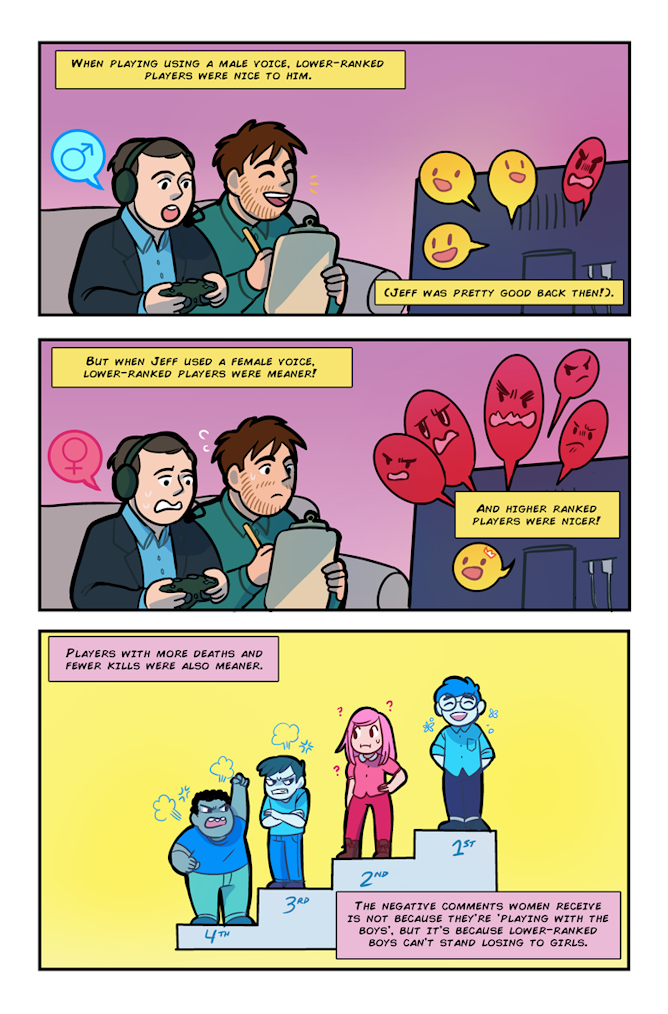
Next comes the fun part. By using a recorded male or female voice, we can see how players respond to teammates of each sex based on their own performance. Jeff played 126 games of Halo 3 using this structure. All the other speaking players on his team were men.
Gaming isn’t always relaxing, and sometimes that tension can spill over into harassment of other gamers. Maryam Abdulghaffar/Flickr, CC BY
What’s in a voice?
What we found was that Jeff’s teammates who died more often generally made more positive comments towards Jeff. And their performance, good or bad, had no effect on the number of negative comments they directed towards him.
In contrast, when Jeff used a female voice, he received many more negative comments, particularly from players who were performing poorly.
This suggests that men behaved according to a social hierarchy. When they were performing poorly – i.e. they were lower status – they did not challenge a male-voiced teammate, but they did challenge a female-voiced one.
This was supported by our results exploring skill level –- our proxy for an individual’s position in the hierarchy. Skill level didn’t affect how men behaved towards another man, but men lower in skill were less positive in the female-voiced treatment.
Interestingly, higher-skilled men were more positive towards women, but not men.
The predicted relationship of the number of negative comments male players made towards a female- or male-voiced teammate as a function of their skill level.
Who wants a beta male anyway?
The take-home seems to be that, just like bullies, the men most likely to have their position in a hierarchy usurped by a woman turned out to be meaner.
When you look at this situation from an evolutionary perspective, some of the reasoning becomes more clear. Since a man’s mating chances are better determined by his status than his looks, if a woman is usurping a man’s status by outperforming him, it means that he is less likely to be attractive to a potential mate, especially one that is higher than him in the hierarchy.
Although it’s unlikely that men are thinking about mate attraction when playing Halo 3, we think the increased negativity directed towards higher status women by some men is an unconscious response to having their masculinity challenged by a woman. “Losing to a girl” is still deemed unacceptable by many men as it can reduce their status in the eyes of others – both men and women.
The hostile aspects of gaming culture could thus be explained as the search for, and maintenance of, status. One way to ensure that a man doesn’t lose to a woman is to keep women from competing by making them feel unwanted in that environment.
Perhaps this perspective may also help explain the misogyny we see when women enter some male-dominated fields. The aggression may come from lower status men that are trying to keep women out by employing sexist bullying in order to ensure they don’t lose status in the presence of their male colleagues.
The one thing that is still quite intriguing is the result that the highly skilled men were more supportive towards women than men.
Are these nice guys behaving this way because they have nothing to fear and are applauding a woman’s entry into the field? Or is it because they have nothing to fear, for now. Would they become more aggressive if they felt threatened? Or are they comfortable in their ability that losing to a woman wouldn’t bother them.
These are questions we don’t know the answer to yet, but we’re willing to play a few thousand games online to find out.
Interested in reading the study in a different format? Then take a look at the comic below! Click on the preview to see the full page. Art by Savanna Ganucheau.
Michael and Jeff will be on hand for an Author Q&A between 10 and 11am AEST on Friday, July 17. Post your questions in the comments section below.
_This article is a part of The Conversation’s series on unique courses. For other articles in this series, read here and here. _
Today’s college students may benefit from an exciting array of subjects to study. But they seem to miss the most important education of all: how to relate their specialization to others in an increasingly interconnected world.
The National Academy of Engineering has categorically stated that today’s engineers need to be more than individuals who simply “like math and science.” They must be “creative problem-solvers” who help “shape our future” by improving our “health, happiness, and safety.”
And in 2001, the engineering accreditation body ABET added a new criterion so as to ensure that students get “the broad education necessary to understand the impact of engineering solutions in a global, economic, environmental, and societal context.”
The point is that the connections between humanities and science have been lost in today’s separation of disciplines. Indeed, a recent report by the American Academy of Arts and Sciences discovered that humanities and STEM (Science, Technology, Engineering and Mathematics) training majors largely dwell in different silos.
So, where and how did we lose our way? And how can educators and institutions change things?
If the interdependence of science and the humanities were more generally understood, men would be more likely to become masters of their technology and not its unthinking servants.
These founders, hailing from leading universities as well as the US Atomic Energy Commission, IBM Corp and New York Life Insurance, knew that connecting the humanities and sciences helps us make informed judgments about our control of nature, ourselves and our destiny.
Connecting the humanities and science helps us make informed decisions. Phillip Barron, CC BY-NC
But, since the 1980s, political rhetoric has emphasized the need for less humanities and more STEM education. STEM is painted as a more profitable investment, in terms of job creation and research dollars generated.
A notable example is the Obama administration’s “Race to the Top” initiative, which both isolates and prioritizes the STEM disciplines from the humanities, arts and social sciences.
This rhetoric is also evident in the creation of separate political education organizations such as the bipartisan STEM Education Caucus founded several years ago by congressional representatives to strengthen STEM education from kindergarten to the workforce.
This separation of disciplines actually hurts education, and it also hurts our ability to innovate and solve big problems.
Connecting STEM with humanities doesn’t just provide the well-rounded education today’s employers want. As the American Academy of Arts and Science’s 2013 “The Heart of the Matter” report observes, connecting these fields is necessary to solve the world’s biggest problems such as “the provision of clean air and water, food, health, energy, universal education, human rights, and the assurance of physical safety.”
So, separating and prioritizing STEM from humanities ignores the fact that we live in a complex social and cultural world. And many different disciplines must combine to address this world’s needs and challenges.
Bringing the disciplines together
To address this gap, four years ago the faculty from materials engineering and liberal arts at the University of Florida began working with the Materials Research Society. We wanted to put together a new course on “materials.”
Why did we choose materials? Because everything is made of them, every discipline studies them and they are tangible (quite literally) to the average freshman.
An interdisciplinary course on materials prepares students for the challenges of the future. Internet Archive Book Images
After all, grade school students still learn about the Stone, Bronze, and Iron ages. The Industrial and Information revolutions revolved around new uses for steel, aluminum and silicon. The human past has been shaped by harnessing and consuming materials and energy.
Materials will be important for our collective future as well. So, we thought, this is the future for which we should be preparing students.
And thus our course, The Impact of Materials on Society (IMOS), was born. Taught by a team of nine faculty from engineering, humanities and social sciences, the course explores the close connection between the “stuff” in our lives and our experiences as social beings.
Students discuss how materials benefit global trade and communication but also risk resource exploitation and political conflict. For example, we depend upon rare earths for our cellphones, iPads and wind farms, but accessing these rare earths from limited sources is not sustainable.
So, some of the questions that the course raises are: what materials do we depend upon in our daily lives? Does this dependence have social consequences? What social relationships form around the production and use of these materials? And how do our current uses of materials affect our ability to discover new uses for them?
Students also discuss the ethical and social aspects of using certain materials. college.library, CC BY
Students are also asked to consider how our values shape our willingness to adopt new technologies. For example, Earl Tupper may have invented Tupperware, but it was Brownie Wise and her home parties with other women who first made his polymer famous!
Each week covers a different material (eg, clay, glass, gold, plastic), its scientific properties, demonstrations, and its past and present impacts.
Working together in multidisciplinary groups, students then contemplate the development of future materials. These include flexible electronic materials that can be used to create wearable sensors that can transmit important information, such as body hydration levels during athletic training. New polymer (plastic) materials made from renewable sources instead of petroleum may have fewer health risks and are more sustainable than today’s plastic cups and bottles.
At the same time, they discuss the ethical and social considerations that might affect the successful production and adoption of these new materials in different contexts.
Gap in education
The course is different from other freshman-oriented courses. It is not a “history course for engineers.” And it is not an “engineering course for humanists.”
It is an interdisciplinary course that uses multiple perspectives to understand materials innovation. A wide range of departments including engineering, anthropology, classics, history, English, sociology and philosophy participate in its teaching.
Students refer to IMOS as a “bridge course” that provides the “connecting dots” between different classes.
And the responses come from students across the different majors. For instance, one engineering major noted, “This class just further proves that you have to understand different aspects of how our world works and not just engineering to be a great engineer.”
Meanwhile a history major observed, “This class gives me a leg up in my other history courses because it reminds me to think about the properties of materials and how they shape our lives.”
These experiences point to a gaping hole in modern education: discipline-specific and general education courses provide important knowledge, but “bridging courses” are needed for students to capitalize upon that knowledge.
To engineer useful technologies, we need to connect scientific study with the cultural competencies of the humanities and social sciences.
Challenges of 21st-century learning
The “Renaissance” ideal was to produce elite men whose broad training prepared them for any endeavor. Thankfully, 21st-century education is more inclusive.
But it still requires intellectual and cognitive flexibility to harness large amounts of data.
This doesn’t mean simply knowing everything, even though we live in the “Age of Google.” Today, students need the ability to make connections across disciplines.
Celebrated innovators such as Einstein, Ada Lovelace and Steve Jobs credit the intersection of disciplines for their inventive thinking.
More boundary-crossing opportunities in higher education can break open the disciplinary silos. And that alone will unleash critical thinking and innovation.
Additional contributors to this article are University of Florida faculty Sean Adams, Marsha Bryant, Florin Curta, Mary Ann Eaverly, Bonnie Effros and Ken Sassaman, and Materials Research Society Outreach Coordinator Pamela Hupp.
Fully 92 percent of American teenagers go online daily. More than half of them do so several times a day and a quarter are online “almost constantly.”
I’m a mother of two teenagers who fall into that latter category. And as a parent and a teacher educator, I work on ways in which we might capitalize on teens’ social nature and fondness for technology to promote something positive.
A question I wrestle with is: can social media help students learn? Or is it just wishful thinking?
Over the past decade, my colleagues and I at the Tarrant Institute for Innovative Education have worked with hundreds of middle school teachers to integrate technology with meaningful learning. Our research suggests that a one-to-one computing environment, where every student has access to an Internet-accessible device such as a tablet, netbook or laptop, can be a powerful complement to middle-grades teaching practices.
So, recently, one of our partner teachers explored the potential of social media to promote learning. Ryan Becker, a teacher at a public middle school, wondered if Twitter might be an effective way to extend classroom learning and to link students to “real world” science.
Working with 128 eighth graders over two years in his physical science classes, Becker first helped each of his students establish a Twitter account specifically for their science learning.
He provided them with a starter list of accounts to follow, such as the National Aeronautics and Space Administration (e.g., @NASA, @SpaceStation, @MarsCuriosity); the radio program Science Friday (@SciFri); Emily Lakdawalla, a science writer and blogger; and @realscientists, a Twitter account that rotates weekly among scientists from diverse branches of science who share interesting details about their lives and their work. He also encouraged students to expand the list of accounts based on their own science-related interests.
Next, students got down to some real work. Both during class and for homework, students were asked to read and tweet regularly about science. They posted pictures and videos to illustrate scientific concepts, such as “acceleration” or “friction.”
They tweeted about their learning, posting personal examples of Newton’s First Law and summarizing chemistry in a mere 140 characters. They tweeted about class projects in order to generate ideas or update others on their progress. And they used Twitter to inspire each other, such as posting videos of successful Rube Goldberg machines, a device that performs a simple task in a complicated fashion, when they were building similar machines in class and sharing their own personal connections and observations.
Based on this Twitter project with middle schoolers and Becker’s subsequent doctoral research with high school students, we found students learned through Twitter in multiple ways.
How Twitter helped students
First, selecting whom to follow based on their own interests helped to personalize the curriculum for students – an approach that is gaining rapid momentum through recent philanthropic and federal funding efforts.
Second, by tweeting about their daily science learning, students found an immediate and potentially unlimited audience for their tweets. Students who were interested in space, for example, could be followed by classmates or an astronomer. They could tweet questions directly to accounts covering missions throughout our solar system.
In almost all cases, the tweets reached a larger audience than was otherwise possible in a classroom.
Third, using Twitter expanded students’ literacy opportunities. For example, most of the tweets students encountered included links to science-related, informational text, such as blogs and research studies, all of which were related to students’ self-identified interests.
Having to distill their own learning into tweets also called for students to use concise language to convey complex ideas, a challenging skill for many. They even integrated different writing genres into their work, such as these sci-kus (haikus that are science-related).
Because tweets are sent and received instantaneously, students’ thoughts and questions could be viewed in real time. Learning how well students were understanding the latest science concepts in turn helped their teacher adjust how and what he taught next.
An earlier study by California State University researcher Carol VanVooren and middle school teacher Corey Bess showed that the use of Twitter helps improve student learning. In that study the researchers found that when teachers used Twitter to reinforce classroom instruction, students performed better on standardized tests.
Challenges of Twitter-based learning
Despite this promising evidence, our research on using Twitter with middle and high school students revealed a number of challenges.
For example, most students in Becker’s classroom did not have Twitter accounts, which was not surprising given that most teens favor Facebook, Instagram and Snapchat as their top social media platforms. Students needed guidance on how to structure a tweet and how to assess the reliability of content – both tasks that took time during the school day. Valuable learning time was also eaten up by the undependable nature of technology, such as inconsistent Wi-Fi and inadequate bandwidth.
Overall, however, our research found the benefits of Twitter far outweighed the drawbacks. Embracing Twitter as part of class – as opposed to teaching the type of stand-alone social media unit so often found in schools – helped students grapple with many of these issues in an authentic way.
Two years of survey data from the 128 eighth graders revealed that over 90 percent of students felt Twitter enabled them to follow real science in real time and to interact with others outside of class. This also helped them to make connections between science and their lives and personal interests.
Clearly, we need a lot more research on the use of social media in middle and high schools to better understand its ultimate potential for promoting learning. But in the meantime, in this media-saturated era, teens can benefit from the opportunity to experience the power of promising digital technologies alongside knowledgeable adults.
Transitioning into any sort of technology-based curriculum can trigger concern in parents for a number of reasons. Change is frightening, and watching your own children experience the world much differently than previous generations – through the lens of a smartphone camera and behind the screens of portable tablets – can be unnerving.
If and when parents come to you with questions about classroom technology, the best thing you can do is address their concerns and explain the reasoning behind your selections. Times are changing, and educators are finding value in technology’s ability to meet individualized needs. It’s important to stress that every EBook and computer lab and online lesson plan is meant to solve problems, not create new barriers.
Here are some of the most common questions parents ask about edtech along with the answers that help you control the conversation.
What’s the point? This is a loaded question. And it’s likely that a few blunt parents will ask you this directly and expect a logical response. Of course, like many questions below, the answer to this question depends on what edtech you’re implementing and the reason you’ve chosen a particular program. If you’ve noticed several students are struggling with long division, introducing a math program with AI-based software can help isolate exactly where students get lost. If kids are shy or uncomfortable asking questions, the software can help teachers get answers that their students just won’t give. It’s also important to remind parents that digital citizenship is more important now than ever before and instilling media literacy will help students thrive in an ever-expanding technological world.
Isn’t it just another distraction? Luckily, most edtech comes with filtering software to prevent kids from accessing social media and entertainment sites. Using iPads in a classroom setting feels counterproductive, but when students who’ve grown up with smartphones and laptops interact with them in school, they’re more likely to remain engaged for longer periods of time.
Can I monitor my child’s activity? Many edtech options come with features that allow parents to track progress as well as teachers. The software may include a teacher dashboard that parents can log in to while some programs are built on maintaining parent-student-teacher communication. If it doesn’t feel like there’s a clear option that allows parents to monitor their child’s online work, create a customized solution so that whatever you’re seeing as the instructor can be conveyed to every attentive parent.
Is privacy considered? Unfortunately, not all edtech is created equal. Before allowing students access to anything, ensure that the software they’re exposed to doesn’t have over-complicated privacy policies that request non-essential information or collect student data for commercial Educate yourself on security-related details so that when parents ask, you can acknowledge their concerns and explain every safety measure taken.
How much time per day is my child spending with tech? It’s important to stress that just because one aspect of the curriculum is technology based, that doesn’t mean kids are spending all day behind a screen. Technology in the classroom will always support the curriculum and shouldn’t interfere with kids speaking to educators and peers in-person.
Can kids access tech from home/will they need to buy devices? Sometimes tech is used solely in the classroom, at times only one device is required, and sometimes students need access to specific devices with multiple accounts from school and Whatever the curriculum, it’s likely yourself, and fellow administrators have taken district demographics into consideration to select an appropriate course of action. If parents are concerned that they don’t have the tools at home necessary to complete assignments, stress that resources will be provided or assignments will be altered for the student at hand. Technology in the classroom is meant to convenience and include students, not hinder or exclude learners based on their access to laptops and iPads.
Are kids trained properly? Yes! Teachers are trained on edtech tools beforehand, and with today’s generation of tech savvy Kindergarteners, it’s unlikely students will have difficulty picking up. Most edtech is specially designed for young kids and easy use.
What is the role of a teacher once edtech is implemented? It’s important to ensure parents that new programs are meant to enhance the lesson plans you’ve already implemented, not replace your job as an educator.
How will the school/you communicate with me? The great thing about most edtech software is that it includes ways for parents, students, and teachers all to communicate quickly and easily. Whether it’s a software that sends messages via text, an online discussion board or an automatic email debriefing a child’s progress, open communication will be easier and more transparent than ever before.
Will students still be writing by hand? Yes, students will still be taught to write and still have access to human It’s not 2084 just yet.
What tools will students be using? Edtech refers to a range of different possible activities and software systems. Because of this, provide students and parents with a comprehensive list and be prepared to speak about each tool’s benefits and basic structure. Refer parents to online tutorials and reference materials from the edtech distributor directly.
What is ‘adaptive learning’? Adaptive learning is one of the most remarkable benefits of implementing edtech. If a software system utilizes adaptive learning, the program changes instruction based on the student’s performance, customizing each child’s educational experience based on their particular strengths, weaknesses, and learning preferences. An issue many teachers and parents grapple with is ensuring that students who pick up quickly are challenged while students who need extra help are getting that extra help. AI-based edtech allows students to learn at an appropriate pace, maximizing each child’s growth.
If a tech tool has recently taken over your classroom, there will be parents with questions and concerns. It’s normal for parents to insist on knowing every detail of a new classroom initiative and it’s important to keep in mind that an attentive parent is better than one who doesn’t care about their child’s academic progress.
Embrace every question and stress that every classroom decision is made with each individual student in mind. Before you know it, parents will be signing up for online tutorials themselves. And getting off your back long enough to do so!



 However, based on the body of academic work that is currently available, we believe while it may be logical to allow online learning in certain circumstances, the cyber charter model is not the appropriate model. And the new education secretary Betsy DeVos might want to exercise caution.


 At present, we don’t have ways of thinking about, talking about or deciding on these balancing acts of freedom of expression and association online. In the offline world, people are free to say racist things to willing audiences, but suffer social consequences if they do so around people who object. As bots become more able to participate in, and exert influence on, our human interactions, we’ll need to decide who sets the standards and how, as well as who enforces them, in online communities.


 Because it is clear that the online environment is a moral terrain which requires successful navigation. By understanding how boulders such as moral disengagement can be avoided, we can help to create a safer and more even path for young people to negotiate.
 Teacher phone use: Teachers’ mobile phones should be switched off and left in a safe place during lesson times. If teachers are using their phones when pupils are banned from doing so, pupils may become resentful. Staff should not contact pupils from their personal mobile phones or give their mobile phone numbers to pupils or parents. This would help teachers maintain sound professional practice.



 Michael and Jeff will be on hand for an Author Q&A between 10 and 11am AEST on Friday, July 17. Post your questions in the comments section below.


 Additional contributors to this article are University of Florida faculty Sean Adams, Marsha Bryant, Florin Curta, Mary Ann Eaverly, Bonnie Effros and Ken Sassaman, and Materials Research Society Outreach Coordinator Pamela Hupp.


 Clearly, we need a lot more research on the use of social media in middle and high schools to better understand its ultimate potential for promoting learning. But in the meantime, in this media-saturated era, teens can benefit from the opportunity to experience the power of promising digital technologies alongside knowledgeable adults.
