Uncategorized

Michelle Obama announces education partnership with the UK

On a trip to the United Kingdom this week, First Lady Michelle Obama revealed that the United States and the UK will form a partnership “to improve girls’ access to education around the world.”

By way of CNN.com, the partnership will included $200 million in funding that will “support adolescent girls’ education.”

What’s even better is that some of the money will target areas impacted by war and domestic crisis situations, like the Democratic Republic of the Congo. That area, according to CNN.com, will “receive $180 million over five years, benefiting “more than 755,000 girls aged 10 to 18.””

The trip is part of the U.S. Agency for International Development’s (USAID) Let girls Learn initiative “that will leverage the investments we have made and success we have achieved in global primary school, and expand them to help adolescent girls complete their education” according to the White House’s website.

In addition to expanding the USAID’s work, Obama will work with the Peace Corps to expand the initiative’s reach by connecting “volunteers with members of the public and private sector to fund small, community-initiated, sustainable, grassroots projects.”

While we often gripe about the state of education in America, like k-12 funding, student loan debt, or the viability of charter schools, education in developing countries and war torn nations is obviously much worse than here in America.

Aiding those students, specifically girls, will contribute to the health and viability of their future, their long-term health, and those country’s economies.

Bowie State students create new project to help the homeless

Students at Bowie State University, a Historically Black College and University (HBCU), have created an app geared towards aiding the homeless.

According to the school’s website, students “developed an electronic kiosk designed to link people seeking the help of local shelters with up-to-date information about what is available in their community.”

The students presented their idea and model in Washington D.C. at the Capitol Hill Maker Faire, a festival that allows makers who use technology to show off their ideas and models.

The kiosk is made-up of “a mini-computer, wireless internet adapter and computer monitor.” This way those in need will have the ability to check for resources at local shelters and if those shelters have space available.

This project is targeted to those in need in Prince George County, “the second-most populous county in Maryland.”

While this model was created by students and only presented at the Maker Faire, hopefully such an innovative idea will receive more attention and possibly implementation statewide.

The idea surrounding the kiosk has the potential to streamline county, state, and federal efforts to help the homeless and those in need of temporary shelter.

This also helps Bowie State in the long-run as the university prides itself on being an educational destination for students interested in pursuing a career in science and technology.


Read all of our posts about HBCUs by clicking here.

Student reflection and data collection

**The Edvocate is pleased to publish guest posts as way to fuel important conversations surrounding P-20 education in America. The opinions contained within guest posts are those of the authors and do not necessarily reflect the official opinion of The Edvocate or Dr. Matthew Lynch.**

A guest post by Carol Miller

We all need to reflect.  What has worked; what hasn’t.  What do I need to remember to do again or what needs to be tweaked a bit.  I like to ask the students what they feel has worked for them and what they have liked.  I think we all do this, but it is a great way to collect data and measure the effectiveness of our program.

For me, I can’t believe the school year is over.  I thought the students did a great job with their video projects and STOP signs.  I also loved the stories we shared.  I wished we had more time for a few more crafts, but we packed a lot into our time together.  I do think there are a few lessons that next year I would try to do in a different room, and I realize that the boys want to do a boys only video.  I might have to create another Lunch Bunch just for video making.  It is a big hit, and the more we did, the more I was able to have students take over the filming and the planning.

This week I sent out several surveys to parents of my lunch bunch students and to our 5th and 6th grade teachers.  I also wanted their opinions as to whether they thought my programs offered any benefits to students.

For parents, I sent out a survey through google forms, and then emailed it to each parent.

I love that the responses come back in an excel spreadsheet.

Here are some of the responses so far:

My daughter befitted from the StarBound group My daughter enjoyed working with the other girls in the group. My daughter enjoyed working with the leader in the group. My daughter learned new skills and is using the skills in an out of school. I would recommend StarBound to other families. Additional Comments.
1 1 1 1 1 My daughter was new this school year and was shy. This program helped her come out of her she’ll. She has made many new friends and understands more about life as a girl. I can’t thank you enough for cracking my daughters shell and mind. I’m so thankful for this group!
1 1 1 1 1 This is a wonderful program. Our students don’t get enough of how to be a great citizen in our schools. It would be great if all students could go through this type of program.
1 1 1 1 1 Isabella told me about EVERY meeting and loved that special time and the activities Carol provided. It helped her feel more empowered and brought her closer together with her friends.
It was so beneficial!
1 1 1 2 1
1 1 1 1 1 I believe my daughters interaction in Starbound has created teacher led small group conversations/activities outside of the classroom allowing her to find common ground with classmates she may not otherwise associate with in her peer group.
2 1 1 2 1
1 1 1 1 1
1 1 1 1 1 Carol Miller is a great asset to Lansing School

I asked teachers the following questions:

  1. Is the student more likely to participate in class discussions or assume a leadership role in group activities?
  2. Is the student exhibiting more positive relationships with peers?
  3. Have you seen an improvement in good student skills–homework completion, studying for tests, etc?
I then collected data on grades, behavior referrals, and personal observations.
Over the next few days, I will have student surveys.  I will share those with you as well once they are completed.
Most of all, it is important to take notes and reflect on your own experiences.  I do this after each project I work on, whether it’s testing, Lunch Bunch, or scheduling.  It has been really helpful to pull out my folder and look back at my notes, so I know what I need to change or fix for the next time.  Sometimes, I need to start projects earlier, or fix a memo I will send out, or add something to a presentation.  Whatever it is, I know I will be ready thanks to my notes and reflections.
This post originally appeared on The Middle School Counselor, and was republished with permission.
___________________
Carol has organized School Counseling Conferences for several years in Central New York through TACA and has presented at these conferences on College Admissions, Best School Counseling Programs, and Sharing Counseling Resources. She is a member and past President of the Tompkins Area Counselor Association, and  a member of NYSSCA and NACAC, and NYSACAC. Carol is a mom to three sons, a crafter at heart, and a soccer and basketball coach in her free time.

After school shootings, students fare poorly in math, English


**The Edvocate is pleased to publish guest posts as way to fuel important conversations surrounding a P-20 education in America. The opinions contained within guest posts are those of the authors and do not necessarily reflect the official opinion of The Edvocate or Dr. Matthew Lynch.**

Louis-Philippe Beland, Louisiana State University and Dongwoo Kim, University of Missouri-Columbia

While school shootings have received widespread media attention, their impact on enrollment and student performance is not well-known. High school shootings can leave potentially damaging effects on both students and schools.

Could extreme violence in high schools hinder the ability of students to learn? Could it also influence their decision about whether to stay or change school?

As researchers studying the economics of education, we conducted a study on the effect of extreme violence in high schools in the United States. Our paper, now forthcoming at the academic journal Educational Evaluation and Policy Analysis, studies the consequences of both homicidal and suicidal shootings at schools.

Effect of high school shootings

We found that homicidal school shootings led to lower test scores in math and English tests. Standardized test scores in math and English went down by 4.9% and 2.9%, respectively, in affected schools.

We also found that enrollment in grade 9 (the high school entrance grade) decreased by nearly 6% following a deadly homicidal shooting.

We did not observe changes in enrollment for upper grades (grades 10, 11 and 12) the year after the shooting. This could be because students had formed their networks and connections by then. And the cost of transferring to another school was high in many ways.

Our estimates indicate that schools, on average, are highly affected when there is a homicidal shooting. The impact was more important in schools that were less affluent.

We found that the decreases in enrollment in grade 9 and in standardized test scores in math and English lasted up to three years after a deadly shooting.

However, we did not find any impact on behavioral outcomes: graduation, attendance or suspension rates.

We also found that suicidal shootings do not have significant impact on test results and enrollment, suggesting that murder at school leads to greater trauma.

Data sources

Here is how we collected our data:

Our data are taken from several sources. We collected data on shooting incidents from the 2010 School Associated Violent Deaths report from the National School Safety Center, a nonprofit that assists with safe schooling practices. The violent deaths report uses newspaper articles to track shootings at schools nationwide. The report covers shootings at schools between 1994 and 2009.

We matched this to the data on student enrollment per grade (grades 9 to 12) in the US from the Common Core of Data (CCD). As a program of the National Center for Education Statistics (NCES), the CCD collects all data on public schools, public school districts and state education agencies in the US.

In addition, we took information about students’ math and English abilities from each school’s report card and from data posted by each state’s Department of Education. A student’s ability in math and English is tested during high school using a standardized test.

Kids' scores drop after school shootings.
Doug, CC BY-NC-ND

Even then, one question that remained was whether students were really affected by shootings or whether our results showing a drop in test scores reflected the fact that good students do not enlist in the school after a shooting, a fact that decreases school test scores.

To answer this question, we got access to restricted student-level data from California and researched shooting incidents in Californian schools. We found that shootings have a negative effect on the math and English test scores of students who decide to stay in the same school.

We found that in California, the likelihood of students getting a satisfactory result in math and English dropped by 4.2% and 10.2%, respectively.

Future impact on kids

While we have looked only at the short-term consequences of school shootings, it is likely that these events have long-term consequences as well.

Several studies have shown how exposure to violent crimes could lead to depression and post-traumatic stress disorder (PTSD).

Studies have found linkages between a fatal sniper attack on a school playground and development of PTSD symptoms in kids. More recent studies have identified the negative effects of violent crime exposure on the cognitive performance of children.

Studies have also found that adolescent kids who had witnessed violence were also more likely to experience depression as adults.

Lower scores on math and English standardized tests could also have future consequences. These students might get accepted only into less selective colleges. And this might have a bearing on their future earnings.

Schools need to respond quickly and adequately in the event of a violent crime. They need to have crisis response plans in place. An adequate crisis response is likely one of the reasons that affluent schools do not see the same decrease in math and English test scores following a school shooting.

But more than that, school shootings should not happen at all. For this, it is important that our policymakers consider preventive measures such as gun control.

_______________The Conversation

Louis-Philippe Beland is Assistant Professor of Economics at Louisiana State University .
Dongwoo Kim is Postdoctoral Fellow at University of Missouri-Columbia.

This article was originally published on The Conversation.
Read the original article.

Adult Education Falls Short

**The Edvocate is pleased to publish guest posts as way to fuel important conversations surrounding P-20 education in America. The opinions contained within guest posts are those of the authors and do not necessarily reflect the official opinion of The Edvocate or Dr. Matthew Lynch.**

A guest post by Barbara Mader

Adult basic education is one of the best investments this country could make in its future, but this isn’t happening. Employers claim we need a better educated work force to compete internationally. One of the most effective improvements we could make to national productivity is a better educated work force. But more than 30 million adults in the US do not have a high school diploma (1).

We have fallen far behind the rest of the world in educating our children, and millions of them leave the free public education available to them each year with no goals or future plans. Spaces in adult education programs are increasingly filled by motivated individuals from around the world who are seeking a better life in the US. Instead of helping drop outs catch up, gain employability skills, and fill job vacancies, adult education programs are helping immigrants improve their English language skills, and gain job skills.

Twenty percent of high school graduates have only beginning literacy skills, which roughly parallel early first grade literacy skills. Adults with beginning functional literacy skills cannot read basic signs or maps, or fill out simple forms. They have few or no computational skills (2). They have little or no recognition of the alphabet and often connect little meaningful relationship between sound and symbol for decoding (reading) or encoding (spelling).

Beginning adult basic literacy skills roughly parallel second grade up through some skills expected of fifth graders. These skills include reading simple directions, signs, and maps with some difficulty, filling out simple forms, and mastering basic arithmetic computation. Individuals with basic literacy skills should be able to:

  • read and print letters,
  • write one, two, and some three syllable words,
  • perform basic alphabetization,
  • read safety warning signs,
  • write their name, address and phone number,
  • write basic messages with simple and some compound sentences,
  • and correctly use basic punctuation.

Beginning adult basic literacy skills is the level at which many adult education programs begin. These classes are referred to as ABE (Adult Basic Education) classes. Often, formal programs (frequently associated with community colleges and other educational institutions) contain several levels of instruction through which students pass as they gain skills. They then take the GED or other high school equivalency exam when they achieve the skills to pass the exam.

Public education fails

Clearly, the nation’s education system is failing to produce workers who can compete internationally at a basic level of job skill competency. A 2013 assessment of adult skills among 24 countries in the world placed US adults 16th in literacy and 21st in numeracy. While other surveys and assessments may have slightly different rankings, US adults are not coming out near the top on any list.

It’s not that public education is short spending on the school age population. The national average expenditure per pupil per year in public education is about $10,000. By contrast, the average spent per adult in an education program is about $800. Two million adults are served annually in a variety of programs through school districts, community colleges, faith based groups, workplaces, unions, housing developments, literacy volunteer programs, prisons, and other settings. Some programs (often those associated with academia) receive a majority of funds through state and federal grants. These programs tend to attract about two-thirds of their instructors from the pool of certified teachers or certified adult literacy instructors.  While paid, most instructors (except administrative personnel) are part time employees. Staffing of other programs may be largely volunteer and those non-credentialed in teaching pedagogy.

Regardless of credentials of the instructors, all 50 states have waiting lists for program enrollment, and public funding cannot come close to meeting the needs of adults seeking a GED or high school equivalency diploma.

Earning potential without a high school education is bleak. Three million students drop out of public school annually. In most states, the legal drop out age is 16, although this number is changing to 17 or 18 over the next year or two in some states. The three million drop outs join the population of 6.7 million young adults between ages 16-24 who are not employed or in any education program. Their earning potential is about $10,000 a year less than high school diploma or equivalency holders.

The earning potential for workers with some college increases by thousands of dollars, and a college graduates earns at least $17,000 more annually than a high school graduate (1). But the way to a college degree is paved through completion of a high school program or equivalency.

Who are adult learners?

Adult learners are a mixed variety of people.  Some are immigrants who may have a high school diploma or college degree from their native country but need the US equivalent for employment. Many of these people are English language learners who need both education skills and English classes. Some estimates place 20% of the US working population as immigrants by 2030. An increase in availability of English language learner classes is obvious.  Many ELL classes are available through adult education programs.

The working poor and unemployed comprise about two-thirds of the learners in adult education programs. The remaining third are people not in the labor force. Students include drop outs (now stay home parents) wanting to serve as role models and help their children with school work, non-working spouses, drop out teens living at home with no clear life goals, or older adults who never finished school. Included in the adult learner population are people who may have undiagnosed learning or emotional challenges trying to gain skills for a better life quality. Some are people seeking social connections, and some have an area of interest such as photography or art history.

African American students make up about 39% of adult learners (3). White students make up about another third. The remainder comes from Asian, Hispanic/Latino, and other non-white ethnic backgrounds.

The states with the most adult students are California, Florida, North Carolina, Texas, and New York. The District of Columbia, North Carolina, Utah, Arkansas, and Oklahoma have the highest percentages of students compared with total state population, while South Dakota, Nevada, Colorado, North Dakota, and Massachusetts had the lowest percentage per state population. The states with the largest 5 year increase in adult education enrollment are Vermont, Utah, Rhode Island, Washington, and Puerto Rico (not a state but statistics are included). The states with the largest 5 year decrease in adult enrollment are Delaware, South Dakota, Florida, Tennessee, and New York.

Students enrolling in adult education classes come from a wide variety of ethnic backgrounds, maturity levels, motivational bases, learning abilities, basic skill levels, life circumstances, and other challenges. While most programs are open to almost any student who walks through the door, statistics citing students served vary by state and federal criteria. These statistics drive much future grant funding for many programs. State mandates often are more rigorous than federal mandates. Some federal grant programs consider a student served who had met 12 hours of contact time with a formal program. These hours may include orientation programs and placement testing hours. Little or no instruction time may be part of the 12 hours. Service to the student is justified by exposure to information about available services and classes which may be accessed at a future time.

Other program challenges include major economic shifts, such as a recession. Many programs saw an increase in enrollment after the recent recession when jobs lost drove the unemployed to seek new or higher level job skills.

Overall, adult education programs benefit the population as a whole. They increase employability of adults, keeping many above the poverty level. They can reduce prison recidivism by up to 29% according to studies (1). They correlate to fewer chronic health problems, raise the tax base by billions, and provide adults with improved decision making skills. Education drives people further toward self-actualization. They encourage voting and civic responsibility. They promote education competency among children whose mothers complete a high school equivalency or GED program. They promote self-esteem and confidence.  They help people positively influence on their community, government, and the nation as a whole.

Changes that will benefit the national adult basic education system as a whole include:

  • Better high school retention programs
  • An increase of available adult education classes
  • Increased training for potential instructors, many of whom are not trained teachers
  • More funding to meet student needs
  • Streamlining the process for obtaining program funding
  • Better evaluation criteria for appropriate class placement
  • Coordination with community human services programs
  • Better pay and employment opportunities for certified instructors


All these improvements could be made at modest cost. Clearly ABE is an investment our country should make now.


  1. http://worlded.org/WEIInternet/us/adult-ed-facts.cfm
  2. http://literacy.kent.edu/Oasis/Workshops/facts/levels.html
  3. http://www.nrsweb.org/reports/fast_facts.aspx

___________

Barbara Mader is a retired teacher certified in special education, speech therapy, and as a Wilson Language Instructor. She taught special needs students in three states for over thirty years. She now tutors, blogs, edits, writes in eight categories for Examiner.com, and is developing a line of all natural non-chemical skin care products. As a hopeful novelist seeking an agent for her first romance adventure she wove together her love of gardening, ancient history, a little magic, and fairies. You can follow her online journalism work at http://www.examiner.com/user-bmader and her somewhat irreverent blog at http://barb-says.blogspot.com.

Insider analysis of ESEA: Congress may succeed in reauthorization

**The Edvocate is pleased to publish guest posts as way to fuel important conversations surrounding P-20 education in America. The opinions contained within guest posts are those of the authors and do not necessarily reflect the official opinion of The Edvocate or Dr. Matthew Lynch.**

A guest post by Derek Black

The Brown Center on Education Policy at Brookings hosted a panel of experts last week to discuss the potential for reauthorization.  They were generally optimistic.  Watch the panel here. They would also seem to be prescient.  On the same day of the panel, the House indicated it was bringing the Elementary and Secondary Education Act back to the floor.  The bill had previously died when warring factions within the Republican Party sought to load the bill down with their own ideology for reform and were told that if they voted for a stripped down bill it would count against their on conservative scorecard rating.  A new proposed procedural solution would allow them to save face.

A summary of the Brown panel follows the jump.

The two most significant laws governing education in this nation, the Elementary and Secondary Education Act (ESEA) and the Higher Education Act (HEA), are both well past due for a congressional update. ESEA was last reauthorized in 2002, with the passage of the No Child Left Behind Act, and the latest iteration of HEA was authorized in 2008. Despite widespread consensus that these laws need to be rewritten, every attempt at reauthorization in recent years has been met with failure.  Recent progress suggests that the current Congress may be poised to succeed where others have failed. But can Americans really expect new education laws this year?

On Wednesday, June 10, the Brown Center on Education Policy at Brookings took an insiders’ look at the efforts to reauthorize ESEA and HEA. Expert panelists who occupied key positions as legislative staffers during previous reauthorization attempted to provide an honest examination of the process, what led to success or failure in the past, and what’s most likely to lead to success this time around.

______

Derek Black is a Professor of Law at the University of South Carolina School of Law. His areas of expertise include education law and policy, constitutional law, civil rights, evidence, and torts.

Should teachers pay for apps?

**The Edvocate is pleased to publish guest posts as way to fuel important conversations surrounding P-20 education in America. The opinions contained within guest posts are those of the authors and do not necessarily reflect the official opinion of The Edvocate or Dr. Matthew Lynch.**

A guest post by Maria Constantides

I very often talk to teachers about online apps and great new tools and the standard question always is: “Is it free?’”

And of course it’s natural for teachers – who are amongst the world’s worst paid people for the amount and quality of the work they have to do – to look for free apps and tools.

Reasons?

On a UK pay scale, a colleague recently told me that they make 23 pounds an hour. In Athens, if you  have training and experience, you will be lucky if you make 9 or 10 euros – the average is 6 per hour while the official hourly rate is 4,5 euros per hour  for only 8 months a year; in the summer you can live off the sun and the sea and unemployment benefit of 300 euros per month  (for some people, not even that).

So if most of my better paid colleagues look for free apps, why would the low-paid colleague do anything different? Teachers look for freebies because

  • Their school won’t pay
  • They can’t afford to pay themselves
  • If it’s free, why pay?

So we all flock to the free options and use them, create accounts, create materials, until one day, the company goes bust and we lose everything!

Of course, the paying users lose even more!

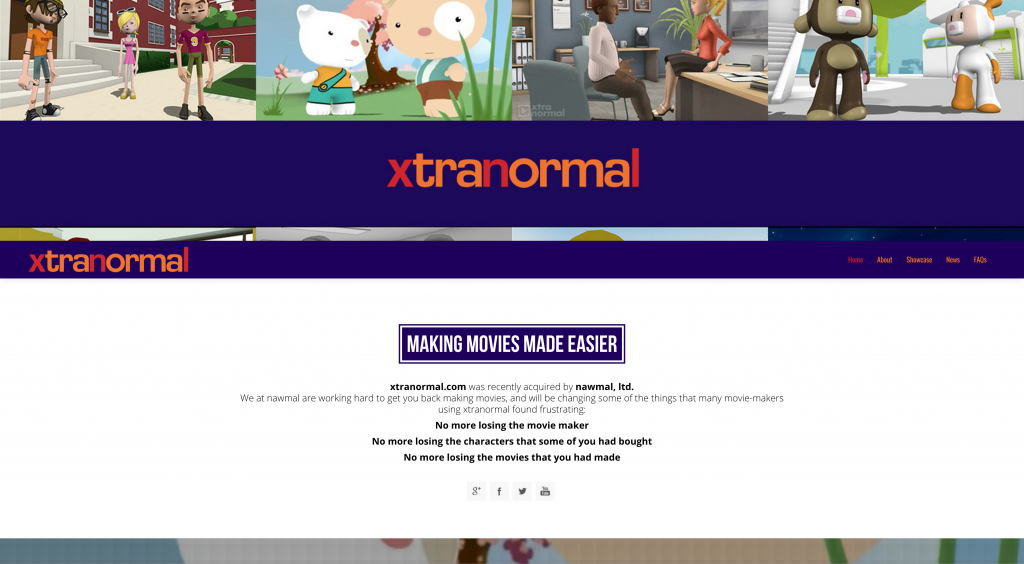
A typical example was one of my favourite online animation tools Xtranormal  I loved this app and used the free version along with thousands of other teachers, then started paying to buy more scenes and more characters and to have the option to download and save my videos!  Suddenly the company announced they were closing and loads and loads of teachers lost all their work.

This is what you can now read on their website, written by a team of people trying to resurrect the service: xtranormal

No more losing the movie maker

No more losing the characters that some of you had bought

No more losing the movies that you had made

So what are the going rates?

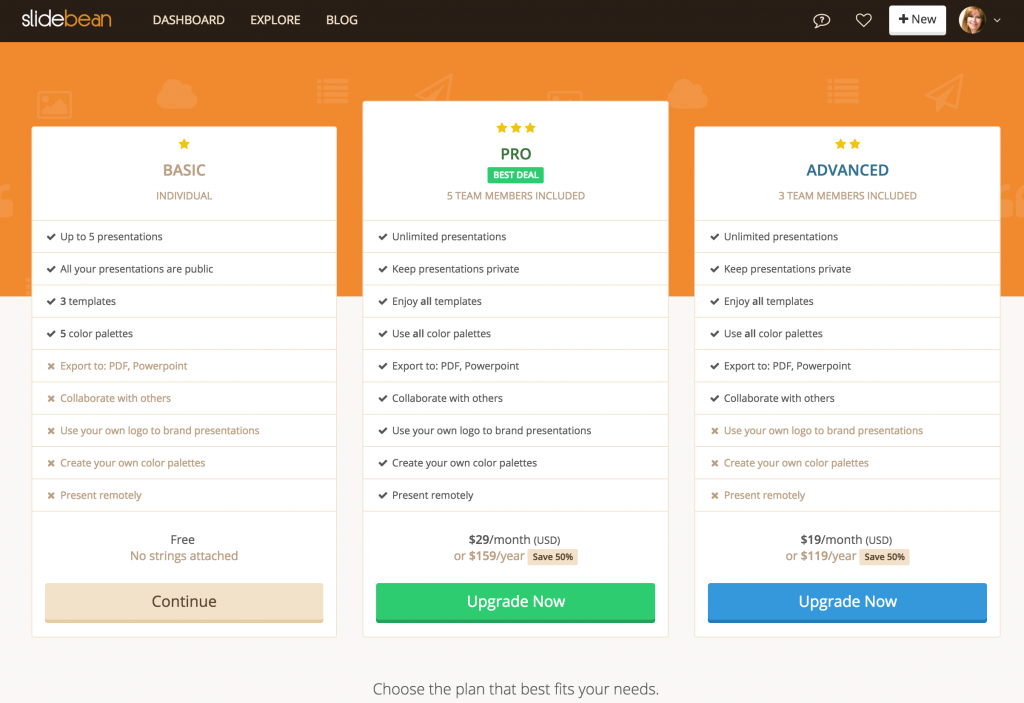
On the flipside of this, you have your average startup company which creates a great product or serivce and they offer a free plan for a limited range of presentations and one or two templates.

Pricing Slidebean

I believe most start ups think in terms of ‘Well, what’ 29 dollars a month? It’s not that much money!’  Or 19 dollars a month!!!

Well, I tell you that at the end of the day, if you pay for a few services like we do as a school, the bill at the end of each month is quite steep!!!!

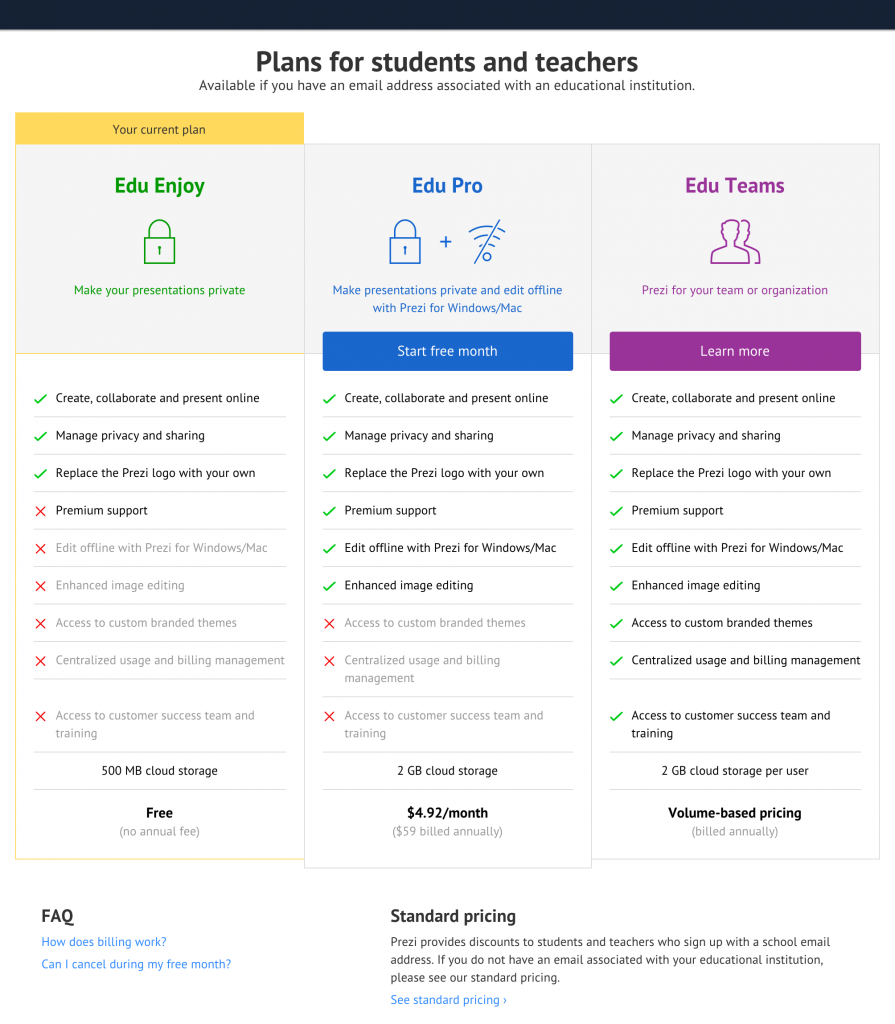
Compare this to the infinitely more versatile and original Prezi pricing plan and you will note the difference.

Of the two services, this is the one I would be more likely to pay for for this, and of course, other reasons, such as the versatility of the presentation templates, the desktop variation of a presentation which can be downloaded and played on one’s pc or laptop…

Pricing Prezi

Up to a couple of years ago, I used to pay a 29 euros per month subscription to Survey Monkey – when I calculated the cost of each survey I did using their services, it has cost me more than 300 or 400 euros!!!!

Google does it for free!!!!

One more example – my favourite screencast software – the famous Jing

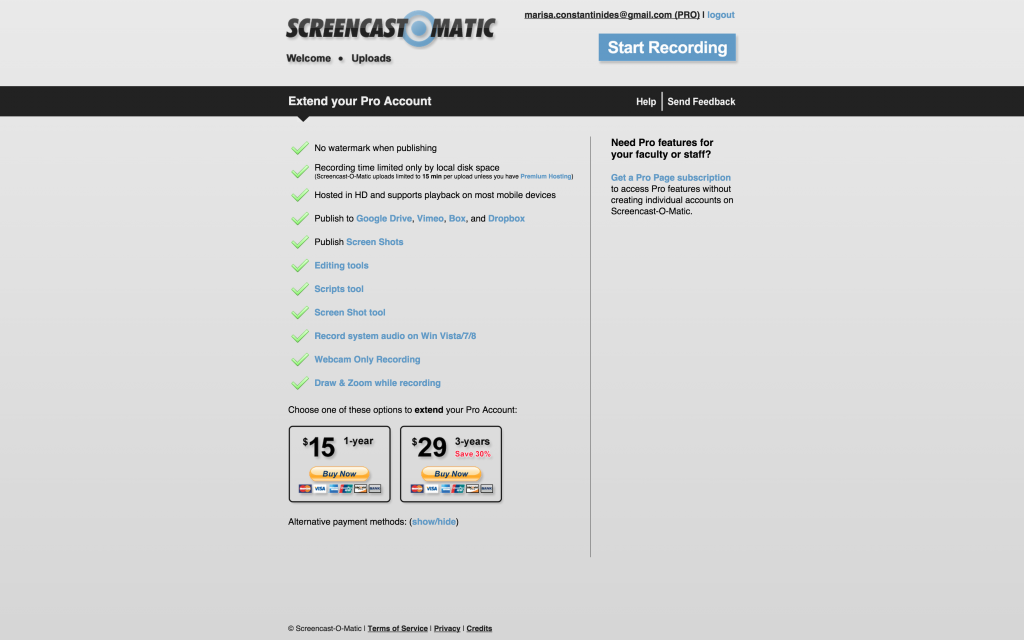
TechSmith Screencast.com online video sharing Plans and PricingCompare it with my OTHER favourite screencasting software, Screen-cast-0-matic

Go Pro Screencast O Matic Free online screen recorder for instant screen capture video sharing.

Compare two great screencast apps – Jing at about 100 dollars a year and Screen-cast-o-matic for 15 or under 10 if you go for the 3 year discount!

Apps

By contrast, most tablet  apps are much lower in price; for example, purchasing Microsoft Powerpoint for my iPad costs nothing, where you would have to pay almost 80 dollars US for the PC version. Keynote is now free but if you purchase an iPhone or iPad and even if you need to buy it is less than 20 dollars US – compare to powerpoint above!


Make the price right!

Make the price right, people! You can’t jump from nothing to 30 dollars a month – bring your prices down and you might get a lot more people paying!

You  let me have dropbox for free but if I want to pay, you ask me for 100 euros per month! 

Why would I pay that when Amazon asks for 70 a year for unlimited storage space!!!! Get real!!!! And OneDrive gives me 50 GB for free – Plus free online use of the latest versions of the Office Suite! 

This has happened to me time and again! I am willing to pay to keep my content safe but prices are too high – so I will keep going for the free versions for as long as I can.


P.S. Just like governments would make more money if they lowered their taxes – but greedy so and so’s that they are, they keep losing more and more money every year!!!!!

This post originally appeared on marisaconstantinides.edublogs.org, and was republished with permission.

____________________

Marisa Constantinides runs CELT Athens, a Teacher Development centre based in the capital of Greece, and is a Course Supervisor for all courses, including the DELTA Cambridge/RSA Diploma, the Institute of Linguists Diploma in Translation and off-site seminars and workshops on a variety of topics.

Pull Your Own Weight: An open letter to Michelle Obama regarding childhood obesity

**The Edvocate is pleased to publish guest posts as way to fuel important conversations surrounding P-20 education in America. The opinions contained within guest posts are those of the authors and do not necessarily reflect the official opinion of The Edvocate or Dr. Matthew Lynch.**

Changing the Default vs. Changing the Strategy

A column by Rick Osbourne

Dear Mrs. Obama,

Please allow me to start by saying that I applaud all the time and effort you’ve invested into the issue of childhood obesity prevention and rehab. Had you not done so this epidemic would still be inflicting its damage on millions of kids below the media’s radar. You’ve changed that. But as you readily confess, the job is still a long ways from finished.

That said, in my view, conventional agencies (including the US Center for Disease Control, American Medical Association, American College of Sports Medicine, American Academy of Pediatrics, Robert Wood Johnson Foundation, Let’s Move, The Alliance for a Healthier Generation, etc.) who endorse the strategy known as The Environmental Approach to Obesity, represent a systematic obstacle that continually undermines your valiant efforts.

This strategy is based on the premise that people, and especially kids, are passive reactors to their environment. It treats kids collectively (not individually), as if they are nothing more than lumps of clay being molded and shaped by their environment. But it fails to take into account that kids (who are each faced with decisions and choices to make every single day of the week) are also pro-active molders and shapers of their own lives.

To demonstrate, let me point to an exchange I had recently with a member of one of these agencies. I posed the following questions and received the following answers.
Q – By starting young, before the obesity seed takes root, and helping kids learn to physically pull their own weight (which they genuinely love to do) kids not only systematically turn the tide on childhood obesity, but the documentation would be 100% concrete and tangible as opposed to mushy surveys about what people think about whatever.

The bottom line is that this intervention works. It can be applied systematically. And there’s not a school or youth program in the nation that’s unable to afford to implement it. As I said when we spoke, I want to avoid wasting anyone’s time. So, with these considerations, I’d like to know if you think our functional intervention fulfills your criteria.


A – Thanks for providing more information on the program. Our group funds research studies and evaluations of policy and environmental change and does not fund studies focused primarily on individual behavior change. While the intervention you propose may be scaleable to schools or youth programs, it is still focused primarily on changing each child’s individual behavior and therefore, unfortunately, it doesn’t seem to fit within the scope of this CFP.


Q – Although it’s been explained to me on a number of occasions, the logic of the “environmental approach” still escapes me. It seems that regardless of how anyone addresses the obesity problem, in the end they’re still trying to impact the behavior of individual human beings. After all, the US is made up of over 300 million individual human beings, a third of whom are apparently obese. By any chance can you square that round peg for me?


A -Ultimately we do want to change individual behavior, but how we change that behavior is through environmental change. For example, if you change the school food environment so that there isn’t any junk food available to students, the students will most likely eat the healthier food that is available. In the nutrition field we call it “changing the default” to one that is healthier and promotes healthier behaviors.


Another example is changing children’s menus in restaurants so that they provide milk instead of pop and apples instead of fries. Parents can still choose to purchase the unhealthy options, but because the “default” is healthier they will likely choose it. While education is indeed very important, our program focuses on a higher level (policies and environments) so that the change can impact more people.


Q – While I agree with the “changing the default” strategy, my contention is that the changes can be increased/improved dramatically and systematically by also addressing the problem from a functional perspective. So why not combine “the passive, environmental approach” with “the active, functional approach” and save millions of kids the trials and tribulations of living their lives in a state of obesity?


Venturing Outside the Box?

For the record, I received no answer to this last question. However, as I indicated, despite the fact that the environmental approach is extremely complicated (multiple culprits), expensive (many billions) to implement, and time consuming (at least a generation to resolve), I tend to agree with its logic, with its theory? On the other hand, as Yogi Berra once pointed out, “In theory there’s no difference between theory and practice. But in practice there is.”


And in practice, the environmental approach has fallen excruciatingly short of the mark for over two decades now, while the epidemic rages on. So why not venture outside the box? Why not try something new and interesting? Why not combine the environmental approach with a strategy the American Society of Exercise Physiologists describes as “A simple, easily implanted, easily documented, and affordable solution to childhood obesity?” It works. It’s cheap. It’s systematic. You’ve got nothing to lose and everything to gain. I for one say, LET’S MOVE!!


Sincerely,

Rick Osbourne

Pull Your Own Weight Foundation

Naperville, IL


______________

Rick Osbourne is a former physical educator and a pioneer in the field of functional childhood obesity prevention. He currently serves as President of the Pull Your Own Weight Foundation which is an Illinois based, 501c3, not for profit organization whose focus is functional childhood obesity prevention. He’s written and published three books in this field, the latest of which is entitled Beating Childhood Obesity Now: A Simple Solution for Parents and Educators. He’s the Examiner’s national childhood obesity prevention correspondent. He writes an online column for The Edvocate. And you can connect with Rick via Twitter, Linkedin, or Facebook.

Using Time to Improve Student Performance

Proponents of a year-round school year suggest that a shift in the time designated for teaching and learning will help students achieve more by minimizing summer learning loss, allowing for innovation and implementation of creative programs. It also provides the time needed to assist children who may benefit from the extra help. Many school districts around the country are in fact working toward increasing both the hours in each school day and the number of days schools are in session.

Many education leaders are open to the idea of increasing the number of days per school year up to an additional month, and some support year-round school programming. Some leaders suggest an extended school day and/or school year for schools that are failing to perform well. This suggestion seems to have some foundation in research. Data shows that certain groups (including students from low socioeconomic backgrounds) are negatively impacted by the traditional summer hiatus. The proponents of year-round schooling claim that with extended time to teach, teachers will be able to help all students attain better performance results.

It is easy to understand why education reformers put so much emphasis on time spent teaching and learning. Research shows that time may be the most essential resource of the education system. However, it is important to recognize that merely increasing the amount of time students are in school is not a panacea for improving student performance. It is necessary to utilize the available time in the best possible manner. If teachers fail to convert the available time to quality teaching and learning time, the increased school hours will not improve student performance.

Parents have a stake in school hours as well. Some parents are already concerned with their children’s academic progress, and thus prefer to employ additional educational services for their children that may offer better after school educational opportunities. Still other parents prefer to spend their own time educating their children after school. In these cases, the idea of increasing school day hours may not be supported by parents of students from affluent backgrounds, and may not be necessary. Still, by increasing high-quality education time, schools can provide help for students who cannot afford learning opportunities outside of school.

While there are many positives of a longer school day or year, there are also a number of concerns. Cost, for example, is an issue that must be considered. Increasing the number of hours and days in school can prove expensive since there are personnel and facility use issues that must be taken into account. This leads some educators to believe more emphasis should be placed on increasing the utility of available school time.

Some education leaders suggest that instead of increasing the hours and days in a school calendar year, it would be better to spread out the available number of school days in such a manner that the school services may remain available for the students throughout the year. This might mean offering three short breaks rather than one long summer vacation, or simply offering various classes or tutoring programs during the summer downtime. Either way, this will add up to increased costs in facility usage and likely increased staff costs as well. Despite some perceived negatives and specific issues that would need to be addressed, the idea of year-round schools is continuously gaining support in the United States.

Understanding Parental Involvement

When we discuss parental involvement in schools, we often concentrate on ways in which parental involvement can help schools perform better and how parents can help their children excel in learning. It is a well-known fact that parental involvement can help students achieve success in school; however, it is difficult to measure how much parental involvement is required of parents in order for them to help their children to improve their learning skills and performance.

Parental actions that obstruct the learning process and other educational goals are equally immeasurable. Comprehending the impact of parental involvement requires understanding deficiencies that reduce student performance, and providing parents with tools to diminish their effects. This same principle applies to understanding the ways that schools can encourage parental involvement in low income communities. Situations like these necessitate sensitivity to ethnicity, race, religious affiliation, linguistic challenges, single parenthood, and familial characteristics.

Parents are often influenced by their ethnic background when trying to help their children improve academically. It is imperative that school personnel understand the importance of the family’s cultural characteristics in the educational process. Schools should structure parental involvement programs that take advantage of the strong qualities individual parents bring to the schooling process, as a means for promoting improved relations between parents and the school. Interactions between parents and school personnel are meant to provide information and assistance to both the school and parents.

It is important to monitor how parents act on the instructions, information, and advice offered through such programs. Due to various cultural differences, some families may succeed in obtaining the maximum possible benefit of such interactional programs, while other families may fail to utilize these opportunities. Another factor to consider is the possibility of conflicts between parent’s cultural and linguistic background, and the social, linguistic, and cultural values existing in the school.

Schools often promote common ideals of a capitalistic culture, and, in doing so, present the impoverished, minorities, the disabled, and immigrants, as inferior. The success of parental involvement programs often depends on reaching parents living within different political, economic, cultural, and social realities. In order to help parents make better use of parental involvement programs, it is necessary to attend to these differences, and incorporate ways to meet the varied needs and expectations of parents within the parental involvement program.

The success of parental education and involvement programs depends on the ways parents can make use of their social, human, and financial resources to help their children perform better at school. Parents can also help their children improve their learning skills by providing attention to their children’s studies and participating in meaningful collaboration with school personnel and authorities. Historically, schools have played a major part in improving social conditions. Collaboration between schools and parents can help alleviate the challenges facing students who are living in families that have a lower socioeconomic status.

Policy makers must realize the importance of public schools and their role in facilitating the prosperity of our nation. Federal and state agencies have initiated various programs to improve the relationship between schools, parents, and communities. In order to increase parental involvement and reduce barriers that restrict parents from participating in the education system, it is essential to offer parent education for impoverished parents or parents with disabilities, so that they may learn better ways to boost their children’s learning skills.

The value of parental involvement programs has been well established. Effective parental involvement programs are best achieved when the program originates with the study of the school community, and then proceeds to develop instruction, and provide advice and information that reflects the circumstances, needs, and potential contributions of families who are a part of the school community.

Schools must be prepared for the fact that one outcome of effective parental involvement programs will be the desire of parents to become partners in the decision-making process existing in schools. Thus, school personnel must possess a genuine belief that shared responsibility for multiple aspects of the educational enterprise will result in improved learning environments for children and youth.