For teachers who are just getting started with Google, Google Drive can be intimidating! In preparation for a Google training, I’ve put together a short explanation of Google Drive and its basic features. Although an increasing number of people have a Gmail account, I run into teachers all the time who are not sure what Google Drive is or how it works.
Google Drive is like a big virtual bucket! It’s where everything you create with Google apps–documents, forms, sheets, slides, drawing–are stored. And unlike a traditional word processing document, you never need to click “Save”…EVER. Your work is automatically saved every 5 seconds (or so).
Google Drive comes with 15 GB of free storage, so you can save files, photos, and videos. You can access any file in your Google Drive from any device as long as you have internet access. This means you are no longer tethered to a piece of hardware. You can open, edit and share files from any device that can get online.
For those with unreliable internet access, you can also install Google Drive onto your devices and work offline. Then when you are back online, your devices will sync and store your work!
Here are some screenshots to help you navigate your Google Drive.
Organize your files in whatever order makes sense to you. You can limit your view to the files you’ve created, the files that have been shared with you or the files that have been most recently edited. This makes it easy to locate the files you’re looking for.
Click on a file or folder and check out the “More actions” icon (3 vertical dots) to manage your documents more easily.
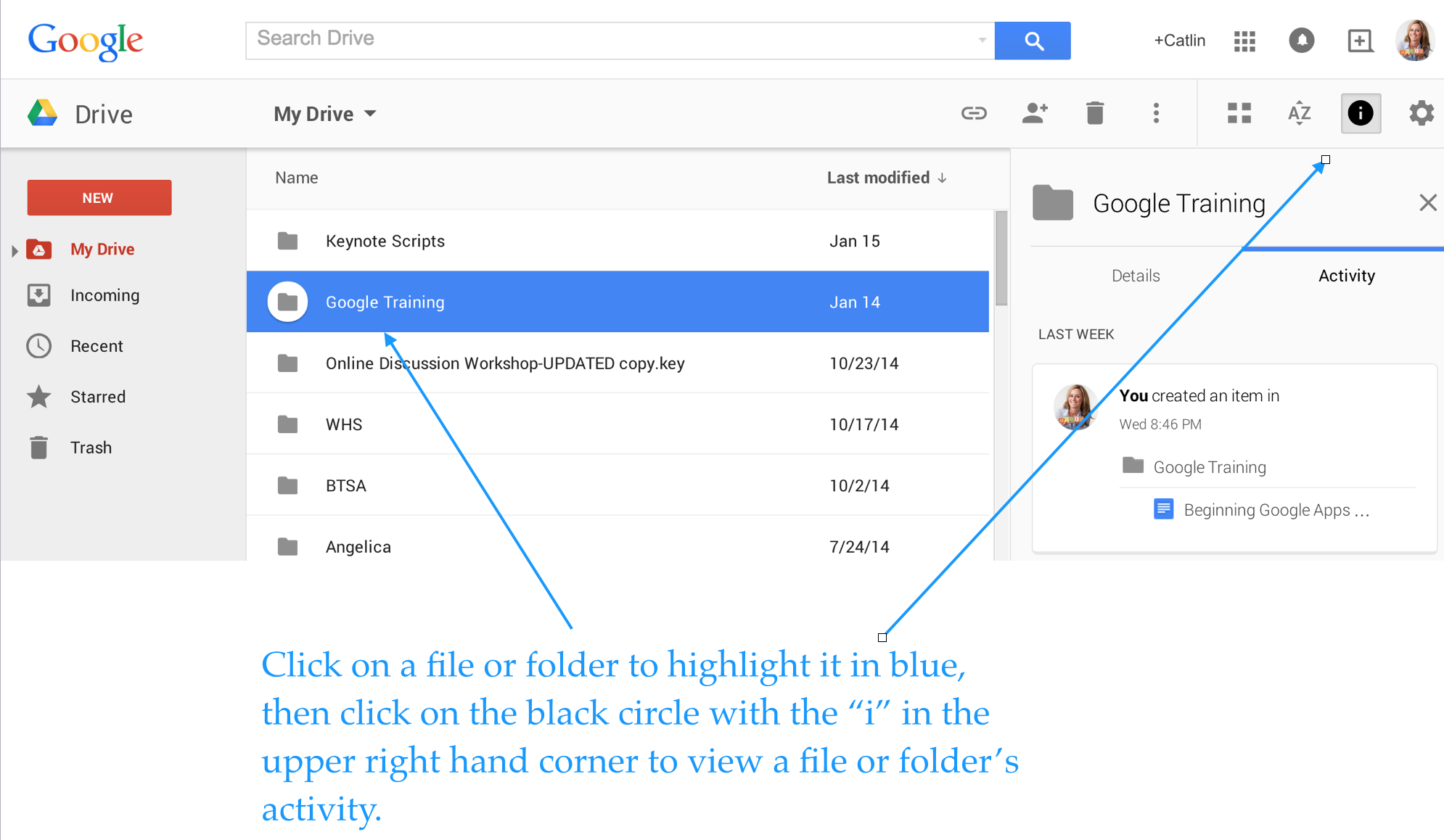
Enjoy total transparency with the “View Details” icon (black circle with the letter “i” in the middle). Simply click on a file or folder and see all of the activity associated with it. You can see when documents were created, when they were edited, and who edited them!
Last, but not least, you can insert files, photos and videos directly from Google Drive into your emails.
If you use Google Drive and have tips to share, please post a comment!
Executive Function is a term given to a variety of cognitive processes (organization, working memory, ability to initiate tasks, switch focus or manage one’s behavior) that allow students to learn and achieve goals. For some students, however, their level of executive function may interfere with their ability to succeed in school. Thankfully, teachers are beginning to recognize the need to develop a child’s executive functioning skills rather than label the child, “lazy” or an “underachiever”.
To support the development of executive functioning skills, I have created a list of 10 simple tools that teachers can use or have in the classroom. Please keep in mind, that students may require the teacher to explain and model the use of each tool. In addition, on-going adult support could be needed to support the successful use of each tool.
1. Timer – a timer can be used to help students in a variety of ways. It can be used to help a student initiate or finish an assignment. A timer can keep pace and prepare a student for transitions. Whether on the classroom wall or at a student’s desk, timers are a very useful tool to assist student’s in monitoring his/her performance.
2. Class Calendar – a calendar gives us the ability to predict an event. When a teacher creates a calendar for the day or month, it gives students an opportunity to both physically and mentally prepare in anticipation. In doing so, students are better able to transition from one activity to another.
3. Checklists – the primary purpose of a checklist is to clearly outline the steps needed to achieve a goal. Checklists can be created and used in a variety of ways for students. They can be made to set goals for the class or for an individual. Checklists can support a student’s ability to manage tasks and make transitions.
4.Color-Coded Workbooks – color-coding books can be very useful for students who are visual learners. By “chunking” subjects or learning materials by color, students can remain organized and retain information in a manageable way. Colored folders, stickers, book covers, bins, felts can help students group important, relevant items that they need for a particular subject.
5. Highlighter – highlighters emphasize parts of text, which can be very useful for helping learners develop their working memory skills. Highlighters can be used to draw attention to directions, important words or text with specific meaning.
6. Class Master Binder – keeping a Master Binder in the classroom is probably one of the most helpful strategies a teacher can use. A Master Binder consists of a copy of any hand-out or worksheet given to students. Not only is it useful for absent students who can refer to missed work when they return, but it is helpful for students who need to develop their organizational skills. It allows students to cross-check paperwork and keep track of class assignments.
7. Supply Storage Caddy – students need one place to keep their supplies. Whether it is a pencil box, desk caddy or pencil case, students need a spot to keep pencils, erasers, glue and scissors together. Not only does this help a student transition between activities, but it cuts down on the time it takes for a student to initiate tasks. I can’t tell you how much learning time can be wasted by a student who is looking for a pencil!
8. Graphic Organizers – graphic organizers are visual pictures that help organize information. Graphic organizers can be used in a variety of ways, for a variety of subjects to support the development of working memory. They can help students collect their thoughts, create and convey ideas as well as draw connections.
9. A Large, Laminated Envelope – this envelope can be designated to facilitate and support the home-school connection. Newsletters, forms and flyers can be put into the envelope and sent home for parents to see. Likewise, parents can use the envelope to return notes and permission slips. It is a simple, yet effective way of keeping all those important bits of school information in one place!
10. Student Day Planner – adults will often use planners to keep track of important dates and events, so why shouldn’t students (who seem to have even busier schedules these days)? The use of a day planner not only keeps the student organized, helps with task transition, working memory and self-regulation, but allows the student to track his or her goal completion and achievements.
By putting more money into early childhood education in Detroit, the crime rate would go down, according to a recent study.
Jose Diaz of the Amherst H. Wilder Foundation conducted the study”Cost Savings of School Readiness Per Additional At-Risk Child in Detroit and Michigan” where the findings appear. The research was commissioned by the Max M. and Marjorie S. Fisher Foundation and it suggests that investing in early childhood education could cut Detroit’s crime rate and save taxpayers in the state millions of dollars, according to a story on the study by The Detroit News. The story says that Detroit taxpayers would save around $96,000 for each child who was enrolled in a quality early education program and Michigan taxpayers would save $47,000 for each child.
The figure was derived from adding cost savings to special education, public assistance, childcare subsidies, the victims of crime and the criminal justice system. The majority of the savings would come from the criminal justice system.
These findings prompted Diaz and law enforcement officials to call on the Legislature to invest more dollars in early childhood education to help halt the alarmingly high crime rate in Detroit.
At the present time, only 4 percent of prisoners in Michigan under the age of 20 years old graduated from high school.
Learning begins at birth, which is why early education programs are so important. These programs provide an integral foundation for young minds and prepare children for success at school and in life. At-risk children who don’t receive high quality early education are more likely to drop out of school and more likely to be arrested for a violent crime.
I think investing in early childhood education programs is a cost-effective way to promote positive development of children and get to the root causes of high crime in the city. I hope that Detroit can see early childhood education as an initiative that could finally pay off and cut crime.
**Editor’s note – These tips are applicable to teachers too, as educators face the challenges of teaching kindness in K-12 classrooms**
Kids and teens can view of themselves as powerless in a world where adults call all the shots. But that’s not the whole story. Kids have power. And every day, your children and mine get opportunities to use that power to do good or to do harm. Sometimes, turning a blind eye and choosing to do nothing results in more harm.
If we truly value kindness and appreciate it when it comes our way, we can’t ignore suffering. We’ve got to do our part to keep kindness alive… every chance we get. And we’ve got to teach our kids to be kind. But how?
Child or adult, it takes extra social courage to exit our comfort zone and to help a vulnerable person. When kids ask me about standing up for someone who is being harassed, I tell them they should never put themselves directly in harm’s way. But I make it clear that there are many ways to help an underdog and let him or her know: “I’m not like the others who are giving you a hard time. I’m here to help.”
Fuel for Thought (for adults) —At different times we have all been underdog, top dog, and middle of the pack dog, so we know what it feels in each of those places. Being on the bottom, without support, can be terribly lonely. Think about a time when you felt like an underdog. Where did you turn for support? What response did you get? Think of a time when you helped an underdog. What happened?
Conversations That Count (with kids)– Talk about the concept of a “pecking order” among animals and humans. Say this to your children: “Most of the time, when we’re not on the bottom, we don’t give much thought to those who are.” Now ask your kids what they think about that. True? Not true? How do you know? Talk about who is “on the bottom” in your child’s class. (Even kids as young as second or third grade have a keen awareness of social strata.) How do other people treat that child? How do you treat that child? What might happen if you stood up for the underdog?
Teach—Challenge your child to be a hero and shake up the social strata at school by standing up for someone who needs a friend. Follow up and find out from your child what happened with the challenge.
Please let me know how you teach your kids and students about the importance of standing up for the underdog.
_____
Annie Fox is an internationally respected parenting expert and family coachwho empowers parents with the special support, leadership skills, and practical tools needed during our children’s tween and teen years. Her books include The Girls’ Q&A Book on Friendship and Teaching Kids to Be Good People.
I work in a small rural school district as a school counselor. Lansing, NY is a great place to raise children. It’s peaceful, it’s quiet, it’s close to many great colleges, and the school district is great. Since the incident at Sandy Hook last year, there has been a focus on safety. We now have a greeter at the front door to sign in visitors and check in on who they are here to see. All doors except the front door are locked during the day, and doors now have swipe cards and staff carries their ID cards with them during the day. We practice lockdown drills in the event of an emergency. We send letters home informing parents of any suspicious activity on or near campus. Recently we sent home letters informing parents of a pickup truck driving past the schools attempting to lure students close to it asking for help and directions. We have improved our attention to potential security threats, but do our children feel safe? Do they feel that we are able to protect them in the event of catastrophe?
I run several weekly Lunch Bunch groups. The 5th and 6th grade students who are a part of these groups eat lunch with me and we talk a lot about friendship, peer relationships and bullying. On more than one occasion this year, students have talked about bullying and related it to school shootings. “You need to help someone who is being bullied, because if you don’t they can hurt so much that they bring a gun to school.” Kids have really related being victimized repeatedly by being bullied with the need for revenge on the bully. Oddly enough, however, this comes with a matter of fact feeling and not with a feeling of being scared.
A fellow school counselor in Massachusetts told me about a recent incident in her urban elementary school. Last Friday she had an incident with a 4th grader. This little boy, who has a tendency to misunderstand other people’s actions, felt that the kids in his class were laughing at him. This taunting escalated into an outburst about how no one likes him. She told me, “Another student was holding a calculator and said something about making it into a bomb. The upset boy then said, “Yeah, I’m going to use this calculator to blow up the school. I hate you all!”” This statement created an explosion, but reactions from her administrators was strong and immediate. Kids and some staff were extremely nervous. “I had to speak to two classes to reassure them that they are safe at school. We talked about how a lot of times people say things that they don’t mean when they are very upset and don’t know how else to communicate that. Most of the kids were okay after that, although handfuls were back in my office to say they still felt unsafe when the boy returned to school. A couple of them verbalized that they believe the kid might do something because one time he hit a classmate at recess. They took this as evidence that he’s a violent, unpredictable person capable of almost anything.”
Another counselor friend at a school in Goshen, Indiana, shared with me an incident during a lockdown drill at her school. “My office has one exit, the door. I have no windows to the outside. At the time of the drill, I had a 7th grade boy in my office.” She described the boy as a tough guy; a real Mr. Joe Cool. “Using the light from my cell phone, we navigated to the back corner of my darker than dark office, behind a bookcase and the junk I had stored there. We were supposed to be silent, no talking. As we sat there in the eerie silence and the seconds ticked by, the boy began to ask me questions. “Ms. D-M, is this a drill?” “Yes,” I whispered. “Ms. D-M, what would we do if someone came in our school with a gun?” “We would do everything we could to protect you, Student X”, again I whispered. I then reminded him we needed to remain silent and he said “okay”. A few seconds later, “Ms. D-M, what if someone came to the door right now, what would you do?”…and the questions continued. I could hear the concern in his voice; I could hear the fear. I could not remind him to remain silent. I had to answer his questions because I had to allay his fears.”
Times have changed in my 20 plus years of being a school counselor. When I first began working in schools, students did not talk about school shootings. They didn’t even think about it. I worked in a large urban district back then, and we had a security guard, but it was to prevent fights from happening. Back then we were concerned about people’s fists or verbal attacks. We weren’t concerned about guns. Sadly today, while it may not be everyday, the thought of someone bringing a gun to school is a very real concern for students. So, when you ask the question, “Are shootings in the back of their mind?” the answer sadly is, “Yes.” We live in an era where safety, concern, and fear have stolen a bit of the innocence from our youth.
—–
Carol Miller is a certified school counselor with 20 years of experience throughout grade levels. She writes the blog The Middle School Counselorand you can follow her on Twitter at @tmscounselor.
Education is the single most important asset when it comes to equal Civil Rights, according to First Lady Michelle Obama. She made the remarks while addressing guests at the White House celebrating Black History Month — specifically celebrating the women of the Civil Rights movement. Mrs. Obama highlighted powerful women like Charlayne Hunter-Gault and Carlotta Walls LaNier who both faced the national spotlight for wanting an equal education during the height of the Civil Rights movement.
“Thanks to their sacrifice, there are no angry mobs gathering outside our schools. Nobody needs a military escort to get to class, but that doesn’t mean that our children don’t still face struggles when it comes to education,” said the First Lady, as reported by the Associated Press.
She went on to say that quality education is the “single most important civil rights issue” of contemporary society, crediting her own education to her successes in life.
The First Lady seconds what I’ve long held to be a truth: inequality for Americans starts in our K-12 schools. The students with more resources and access to educational opportunities fare better in life. This is not to say that any one of our students is a lost cause, though. All schools should strive to elevate the learning experiences for each student, no matter what the circumstances.
Better distribution of federal funds and tax dollars is also something that needs to take place to ensure that all students have the same educational opportunities as their peers. Better equality in education will translate to more equal footing throughout society.
By Marisa ConstantinidesPicture this: …a teacher holding up her laptop or tablet and a circle of children listening to her and following the digital images of her imagination, completely absorbed in the world she has been weaving for them through her narration.Now Picture this: The image is the same, it’s just the technology that changes, and books were new technology in the history of mankind, too, not so many centuries ago!
Storytelling & Language Acquisition
Much has been written about the importance of storytelling; bedtime stories form a part of our first contact with books, with language, as well as forge bonds between parent and child, storyteller and story listener, both engaging in a type of communication that goes beyond the narrative itself.
Very wisely, teachers of young learners, have been replicating this model of learning in young learner classrooms around the world.
Stories help children acquire…
… language
… values
… knowledge
… cultural identity
… cultural awareness
Moreover, all this is done naturally, in a way that appeals to the child echoing the process of L1 acquisition when stories and images play such a strong part in developing language skills.
Storytelling & Educational Objectives
Storytelling and story creation cover a wide spectrum of educational objectives. In the revised Bloom’s taxonomy of cognitive domains, creating appears at the very top of Higher Order Thinking Skills and remembering – according to this taxonomy, appears as a Lower Order Thinking Skill. Even in Bloom’s own ordering. In the original model creating did not feature but instead “Synthesis” was mentioned a higher order thinking skill which is very much an alternative way of describing creative thinking.
With the exception of ‘analyzing’, which is perhaps not suited to young learner classes, I would suggest that by using story telling activities which lead to storymaking by the learners, you satisfy most of the educational objectives shown in Bloom’s taxonomy* – both lower and higher order cognitive domains.
Even if ‘remembering’ and ‘understanding’ are seen be at the lower order end of the cognitive abilities scale, they are equally important and vital in the process of learning anything; recalling language and concepts is a necessary building block for language acquisition.
By engaging your learners in digital storytelling activities you take care of more than just language forms; you also integrate the language skills in a most natural way.
Listening to stories can very naturally lead to story telling
Reading stories can equally naturally lead to story writing
Storytelling and making appeal to our affective domain as well – we connect with other fellow humans and to the collective human experience through storytelling
And, finally, by engaging your pupils in digital story telling activities, you are not only helping their language acquisition processes but also preparing them to be digitally literate and more successful 21st century learners .
Digital Storytelling & Adult Learners
We feel compelled to tell stories.
We tell each other stories every day of our lives, stories meant to help us connect, stories that echo our friends’ stories which makes us feel closer to them, stories that amuse or stories we invent – literary would exist without this strong human need.
Stories are a major part of how we communicate and how we teach – often, they are more powerful than direct instruction. They seem to reach parts that lecturing or direct instruction often are unable to!
Narrating & Adult Communication
Whether learning English on a general purpose course or on a specialist language focus programme, narration is an important part of developing fluency.
Personal narratives or anecdotes can motivate adults to produce long turns, to sustain talk for longer than the disjointed fragments of question and answer conversations common to a language lesson.
They can be rehearsed and satisfy the adult learner’s need for meaningful and motivating controlled practice
They provide more concrete evidence of progress to the teacher (and the learner herself/himself)
They are great for homework which can be recorded digitally in some way – adults are more likely to be motivated by this time of homework assignment.
They can build the basis for great presentation skills, which seems to be a skill more and more in demand in a world of online conferences, google hangouts, product presentations and online tutorials uploaded on you tube.
They can form the basis of good report writing
They can help the adult user establish and maintain better personal and business relationships with other L2 users.
Stories help adults with …
… language
… cultural awareness
… social awareness
… motivation
… oral & written fluency
Stories help adults develop…
… confidence
… social relationships
… ability to sustain talk or writing
… ability to concentrate
… auditory ability
… multiple intelligences
… critical thinking
… creative thinking
Some tools for digital narration
There are too many tools to include in just one post. Digital narration/storytelling is truly worth exploring and to that end I have included some great links for further exploration at the end of this post.
Example 1 – with Voicethread
In this Voicethread, the image serves as a prompt for prediction. The learners record their version of the story before they hear the teacher narrate what actually happened
The image/prompt is a Word Cloud, another great tool which can lead to written or oral narration. The students study the phrases, attempt connections, create episodes and sequences before they embark on their own story.
Comment: The students could equally well be asked to write their own version before they hear or read the original story; thus the prompts can lead to speaking, writing or both
Example 2 – with Creaza
A story animation created with this tool to show how you can use familiar themes with a twist to get adults to narrate. The story of Little Red Riding Hood has been used as an example as it was rewritten by American humorist James Thurber in 1932
N.B. The original version can be used with younger learners (though that one is pretty scary too )
You can find more ideas on how to use this type of animation – or similar ones that you can create with Xtranormal, GoAnimate or other similar tool, by reading a previous blog post of mine on Animating Stories.
In my original post, I usedJing – a free screencast tool – to capture the story animation and to record my voice narrating it, something which the students can be shown how to do.
Postscript
The ‘digital’ aspect of storytelling is not a must to make a storytelling lesson a great success, although some of the tools – if available – will create an enhanced experience for younger and older learners alike, and may motivate further.
Marisa Constantinides runs CELT Athens, a Teacher Development centre based in the capital of Greece, and is a Course Supervisor for all courses, including the DELTA Cambridge/RSA Diploma, the Institute of Linguists Diploma in Translation and off-site seminars and workshops on a variety of topics.
This post originally appeared on the blogTEFL Matters and was republished with permission.
Wouldn’t it be wonderful, after all, if high school students were as deeply absorbed in their ‘work’ as five-year-olds are in their play? – Deborah Meier
The other day, a colleague and I preparingfor a conference workshop gave ourselves some time to ask ourselves a number of the 30,000-foot questions we rarely take the time to ask. I found myself fascinated by how rarely in our national dialogue about K-12 school reform – dominated by a myopic, nostalgic, and restrictive construct of “college readiness” entrenched by federal education policy and public education debate — we ever dare to pose critical questions about learning theory or teaching practice in college settings; just what K-12 schools are preparing children to accomplish in college; just what colleges are doing to attend to the demonstrated learning needs of their students; or exactly what relevance much of college learning brings to bear either on the developmental needs of young adults enrolled in college, their discovery of joy and purpose, or their fitness for engagement in a democratic society.
Instead, we tend to wed ourselves to sweeping assumptions about the nature and propriety of college-level academic readiness, uncritically accept the principles embedded in it, and plan backwards from that unexamined construct of ‘college readiness’ in all the grade levels that precede it. K-12 education has become as a result, in the public imagination and in many of our schools, an elaborate dress rehearsal for a show that might not, at the end of the day, be particularly well-conceived, written, directed, or produced. But who can tell for sure?
In the shadow of national anxiety about ‘college readiness’ — in which many of us spend our time assessing how well our K-12 schools prepare children for college learning by determining how much their current learning resembles it – I have long found Deborah Meier’s account of the formation of the Central Park East schools a dynamically different challenge and welcome inspiration. When I first landed on these lines from The Power of Their Ideasa few years back, for example, something changed forever in the way I think about teaching and learning:
Just as our elementary school was based on the idea of keeping the traditions of kindergarten going through the sixth grade, so for our secondary school we largely imagined our task as keeping the spirit of kindergarten going for a few more years. I do not mean this to sound condescending or belittling. I see the spirit I’m referring to as fundamental to all good education; wouldn’t it be wonderful, after all, if high school students were as deeply absorbed in their “work” as five-year-olds are in their “play”? (p. 47)
Meier concedes that “I speak here of an old-fashioned kindergarten, one that doesn’t look like first grade” (48), and from that – as well as the increasing and regrettable insistence in recent decades that kindergartens should look more like first grade — I have taken license to ask some of the same questions about preschool and the influence it could bring to bear on older students’ learning.
In the last several weeks I’ve been spending some of my time with kindergarten and 1st grade teachers at a progressive elementary school, helping them explore together how documentation practices and collaborative inquiry protocols, adapted from the Reggio preschool model, can deepen their learning, teaching, and professional collaboration. On other days, I’ve been spending time at an extraordinary Reggio-inspired preschool – observing highly skilled teachers in practice, and participating in shared inquiry and reflection after hours – to learn how such practices are implemented among younger learners still. In off hours, I find myself – as someone who has long been preoccupied by the work of Project Zero in collaboration with leaders of the Reggio Schools since I first stumbled upon Making Learning Visible— continually thinking about how elementary, middle, and high school teaching and learning could be deepened by an explicit understanding, appreciation, and extension of practices in early learning. And in my continued research, I’ve been thinking about the ways these practices represent a dramatically more authentic and effective alternative – in their acuity, their intentionality, their integrity, and their transparency – to many of the problematic notions embedded in current constructs of ‘accountability.’
All the while, I find myself remembering the way that Deborah Meier framed both a construct of early learning, the immense power it brings to bear on our conceptualization of older students’ learning, and the remarkable prospects these principles invite in K-12 schools in a time of transformative change: not only the prospect of more engaged, joyful, and purposeful learning, and not only the prospect of more inclusive, democratic, and devoted learning communities, but also the promise of deeper, richer learning and the extraordinary academic achievement that — ironically, perhaps — inevitably emerges from it. For these reasons I wanted to share an extended passage from The Power of Their Ideasto invite your reflection:
Kindergarten is the one place— maybe the last place— where teachers are expected to know children well, even if they don’t hand in their homework, finish their Friday tests, or pay attention. Kindergarten teachers know children by listening and looking. They know that learning must be personalized because kids are incorrigibly idiosyncratic… Kindergarten teachers know that helping children learn to become more self-reliant is part of their task—starting with tying shoes and going to the bathroom. Catering to children’s growing independence is a natural part of a kindergarten teacher’s classroom life.
This is, alas, the last time children are given independence, encouraged to make choices, and allowed to move about on their own steam. The older they get the less we take into account the importance of children’s own interests, and the less we cherish their capacity for engaging in imaginative play. (In fact, we worry in kindergarten if children lack such capacity, while later on we worry if they show it too much.) In kindergarten we design our rooms for real work, not just passive listening. We put things in the room that will appeal to children, grab their interests, and engage their minds and hearts. Teachers in kindergarten are editors, critics, cheerleaders, and caretakers, not just lecturers or deliverers of instruction. What Ted Sizer calls “coaching” is second nature in the kindergarten classroom.
A good school for anyone is a little like kindergarten and a little like a good post-graduate program— the two ends of the educational spectrum, at which we understand that we cannot treat any two human beings identically, but must take into account their special interests and styles even as we hold all to high and rigorous standards…. We don’t need research on this astounding proposition. (pp. 48-49)
Many of the moments that have particularly captivated me in recent weeks have emerged from intentional dialogue with teachers about the relational elements of children’s learning: purposeful efforts by educators to learn more about individual children’s unique needs and challenges in the context of our relationships with them, and equally purposeful observation and interpretation of children’s dispositions and behavior in their relationships with each other. This makes me wonder—among many other things—just how much we’ve sacrificed in supporting students’ learning, to say nothing of the fullness of their and our humanity, to the altar of academic ‘excellence’ as it’s conventionally constructed, and the slippery signifier of ‘college readiness’ as it currently dominates debate about school reform.
I hope to explore emerging and related questions more in the weeks and months to come. For now, my primary purpose was to share this compelling passage from Meier’s work and to invite your thoughts.
What do we know about children that we have neglected to honor in our commitments to traditional notions of academic excellence? What parts of this collective knowledge must we recapture and reintegrate? How might we draw on early learning practices to enrich students’ social, academic, and ethical development in K-12 schools in the years to come?
Chris Thinnes is a veteran independent school leader, an active collaborator with educators from the private and public sectors, and an engaged public school parent. In the 2013-2014 school year, he was honored as a Fellow of the Martin Institute for Teaching Excellence, named one of Carney Sandoe’s “8 Thought Leaders to Follow Now,” and featured as a panelist for the ASCD Whole Child Town Hall.
This post originally appeared on chris.thinnes.meand was republished with permission.
David Deming – an Associate Professor of Education and Economics at Harvard – just published in the esteemed American Economic Reviewan article about Value-added model, or VAM, based bias, in this case when VAMs are used to measure school versus teacher level effects.
Deming appropriately situated his study within the prior works on this topic, including the key works of Thomas Kane (Education and Economics at Harvard) andRaj Chetty(Economics at Harvard). These two, most notably, continue to advance assertions that using students’ prior test scores and other covariates (i.e., to statistically control for students’ demographic/background factors) minimizes VAM-based bias to negligible levels. Deming also situated his study given the notable works ofJesse Rothstein(Public Policy and Economics at the University of California, Berkeley) who continues to evidence VAM-based bias really does exist. The research of these three key players, along with their scholarly disagreements, have also been highlighted in prior posts about VAM-based bias on this blog (see, for example,here and here).
In this study to test for bias, though, Deming used data from Charlotte-Mecklenburg, North Carolina, given a data set derived from a district in which there was quasi-random assignment of students to schools (given a school choice initiative). With these data, Deming tested whether VAM-biased bias was evident across a variety of common VAM approaches, from the least sophisticated VAM (e.g., one year of prior test scores and no other covariates) to the most (e.g., two or more years of prior test score data plus various covariates).
Overall, Deming failed to reject the hypothesis that school-level effects as measured using VAMs are unbiased, almost regardless of the VAM being used. In more straightforward terms, Deming found that school effects as measured using VAMs are often-to-always biased.
There are at least three reasons that could lead to bias in either direction (I.e., positive, in favor of school effects or negative, underestimating school effects):
VAMs may be biased due to the non-random sorting of students into schools (and classrooms) “on unobserved determinants of achievement” (see also the work of Rothstein,here andhere).
If “true” school effects vary over time (independent of error), then test-based forecasts based on prior cohorts’ test scores (as is common when measuring the difference between predictions and “actual” growth, when calculating value-added) may be poor predictors of future effectiveness.
When students self-select into schools, the impact of attending a school may be different for students who self-select in than for students who do not. The same thing likely holds true for classroom assignment practices, although that is my extrapolation, not Deming’s.
In addition, and in Deming’s overall conclusions that also pertain here, “many other important outcomes of schooling are not measured here. Schools and teachers [who] are good at increasing student achievement may or may not be effective along other important dimensions” (see also here).
For all of these reasons, “we should be cautious before moving toward policies that hold schools accountable for improving their ‘value added” given bias.
____
This post originally appeared on the blog VAMboozled! and has been republished with permission.
If you have performed a recent search you may have found there is a countless number of social studies resources on the internet. In this post the goal was to find ten sites that addressed the area of Social Studies across all the diversified areas found in the discipline. Below, you will find the results of some extensive searching! You will discover a wide variety of materials including readings, OER (Open Education Resources), primary documents, textbooks, lessons, activities, interactives, videos, audios, and some great blog readings. There is bound to be something for any teacher. Best of all many of these resources will help build a Social Study Classroom e-curriculum while facilitating those important 21st century skills and engaging students! Enjoy your journey!
National Council for Social Studies –While NCSS has an outstanding website loaded with great information, you may wish to take a closer look at the Teacher Library. In this wonderful database NCSS has selected a collection of amazing classroom activities, teaching ideas, and articles from Social Education, Middle Level Learning, and Social Studies and the Young Learner. Educators can browse the collection, or search by historical period and grade level. It could pay off to take a moment and explore the site. Be sure to visit the lesson resources link for some outstanding lessons
Edsitement – The link brings you to the lesson plan page, be sure to explore other amazing areas in the site. The lesson plans can be explored by Art & Culture, World Language, History & Social Studies , AP U.S. History, and Literature & Language Arts. Be sure to explore theStudent Resources. These are engaging interactive activities by grade or subject area collected from around the Web. They can be used to support related lesson plans or as standalone activities in the classroom.
New York Times Learning Network – The New York Times has a wonderful selection of articles and lessons that have a wide range of social studies ideas. You will find categories covering regular social studies, civics, american history, global history, this day in history, geography, current events, and economics. The lessons contain wonderful readings, graphics, and ideas to add to any social study class digital collection.
SAS Curriculum Pathways – This is a wonderful collection of highly engaging lessons plans available for free from SAS Curriculum Pathways in North Carolina. With a collection of around 700 lesson plans as of this publication, the archive allows teachers to search and also browse through multiple social studies categories. The provided link will bring you to the Social Studies area of the site.
Teachers Pay Teachers – On a recent visit to this site there were close to 80,000 social studies and history resources available.. It could then be narrowed down to almost 10,000 free social studies and history resources. The supplied link goes to those almost 10,000. With this many, it is real possible to find something. Best of all, use the keyword search and narrow it down more. If free is desired… be sure to turn on that filter.
Go Social Studies Go– This is an open education resource with a goal of bring free social studies textbooks to the work. The selection has text, graphics, movies, interactive activities, and other engaging links. Presently there are textbooks for US History, Ancient History, and World History.
Annenberg Learner– Here you will find a rich interactive collection of activities and they can all be yours to discover when you visit the Annenberg Learner Social Science Collection. Choose from some engaging opportunities that will benefit a wide variety of social studies classrooms. You can pick from Psychology, Political Science, Area Studies/Geography, History, and Anthropology/Archeology.
OER Commons – What a wonderful place to find open educational resources. In fact, the link provided will bring up over 10, 000 resources just in the social sciences. Take some time and do a search for the exact category of social studies desired. There are some great resources that will supplement any curriculum.
Social Studies and History Teachers’ Blog – Discover this wonderful blog that allows all social studies related teacher to find something that just might fit into a lesson. Here you will find some fun reading, and a lot of engaging ideas.
Mr D’s Neighborhood– This is another creative social studies blog filled with valuable resources and information. It’s content is relevant, engaging, and bound to get students excited about learning all those areas that the social studies encompass. Get ready for a lot of resources.






 t. And we’ve got to teach our kids to be kind. But how?
 )
