

“`html
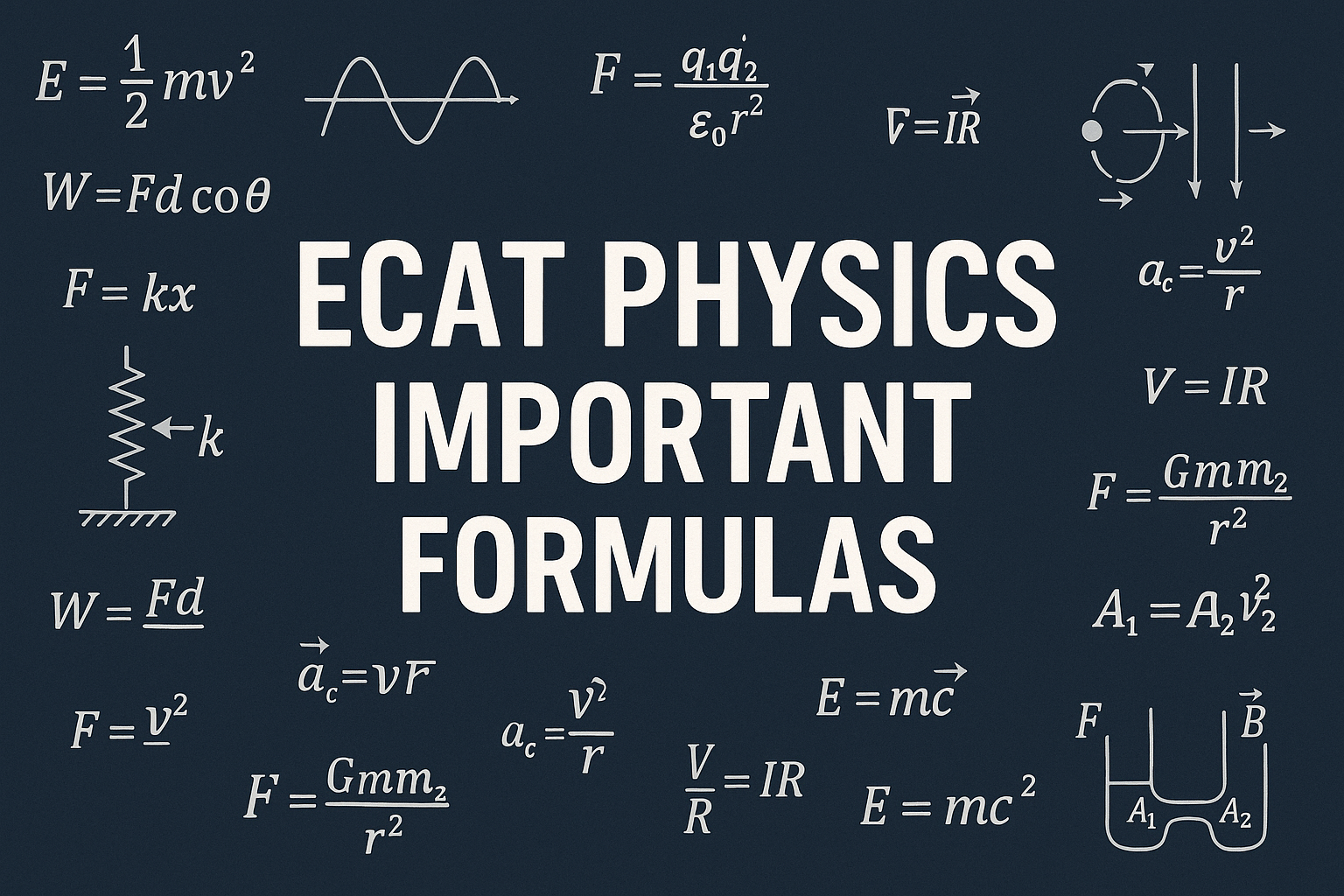
As students gear up for the Engineering College Admission Test (ECAT), mastering the mathematical formulas in Physics becomes a fundamental step toward achieving success. Not only do these ECAT Physics formulas provide the foundation for solving complex physics problems, but they also play a crucial role in various engineering disciplines. In this article, we’ll explore the most important formulas, their practical applications, and strategies for effectively memorizing and utilizing these equations during the exam.
Understanding the Importance of ECAT Physics Formulas
Physics is often considered the backbone of engineering; it helps us understand the natural phenomena that influence technology, design, and innovation. For ECAT, students are tested on various Physics concepts, including Mechanics, Thermodynamics, Waves, and Electricity. The formulas serve as shortcuts to solving problems that would otherwise require lengthy calculations or extensive theoretical knowledge. There’s a fuller look at C Mechanics overview.
Importantly, ECAT Physics formulas not only must be memorized; they also need to be understood in context. Each formula reflects a fundamental concept in physics, and grasping the reasoning behind them enhances problem-solving skills. For instance, knowing the formula for kinetic energy is essential, but understanding how it connects to force and motion is even more critical.
Key Physics Formulas for ECAT
Let’s dive into some of the essential ECAT Physics formulas that every aspiring engineer should be familiar with:
1. Mechanics
Mechanics involves the study of motion and forces. Several key formulas in this area include:
- Newton’s Second Law: F = ma
Here, F is the force applied, m is mass, and a is acceleration. This formula helps determine how much force is needed to move an object with a given mass at a certain acceleration. - Kinematic Equations: These equations describe motion under constant acceleration. The three most commonly used are:
1. v = u + at
2. s = ut + (1/2)at²
3. v² = u² + 2as
Here, u is initial velocity, v is final velocity, a is acceleration, s is displacement, and t is time. - Work-Energy Principle: W = ΔKE
This indicates that the work done by the forces acting on an object results in a change in kinetic energy.
2. Thermodynamics
Thermodynamics deals with heat and temperature. Important formulas include:
- First Law of Thermodynamics: ΔU = Q – W
Here, ΔU is the change in internal energy, Q is heat added to the system, and W is work done by the system. - Ideal Gas Law: PV = nRT
It relates the pressure (P), volume (V), and temperature (T) of an ideal gas, with n as the number of moles and R as the ideal gas constant. - Efficiency: η = (W_out / Q_in) × 100%
This formula is used to determine the efficiency of heat engines.
3. Waves
Waves encompass a range of phenomena, from sound to light. Key formulas include:
- Wave Speed: v = fλ
This formula connects wave speed (v), frequency (f), and wavelength (λ). - Sound Intensity: I = P/A
Here, I is intensity, P is power, and A is area. This is crucial when dealing with sound waves.
4. Electricity and Magnetism
Electricity is fundamental to many engineering applications. Essential formulas include: (See: Overview of Physics concepts.)
- Ohm’s Law: V = IR
Voltage (V) is equal to current (I) multiplied by resistance (R). This is a fundamental relationship in electronics. - Power in Electric Circuits: P = IV
Power (P) is the product of current and voltage. - Faraday’s Law of Electromagnetic Induction: ε = -dΦ/dt
This describes how a changing magnetic field induces an electromotive force (EMF).
5. Optics
Optics is the study of light. Important equations in this field include:
- Lens Formula: 1/f = 1/v – 1/u
Here, f is the focal length, v is the image distance, and u is the object distance. - Magnification: M = h’/h = -v/u
This describes the ratio of image height to object height.
Strategies for Memorizing ECAT Physics Formulas
With so many ECAT Physics formulas to memorize, it can be daunting. Here are some practical strategies to help you effectively retain these equations:
1. Understanding Over Memorization
While rote memorization can be effective in the short term, understanding the underlying concepts behind each formula will help you remember them much better. Take the time to explore the derivation of each formula and relate it to real-world applications. For instance, rather than simply memorizing the Ideal Gas Law, consider how it can help explain behaviors of gases in different conditions.
2. Create a Formula Cheat Sheet
Compile all important formulas into a single document or cheat sheet. Organize them by subject (Mechanics, Thermodynamics, etc.), making it easier to find what you need. Regularly review this sheet, and consider putting it in a place where you can see it daily, like on your study wall or as your phone wallpaper. For more on this, see Fundamental concepts in Physics 1.
3. Practice Problems
The best way to reinforce your understanding of ECAT Physics formulas is through application. Solve various problems that require you to use different formulas. This not only solidifies your memory but also enhances your problem-solving skills. Resources like past ECAT papers or physics problem sets can provide invaluable practice.
4. Use Mnemonics
Utilizing mnemonics can make memorization easier. For example, you can create acronyms or memorable phrases to represent a series of formulas. For instance, to remember the kinematic equations, you might create a story where each character represents a variable. This technique can make recalling complex information much simpler during high-pressure moments like exams.
Current Relevance of ECAT Physics Formulas
The significance of ECAT Physics formulas extends beyond exams. In today’s fast-evolving technological landscape, a solid understanding of physics is vital for aspiring engineers. Whether it’s in renewable energy projects, robotics, or aerospace engineering, these formulas lay the groundwork for innovative solutions to contemporary challenges.
Moreover, industries are increasingly focusing on interdisciplinary approaches, where physics principles combine with fields like computer science or materials engineering. Mastering these formulas not only prepares students for the ECAT but also provides them with transferable skills for their future careers. (See: Importance of physics education.)
Real-Life Applications of ECAT Physics Formulas
Understanding and applying ECAT Physics formulas reaches into the real world, affecting technologies and innovations. Here are a few examples:
- Engineering Structures: Engineers use mechanics formulas to analyze forces acting on buildings and bridges. Knowledge of Newton’s laws helps in ensuring structures can withstand loads and environmental forces.
- Automotive Engineering: Kinematic equations are essential in designing cars for safety and performance. Engineers must calculate speeds and accelerate forces for crash tests and efficiency standards.
- Environmental Science: Thermodynamics formulas are key in designing systems for energy conversion, such as wind turbines and solar panels. These systems convert natural energy into usable electrical energy while maximizing efficiency.
- Telecommunications: Waves and optics principles are crucial in the design of communication systems, including fiber optic cables and satellite communications, which rely on understanding wave propagation and light behavior.
Expert Perspectives on Mastering Physics Formulas
Insights from educators and industry professionals can provide additional guidance. Here’s what experts say:
Dr. Ayesha Khan, Physics Professor: “Students often miss the connection between formulas and real-world applications. Engaging in projects or experiments that utilize these formulas can deepen understanding and retention.”
Engr. Usman Ali, Mechanical Engineer: “The ability to apply physics formulas in practical situations, like during internships or in labs, gives students an edge. It’s essential to practice using these formulas in varied contexts.” See also AP Physics 1 insights.
Common Mistakes to Avoid When Learning ECAT Physics Formulas
As students prepare for the ECAT, they often make a few common mistakes. Being aware of these can help you avoid pitfalls:
- Ignoring Units: Forgetting to include or convert units can lead to incorrect answers. Always double-check your units when using formulas.
- Neglecting Conceptual Understanding: Relying solely on memorization without understanding the formulas can hinder your ability to apply them effectively. Take time to grasp the concepts behind each formula.
- Not Practicing Enough: Practice is crucial for mastering physics formulas. Regularly solving problems helps reinforce your understanding and application skills.
- Overlooking Contextual Applications: Failing to link formulas to real-world scenarios limits comprehension. Relate formulas to practical examples to enhance your understanding.
FAQ About ECAT Physics Formulas
Here are some frequently asked questions regarding ECAT Physics formulas:
Q1: How many physics formulas do I need to memorize for the ECAT?
A1: While there’s no set number, being familiar with the key formulas across the main topics—Mechanics, Thermodynamics, Waves, and Electricity—is essential. Focus on formulas that frequently appear in practice problems and past papers. (See: Engineering Physics topics.)
Q2: Are there any online resources for practicing ECAT Physics problems?
A2: Yes, several online platforms offer practice problems specifically tailored for the ECAT. Websites like Physics Classroom, Khan Academy, and ECAT prep forums can provide invaluable resources. Related reading: AP Physics 2 essentials.
Q3: Can I bring a formula sheet to the ECAT exam?
A3: Generally, you won’t be allowed to bring a formula sheet into the exam. However, some testing centers provide a list of essential formulas. It’s best to verify the exam regulations ahead of time.
Q4: What is the best way to study for the physics section of the ECAT?
A4: Create a study plan that includes reviewing conceptual understanding, memorizing formulas, practicing problems, and taking mock tests. Balance your time between these elements for a well-rounded preparation strategy.
Additional Tips for Success in ECAT Physics
Here are a few more tips that can help you in your preparation:
- Group Study: Sometimes, discussing concepts with peers can clarify confusion. Consider forming a study group where you can explain formulas to each other, as teaching is one of the best ways to learn.
- Use Visual Aids: Diagrams, charts, and graphs can significantly enhance understanding. For instance, sketching out the forces acting on an object can help visualize how Newton’s laws apply in real scenarios.
- Stay Updated: Physics is a constantly evolving field. Keep an eye on recent discoveries or innovations that may relate to the formulas you are studying. Understanding how physics is applied in the modern world can make your studies more relevant and exciting.
Conclusion: Your Path to Success
Ultimately, mastering the ECAT Physics formulas isn’t just about passing an exam; it’s about cultivating a deep understanding of the principles that govern our world. By investing time in learning, understanding, and applying these formulas, students will not only succeed in the ECAT but also lay a strong foundation for their future studies and careers in engineering. Remember, every formula is a key that can unlock the mysteries of the universe—so grab those keys and get ready to unlock your potential.
“`
Trending Now
Frequently Asked Questions
What are the important physics formulas for ECAT?
Important physics formulas for ECAT include Newton's Second Law (F = ma), kinematic equations, and formulas related to thermodynamics, waves, and electricity. Mastering these formulas is crucial for solving complex problems effectively during the exam.
Why are physics formulas important for engineering students?
Physics formulas are essential for engineering students as they provide the foundational tools needed to solve real-world problems in various engineering disciplines. Understanding these formulas enhances problem-solving skills and helps in grasping complex concepts.
How can I memorize physics formulas for the ECAT?
To memorize physics formulas for ECAT, utilize techniques like creating flashcards, practicing problems regularly, and understanding the context behind each formula. Grouping related formulas can also aid retention and recall during the exam.
What topics are covered in ECAT physics?
ECAT physics covers a range of topics including Mechanics, Thermodynamics, Waves, and Electricity. Each topic includes fundamental concepts and key formulas that students must understand to succeed in the exam.
How does understanding physics formulas help in problem-solving?
Understanding physics formulas helps in problem-solving by providing a framework for applying theoretical concepts to practical situations. It allows students to identify relevant equations and apply them effectively to find solutions to complex problems.
Have you experienced this yourself? We'd love to hear your story in the comments.



