
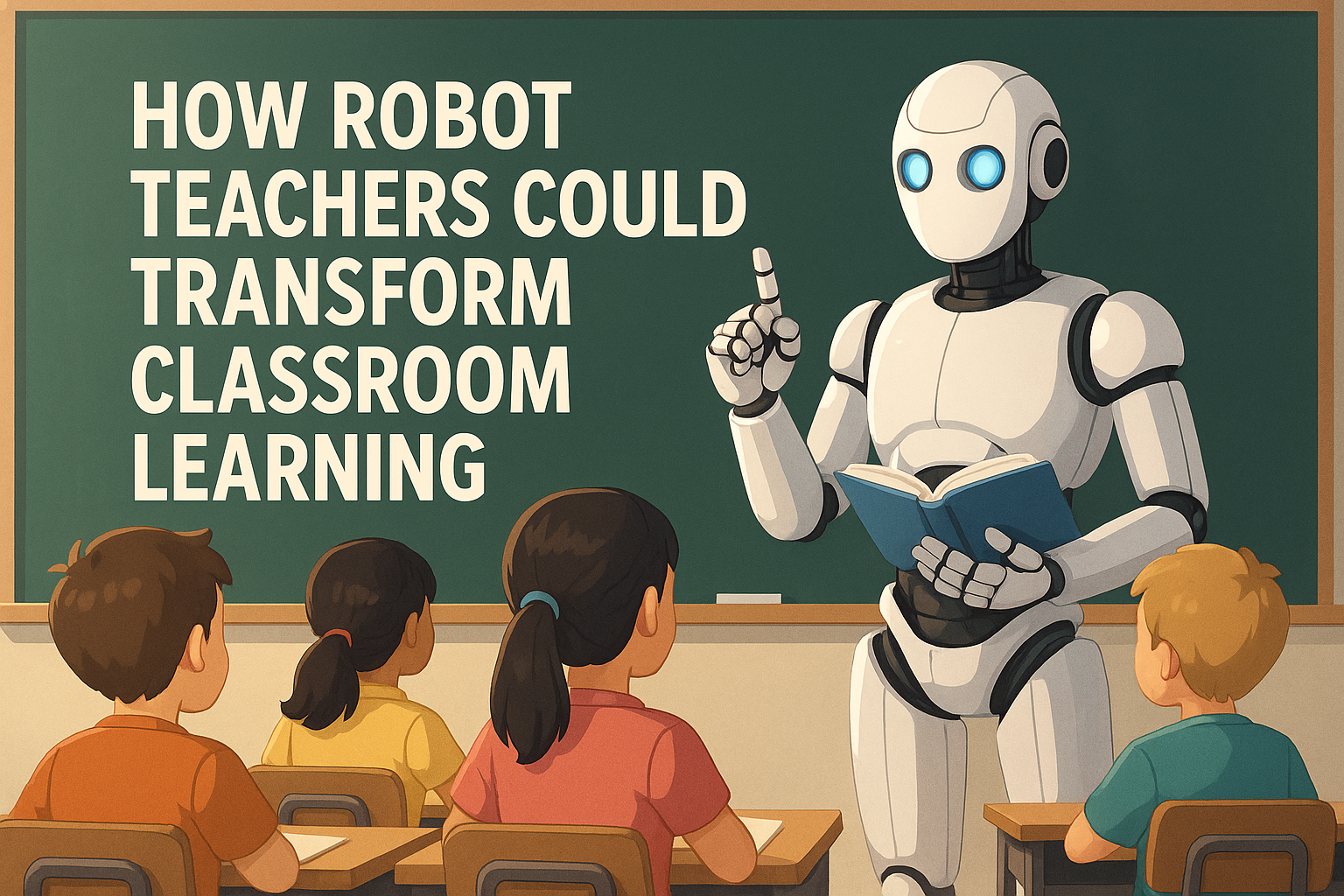

“`json
{
“title”: “The Untapped Potential: Why Robot Teachers Might Be Education’s Next Revolution”,
“content”: “
Imagine a classroom where every student receives personalized attention, where lessons adapt in real-time to individual learning styles, and where no question goes unanswered due to a lack of resources. This isn’t some far-off science fiction fantasy; it’s the promise held by the emerging field of artificial intelligence in education, particularly with the introduction of robot teachers. While the concept might sound futuristic, the integration of AI into our schools is already underway, albeit with some understandable growing pains. You might have seen the headlines recently about the Salamanca City Central School District in Western New York, which, on July 24, 2026, paused its ambitious pilot program to bring a humanoid robot from Realbotix into its classrooms. This decision, following a New York Focus report and significant community backlash, underscores a critical juncture: how do we balance innovation with caution, and how do we ensure that the genuine benefits of robot teachers in education aren’t overshadowed by fear and misunderstanding?
\n
The Salamanca incident, though a setback for that specific program, serves as a powerful case study. It highlights the fierce debate surrounding AI in schools, particularly when it takes the form of a physical, interactive robot. The State Education Department even weighed in, expressing concerns to Superintendent Mark Beehler, which ultimately led to the district’s decision to hit the brakes. Their stated reasons – the need for \”enhanced student data privacy agreements\” and more extensive community engagement – are entirely valid. But let’s be clear: this pause isn’t a dismissal of the technology itself. It’s an opportunity to learn, to refine, and to prepare for a future where intelligent machines could profoundly reshape how we teach and learn. The potential for these tools to revolutionize pedagogy is immense, and it’s a conversation we need to have openly and thoughtfully.
\n\n
The Unstoppable March of AI in Learning Environments
\n
Whether we embrace them or not, artificial intelligence tools are already permeating our educational landscape. From sophisticated learning management systems that track student progress to AI-powered tutoring apps that offer instant feedback, the technology is here. Robot teachers represent the next frontier, moving beyond software to embody a physical presence that can interact with students in a more tangible way. Think about it: a robot isn’t just a screen; it’s a dynamic entity that can move, speak, and even express simulated emotions, potentially fostering a different kind of engagement. This isn’t about replacing human teachers, a common misconception that often fuels public apprehension. Instead, it’s about augmenting their capabilities, providing support, and creating educational opportunities that are currently impossible to scale. There’s a fuller look at future of personalized learning.
\n
Consider the sheer volume of students in many classrooms today. A single human teacher, no matter how dedicated, simply cannot provide truly individualized instruction to thirty or more diverse learners simultaneously. This is where the benefits of robot teachers in education become undeniably clear. They can offer personalized learning paths, adapting content difficulty and presentation based on each student’s real-time performance and learning style. Imagine a student struggling with algebra. A robot could provide unlimited, patient practice problems, identify specific areas of weakness, and even explain concepts in multiple ways until understanding clicks. This kind of persistent, tailored support is a luxury most educational systems simply can’t afford with human resources alone.
\n\n
Personalized Learning at Scale: A Core Advantage
\n
One of the most compelling arguments for integrating robot teachers is their unparalleled ability to deliver truly personalized education. Human teachers, even the most dedicated, are constrained by time and the number of students in their charge. They do their best to differentiate instruction, but the reality of a crowded classroom means some students inevitably fall through the cracks, while others aren’t sufficiently challenged. Robot teachers, however, operate differently. They can analyze vast amounts of data on a student’s performance – from test scores to engagement levels and even response times – to construct a dynamic learning profile. (See: robot teachers in education.)
This profile then guides the robot’s interactions, tailoring everything from the pace of instruction to the types of examples used. For a visual learner, a robot might present more diagrams and videos. For an auditory learner, it might focus on verbal explanations and discussions. Struggling with a particular concept? The robot can detect this and offer targeted remedial exercises or re-explain the material from a different angle, without judgment or impatience. Conversely, for a gifted student, the robot can provide advanced challenges and enrichment activities, ensuring they remain engaged and continue to grow. This isn’t just about efficiency; it’s about optimizing the learning experience for every single child, something that has historically been an aspirational, rather than achievable, goal for most public school systems. The sheer scale of personalized attention that AI and robot teachers can offer is a game-changer.
Addressing Teacher Workload and Resource Gaps
Let’s face it, teaching is an incredibly demanding profession. Teachers often wear multiple hats: instructor, mentor, counselor, data analyst, and sometimes even surrogate parent. The administrative burden alone can be overwhelming, diverting precious time away from direct instruction. This is another area where the benefits of robot teachers in education could be transformative. Imagine a robot handling the repetitive tasks that often bog down human educators: grading multiple-choice quizzes, tracking attendance, generating progress reports, or even providing basic remedial instruction for common misconceptions. By offloading these tasks, human teachers would be freed up to focus on what they do best: fostering critical thinking, nurturing creativity, providing emotional support, and engaging in deeper, more complex pedagogical interactions.
Furthermore, in areas with teacher shortages, particularly in specialized subjects like advanced mathematics, physics, or certain foreign languages, robot teachers could fill critical gaps. Rural districts, for instance, often struggle to attract and retain highly qualified educators in niche fields. A robot, programmed with expert-level knowledge, could provide access to high-quality instruction that would otherwise be unavailable. This isn’t about replacing human expertise, but rather democratizing access to it, ensuring that geographical location or economic disadvantage doesn’t limit a student’s educational opportunities. The potential to bridge these resource disparities is a significant, often overlooked, benefit. Related reading: AI's impact on education.
Data-Driven Insights for Improved Pedagogy
One of the less obvious, but profoundly impactful, benefits of robot teachers in education lies in their ability to collect and analyze vast amounts of educational data. Every interaction, every correct answer, every struggle, every moment of engagement can be recorded and analyzed. This isn’t about surveillance in a negative sense; it’s about gaining unprecedented insights into the learning process itself. Human teachers rely on their experience and observation, which are invaluable, but also subjective and limited by bandwidth. A robot, however, can objectively track patterns, identify common stumbling blocks across a class or even an entire district, and pinpoint which teaching methods are most effective for different types of learners. (See: Harvard University research on AI.)
This data can then be aggregated and provided to human educators, administrators, and curriculum developers. Imagine having real-time insights into which parts of a curriculum are consistently challenging, or which teaching strategies yield the best results for specific demographics. This feedback loop could lead to continuous improvement in curriculum design, pedagogical approaches, and even teacher training. It moves education from a largely intuitive art to a more data-informed science, allowing us to refine our methods and optimize outcomes for all students. Of course, this is precisely where those \”enhanced student data privacy agreements\” become absolutely paramount, ensuring that this powerful data is used ethically and securely.
The Role of Social-Emotional Learning and Human Connection
While the technical and academic benefits are clear, we can’t ignore the vital role of social-emotional learning (SEL) and human connection in a child’s development. This is often the first concern raised when discussing robot teachers, and it’s a valid one. No robot, no matter how advanced, can replicate the nuanced empathy, spontaneous humor, or profound mentorship that a great human teacher provides. The ability to read subtle cues, offer comfort during a tough time, or inspire a love for learning through shared passion – these are uniquely human attributes. envisioning AI in classrooms offers useful background here.
However, the conversation shouldn’t be about robots replacing these functions, but rather complementing them. By taking on some of the more rote or data-intensive tasks, robots could actually free up human teachers to focus more on SEL, on building relationships, and on fostering a supportive classroom community. Imagine a teacher with more time for one-on-one check-ins, for facilitating group discussions, or for designing creative, collaborative projects that emphasize teamwork and communication. The goal isn’t a robot-only classroom, but a hybrid model where the strengths of both humans and machines are leveraged, creating a richer, more effective, and more humane educational experience. The benefits of robot teachers in education, when viewed through this lens, are not about dehumanizing learning, but about enhancing the human elements that truly matter.
Navigating the Ethical Minefield: Privacy, Bias, and Acceptance
The Salamanca City Central School District’s pause serves as a stark reminder that the journey to integrating robot teachers is fraught with ethical and practical challenges. The most immediate concern, and rightly so, is student data privacy. These robots, if they are to provide personalized learning, will necessarily collect a wealth of information about students: their learning styles, their academic strengths and weaknesses, their progress, and potentially even their emotional responses to learning stimuli. Ensuring this data is collected, stored, and used ethically and securely is non-negotiable. Robust encryption, strict access protocols, and transparent policies are not just good practice; they are essential for building trust with parents and communities. (See: robot teachers and AI integration.)
Beyond privacy, there’s the critical issue of algorithmic bias. AI systems are only as unbiased as the data they’re trained on. If the training data reflects societal biases, the robot teacher could inadvertently perpetuate or even amplify those biases, leading to inequitable outcomes for certain student groups. Developers must prioritize diverse and representative datasets, and educators must be vigilant in monitoring for and mitigating any signs of bias in how these systems interact with students. Finally, community acceptance, as seen in Salamanca, is paramount. Introducing a physical robot into a classroom is a significant cultural shift. It requires open dialogue, clear communication about the purpose and limitations of the technology, and genuine engagement with parents, students, and staff to address their concerns and build a shared vision for the future of education. Without this groundwork, even the most promising technology is likely to falter.
Looking Ahead: The Future of Hybrid Classrooms
The vision for the future isn’t one where robots entirely replace human teachers, but rather where they work in tandem, creating a powerful synergy. Picture a classroom where a human teacher orchestrates complex group projects, facilitates deep discussions, and provides invaluable social-emotional guidance, while an AI-powered robot acts as a tireless tutor, a data analyst, and a personalized learning assistant for every student. This hybrid model promises to elevate the role of the human teacher, allowing them to focus on the higher-order thinking and human connection that truly inspire learning.
The pause in Salamanca isn’t a failure; it’s a valuable lesson. It underscores the importance of thoughtful implementation, rigorous privacy frameworks, and proactive community engagement. As technology continues its relentless march forward, the question isn’t if AI and robot teachers will enter our classrooms, but how we will responsibly and effectively integrate them to unlock their full potential. The benefits of robot teachers in education—from personalized learning at scale to reduced teacher workload and data-driven pedagogical improvements—are too significant to ignore. Our challenge, and our opportunity, is to harness these tools in a way that truly serves the best interests of every student, preparing them not just for the tests of today, but for the world of tomorrow. We covered ways AI is enhancing education in more detail.
“`
}
Trending Now
Frequently Asked Questions
How can robot teachers improve classroom learning?
Robot teachers can enhance classroom learning by providing personalized attention to each student, adapting lessons in real-time according to individual learning styles, and ensuring that every question is answered. This allows for a more tailored educational experience that can address diverse needs within the classroom.
What are the benefits of using AI in education?
The benefits of using AI in education include personalized learning experiences, increased engagement through interactive teaching methods, and the ability to analyze student performance data effectively. This technology can also help teachers manage classroom dynamics more efficiently, allowing them to focus on instruction.
What challenges do robot teachers face in schools?
Robot teachers face several challenges, including community acceptance, privacy concerns regarding student data, and the need for proper integration into existing curricula. Incidents like the one in Salamanca highlight the importance of addressing these issues through community engagement and careful planning.
Are robot teachers a viable alternative to human teachers?
While robot teachers can complement human educators by providing personalized support and assistance, they are not a complete replacement. The human touch in teaching—empathy, understanding, and social interaction—remains crucial, making a blended approach the most effective strategy.
What was the Salamanca City Central School District incident?
The Salamanca City Central School District paused its pilot program for a humanoid robot teacher due to community backlash and concerns about student data privacy. This decision highlights the ongoing debate about the integration of AI in education and the importance of addressing community concerns.
Have you experienced this yourself? We'd love to hear your story in the comments.






