
“`html
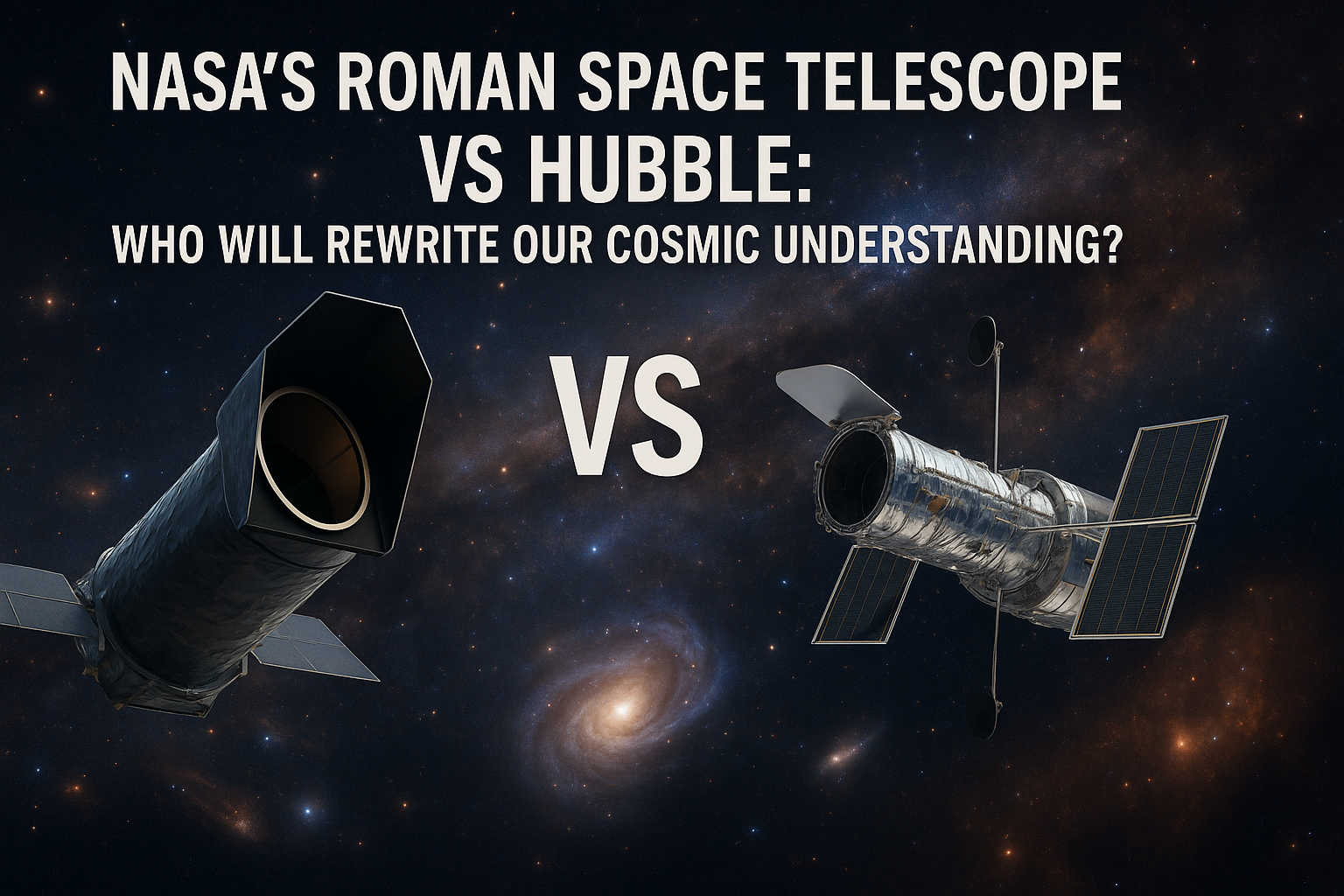
The cosmos has always fascinated humanity, driving our quest for knowledge about the universe and our place within it. As we expand our understanding of the universe, two powerful observatories stand at the forefront of this endeavor: NASA’s Hubble Space Telescope and the upcoming Nancy Grace Roman Space Telescope. This article aims to provide an in-depth NASA Roman Space Telescope vs Hubble comparison, focusing on their technological advancements and unique contributions to cosmic exploration. Buckle up; this is going to be an exciting journey through space!
The Legacy of Hubble: A Benchmark in Cosmic Observation
Since its launch in 1990, the Hubble Space Telescope has redefined our understanding of the universe. Positioned above Earth’s atmosphere, Hubble has delivered breathtaking images and critical data, significantly contributing to fields such as cosmology and astrophysics. Its observations have led to groundbreaking discoveries, including the expansion rate of the universe and the existence of exoplanets.
Hubble operates primarily in the optical and ultraviolet wavelengths, allowing it to capture stunning images of distant galaxies, nebulae, and star clusters. Its high-resolution capabilities have made it an indispensable tool for astronomers, enabling them to peer into the depths of space with remarkable clarity. Hubble’s wide-ranging contributions are well-documented, making it an observational benchmark against which new space telescopes are measured.
Introducing the Nancy Grace Roman Space Telescope
Enter the Nancy Grace Roman Space Telescope (formerly known as WFIRST), set to launch in the mid-2020s. This telescope is named after Nancy Grace Roman, NASA’s first Chief Astronomer, and it promises to build upon Hubble’s legacy while utilizing cutting-edge technology. The Roman Space Telescope is designed with a specific focus: to undertake wide-field cosmic surveys, enhancing our understanding of the universe’s structure and the enigmatic dark energy that drives its expansion.
One of the standout features of the Roman Telescope is its “spy mirror” design, which provides a wider field of view than Hubble. This means that Roman can capture vast areas of the sky in a single observation, opening the door for comprehensive surveys that could reveal new cosmic phenomena and more accurately map the universe’s large-scale structure.
Technological Innovations: What Sets Roman Apart?
When discussing the NASA Roman Space Telescope vs Hubble comparison, the differences in their technologies are significant. Roman will feature a 2.4-meter aperture mirror, similar to Hubble’s, but its advanced optics and large field of view will allow it to collect more light and data at once. This capability is essential for studying rare and transient cosmic events, such as supernovae and gravitational lensing.
Additionally, the Roman Space Telescope will utilize a wide-ranging infrared survey capability. This will enable it to observe objects obscured by dust clouds, which often hinder optical telescopes. Hubble has made remarkable discoveries in visible and ultraviolet light, but Roman’s ability to survey the infrared spectrum expands its reach, providing insights into the formation of stars and galaxies.
Wide-Field Surveys: A New Era of Cosmic Mapping
One of the primary objectives of the Roman Space Telescope will be to conduct wide-field surveys that could redefine our cosmic maps. The telescope is expected to survey 100 times more sky than Hubble, a game-changer for researchers aiming to understand the distribution of dark matter and dark energy in the universe.
Imagine a telescope that can survey a larger volume of the universe in a fraction of the time it takes Hubble to do so. Roman will gather data on millions of galaxies and thousands of supernovae, allowing astronomers to analyze their properties and distribution on an unprecedented scale. This capability is vital for studying the universe’s large-scale structure and refining our models of cosmic evolution. (See: Hubble Space Telescope overview.)
Dark Energy: Peering into the Unknown
One of the most pressing questions in modern astrophysics is the nature of dark energy, which is believed to make up about 68% of the universe. Hubble has made significant contributions to our understanding of dark energy, but its observational limitations prevent it from unraveling the mystery fully.
The Roman Space Telescope is poised to dive deeper into this enigma. By using gravitational lensing and measuring the distribution of galaxies over large distances, Roman will help scientists map out dark energy’s effects on cosmic expansion. This data could reshape our understanding of the universe’s fate—whether it will continue expanding indefinitely or eventually collapse back in on itself.
Timing and Future Discoveries: What Lies Ahead?
Both telescopes have played pivotal roles in advancing our knowledge of the cosmos, but their timelines differ significantly. Hubble has been operational for over three decades, while the Roman Space Telescope is scheduled for launch in the mid-2020s. This timing is crucial; as Hubble continues its observations, Roman’s data will complement and expand upon what we have learned.
The collaboration between Hubble and Roman can lead to groundbreaking discoveries. For instance, while Hubble captures detailed images of particular celestial objects, Roman can provide the broader context needed to understand their significance on a cosmic scale. Pairing Hubble’s precision with Roman’s expansive surveys could illuminate areas of research previously thought to be beyond reach.
Comparative Performance: Hubble vs. Roman
When it comes to performance, comparing Hubble and Roman reveals fascinating insights. Hubble, with its optical capabilities, has the advantage in capturing high-resolution images of individual celestial objects. Its ability to observe specific targets in great detail has led to spectacular images of phenomena like the Pillars of Creation and the Hubble Deep Field.
On the flip side, Roman’s strength lies in its ability to gather vast amounts of data across wide fields, making it ideal for statistical studies of cosmological events. Its surveys will be able to detect rare events, such as transient objects, at a much larger scale than Hubble, potentially allowing astronomers to see thousands of supernovae in a single survey.
In terms of data collection, Roman is expected to produce data equivalent to the combined output of Hubble, Kepler, and several other missions, leading to discoveries that could significantly alter our understanding of astrophysics.
Expert Perspectives: What the Scientists Say
Experts in the field have expressed great excitement about the potential of the Roman Space Telescope. Dr. Jennifer Lotz, an astronomer at the Space Telescope Science Institute, states, “Roman will enable us to answer fundamental questions about the universe’s structure, evolution, and the role of dark energy in a way that Hubble simply cannot.” This sentiment is echoed by many in the scientific community who view Roman as a game-changer in cosmological studies.
Another prominent astrophysicist, Dr. David Spergel, has noted, “The wide-field surveys of Roman will allow us to create a three-dimensional map of the universe. This capability will help us understand how galaxies formed and evolved over billions of years.” Such insights will be invaluable in addressing some of the most profound questions in cosmology. (See: NASA's Roman Space Telescope overview.)
Applications Beyond Astronomy
The advancements brought by the Roman Space Telescope won’t just benefit astronomy. The technology and methodologies developed for Roman could have far-reaching applications across various scientific fields. For instance, techniques for analyzing vast amounts of data will find applications in fields like climate science, where understanding complex data patterns is crucial.
Furthermore, the study of dark energy may also inspire advancements in fundamental physics, potentially leading to new theories about the forces that shape our universe. The collaboration between astronomers and physicists could illuminate unforeseen connections between cosmic phenomena and particle physics, sparking innovations that impact technology and theory alike.
Challenges and Expectations: What to Watch For
As we prepare for the launch of the Roman Space Telescope, several challenges remain. The engineering complexities involved in ensuring that the telescope operates flawlessly in space cannot be understated. Given Hubble’s past technical difficulties, there’s a collective hope that the lessons learned will pave the way for a smoother deployment of Roman.
Moreover, funding and political support are critical in maintaining the timeline for Roman’s launch and subsequent operational phases. Continuous advocacy for space science will be necessary to ensure that ambitious projects like Roman are not sidelined by budgetary concerns or shifting priorities.
FAQ: Your Questions Answered
1. What is the primary purpose of the Roman Space Telescope?
The primary purpose of the Roman Space Telescope is to conduct wide-field surveys of the universe, focusing on understanding dark energy, galaxy formation, and large-scale cosmic structures.
2. How does Hubble’s technology differ from Roman’s?
Hubble primarily operates in optical and ultraviolet wavelengths, while Roman has advanced infrared capabilities, allowing it to survey objects hidden by dust and gather broader datasets.
3. What are the expected launch dates for both telescopes?
Hubble was launched in 1990 and continues to operate, while the Roman Space Telescope is scheduled for launch in the mid-2020s.
4. How will Hubble and Roman work together?
Hubble and Roman will complement each other, with Hubble capturing detailed images of specific targets and Roman providing extensive surveys that reveal the broader context of those findings. (See: New York Times article on Roman Telescope.)
5. What new discoveries are expected from the Roman Space Telescope?
Roman is expected to lead to significant discoveries related to dark energy, the formation and distribution of galaxies, and the identification of numerous transient cosmic events.
6. Will Roman replace Hubble?
No, the Roman Space Telescope is not intended to replace Hubble. Instead, it will complement Hubble’s capabilities, allowing for a more comprehensive exploration of the universe.
7. How will Roman’s data collection capabilities impact scientific research?
Roman’s ability to collect massive amounts of data will enable astronomers to conduct large-scale surveys and statistical analyses, enhancing our understanding of cosmic phenomena and allowing for more precise models of the universe.
The Future of Cosmic Exploration
The NASA Roman Space Telescope vs Hubble comparison reveals two powerful yet distinct approaches to cosmic exploration. Hubble, with its rich legacy of discoveries, continues to inspire awe and wonder. At the same time, Roman represents a leap forward in our capacity to survey and understand the universe.
As each telescope continues to contribute to our understanding of the cosmos, the scientific community eagerly anticipates the revelations that await us. The synergy between Hubble and Roman promises a future where the mysteries of dark energy, galaxy formation, and the overall structure of the universe are unraveled.
In the coming years, researchers will harness the unique capabilities of both telescopes to explore unprecedented depths of space and time. The quest for knowledge never ceases, and with instruments like the Roman Space Telescope on the horizon, we are bound to discover answers to questions we haven’t even thought to ask yet.
“`
Trending Now
Frequently Asked Questions
What is the main difference between NASA's Roman Space Telescope and Hubble?
The main difference lies in their design and focus: Hubble operates primarily in optical and ultraviolet wavelengths for detailed imaging, while the Roman Space Telescope is designed for wide-field cosmic surveys to enhance our understanding of the universe's structure.
What advancements does the Roman Space Telescope have over Hubble?
The Roman Space Telescope incorporates cutting-edge technology that allows it to conduct extensive surveys of the cosmos, which will enable astronomers to study large-scale structures and phenomena, providing a broader perspective compared to Hubble's focused observations.
How has Hubble contributed to our understanding of the universe?
Since its launch in 1990, Hubble has significantly advanced our knowledge of the universe through breathtaking images and critical data, leading to discoveries such as the expansion rate of the universe and the existence of exoplanets.
When is the Roman Space Telescope expected to launch?
The Nancy Grace Roman Space Telescope is set to launch in the mid-2020s, aiming to complement and expand upon the discoveries made by the Hubble Space Telescope.
Why is the Roman Space Telescope named after Nancy Grace Roman?
The Roman Space Telescope is named after Nancy Grace Roman, NASA's first Chief Astronomer, in recognition of her significant contributions to astronomy and her role in advancing space science.
Have you experienced this yourself? We’d love to hear your story in the comments.