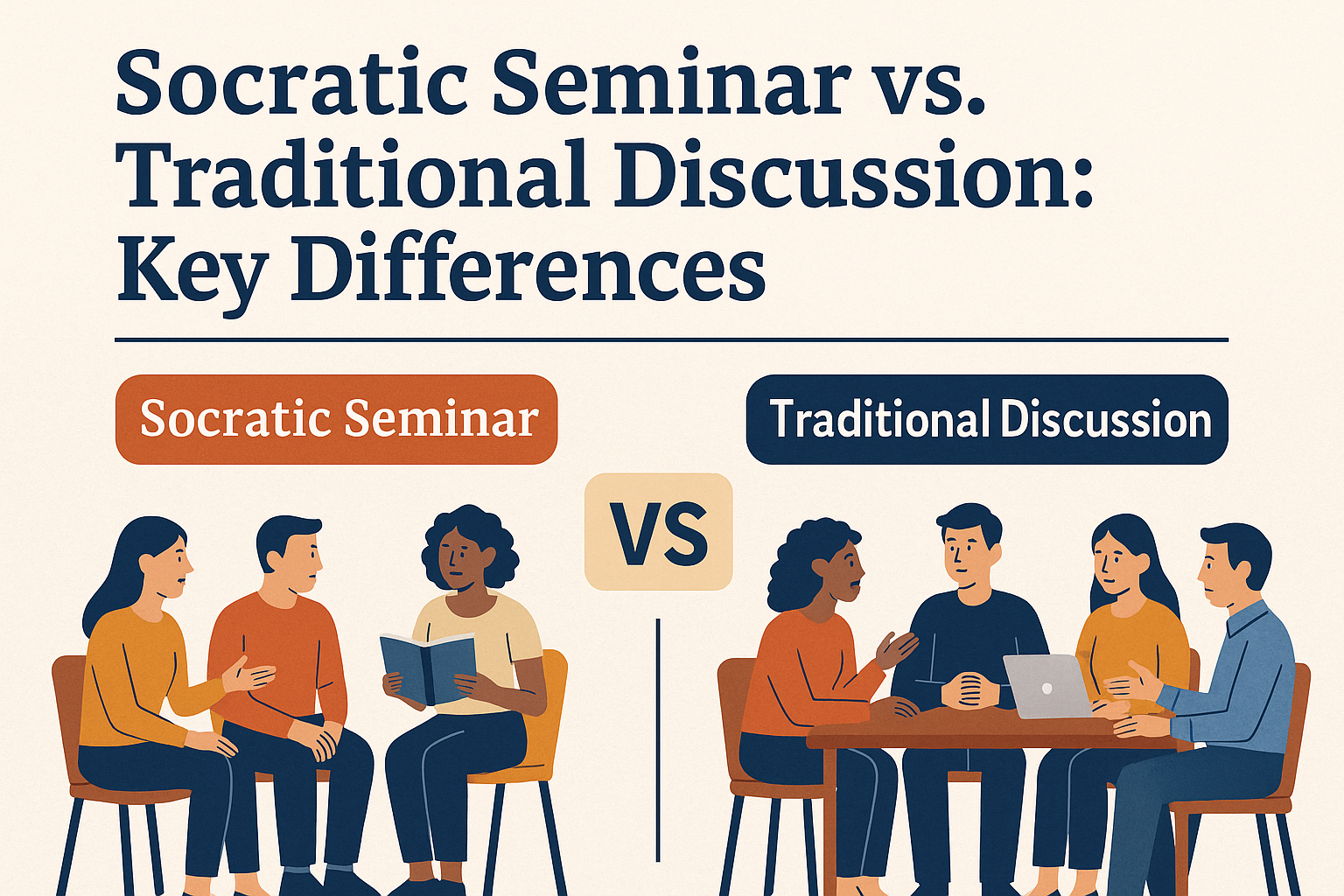

When it comes to classroom discussions, educators often face a choice between two popular methods: the Socratic Seminar and the traditional discussion format. Both approaches aim to foster critical thinking and engagement among students, yet they differ significantly in their structure, objectives, and outcomes. Understanding these differences is crucial for educators looking to enhance their teaching strategies and improve student learning. In this article, we’ll explore the key aspects of both methods and provide insights on how to choose the right approach for your classroom.
1. Understanding the Socratic Seminar
The Socratic Seminar is named after the ancient Greek philosopher Socrates, who believed in the importance of dialogue in the pursuit of knowledge. This method emphasizes questioning, dialogue, and critical thinking rather than rote memorization or regurgitation of information. In a typical Socratic Seminar, students engage in an open discussion around a text or topic, guided by thought-provoking questions posed by the teacher or other students.
One of the hallmarks of the Socratic Seminar is its focus on student-led discussions. Instead of the teacher serving as the primary source of information, students take the lead in exploring ideas, challenging one another’s perspectives, and building on each other’s thoughts. This fosters a collaborative learning environment where students feel empowered to express their opinions and engage in deeper analysis.
2. The Structure of Traditional Discussion
In contrast, traditional discussions typically follow a more structured format, often led directly by the teacher. The teacher introduces a topic or question and guides the conversation, frequently providing information or context. Students may contribute their thoughts, but the discussion often revolves around the teacher’s agenda and intended outcomes.
While traditional discussions can still promote engagement, they often prioritize the dissemination of knowledge over critical thinking and student agency. This can lead to a situation where a few voices dominate the conversation, and quieter students may feel less inclined to participate. The teacher’s role is pivotal in steering the discussion, which can sometimes limit the depth of student exploration.
3. Objectives and Outcomes
The objectives behind each discussion method also differ significantly. Socratic Seminars aim to develop critical thinking skills, enhance comprehension, and encourage students to formulate and express their own ideas. The process of questioning and dialogue helps students think deeply about the material, making connections, and exploring multiple perspectives.
On the other hand, traditional discussions often focus on knowledge acquisition and clarification. The goal is to ensure that students understand the material being covered, which can sometimes lead to surface-level engagement. While comprehension is important, relying solely on this method may not cultivate the analytical skills that modern education increasingly values.
4. Engagement Styles
Engagement in a Socratic Seminar looks different than in a traditional discussion. In a Socratic Seminar, students must actively listen to their peers, respond to different viewpoints, and engage with the text on a deeper level. They are encouraged to ask questions and seek clarification, which can lead to a richer understanding of the content. (See: Socratic method overview.)
Conversely, traditional discussions may lead to more passive engagement. Students may listen attentively but may not feel compelled to interact unless prompted. This method can sometimes foster an environment where students rely heavily on the teacher for answers, potentially stifling their curiosity and creativity.
5. Teacher’s Role
The role of the teacher in each format is another critical difference. In a Socratic Seminar, the teacher assumes the role of a facilitator rather than a lecturer. Their job is to create an environment where students feel comfortable sharing their thoughts and to encourage dialogue through strategic questioning.
In traditional discussions, however, the teacher often acts as the primary authority figure, controlling the flow of information and guiding the discussion toward specific learning outcomes. This can be beneficial for ensuring that key points are covered, but it may limit opportunities for student-directed exploration.
6. Assessment Methods
Assessment also varies between these two methods. In a Socratic Seminar, assessment is often informal and based on students’ participation, engagement, and ability to articulate their thoughts. Teachers may look for evidence of critical thinking and the ability to engage in meaningful dialogue rather than focusing solely on correct answers.
In contrast, traditional discussions might lend themselves more naturally to formal assessments, such as quizzes or tests that measure students’ retention of factual information. While this can provide clear benchmarks for understanding, it might not effectively capture a student’s depth of engagement or critical thinking skills.
7. Practical Insights for Implementation
Implementing a Socratic Seminar or traditional discussion requires careful planning. For a successful Socratic Seminar, teachers should select compelling texts or questions that will provoke thoughtful discussion. It’s also vital to establish ground rules to ensure respectful dialogue and encourage all students to participate.
When using a traditional discussion format, it can be helpful to prepare guided questions to steer the conversation and ensure that all key concepts are addressed. Encouraging a mix of teaching methods—incorporating both Socratic Seminars and traditional discussions—can offer a balanced approach that caters to diverse learning styles.
8. Current Relevance in Education
In today’s educational landscape, the emphasis is increasingly on developing critical thinking and collaborative skills. As a result, many educators are leaning towards the Socratic Seminar model, recognizing its potential to engage students more deeply and prepare them for real-world problem-solving. Schools are beginning to prioritize methods that foster dialogue and critical engagement rather than merely delivering content.
Furthermore, with the rise of remote learning and digital classrooms, the principles behind the Socratic Seminar can translate well into online discussions. Platforms that facilitate student interaction can mimic the seminar format, allowing for meaningful exchanges even in virtual settings. (See: Harvard University education resources.)
9. Challenges and Considerations
Despite the advantages of the Socratic Seminar, there are challenges to consider. For instance, some students may feel uncomfortable sharing their thoughts openly, particularly in larger groups. Teachers may need to implement strategies to build trust and ensure that all voices are heard.
Conversely, while traditional discussions can offer structure, they can become monotonous if overused. Educators must find a balance to keep students engaged and foster an environment where inquiry and curiosity thrive. Combining elements of both approaches can help mitigate these challenges, creating a more dynamic learning experience.
10. Final Thoughts: Choosing the Right Method
Ultimately, the choice between the Socratic Seminar vs traditional discussion hinges on your educational goals and the needs of your students. While the Socratic Seminar promotes critical thinking and collaborative learning, traditional discussions can effectively convey essential knowledge and skills. Many educators find that blending both strategies yields the best results, allowing students to benefit from the strengths of each method.
As you strive to create an engaging and effective classroom environment, consider how each method aligns with your objectives and the unique dynamics of your students. With thoughtful planning and execution, either approach can lead to profound learning experiences that resonate well beyond the classroom.
11. Examples of Socratic Seminar in Practice
To illustrate the effectiveness of Socratic Seminars, consider a high school English class discussing Shakespeare’s Hamlet. Instead of simply summarizing the plot, the teacher poses a question like, “What does Hamlet’s hesitation reveal about human nature?” Students engage in a robust dialogue, examining motivations and philosophical implications, which can lead them to appreciate the complexity of the text on a deeper level. Similarly, in a history class, a seminar on the causes of World War I could revolve around questions about nationalism and its effects on global relations. Such discussions not only enhance understanding of historical events but also cultivate critical thinking about their impact on modern society.
12. Statistics on Engagement and Learning Outcomes
Research has shown that methods like the Socratic Seminar can significantly improve student engagement and learning outcomes. A study from the Journal of Educational Psychology found that classrooms implementing discussion-based learning saw a 20% increase in student attendance and participation. Furthermore, a meta-analysis published in Review of Educational Research indicated that students involved in Socratic dialogues exhibited a 30% improvement in critical thinking skills compared to their peers in traditional lecture settings. These numbers underline the effectiveness of discussion formats that prioritize engagement and critical inquiry.
13. Expert Perspectives on Discussion Formats
Educational experts widely acknowledge the value of both Socratic Seminars and traditional discussions. Dr. Linda Darling-Hammond, a renowned education researcher, emphasizes that “the ability to think critically and communicate effectively is paramount for students in the modern world.” She advocates for the Socratic method as it encourages students to articulate their thoughts and challenge assumptions. On the other hand, Dr. Grant Wiggins, co-author of Understanding by Design, argues that traditional discussions can lay the groundwork for deeper exploration, suggesting that both methods can coexist and complement each other in a well-rounded curriculum.
14. Frequently Asked Questions (FAQ)
What is the main difference between Socratic Seminars and traditional discussions?
The main difference lies in the approach and student involvement. Socratic Seminars focus on student-led discussions that promote critical thinking and deeper analysis, while traditional discussions are teacher-led and often focus on conveying specific content.
Can a teacher effectively use both methods in one classroom?
Absolutely! Many educators find that a blended approach allows them to cater to diverse learning styles and objectives. Incorporating both methods can provide a more comprehensive learning experience.
How can I encourage quieter students to participate in a Socratic Seminar?
Building a supportive environment is key. Start by establishing ground rules that promote respect and encourage all voices. Teachers can also assign roles or use small group discussions as a precursor to larger seminars to help quieter students feel more comfortable sharing their thoughts.
What subjects are best suited for Socratic Seminars?
While Socratic Seminars can work across disciplines, they are particularly effective in subjects like literature, philosophy, history, and social studies, where open-ended questions can lead to rich dialogue and diverse viewpoints.
Are Socratic Seminars suitable for all grade levels?
Socratic Seminars can be adapted to suit various age groups, from elementary school through college. The key is to tailor the complexity of the text and the questions to match the students’ developmental levels and abilities.
How do I assess student learning in a Socratic Seminar?
Assessments can be informal, based on participation and engagement, or formal, using rubrics that evaluate critical thinking, articulation of ideas, and peer interaction. Feedback should focus on the quality of dialogue and contribution to the collective understanding.
Trending Now
Frequently Asked Questions
What is a Socratic Seminar?
A Socratic Seminar is a student-led discussion format that emphasizes dialogue and critical thinking. Named after Socrates, it encourages students to explore ideas through questioning and collaborative analysis, rather than relying on rote memorization. The focus is on students engaging with each other’s perspectives, fostering a deeper understanding of the material.
How does a traditional discussion differ from a Socratic Seminar?
Traditional discussions are typically teacher-led and follow a more structured format. The teacher introduces topics and guides the conversation, often providing information. In contrast, Socratic Seminars prioritize student-led discussions, where students explore ideas and challenge each other's viewpoints, promoting critical thinking and engagement.
What are the benefits of using a Socratic Seminar in the classroom?
Socratic Seminars promote critical thinking, student engagement, and collaborative learning. By allowing students to lead discussions, they develop communication skills, enhance their ability to analyze texts, and learn to respectfully challenge and build on each other’s ideas, creating a more dynamic learning environment.
What are the key objectives of a traditional discussion?
The key objectives of a traditional discussion include providing students with information, guiding them through a topic, and achieving specific learning outcomes set by the teacher. This format can facilitate engagement, but often centers around the teacher's agenda rather than student-led exploration.
When should educators choose a Socratic Seminar over a traditional discussion?
Educators should choose a Socratic Seminar when the goal is to foster critical thinking and deeper analysis of a text or topic. If the focus is on guiding students through structured content and achieving specific learning goals, a traditional discussion may be more appropriate.
What’s your take on this? Share your thoughts in the comments below — we read every one.