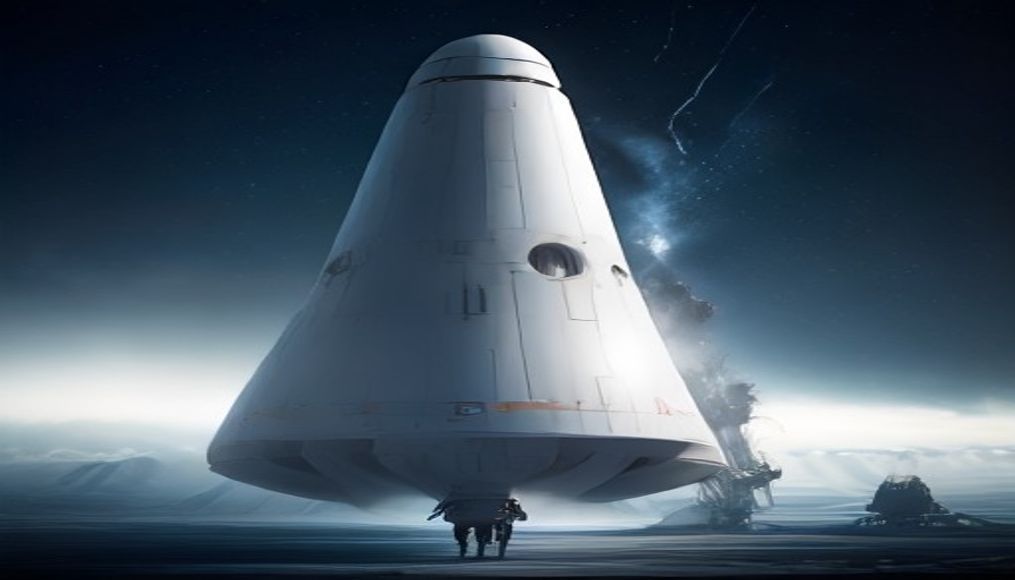

Remember when space was just for astronauts and grand, government-funded missions? Well, those days are rapidly becoming a quaint memory. We’re on the cusp of a manufacturing revolution, and it’s happening hundreds of miles above our heads. At the heart of this audacious shift is SpaceX, and specifically, their audacious new vehicle: the Starfall re-entry capsule. This isn’t just another piece of hardware; it’s a direct conduit to a future where gravity no longer dictates what we can create, fundamentally changing how SpaceX Starfall capsule transforms in-space manufacturing.
On June 23, 2026, the world quietly witnessed a pivotal moment. A Falcon 9 rocket, a familiar sight by now, soared from Cape Canaveral, carrying an uncrewed Starfall capsule. This wasn’t a mission to the ISS or a satellite deployment; it was a maiden voyage designed to prove a concept that could unlock entirely new industries. The capsule, a sleek, autonomous vessel, successfully validated its flight controls before gracefully splashing down in the Pacific Ocean. While the public might have focused on the spectacle of the launch and return, those in the know understood its true significance. This test wasn’t just about a successful flight; it was about demonstrating a reliable, repeatable pathway to and from the microgravity environment of orbit. And that, my friends, is where the magic, and the money, truly begin to flow.
The timing of this test flight is no accident. It followed hard on the heels of SpaceX’s initial public offering (IPO) in June 2026. This wasn’t just a big payday for Elon Musk and early investors; it was a liquidity event that injected a truly astonishing amount of capital into the commercial space industry. We’re talking about a financial tidal wave, and it’s already accelerating the growth of a new generation of frontier-technology startups. These aren’t your grandfather’s aerospace companies; they’re nimble, innovative ventures focused on in-space logistics, orbital manufacturing, and, crucially, autonomous re-entry systems like Starfall. This isn’t just about getting things into space; it’s about making space a viable, profitable place to make things, and then bring them back down to Earth. It’s a full-circle economic model that Starfall is poised to enable.
The Allure of Microgravity: Why Build in Orbit?
You might be wondering, why bother manufacturing in space? What’s so special about microgravity? The answer is profound and multifaceted, touching everything from medicine to advanced materials. On Earth, gravity is a constant, often unseen, force that influences every chemical reaction, every crystal formation, every material aggregation. It causes sedimentation, convection currents, and imperfections in structures that are impossible to eliminate, no matter how precise our terrestrial manufacturing techniques become.
In the near-zero gravity environment of orbit, these constraints vanish. Imagine growing perfect, large crystals of pharmaceuticals without gravity causing them to settle or clump, leading to purer, more effective drugs. Think about manufacturing optical fibers with an unprecedented level of clarity and uniformity, free from the micro-defects caused by gravity-induced sagging or impurities. Or consider creating novel alloys and composites with unique properties, where different materials can mix and bond in ways that are simply impossible when fighting against Earth’s pull. These aren’t sci-fi dreams; they are tangible possibilities, and they represent multi-billion-dollar opportunities for industries willing to look skyward.
The Starfall capsule, designed to carry up to 2,200 pounds of payload, effectively acts as a mobile, self-contained microgravity laboratory. This isn’t just about conducting experiments; it’s about enabling industrial-scale production in an environment that offers unparalleled advantages. Pharmaceutical companies, for instance, are keenly interested in protein crystallization in microgravity. Proteins, the building blocks of life and the targets of many drugs, often crystallize poorly on Earth, making it difficult to study their precise 3D structures. In microgravity, these crystals can grow larger and more perfectly, providing invaluable insights for drug discovery and development. This is a direct answer to how SpaceX Starfall capsule transforms in-space manufacturing, particularly for high-value biologicals. (See: International Space Station Overview.)
From Lab Bench to Orbit: Specific Applications
Let’s get specific about some of the industries poised for disruption. Beyond pharmaceuticals, the optical fiber sector is a prime candidate. ZBLAN, a type of fluoride glass fiber, exhibits significantly lower signal loss than traditional silica fibers – but it’s incredibly difficult to produce with high quality on Earth due to gravity-driven crystallization and imperfections. In microgravity, ZBLAN fibers could be drawn with near-perfect structures, leading to a new generation of ultra-high-bandwidth communication cables and superior laser systems. This isn’t just an incremental improvement; it’s a quantum leap in performance that could redefine data transmission and various optical technologies.
Material science is another huge beneficiary. Imagine creating superalloys with enhanced strength-to-weight ratios or novel semiconductor materials with superior electronic properties, all thanks to the unique solidification processes possible in microgravity. Even the production of certain types of industrial crystals, used in everything from sensors to high-power lasers, could see dramatic improvements in quality and yield. The ability to precisely control the solidification of molten materials without the interference of convection currents or segregation caused by density differences opens up a universe of possibilities for advanced materials engineers. Starfall isn’t just a delivery vehicle; it’s an orbital foundry, an alchemist’s lab in the sky.
Starfall’s Unique Capabilities: More Than Just a Ride
What makes Starfall stand out from other space cargo solutions? It’s not just its capacity, though 2,200 pounds is a respectable amount for specialized manufacturing payloads. It’s the combination of its autonomous flight controls, precision re-entry, and targeted splashdown capability. This isn’t about dropping a capsule somewhere vaguely in the ocean; it’s about retrieving valuable, often delicate, payloads with minimal delay and risk. For high-value products like specialized pharmaceuticals or pristine optical fibers, this rapid and reliable return is absolutely critical.
The autonomous nature of Starfall’s operations also reduces the need for extensive human intervention, streamlining the logistics chain. This means lower operational costs and increased mission flexibility. You’re not relying on a complex, multi-stage human-crewed mission for every manufacturing run; you’re essentially calling an orbital Uber for your bespoke space-made goods. This efficiency is a cornerstone of how SpaceX Starfall capsule transforms in-space manufacturing from an experimental endeavor into a commercially viable enterprise.
Furthermore, Starfall’s design allows for a contained, stable microgravity environment throughout the mission duration. This is crucial for processes that require sustained, consistent conditions, such as crystal growth or complex alloy solidification. Vibrations, temperature fluctuations, and other disturbances that can plague larger, more complex orbital platforms are minimized. It’s a dedicated, purpose-built platform for microgravity manufacturing, designed from the ground up to optimize conditions for sensitive industrial processes. This focused design ethos is what truly sets it apart.
The Broader Ecosystem: A New Space Economy Blossoms
The success of Starfall, and the capital injection from SpaceX’s IPO, isn’t happening in a vacuum. It’s catalyzing a broader ‘New Space’ economy. We’re seeing a burgeoning ecosystem of startups focused on everything from in-space logistics – think orbital fuel depots and repair services – to advanced robotics for assembly in orbit. Autonomous re-entry systems, like Starfall itself, are becoming a hot area of innovation, as the ability to reliably bring products back to Earth is just as important as getting them up there in the first place. (See: In-space manufacturing advancements.)
This isn’t just about SpaceX; it’s about the entire industry maturing. With more private capital flowing in, and proven technologies like Starfall demonstrating commercial viability, the risk profile for investors in space ventures is changing. What was once seen as a purely speculative, high-risk sector is now attracting serious institutional money. This financial impetus is fueling innovation at an unprecedented pace, creating a virtuous cycle where technological breakthroughs attract more investment, leading to even more advanced capabilities. It’s an exciting time to be watching, and perhaps investing, in this rapidly expanding frontier.
Investment and Opportunity: The Financial Impact
For investors, the implications are significant. We’re seeing new opportunities emerge in space tech investment analysis, focusing not just on launch providers, but on the entire value chain of in-space manufacturing. Companies that can provide B2B services for orbital factories, such as specialized power systems, environmental controls, or even orbital waste management, are finding fertile ground. The discussion around the financial impact of space ventures has shifted from theoretical to concrete, with real revenue streams and profit margins on the horizon.
Consider the market for high-purity semiconductors or next-generation optical components. If in-space manufacturing can deliver products with superior performance at a competitive cost, the demand will be enormous. This isn’t just about niche markets; it’s about potentially disrupting established terrestrial industries with products that simply cannot be replicated on Earth. The early movers in this space, those who can leverage Starfall and similar capabilities, stand to capture significant market share and create entirely new product categories. This is a truly compelling answer to how SpaceX Starfall capsule transforms in-space manufacturing in a very tangible, economic sense.
Challenges and the Road Ahead for Orbital Manufacturing
Of course, it’s not all smooth sailing and limitless potential. Significant challenges remain. The cost of launch, while decreasing, is still a major factor. While Starfall offers a relatively affordable way to access microgravity, scaling up manufacturing to truly industrial levels will require even greater efficiencies. We’ll need more frequent launches, larger payload capacities, and perhaps even reusable orbital platforms to bring down the per-unit cost of space-made goods.
Regulatory frameworks also need to evolve. Who owns what in space? How are intellectual property rights protected? What are the international agreements governing commercial manufacturing in orbit? These are complex questions that require thoughtful answers from governments and international bodies. Moreover, the technical challenges of automating complex manufacturing processes in a remote, unforgiving environment are considerable. Robotics and AI will play an increasingly vital role in making orbital factories truly autonomous and efficient. (See: SpaceX's impact on space exploration.)
But these challenges, while real, don’t diminish the promise. They are hurdles to be overcome, not insurmountable barriers. The trajectory is clear: humanity is moving towards utilizing space not just for exploration and observation, but for economic activity. Starfall is a powerful testament to this shift, providing a crucial piece of the puzzle for a robust, Earth-independent industrial base.
The Future is Fabricated in Orbit
Imagine a world where life-saving drugs are synthesized with unprecedented purity, where communication networks are powered by optical fibers so clear they transmit data almost flawlessly, and where materials exist that defy the limits of terrestrial physics. This isn’t a distant dream; it’s a future being actively engineered by companies like SpaceX, with tools like the Starfall capsule leading the charge.
The successful maiden flight of Starfall on June 23, 2026, was more than just a technical achievement. It was a clear signal that the era of in-space manufacturing is not only here, but it’s accelerating. As more capital flows into the space industry, and as technologies like Starfall become more reliable and cost-effective, we can expect to see an explosion of innovation. The question is no longer if we will manufacture in space, but rather, how quickly we can build out the infrastructure to realize its full, transformative potential. Get ready, because the things we’ll be making off-world are going to change everything we thought we knew about production here on Earth.
Frequently Asked Questions
What is SpaceX's Starfall capsule?
SpaceX's Starfall capsule is a new autonomous re-entry vehicle designed for in-space manufacturing. It aims to revolutionize how products are created in a microgravity environment, offering a reliable pathway for transporting materials to and from orbit.
How does the Starfall capsule impact manufacturing?
The Starfall capsule enables manufacturing in microgravity, allowing for the creation of materials and products that are not possible on Earth due to gravitational constraints. This could lead to entirely new industries centered around space-based production.
What was the significance of the Starfall capsule's maiden flight?
The maiden flight of the Starfall capsule on June 23, 2026, was significant because it validated the capsule's flight controls and demonstrated a reliable method for accessing microgravity, marking a crucial step in advancing in-space manufacturing capabilities.
How does SpaceX's IPO relate to the Starfall capsule?
SpaceX's IPO in June 2026 provided a substantial influx of capital into the commercial space industry, which is accelerating the development of new technologies, including the Starfall capsule, and fostering a wave of innovative startups focused on space logistics.
What are the future implications of the Starfall capsule?
The Starfall capsule could lead to a manufacturing revolution in space, unlocking new industries and opportunities by enabling the production of advanced materials and products that leverage the unique conditions of microgravity.
Agree or disagree? Drop a comment and tell us what you think.