edchat

The A-Z of Education: Curriculum and Instruction

In this series, I hope to guide you in acquiring the vocabulary that you need to know to be considered a competent education professional. In this article, we will discuss education vocabulary centered on curriculum and instruction.

Click here to view all of the articles in this series.

Convergent Questions allow students a chance to provide simple, single answer to questions, which can even be narrowed down to yes or no responses.

Curriculum refers to a predetermined set of courses, as well as the course content, that is offered at an educational institution.

Curriculum Mapping describes the process through which schools detect gaps in learning between curricula, by analyzing a database where teachers enter course planning, content, skills, and assessment information. Any gaps detected are managed appropriately to ensure that the standard of learning provided at the institution meets district or state requirements.

Differentiated Instruction refers to the concept that defines the fact that students learn differently and have to receive instruction according to those differences.

Direct Teaching Methods refer to instances where the teacher is primarily regarded as the provider of information. The teacher is in full control of the pace, content, and structure of the lesson at all times, and students are required to follow.

Divergent Questions are questions that could have more than one answer. These require students to analyze responses before selecting.

Indirect Teaching Methods refer to instances where students take the primary responsibility and the teacher acts as a facilitator. The students are responsible for the direction and pace of their learning, as well as the content to variable degrees.

Integrated Teaching Methods combine direct and indirect teaching methods. The teacher begins with an instructive session and gradually engages the students to take the lead.

Learning Style refers to the various methods by which students are able to learn information presented to them, and which style suits them best.

Pedagogical Content refers to what binds subject knowledge with pedagogy. Pedagogical content knowledge might be viewed as a profound understanding, interpretation, and adaptation of the curriculum, which may only be achieved by a profound knowledge of the subject, the curriculum, and the students. It refers to the way that the teachers organize the topics and choose the clearest analogies and metaphors in order to leave an impact on their students.

Standardized System is an education system that has the same characteristics for all individuals and all institutions.

Student-Centered Curriculum refers to a non-authoritative, participation-focused model that reflects the necessity of a focus on both learners and learning.

Subject-Centered Curriculum is divided into strict subject areas, where there is little flexibility for cross-curricula activity. Subjects are taught in isolation, and there is an emphasis on acquisition and memorization of information and knowledge regarding each specific content area.

Theories-in-Use are theories that we take for truths, often without consciously analyzing, evaluating, or questioning them in any way.

Are there any terms that I missed?


Why global education rankings don’t reveal the whole picture

Daniel Caro, University of Oxford and Jenny Lenkeit, University of Oxford

Country rankings in international education tests – such as PISA and TIMSS – are often used to compare and contrast education systems across a range of countries. But it isn’t always an even playing field.

This is because countries with very different social and economic realities participate, so countries such as Norway, Russia, Chile, Lebanon and Thailand are all being compared against each other. And this is without the difference in socio-economic backgrounds of these different countries being taken into account.

If the latest world education rankings are anything to go by, Turkey and Thailand perform poorly when it comes to their students’ achievement in science. But our analysis shows that if you look at the rankings differently (from an even starting point), both Thailand and Turkey may in fact be just as good as some of the high performing Asian countries.

Our analysis is a much fairer comparison, as it allows for the differences in wealth and social development in which students learn and teachers teach. It builds upon our previous work, where we produced and analysed an indicator of “effectiveness”. The effectiveness indicator ranks performance of countries as if they all had similar socio-economic conditions – thus levelling the playing field.

This makes it easier to see which countries are actually the most effective at educating their students, with social economic factors like wealth taken into account.

New style rankings

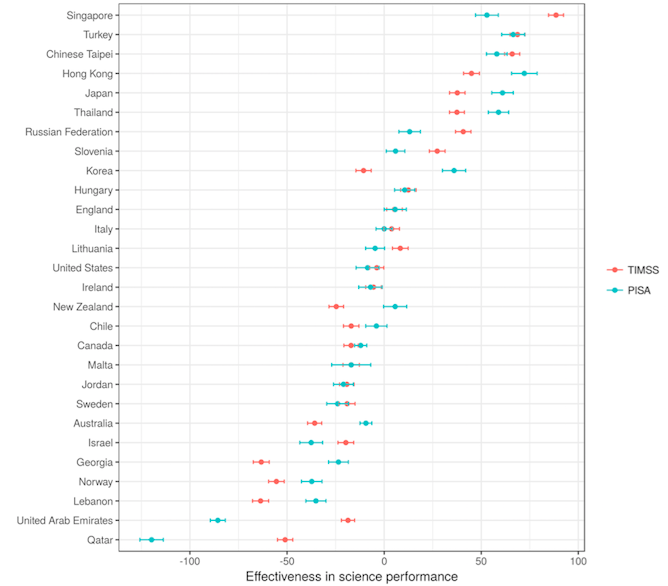
The graph below shows how countries are ranked in their effectiveness. At the top of the effectiveness ranking, we find education systems such as Singapore and Japan, which are also generally high performing in PISA and TIMSS.

TIMSS-PISA 2015. Values higher than zero (towards the right-hand side) indicate that students in those education systems perform above expectations, meaning the education system is effective. Those values below zero, to the left, indicate ineffective education systems.
Author provided

But our analysis also revealed that countries such as Turkey and Thailand are actually highly effective and perform above expectations in terms of education. This is despite both countries having an overall lower performance score in the global education rankings.

As the graph shows, the performance of education systems in Turkey and Thailand is underestimated if guided by country rankings alone. This is because although these countries perform below average and rather poorly in PISA, they are as effective as high performing Asian countries.

This means that Turkey and Thailand would be ranked among the highest performing countries in the world – if there was no socio-economic differences between countries.

TIMSS-PISA 2015. Effectiveness vs performance according to rankings. The horizontal line at 0 separates effective from ineffective systems and the vertical line at 500 indicates average performance for TIMSS and OECD education systems.
Author provided

Our analysis also shows education systems in Norway are ineffective, and the same was found to be true of Australia. So while these countries are ranked highest in human development in the world, they are not among the highest performing in these international tests when we level the playing field.

On the lower end of the effectiveness ranking, we find Qatar and the United Arab Emirates. These countries are also among the lowest performing in PISA rankings and could be doing much better for their high income per capita levels.

Fair comparison

It is clear then that overall performance rankings alone do not make a fair comparison when it comes to judging the quality of education in different countries. And our analysis shows how the socioeconomic conditions of a country are vitally important when comparing global performance in education rankings.

The ConversationUsing our data, there would certainly be a case for countries like Chile, Malta, Georgia, the United Arab Emirates and Qatar to look to Turkey and Thailand to work out how to improve their education systems. And as our analysis shows, global education rankings are probably not the best measure of educational performance after all.

Daniel Caro, Research Fellow, Oxford University Centre for Educational Assessment, University of Oxford and Jenny Lenkeit, Research Fellow, Oxford University Centre for Educational Assessment, University of Oxford

This article was originally published on The Conversation. Read the original article.

Is charter school fraud the next Enron?

Preston Green III, University of Connecticut

In 2001, Texas-based energy giant Enron shocked the world by declaring bankruptcy. Thousands of employees lost their jobs, and investors lost billions.

As a scholar who studies the legal and policy issues pertaining to school choice, I’ve observed that the same type of fraud that occurred at Enron has been cropping up in the charter school sector. A handful of school officials have been caught using the Enron playbook to divert funding slated for these schools into their own pockets.

As school choice champions like Secretary of Education Betsy DeVos push to make charter schools a larger part of the educational landscape, it’s important to understand the Enron scandal and how charter schools are vulnerable to similar schemes.

What is a related-party transaction?

Enron’s downfall was caused largely by something called “related-party transactions.” Understanding this concept is crucial for grasping how charter schools may also be in danger.

Related-party transactions are business arrangements between companies with close associations: It could be between two companies owned or managed by the same group or it could be between one large company and a smaller company that it owns. Although related-party transactions are legal, they can create severe conflicts of interest, allowing those in power to profit from employees, investors and even taxpayers.

This is what happened at Enron. Because Enron wanted to look good to investors, the company created thousands of “special purpose entities” to hide its debt. Because of these off-the-books partnerships, Enron was able to artificially boost its profits, thus tricking investors.

Enron’s Chief Financial Officer Andrew Fastow managed several of these special purpose entities, benefiting from his position of power at the expense of the company’s shareholders. For instance, these companies paid him US$30 million in management fees – far more than his Enron salary.

Fastow also conspired with other Enron employees to pocket another $30 million from one of these entities, and he moved $4.5 million from this scheme into his family foundation.

Enron’s collapse revealed the weaknesses of the gatekeepers – including boards of directors and the Securities and Exchange Commission – that are responsible for protecting the markets. Because of lax accountability and federal deregulation, these watchdogs failed to detect the dangers posed by Fastow’s conflict of interest until it was too late. Congress responded by passing the Sarbanes-Oxley Act, which tightened the requirements for oversight.

Enron employees lost their jobs and billions of dollars in pension benefits.
AP Photo/Pat Sullivan

How do related-party transactions occur in charter schools?

Forty-four states and the District of Columbia have legislation that allows for charter schools. Just like public schools, charter schools receive public funding. However, unlike public schools, charter schools are exempt from many laws governing financial transparency.

Without strict regulation, some bad actors have been able to take advantage of charter schools as an opportunity for private investment. In the worst cases, individuals have been able to use related-party transactions to fraudulently funnel public money intended for charter schools into other business ventures that they control.

Such was the case with Ivy Academia, a Los Angeles-area charter school. The co-founders, Yevgeny Selivanov and Tatayana Berkovich, also owned a private preschool that shared facilities with the charter school. The preschool entered into a sublease for the facilities at a monthly rent of $18,390 – the fair-market value. The preschool then assigned the sublease to the charter school at a monthly rent of $43,870.

The Los Angeles district attorney’s office charged the husband-and-wife team with multiple counts of fraud. Selivanov was sentenced to nearly five years in jail in 2013.

Fraudulent related-party transactions can also occur between education management organizations (EMOs) and their affiliates. EMOs are for-profit or nonprofit entities that sometimes manage charter schools, and might also own smaller companies that could provide services to those schools.

For example, Imagine Schools is a nonprofit EMO that runs 63 charter schools enrolling 33,000 students across the country. It also owns SchoolHouse Finance, a for-profit company that, among other things, handles real estate for many of Imagine’s charter schools. Though charter schools typically spend around 14 percent of their funding on rent, some of the Imagine Schools were paying SchoolHouse Finance up to 40 percent of their funding for rent.

One of the charter schools operated by Imagine Schools, Renaissance Academy in Kansas City, sued the company for charging it excessive rent. In 2015, a federal judge agreed, ordering Imagine Schools to pay almost $1 million in damages to Renaissance. The court’s ruling suggested that Imagine Schools was essentially taking advantage of the charter school: The EMO profited from the excessive rent and failed to tell the school’s board of directors how the cost might disrupt the school’s ability to pay for textbooks and teacher salaries.

Students at Renaissance Academy charter school work on a paper recycling project. Renaissance Academy shut down in 2012 and was later ordered to receive $1 million in damages from its EMO, Imagine Schools.
AP Photo/Orlin Wagner

The problem could get worse

Because of insufficient oversight, Fastow’s fraudulent use of related-party transactions at Enron was not stopped until it was too late. Similarly, the Ivy Academia and Renaissance Academy examples reveal insufficient checks and balances in the charter school sector. In both cases, the monitors responsible for protecting charter schools found nothing wrong with the rental agreements.

It might be tempting to conclude that Ivy Academia and Renaissance Academy stories are anecdotal – that fear of widespread abuse of related-party transactions is overblown. However, there have been dozens of allegations of similar transgressions, including against industry giants such as K12 Inc. and Pennsylvania Cyber Charter School. Though only a handful of these allegations have resulted in the removal of the charter school operators, related-party fraud in the charter school sector is an emerging issue.

In September 2016, the Education Department’s inspector general released the findings of an audit of several dozen charter schools detailing significant problems with related-party transactions.

The report also made several recommendations for additional oversight. Such protection could come at the state level (e.g., providing guidance to states regarding charter school contractual agreements with EMOs) or at the federal level (e.g., improving the Department’s own monitoring of charter school-EMO relationships).

However, Trump has generally expressed a dislike of federal regulations, and DeVos, who played a major role in the development of Michigan’s charter school law, has successfully fought attempts to increase oversight of Michigan’s charter school sector. With such anti-regulatory stances, it seems unlikely that Trump or DeVos will support the kind of oversight that’s needed to protect charter schools.

The ConversationThis aversion to regulation at the federal level could cost taxpayers millions of dollars and could result in the closing or disruption of schools – potentially damaging the education of students they serve. Since charter schools are growing fastest in low-income and minority communities, these children stand to be hurt the most.

Preston Green III, John and Carla Klein Professor of Urban Education, Professor of Educational Leadership and Law, University of Connecticut

This article was originally published on The Conversation. Read the original article.

4 Things That Educators Should Know About Education Reform

The United States educational system has undergone several reforms in response to the ever-changing needs of society. As high school graduates are expected to become a part of the national workforce, the output of schools needs to be in line with the expectations conferred on the national workforce as a whole. In this article, you will be guided through the major reforms that have taken place in the United States.

Reform refers to rectifying something that is unfit for its purpose. It is an ongoing process. Your educational experience was likely influenced by reform, and no doubt you too will be required to make certain adjustments or changes in your style of teaching on the basis of new reforms. Reform initiatives are also powerful sociopolitical agendas, which may determine the education you receive to become a teacher, the structure of the school in which you will teach, or the perception of what constitutes “effective teaching” as you begin your work as a new teacher.

To understand actions to change today’s education environment, you must have an understanding of reforms of the past. This will not only help you to become a better teacher; it will also allow you to use this knowledge when you become involved in the making and shaping of educational policy. Developments in technology, growing concerns around sustainability and increasing globalization, and the diverse multicultural society that has developed all put pressure on the educational system to change and undergo reforms. You never know what challenges the future will hold in this regard, or when you will be called upon to comment on or participate in reform initiatives.

Of fundamental importance to any discussion of educational reform is the role played by major stakeholders in the U.S. educational enterprise. As result, throughout this article we address the roles played by school districts, the states, and the federal government, and the impact of each on education reform. We also look at your calling to be a teacher, and the role you will play in enacting and participating in educational reform.

What education reforms in the United States have influenced how education is viewed and practiced today? The Commission of the Reorganization of Secondary Education’s 1918 report recommended that high schools offer a more diverse array of material than purely academic subjects. Subsequent reforms bolstered the provision of electives, and introduced guidance counselors and vocational training. The 1983 A Nation at Risk report suggested that the United States was failing to provide an adequate education. This report led to reforms in standardizing academic content and to a focus on standardized testing. In the 1980s and 1990s, teachers reacted against the confines of the standardized testing model. Growing awareness of poverty led to “full-service” schools, which provided health care, parent instruction, and more. In the 2000s, more diverse opportunities were on offer, including a rise in homeschooling, charter schools, and virtual schools. With the school voucher system, magnet schools, and open enrollment, strictures on attending public schools loosened somewhat.

What role (current and historical) has the school district, state, and federal government played in educational reform in the United States? District involvement in educational reform has traditionally been heavy, but recently districts are becoming more decentralized, giving more power to school boards and principals. States were initially interested in results-based reforms, focusing on grades and test scores. In the late 1980s, states moved toward more deregulation, which lasted about a decade. In the 1990s, states restructured schools in ways that fostered student development and empowered teachers. The No Child Left Behind Act in the early 2000s returned to a focus on standards-based education, though it has been heavily criticized and is viewed as being in need of reform. In the early 2010s, the federal government created the Common Core Standards, which provide teachers with insights into the skills and knowledge students require to excel.

At the end of December 2015, President Obama signed the Every Student Succeeds Act (ESSA) into law, effectively sweeping away NCLB (Nelson 2015). The new bill made major changes to federal education policy. One thing that changed with the ESSA was how teacher performance is evaluated. States now have the ability to individually appraise how well its teachers are doing performance wise. Another alteration under the new law will allow states “to come up with their own way to determine the quality of their local schools.” This means that test scores are no longer the sole deciding factor for school performance.

ESSA lists music as a component of a well-rounded education and gives it more support than previous policies when it comes to access and funding. The law also means federal grant funding is opened for states and local school districts to support music education programs and further train music teachers. ESSA has been a long time coming. Considering that NCLB had needed an update since 2007, it is shocking how long it took to sign this new law.

What are the most significant trends and developments in educational reform in the United States today? Alternative teacher education programs are growing, though there have been criticisms that they focus on quantity rather than quality. The Teacher Education Accreditation Council (TEAC) and the National Council for Accreditation of Teacher Education (NCATE) are in the process of merging into a single body called the Council for the Accreditation of Educator Preparation (CAEP). NCLB has expanded parental rights by giving them more public school options. More collaboration between educational bodies at the state and district levels are helping to improve policy coordination. The idea of year-round schools is gaining ground among some reformers. Value-added assessment, which focuses on individual improvement rather than comparative scores, is another idea on the rise.

What factors promote successful reform? The creation of a “road map” is key to sustaining reform. Schools need commitment; ongoing improvement and development; adequate time to accomplish reform; effective, sustained leadership; and adequate funding. Accurate and effective evaluation of the reforms is also crucial.

Did we miss anything?

Click here to read all of the articles from this series.

5 Things That Educators Should Know About Diversity

We live in a diverse world. Nowhere is this more evident than in the United States. For decades, our country has been known as the “Land of Opportunity.” A chance to participate in making use of these opportunities, however, requires the acquisition of an education. This education is easier to come by for some groups of people than others. For instance, there are some people who still believe that children with learning disabilities or physical disabilities should be kept out of the school environment. Not only does this type of thinking prevent these children from receiving an adequate education; it also prevents them from becoming independent and active contributors to society in their lives beyond school.

In order to understand the full impact of student differences on school environments, multiple aspects of diversity need to be addressed. The areas in which differences can exist include gender, socioeconomic status, and sexual orientation. It is also important to consider student variability in areas such as learning style and ability when we address the differences existing among students in schools.

Diversity in the United States is well represented in American schools. Public schools were created with the intention of ensuring that all students have equal access to quality education. Teachers today work in schools with diverse populations of students, in a country where diversity is only now being accepted and embraced. This diversity, however, extends beyond the boundaries of culture and ethnicity. It includes differences in affiliation, preferences, and sexual orientation. In this article, we will discuss all of the things that educators should know about diversity.

How intellectually diverse are our schools? Older IQ tests as a means of measuring intelligence are seen as flawed, and were often used to promote a racist agenda. Howard Gardner’s notion of multiple intelligences is gaining acceptance. Currently, the Wechler test, which also takes into account a broad variety of factors, is viewed as the most accurate measure of intelligence.

Gifted students and students with learning disabilities require special attention. Gifted students may benefit from broadened and accelerated learning. For students who have learning disabilities, it is important to ascertain the nature of the learning disability and work at solutions to enable the student to learn effectively. Students with learning disabilities may be highly intelligent, and many noted personalities have had learning disabilities. The law stipulates that students with learning disabilities should be given appropriate and nondiscriminatory education. Teachers will have to fill out Individualized Education Plans for these students.

How does gender affect student learning? Boys and girls have traditionally been treated differently in the classroom, and have been represented differently in textbooks, reflecting cultural norms. Boys are more likely to enroll in classes in mathematics, science, and engineering. Girls tend to do better in reading and writing and other academic subjects, but women still do not achieve the same job status and pay as men with equal qualifications: the gender gap has not yet been breached. While there are socially constructed differences, there also seem to be biological factors at play, though these are still not fully understood. It is important to create gender-aware classrooms, using teaching styles that appeal to both boys and girls. An approach focusing on students where they are, rather than the standardized “one size fits all” idea, may be useful.

What are the educational implications of sexual orientation? Lesbian, gay, bisexual, and transgender (LGBT) students are gaining increasing acceptance in educational settings, though this is highly dependent on location. However, the situation in U.S. schools is still difficult for LGBT students, and they are often the focus of bullying and aggression. This is even truer for LGBT students of color. Regardless of the policies of the school and the state, it is crucial that all students are safe from bullying, whether verbal or physical, from fellow students and teachers. As a teacher, you are obliged to protect your students, and to report abuse.

What are some of the other challenges that students face? Poverty is a dire and growing problem in the United States, particularly among minorities. As the gap between the wealthiest and poorest Americans continues to widen, those at the bottom end of the economic scale are being left behind. Problems they face include drugs, violence, broken homes, hunger, and inadequate medical coverage.

One and a half million children in the United States  are homeless, and face a special set of problems, including lack of nutrition and difficulties finding transportation. Many have faced  physical, sexual, or emotional abuse.

Teachers should be aware of signs that point to abuse, including shyness, bruises, and aggression, and should follow up with the appropriate authorities. Note that 97 percent of juvenile offenders were abused as children.

Bullying is perennial problem in schools, and now includes cyber bullying: bullying over the Internet. Violence is a related problem. In schools that have a problem with violence, structures should be put in place to minimize the issues. Drug use includes alcohol and tobacco, as well as illegal drugs. Thus far, programs implemented by schools and the government have done little to alleviate the problem.

Other issues faced by students include pregnancy and sex outside of marriage. Most schools promote abstinence, while still offering advice on safe sex and preventing and coping with pregnancy.

How can teachers accommodate different learning styles? Every student has an individual style of learning. They may be classified into three broad types of learners: visual, auditory, or kinesthetic. It may be helpful to view intelligence not as a linear scale but as a web. Your task as a teacher is to develop each student’s strengths and needs. Students are influenced by both “emotional” factors, which refers to the responsibility and persistence that the student naturally puts into learning, and “sociological” factors, which refers whether a student has a preference in learning individually, or in small or large groups. The Learning Style Inventory, which looks at five categories—environmental emotional, sociological, physiological, and psychological—may be helpful in assessing a student’s learning style.

Did we miss anything?

Click here to read all of the articles from this series.

The A-Z of Education: The Philosophy of Education

In this series, I hope to guide you in acquiring the vocabulary that you need to know to be considered a competent education professional. In this article, we will discuss education vocabulary centered on the philosophy of education.

Click here to view all of the articles in the series.

Alienation denotes a society that is organized into classes based on what they do or do not own.

American Exceptionalism is the idea that the United States is a special country with a manifest destiny.

Axiology is the branch of philosophy that considers the study of fundamental principles.

Behaviorism is the perspective that because behaviors are caused by experiences, altering circumstances will alter behaviors. (Also known as Behavior Modification)

Classical Conditioning is another term for conditioned behavior, a behavior that responds to a stimulus that doesn’t normally cause that reflexive response.

Classical Idealism is a branch of Idealist philosophy searching for the absolute truth. It is the theories of the renowned Western philosophers Socrates and Plato (427–347 BC), who were searching for an absolute truth.

Classical Realism is a branch of Realist philosophy that suggests that matter is real and that it is separate from our perceptions.

Cognitive Psychology, also known as constructivism, is the perspective that students “build” their knowledge as new experiences are linked to previous experiences.

Conception of Property and the Government is the liberalist notion that government shouldn’t interfere with business transactions.

Conceptualization of Ideas refers to the knowledge acquired through big ideas that allow us to understand the world around us.

Conditioned Behavior refers to a behavior that responds to a stimulus that doesn’t normally cause that reflexive response. (Also known as “reflexive conditioning” or “classical conditioning.”)

Conservatism is the belief that institutions should function according to their intended original purpose and any concepts that have not been maintained should be restored

Constructivism is the perspective that students “build” their knowledge as new experiences are linked to previous experiences. (Also known as Cognitive Psychology.)

Critical Theory is a philosophy of education that analyzes institutions, organizations, and instruction in terms of power relationships.

Deconstruction Method is a process of criticizing literary text, philosophical text, and political theory. It entails a breakdown of the rational purposes, or logos, of earlier Western philosophy that was believed to govern the universe.

Deductive Reasoning is reasoning that allows a person to think from general principles to a specific event.

Dialectical Epistemology is continuing to engage in class conflict and struggle and materialism.

Dialectical Materialism is the combination of materialism and realism with the Idealist idea of dialectical change. It perceives society as a developing and constantly changing network of human relationships that have economic consequences.

Educating for General Citizenship refers to the Liberalist belief that we should educate everyone equally and in preparation to become a political leader.

Episteme are the assumptions that contribute to a society at a particular time in history.

Epistemology is the branch of philosophy that contemplates how people come to learn what they know.

Equalitarian refers to aspiring to the doctrine that all human beings are equal; a less common word for egalitarian.

Essentialism is a philosophy of education that consists of core knowledge in reading, writing, math, science, history, foreign language, and technology.

Ethno-nationalism refers to loyalty to an ethnic or racial group rather than to a nation.

Existentialism is the philosophy that accentuates attentive personal consideration about one’s character, beliefs, and choices. The primary question existentialists ask is whether they want to define who they are themselves, or whether they want society to define them.

Existentialist Phenomenology concludes that we construct our own truths from within, as opposed to the previous theories of one universal truth.

Experimentalism is a conjecture that the earth is still in process and is still becoming, so that there is no absolute truth.

Forms of Good refers to a belief by Plato who arranged his ideas, referred to as “forms,” in a hierarchy with the greatest of all forms being the Forms of Good.

Global Communication Processes are how information is delivered. Television, email, Internet, newspapers, and textbooks are all sources of Globalization Communication

Global Economic Processes involve all aspects of buying and selling goods and services across the globe.

Global Educational Processes are the process by which schools and universities are expected to “compare and compete” globally. The World Bank fosters to the globalization these institutions by adjusting policies for less technologically developed countries.

Global Political Processes are the process by which government and officials are expected to “compare and compete” globally. The World Bank fosters to the globalization these institutions by adjusting policies for less technologically developed countries.

Globalization is the process that promotes worldwide participation and relationships between people of different countries, cultures, and languages.

Great Works are works of literature written by history’s finest thinkers that transcend time and never become outdated.

Historical Materialism is an analysis of capitalism.

Humanistic Psychology is a philosophy that focuses on the value and meaning of education rather than the dissemination and attainment of facts.

Idealism is a major school of thought in educational philosophy, of which the underlying principle is that reality is mostly spiritual. It is the belief that physical things exist only in the mind.

Individualism is the Liberalist belief that individuals retain inherent human rights that the social order cannot give or take away.

Inductive Reasoning refers to reasoning that allows a person to think from that specific event back to what the general principle was that caused the event.

Information Processing refers to how the brain processes information by attending to stimuli, and receiving, storing, and retrieving information.

Liberalism is the ideology that people should enjoy the greatest possible individual freedom and that it should be guaranteed by due process of law.

Life-Affirmation involves questioning even the most socially acceptable doctrines, such as Christianity and morality.

Logic is the branch of philosophy that looks to bring organization to the reasoning process.

Marginalize refers to taking or keeping somebody or something away from the center of attention, influence, or power.

Marxism is an ideological and political movement that focuses on the class system as a form of conflict within the social, political, and educational realms.

Metaphysics is the branch of philosophy that considers questions about the physical universe.

Modern Idealism is a branch of Idealist philosophy that believes in a material world and a world of the mind. It implies that since a man is thinking that he must exist. It further questions existence and how we came to be, concluding that some form of deity must be present that allows us to exist.

Modern Realism is a branch of Realist philosophy that suggests that everything we know comes from experience and reflecting on that experience. We are not born with any innate or preconceived ideas, but rather are a blank slate.

Nationalism is a national spirit, a love of one’s country, and the emotional ties to the interests of a nation and the symbols that represent it.

Operant Conditioning is a behavior conditioned by reinforcement for performing desired actions rather than causing reflexive behaviors.

Paideia Program refers to a Perennialist program developed from the book The Paideia Proposal. It is based on the Great Works of literature, and has been implemented by hundreds of schools in the United States.

The Paideia Proposal is a book that was written by Mortimer Alder in 1982, which described a system of education based on the Great Works. The book inspired the school model referred to as the “Paideia Program.”

Perennialism is a philosophy of education that asserts that certain notions transcend time and are predominantly found in the great literature of the ages.

Philosophy of Education Statement is a written description of what we interpret the best approach to education to be.

Postmodernism is a major school of thought in Educational Philosophy that describes the cultural changes to philosophy that are caused by present-day information such as from contemporary literature, feminism, and art.

Pragmatism is a major school of thought in Educational Philosophy, which concludes that our ideas serve a purpose and that we seek out that purpose by solving problems and considering what the consequences may be.

Problem-Solving Method is the method developed by John Dewey that deduces that people think in order to solve problems, and lists the steps used to search for absolute truth. The steps include: recognizing that there is a problem, clearly defining a problem, suggesting possible solutions, considering possible consequences, and observing and experimenting to either accept or reject the idea as an absolute truth.

Progress and Representative Political Institutions refer to the Liberalist belief that holds that liberation of human rights will lead to improving the human condition.

Rationality and the Power of Reasoning refers to the belief that most people can be reasonable, and that teachers need to use teaching methods that build and support the ability to rationalize and use their intelligence

Realism is a major school of thought in Educational Philosophy that is the notion that the world exists “because it does.”

Reflexive Conditioning is another term for conditioned behavior: a behavior that responds to a stimulus that doesn’t normally cause that reflexive response.

Religious Idealism is the branch of Idealist philosophy that theorizes two separate worlds: a world of God and a world of humanity. These two worlds are separated by sin, and the soul is the bridge to rejoin the world of God.

Religious Realism is the branch of Realist philosophy that presumes that God is pure reasoning, which is the truth of all things. Religious Realists believe the sole purpose of existence is to reunite the soul with God.

Scaffolding is a constructivist technique of “constructing meaning.”

Schemata are how we organize our knowledge that allows us easy access to memories that haven’t been used in some time.

Secularism is the belief in the strict enforcement of the separation of church and state.

Social Reconstructionism is the perspective that schools are the organization that should be used to solve society’s problems.

Society-Centered Philosophies go beyond focusing on strictly the teacher or the student, and focus on a group or a people instead. Whether it is a minority group or the world as a whole, society-centered philosophies focus on educating a group of people rather than a curriculum or a student.

Socratic Method is the process of gaining knowledge by carefully questioning and then criticizing the answers.

Socratic Seminars are lectures in which the teacher asks a specific series of questions in order to encourage the students to think, rationalize, and discuss the topic.

Student-Centered Philosophies refer to philosophies that focus more on educating students individually. They place more emphasis on the individuality of the students and helping them to realize their potential.

Teacher-Centered Philosophies are philosophies that pass knowledge on from one generation of teachers to the next. In teacher-centered philosophies, the job of the teacher is to impart a respect for authority, determination, a strong work ethic, compassion for those around us, and sensibility.

Are there any terms that we missed?

Understanding Academic Language and its Connection to School Success

Carlyn Friedberg, MS, CCC-SLP, Assessment Specialist, Lexia Learning

Alison Mitchell, Ph.D., NCSP, Director of Assessment, Lexia Learning

Elizabeth Brooke, Ph.D., CCC-SLP, Chief Education Officer, Lexia Learning

As students progress through school, they are expected to demonstrate increasing levels of sophistication in their language and reading skills across all content areas. In order to gain knowledge through independent reading and participate in meaningful discussions in the classroom, students must master the complex words and phrases that characterize the language of school. Proficiency in these skills, otherwise known as academic language, is critical for reading comprehension and overall academic success.

Across the country, educators and policymakers have begun to acknowledge the importance of academic language, as well as its notable absence from curriculum and assessment. Recent national and state standards reflect a shift towards academic language by calling for instructional focus on words that appear across content areas, as well as opportunities for students to develop knowledge of words and concepts through discussion and reading (Baker et al, 2014). Students must be able to determine the meaning of unfamiliar words, understand nuances in word meanings and multiple meaning words, and utilize sophisticated words and phrases, including transitions and precise word choice (National Governors Association Center for Best Practices & Council of Chief State School Officers, 2010). These demands are particularly challenging for students with impoverished experience or limited exposure to English.

Many students struggle with academic language because their exposure to language outside of school does not include advanced words and phrases. The transition to “school talk” poses a particular challenge for English Language Learners (ELLs) since they must simultaneously develop everyday language already familiar to their monolingual peers, along with academic language skills (O’Brien and Leighton, 2015). Without exposure to advanced English language skills at home, ELLs face double the demands of language learning. Increasing numbers of ELL students attending schools across the country, as well as significant numbers of students from low income backgrounds and those with learning disabilities, have made it an educational imperative that instruction and assessment directly promote students’ academic language proficiency.

What is Academic Language?

The term academic language may be used to refer to formal English rules, structure, and content for academic dialogue and text, and the communicative conventions that allow students to meet the demands of school environments. A concise definition refers to academic language as “the specialized language, both oral and written, of academic settings that facilitates communication and thinking about disciplinary content” (Nagy & Townsend, 2012). For actionable, instructional purposes, these specialized language skills include advanced vocabulary and syntax that help students unlock key elements of both oral and written language. These skills support the listener or reader in gaining a rich understanding of the message being delivered.

What are key elements of Academic Language?

Vocabulary and syntactic knowledge in oral and written language encompass specific skills that allow students to meet academic demands across the curriculum. Though commonly used to denote breadth of knowledge of word definitions (i.e., how many words a student knows), vocabulary knowledge also refers to depth of understanding of word parts (prefixes, suffixes, roots), multiple meanings, and figurative language that shape the subtleties of vocabulary use. Proficiency in word parts and relationships helps students acquire new vocabulary, reason about the meaning of unfamiliar words, and comprehend the sophisticated vocabulary that characterizes academic language, including:

  • Morphologically complex words (words with multiple parts, including prefixes and suffixes) e.g., comfortable; prediction; reconciliation
  • General-academic words that are high frequency and may be abstract or have multiple meanings, e.g., investigate; principle; asylum
  • Discipline-specific words that typically contain Greek combining forms, e.g., ecosystem; longitude; integer

Syntactic knowledge refers to the understanding of parts of speech and rules that govern how words and phrases combine into sentences, and how sentences combine into paragraphs. To comprehend connected text, students must master basic grammatical rules as well as sophisticated knowledge of words and phrases that are used to establish referents, organize ideas, denote relationships between concepts, and develop text cohesion, including:

  • Use of connective words requiring sentence-level inferencing, e.g., consequently; whereas; similarly
  • Resolution of pronoun reference, e.g., We examined the extent to which native plants in coastal regions adapted to climatic changes in their (The reader needs to connect the pronoun their to the noun native plants)
  • Grammatical agreement between subjects, verbs, and tense, e.g., All of the candidates, as well as the current President, are attending the televised debate.

Given the increasing emphasis on students’ abilities to independently engage with complex text, perhaps the domain most impacted by students’ academic language skills as they progress through school is reading comprehension. In fact, researchers have shown that reading comprehension difficulties are in large part due to students’ challenges in understanding the academic language of school texts (Uccelli et al, 2015). Vocabulary knowledge particularly predicts students’ literacy achievement, because it contributes significantly to both word identification and reading comprehension skills. In addition, vocabulary and syntactic knowledge have been shown to account for the majority of individual differences in reading comprehension performance for students in upper elementary school through high school (Foorman, Koon, Petscher, Mitchell, & Truckenmiller, 2015). Vocabulary knowledge and syntactic knowledge help students engage with text and progress towards deep reading comprehension with increasing independence by supporting their abilities to:

  • Acquire knowledge through reading and synthesize it with previously learned material
  • Analyze audience, structure, purpose, and tone of texts
  • Evaluate evidence, main ideas, and details in what they read

How do you teach Academic Language?

Instruction in academic language supports students’ access to content across all subject areas. Because the functions and structures of students’ home languages can significantly affect their reading comprehension, even when their first language is English (Westby, 2005), this instruction must be explicit and structured. Using language from the curriculum, educators of all disciplines can provide students with repeated exposure to and application of high-utility vocabulary words, both general-academic and discipline-specific, instruction in word-learning strategies and word relationships, and practice with complex syntactic forms.

In order to maximize the impact of academic language instruction, educators need to first understand their students’ specific language competencies. Educators should assess students’ knowledge of word associations, use of structural analysis, and abilities to make connections and inferences within and across sentences. In addition, evaluating both academic language and reading comprehension skills through use of authentic academic texts will help educators to identify students who need support coordinating vocabulary and syntactic knowledge with comprehension strategies.  By assessing students’ skills before, during, and after teaching academic language, educators can collect actionable data that helps identify which students are likely to be successful or at risk for academic difficulty and what areas to target in instruction.

Academic Language Instruction for Early Elementary Students

Students need a strong foundation in age-appropriate language to aid their comprehension and expression in the classroom and support them towards engaging with more complex language as they progress through school. For early elementary students who are learning to read, academic language can be taught via oral language instruction. As students’ reading skills develop, they can apply their knowledge to text. Educators can leverage younger students’ natural enthusiasm for learning new words and participating in discussions to teach vocabulary and syntactic skills using the following strategies:

  • Foster a language-rich classroom that includes opportunities for students to learn and apply new vocabulary when following directions, describing, participating in conversations, and listening and responding to stories.
  • Provide explicit instruction in word relationships and categories, high-utility vocabulary (e.g., spatial, relational, temporal, and descriptive words), and content-area words.
  • Teach word-learning strategies for acquiring new vocabulary, including the use of sentence-level context clues and word analysis skills.
  • Demonstrate self-monitoring of comprehension when encountering complex language and ideas in texts read aloud.

Academic Language Instruction for Upper Elementary and Secondary Students

As students approach third grade and beyond, extracting relevant meaning while reading becomes more essential but challenging as students encounter texts that are increasingly complex and diverse (Nagy & Anderson, 1984). To meet these challenges, upper elementary and secondary students need instruction in more sophisticated academic language skills, including advanced vocabulary and grammatical structures. In particular, instruction in words and phrases that contain Greek and Latin word parts are essential to academic success (Corson, 1997), as 60–90% of words found in academic contexts contain these forms. Illuminating the connection between the root “struct” and the words “instruct,” “construct,” and “destruction” not only provides a key to the meaning of those words, but may also inspire students to engage with future novel words in an inquiring manner. Educators can help older students build their vocabularies, learn ways to reason about unfamiliar words, and think critically about what they have read with the following strategies:

  • Teach students about the morphological structure of words (prefixes, suffixes, and base/root words) and how words are joined together. Transitioning students’ thinking from “I don’t know the meaning of this word” to “What parts of this word do I recognize?” has the potential to generate a more active approach in a student’s response to spoken and written language.
  • Before students read class selections, preview and pre-teach vocabulary that will be important for their comprehension of the text, and provide semantic maps (graphic organizers or “webs” that connect new vocabulary to related words and concepts) when teaching new words.
  • Combine exposure and modeling with guided practice and independent, repeated oral and written application.

In addition to developing vocabulary, students need explicit instruction in the ways that words connect to other words, phrases, and concepts; new words must be learned and applied alongside the language structures within which they appear (Nagy and Townsend, 2012). With opportunities to read, write, say, and hear language that varies in form and function across contexts, students can internalize syntactic knowledge skills. In particular, focusing on connective (or “signal”) words and phrases in text can help students interpret relationships between ideas within and across sentences, clarify what they have already read, and provide clues to what they will read.  To teach syntax skills, educators can use the following strategies:

  • When discussing texts, coach students through the meaning of sentences that require careful interpretation, especially those that require connections or inferences about multiple ideas.
  • Provide students with sentence frames that chunk complex sentences into meaningful phrases and demonstrate how changes in word choice and order affect meaning, subject-verb agreement, and pronoun usage.
  • Enhance lessons and conversations using academic language with pictures, video, and other multimedia to help students with language weaknesses connect definition and function to concepts and their current background knowledge.

Summary

Through targeted assessment and explicit instruction in academic language, educators have the power to impact students’ vocabulary knowledge, syntactic knowledge, and, subsequently, their reading comprehension. Although this instruction is particularly critical for struggling readers and English Language Learners, all students will benefit from targeted instruction in the words, phrases, and forms that constitute academic texts and discussions. While teachers’ classroom practices support students individually, school leaders can bolster language gains through selection of curriculum, assessment, and professional development opportunities that target this goal.  A unified mission around academic language helps districts and schools improve students’ likelihood of educational success and provides students with the tools they need to comprehend their world, in school and beyondReferences:

Click here to access the references for this whitepaper.


The A-Z of Education Blogs: Letters A-B

Staying abreast of the constant changes in education is almost a full-time job on it’s on! That’s why subscribing to a few good education blogs is a convenient and time-saving way to remain knowledgeable about this constantly evolving landscape.

Click here to access all of the articles in this series.

Education blogs exist for almost every purpose you can imagine. There are blogs dedicated to edtech, higher education, early childhood education, the teaching of math, reading, science and virtually any other discipline that you can think of. There are blogs about coding and blogs about blogging, geared towards every grade level from kindergarten all the way up through the terminal and professional degree levels.

But how do you know which of these are worth your time? We decided to do this work for you. In this multi-part series, I will profile the best of the best blogs in education, in alphabetical order.

Although we did not rank the blogs, we did evaluate them using the following categories as a rubric:

Activity (25%). Information should be updated regularly to reflect the very latest trends.

Originality (25%). It should add value with content that’s different from all the other blogs out there.

Helpfulness (25%). A good education blog should teach you a new skill, direct you to a useful resource, or at least get you to think in a new way about something.

Authority (25%). The author/authors have the authority and credentials to blog about the topic.

Each category was assigned an equal weight in our evaluation. They were averaged together to determine the final score. This score is meant to provide you with information about the overall quality of each blog. Let’s begin by tackling letters A-B.

A Millennial Professor’s View of Higher Education

The blog focuses on many of the different aspects of higher education administration and staffing, from finding a job to creating and maintaining long-term relationships in the academic world. If you are an administrator, this is definitely a blog you should be checking out regularly.

Score:  Active 18.3, Original 22, Helpfulness 23, Authority 22

Total: 85.3

Twitter: @drjtedwards

A Principal’s Reflections

Eric Sheninger reflects on digital leadership and how it affects parental communication and student and faculty engagement. He connects trends in technology with changes in the larger culture.

Score: Activity 25, Originality 23, Helpfulness 23, Authority 25

Total Score: 96

Twitter: @E_sheninger

Academic Computing

A new blog posts about every other month, but it well worth the wait. The focus is on coding in higher education and new technology. It also touches on topics that matter to professors and students who would like to keep up with the way colleges are teaching computer basics and coding.

Score:  Active 10, Original 25, Help 20, Authority 25

Total: 80

Twitter: @neilccbrown

Academic Tech Tips

This blog takes a look at the newest tools and trends that professors and administrators can use in schools. It also provides some help on common tools and how to get the most out of them.

Score:  Active 23, Original 19, Help 20, Authority 17

Total: 79

Email: [email protected]

ACRLog

The blogs focus on things that matter to both librarians and academics. It takes a look at how best to reach students through the library setup, how to manage events and a host of other items that you may not think about when you talk about libraries. It is a niche subject, but it is incredibly helpful to those who need their libraries or who are interested in seeing how best to utilize them in a higher education setting.

Score:  Active 23, Original 25, Helpfulness 19, Authority 22

Total: 89.

Email: [email protected]

A.J. Juliani

A.J. Juliani is the Director of Technology & Innovation for Centennial School District and blogs about anything and everything related to innovation. Not unlike other blogs on this list a lot of the posts focus on project based learning, edtech, implementing design thinking in the K-12 classroom and designing the future of education. However, there are also plenty of other topics covered and the blog offers interesting thoughts to ponder and ideas to implement.

Score: Activity 21, Originality 21, Helpfulness 19, Authority 22.5

Total Score: 83.5

Email: [email protected]

Twitter: @ajjuliani

Ask a Tech Teacher

Technology teacher Jacqui Murray provides lesson plans for technology integration and tips on practical matters such as backing up files and speeding up your computer. She also curates a variety of helpful resources.

Score: Activity 22, Originality 18, Helpfulness 17, Authority 17

Total Score: 74

Email: [email protected]

Twitter: @AskATechTeacher

assorted stuff

 Educational Technology Specialist Tim Stahmer reflects on the need for change and reform in public schools and suggests relevant literature.

Score: Activity 16, Originality 19, Helpfulness 20, Authority 18.5

Total Score: 72.5

Twitter: @timstahmer

Blogging Through the Fourth Dimension

This blog, by Pernille Ripp, offers a lot of ideas as to how to tackle different things within the classroom and offers teachers a plethora of resources, from ideas for bookclubs, to lesson plans. Pernille is an educational influencer, and the’s creator of the Global Read Aloud Project, a global literacy initiative that has connected more than 500,000 students and Co-founder of EdCamp MadWI.

Score: Activity 24, Originality 21.5, Helpfulness 21, Authority 22

Total Score: 88.5

Twitter: @pernilleripp

Blog High Ed

Blog High Ed pulls blogs on higher education and puts them in a single space. The topics cover the gamut of what you need to know in higher education, from Google Analytics and teaching in the classroom to graduation to the latest news. Anyone attending, teaching, or attached to a college or university should bookmark the site and check back regularly for new information.

Score:  Active 25, Original 10, Help 20, Authority 18.5

Total: 73.5

Twitter: @mherzber

Email: [email protected]

Brilliant or Insane

Their tag line is “education on the edge” which is a good sum up as to what’s posted on this blog. The blog mainly offers tips and tricks to implement in the classroom (from classroom cleaning hacks to how to implement PBL), as well as a few articles surrounding research in the educational field. They also publish up to date teaching hacks books.

Score: Activity 22.5, Originality 24, Helpfulness 25, Authority 25

Total Score: 96.5

Email: [email protected]

Twitter: @markbarnes19

Bryan Alexander

One of the best-known authorities for technology in higher education, this blog covers a wide range of tech-related topics that can be inspirational and informative. From finances to international higher education to the latest news in the US, it is always worth a look to see what he has to say on a weekly basis.

Score:  Active 22, Original 23, Helpfulness 21, Authority 25

Total: 91

Twitter: @BryanAlexander

Busy Teacher  

This site offers articles, lesson plans, creative writing prompts and worksheets centered around teaching English. The content is varied age wise – some is suitable for the little ones, some for high school students and beyond. There are also helpful articles about classroom management, which applies to any teacher. It’s definitively a blog worth visiting due to all the different resources available.

Score: Activity 17.5, Originality 18, Helpfulness 18, Authority 18

Total Score: 71.5

Email: [email protected]

Well, that does it for letters A-B. Did we miss any?

The U.S. Education System is Under-performing and Here’s Why

The U.S. public school system was originally established to educate America’s youth. More specifically, it was created to teach children basic skills, and to make them into productive citizens. Fast forward to now, and it is plan to see that the U.S. education system is failing to live up to its original intent. In the piece, I will discuss 4 reasons why we find ourselves in this predicament.

  1. Schools are closing left and right. It’s been a rough year for public schools. Many have found themselves on the chopping block. Parents, students and communities as a whole feel targeted, even if school board members are quick to cite unbiased numbers. There is no concrete way to declare a winner in these cases, either. Sometimes, a school closing is simply inevitable but communities should first look for other solutions. Instead of shutting down underutilized public schools – icons of the community – districts should consider other neighborhood uses, such as a community center or adult education classes. Closing public schools should not be a short-sighted procedure. The decision should focus on the only investment that really matters: a quality public education for all our nation’s children.
  2. S. schools suspend too many students. Statistics tell us that not only do urban students more often come from tumultuous home lives, but they are often punished more harshly for the same infractions than suburban peers. Over 68 percent of all incarcerated adult American men do not have a high school diploma. Removal from school as a disciplinary measure, while potentially the easiest short-term solution, feeds the school-to-prison cycle that is built primarily in urban schools. Instead, mentorship programs would go a long way toward directing urban students toward higher academic engagement and graduation rates. Many colleges have implemented mentorship programs for at-risk students, like first-generation college students, so why can’t K-12 schools do the same?
  3. For underperforming urban school systems, a lot of the “plans for change” are full of hot air. At least, they often seem to be. The problem usually lies with the inability to sustain existing reform efforts and initiatives. Mayors and school superintendents in these areas often concoct grandiose reform plans that are merely political devices meant to woo voters into believing they genuinely care about educational reform. It is sad and sobering to realize that often, politicians create school reform to gain popularity and votes. It is discouraging to realize that our children’s futures might be used as a political device to win elections.
  4. School spending is stagnant, even in our improving economy. As the U.S. economy continues to improve, according to news headlines, one area is still feeling the squeeze from the recession years: K-12 public school spending. A report this month from the Center on Budget and Policy Priorities found that 34 states are contributing less funding on a per student basis than they did prior to the recession years. Since states are responsible for 44 percent of total education funding in the U.S., these dismal numbers mean a continued crack down on school budgets despite an improving economy. If we cannot find the funding for our public schools, how can we expect things like the achievement gap to close or high school graduation rates to rise? It was understandable that budgets had to be slashed when the bottom dropped out of the economy. Now we are in a more stable place, though, it is time to get back to funding what matters most: the education of our K-12 students.

Can you think of any additional reasons why U.S. education system is failing?

Benefits and Drawbacks of Technology in the Classroom

The late Reverend Martin Luther King Jr. once famously said, “Change does not roll in on the wheels of inevitability, but comes through continuous struggle.” Though he was speaking about the road to true equality for all people, I have often attributed this quote to the role of education in America, particularly public education for K-12 students. Despite the quickness with which our society has become accustomed to having everything, all at once, educational reform and progression is still a slow-turning gear in the great machine of time.

The truth is that the face of K-12 education is in a constant state of change. Educators that have been in the field for several decades may notice that the speed at which changes in methodology and student population are taking place is on a high-speed course compared to the past. Many factors play into this but none as strongly as technological advancements. The Internet, wireless devices and improvements in communication all heighten the immediacy of information both within and without the classroom.

This is both a blessing and a curse, of course. It is really too soon to tell if the first Internet-raised generations will fare better or worse in life and succeed on a global scale. The assumption is that technology equals improvement and I would argue that overall, it is a true statement. More access to information and a shrinking world can only lead to beneficial results for K-12 students. The children graduating from high school in the next decade will have a broader view of the world than ever before and that is thanks to traditional geographic boundaries becoming non-issues in communication, workforce and learning. I take no issue with the actual technology. It is great. Where I see existing and potential problems is in the indirect effects of technology on the comprehension habits of our youngest learners.

You have to look at the overall influence of rapidly advancing technology to realize how it is also an obstacle to K-12 classrooms. In its broadest sense, technology has totally transformed the way that our children view life. A recent study by Common Sense Media for children age eight or younger found that 72 percent have computer access at home. Television use is almost universal, with 98 percent of children in this age group having at least one at home and 10 percent reporting that theirs is kept on all the time.

While television consumption by children is nothing new, programs targeted toward toddlers and even infants are on the rise.  Consider cable and satellite television staple Baby First TV. The channel plays continuous programming aimed at infants and toddlers that is commercial free. I bring this up not to spark a debate about whether this type of television viewing is helpful or hurtful to developing youngsters; I mention it as an example of just how ingrained screen culture has become in the lives of our kids. The journal Pediatrics found that between the ages of birth and six, kids watch an hour-and-a-half television per day. These measurements do not even address indirect exposure, which puts the amount of time a television plays in the background at four hours per day for kids under the age of two. Love it or hate it, screen culture is a foundational element of the contemporary American childhood.

As a result, our kids arrive at Kindergarten with an advanced idea of instant gratification. They know that any game, program or form of communication is available at the touch of a button. This easy access to everything translates to the way that these children are programmed for learning, especially when moments of frustration arise. There is not a “quick fix” solution for everything but most children have limited firsthand experience with waiting. It has always been very difficult to keep the attention of students, particularly in the elementary set, but advancements like smartphones, tablets and Web sites directed at young learners have complicated this truth even more. Teachers and administrators today must find ways to keep students interested but not completely abandon tried-and-true methodology. Thus the great problem with technology takes its toll on K-12 classrooms across the nation.

Phrases like “hitting the books” may soon be non-existent as budgets for e-readers slowly chip away at the book budgets for school libraries. An electronic book has a lot of appeal: it is cheaper to manufacture, lighter to carry and even manages to reduce the carbon footprint of the student. Since students are so comfortable with touchscreen methods, it stands to reason that reading may actually come more easily when learned through an electronic device. The problem again is not that the technology harms the actual learning mechanics, but it leads to another issue altogether.

When was the last time you bought or borrowed a book, electronic or hard copy, just to admire the rhetoric? Have you ever found yourself reading simply because you enjoy grammar? Most of us would have different responses to why we read for leisure. Special interest. Excitement. Chance to escape reality. People that love to read have an interactive relationship with the material. Cracking open a fresh book is an experience unlike any others and is a reserved, special moment. Kids that are introduced to literature in the same way that they learn math problems, or have video calls with grandparents, or play non-educational games do not have the same reverence for reading because it is nothing special.

I’ve heard the argument that it is not the delivery method but the content that matters in getting kids excited about reading but I’m not sure I’m biting. Again, this is an issue that is still too young to have definitive answers. It is just one area of the indirect impact of rapidly advancing technology that keeps me up at night.

So what then is the answer? If technology is embraced by some and rejected by others, how can K-12 students be expected to know the right way to learn? It seems that the answers are about as clear as mud. I believe that technology has provided the swift kick that K-12 education has needed for decades to make the sweeping adjustments required to reach contemporary students and inspire education. I am just not sure yet which traditional teaching elements deserve to be clung to and which ones are meant to for the curb. The debate of how to best prepare our children for a lifetime of achievement is one that I believe deserves constant fueling in order to give K-12 students the best shot at academic, and life, success.

Read all of our posts about EdTech and Innovation by clicking here.