edtechchat

Why Coding Should Be a Compulsory Subject for Students

The main role of the educational system is to teach children how to become responsible, productive citizens of society. Schools offer a variety of subjects to equip kids with the skills and knowledge needed for adulthood – starting from kindergarten, where children learn the basics of writing, reading, and simple math and logical problems. These classes are designed as the ‘building blocks’ of knowledge. There are new blocks in education with every consecutive year.

When we talk about computer-related knowledge, one of the most important classes in schools is typing class. By learning to touch-type, children get used to the visual environment and improve their typewriting speed. Although the typewriter is outdated, keyboards and typing remain relevant today, particularly when entering data or programming devices.

One might say that kids intuitively acquire knowledge about information technology and its usage. They start touching keyboards and screens at a young age, and quickly learn how to navigate the Internet.But what about coding? Should our kids also learn how to code? Fundamentally understanding these new technologies—how they operate and how to customize them for better functionality—would improve kids’ experience with today’s digital devices.

Introductory programming classes in schools can help children understand the basics of programming structure, logic, and design. Of course, not all children will become software engineers; however, learning programming may help sharpen their practical and logical thinking skills. What’s more, some people found coding helped them get more out of their computers, tablets, smartphones, and other popular digital devices.

There are a lot of possibilities for a child that knows how to code, and the most important skill they acquire along the way is that they learn how to create their own solutions. Many would argue that it is hard for children to learn to code, but there are a number of applications and games designed specifically for that. Additionally, learning to code is the same as learning new language skill, especially for the children.

Since we are living in a digital age, technology plays a huge role in our daily lives. Smart devices are all around us—at home, school, the office, and so on. Although we use these devices every day, we typically only use them for basic functions, such as text messaging, phone calls, entertainment, music, etc.

When software and hardware designers make devices or apps, they usually add a lot of functions and features that most customers barely use. Mobile technology is developing rapidly, so the cell phones in our hands act as small personal computers with a broad range of tasks. Even TVs and other home appliances have become multi-functional devices.

Did you know that coding is a background for many of these devices? Unfortunately, most of us are unaware of the importance of coding. By teaching people how to create software codes that run devices, they will better understand how these devices actually work. Aside from that, coding classes can help students realize how applications are designed, as well as how the software triggers the device capabilities. That’s why coding should be a compulsory subject for students in the future.

Most experts emphasize the importance of introducing of coding into the school systems. According to Douglas Rushkoff from Codecademy, who is considered to be one of the world’s leading digital experts, schools have to incorporate code programming into their curriculum. By teaching students to code, we will create more future software and hardware engineers and meet the high demand for skilled tech workers.

Schools must recognize that both technology-related devices and coding are integral parts of our lifestyles. They should incorporate coding into their curriculum as a building block, to help kids not only understand how technology works and how to utilize its potential but to possibly get them interested in a future career in digital technology.

The Edvocate’s List of 20 Must-Follow Higher Education Twitter Feeds

*The Edvocate is pleased to produce its “Best of the Best” resource lists. These lists provide our readers with rankings for education-related blogs, twitter accounts, influencers, products, etc. These lists are meant to be fluid, and for that reason, they are regularly updated to provide up to the moment information.*

Twitter is often waved off by academics as a way to pass the time when you have nothing better to do. However, there are some who understand just how useful Twitter can be a tool for reaching the younger generations. If you want to spread the word about higher education policies, critiques, or ideas, Twitter is a brilliant way to share ideas. And sometimes some individuals are so entrenched in higher education that they understand what people really need is a good laugh about the whole thing.

The following 20 accounts provide insight not only into the world of academia but into the right way to manage a Twitter account. Some of the accounts are run by individuals who have a lot to say about higher education, the cost, the lifestyle, and the pains, while other focus on making people laugh. All of them can help you keep things in perspective while teaching you a thing or two about how to wield Twitter in a way that is beneficial, entertaining, or both.

Our list has been compiled with the following four key qualities in mind:

  1. Activity. The account sends out tweets regularly to disseminate the very latest news and trends in higher education.
  2. Originality. The tweets add value with content that’s different from all the other higher education focused Twitter accounts out there.
  3. Helpfulness. A good higher education Twitter account should teach you something new, direct you to a useful resource, or at least get you to think in a new way about something.
  4. Authority. The author/authors have the authority and credentials to tweet about the topic of higher education.
  1. @AcademicsSay

This blog can help you keep things in perspective when you are frustrated or tired after a long day in the higher education realm. Constantly poking fun at some of the absurdities and taking a new perspective on the things that get under your skin, this feed can make you laugh despite everything else happening. It reminds you to take things less seriously because sometimes the things that seem normal in the academic world are shown to be just as silly or complicated as you thought they were.

  1. @thesiswhisperer

Managed by Dr. Mewburn of the Australian national University, this Twitter feed takes a look at many different aspects of dealing with that final thesis. It covers the basics, such as font and spacing, and more complicated and difficult questions, such as getting the right flow. No field is off limits either, making it a great feed if you are writing or deal with a thesis on a regular basis. There is nothing quite like feeling like someone understands your pain.

  1. @studentactivism

Written and managed by Angus Johnston, this blog will keep you updated on the latest news and events in the student activism realm. There are few places where activism has so much passion and dedication. This feed can help you understand the latest movements and events that matter to students.

  1. @TheLitCritGuy

This is not a feed for just English and Literature. Every field has their own literary needs and rules. The Lit Crit guy helps professors get a grasp on all of the complaints and problems with dealing with student work. It also manages to sympathize with students when it comes to meeting hard deadlines and keeping an open mind when it comes to criticism.

  1. @dynarski

One of the biggest criticisms (and complaints) about higher education in the US is the cost and access for the vast majority of students. Due Dynarski covers many of the commercial areas of the industry, although her feed is not limited to it. There is a good bit of politics and academic stories mixed into the feed as both can affect numerous aspects of higher education.

  1. @hashtagoras

Managed by Joseph a Howley, this feed is full of humor and academic/nerdy references that can help you laugh on the roughest of days. Naturally, there is no particular field or area of focus. It is free.

  1. @Chemjobber

If you are in chemistry (or any science field), this particular Twitter feed can be incredibly helpful in keeping current with changes and news. Naturally, there is a bit of humor cooked into the feed as well.

  1. @OED

While not technically a blog just for higher education, it is certainly a Twitter feed that everyone in academia should be following. The Oxford English Dictionary feed provides a daily look at the language one word at a time. They also celebrate certain events, such as the birthdate of a famous person who helped change the field (J.R.R. Tolkien was honored on January 3 with the word he created, Orchish), as well as taking a look at the world through the words chosen.

  1. @AcademiaObscura

You can get a look at some of the most obscure and bizarre things in the academic world by following this Twitter feed. For example, if you can check out the most often googled ideas by entering “Why are professors” or “Why are academics” into Goggle. It can help you see just what people think of the profession. Many of the posts are funny, largely because of how much you will identify with them.

  1. @raulpacheco

This feed is for those who are in the academic world for the long haul. It details what it is like living the life of an academic, especially the amount of writing required to stay in the field. It covers a wide range of topics, from school and government politics to policy to the daily grind.

  1. @academicpain

If you prefer a visual, every post on this feed contains a GIF. That makes it easy to process each point without having to engage your brain too much. A quick look at the page will help you destress and laugh when things just aren’t going the way you planned. The posts are usually generic, so you are almost guaranteed to find something familiar from a new (and more interesting) light.

  1. @Jessifer

Jesse Stommel manages this feed, and it is the ultimate place for pedagogy on a different level. The feeds often remind you that no matter how far you make it, there is always some way to improve. It is a great reminder that everyone can do better, so never sit back and be complacent.

  1. @AlexUsherHESA

This particular Twitter feed focuses on higher education in Toronto, but many of the points are absolutely universal. Through the healthy dose of policies and politics, you can find things that are similar to what you have to deal with regularly.

  1. @bonstewart

Managed by Bonnie Stewart, this feed looks at many of the different issues with being an educator in higher education. She offers advice and anecdotes on class methodology and dealing with online classes.

  1. @ubcprez

The only feed to make the list run by a higher education president, this feed goes beyond the usual college feed. Santa J. Ono offers students information about the school, as well as providing information on a wide range of areas, such as dealing with Twitter and the problems that are universal on any campus.

  1. @saragoldrickrab

This is another Twitter feed that provides details on being an activist in academia. It is not limited to being just a student activists either so that anyone who wants to start making a difference can find ways to join or assist in the areas that matter to them.

  1. @chronicle

Chronicle is based in Washington, DC and it focuses on many of the different aspects of higher education. It publishes news stories from around the US about policies, reports, and findings related to higher education. It also posts information that will help students with college life and the transition into a career.

  1. @GdnHigherEd

The Higher Education Twitter account was created to give everyone within the higher education arena a place to find news, post ideas and opinions, and to hold professional debates. It is a part of The Guardian, a UK news agency, but many of the posts are relevant regardless of where you live.

  1. @rkelchen

Whenever a big story breaks about higher education, you are likely to find information on it here. Managed by Robert Kelchen, this feed posts congratulations, information, news, and trends happening in the US.

  1. @MalindaSmith

Malinda Smith works at the University of Alberta as a professor in political science. Her Twitter feed is full of information and news about equality, civil rights, diversity, and bias within higher education. Nor are her posts restricted to the news in Canada, as there are about as many posts on US higher education as on Canadian news.

Conclusion

It is easy to think of Twitter as a shallow method of communicating when used right; Twitter can actually be a highly effective way of reaching thousands or millions of people. For those in higher education, it is a boon to ensure that you are keeping current with all of the latest changes, trends, and information. It also provides the perfect outlet to step back and laugh.

Kindergartners get little time to play. Why does it matter?

Christopher Brown, University of Texas at Austin

Being a kindergartner today is very different from being a kindergartner 20 years ago. In fact it is more like first grade.

Researchers have demonstrated that five-year-olds are spending more time engaged in teacher-led academic learning activities than play-based learning opportunities that facilitate child-initiated investigations and foster social development among peers.

As a former kindergarten teacher, a father of three girls who’ve recently gone through kindergarten, and as researcher and teacher-educator in early childhood education, I have had kindergarten as a part of my adult life for almost 20 years.

As a parent, I have seen how student-led projects, sensory tables (that include sand or water) and dramatic play areas have been replaced with teacher-led instructional time, writing centers and sight words lists that children need to memorize. And as a researcher, I found, along with my colleague Yi Chin Lan, that early childhood teachers expect children to have academic knowledge, social skills and the ability to control themselves when they enter kindergarten.

So, why does this matter?

All work, and almost no play

First, let’s look at what kindergarten looks like today.

As part of my ongoing research, I have been conducting interviews with a range of kindergarten stakeholders – children, teachers, parents – about what they think kindergarten is and what it should be. During the interviews, I share a 23-minute film that I made last spring about a typical day in a public school kindergarten classroom.

Learning for tests? MJGDSLibrary, CC BY-NC-ND

The classroom I filmed had 22 kindergartners and one teacher. They were together for almost the entire school day. During that time, they engaged in about 15 different academic activities, which included decoding word drills, practicing sight words, reading to themselves and then to a buddy, counting up to 100 by 1’s, 5’s and 10’s, practicing simple addition, counting money, completing science activities about living things and writing in journals on multiple occasions. Recess did not occur until last hour of the day, and that too for about 15 minutes.

For children between the ages of five and six, this is tremendous amount of work. Teachers too are under pressure to cover the material.

When I asked the teacher, who I interviewed for the short film, why she covered so much material in a few hours, she stated,

There’s pressure on me and the kids to perform at a higher level academically.

So even though the teacher admitted that the workload on kindergartners was an awful lot, she also said she was unable to do anything about changing it.

She was required to assess her students continuously, not only for her own instruction, but also for multiple assessments such as quarterly report cards, school-based reading assessments, district-based literacy and math assessments, as well as state-mandated literacy assessments.

In turn, when I asked the kindergartners what they were learning, their replies reflected two things: one, they were learning to follow rules; two, learning was for the sake of getting to the next grade and eventually to find a job. Almost all of them said to me that they wanted more time to play. One boy said:

I wish we had more recess.

These findings mirror the findings of researchers Daphna Bassok, Scott Latham and Anna Rorem that kindergarten now focuses on literacy and math instruction. They also echo the statements of other kindergarten teachers that kids are being prepared for high-stakes tests as early as kindergarten.

Here’s how play helps children

Research has consistently shown classrooms that offer children the opportunities to engage in play-based and child-centered learning activities help children grow academically, socially and emotionally. Furthermore, recess in particular helps children restore their attention for learning in the classroom.

Focus on rules can diminish children’s willingness to take academic risks and curiosity as well as impede their self-confidence and motivation as learners – all of which can negatively impact their performance in school and in later life.

Giving children a chance to play and engage in hands-on learning activities helps them internalize new information as well as compare and contrast what they’re learning with what they already know. It also provides them with the chance to interact with their peers in a more natural setting and to solve problems on their own. Lastly, it allows kindergartners to make sense of their emotional experiences in and out of school.

Children learn through play. woodleywonderworks, CC BY

So children asking for more time to play are not trying to get out of work. They know they have to work in school. Rather, they’re asking for a chance to recharge as well as be themselves.

As another kindergarten boy in my study told me,

We learn about stuff we need to learn, because if we don’t learn stuff, then we don’t know anything.

Learning by exploring

So what can we do to help kindergartners?

I am not advocating for the elimination of academics in kindergarten. All of the stakeholders I’ve talked with up to this point, even the children, know and recognize that kindergartners need to learn academic skills so that they can succeed in school.

However, it is the free exploration that is missing. As a kindergarten teacher I filmed noted,

Free and exploratory learning has been replaced with sit, focus, learn, get it done and maybe you can have time to play later.

Policymakers, schools systems and schools need to recognize that the standards and tests they mandate have altered the kindergarten classroom in significant ways. Families need to be more proactive as well. They can help their children’s teachers by being their advocates for a more balanced approach to instruction.

Kindergartners deserve learning experiences in school that nurtures their development as well as their desire to learn and interact with others. Doing so will assist them in seeing school as a place that will help them and their friends be better people.

The Conversation

Christopher Brown, Associate Professor of Curriculum and Instruction in Early Childhood Education, University of Texas at Austin

This article was originally published on The Conversation. Read the original article.

Low Tech Lessons to Make Your Class Ready for the High Tech World

By Brian Cleary

Instructional Coach- Hearthwood Elementary

Evergreen School District


Underneath the flash and dazzle flowing into classrooms on the currents that feeds 21st-century technology is a newly important skill.  A singular skill made more important in the digital age but developed independently from the devices and digital tools that define it.  Fake news, media hyperbole, and the seeming end of simple answers have all contributed to the increased importance of all of us to ask better questions.

Questioning is perhaps the single most important skill we can teach our students.  It crosses all curriculum, it plays directly into the real world, and is not reliant on any type of software, or hardware to apply.

In a real sense, much of our history and success as humans has been built strictly on our ability to ask great questions and then search for their answers.  From the first wandering cave dweller to look at a coffee plant and ask his partner, “If we pick those berries, dry them out, cook them, crush them, then soak them in water do you think it will taste good? Or shall we use that tree bark instead?”   To “How do we land a man on the Moon?”  Good questions have moved us forward and rippled into every aspect of our lives. Good questions are what has gotten us where we are today.

Perhaps just as importantly it must be noted that not asking good questions, has also gotten us into many of the problems we face today. That we never bothered to ask if there was a smog we have been putting into the air since the industrial revolution would be bad, or that the brightest minds of the age never questioned if maybe splitting atoms could have complicating going forward does not speak well of us as a species.

Much of Creativity is rooted in questioning old patterns and paths, much more of science is grounded in our endless pursuit of curiosity.

As critical to 21st-century thinking as inquire is, it does not require a one to one classroom, special software or even bandwidth. Below are three example of lesson frames that do a great job of building an inquisitorial skill set, that require no technology at all.

  • Math without numbers:
    • This is simply taking the rich math question and pulling strategic data out of the problem before giving it to the kids in groups. The students’ then work together to figure out what questions will get them than information they need. The result is a demonstration of the student understanding of how the math they are learning applies to a problem they are working to solve. (a link to a web resource with rich math tasks)
  • Linear questions:
    • Some of us remember these as “trip fillers” from our childhood. Those mystery scenarios ask into the back seat during long road trips, (i.e.) A man escapes from a room with no windows or doors, how does he do it?  The back seat gets to ask only yes or no questions to work toward the solution, building off the collection of answers. The result a training session on refining and distilling questions to offer the greatest depth.  ( lists of good linear questions here)
  • 90% stories:
    • A bit more work from the teacher these coming in a varied of forms, but the foundations stay the same; a historical event, scientific discovery, or personal narrative that is “mostly true”, thus the 90%. The students then work, question, or research to find the lie. These stories are told by teachers as often as read.   (Examples of 90% stories here)

Here are 3 ½ more that can be done with one computer in a classroom.

  • Mystery Hangout / Mystery Skype
    • Both Goggle Hangouts and Skype, through Microsoft classroom, offer teachers and their students a chance to play 20 questions with classroom around the world. Just project one screen to the front of a room and have the student ready to try and figure out where their counterparts are from using yes or no questions
  • 3 Act Tasks
    • A small but growing movement in math education started by Dan Meyer, the idea is simple enough, use the classing structure of story to explore or use a mathematical practice. – Act 1 -Hook a class of students with a short video that leaves the audience hanging.      -Act 2- Mead out information to develop the story so that a path from cause to effect can be followed.                                                                                                                                         -Act 3- back to the video for the conclusion of the story to compare its outcome with that of the students.

This last offering is designed for whole class use, where everyone has a device, but with only the slightest of variations, it can be used on a singular machine or even phones.

  • M.I.L.E. Stanford Mobile Inquiry Learning Environment
    • The idea for this site seems too simple have come out of a genius farm like Stanford until you recognize the brilliance within its simplicity. Student go online, to create and answer each other’s questions, then rate the quality of that question. The depth of the questions is a reflection of students’ conceptual understanding of the subject as well as its application.

In his book, A More Beautiful Question Warren Berger says that kids come to us in kindergarten asking 100 questions a day, by middle school that number is down to almost zero.  Humans are curious animals, properly formed that inherent inquiry is the most important piece to our success both collectively and individually.


10 techniques to ensure that your lessons are as dull as dish water

**The Edvocate is pleased to publish guest posts as way to fuel important conversations surrounding P-20 education in America. The opinions contained within guest posts are those of the authors and do not necessarily reflect the official opinion of The Edvocate or Dr. Matthew Lynch.**

By Kelly Walsh

Seriously, it’s our Job to Inspire Learning?

We’ve all heard of or witnessed so many of these tired old approaches to delivering lessons. If you do happen to witness other educators sucking the will to learn out of students, please don’t just sit idly by. Weep openly, gnash your teeth, moan and shake our head, or maybe even wail loudly and pound your fists against the wall.

Here are some of the many unfortunate ways in which students everywhere are being disenchanted, disaffected, discouraged, disavowed, disarmed, disturbed, disgruntled and disingenuously served by some of our colleagues, who apparently feel that it is simply not their job to inspire learning or motivate students …

  1. Frequently lecture endlessly throughout the entire class session, expecting students to learn by scribbling notes as fast as they can.
  2. Don’t provide any activities that allow students to get up and move (a particularly heinous act for younger students).
  3. Have students read or work on problems alone in their chairs for the entire class session (as one of my elementary teachers used to say, “Read, Damn it, Read!” Good times.).
  4. Create online video lessons that basically just repeat what’s in the text book.
  5. Never give any group lessons or collaborative assignments.
  6. Create “digital lessons” in the form of narrated PowerPoint slides, reading verbatim from the text in the slides.
  7. Avoid all forms of formative assessment.
  8. Let Teacher’s Assistants give the bulk of the lectures, during which they frequently just rewrite content from the text on the board and attempt to explain it (not to mention the occasional indiscernible accent, which may not be ‘PC’ to say, but is nevertheless simply not fair to students).
  9. Rarely encourage interaction and dialogue (those *&^# students really should just sit there and listen!).
  10. Never taking a moment to recognize your students as individuals and reward them with gratitude, appreciation, and recognition of effort.

If you do come across this unfortunate situation, you might consider printing this article out and slipping it under that colleague’s door or in their mail box. Maybe, just maybe, they’ll check out some of these resources to try to change their ways (we can all dream can’t we?):

This post originally appeared on Emerging EdTech, and was republished with permission.

Read all of our posts about EdTech and Innovation by clicking here. 

________________________

Kelly Walsh is Chief Information Officer at The College of Westchester, in White Plains, NY, where he also teaches. In 2009, Walsh founded EmergingEdTech.com. As an education and instructional technology advocate, he frequently delivers presentations on a variety of related topics at schools and conferences across the U.S. Walsh is also an author, and online educator, regularly running Flipped Class Workshops online. His eBook, the Flipped Classroom Workshop-in-a-Book is available here. Kelly also writes, records, and performs original music … stop by kwalshmusic.com and have a listen!

Should teachers pay for apps?

**The Edvocate is pleased to publish guest posts as way to fuel important conversations surrounding P-20 education in America. The opinions contained within guest posts are those of the authors and do not necessarily reflect the official opinion of The Edvocate or Dr. Matthew Lynch.**

A guest post by Maria Constantides

I very often talk to teachers about online apps and great new tools and the standard question always is: “Is it free?’”

And of course it’s natural for teachers – who are amongst the world’s worst paid people for the amount and quality of the work they have to do – to look for free apps and tools.

Reasons?

On a UK pay scale, a colleague recently told me that they make 23 pounds an hour. In Athens, if you  have training and experience, you will be lucky if you make 9 or 10 euros – the average is 6 per hour while the official hourly rate is 4,5 euros per hour  for only 8 months a year; in the summer you can live off the sun and the sea and unemployment benefit of 300 euros per month  (for some people, not even that).

So if most of my better paid colleagues look for free apps, why would the low-paid colleague do anything different? Teachers look for freebies because

  • Their school won’t pay
  • They can’t afford to pay themselves
  • If it’s free, why pay?

So we all flock to the free options and use them, create accounts, create materials, until one day, the company goes bust and we lose everything!

Of course, the paying users lose even more!

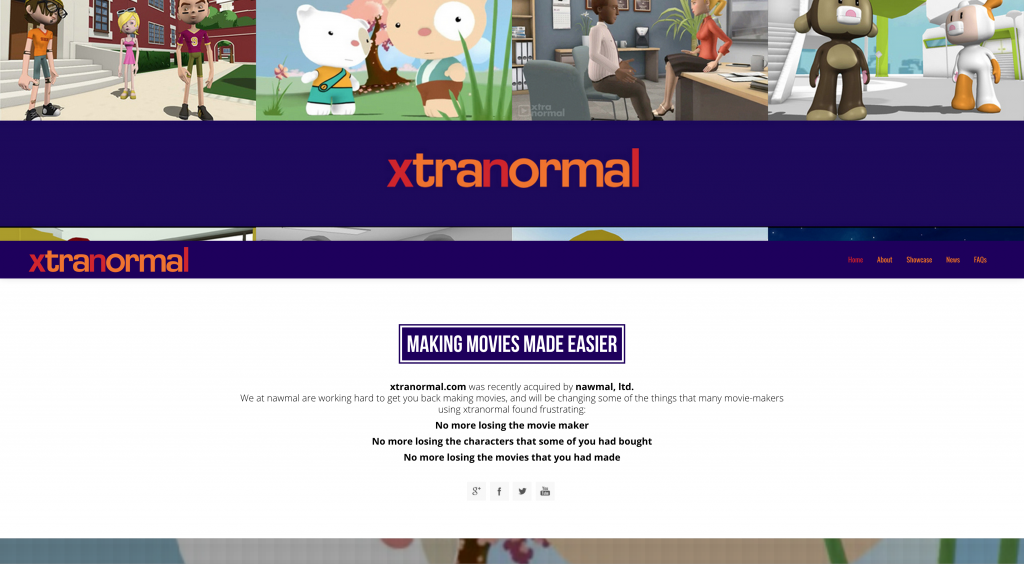
A typical example was one of my favourite online animation tools Xtranormal  I loved this app and used the free version along with thousands of other teachers, then started paying to buy more scenes and more characters and to have the option to download and save my videos!  Suddenly the company announced they were closing and loads and loads of teachers lost all their work.

This is what you can now read on their website, written by a team of people trying to resurrect the service: xtranormal

No more losing the movie maker

No more losing the characters that some of you had bought

No more losing the movies that you had made

So what are the going rates?

On the flipside of this, you have your average startup company which creates a great product or serivce and they offer a free plan for a limited range of presentations and one or two templates.

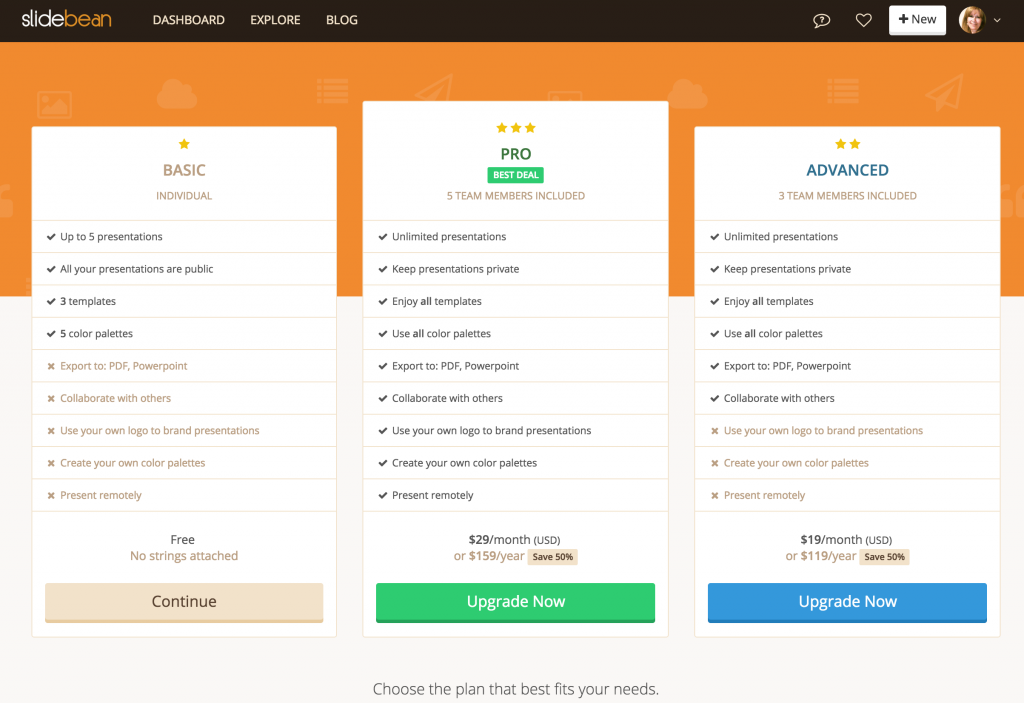
Pricing Slidebean

I believe most start ups think in terms of ‘Well, what’ 29 dollars a month? It’s not that much money!’  Or 19 dollars a month!!!

Well, I tell you that at the end of the day, if you pay for a few services like we do as a school, the bill at the end of each month is quite steep!!!!

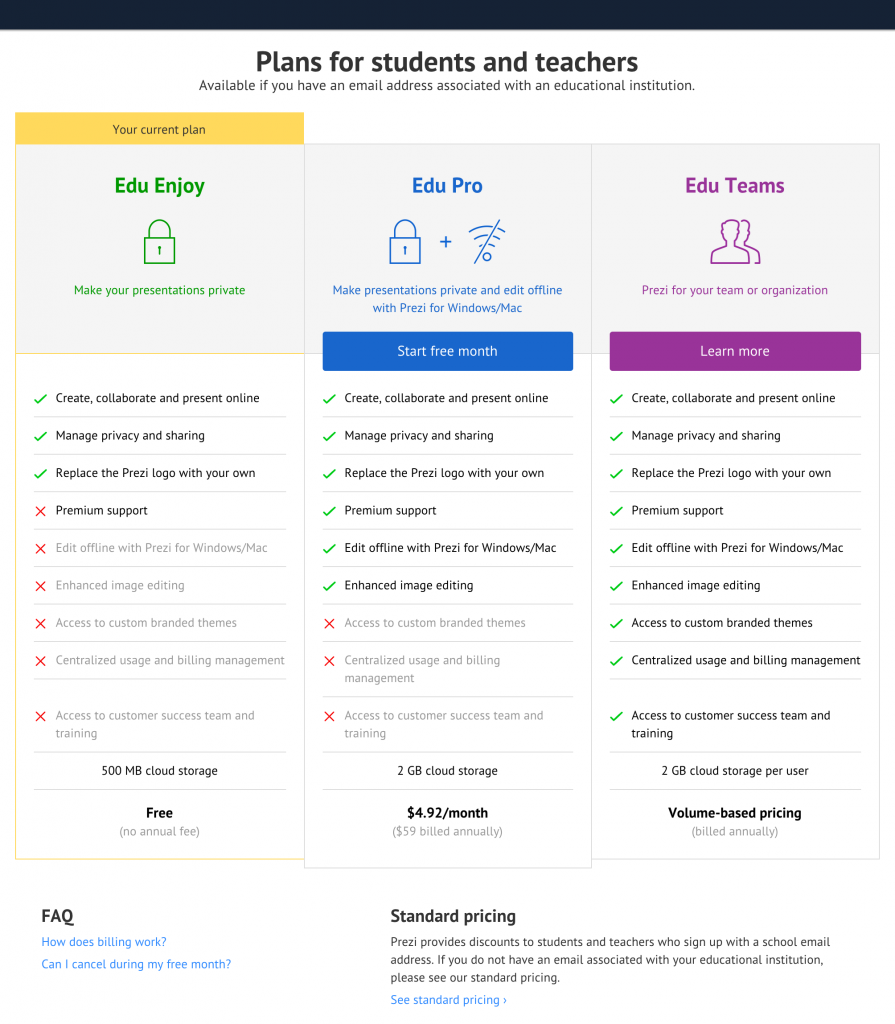
Compare this to the infinitely more versatile and original Prezi pricing plan and you will note the difference.

Of the two services, this is the one I would be more likely to pay for for this, and of course, other reasons, such as the versatility of the presentation templates, the desktop variation of a presentation which can be downloaded and played on one’s pc or laptop…

Pricing Prezi

Up to a couple of years ago, I used to pay a 29 euros per month subscription to Survey Monkey – when I calculated the cost of each survey I did using their services, it has cost me more than 300 or 400 euros!!!!

Google does it for free!!!!

One more example – my favourite screencast software – the famous Jing

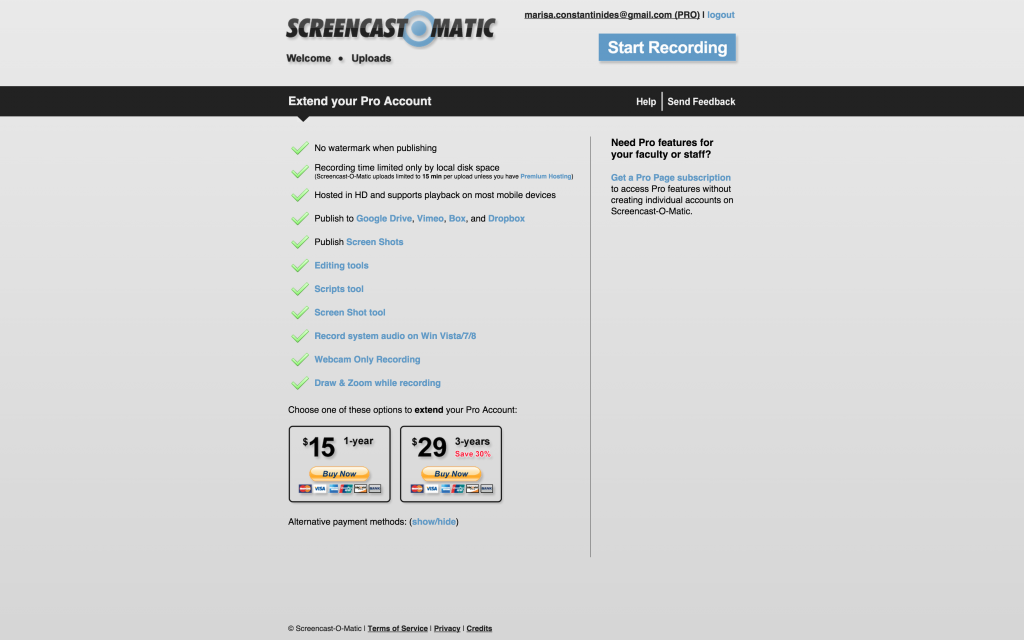
TechSmith Screencast.com online video sharing Plans and PricingCompare it with my OTHER favourite screencasting software, Screen-cast-0-matic

Go Pro Screencast O Matic Free online screen recorder for instant screen capture video sharing.

Compare two great screencast apps – Jing at about 100 dollars a year and Screen-cast-o-matic for 15 or under 10 if you go for the 3 year discount!

Apps

By contrast, most tablet  apps are much lower in price; for example, purchasing Microsoft Powerpoint for my iPad costs nothing, where you would have to pay almost 80 dollars US for the PC version. Keynote is now free but if you purchase an iPhone or iPad and even if you need to buy it is less than 20 dollars US – compare to powerpoint above!


Make the price right!

Make the price right, people! You can’t jump from nothing to 30 dollars a month – bring your prices down and you might get a lot more people paying!

You  let me have dropbox for free but if I want to pay, you ask me for 100 euros per month! 

Why would I pay that when Amazon asks for 70 a year for unlimited storage space!!!! Get real!!!! And OneDrive gives me 50 GB for free – Plus free online use of the latest versions of the Office Suite! 

This has happened to me time and again! I am willing to pay to keep my content safe but prices are too high – so I will keep going for the free versions for as long as I can.


P.S. Just like governments would make more money if they lowered their taxes – but greedy so and so’s that they are, they keep losing more and more money every year!!!!!

This post originally appeared on marisaconstantinides.edublogs.org, and was republished with permission.

____________________

Marisa Constantinides runs CELT Athens, a Teacher Development centre based in the capital of Greece, and is a Course Supervisor for all courses, including the DELTA Cambridge/RSA Diploma, the Institute of Linguists Diploma in Translation and off-site seminars and workshops on a variety of topics.

Ed Tech Companies That I Really Love: Part III

Read the entire series of Ed Tech companies that I love here.

By Matthew Lynch

This is the third installment in my series on ed tech companies that I really love. I’m interested to hear your thoughts on these ed tech companies and the wonderful work that they are doing.

EduSkills

EduSkills offers ELL data portfolio software (AccountabELL) that helps educators better manage the often fragmented school system data for ELLs. By streamlining the management side of ELL initiatives and documentation, the AcountabELL system makes it possible for all educational stakeholders to make informed decisions about ELL instruction and progress.

A few of the features of the program include scanning and uploading capabilities that help track the Home Language Survey and other ELL forms, calculations of immigrant/bilingual/ELL students across a chosen selection, and support of Title III requirements like language instruction education plans, parent notification and reporting. All of these specific tasks centralize ELL tasks and give educators easier ways to look at the data sets, and apply what it all means to real-time classroom activities. The software makes it easier for communication between all of the important people in a student’s career: current teachers, future teachers, administrators and parents.

Unlike other edtech companies that often see the technical side of their projects before seeing the students and educators they will impact, EduSkills has worked backward. By pinpointing exactly what is needed to make ELL classrooms more impactful, then building the software to support it, EduSkills has been able to create a truly effective tool for ELLs and their educators. The company also has program evaluation software that helps schools assess their effectiveness as a whole and personnel to help implement any needed changes – extending its ELL focus to the overall management of schools.

Brainzy: Smart Learning for the Youngest Students

I’m always interested in the ways in which companies are combining technology with learning initiatives, and I recently got the chance to check out Brainzy, a new math and reading program from Education.com that focuses on 30 foundational academic skills for ages 3 to 7. The site was developed based on data from the 20 million worksheets or modules downloaded by educators from Education.com every year (to put this in perspective, one-quarter of U.S. teachers have accessed materials from Education.com).

Brainzy eliminates the foundational learning guesswork on the part of parents, and teachers, by aligning with Common Core Standards on subjects like reading and math for pre-k, kindergarten and first grade students. Along with hundreds of academically-themed games, there are 50 educational songs and 50 read-along stories. For parents and educators who want to give the site a test drive, Brainzy offers a 7-day free trial. After that the monthly cost for families and teachers is less than a trip or two to the coffee shop and provides unlimited access to the resources on the site.

Instead of a “pick and choose” layout where students just decide what they want to complete randomly, Brainzy sets up user accounts for individuals based on their grade level and guides them through activities. A family, for example, could set up a different user account for each child and pick that profile when that particular student logs in. This provides a distinct learning track for individual students, as opposed to the majority of education sites that must be searched and navigated to track down the right material. The same goes for school accounts. Teachers can sign up to have individual accounts for the students in their classrooms, allowing them customized learning paths within the program.

The way these learning tracks are determined is also pretty innovative. Brainzy is built from data gathered from users on the already well-established Education.com. The site does not have to guess what materials parents and teachers will come looking for based on grade level—it is crafted into its own learning program in advance. A lot of research time is eliminated and then redirected to actual learning time for students.

What I like the most about Brainzy is that it focuses on a specific age set and uses interactive methods to get messages across. Fun and friendly characters accompany the lessons, aligning the Brainzy experience with what kids already enjoy doing at that age—singing songs, using their imaginations and learning through creative play. I look forward to seeing more from this learning program as it gains more followers and is sure to expand on its already vast collection of resources.

ParentSquare

ParentSquare is a simple to use, private communication platform that streamlines communication via web, email, text or mobile app. The easy-to-use interface offers two-way messaging, file and photo sharing, event and volunteer sign-up and more. With tabs for messages, events, people, photos, files and other options, parents can log into one system and have all the information they need. In short, ParentSquare makes school-to-home messaging simple, empowering parents to take a more active role in the academic success of their kids. Some of the standout features of ParentSquare include:

  • Two-way messaging
  • Text, email, web and mobile apps ensure schools reach every parent
  • Collaboration tools
  • Safe place to store photos – Unlimited photo upload and parents can see and download the full resolution pictures
  • Family-friendly features – easy to sign up to volunteer/bring classroom supply, ask a question, share photos and calendar
  • In addition to classroom communication, Parents can join and interact with school groups like fundraising committees or ELAC.
  • An instant Spanish translation option, removing this language barrier in homes where it may otherwise prevent parents from being completely in the know regarding their kids’ academics.
  • A people directory that gives contact information for important figures at the school and allows for messaging them within the platform
  • Statistics – A dashboard that shows who receives, reads and engages in the messages.

Read all of our posts about EdTech and Innovation by clicking here. 

Trends in Tech: How Schools Can Access the Future, Now

Technology has been changing the way teachers instruct and the way classes are held. It will introduce some interesting changes in the future of education. What does the future hold? Consider some up-and-coming possibilities:

Holography

Holography was just science fiction a few years ago, but it’s now becoming a reality in some fields, such as medicine. This imaging technique, which allows one to see a 3-D view of an image, has yet to become a part of everyday classroom activities. Holography introduced in classroom activities would change entirely how some subjects are taught. Biology, physics, astronomy, and chemistry could be taught on an entirely different level.
Virtual Reality

Experiential education has been used as an instructional method for years. Field trips have always been a way to introduce students to real-world issues, and to experience what they have learned and studied from books. Technology using virtual reality has introduced new levels of experiential education. Virtual 3-D worlds allow students and teachers to visit places that would have been impossible to visit without it. They can go to space, deserts, or foreign countries without physically traveling there.

Bring Your Own Device

Bring your own device (BYOD) initiatives represent a reversal from schools’ original stance on mobile devices. Instead of asking students to put smartphones or tablets away during class time, teachers and administrators are starting to encourage those devices in public school settings. Integrating the technology that students already own and use is an affordable approach to digital forms of learning. Of course, not every student has access to a personal mobile device, but this change of mindset shifts learning control from school officials to the hands of the student user.

Natural User Interfaces

In its simplest definition, a natural user interface (NUI) uses the body’s movements to provide outcomes. In the consumer market, examples of NUIs include the Nintendo® WiiTM, Xbox KinectTM, and the iPhone virtual assistant, Siri. The potential in the field of K–12 education is still being realized but will certainly lead to developments in the next half-decade. Students who are blind, deaf, or have physical disabilities or autism can better learn through use of this still-evolving technology.

Personal Learning Environments

With a focus on allowing students to choose resources, often through electronic formats, personal learning environments (PLEs) provide individual learning that fits students’ own style and pace. If implemented correctly, students will be empowered to create their own learning futures and reflect on the way these tools impact academic and life success. For public schools to completely embrace this philosophy, cloud computing and mobile device technology needs to be in place. PLEs need to be portable and easily accessed to really provide an academic advantage.

The Internet seems to have changed the preeminence of the printed page. When doing a research project, students rarely use a book to look for information. It’s more difficult and takes more time than using Internet tools, where you can go to a specialized Web site using a search engine and read only what’s relevant to your search. All of the books needed for school can be carried virtually, using a tablet computer, an e-reader, or similar reading device, or using smartphones. The advantages of carrying hundreds of pages in your pocket (with instant access to millions more) instead of carrying a heavy bag full of books are evident.

Cloud Computing

When it comes to greater educational collaboration, cloud computing has unlimited potential. This is true for teacher-to-teacher, teacher-to-parent, and teacher-to-student applications. By using a common location, academic expectations can be better accessed, along with actual student work. Instructors can also share learning materials and experiences through the remote opportunities that cloud computing provides.

Learning Analytics

An evolving concept in K–12 classrooms, learning analytics essentially show students what they have achieved and how those goals match up with their peers. If implemented correctly, this technology has the potential to warn teachers early of academic issues while keeping students more accountable. Using the mobile and online technology already in place, students can better track and tailor their academic experiences.

3-D Printing

Also known as prototyping, 3-D printing technology will allow K–12 students to create tangible models for their ideas. Many fields, like manufacturing, already make use of this technology to determine the effectiveness of ideas on a smaller, printable scale. In education, this technology will bolster creativity and innovation, along with science and math applications.

Virtual Laboratories

These Web applications give students the chance to perform physical science experiments over and over, from anywhere with Internet access. As in a physical lab, the performance of the student will determine the results of the experiment. While not a replacement for all in-lab exercises, the virtual version can provide extra practice and guidance. There is no pressure to “get it right” on the first run, and mistakes are allowable because the technology lends itself to no-cost repetition. It also may prove a smart solution to rekindling the American public’s interest in the scientific.

While some of these technologies are still in the realm of the hypothetical, several of them are available now. Check out local science groups, maker-fairs, and other tech-savvy gatherings for ideas and inspiration on bringing the future to your students, now.

If we really want an ideas boom, we need more women at the top tiers of science

Emma Johnston, UNSW Australia; Nalini Joshi, University of Sydney, and Tanya Monro, University of South Australia

On Wednesday March 30, Emma Johnston, Nalini Joshi and Tanya Monro spoke at the National Press Club for a special Women Of Science event. Here they outline their views on how to promote greater participation by women at the top levels of science.


Few of us would imagine accepting that our daughters have fewer options than our sons. And yet that is exactly the situation we allow to persist in Australian science, technology, engineering and mathematics (STEM) today.

The 2016 woman scientist’s story starts well enough, particularly when you compare it with her 1960s counterpart.

Fifty-six per cent of undergraduates and half of PhD students are female. Even better, almost 60% of junior science lecturers are female.

These bright, talented people are eager to find cures for all cancers, explain dark energy, invent faster mobile phones, design robots, become astronauts and prove the Riemann hypothesis, a millennial open problem in mathematics.

But towards the top end, things are very different. In STEM, women comprise about 16% of top-level professors. That figure rises to 23% if you include medicine.

Our own personal stories reflect this: when Tanya Monro arrived at Adelaide University in 2005 she was its first female professor of physics, even though there had been physics professors there since the 1880s.

In 2002, Nalini Joshi was appointed the first woman professor of mathematics at the University of Sydney, Australia’s oldest university.

In this respect, Australia is frozen in time. We are throwing away our opportunity to harness the huge intelligence and prodigious drive of the females already in the research workforce. How is this so different to the 1950s when talented women like Ruby Payne-Scott, one of the inventors of radio astronomy, when she was required to resign as soon as she was married?

The push now is often subtler, embedded in principles, conventions and bias that is rarely visible. Modern science is still conducted within organisational cultures that resemble a feudal monastery; information is power and it is tightly held, it is difficult to find anything unless you know the right person to ask, survival rests on competition to be noticed by a “nobility”.

Unconscious, subjective conventions have evolved in response and that impacts everyone, both men and women.

As a nation, by forcing half our potential innovators to work much harder to reach the same seniority as the other half, we are doing ourselves a grave disservice.

Buried bias

The standard of living for future Australians depends on how effectively we can bring innovation into our businesses. We know that 75% of jobs in the fastest-growing industries require STEM skilled workers, and since last year’s announcement of the National Innovation and Science Agenda (NISA), it appears we’re in an ideas boom.

NISA proposes “encouraging our best and brightest minds to work together to find solutions to real world problems and to create jobs and growth”.

We agree. And we propose that the single most powerful response Australia could mount to this challenge would be to transform the relationship between women and science, technology, engineering and mathematics.

Australia is at, or near the bottom, of the OECD rankings in a range of critical innovation measures. The reasons for this are complex and multi-faceted, but a big one surely has to be that a huge proportion of our great thinkers – our potential science and innovation leaders – are being subtly and pervasively pushed out of STEM. Not based on their merit but based on gender.

A 2014 study found that without any information other than a candidate’s appearance (making gender clear), both males and females are twice as likely to hire a man than a woman to complete a mathematical task.

A study published earlier this year found that both male and female undergraduates were more likely to explain a woman’s science-related setbacks by mentioning factors about her, such as “she was let go because she messed up an experiment”. Whereas a man’s setbacks are more likely to be explained by contextual factors, such as “he was let go because there were budget cuts”.

Then there’s the “motherhood penalty”, with negative effects on income, career advancement, and perceived competence relative to both fathers and women without children.

Australia must pursue change. The benefits of that change will clearly go beyond gender, beyond sexual identity, race and ethnicity. That change will make our society become more creative, abundant, and innovative.

There’s no doubt that improved female engagement in STEM will drive all areas of science and innovation, and achieve aspirations articulated across the whole NISA agenda.

Re-think

There’s no single solution or silver bullet, but the prize is big enough that it’s critical that we tackle every facet of this issue.

We need to challenge the assumptions: the first and biggest is that it’s just a career pipeline issue. It isn’t, and we can’t just wait for the passing of time to solve it.

Next we need to re-think what a good research track record looks like. When Tanya Monro secured her Federation Fellowship in 2008, she had three children and had moved across the world to set up a lab from scratch in the five years over which track record is traditionally assessed. At the time, the application process provided no mechanism for extending the time window over which her productivity was assessed.

We need to re-think the language we use to describe women and their behaviour. Men are often called “assertive” where women are called “aggressive”. Male researchers who have children are more often described as “scientists”; female researchers who have children are often described as “mothers”. We can be both feminine and assertive. We can be both outstanding research scientists and loving mothers.

And we need to work on shifting the conscious and unconscious bias that many of us don’t want to admit exists. Science goes to great lengths to remove bias from observations and experiments, yet many in science fail to adequately recognise and respond to our own biases.

One of the most powerful ways to combat this bias is via the relentless promotion of role models – as NISA suggest – we should “highlight the amazing stories of Australia’s successful female innovators and entrepreneurs”. However, the media consistently under-represent women in science. One only needs to think of television science celebrities, and even in the social media, to find that 92% of the most successful Twitter scientists are male. And when female scientists are mentioned, they tend to focus on our appearance or parental status.

All three of us have done our bit to increase the representation of women in the media, taking every opportunity to speak in public and on radio and television – through news, Q&A, the National Press Club this week, Coast Australia, Catalyst, and other radio, TV and social media.

Be bold

The good news is that we know how to enact change. Some of it is as simple as structural and regulatory changes to increase early career job security, provide parental care that can be accessed by both parents, create flexibility in the workplace, enable career breaks with guaranteed re-entry, move towards anonymous grant and journal review processes, allocate teaching and administrative tasks in transparent manner and value those tasks.

We need to push against that “motherhood penalty”, and there have been some real gains in recent years. For example, changes to the Australian Research Council criteria, which now allows for the selection criterion of Research Opportunity and Performance Evidence (ROPE) to replace the concept of “track record”.

We must also embrace our national character: our diverse community, relatively flat hierarchy and willingness to challenge and take risks.

We must be willing to implement quotas or targets. You only have to look at the consistent success the Academy of Technology and Engineering (ATSE) has had in bringing in significant numbers of stellar female Fellows over the last decade, and the recent pleasing developments at the Australian Academy of Science (AAS).

We need to remind ourselves that whenever we see a space where there isn’t a diverse workforce we don’t have the best possible people for the task.

Part of the solution has already been underway in the United Kingdom for more than ten years. The Athena SWAN program requires participating organisations to look internally, find out where the holes in their own career pipelines are and propose action plan to address these holes. The charter then rates organisations based on these policies and practices, rewarding them with gold, silver or bronze awards.

The AAS and ATSE have joined together to mount a pilot of the Athena SWAN program as part of the Science in Australia Gender Equity (or SAGE) initiative. Thirty-two enthusiastic organisations have already signed up to participate in the pilot.

Even the first step, – data collection and analysis – will be a challenge for most pilot participants. Of course they know how many women work there and how many may be promoted there, but they have probably not considered questions like how many are in the eligible pool for the next promotion or how long a period qualified female staff have waited before being promoted.

The Athena SWAN evaluations in the UK tell us that the outcomes will encourage and improve the working life of everyone, whether they are men or women.

Australia stands today with an unparalleled opportunity to engage the next generation of potential scientists. We simply cannot afford to lose so many of the talented people that we produce. So many great ideas that go elsewhere.

Imagine if we could encourage and keep these talented people. Imagine the great ideas doubling our Nobel Prize winners. Imagine being in a room full of female STEM professors.

Imagine the ideas boom then.

The Conversation

Emma Johnston, Professor of Marine Ecology and Ecotoxicology, Director Sydney Harbour Research Program, UNSW Australia; Nalini Joshi, Professor of Mathematics, University of Sydney, and Tanya Monro, Deputy Vice Chancellor Research & Innovation, University of South Australia

This article was originally published on The Conversation. Read the original article.

How to keep more women in science, technology, engineering and mathematics (STEM)

Merryn McKinnon, Australian National University

There have been myriad promises made by the major political parties over the years focused on funding programs aimed at increasing the number of women pursuing careers in science, technology, engineering and mathematics (STEM).

Although some of the policies do target disciplines where women are underrepresented, there seems to be very little acknowledgement of the bigger problem.

Attracting women to STEM careers is one issue, retaining them is another. And that does not seem to get the same level of attention.

Simply trying to get more women into STEM without addressing broader systemic issues will achieve nothing except more loss through a leaky pipeline.

Higher Education Research Data from 2014 shows more females than males were being awarded undergraduate degrees in STEM fields. Early career researchers, classified as level A and B academics, are equally represented in the genders.

Gender disparity in STEM fields at the higher academic levels (C-E) based on Higher Education Research Data, 2014. Science in Australia Gender Equity (SAGE)

At senior levels, though, the gender disparity plainly manifests – males comprise almost 80% of the most senior positions.

A biological and financial conundrum

Studies in the United States found that women having children within five to ten years of completing their PhD are less likely to have tenured or tenure-track positions, and are more likely to earn less than their male or childless female colleagues.

Angela (name changed) is a single parent and a PhD student in the sciences. She told me she is determined to forge a career for herself in academia, despite the bureaucratic and financial hurdles she has to overcome.

Finding ways to get enough money to afford childcare […] jumping through bureaucratic hoops […] It was ridiculous and at times I wondered if it was all worth it.

It may be just one reason for women leaving STEM, especially those with children, and doubly so for single parent women.

Women tend to be the primary caregivers for children, and are more likely to work part time, so perhaps this could explain the financial disparity. But according to the latest report from the Office of the Chief Scientist on Australia’s STEM workforce, men who also work part time consistently earn more, irrespective of their level of qualification.

Percentage of doctorate level STEM graduates working part time who earned more than $104 000 annually, by age group and gender.Australia’s STEM Workforce March 2016 report from the Office of the Australian Chief Scientist., CC BY-NC-SA

The same report also shows that women who do not have children tend to earn more than women who do, but both groups still earn less than men.

Perhaps children do play a part in earning capacity, but the pay disparities or part-time employment do not seem to fully explain why women leave STEM.

Visible role models

The absence of senior females in STEM removes a source of visible role models for existing and aspiring women scientists. This is a problem for attracting and retaining female scientists.

Having female role models in STEM helps younger women envision STEM careers as potential pathways they can take, and mentors can provide vital support.

Yet even with mentoring, women in STEM still have higher attrition rates than their male colleagues.

So what else can we do?

There are many programs and initiatives that are already in place to attract and support women in STEM, including the Science in Australia Gender Equity (SAGE) pilot, based on the United Kingdom’s Athena SWAN charter.

But women’s voices are still absent from leadership tables to our detriment.

Homeward Bound

This absence is especially noticeable in STEM and policy making arenas, and was the impetus for Australian leadership expert, Fabian Dattner, in collaboration with Dr Jess Melbourne-Thomas from the Australian Antarctic Division, to create Homeward Bound.

Dattner says she believes the absence of women from leadership “possibly, if not probably, places us at greatest peril”.

To address this, Homeward Bound is aimed at developing the leadership, strategic and scientific capabilities of female scientists to enhance their impact in influencing policy and decisions affecting the sustainability of the planet.

Initially, it will involve 77 women scientists from around the world. But this is only the first year of the program, and it heralds the beginning of a global collaboration of 1,000 women over ten years.

These women are investing heavily – financially, emotionally and professionally – and it is clearly not an option for everyone.

Flexible approaches

There are other simple ways to support women in STEM, which anyone can do.

Simply introducing genuinely flexible work arrangements could do a lot towards alleviating the pressure as Angela shows:

My supervisor made sure that we never had meetings outside of childcare hours […] or I could Skype her from home once my child was in bed. They really went above and beyond to make sure that I was not disadvantaged.

We have already attracted some of the best and brightest female minds to STEM.

If keeping them there means providing support, publicly celebrating high-achieving women, and being flexible in how meetings are held, surely that’s an investment we can all make.

The Conversation

Merryn McKinnon, Lecturer, Australian National University

This article was originally published on The Conversation. Read the original article.