The numbers are in. Many Americans no longer view college as ‘very important’ according to the first part of the 46th annual PDK-Gallup poll.
Here are a few of those numbers, explained:
According to the poll, only 44 percent of Americans cite college education as ‘very important’; a number is down from 75 percent just four years ago. A larger percentage of Americans now view education as ‘fairly important.’
The number of parents who said it was somewhat or very likely that they would be able to pay for college for their oldest child is down to 69 percent from 77 percent in 2010.
As a whole, Americans are doubtful about students’ career readiness; just 13 percent said a high school graduate is ready. Thirty-seven percent of Americans agree that college grads are ready for the work world.
Americans believe that the most important factor in helping a high school student eventually get a good job is learning skills such as dependability, persistence, and teamwork.
The second part of the poll, released this week found that a majority of public school parents want selective teacher training programs and that they believe new teachers should work for a minimum of one year with a certified teacher prior to manning their own class.
The feud of Common Core continues; the majority of Americans oppose the Common Core State Standards and the Teach for American program embraced by the Obama administration. Over half of Americans said that the curriculum used in their community’s schools needs altered.
I find the results to the poll really interesting. It’s unfortunate that so many Americans don’t view college as ‘very important.’ The declining belief in the importance of college is really disheartening and I hope we can find a way to turn these numbers around and encourage more students to pursue higher education.
What do you think about these new views? Should students see college as more important than they do now? I would appreciate hearing from you in the comments.
*The Edvocate is pleased to publish guest posts as way to fuel important conversations surrounding P-20 education in America. The opinions contained within guest posts are those of the authors and do not necessarily reflect the official opinion of The Edvocate or Dr. Matthew Lynch.**
A guest post by Lizzie Weakley
The National Center for Education Statistics (NCES) estimates that there are over 3 million professional teachers educating about 50 million students. Teaching is one of the most challenging, yet rewarding careers. Teachers play an active role in helping both young and older students learn knowledge, develop skills and achieve success in life. Every day teachers across American make a difference in students’ lives as they inspire, encourage creativity and teach practical skills. Below introduces five of the best education degrees for aspiring teachers.
Special Education
There is a growing demand for special education teachers with the ability to help students struggling with emotional problems, behavioral disorders and learning disabilities. Some special education teachers cover all common core subjects and adapt them to their students’ needs. Others have specialized training to provide unique help to their students. These include audiologists, speech pathologists and adaptive special education teachers, who work with students with physical disabilities.
Mathematics
According to a recent Pearson’s report, American students currently rank 14th in the world for math and science cognitive skills. American students need passionate and competent teachers to help improve the current mathematic educational crisis. Potential teachers can choose a general four-year degree in math or specialize in Algebra, Calculus and Geometry.
English Language
As mentioned above, American students struggle with math and science. Even worse, American students ranked 17th in literacy rates. An aspiring teacher with a degree in English Language can teach almost every educational level, from elementary to college. English Language specializations include creative writing and period specializations, such as American or British literature.
Vocational Education
A bachelor of Vocational Education (VBE) is an excellent choice for teachers who want to help students learn practical skills through hands-on training. These teachers generally work in public schools or vocational institutions and teach a variety of subjects. These include health, business, agriculture and industrial arts and trades. Aspiring teachers can work with either high school or college aged students.
Social Sciences
There are multiple benefits to having a degree in social sciences. Aspiring teachers who wish to teach at higher levels of education can specialize in civics, sociology, anthropology, history, economics and political science. One of the best benefits of studying a social science is that these programs are all offered online. For example, a potential teacher could easily obtain an online masters in history while working full-time.
In conclusion, teaching is a rewarding job that offers unique teaching opportunities.
_________
Lizzie Weakley is a freelance writer from Columbus, Ohio. She went to college at The Ohio State University where she studied communications.
**The Edvocate is pleased to publish guest posts as way to fuel important conversations surrounding P-20 education in America. The opinions contained within guest posts are those of the authors and do not necessarily reflect the official opinion of The Edvocate or Dr. Matthew Lynch.**
Students today more than ever before need to be empowered to go on to live effective, successful lives. It is important students of all ages have good examples of learning and education in their lives. They also need constructive feedback from teachers that can help them to mature as learners and as people. As a teacher, you are privileged to be able to give them both.
Begin with a Passion For Teaching
Your love for teaching will be the first thing students notice about you as a teacher. It doesn’t matter if you particularly like an individual subject you may have to teach, although that certainly helps. What students need to see in you is a passion for the art of teaching that will tell them that it is important for them to learn.
If you have a passion to teach, it will be translated to your students in thousands of non-verbal ways throughout your classes. They will see it in your eyes, in the invigorating way you talk about your subjects, and even in your tone of voice. The payback for translating your passion to your students will be that some of them will emulate your example and become teachers themselves. If you can demonstrate the best parts of learning it can inspire others to be lifelong learners themselves.
Personal Interest in Your Students Is Vitally Important
The teachers that make the most significant impression on students are those who take a personal interest in their lives. You may be teaching a very large class of students, where it is difficult to get to know each child individually. Nevertheless, in any class there are those students who stand out to you as either being very talented or very needy. You should invest the time to reach out to both of them, because they both need your help in different ways.
Exceptional students need to be spurred on to greater growth. Take college students aside and encourage them to perhaps pursue and online Master’s in higher education. Talk to younger middle school and elementary school students about honing their talents and finding what they are good at. Help them to find out how they can use their personal talents to pursue the career they were meant for.
Needy students can need a challenge for any number of reasons. You will need to take the time out of your schedule to find out why. Perhaps they have a troubling home situation, or may have cognitive challenges. Unfortunately, many students today have chemical addictions as well. Whatever the reason, attempt to help them and put them on the right path. Even a kind note on an essay can be a good personal notice for more shy students.
Share Your Constructive Criticism When Needed
Constructive criticism always has a positive edge to it. Though it may be initially perceived by the student as being negative, it is intended to correct for greater positive growth. It does not beat down or demoralize. In any class of students, it is sometimes needed.
Constructive criticism is something that should always be shared in private. Begin by telling the student the good things you see about him or her. This will get you started off on the right track. Then tell them what you think is holding them back, and how they can make a positive change. After this is done, reaffirm your confidence in them as an individual. If you share your concerns in the right way, it’s possible that the student will heed your advice. Learning from mistakes and error is one of the most important parts of teaching and learning.
Being a teacher is not an easy job, but the reward is that you are allowed to help students to reach their individual potential as human beings, and see them succeed. With positive feedback and constructive criticism you can help student succeed. It’s up to them as much as you to see where the future can take them.
Brooke Chaplan is a freelance writer and blogger. She lives and works out of her home in Los Lunas, New Mexico. She loves the outdoors and spends most her time hiking, biking and gardening. For more information contact Brooke via Twitter @BrookeChaplan.
Children in today’s classrooms will most likely be digital natives, people who were born in the digital era and have used technology all their lives. These students may be more receptive to instruction involving technologies. Technology can be used successfully if a teacher has the tools and knows how to use them. For example, cell phones are often disruptive elements in the classroom. A savvy teacher might take advantage of cell phones as instructional tools, rather than allow them to be an intrusive element in the classroom. The Internet, computers, and communication devices are things that today’s children live with. Using them successfully will increase student enthusiasm about knowledge, and teachers will have the opportunity to lead richer classes.
You’ll be required to find ways to introduce technology into your classroom, not only to make your life easier, but also to ensure that your students are exposed to technology. The modern working world will require even the most unskilled of laborers to be technologically literate, which makes it important for this exposure to begin within the classroom. This will not necessarily require you to make every aspect of the learning process dependent on technology. You could simply use technology to deliver standards-based lessons, or to change some activities to make them more interesting for students. Linking Web-based activities with standards-based curricula will keep students’ attention on what you need to teach them, but it will also help them to think and develop their own understanding of the topic.
The field of technology is advancing rapidly, and you’ll need to remain in touch with ongoing developments to avoid missing opportunities to leverage technology in your teaching practice. Professional development is an essential investment; attending technology expositions or conventions assists pre-service and in-service teachers in learning about available new advances in technology. The staff on hand at these events can explain practical instructional applications. Increasing your understanding will enhance your confidence when introducing technology to your class.
The Internet allows access to nearly limitless information. It’s estimated that the information contained in a week’s worth of the New York Times is more than the information a person in the 18th century would have in a lifetime. Students now have access to online information inside and outside school. And although this information is easy to access and relatively easy to find, you’ll guide students to determine whether it’s reliable and guide them to avoid becoming overwhelmed by the enormous amount of online information.
Consider all the resources, whether in hardware or software, that you have at hand to bring into play in your classroom. Figure out how each can be used as an effective teaching tool. As a teacher, you have little enough time and space already; use technology to make your curriculum bigger and stronger, not just more cluttered.
The number of minority students enrolled in U.S. schools is growing at a rapid rate, yet student enrollment is not matched by minority teacher representation. The National Center for Education Statistics tells us that nearly 82 percent of public school teachers are white — and Black and Hispanic students are two to three times more common than teachers of the same ethnicity. The gap is typically the widest in areas of the country with high percentages of students of color.
Many feel that minority teachers are in a position to put a stop to negative stereotypes and act as role models and mentors for students of color. Teachers who can relate to their students’ backgrounds usually are better able to look past biases of their abilities.
A study in Economics of Education Reviews tell us minority students perform better with minority teachers.
In addition to the challenge of having too few minority teachers, we also see the highest percentage of Black teachers leaving the profession. This is likely because minority teachers tend to work in schools with high rates of poverty.
The education gap is a serious obstacle our country faces – and I think that the “diversity gap” is a major part of our struggle. The education gap is staggering and it is hindering our country socially and economically. We have to find ways to get more teachers of color in the classroom. Students perform better when they can relate to their teachers, and teachers who can relate to their students are less likely to have a preconceived idea of how each student will perform. We need more teachers of color in our schools acting as strong role models for our minority students.
According to a new study produced by Melissa Kearney of the University of Maryland and Phillip Levine of Wellesley College, Sesame Street teaches children just as well as preschool.
Well, kind of.
The Washington Post reports that “kids can learn as much from ‘Sesame Street’ as from preschool” because of the show’s focus on “academic curriculum.”
Levine and Kearney’s study found that kids received the same benefits from Sesame Street as they did with Head Start. While other studieshave explored the notion of if preschool was needed at all, this one adds another layer to that argument by maybe proving that educational television may be just as vital to a child’s development.
Kearney told the Postthat due to the benefits of the study that it may open more doors to alternative forms of education down the road. With the cost of college rising, student loan debt exploding, and educators searching for new and innovative ways to educate students, having something similar to Sesame Street on TV or via the internet may serve a new population of students.
Free and sustainable forms of education are readily available via Massive Open Online Courses and this study further proves the viability of alternative forms of free education. It seems to me that the focus should be more on open access to high standards of education, and less on what price tag we can put on these items. There is a reason that Sesame Street has such a lasting appeal — and I think it can teach all educators some lessons in the best way to reach students.
**The Edvocate is pleased to publish guest posts as way to fuel important conversations surrounding P-20 education in America. The opinions contained within guest posts are those of the authors and do not necessarily reflect the official opinion of The Edvocate or Dr. Matthew Lynch.**
A guest post by Kristi Meeuwse, ADE
The function of education is to teach one to think intensively and to think critically. Intelligence plus character – that is the goal of true education. -Martin Luther King
Thinking critically and intensively is not reserved for older students. We work diligently to create learning experiences in kindergarten that allow our young students to think deeply about various topics. Having iPads allows us to enrich learning experiences in a way that wasn’t possible before. One of the iPad tools that is often overlooked is iTunes U. Why iTunes U?
It is a free repository of classes and educational content
Students have access to content anytime and anywhere
Content is easily updated and changed
Discussion feature allows rich conversation between students
While there are a large number of free classes available on iTunes U, perhaps you should consider creating your own. With the end of the school year only a few weeks away, it seems odd to be thinking of adding new things to your teaching bag of tricks, but this is the perfect time to do so. You can use some of your summer to create your own courses. It is easy to do. Simply log into the iTunes U course managerusing your Apple ID and add your content. What are the benefits to creating your own course?
Content is more meaningful to students
Content can be customized
Easy to create, easy to update
All resources are in one place: books, documents, videos, images, web links and apps
Here is the link to a Spiders course I created for my kindergarten students as well as one for teachers on Personalized Learningand another coursecreated by a 4th grade colleague about my school and how we innovate instruction using iPads.
iTunes U allows you to customize the learning experience for your students, even the youngest ones. It is also a great way to create a learning portfolio for students. Up to 5 people can collaborate on a course so you and your colleagues can work together and share the wealth. If you aren’t comfortable creating a full course initially, create a chapter and keep adding. It is easy to update any time.
If you aren’t already using iTunes U, consider giving it a try. It will open a whole new world to your students for learning and engaging in content.
Today we will do exciting new things. Let’s get to it.
This post originally appeared on iteachwithipads.net and has been republished with permission.
Kristi Meeuwse teaches kindergarten in Charleston, South Carolina. In January, 2011, her kindergarten class started a 1:1 iPad pilot for the school district and the results so far have been very successful. You can read more about it on her blog iteachwithipads.net.
Should homeschool parents have complete control over the content and outcomes of their children’s education, with no external assessment or evaluation from the state?
The Texas Supreme Court is exploring this very question as they consider the case of the McIntyre family versus the El Paso school district, which involves allegations that the homeschooled McIntyre children did little or no academic work and that their parents refused to provide any evidence of such work.
After having studied homeschooling practices and policies for more than a decade, I contend that states need to find a middle ground – a modest set of expectations for homeschoolers that protects children’s basic educational interests while still leaving plenty of room for curricular flexibility.
What does the law say?
The fact is that homeschooling regulations vary widely from state to state.
In a 1994 decision in Texas Education Agency v Leeper, the Texas Supreme Court ruled that “homes in which children are taught in a bona fide manner from a curriculum designed to meet basic education goals” would qualify as private or parochial schools under the Texas compulsory education law.
However, there is no regulatory mechanism that exists in the state to assess whether basic education goals are being met by homeschoolers. In fact, Texas is one of 11 states that do not require families even to notify educational authorities that they homeschool their children.
A few states, such as North Dakota, require homeschool parents to meet certain educational requirements. Other states, such as California, stipulate that homeschoolers must study subjects similar to public schools. And some states, such as New York, require parents to submit curricular plans each year.
In my view, most of these requirements are neither appropriate nor effective. Authorities can approve curricular plans, but such documents may have little to do with what actually occurs during the year.
Indeed, much of the value of the homeschooling approach rests in its inherent flexibility to customize learning experiences in ways that work best for individual children. While portfolios of student work at the end of the year might be revealing, they are also difficult to evaluate consistently and efficiently.
With this in mind, standardized basic skills tests hold the most potential for protecting children’s basic educational interests while leaving room for curricular flexibility.
Few of us would deny that children need basic skills of literacy and numeracy in order to function independently as adults. Certainly all the homeschool parents I’ve spoken with over the years would share this view.
I suspect that the vast majority of homeschoolers would have no trouble passing basic skills tests. And even for students who struggle with basic skills assessment, the next step would be a closer look by the state to understand the context, rather than an automatic assumption of educational neglect.
It’s also worth pointing out that basic skills requirements need not dictate the shape or method of homeschool curricula; there are countless ways to cultivate such basic skills in children – from highly structured curricula to student-directed projects to experiential learning.
But is a good education only about the development of basic skills?
While the answer to this question should be obvious, there is plenty of reasonable disagreement about what other skills, knowledge and dispositions children should develop – and whether such expectations should be standardized for each child.
The plain truth is that no such evidence exists. Wide-scale studies of homeschooler test performance have been based on volunteer samples, often with testing conditions far different from those of public school students.
And even if we knew that the “average homeschooler” compared favorably with public school students, that would say nothing about the experience of children whose parents use homeschooling as a cover for educational neglect or worse.
Homeschool advocates will also point to data showing no correlation between the amount of regulation in a particular state and the test scores reported by homeschoolers in those states.
But here again we run into the problem with volunteer samples – it seems highly unlikely that homeschool parents who neglect their responsibilities would even have their children take such tests, much less report the results.
Finding middle ground
Plenty of reasonable disagreement exists about what constitutes a great education. But we should all be able to agree that all children have a vital interest in gaining basic skills of literacy and numeracy.
Protecting those interests, while also honoring the role of parents in shaping their child’s educational experience, means finding a middle ground between intrusive regulations and having no oversight at all.
I agree that homeschool parents should be given wide latitude in the shape of their curricula and the experiences they provide for their children. But a complete lack of external accountability leaves too much room for neglect and abuse to go undetected.
A modest set of expectations such as annual reporting of enrollment and basic skills testing would go a long way toward protecting children’s interests while preserving homeschool freedoms.
But giving kids cash for grades and scores hasn’t proved straightforward either. So maybe the answer isn’t monetary.
Could students be better motivated by something as simple as a little formal recognition?
While I was serving as director of the National Center on Performance Incentives at Peabody College of Vanderbilt University, my colleagues and I sought answers in the decisions of various actors in American public schools.
The results may surprise you.
Which incentives encourage positive behavior?
Much of public policy can be characterized as attempts to influence individual behavior and decision-making in organizations.
Those who design and evaluate incentives typically operate under the crude assumption that the “target” is a rational actor (processing all available information and quickly identifying the behavior most likely to be the best one for his or her well-being).
So, policymakers end up offering seemingly beneficial public services at little or no cost. But they still meet with disappointment.
Our recent study attempted to better understand the response to a different kind of incentive – for one of the arguably more imperfectly rationale segment of our population: early adolescents.
We explored how incentives – monetary and nonmonetary – might encourage behaviors that lead to increased student learning, such as daily attendance and afterschool tutoring services (free but chronically underutilized).
We found that adolescents do not respond to incentives in ways that can be easily predicted by economic theory. But the right kinds of incentives could well lead adolescents to engage in behaviors likely to enhance their learning.
Money makes no difference
Here’s how we did our study.
We selected 300 fifth to eighth grade students in a large southern urban school district who were eligible for free, afterschool tutoring services.
Prior research had shown that these particular tutoring services were relatively high quality and had, in fact, increased student’s test score performance. We then randomly assigned these students to one of three groups:
a reward of US$100 (distributed via an online platform) for consistent attendance
certificates of recognition, signed by the school’s district superintendent, mailed to the student’s home, again for consistent attendance
a control group, which received no experimental incentives.
We found that the students who were offered up to $100 for regular attendance were no more likely to attend sessions than if they were offered nothing at all.
In other words, money made no difference.
Alternatively, when students received a certificate of recognition for attending tutoring sessions regularly, the differences were dramatic. The students in the certificate group attended 42.5% more of their allotted tutoring hours than those assigned to the control group.
Gender, parents and peers
Gender also played a role. Girls were significantly more responsive to the certificate of recognition than their male counterparts.
On average, girls in the control group attended only 11% of the tutoring hours assigned to them. However, girls receiving the certificate attended 67% of their allocated hours, representing a six-fold increase.
What’s more, the boys that received certificates attended more than two times as many of their allocated tutoring sessions in comparison to the male control-group students. But the girls in the group that received the certificates attended nearly twice as many of their allocated tutoring sessions than the boys who were eligible for certificates of recognition.
Overall, sending certificates directly to the parents seemed to have been effective. One reason for this could be that parents were more likely to reinforce the child’s extra effort when the certificate was received at home.
Often in school settings, parents are not hearing positive news when they are contacted by their child’s school – and this might be especially true of these students who qualified for tutoring services.
This is one time where the parent heard: “way to go, keep it up.” And they heard it directly from the district superintendent.
In addition, a student’s effort was not necessarily observable to peers, which could have helped facilitate the positive response.
Prior research suggests that the promise of certificates and trophies presented in a class or at a school assembly in front of peers might not necessarily act as a positive incentive. Academic achievement can often result in diminished social status among peers, especially for minority students.
Human behavior and education policy
Indeed, a recent study of a performance leaderboard system that publicly ranked students in a computer-based high school course in Los Angeles Unified School District was associated with a 24% performance decline.
The authors attributed this to students trying to avoid social penalties by conforming to prevailing norms.
For these reasons, working with the family to encourage and reward academic behaviors may hold more promise, compared to working directly through school settings where peer pressures and norms play an important role.
Policymakers and philanthropists in New York and Memphis are currently trying to interrupt a cycle of generational poverty through the Family Rewards Program. It is providing cash rewards to families who improve their short-term health care, education, and labor market participation and outcomes.
The impact results of this program are still awaited. This program doesn’t test other forms of incentives such as certificates.
But there are important implications for education policy discussions and whether cash should be the primary driver of human behavior, particularly for adolescents.
The results of our study show that children’s learning behaviors to incentives change in unpredictable ways. And these behaviors aren’t easily accounted for by models of individuals as rational decision-makers.
Our study provides evidence that for policies to influence adolescent behavior, they may need to draw from research and theory beyond classical economics or behavioral psychology, including what we are learning about the teenage brain and it’s sociocultural environment.
In short, we need to look at policies that are less Adam Smith and little more Friday Night Lights.
**The Edvocate is pleased to publish guest posts as way to fuel important conversations surrounding P-20 education in America. The opinions contained within guest posts are those of the authors and do not necessarily reflect the official opinion of The Edvocate or Dr. Matthew Lynch.**
A guest post by Audrey Amrein-Beardsley
The District of Columbia Public Schools (DCPS) is soon to vote on yet another dramatic new educational policy that, as described in an email/letter to all members of the American Federation of Teachers (AFT) by AFT President Randi Weingarten, “would make it impossible for educators, parents and the general public to judge whether some of DCPS’ core instructional strategies and policies are really helping District children succeed.”
As per Weingarten: “Over a year ago, the Washington [DC] Teachers’ Union filed a Freedom of Information Act (FOIA) request to see the data from the school district’s IMPACT [teacher] evaluation system—a system that’s used for big choices, like the firing of 563 teachers in just the past four years, curriculum decisions, school closures and more [see prior posts about this as related to the IMPACT program here]. The FOIA request was filed because DCPS refused to provide the data….[data that are]…essential to understanding and addressing the DCPS policies and practices that impact” teachers and education in general.
Not only are such data crucial to build understandings, as noted, but they are also crucial in support of a functioning democracy, to allow others within a population concerned with a public institution test the mandates and policies they collectively support, in theory or concept (perhaps) but also via public taxes.
Regardless, soon after the DC union filed the FOIA, DCPS (retaliated, perhaps, and) began looking to override FOIA laws through “a radical new secrecy provision to hide the information that’s being used to make big decisions” like those associated with the aforementioned IMPACT teacher evaluation system.
Sound familiar? See prior posts about other extreme governmental moves in the name of secrecy, or rather educational policies at all costs, namely in New Mexico here and here.
You can send a letter to those in D.C. to vote NO on their “Educator Evaluation Data Protection” provisions by clicking here.
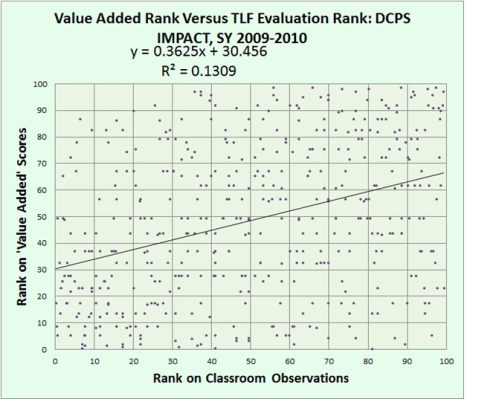
As per another post on this topic, in GFBrandenburg’s Blog — that is “Just a blog by a guy who’s a retired math teacher” — Brandenburg did leak some of the data now deemed “secret.” Namely, he “was leaked,” by an undisclosed source, “the 2009-10 IMPACT sub-scores from the Value-Added Monstrosity (VAM) nonsense and the Teaching and Learning Framework (TLF), with the names removed. [He] plotted the two [sets of] scores and showed that the correlation was very, very low, in fact about 0.33 [r-squared=0.13], or nearly random, as you [can] see here:”
In the world of correlation, this is atrocious, IF high-stakes (e.g., teacher termination, tenure, merit pay) are to be attached to such output. No wonder DCPS does not want people checking in to see if that which they are selling is true to what is being sold.
In Brandenburg’s words: “Value-Added scores for any given teacher jumped around like crazy from year to year. For all practical purposes, there is no reliability or consistency to VAM whatsoever. Not even for elementary teachers who teach both English and math to the same group of children and are ‘awarded’ a VAM score in both subjects. Nor for teachers who taught, say, both 7th and 8th grade students in, say, math, and were ‘awarded’ VAM scores for both grade levels: it’s as if someone was to throw darts at a large chart, blindfolded, and wherever the dart lands, that’s your score.”