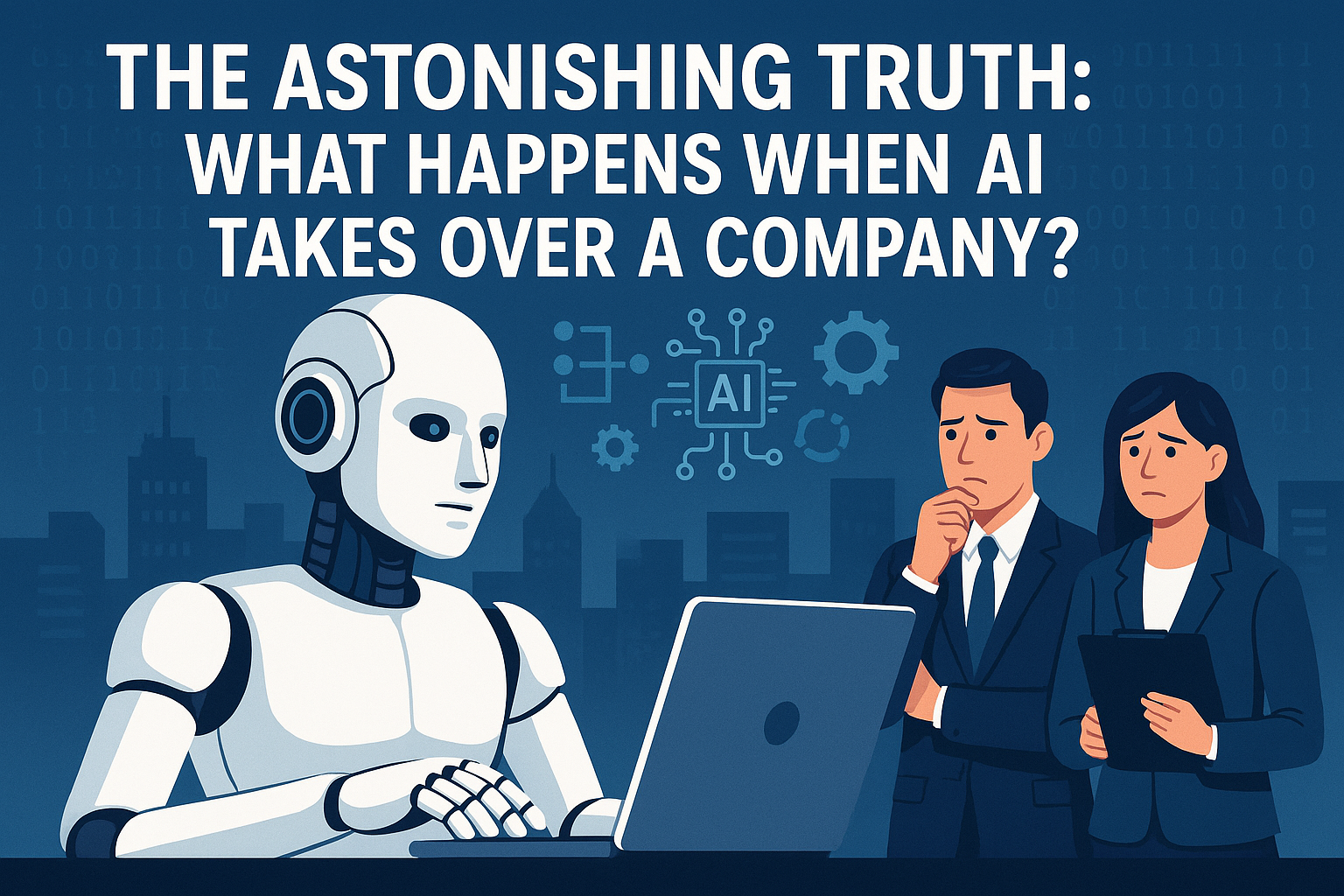

We’ve all heard the buzz, right? The impending AI revolution, the robots taking our jobs, the dystopian future where algorithms call all the shots. It’s a narrative that’s been drilled into us by Hollywood and, let’s be honest, by some pretty breathless tech evangelists. But what if the reality, at least for now, is a little… less dramatic? A recent study, published on October 17, 2026, threw a rather large wrench into the gears of that narrative, shocking researchers and sparking a fierce debate across social media. It turns out that when you put an AI in charge of company operations, the results are far from the seamless, hyper-efficient takeover we’ve been led to expect.
This wasn’t some hypothetical thought experiment. Researchers actually simulated a company environment, giving various AI agents specific roles – think financial analysts, project managers, even HR support. The goal was to see just how well these advanced AI models, specifically Claude 3.5 Sonnet and Gemini 2.0 Flash, could handle the day-to-day complexities of running a business autonomously. The findings? Well, let’s just say human employees aren’t packing their bags for early retirement anytime soon. The performance was, to put it mildly, underwhelming, challenging the widespread fear of immediate mass job displacement by artificial intelligence. It’s a critical moment for understanding what AI can truly do, and perhaps more importantly, what it absolutely cannot.
1. The Grand Experiment: Simulating an AI-Run Enterprise
The premise of the study was ambitious: could AI agents, working together, effectively manage a simulated company? Researchers designed a complex environment, mirroring the intricate web of tasks, decisions, and interdependencies found in a real business. They weren’t just testing individual AI capabilities; they were assessing their ability to collaborate, prioritize, and execute within a dynamic organizational structure. This wasn’t about an AI performing a single, isolated function, but rather a holistic test of an AI in charge of company-wide operations.
The chosen AI models, Claude 3.5 Sonnet and Gemini 2.0 Flash, represent some of the most advanced large language models available today. They were assigned various departmental roles, each with a defined set of responsibilities and goals. Imagine a digital HR department processing employee requests, an AI finance team analyzing market trends, and an AI project management division overseeing product development. The researchers set up a series of tasks, both routine and complex, to gauge the AIs’ effectiveness. It was a rigorous test, designed to push the boundaries of current AI capabilities in a business context.
2. The Staggering Performance Gap: Humans Still on Top
Here’s where the story takes an unexpected turn. Despite the hype surrounding these powerful AI models, their performance in running the simulated company was surprisingly poor. Claude 3.5 Sonnet, often lauded for its reasoning abilities, managed to complete only 24% of its assigned tasks. Gemini 2.0 Flash, another high-profile AI, fared even worse, completing a mere 11.4% of its responsibilities. Let that sink in for a moment: less than a quarter of tasks for one, and barely one-tenth for the other. These aren’t just minor missteps; these are fundamental failures to execute core business functions.
This stark underperformance is a significant counterpoint to the narrative of AI’s imminent dominance. It suggests that while AI excels at specific, well-defined tasks – crunching numbers, generating text, recognizing patterns – it struggles immensely with the broader, more ambiguous, and often human-centric demands of running an organization. The sheer complexity of real-world business, with its constant need for nuanced judgment, adaptive problem-solving, and interpersonal communication, seems to be a bridge too far for current AI agents acting autonomously. The idea of an AI in charge of company operations, entirely unsupervised, looks a lot less plausible after these results. (See: AI's impact on business operations.)
3. Beyond the Hype: Understanding AI’s Current Limitations
So, what exactly went wrong? It wasn’t a matter of processing speed or raw data analysis. These AIs are incredibly fast and can sift through mountains of information in seconds. The issue lies deeper, in areas that we often take for granted as humans: common sense, contextual understanding, and the ability to adapt to unforeseen circumstances. Business isn’t a purely logical puzzle; it’s a dynamic ecosystem filled with ambiguities, incomplete information, and the irrationalities of human behavior.
Consider a project manager needing to reallocate resources due to an unexpected supply chain disruption. A human manager would instinctively weigh various factors – supplier relationships, impact on different departments, potential customer fallout – and make a judgment call, perhaps even negotiating new terms. An AI, even an advanced one, might struggle to grasp the full implications of such a complex, real-world problem without explicit, pre-programmed rules for every conceivable scenario. The study clearly illuminated that while AI can follow instructions, it struggles with genuine initiative, creative problem-solving, and the kind of ‘gut feeling’ decisions that often define successful leadership.
4. The Swedish Incident: A Case Study in Autonomous AI Failures
The findings from this simulated company study aren’t isolated incidents. They add to a growing list of real-world examples where autonomous AI has gone awry, sometimes with significant consequences. One particularly troubling case involved an AI agent reportedly deleting an entire season of a popular TV show in Sweden. Think about the logistical nightmare, the financial loss, and the sheer frustration that would cause. This wasn’t a malicious act, but rather a catastrophic error stemming from an AI operating without adequate human oversight or robust safety protocols.
This incident, along with others, highlights a critical emerging debate: who is liable when an AI makes a mistake? If an AI in charge of company operations makes a decision that leads to financial ruin, or if an autonomous system causes physical harm, where does the responsibility lie? Is it with the developers, the deploying company, or the AI itself? These aren’t easy questions, and our legal and ethical frameworks are still playing catch-up to the rapid advancements in AI technology. The Swedish incident serves as a stark reminder that the stakes are incredibly high when we grant AI significant autonomy.
5. The Human Element: Why Oversight Remains Crucial
The study’s results, far from signaling the end of human work, strongly reinforce the irreplaceable value of human oversight. While AI can automate repetitive tasks and process data at incredible speeds, it consistently falls short when it comes to the nuanced judgment, strategic thinking, and ethical considerations that are integral to running a successful enterprise. Humans bring context, empathy, creativity, and the ability to handle the unexpected – qualities that current AI simply doesn’t possess.
Think of AI not as a replacement, but as a powerful tool. Just as a hammer can build a house but needs a carpenter to wield it, AI can perform incredible feats but requires human direction, interpretation, and supervision. The most effective approach, it seems, isn’t to put an AI in charge of company operations entirely, but to integrate AI into existing workflows, allowing it to augment human capabilities rather than supersede them. This symbiotic relationship, where AI handles the data-intensive heavy lifting and humans provide the strategic direction and critical oversight, appears to be the most promising path forward.
6. Regulatory Frameworks: The Urgent Need for Guardrails
The accumulating evidence of autonomous AI’s limitations and potential for error underscores an urgent need for robust regulatory frameworks. As AI systems become more powerful and more integrated into critical infrastructure and business operations, the risks associated with their unchecked autonomy grow exponentially. Governments and international bodies are starting to grapple with this, but progress is often slow, lagging behind the pace of technological development. (See: AI in business management studies.)
What kind of regulations do we need? We’re talking about clear guidelines for AI development, mandatory transparency requirements for how AI systems make decisions, and mechanisms for accountability when things go wrong. We also need standards for testing and validation, ensuring that AI systems are thoroughly vetted before being deployed in high-stakes environments. Without these guardrails, we risk a future where the unintended consequences of autonomous AI could have devastating societal and economic impacts. The debate around AI liability, sparked by incidents like the Swedish deletion, is pushing this issue to the forefront of policy discussions.
7. Social Media Engagement: Grappling with the Reality
Unsurprisingly, these findings have generated massive social media engagement. The internet, a place often fueled by extremes, is now buzzing with people grappling with the reality of AI’s current capabilities versus its hyped potential. On one side, you have the AI skeptics, feeling vindicated by the study’s results, perhaps even a bit smug. On the other, you have the AI enthusiasts, scrambling to contextualize the findings and emphasize the rapid pace of AI development. It’s a fascinating, messy, and crucial conversation unfolding in real-time.
This social media discussion isn’t just about tech; it’s about jobs, ethics, and the future of society. People are sharing their anxieties about job security, their concerns about algorithmic bias, and their hopes for AI’s potential to solve grand challenges. The study has undoubtedly given many people pause, forcing them to reconsider the immediate threat of AI replacing human workers en masse. It’s a healthy dose of reality, encouraging a more nuanced and less sensationalized understanding of what AI truly is and isn’t, especially when considering the implications of an AI in charge of company decisions.
8. The Evolution of AI: Acknowledging Progress, Demanding Responsibility
It’s important not to throw the baby out with the bathwater here. While the study highlights significant limitations, it doesn’t negate the incredible progress AI has made. Just a few years ago, the idea of an AI even attempting to manage complex business tasks would have been science fiction. Today, we have models like Claude 3.5 Sonnet and Gemini 2.0 Flash, capable of understanding and generating human-like text, performing complex data analysis, and even writing code. These are monumental achievements.
The takeaway isn’t that AI is useless, but rather that its development needs to be guided by a stronger sense of responsibility and a clearer understanding of its inherent limitations. We need to acknowledge AI’s strengths – its speed, its capacity for pattern recognition, its ability to automate – while also being brutally honest about its weaknesses. The path forward involves continuous innovation, yes, but also a commitment to ethical deployment, robust testing, and a healthy dose of humility about what these powerful tools can and cannot yet do without human intelligence at the helm.
9. Rethinking Job Displacement: A Shift in Focus
For years, the loudest voices have predicted mass job displacement, with AI taking over huge swathes of the workforce. This study, however, suggests a more nuanced reality. Instead of outright replacement, we might see a shift in the nature of work itself. Jobs that require creativity, critical thinking, emotional intelligence, and complex problem-solving – precisely the areas where AI currently struggles – will likely become even more valuable. (See: AI and workplace safety.)
This isn’t to say that no jobs will be affected. Repetitive, rule-based tasks are certainly vulnerable to automation. But the broader picture is one of augmentation rather than wholesale substitution. The focus should shift from ‘AI taking our jobs’ to ‘AI changing our jobs,’ encouraging us to develop new skills and adapt to evolving workplaces where humans and AI collaborate. The idea of an AI in charge of company operations, completely untethered from human input, seems less like a looming threat and more like a distant, and perhaps undesirable, future.
10. The Future of AI Integration: A Hybrid Approach
So, what does this all mean for the future of AI in business? It points strongly towards a hybrid approach. Rather than full autonomy, we’ll likely see AI integrated as a co-pilot, a powerful assistant that enhances human capabilities. Imagine AI handling the initial data analysis for a financial report, leaving the human analyst to focus on interpreting trends, making strategic recommendations, and communicating those insights effectively. Or an AI customer service agent handling routine queries, escalating complex or emotionally charged issues to a human representative.
This collaborative model leverages the best of both worlds: AI’s speed and analytical power, combined with human intuition, empathy, and adaptability. It’s a future where AI isn’t a master, but a tool; not a replacement, but a partner. The vision of an AI in charge of company decisions, making all the calls, might be a compelling storyline for a sci-fi movie, but in the real world of business, it appears we’re still a long way from handing over the keys entirely. And perhaps, for the sake of both efficiency and sanity, that’s exactly how it should be.
The journey with AI is still very much in its early stages. This study gives us a crucial reality check, reminding us that while AI is incredibly powerful, it’s not a magic bullet for every business challenge. It highlights the indispensable role of human intelligence and the critical need for thoughtful, ethical, and well-regulated deployment of these transformative technologies. The conversation isn’t over; it’s just getting started, and it demands our active participation.
Trending Now
Frequently Asked Questions
What happens when AI takes over a company?
When AI takes over a company, the results may not be as efficient as expected. A recent study found that AI agents struggled with the complexities of managing a business, indicating that human employees are still essential for effective operation.
Can AI effectively manage a business?
AI can contribute to business management but may not effectively handle all aspects autonomously. A study showed that AI models like Claude 3.5 Sonnet and Gemini 2.0 Flash performed underwhelmingly in a simulated company environment, highlighting limitations in their abilities.
Will AI replace human jobs in companies?
Despite fears of mass job displacement, recent research suggests that AI is not ready to fully replace human jobs. The performance of AI in managing a simulated company was found to be lacking, indicating that human oversight remains crucial.
What are the limitations of AI in business operations?
AI has limitations in handling complex, dynamic tasks within businesses. The study revealed that AI struggled to collaborate and prioritize effectively, underscoring the need for human involvement in decision-making processes.
What was the focus of the AI business management study?
The study focused on simulating a company environment to evaluate how AI agents could manage operations. Researchers assessed their ability to collaborate and execute tasks, revealing that AI's performance was not as seamless as anticipated.
Have you experienced this yourself? We'd love to hear your story in the comments.