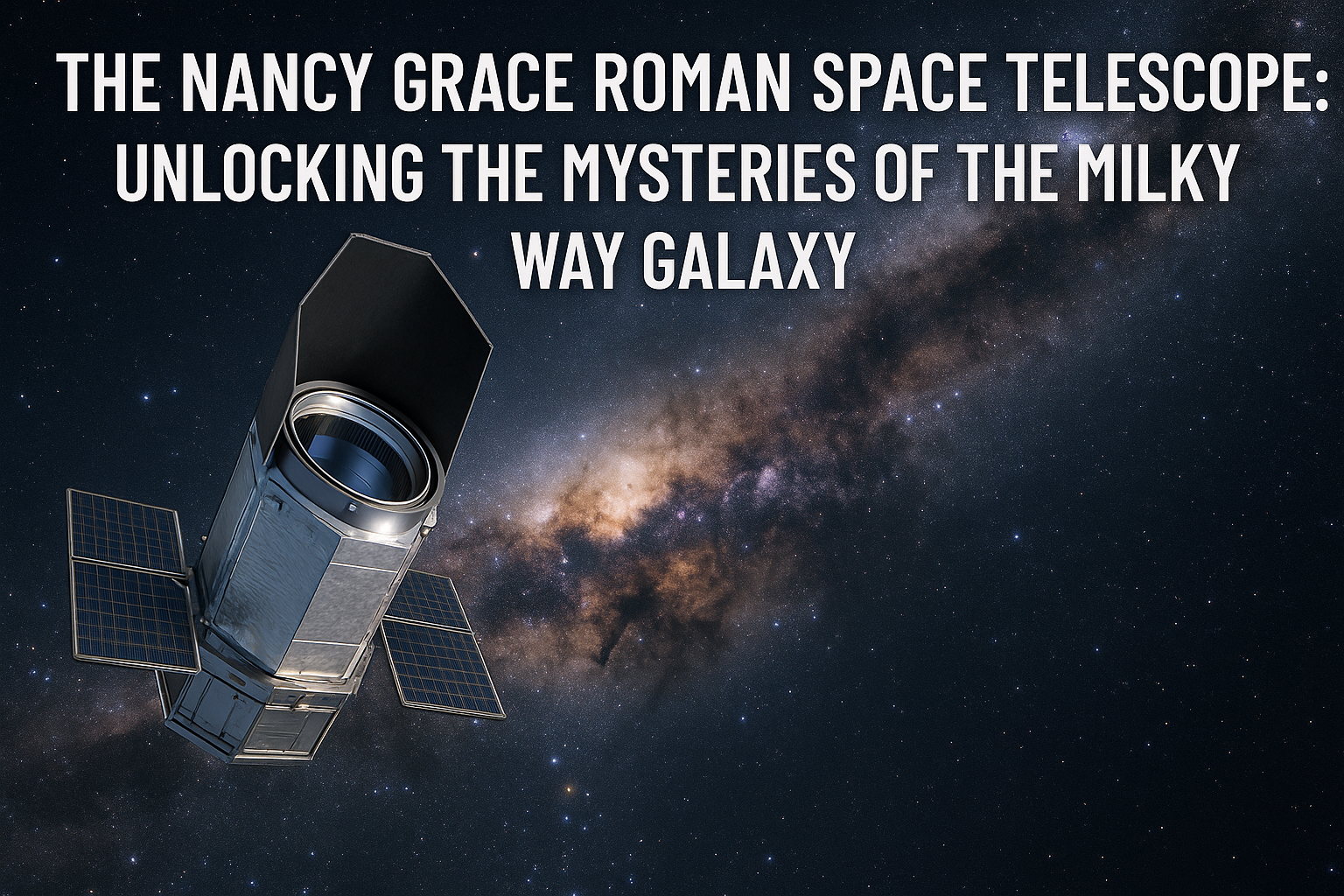

“`html
The cosmos has always held a captivating allure for mankind, and the upcoming launch of NASA’s Nancy Grace Roman Space Telescope promises to deepen our understanding of our own Milky Way galaxy like never before. With its remarkable capability to peer into the far side of our galaxy, this groundbreaking mission is set to expand our knowledge of exoplanets and their formation, potentially unveiling around 100,000 new worlds—an astonishing number compared to the nearly 6,300 exoplanets discovered to date. Join us as we explore how the Roman Space Telescope could redefine our understanding of the Milky Way galaxy and our place within it.
The Dawn of a New Era in Exoplanet Discovery
Launched as a successor to the Hubble Space Telescope, the Nancy Grace Roman Space Telescope is equipped with advanced imaging and survey capabilities that promise to revolutionize our understanding of exoplanets. Unlike previous missions, which have discovered exoplanets primarily through indirect methods, the Roman Space Telescope will use a direct imaging approach to observe a significant region of the Milky Way galaxy. This method allows for the identification of planets that may have been previously overlooked.
The sheer scale of the mission is staggering. Scientists estimate that the Roman Space Telescope could uncover around 100,000 exoplanets, providing unprecedented insights into the diversity and prevalence of planets within our galaxy. This is a monumental leap from the current tally of exoplanets, highlighting the telescope’s potential to reshape our understanding of the Milky Way galaxy.
Peering into the Far Side of the Milky Way Galaxy
One of the most exciting aspects of the Roman Space Telescope is its ability to gaze into the far side of the Milky Way galaxy, a region that has remained largely unexplored. This capability is crucial because it offers astronomers a unique vantage point to study planetary formation in environments that differ significantly from our solar neighborhood.
The far side of the Milky Way galaxy is often obscured by dust and gas clouds, complicating observations from Earth. The Roman Space Telescope, with its wide field of view and advanced imaging technology, can penetrate these barriers to provide clearer images of this enigmatic region. By examining the far side, scientists hope to discover new types of planetary systems and understand the conditions under which they form.
Understanding Planet Formation in the Milky Way Galaxy
The study of exoplanets not only piques human curiosity but also plays a critical role in understanding planetary formation. The ability to observe and analyze a larger pool of exoplanets will give astronomers insights into the processes that lead to planet formation. The Milky Way galaxy is home to a vast array of environments, and studying planets in these diverse settings will help identify the factors that contribute to the development of habitable worlds.
In particular, the Roman Space Telescope’s capabilities will help scientists explore questions like:
- What types of stars are most likely to host planets?
- How do the conditions of a star’s environment influence planet formation?
- Are there common characteristics among exoplanets that could indicate potential habitability?
By answering these questions, researchers will gain a more nuanced understanding of the Milky Way galaxy and its potential to host life. (See: Nancy Grace Roman Space Telescope overview.)
How the Roman Space Telescope Works
At the heart of the Roman Space Telescope’s mission are its groundbreaking technologies. The telescope features a wide-field instrument that can capture images of large swathes of the sky, allowing it to survey millions of stars and their surrounding planets in a fraction of the time required by previous missions. This efficiency is vital in maximizing the discoveries the telescope can make during its operational lifespan.
Additionally, the Roman Space Telescope is equipped with a highly sensitive camera that can detect faint light from distant objects. This capability is crucial when observing exoplanets, some of which may be dim and difficult to distinguish from their parent stars. By leveraging advanced imaging techniques, the telescope will be able to detect the subtle light changes caused by a planet transiting its host star, thereby confirming its presence.
Expected Discoveries: What Scientists Hope to Learn
As the Roman Space Telescope prepares for its mission, scientists are abuzz with anticipation about the potential discoveries that await. With its ability to observe the far side of the Milky Way galaxy, they expect not only to find new exoplanets but also to uncover insights into their characteristics and distributions.
Among the most exciting prospects is the identification of planets in various stages of development. By studying planets of different ages and sizes, astronomers hope to piece together the timeline of planetary formation. This knowledge could lead to a better understanding of how Earth-like planets emerge in habitable zones and whether such worlds are common throughout the Milky Way galaxy.
Additionally, the Roman Space Telescope may uncover unusual planetary systems that challenge existing theories about how planets form. For example, the discovery of gas giants orbiting close to their stars or planetary systems with multiple planets in close proximity could prompt a reevaluation of current models of planet formation.
Broader Implications for Astrobiology
The discoveries made by the Roman Space Telescope will not only expand our understanding of planetary systems but will also have profound implications for astrobiology—the study of life in the universe. Identifying new exoplanets, particularly those situated within the habitable zones of their stars, will help astronomers focus their search for extraterrestrial life.
With an estimated 100,000 new worlds at stake, the potential for discovering Earth-like planets that could support life is more significant than ever. The question of whether we are alone in the universe has long fascinated humanity, and the findings from the Roman Space Telescope may bring us closer to answering this age-old question.
Moreover, understanding the conditions under which planets form may provide insights into the likelihood of life existing elsewhere in the cosmos. For example, planets that form in environments rich in water and organic materials may have a higher chance of developing life-sustaining conditions.
Challenges and Considerations
While the potential discoveries of the Roman Space Telescope are thrilling, the mission does not come without challenges. Astronomical observations are inherently complex, and interpreting the data collected will require collaboration across numerous scientific disciplines. The sheer volume of information generated by the telescope will necessitate robust data analysis techniques and innovative computational methods. (See: revolutionize exoplanet discovery.)
Furthermore, as scientists prepare for the influx of new exoplanet data, ethical considerations surrounding the exploration of extraterrestrial life become increasingly pertinent. If Earth-like planets are discovered in habitable zones, discussions about the implications for human exploration and potential colonization will need to be conducted thoughtfully.
Comparative Look: Traditional vs. New Astronomy Methods
To fully appreciate the advancements brought by the Roman Space Telescope, it is essential to compare traditional astronomy methods with the new approaches being employed. Traditionally, astronomers relied heavily on indirect methods such as the transit method and radial velocity measurements to infer the existence of exoplanets. These techniques, while effective, often resulted in biases towards detecting larger planets close to their stars.
In contrast, the Roman Space Telescope’s direct imaging approach aims to visualize planets by capturing the light they reflect. This method has the potential to uncover smaller, more distant planets that have previously evaded detection. For example, while traditional methods might miss Earth-sized planets around sun-like stars, the Roman Space Telescope could revolutionize our understanding of these smaller worlds and their atmospheres.
This shift from indirect to direct methods signifies a pivotal change in astronomy, where instruments can now provide a more comprehensive picture of planetary systems, fostering a deeper understanding of the Milky Way galaxy.
Future Missions and Their Implications
The Roman Space Telescope is just one part of a broader tapestry of astronomical missions planned for the coming years. Following its launch, missions like the James Webb Space Telescope will complement its findings by studying the atmospheres of discovered exoplanets, searching for biosignatures that could indicate life.
These missions collectively enhance our understanding of the Milky Way galaxy and its potential for life. As technology continues to advance, the synergy between different telescopes and observatories will provide unprecedented access to the cosmos, allowing scientists to explore not just our galaxy but the universe as a whole.
FAQs About the Milky Way Galaxy and the Roman Space Telescope
What is the Milky Way galaxy?
The Milky Way galaxy is a barred spiral galaxy that contains our solar system, along with billions of other stars and planetary systems. It is estimated to be about 100,000 light-years in diameter and is home to a variety of celestial phenomena.
How does the Roman Space Telescope differ from the Hubble Space Telescope?
While both telescopes are crucial for astronomical exploration, the Roman Space Telescope has a much wider field of view and specializes in surveying large areas of the sky for exoplanets, whereas Hubble focuses on detailed observations of individual astronomical objects. (See: New York Times article on Roman Telescope.)
When is the Roman Space Telescope expected to launch?
The Roman Space Telescope is scheduled to launch in the mid-2020s, with precise timing dependent upon various factors, including technological readiness and mission objectives.
How can the discoveries from the Roman Space Telescope impact our understanding of life beyond Earth?
The discoveries made by the Roman Space Telescope could identify a myriad of exoplanets, particularly those within habitable zones, and foster extensive research into their atmospheres and potential for life. This could redefine our understanding of life in the universe.
What are some potential challenges that the Roman Space Telescope might face?
Challenges include data handling due to the vast amount of information collected, the need for collaborative interdisciplinary approaches to interpret the data, and the ethical implications of discovering potentially habitable worlds.
Conclusion: A New Chapter in Milky Way Exploration
The Nancy Grace Roman Space Telescope stands at the forefront of a new chapter in our exploration of the Milky Way galaxy. By positioning itself to make groundbreaking discoveries about exoplanets and planetary formation, this mission has the potential to reshape our understanding of where we fit into the grand tapestry of the universe.
As scientists prepare for the launch, excitement builds around the prospect of uncovering a wealth of knowledge about our galaxy. The Roman Space Telescope is not just a technological marvel; it represents humanity’s insatiable curiosity and quest for understanding. With its powerful capabilities, we may soon find ourselves standing on the brink of a new era in astronomy, one that could change our perspective on life beyond Earth forever.
“`
Trending Now
Frequently Asked Questions
What is the purpose of the Nancy Grace Roman Space Telescope?
The Nancy Grace Roman Space Telescope aims to deepen our understanding of the Milky Way galaxy by using advanced imaging techniques to discover and observe exoplanets. It is expected to uncover around 100,000 new worlds, significantly expanding our knowledge of planetary formation and the diversity of planets in our galaxy.
How will the Roman Space Telescope differ from the Hubble Space Telescope?
Unlike the Hubble Space Telescope, which primarily uses indirect methods to discover exoplanets, the Roman Space Telescope employs direct imaging techniques. This allows it to observe a vast region of the Milky Way galaxy, potentially identifying planets that were previously overlooked and providing new insights into their characteristics.
What could the Roman Space Telescope reveal about exoplanets?
The Roman Space Telescope could reveal a wealth of information about exoplanets, including their formation and diversity. With the potential to discover around 100,000 new exoplanets, it will enhance our understanding of how these worlds are formed and their prevalence within the Milky Way galaxy.
Why is studying the far side of the Milky Way important?
Studying the far side of the Milky Way is crucial as it has remained largely unexplored. The Roman Space Telescope's ability to observe this region will offer astronomers unique insights into planetary formation in varied environments, potentially leading to groundbreaking discoveries about our galaxy.
When is the Nancy Grace Roman Space Telescope expected to launch?
While the exact launch date may vary, the Nancy Grace Roman Space Telescope is anticipated to launch in the mid-2020s. This mission is highly anticipated in the astronomy community due to its potential to unlock new mysteries of the Milky Way galaxy.
Agree or disagree? Drop a comment and tell us what you think.