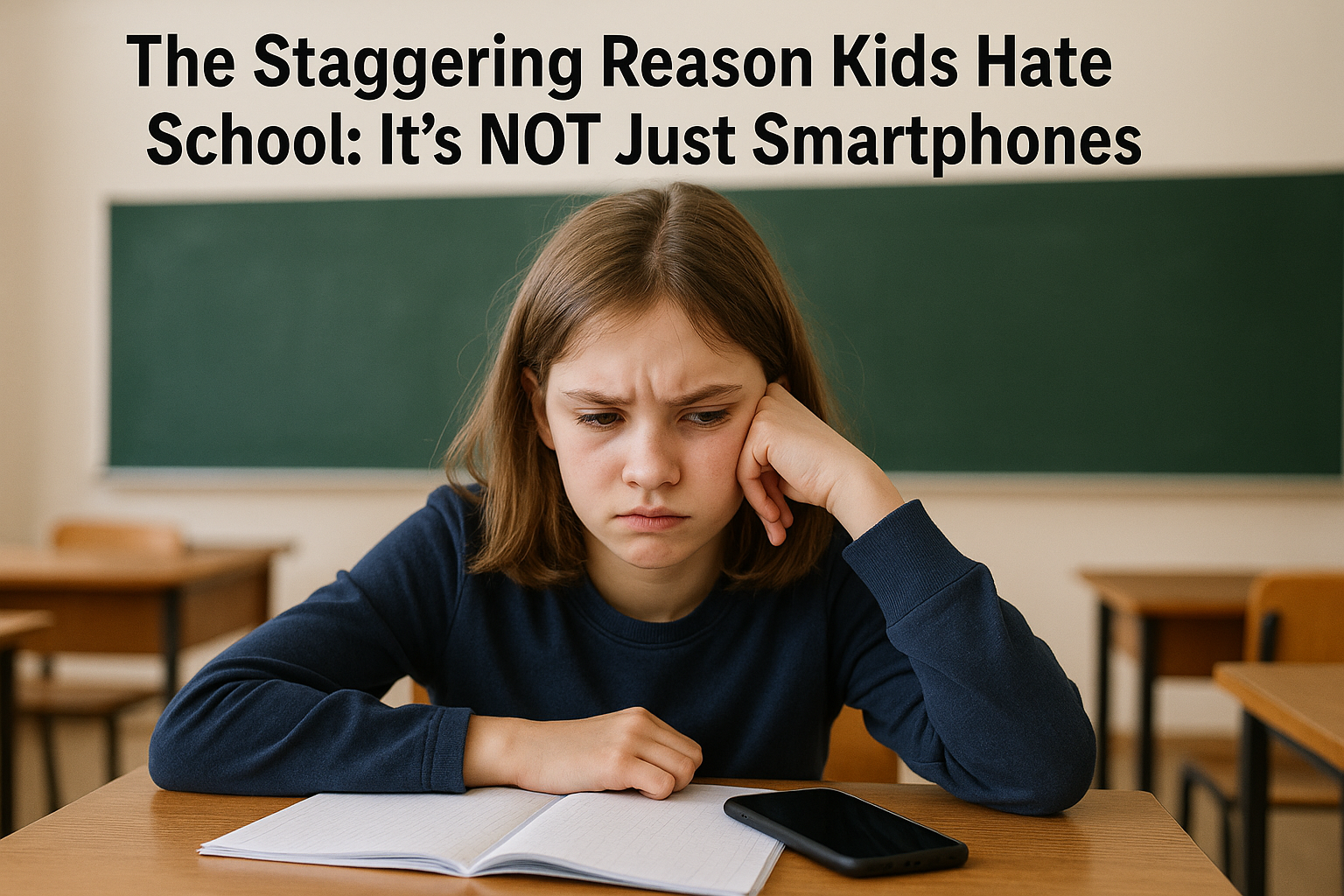

You’ve probably seen the headlines, heard the worried whispers from parents, and maybe even experienced it firsthand: kids are checking out of school. And I’m not just talking about the occasional daydream or a bad day. We’re seeing a full-blown, systemic disengagement that’s leaving educators, families, and even students themselves scratching their heads. It’s a crisis manifesting in declining attendance, plummeting academic performance globally, and a distressing surge in youth mental health issues.
The numbers are frankly, pretty stark. Recent research paints a concerning picture of student interest, revealing a dramatic drop in how many kids actually find school engaging. Back in 2020-21, a respectable 42% of students reported feeling interested in their learning “always/very often” or “quite often.” Fast forward to 2023, and that number has plummeted to a mere 28%. That’s a huge slide in just a couple of years, and it should set off alarm bells for anyone invested in the future of our youth and, by extension, our society.
Now, when we talk about this problem, the conversation often quickly swerves to the usual suspects: smartphones and social media. And yes, those absolutely play a role. The addictive algorithms, the constant notifications, the curated highlight reels – they’re powerful distractions, no doubt. But what if the real problem, the deeper, more fundamental issue, isn’t just external? What if it’s baked right into the very structure of our schools? Journalist Jenny Anderson, for one, argues exactly this, suggesting the core issue isn’t merely the allure of TikTok, but a fundamental flaw in how we design the learning experience itself. She posits that students are often “bored to tears by content that feels irrelevant.” And if that’s true, then true education reform needs to look far beyond just banning phones.
The Silent Epidemic of Disengagement: More Than Just Boredom
Let’s be honest, who hasn’t felt bored in school at some point? But what we’re witnessing today goes beyond typical adolescent apathy. This isn’t just about a particularly dry history lesson or a math concept that’s hard to grasp. This is a pervasive, almost existential disengagement where a significant chunk of the student population simply doesn’t see the point. They’re not connecting with the material, they’re not connecting with the process, and in many cases, they’re not connecting with the institution itself. It’s a silent epidemic, spreading through classrooms and hallways, quietly eroding the very foundation of learning.
Think about it: when content feels irrelevant, it’s not just a minor inconvenience; it’s a barrier to meaning. Our brains are wired to seek patterns, to make connections, and to understand how things fit into the bigger picture. When school feels like an endless series of disconnected facts and tasks, without a clear purpose or application, it’s incredibly difficult for students to invest their mental and emotional energy. This isn’t just about academic performance; it’s about the holistic development of young people. If they’re not engaged in learning, they’re also missing out on opportunities to develop critical thinking skills, problem-solving abilities, and even their own sense of identity and belonging within a community.
This widespread disinterest signals a profound disconnect between what schools offer and what students actually need or perceive as valuable. It suggests that the traditional models of instruction, the curriculum choices, and even the very environment of the classroom might be failing to resonate with a generation growing up in a vastly different world. True education reform, then, must begin by understanding this disconnect and working to bridge it, moving beyond superficial fixes to address the root causes of this deep-seated apathy. (See: CDC Youth Risk Behavior Survey.)
Beyond the Screen: The Deeper Flaws in School Design
It’s easy to point fingers at technology. Smartphones and social media are convenient scapegoats, and their role in distracting students and contributing to mental health challenges is undeniable. But to solely blame technology is to miss a much larger, more uncomfortable truth: our education system, in many ways, is still operating on a model designed for a different century. The factory model of education, with its emphasis on rote memorization, standardized testing, and a one-size-fits-all curriculum, often struggles to ignite genuine curiosity or foster deep, meaningful learning in today’s rapidly changing world.
Consider the structure of a typical school day. Bell rings, switch subjects, absorb information, take a test. Repeat. For many students, this feels like an assembly line, where they are passive recipients of knowledge rather than active participants in their own learning journey. When the material presented in class bears little resemblance to the complex, interconnected challenges of the real world, or when it fails to tap into their individual interests and passions, it’s no wonder they reach for their phones. The real world, after all, is messy, interdisciplinary, and often driven by personal relevance.
The problem isn’t just the content itself, but how it’s delivered. Are we giving students enough opportunities for hands-on learning, collaborative projects, critical inquiry, or even just genuine choice in what and how they learn? If the answer is often ‘no,’ then we’re inadvertently creating a vacuum that screens are all too happy to fill. Meaningful education reform demands a re-evaluation of these foundational design principles, shifting from an industrial model to one that nurtures curiosity, creativity, and critical engagement.
The Curriculum Conundrum: Irrelevance as a Barrier to Growth
At the heart of Jenny Anderson’s argument is the idea that much of what students are taught simply feels irrelevant. This isn’t about dismissing the importance of foundational knowledge, far from it. It’s about how that knowledge is presented and contextualized. When a student can’t connect a historical event to current global affairs, or a mathematical concept to a practical application, or a piece of literature to their own lived experience, the information becomes abstract, dry, and ultimately forgettable. It becomes something to be regurgitated for a test, not internalized for understanding.
Take, for instance, a classic curriculum. Often, it’s heavily weighted towards content that might have been crucial a generation or two ago, but now feels distant from the realities of the 21st century. While a strong foundation in core subjects is essential, the modern world demands skills like digital literacy, critical media consumption, emotional intelligence, and complex problem-solving – areas often marginalized in favor of traditional academic disciplines. Are we truly preparing students for a world of AI, climate change, and unprecedented global interconnectedness if our curriculum largely ignores these vital subjects or integrates them poorly?
Education reform in this area isn’t about throwing out the classics; it’s about making them relevant. It means connecting the past to the present, theory to practice, and abstract ideas to concrete applications. It involves empowering educators to adapt curricula to local contexts and student interests, fostering a sense of ownership over what is learned. When students see the immediate and future value in what they’re studying, their engagement naturally skyrockets, and the perceived competition from their devices diminishes. (See: AP News on education trends.)
Mental Health and the Learning Crisis: A Vicious Cycle
The rise in youth mental health struggles isn’t just an unfortunate coincidence alongside declining academic engagement; it’s deeply intertwined. When students feel disconnected, bored, and irrelevant in their primary daily environment – school – it inevitably takes a toll on their emotional well-being. A lack of purpose, a feeling of being unheard, and the constant pressure of a system that might not feel designed for them can contribute significantly to anxiety, depression, and a general sense of malaise.
Think about the pressure cooker environment many schools inadvertently create. The relentless focus on grades, the high-stakes testing, the competition for college admissions – these can be incredibly stressful for young people, especially when they don’t feel adequately supported or find intrinsic joy in the learning process itself. When learning becomes a chore rather than a discovery, the emotional burden can become immense. This can lead to a vicious cycle: mental health issues make it harder to engage in school, and disengagement in school exacerbates mental health issues.
Effective education reform must therefore be holistic, recognizing the inseparable link between well-being and learning. This means prioritizing social-emotional learning, providing robust mental health support services within schools, and creating environments where students feel safe, valued, and understood. It means fostering a culture where asking for help is normalized, and where the focus shifts from simply processing information to nurturing healthy, resilient, and engaged individuals. Only then can we hope to break this cycle and create truly supportive learning ecosystems.
Reimagining the Classroom: Strategies for Genuine Engagement
If the problem is fundamental school design and irrelevant content, what does genuine education reform look like? It means a radical reimagining of the classroom experience, moving away from passive instruction towards active, experiential, and personalized learning. We need to create environments where students are not just consumers of information, but creators, problem-solvers, and critical thinkers.
- Project-Based Learning (PBL): Instead of isolated subjects, imagine students tackling real-world problems through interdisciplinary projects. Building a sustainable community garden, designing a local public awareness campaign, or analyzing data to propose solutions for local issues – these approaches make learning tangible and relevant. When students are actively involved in solving problems that matter, their intrinsic motivation soars.
- Personalized Learning Pathways: Recognizing that every student learns differently and has unique interests, schools can offer more choice and flexibility. This could involve self-paced learning modules, interest-based electives, or opportunities for students to pursue independent research on topics they’re passionate about. Technology, when used thoughtfully, can be a powerful tool here, facilitating customized learning experiences rather than just being a distraction.
- Community Engagement: Connecting school to the wider community can transform learning. Partnerships with local businesses, non-profits, or government agencies can provide students with mentorship opportunities, internships, and a chance to apply their skills in real-world settings. This not only makes learning relevant but also helps students develop a sense of civic responsibility and belonging.
- Empowering Educators: Teachers are on the front lines, and they need the autonomy, resources, and professional development to innovate. This means trusting them to adapt curriculum, experiment with new pedagogies, and foster student-centered classrooms. Reducing bureaucratic burdens and investing in their growth is paramount.
- Focus on Skills, Not Just Content: While content knowledge is important, the ability to think critically, communicate effectively, collaborate, and adapt are arguably more vital for future success. Education reform should prioritize teaching these “21st-century skills” through engaging activities and assessments that go beyond simple recall.
These aren’t just buzzwords; they represent concrete shifts in how we approach teaching and learning. They demand a willingness to move beyond traditional structures and embrace approaches that truly put the student at the center of the educational experience. It won’t be easy, and it will require significant investment and a sustained commitment, but the alternative is a generation of disengaged learners. (See: New York Times on mental health in schools.)
The Path Forward: Collective Action for Education Reform
Turning around a struggling education system isn’t a task for any single group; it requires a concerted, collaborative effort from all stakeholders. Parents, educators, policymakers, community leaders, and even students themselves must be part of the conversation and the solution. The viral traction this topic is gaining suggests a widespread recognition of the problem, and that’s a crucial first step. People are grappling with the perceived failures of the current system and the pervasive influence of technology, and they’re hungry for answers.
For parents, it means advocating for more engaging and relevant learning experiences, asking tough questions about curriculum and pedagogy, and supporting initiatives that prioritize student well-being. For educators, it means having the courage to innovate, to experiment, and to push for systemic changes that empower them to truly meet the needs of their students. For policymakers, it means moving beyond reactive measures and investing in long-term, evidence-based education reform that addresses the root causes of disengagement, rather than just treating the symptoms.
Ultimately, the goal isn’t just to get kids off their phones; it’s to create an educational experience so compelling, so relevant, and so deeply engaging that screens become a secondary thought. It’s about fostering environments where learning is an adventure, where curiosity is celebrated, and where every student feels a sense of purpose and belonging. This isn’t an overnight fix; it’s a generational commitment to building schools that truly serve the needs of our children and prepare them not just for tests, but for rich, meaningful, and engaged lives.
Trending Now
Frequently Asked Questions
Why do kids hate school so much?
Kids are increasingly disengaged from school due to a variety of factors, including boredom from content that feels irrelevant and a lack of engaging learning experiences. Recent statistics show a significant drop in student interest, with only 28% of students finding school engaging in 2023 compared to 42% in 2020.
Are smartphones the main reason kids are disengaged from school?
While smartphones and social media contribute to student disengagement through distractions, the deeper issue lies in the structure of the education system itself. Many students find the curriculum boring and irrelevant, suggesting that reform should focus on improving the learning experience rather than solely addressing technology use.
What are the effects of student disengagement?
Student disengagement leads to declining attendance, lower academic performance, and increased mental health issues among youth. This systemic problem is alarming for educators and families, highlighting the urgent need for educational reform to better engage students.
How can schools improve student engagement?
To improve student engagement, schools need to redesign the learning experience by making it more relevant and interesting. This could involve updating curricula, incorporating interactive teaching methods, and addressing the factors that contribute to boredom in the classroom.
What role does boredom play in student disengagement?
Boredom is a significant factor in student disengagement, with many students feeling uninterested in the material presented. When content is perceived as irrelevant, students are less likely to engage, leading to a greater disconnect from the educational process.
What's your take on this? Share your thoughts in the comments below — we read every one.