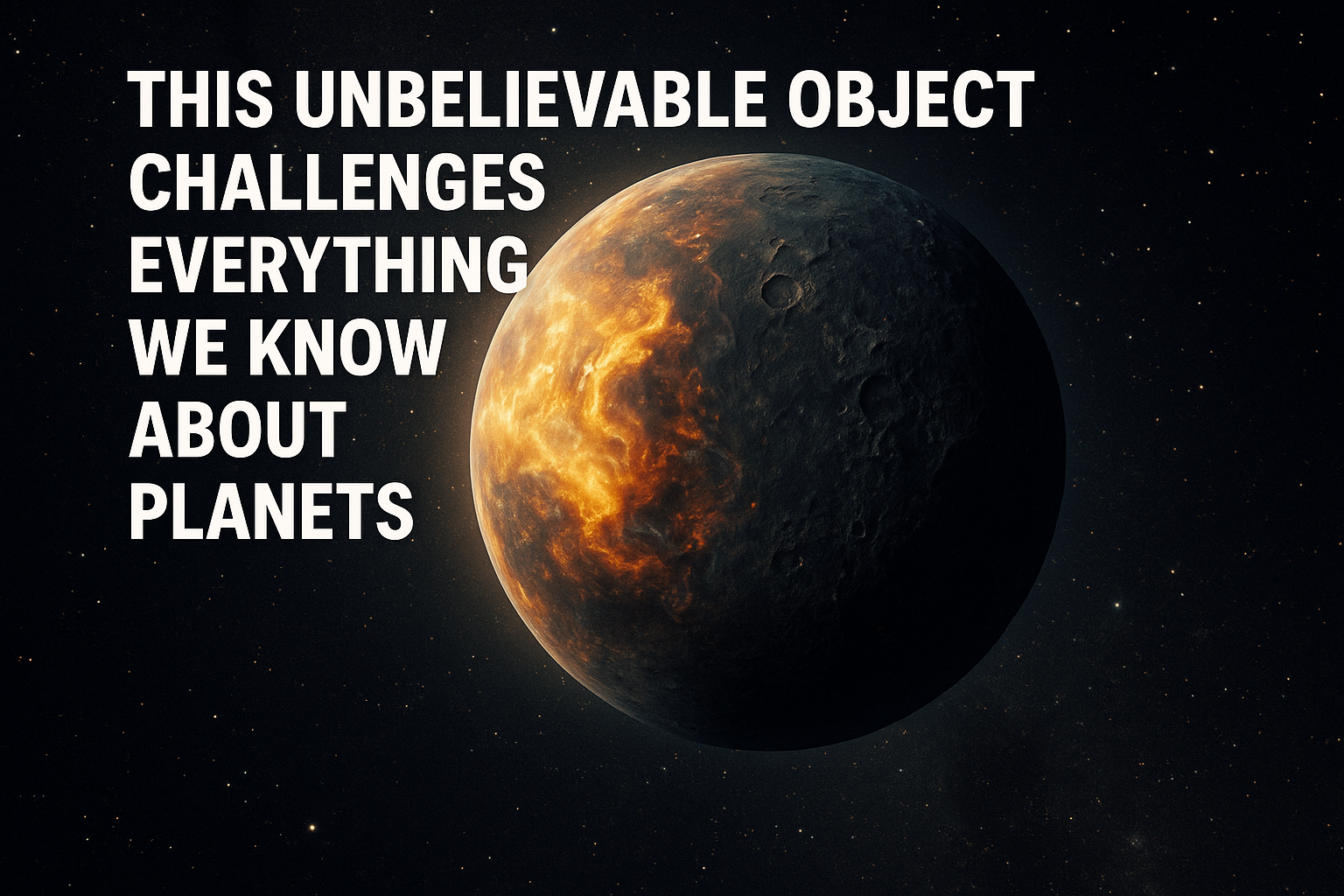

Imagine you’re an astronomer. You’ve spent your life studying the cosmos, categorizing celestial bodies into neat little boxes: stars, planets, moons, asteroids, comets. It’s a system that’s served us well for centuries, built on observations and gravitational physics. Then, one day, a discovery comes along that rips open those boxes, scatters the labels, and leaves you scratching your head, wondering if you ever truly understood anything at all. That’s precisely the situation astronomers find themselves in with a recent, truly mind-bending find in the CD-35 2722 system, about 73 light-years from Earth.
This isn’t just another exoplanet or a run-of-the-mill moon. This object is a cosmic anomaly, a celestial rebel that refuses to conform. It’s got the heft of a giant planet, yet it’s orbiting something else entirely – a brown dwarf – which in turn orbits a star. It’s a three-tier gravitational dance that has forced scientists to coin a new term: ‘exosatellite.’ But what exactly *is* an exosatellite, and what is the fundamental difference between an exosatellite and a planet? This isn’t just an academic debate; it’s a profound challenge to our very definitions of what constitutes a planet or a moon, and it promises to reshape our understanding of how cosmic bodies form and interact.
The Curious Case of CD-35 2722: A Cosmic Riddle
The discovery itself reads like a detective story. Using the formidable power of the European Southern Observatory’s Very Large Telescope (VLT) in Chile, researchers detected this peculiar object not by seeing it directly, but by observing the subtle gravitational tug-of-war it was playing with its host. The object’s gravity was causing tiny, rhythmic wobbles in the brown dwarf it orbits. These minute shifts, though barely perceptible, were enough to betray the presence of something truly massive.
Now, let’s unpack that system for a moment. You have a central star, around which orbits a brown dwarf. Brown dwarfs are fascinating objects in their own right – often called ‘failed stars’ because they’re too massive to be planets but not massive enough to ignite sustained nuclear fusion like a star. And then, circling this brown dwarf, is our mystery object. Its mass is roughly comparable to Jupiter, our solar system’s largest planet. Think about that for a second: an object as massive as Jupiter, orbiting *another* object (a brown dwarf) that is itself orbiting a star. It’s a hierarchical structure that doesn’t fit neatly into our established categories.
This isn’t just about semantics; it’s about the very mechanisms of formation. How does an object of planetary mass end up in a moon-like orbit around a brown dwarf? This particular configuration challenges the conventional wisdom that dictates how planets form around stars and how moons form around planets. The implications ripple through our theoretical models, demanding new explanations and perhaps entirely new pathways for cosmic evolution.
Defining the Indefinable: The Exosatellite Emerges
Before this discovery, the lines were relatively clear, at least in our solar system. Planets orbit stars. Moons orbit planets. Easy, right? But what do you call something with the mass of a planet that orbits a brown dwarf, which itself orbits a star? The term ‘exosatellite’ has been tentatively adopted, but it’s more a placeholder than a definitive answer. It highlights the object’s moon-like orbital characteristic – orbiting something other than a star – while acknowledging its planetary-scale mass. This is the crux of the problem and the main difference between an exosatellite and a planet as we traditionally understand it. (See: Understanding exoplanets and their classifications.)
To truly grasp the novelty here, let’s revisit the International Astronomical Union’s (IAU) definition of a planet, established in 2006 (and famously demoting Pluto). A planet must:
- Orbit the Sun (or, by extension, another star).
- Be massive enough for its own gravity to pull it into a nearly round shape.
- Have cleared the neighborhood around its orbit.
Our new exosatellite fails the first criterion spectacularly. It doesn’t orbit a star directly. It orbits a brown dwarf. So, it’s not a planet by this definition. But then, it’s also far too massive to be a typical moon. Our solar system’s largest moon, Ganymede (orbiting Jupiter), is only about 2.5% the mass of Earth. This new object is Jupiter-mass. That’s a staggering difference, making it an entirely different beast.
The Fundamental Difference Between an Exosatellite and a Planet
Let’s get down to the brass tacks of the classification conundrum. The core difference between an exosatellite and a planet boils down primarily to its gravitational parent and, by extension, its formation history. A planet, by almost every modern astronomical definition, is a celestial body that orbits a star. It is a primary body in its orbital system, directly influenced by the star’s immense gravity.
An exosatellite, however, introduces a new layer of hierarchy. It’s an object of significant mass (in this case, planetary mass) that orbits *another* non-stellar body, which in turn orbits a star. Think of it as a sub-satellite, but one that has the characteristics of a planet. This isn’t a mere nuance; it fundamentally alters our understanding of gravitational hierarchies and the distribution of mass within a star system. A planet exists in a direct, primary relationship with its star. An exosatellite exists in a secondary, dependent relationship with its primary orbiter, which then has a primary relationship with its star.
This distinction isn’t just about where something orbits; it speaks volumes about how it came into being. Planets are generally thought to form from the protoplanetary disk of gas and dust surrounding a young star. Moons, especially large ones, can form through various mechanisms: accretion from a circumplanetary disk, capture of rogue asteroids, or even catastrophic impacts. An object of Jupiter’s mass orbiting a brown dwarf suggests formation pathways that might be entirely different from either of these traditional scenarios. Could it have formed in a mini-disk around the brown dwarf itself? Or was it a rogue planet captured by the brown dwarf? Each possibility opens up a new frontier in theoretical astrophysics.
Implications for Planet Formation Theories
This discovery isn’t just a quirky outlier; it’s a data point that could force a seismic shift in our planet formation theories. Currently, two dominant models explain how planets come to be:
- Core Accretion: This is the most widely accepted model, suggesting that planets form from the gradual accumulation of dust and rock particles in the protoplanetary disk. Over millions of years, these particles stick together, forming planetesimals, which then grow into protoplanets and eventually full-fledged planets. Gas giants like Jupiter are thought to form a solid core first, then rapidly accrete vast amounts of gas from the surrounding disk.
- Gravitational Instability: In this model, massive regions within a very dense protoplanetary disk can collapse directly under their own gravity, forming gas giant planets much more quickly. There’s no need for a solid core to form first; the whole thing just collapses.
Now, where does our Jupiter-mass exosatellite fit into this? If it formed around the brown dwarf, the ‘star’ for that system is much smaller and less luminous than a typical star. The protoplanetary disk around a brown dwarf would be significantly different in terms of mass, temperature, and composition compared to a disk around a sun-like star. Could core accretion still happen efficiently enough to build a Jupiter-mass object in such an environment? Or does the gravitational instability model become more plausible for objects forming around brown dwarfs? (See: NASA's Kepler mission and exoplanet discoveries.)
What if it didn’t form there at all? What if this was a free-floating planet, wandering through interstellar space, that was subsequently captured by the brown dwarf? While planetary capture events are theoretically possible, capturing something as massive as Jupiter into a stable orbit is a complex dance of gravitational forces. Each scenario presents its own set of challenges and demands a re-evaluation of the conditions under which such massive bodies can form or be acquired.
The Ever-Expanding Universe of Exoplanets and Exomoons
It’s worth remembering that the concept of ‘exoplanets’ – planets outside our solar system – was once a theoretical dream. Now, we’ve confirmed thousands of them, with new discoveries announced regularly. This explosion of exoplanet data has already broadened our understanding of planetary diversity. We’ve found ‘hot Jupiters’ orbiting incredibly close to their stars, ‘super-Earths’ far larger than our home world, and even planets orbiting multiple stars. Each new type forces us to refine our models and expand our definitions.
Exomoons, too, are becoming a frontier of research. While notoriously difficult to detect directly, the search for exomoons is gaining traction. The traditional understanding is that exomoons would be significantly smaller than their host exoplanets, much like our own moons. But what happens when an exomoon is *as big* as an exoplanet? That’s the boundary our new exosatellite is blurring. It forces us to ask: at what point does a ‘moon’ become so massive that it transcends the very concept of a satellite and demands a new classification?
This isn’t an isolated incident either. The universe is vast and full of surprises. As our observational techniques improve and our telescopes become more powerful, we are bound to uncover more such ‘in-between’ objects. Each one will add another puzzle piece to the grand cosmic tapestry, challenging our preconceived notions and forcing us to think bigger, literally and figuratively.
Why This Discovery is Generating Viral Buzz
You might wonder why a seemingly academic debate about celestial classification is generating significant viral interest. It’s because this discovery isn’t just for astronomers; it touches on something fundamental about our human desire to understand the universe around us. When scientists say they’re ‘baffled’ or ‘at a loss for how to categorize’ something, it captures the public imagination. It’s a reminder that even with all our technological prowess and scientific understanding, the cosmos still holds profound mysteries.
This particular finding fundamentally questions our understanding of cosmic bodies and their formation. It’s like finding a creature that has both fins and fur – it defies our established biological classifications and makes us reconsider the very definition of a ‘fish’ or a ‘mammal.’ The same applies here. This exosatellite forces us to confront the limitations of our current definitions and sparks widespread debate and curiosity among both the scientific community and the public. It reminds us that science is not about having all the answers, but about constantly asking better questions. (See: Research on planetary formation and classification.)
Furthermore, the idea of a three-tiered system – a star, a brown dwarf, and a Jupiter-mass object orbiting the brown dwarf – is inherently captivating. It paints a picture of a universe far more complex and gravitationally intricate than many might have imagined. It pushes the boundaries of what we thought was possible for stable orbital configurations and hints at a richness of astronomical phenomena we’re only just beginning to uncover.
The Future of Cosmic Classification and Exploration
What does this mean for the future? Well, for starters, it means astronomers will be busy. This discovery isn’t the end of the story; it’s just the beginning. More observations of the CD-35 2722 system will be crucial. We need to characterize this exosatellite further: Is it rocky or gaseous? What is its atmospheric composition? Are there other objects in this complex system? Each piece of data will help us refine our understanding and potentially develop new models.
Beyond this specific object, this finding will undoubtedly spur a renewed focus on finding similar ‘in-between’ bodies. Are there more Jupiter-mass objects orbiting brown dwarfs? What about Earth-mass objects orbiting gas giants in other systems? The search parameters for exoplanets and exomoons might need to be broadened, encompassing a wider range of mass ratios and orbital hierarchies.
Ultimately, this discovery underscores the dynamic and ever-evolving nature of astronomy. Our definitions are not set in stone; they are tools that help us understand the universe. When the universe presents us with something that breaks those tools, it’s not a failure, but an opportunity. It’s an invitation to refine our understanding, to develop new concepts, and to push the boundaries of human knowledge even further. The difference between an exosatellite and a planet might seem like a technicality, but it’s a distinction that could unlock entirely new chapters in the story of cosmic formation and evolution, reminding us that the universe is far stranger, and far more wonderful, than we could ever have imagined.
Trending Now
Frequently Asked Questions
What is an exosatellite?
An exosatellite is a newly coined term for a celestial object that orbits a brown dwarf, which itself orbits a star. This challenges traditional definitions of planets and moons, as it blurs the lines of how we categorize celestial bodies.
How was the exosatellite in the CD-35 2722 system discovered?
The exosatellite was discovered using the European Southern Observatory's Very Large Telescope. Researchers detected it indirectly by observing the gravitational effects it had on its host brown dwarf, causing subtle wobbles that indicated the presence of a massive object.
What makes the CD-35 2722 system unique?
The CD-35 2722 system is unique because it features a complex gravitational arrangement where a giant planet-like object, termed an exosatellite, orbits a brown dwarf, which in turn orbits a star. This three-tiered system challenges existing definitions of celestial bodies.
Why is the discovery of the exosatellite significant?
The discovery of the exosatellite is significant because it challenges our understanding of planetary classification and formation. It prompts scientists to reconsider the criteria that define planets and moons, potentially reshaping our knowledge of cosmic bodies.
What are brown dwarfs?
Brown dwarfs are substellar objects that are not massive enough to sustain hydrogen fusion like stars. They occupy a unique space between the largest planets and the smallest stars, making them intriguing subjects of study in astronomy.
What's your take on this? Share your thoughts in the comments below — we read every one.