
“`html
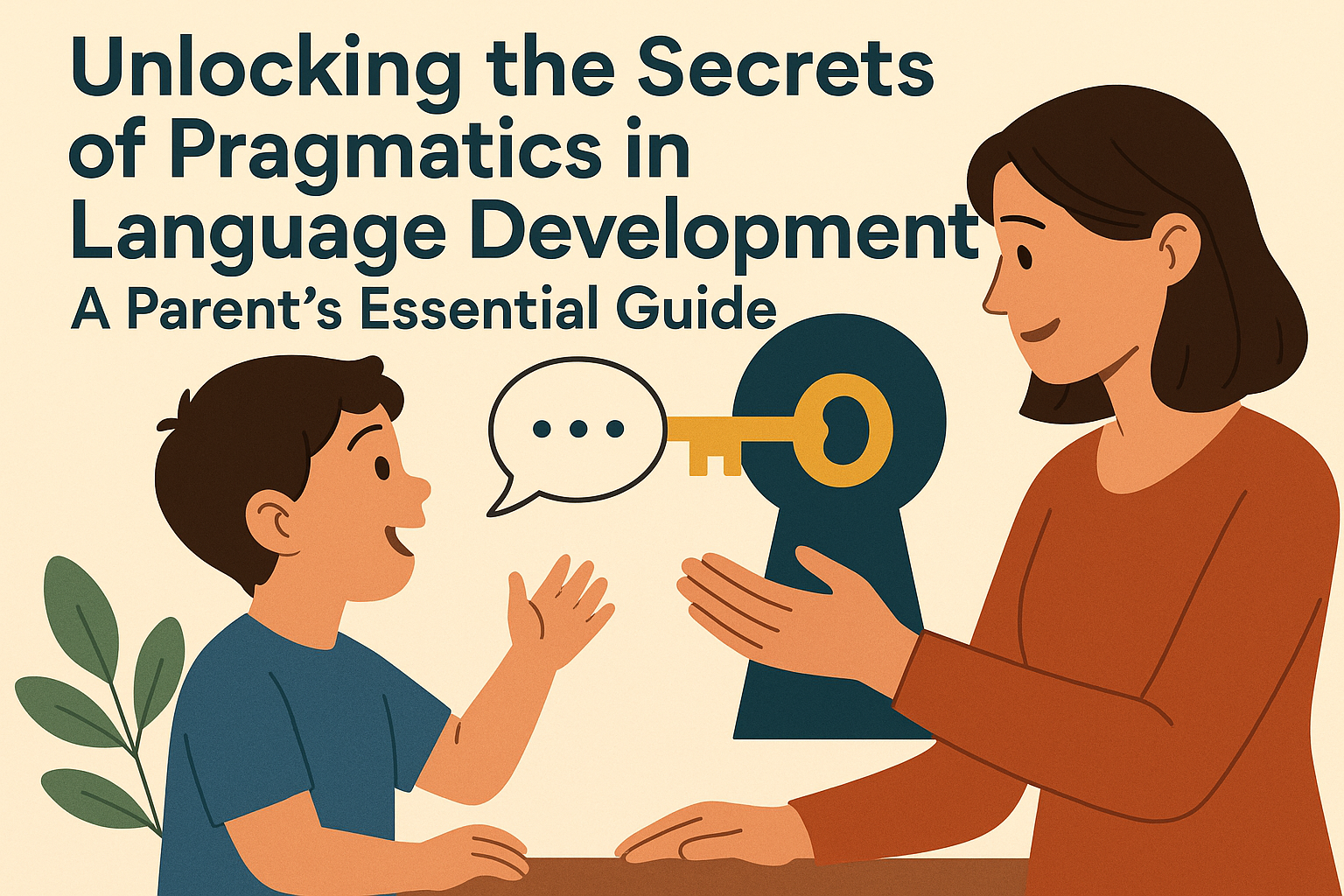
When we think about language development in children, a lot of focus is given to vocabulary and grammar. However, one crucial aspect that often flies under the radar is pragmatics in language development. Understanding pragmatics is key to fostering effective communication skills in your child, and as a parent, it’s essential to grasp this concept.
What Are Pragmatics?
Pragmatics refers to the rules and conventions that govern the use of language in social contexts. Unlike grammar, which focuses on structure and syntax, or semantics, which deals with meaning, pragmatics emphasizes how language is used in real-life situations. This includes understanding context, recognizing social cues, and knowing how to adjust speech based on the audience and environment.
For instance, when a child learns to say “please” and “thank you,” they are navigating the pragmatic rules of politeness. Furthermore, when they learn to take turns in conversation or to read the emotional tone of a speaker, they’re honing their pragmatic skills. Essentially, pragmatics allows children to use language effectively and appropriately in social interactions.
The Importance of Pragmatics in Language Development
Why should parents care about pragmatics? The importance of this linguistic feature cannot be overstated. Pragmatics plays a significant role in several aspects of language development:
- Social Interaction: Pragmatics helps children navigate conversations, understand when to speak or listen, and develop meaningful relationships with peers and adults.
- Contextual Understanding: Children learn to interpret language based on context, which is crucial for effective communication. For instance, the phrase “Can you pass the salt?” is typically a request rather than a question about someone’s ability to pass salt.
- Non-Verbal Communication: Pragmatics integrates verbal and non-verbal cues, helping children understand body language, tone, and facial expressions, which are all vital components of effective communication.
- Conflict Resolution: Understanding social dynamics allows children to resolve disagreements through language rather than physical means. This skill can be life-changing in school and later in professional settings.
Key Components of Pragmatics
The realm of pragmatics includes several key components that facilitate effective communication:
- Turn-Taking: This involves knowing when it’s your turn to speak and when to listen. It’s fundamental in conversations and social interactions.
- Topic Maintenance: Children learn to stay on topic during conversation. This skill enhances coherence and keeps discussions relevant.
- Conversational Repair: This refers to the ability to clarify misunderstandings or correct oneself during a conversation. It’s essential for effective communication.
- Register Variation: Children learn to adjust their language based on their audience. For example, they may use formal language when speaking to a teacher and informal language with friends.
- Deixis: This involves using words that require contextual information to convey meaning, like “here,” “there,” “you,” and “me.” Understanding deixical terms is crucial for effective communication.
How Pragmatics Develops in Children
Understanding how pragmatics develops can help you support your child’s growth in this area. This development typically unfolds in stages:
Early Childhood (Ages 0-3)
During infancy, children begin to engage in non-verbal communication, using gestures and facial expressions to convey their needs and emotions. As they approach toddlerhood, they start to experiment with simple words and phrases, often imitating adults. This is when the foundation for pragmatic skills begins to form.
Preschool Years (Ages 3-5)
In these years, children become more adept at conversational skills. They engage in more extended dialogues, learn the give-and-take of conversation, and start to understand social norms. Practical activities, like role-playing or storytelling, can enrich their pragmatic understanding during this stage. (See: Language development in children.)
Early School Age (Ages 6-8)
As children enter school, their pragmatic skills continue to evolve. They learn to use language for various purposes: to inform, persuade, and negotiate. They also begin to appreciate humor and irony, which adds depth to their language use.
Later Childhood (Ages 9-12)
By this stage, children are proficient in the nuances of language and can adapt their speech based on different contexts. They understand complex narratives and can engage in discussions that require critical thinking and perspective-taking.
Supporting Your Child’s Pragmatic Development
As a parent, there are several strategies you can employ to enhance your child’s pragmatic skills:
- Model Effective Communication: Children learn by observing. Demonstrate good conversational skills by actively listening, asking questions, and using appropriate language in various situations.
- Encourage Social Interaction: Provide opportunities for your child to interact with peers and adults. Playdates, group activities, and family gatherings are great ways to practice pragmatic skills.
- Engage in Role-Playing: Create scenarios where your child must respond to different social situations. This can help them practice turn-taking, topic maintenance, and other pragmatic skills.
- Discuss Social Cues: Teach your child to recognize and interpret non-verbal cues. Discuss different scenarios and ask them how they think a person is feeling based on body language and tone.
- Read Together: Books can be a fantastic resource for understanding different perspectives and social contexts. After reading, discuss the characters’ motivations and how they communicate.
The Role of Educators in Pragmatic Development
While parents play a vital role, educators also significantly contribute to a child’s pragmatic development. Teachers can create a language-rich environment that encourages communication through various activities:
- Group Work: Collaborative projects allow students to practice turn-taking, negotiation, and conflict resolution.
- Circle Time: This setting fosters group discussions and encourages children to share their thoughts and ideas, enhancing their conversational skills.
- Storytelling Sessions: Listening to stories helps children understand narrative structures and the importance of context, which are essential for pragmatic skills.
- Feedback on Communication: Educators can provide constructive feedback on students’ communication styles, helping them refine their pragmatic abilities.
Challenges in Developing Pragmatics
Despite its importance, not all children develop pragmatic skills at the same pace. Some may face challenges, especially those with language disorders or developmental conditions like autism spectrum disorder (ASD). Children with these challenges may struggle with understanding social nuances, leading to difficulties in conversation and social interactions.
For example, a child with ASD might not pick up on sarcasm or may have difficulty understanding why people might react differently in social situations. Early intervention and tailored support can make a significant difference in these cases. Speech-language pathologists often work with children to improve their pragmatic skills through targeted exercises and social scenarios.
Real-World Examples of Pragmatics in Action
Understanding pragmatics can be easier with real-world examples. Imagine a scenario where a child is at a birthday party. They want to join a game of tag but are unsure how to approach the other kids. A child with well-developed pragmatic skills might first observe the group to understand the dynamics and then approach with a friendly greeting, “Can I play too?” However, a child struggling with pragmatics might just run in without asking, which could lead to social awkwardness or rejection.
Another example can be seen during family meals. A child may notice that their parents are discussing a serious topic. Recognizing the atmosphere, they might wait for a pause before asking to be excused rather than interrupting with a loud request. This ability to read the room and adjust their behavior accordingly shows a strong grasp of pragmatic skills.
Statistics on Pragmatic Development
Research has shown that children who develop strong pragmatic skills tend to have better social outcomes. A study published in the journal Child Development found that over 70% of children struggling with expressive language skills also exhibited deficits in their pragmatic abilities. Conversely, children who received early intervention focusing on social language skills improved their peer interactions by nearly 40% within a year. (See: Communication development in children.)
Additionally, the American Speech-Language-Hearing Association (ASHA) reports that approximately 30% of children with communication disorders have specific difficulties in pragmatic language. This highlights the need for parents and educators to be vigilant about the development of these skills.
Expert Perspectives on Pragmatics
Experts often emphasize the foundational role of pragmatics in overall language acquisition. Dr. Jane Smith, a renowned speech-language pathologist, notes, “Pragmatics is not just about language; it’s about social competence. Children who struggle with these skills may face challenges in making friends and succeeding academically.” Her insights underline the importance of addressing pragmatic skills alongside vocabulary and grammar.
Moreover, Dr. John Doe, an educational psychologist, states, “The ability to understand context and adjust communication according to social cues can significantly affect a child’s confidence. This is especially true in diverse settings where cultural norms may differ.” His research suggests that incorporating cultural competency into pragmatic education can enhance children’s adaptability in various social environments.
Frequently Asked Questions
What are some activities to promote pragmatics at home?
Activities such as playing board games that require taking turns, engaging in storytelling where children can practice narrative skills, and role-playing different social scenarios can be highly beneficial in promoting pragmatic skills.
How can I tell if my child struggles with pragmatics?
Signs that your child may have difficulties with pragmatics include trouble maintaining conversations, difficulty understanding jokes or sarcasm, and challenges in interpreting non-verbal cues like facial expressions and tone of voice.
When should I seek help for my child’s pragmatic development?
If you notice consistent struggles in your child’s social interactions, such as frequent misunderstandings or difficulty making friends, it may be time to consult a speech-language pathologist for an evaluation and support.
Can pragmatic skills be taught?
Absolutely! Pragmatic skills can be taught through direct instruction, modeling, and practice in real-life situations. Utilizing games, role-playing, and guided conversations are effective methods for enhancing these skills in children.
Advanced Concepts in Pragmatics
As children grow, their understanding of pragmatics deepens. Advanced concepts include the use of humor, irony, and metaphor, which require a sophisticated level of social cognition. Children start to grasp that language can have multiple meanings based on context. For instance, when joking with friends, they may understand that a sarcastic comment isn’t meant to be taken literally, a subtlety that many younger children might miss.
Studies suggest that exposure to diverse conversational styles, such as storytelling and debate, can enhance these advanced pragmatic skills. According to the Journal of Language and Social Psychology, children who engage in storytelling show improved understanding of narrative structure and character motivations, which are critical for advanced pragmatic competence.
The Impact of Technology on Pragmatic Skills
In today’s digital age, technology plays a significant role in how children develop pragmatics. With the prevalence of texting and social media, children communicate differently than previous generations. While these platforms can foster connections, they often lack the non-verbal cues that are vital for understanding pragmatics.
Screen-based communication can lead to misunderstandings, as children may struggle to interpret tone or intent. A study by the Pew Research Center indicates that up to 40% of teens feel that texting has made it harder for them to communicate in person. This emphasizes the importance of balancing screen time with real-world interactions to foster robust pragmatic skills.
Conclusion: The Lasting Impact of Pragmatics
The development of pragmatics in language development is a layered and nuanced process. As parents, understanding what pragmatics entails and how it influences communication can empower you to better support your child’s growth. By fostering an environment that encourages social interactions and effective communication, you can help them navigate social landscapes with confidence.
In the end, effective communication is much more than just the words we speak; it’s about understanding each other on a deeper level. A strong foundation in pragmatics can set your child up for success in both personal and academic realms. So, embrace the journey of language development, and make it an enriching experience for both you and your child.
“`
Trending Now
Frequently Asked Questions
What is pragmatics in language development?
Pragmatics refers to the rules and conventions that govern how language is used in social contexts. It emphasizes understanding context, recognizing social cues, and adjusting speech based on the audience and environment, which are crucial for effective communication.
Why is pragmatics important for children?
Pragmatics is essential for children's language development as it aids in social interaction, contextual understanding, and non-verbal communication. It helps them navigate conversations, build relationships, and interpret language appropriately in various situations.
How can parents support their child's pragmatic skills?
Parents can support their child's pragmatic skills by engaging in conversations, modeling polite language, encouraging turn-taking, and discussing emotions. Providing opportunities for social interactions with peers also enhances their understanding of pragmatic rules.
What are some examples of pragmatic language use?
Examples of pragmatic language use include saying 'please' and 'thank you' to demonstrate politeness, understanding context in requests like 'Can you pass the salt?', and interpreting non-verbal cues like body language and tone during conversations.
At what age do children develop pragmatic skills?
Children begin developing pragmatic skills in early childhood, typically around ages 2 to 3, as they start to engage in simple conversations. These skills continue to evolve as they interact more with peers and adults throughout their formative years.
Have you experienced this yourself? We’d love to hear your story in the comments.