
Solar and lunar eclipses have fascinated humanity for millennia, inspiring everything from scientific inquiry to mythological tales. These celestial events occur when the Sun, Moon, and Earth align in specific ways, temporarily blocking or dimming light from the Sun or Moon. Understanding when these spectacular astronomical phenomena occur and how to safely view them has become a popular interest for people around the world.
The April 2024 Total Solar Eclipse
On April 8, 2024, a remarkable total solar eclipse crossed North America, creating a path of totality approximately 115 miles wide that stretched from Mexico through the United States and into Canada. This was the last total solar eclipse visible from the contiguous United States until 2044, making it an especially significant event.
The eclipse began over the South Pacific Ocean, with the moon’s shadow first touching Mexico’s Pacific coast at around 11:07 AM PDT. The path then traveled northeast across the United States, passing through Texas, Oklahoma, Arkansas, Missouri, Illinois, Kentucky, Indiana, Ohio, Pennsylvania, New York, Vermont, New Hampshire, and Maine. The eclipse continued into Canada through southern Ontario, Quebec, New Brunswick, Prince Edward Island, and Newfoundland before ending in the Atlantic Ocean.
In the path of totality, viewers experienced darkness for up to 4 minutes and 28 seconds at the point of greatest eclipse, which occurred over Mexico. The exact timing varied by location:
- Dallas, TX: Totality began at approximately 1:40 PM CDT
- Little Rock, AR: Totality began at approximately 1:51 PM CDT
- Carbondale, IL: Totality began at approximately 1:59 PM CDT
- Indianapolis, IN: Totality began at approximately 3:06 PM EDT
- Cleveland, OH: Totality began at approximately 3:13 PM EDT
- Buffalo, NY: Totality began at approximately 3:18 PM EDT
- Burlington, VT: Totality began at approximately 3:26 PM EDT
Areas outside the path of totality experienced a partial solar eclipse, with the Moon covering only a portion of the Sun’s disk. The percentage of the Sun that was covered depended on how close a location was to the path of totality.
Understanding Solar Eclipses
A solar eclipse occurs when the Moon passes between the Earth and the Sun, casting a shadow on Earth. There are four types of solar eclipses:
- Total Solar Eclipse: The Moon completely blocks the Sun’s disk, revealing the Sun’s outer atmosphere (corona). This can only be seen from within the path of totality.
- Partial Solar Eclipse: The Moon covers only a portion of the Sun’s disk. This is visible from a larger area of Earth than a total eclipse.
- Annular Solar Eclipse: The Moon is at a point in its orbit where it appears smaller than the Sun, creating a “ring of fire” effect where a ring of sunlight is visible around the Moon’s silhouette.
- Hybrid Solar Eclipse: A rare type that shifts between total and annular as the Moon’s shadow moves across Earth’s curved surface.
Understanding Lunar Eclipses
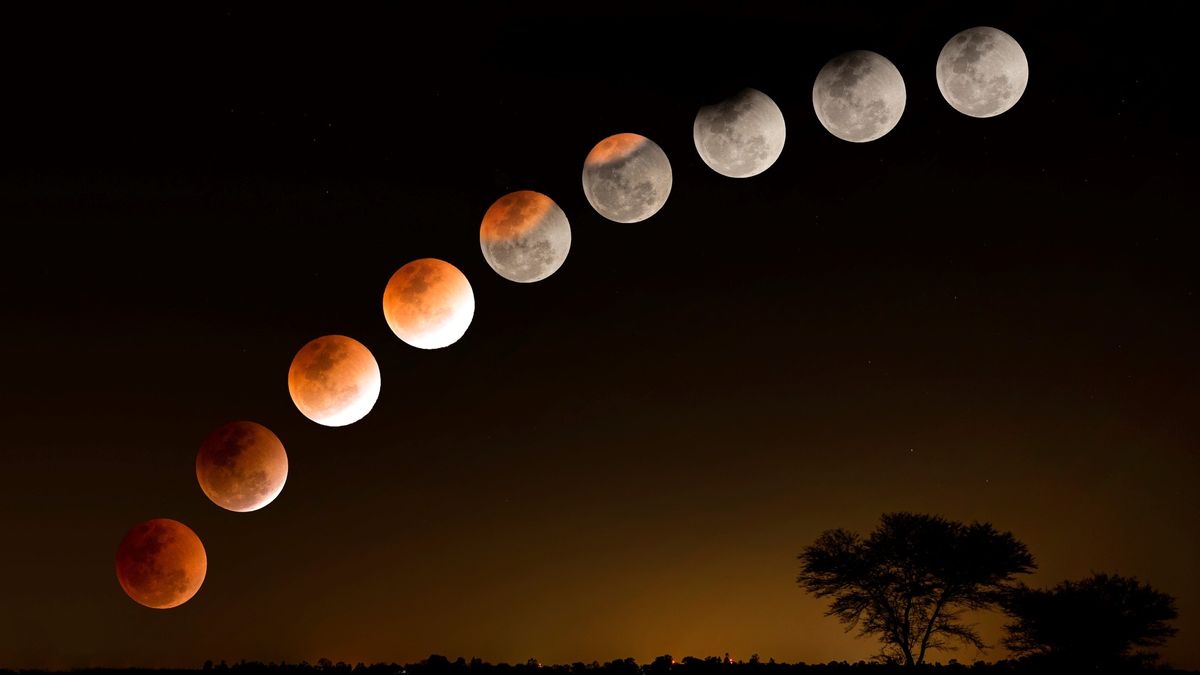
A lunar eclipse occurs when Earth passes between the Sun and the Moon, casting Earth’s shadow on the Moon. There are three types of lunar eclipses:
- Total Lunar Eclipse: Earth’s umbral shadow completely covers the Moon, often giving it a reddish appearance commonly called a “blood moon.”
- Partial Lunar Eclipse: Only a portion of the Moon enters Earth’s umbral shadow.
- Penumbral Lunar Eclipse: The Moon passes through Earth’s penumbral shadow, resulting in a subtle darkening that can be difficult to detect.
Unlike solar eclipses, lunar eclipses are visible from anywhere on Earth where the Moon is above the horizon during the event.
Upcoming Eclipses in 2024-2025
Several notable eclipses are scheduled to occur in the near future:
2024 Eclipses:
- September 18, 2024: Partial lunar eclipse visible from Europe, Africa, Asia, and Australia
- October 2, 2024: Annular solar eclipse visible from Chile and Argentina
2025 Eclipses:
- March 14, 2025: Total lunar eclipse visible from North and South America, Europe, Africa, and parts of Asia
- March 29, 2025: Partial solar eclipse visible from Europe, North Africa, and northern Asia
- September 7, 2025: Partial lunar eclipse visible from Europe, Africa, Asia, and Australia
- September 21, 2025: Partial solar eclipse visible from south Pacific, New Zealand, and Antarctica
How Eclipse Timing is Determined
Astronomers can predict eclipses with remarkable precision using knowledge of celestial mechanics. The calculations take into account:
- Orbital Mechanics: The precise positions of the Earth, Moon, and Sun
- Saros Cycles: Patterns of eclipses that repeat approximately every 18 years, 11 days, and 8 hours
- Geographic Considerations: How Earth’s curved surface affects the path of the Moon’s shadow
- Atmospheric Refraction: How Earth’s atmosphere bends light
Modern eclipse predictions account for factors down to the second and can pinpoint the path of totality or partiality with accuracy to within a few kilometers.
Safe Eclipse Viewing
Viewing a solar eclipse requires special precautions to protect your vision:
- Solar Eclipse Glasses: Use certified eclipse glasses that meet the ISO 12312-2 international safety standard. Regular sunglasses are NOT safe for viewing the Sun.
- Indirect Viewing Methods: Pinhole projectors allow you to see an image of the eclipse without looking directly at the Sun.
- Photography Equipment: If photographing an eclipse, use proper solar filters for cameras and telescopes.
- Timing Considerations: Remove protective filters ONLY during the brief period of totality in a total solar eclipse. As soon as totality ends, protective measures must be used again.
For lunar eclipses, no special eye protection is required, as the Moon is not bright enough to cause eye damage.
Cultural and Historical Significance of Eclipses
Throughout history, eclipses have been interpreted through various cultural lenses:
- Ancient Interpretations: Many ancient civilizations viewed eclipses as omens or signs from deities. Chinese records of solar eclipses date back to 2134 BCE.
- Scientific Milestones: The 1919 solar eclipse provided crucial evidence supporting Einstein’s theory of general relativity when astronomers observed the bending of starlight around the Sun.
- Modern Cultural Impact: Today, eclipses often inspire tourism, educational opportunities, and community events. The 2017 and 2024 total solar eclipses in the U.S. each drew millions of visitors to the paths of totality.
Eclipse Chasing and Tourism
Eclipse tourism has grown into a significant phenomenon, with dedicated “eclipse chasers” traveling worldwide to experience these events:
- Economic Impact: Areas in the path of totality often see substantial economic benefits from visitors. For the 2024 eclipse, some cities along the path reported hotel occupancy rates near 100% with bookings made years in advance.
- Travel Planning: Eclipse chasers consider factors like historical weather patterns, accessibility, and duration of totality when planning their trips.
- Group Experiences: Many organizations arrange eclipse-viewing parties, scientific expeditions, and cruises specifically positioned for optimal viewing.
The Psychology of Eclipse Viewing
Many eclipse viewers report profound emotional and psychological effects:
- Awe and Wonder: The sudden darkness of a total solar eclipse and the appearance of the corona often evoke feelings of awe.
- Connection to Nature: Eclipses remind viewers of cosmic relationships and their place in the universe.
- Communal Experience: Sharing the experience with others creates a sense of community and shared wonder.
Scientists have begun studying these psychological effects, noting that experiences of awe can have positive impacts on well-being and perspective.
Conclusion
Eclipses represent some of nature’s most spectacular displays, connecting us to astronomical cycles that have fascinated humanity throughout history. Whether you’re planning to view an upcoming eclipse or simply learning about these phenomena, understanding the timing, mechanics, and proper viewing techniques enhances appreciation for these remarkable celestial events.
The April 2024 total solar eclipse offered millions of people an opportunity to witness one of nature’s grandest spectacles, while upcoming eclipses in 2024-2025 will provide additional viewing opportunities around the world. By knowing when these events will occur and how to view them safely, you can join in this ancient yet ever-new experience of wonder and discovery.