
“`html
The cosmos has always been a source of wonder and mystery, but thanks to advancements in astronomical technology, we’re on the brink of uncovering secrets that have eluded scientists for centuries. At the forefront of this endeavor is NASA’s upcoming Nancy Grace Roman Space Telescope, set to revolutionize our understanding of the universe with its remarkable ‘spy mirror’ design. But what does this mean for the future of cosmic exploration?
The Vision Behind the Nancy Grace Roman Space Telescope
The Nancy Grace Roman Space Telescope, named after NASA’s first Chief of Astronomy, is not just another telescope in a long line of observational instruments. It is a next-generation space observatory designed with one primary aim: to delve deeper into the mysteries of the universe. Slated for launch in the mid-2020s, the telescope will take a significant leap forward in our ability to conduct wide-field cosmic surveys.
Unlike its predecessors, the Roman Space Telescope boasts a unique combination of advanced technologies and scientific goals. It will be equipped to survey large portions of the sky at once, providing invaluable data that can help astronomers map the distribution of galaxies and understand the enigmatic nature of dark energy that is believed to shape the universe’s expansion.
The Innovations of the ‘Spy Mirror’
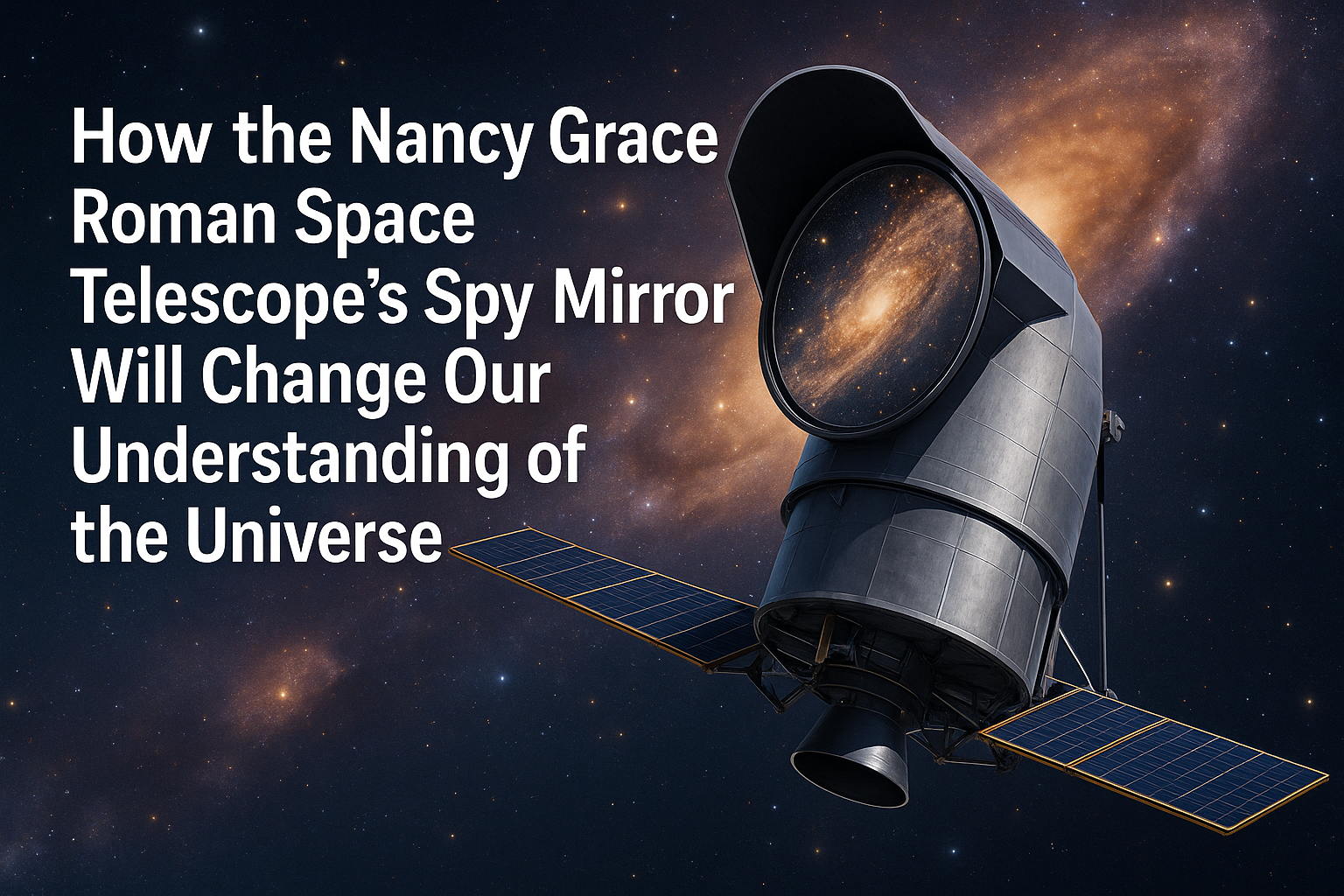
One of the standout features of the Nancy Grace Roman Space Telescope is its innovative ‘spy mirror’ design. This advanced mirror system is engineered to capture more light and produce sharper images than traditional telescopes. The ‘spy mirror’ allows it to survey the sky with unprecedented clarity and detail, which is crucial when studying faint objects in the cosmos.
The design leverages a wide-field view to observe vast areas of the night sky simultaneously. In practical terms, this means that the Roman Space Telescope can capture images of entire galaxy clusters, monitor supernovae, and study phenomena like gravitational lensing – where massive objects bend light around them, a phenomenon that can hint at the presence of dark matter.
Mapping the Universe: The Cosmic Quest
Why is mapping the universe so important? The vastness of space is filled with questions about the origins and fate of the cosmos. By mapping galaxies and their structures, scientists can piece together the history of the universe and gain insights into its expansion. The Nancy Grace Roman Space Telescope will be instrumental in this process.
The telescope is expected to collect data that will help answer fundamental questions, such as: How do galaxies form and evolve over time? What is the role of dark energy in the universe’s expansion? And how does the large-scale structure of the universe give rise to the galaxies we see today?
Additionally, with its wide-field capability, the Roman Space Telescope could uncover thousands of new galaxies and hundreds of thousands of distant supernovae. This wealth of information will enable astronomers to delve deeper into the mysteries of the universe and refine our models of cosmic evolution.
Dark Energy: The Driving Force
At the heart of many cosmic mysteries lies dark energy, a form of energy that is believed to make up about 68% of the universe. Its existence was first suggested in the late 1990s when observations revealed that the universe’s expansion is accelerating. Despite this knowledge, dark energy remains one of the greatest enigmas in astrophysics.
The Nancy Grace Roman Space Telescope is uniquely positioned to shed light on this elusive force. By mapping the distribution of galaxies and their clustering patterns, the telescope will help scientists understand how dark energy influences the cosmic landscape. By comparing galaxy distributions over time, researchers hope to distinguish between different theories of dark energy and its role in the universe’s dynamics.
Potential Discoveries on the Horizon
The excitement surrounding the Nancy Grace Roman Space Telescope isn’t just about the technology; it’s also about the potential discoveries waiting to be made. Imagine uncovering a previously unknown class of celestial objects or gaining a better understanding of how galaxies interact with each other.
With the capability to observe over 300 million galaxies across vast cosmic distances, the Roman Space Telescope could identify new exoplanets, study the atmospheres of these distant worlds, and even contribute to the search for extraterrestrial life. The telescope’s capability to perform time-domain astrophysics means it will monitor transient events, like supernova explosions and gamma-ray bursts, providing insights into these spectacular cosmic phenomena.
A Collaboration of Scientific Ambitions
The Nancy Grace Roman Space Telescope is part of a broader collaboration among multiple scientific communities and institutions. NASA has partnered with various research organizations, universities, and international collaborations to ensure that this mission brings together the best minds in astronomy and technology.
This collaborative approach not only fosters innovation but also creates a platform for diverse research efforts. Researchers will have access to the data collected by the telescope, enabling them to propose new projects and studies that could further unlock the mysteries of the universe.
As the telescope prepares for launch, a myriad of proposals is already on the table. The scientific community is buzzing with ideas on how to utilize this powerful tool to explore questions ranging from the formation of stars to the distribution of dark matter. This synergy will undoubtedly accelerate our understanding of the cosmos.
Looking Ahead: The Future of Cosmic Exploration
As we approach the launch of the Nancy Grace Roman Space Telescope, excitement builds not just within the scientific community but also among space enthusiasts and the general public. The potential findings could reshape our understanding of the universe and our place within it.
To put it simply, the Roman Space Telescope represents a new era in astronomy. With its unique capabilities, it promises to unveil features of the universe that have remained hidden for far too long. As we stand on the brink of this new frontier, one can’t help but wonder: What astonishing revelations await us among the stars?
In a world where our understanding of the universe is constantly evolving, the Nancy Grace Roman Space Telescope offers a glimpse into what the future of cosmic exploration holds. It’s not just a telescope; it’s a key to unlock the universe’s greatest secrets, and we are all on the precipice of witnessing its incredible journey.
Technical Specifications of the Nancy Grace Roman Space Telescope
Understanding the technical specifications of the Nancy Grace Roman Space Telescope can deepen our appreciation of its capabilities. The telescope will feature a primary mirror that spans 2.4 meters in diameter, similar in size to the Hubble Space Telescope. However, its innovative design allows it to capture images over a field of view that is 100 times larger than that of Hubble.
The Roman Space Telescope will also be equipped with a Wide Field Instrument (WFI), which will enable it to gather data across a wide range of wavelengths, including visible and near-infrared light. This versatility ensures that it can observe various cosmic phenomena, from the faint light of distant galaxies to the energetic emissions from supernovae. With an expected mission duration of five years, the potential for groundbreaking discoveries is vast.
Impact on Exoplanet Research
A significant area of focus for the Nancy Grace Roman Space Telescope will be exoplanet research, which has gained momentum in the last few decades. The telescope’s ability to monitor large swathes of the sky will facilitate the identification of new exoplanets, particularly those in distant star systems. By analyzing the light curves of stars, scientists can detect the slight dimming that occurs when a planet transits in front of its host star.
Additionally, the Roman Space Telescope will allow astronomers to study the atmospheres of these exoplanets through spectroscopy. This technique will enable the examination of chemical compositions, potentially leading to the discovery of habitable conditions or even signs of life beyond Earth.
Engaging the Public: Outreach and Education
As the Nancy Grace Roman Space Telescope prepares for launch, NASA is committed to fostering public engagement and education. The mission aims to inspire future generations of scientists and engineers by providing a wealth of educational resources and opportunities for hands-on experiences. Interactive websites, educational kits, and public talks will make the science accessible to everyone, regardless of age or background.
The telescope’s findings may also be integrated into school curricula, allowing students to learn about cutting-edge astronomy while exploring fundamental questions about the universe. By nurturing interest in space science, NASA hopes to cultivate a new generation of innovators ready to tackle the challenges of tomorrow.
Frequently Asked Questions About the Nancy Grace Roman Space Telescope
What is the primary goal of the Nancy Grace Roman Space Telescope?
The primary goal of the Nancy Grace Roman Space Telescope is to explore the universe’s mysteries, particularly focusing on dark energy, galaxy formation, and exoplanet research. It aims to conduct wide-field surveys of the cosmos to gather unprecedented data.
When is the Nancy Grace Roman Space Telescope scheduled to launch?
The Nancy Grace Roman Space Telescope is scheduled for launch in the mid-2020s, although exact dates may vary based on technical and logistical considerations.
How will the telescope contribute to the understanding of dark energy?
By mapping the distribution and clustering of galaxies, the Roman Space Telescope will provide insights into dark energy’s role in the universe’s expansion. This data will help distinguish between different theories of dark energy and enhance our understanding of cosmic dynamics.
Can the Nancy Grace Roman Space Telescope detect exoplanets?
Yes, the Roman Space Telescope is designed to detect exoplanets by observing transits, where a planet passes in front of its star, causing a dimming effect. It will also study the atmospheres of these planets, looking for chemical signatures that may indicate habitability.
How does the Nancy Grace Roman Space Telescope compare to the Hubble Space Telescope?
While both telescopes feature similar mirror sizes, the Roman Space Telescope has a much larger field of view—100 times greater than Hubble’s. This allows it to survey vast areas of the sky simultaneously, significantly increasing its data collection capabilities.
Will the data from the Nancy Grace Roman Space Telescope be available to the public?
Yes, NASA plans to make the data collected by the Roman Space Telescope publicly available. This open data policy encourages collaboration and enables researchers worldwide to utilize the findings in their work, fostering scientific discovery.
“`
Trending Now
Frequently Asked Questions
What is the Nancy Grace Roman Space Telescope?
The Nancy Grace Roman Space Telescope is a next-generation space observatory designed by NASA to conduct wide-field cosmic surveys. It aims to deepen our understanding of the universe, particularly in mapping galaxies and exploring dark energy, with its launch slated for the mid-2020s.
How does the 'spy mirror' work in the Roman Space Telescope?
The 'spy mirror' in the Roman Space Telescope is an advanced mirror system designed to capture more light and produce sharper images than traditional telescopes. This innovative design allows the telescope to survey vast areas of the night sky with unprecedented clarity, essential for studying faint cosmic objects.
What advancements does the Roman Space Telescope offer over previous telescopes?
The Roman Space Telescope features a unique combination of advanced technologies, including its 'spy mirror' design that enables wide-field surveys of the sky. This allows it to capture images of entire galaxy clusters and monitor celestial events like supernovae more effectively than its predecessors.
Why is the Roman Space Telescope important for cosmic exploration?
The Roman Space Telescope is crucial for cosmic exploration because it will provide invaluable data on the distribution of galaxies and the nature of dark energy. Its capability to survey large portions of the sky will enhance our understanding of the universe's expansion and its underlying mysteries.
When will the Nancy Grace Roman Space Telescope be launched?
The Nancy Grace Roman Space Telescope is scheduled for launch in the mid-2020s. Its deployment will mark a significant advancement in astronomical technology and our ability to explore the cosmos.
Have you experienced this yourself? We’d love to hear your story in the comments.