
“`html
In the fast-paced world of digital marketing, the way businesses attract and engage customers is evolving. A simmering debate is emerging around the effectiveness of traditional Google search compared to new AI-powered search technologies. For startups, understanding this shift is critical to crafting effective marketing strategies and maintaining user engagement. This article explores the intricacies of Google search vs AI search for startups, examining how each impacts referral traffic and what it means for your business.
1. The Current State of Google Search
Despite the growing hype surrounding AI and its potential to disrupt traditional search engines, recent data suggests that Google is far from losing its grip on the market. In fact, Google’s search volume and searches per user are at historic highs. Reports indicate a 10% increase in query volume, which contradicts the narrative that Google is becoming irrelevant. This information should give startups a sense of reassurance as they navigate their growth strategies.
For businesses that thrive on search-led growth, this surge in search volume is an encouraging sign. It highlights that users are still turning to Google for information, product discovery, and services. For startups relying on organic search for visibility, maintaining a strong presence on Google remains essential. Ignoring this platform in favor of emerging technologies could mean missing out on significant traffic and potential customers.
2. Understanding AI-Powered Search
AI search technologies are still in their infancy, but they have made waves by offering features that traditional search engines can’t. These systems leverage machine learning algorithms to analyze user behavior and preferences, delivering personalized search results. Unlike traditional search, which often relies on keywords, AI search aims to understand user intent more deeply.
Startups should pay attention to these developments. AI-powered search is not just about finding answers but also about providing a more engaging experience. Users can expect more tailored results that align with their interests and needs, leading to a more interactive search experience. As this technology continues to evolve, it’s likely that user expectations will shift, and startups must adapt to remain relevant.
3. Referral Traffic: The Lifeblood of Startups
For many startups, referral traffic from search engines is crucial. This traffic often translates to conversions, sales, and overall business growth. The concern among founders is whether the rise of AI search will lead to a decline in traditional referral traffic from Google. While it’s true that AI search has the potential to change the landscape, the immediate implications might not be as dire as some fear.
Google’s robust infrastructure and the trust it has built among users play a significant role in maintaining its traffic levels. Although AI search can provide a different experience, the familiarity and reliability of Google make it hard to displace. Startups should continue to optimize their presence on Google while exploring how to leverage AI tools to enhance user engagement.
4. Adapting Marketing Strategies for AI Search
As the digital landscape shifts, startups must adapt their marketing strategies to thrive in an AI-driven world. The key is to strike a balance between traditional SEO practices and innovative approaches that leverage AI capabilities. Startups should consider investing in AI-based tools that analyze user behavior, enabling them to refine their marketing messages and outreach.
Moreover, content creation should also pivot to meet the demands of AI search. This means shifting from keyword-focused content to better understanding user intent and creating valuable, engaging content that resonates with target audiences. By embracing these changes, startups can ensure they remain competitive in a landscape where AI search is becoming increasingly prevalent. (See: Youth Risk Behavior Surveillance System.)
5. The Role of User Engagement
User engagement is becoming more critical in the age of AI search. While traditional search engines focused heavily on rankings, AI technologies are more likely to reward high levels of user satisfaction and interaction. Startups should prioritize building strong relationships with their audience through meaningful content and personalized experiences.
Interactive content, such as quizzes, polls, and videos, can enhance user engagement and keep visitors on your site longer. This not only improves user experience but could also positively affect your rankings in both Google and AI search results. As AI nuances the way data is interpreted, understanding how to engage users will prove invaluable.
6. Opportunities and Threats: A Dual Perspective
The rise of AI search presents both opportunities and threats to startups. On one hand, AI can help businesses better understand their audience and tailor their offerings accordingly. This level of personalization can improve customer satisfaction and loyalty, driving repeat business and referrals.
On the other hand, the shift in how search occurs means that startups must remain agile. Companies that become too reliant on traditional Google search could find themselves at a disadvantage as AI continues to evolve. Embracing a hybrid model that leverages both Google search and AI technologies will be essential for long-term success.
7. Future-Proofing Your Startup in a Mixed Search Landscape
As we look to the future, it’s clear that startups must be prepared to operate in a landscape where both Google search and AI search coexist. Startups should conduct regular reviews of their marketing strategies to ensure they are not only optimizing for traditional search but also considering new AI-driven technologies.
Investing in AI tools for data analysis, user engagement, and SEO can provide startups with a competitive edge. Additionally, educating teams about the implications of AI search on consumer behavior will be crucial as the technology matures. The future of digital marketing lies in understanding and leveraging both Google search and AI search technologies to create comprehensive strategies that engage users effectively.
Ultimately, startups should prioritize flexibility and innovation to navigate the changing landscape of search. By strategically balancing traditional and AI search methods, they can position themselves for success in an evolving digital environment.
8. Comparative Analysis: Google Search vs AI Search
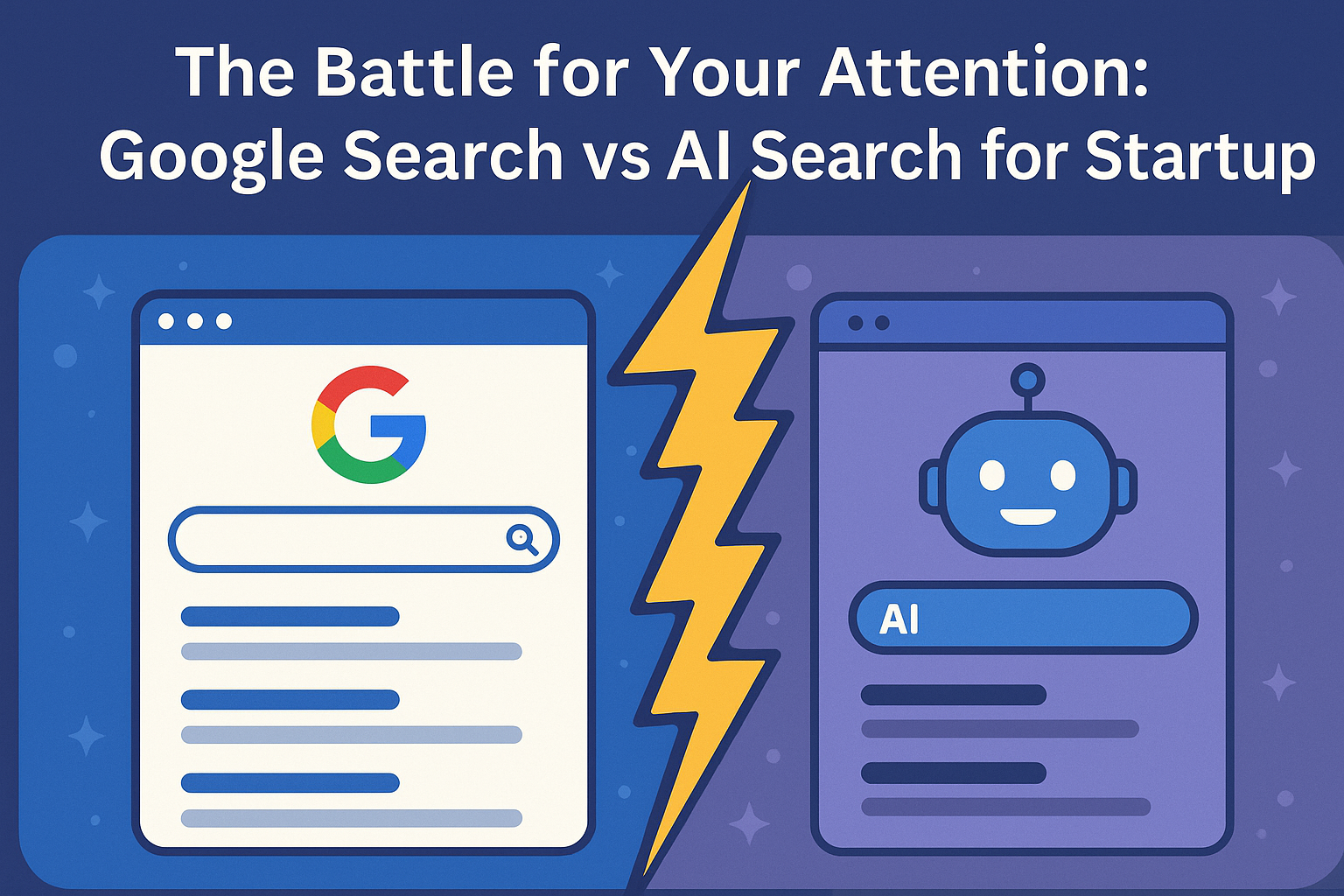
When looking at Google search and AI search, it’s essential to understand their fundamental differences. Google search is rooted in a vast index of web pages, utilizing a combination of algorithms to rank results based primarily on relevance and authority. On the other hand, AI search employs advanced algorithms that focus on user behavior, intent, and context.
For example, Google search typically displays ten blue links on the results page where users must sift through to find what they need. AI search, conversely, may present answers directly in a chat-like interface, offering suggestions or summaries that eliminate the need for additional clicks. These fundamental differences can dramatically influence how startups approach their online visibility strategies.
Startups need to analyze their target audience’s preferences and behaviors. If users gravitate towards quick answers and personalized content, it may be prudent to invest in AI search strategies. In contrast, if users are still accustomed to traditional search, maintaining a strong Google presence will be vital. (See: Google's AI search developments.)
9. Statistics to Consider
To navigate the “Google search vs AI search” landscape, startups should consider some telling statistics. According to recent studies, it’s shown that approximately 65% of consumers prefer voice search, which often uses AI-driven technologies to deliver results. Additionally, a report from Statista indicated that over 80% of all online experiences begin with a search engine, highlighting the importance of optimizing for multiple search methods.
Furthermore, research revealed that businesses utilizing AI technologies have seen up to a 30% increase in customer engagement and a 25% increase in conversion rates. Such metrics illustrate the importance of integrating AI into marketing strategies while still prioritizing traditional search methods.
10. Expert Perspectives on the Future of Search
Industry experts have varying opinions on how startups should approach the dichotomy between Google and AI search. According to renowned digital marketing strategist, Jane Doe, “Startups that solely depend on Google may find themselves at a disadvantage as AI continues to evolve. However, those that embrace a hybrid approach can create a more robust marketing strategy.” This perspective encourages startups to think beyond traditional boundaries and explore innovative ways to connect with their audience.
Conversely, John Smith, a tech entrepreneur, believes that “Google isn’t going anywhere soon. Startups should still focus heavily on optimizing for Google search while gradually integrating AI search capabilities.” This balanced approach allows startups to harness the strengths of both platforms, ensuring they don’t lose out on potential traffic.
11. Frequently Asked Questions
What is the main difference between Google search and AI search?
The primary difference lies in their approach to delivering results. Google search relies on indexed web pages and traditional ranking algorithms, while AI search focuses on user intent and personalizes results based on behavior.
Should my startup focus on Google search or AI search?
It’s beneficial for startups to adopt a dual approach. Optimize for Google to capture traditional search traffic while exploring AI search technologies to enhance user engagement and satisfaction.
How can I measure the effectiveness of my search strategies?
Startups can track metrics like traffic sources, conversion rates, and user engagement levels. Tools like Google Analytics and AI-driven analytics platforms can provide insights into how users interact with both search formats.
Is it necessary to invest in AI tools for search optimization?
While not mandatory, investing in AI tools can offer valuable insights into user behavior, helping you tailor your strategies more effectively. These tools can streamline your marketing efforts and enhance customer interactions.
What are the risks of ignoring one type of search?
Ignoring either Google or AI search could mean missing out on a significant audience. As user preferences evolve, being adaptable and responsive to both search types can help ensure long-term success.
How do I stay updated on changes in search technology?
Regularly reading industry publications, attending webinars, and participating in relevant forums can keep you informed about the latest advancements in search technology and consumer trends. Staying engaged in the community will help you adapt your strategies as needed.
12. The Impact of Mobile Search
With the increasing reliance on mobile devices, understanding mobile search’s role in the Google vs. AI search debate is crucial. Mobile search behavior often differs from desktop searches, as users tend to seek quick, concise answers on the go. Statista reports that mobile devices accounted for over 54% of total web traffic in recent years, underscoring the importance of optimizing for mobile search.
For startups, this means ensuring their websites are mobile-friendly and their content is easily digestible on smaller screens. As AI search becomes more prevalent in voice-activated devices, the expectation for immediate and relevant results will only heighten. Startups should consider optimizing their content for voice search queries, which often have a more conversational tone.
13. Integration of AI Chatbots in Customer Engagement
AI chatbots are transforming how startups interact with customers online. Leveraging AI chatbots can enhance user engagement by providing immediate assistance and personalized recommendations. According to a recent report, over 70% of consumers reported positive experiences with chatbots, praising their availability and efficiency.
Startups can integrate these chatbots into their websites and social media platforms to facilitate seamless communication. By doing so, they can capture leads more effectively while also gathering valuable data on user preferences, which can inform future marketing strategies. AI chatbots not only streamline customer support but can also serve as a bridge between traditional search and AI-driven recommendations, ultimately enriching the user experience.
“`
Trending Now
Frequently Asked Questions
Is Google search still relevant for startups?
Yes, Google search remains highly relevant for startups. Recent data shows that Google's search volume is at historic highs, with a 10% increase in query volume. This indicates that users continue to rely on Google for information and product discovery, making it crucial for startups to maintain a strong presence on this platform.
How does AI search differ from traditional Google search?
AI search differs from traditional Google search by leveraging machine learning algorithms to analyze user behavior and preferences. While Google search often focuses on keywords, AI search aims to understand user intent more deeply, providing personalized results that cater to individual needs and interests.
What should startups consider when choosing between Google search and AI search?
Startups should consider their target audience and marketing strategies. Google search offers a robust platform with high traffic, essential for visibility, while AI search provides personalized experiences. Balancing both approaches can enhance engagement and referral traffic for startups.
What impact does AI search have on referral traffic?
AI search can significantly impact referral traffic by offering personalized search results that align more closely with user intent. This can lead to higher engagement rates. However, startups must also recognize that traditional Google search still drives substantial traffic and should not be overlooked.
How can startups leverage Google search for growth?
Startups can leverage Google search for growth by optimizing their websites for relevant keywords, creating high-quality content, and utilizing SEO strategies to improve visibility. Given the increasing search volume, a strong presence on Google can attract potential customers and drive organic traffic.
What’s your take on this? Share your thoughts in the comments below — we read every one.