

“`html
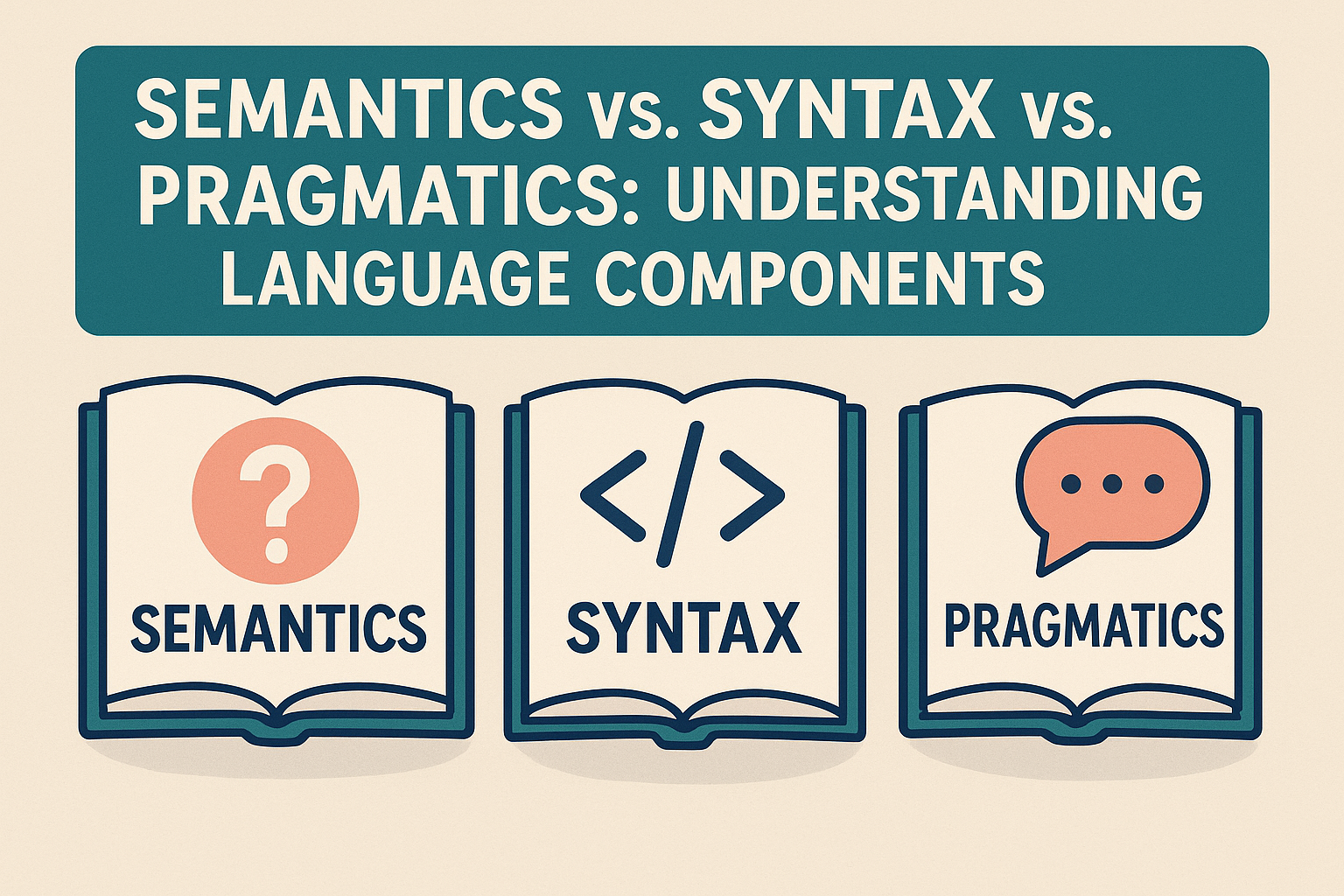
Language is a complex system that enables us to communicate our thoughts, ideas, and emotions. But how do different aspects of language function to ensure we understand each other? The concepts of semantics, syntax, and pragmatics form the foundation of linguistic communication. Despite being interconnected, each plays a distinct role in how we interpret meaning. Let’s explore these components in detail, focusing on their differences, interrelations, and practical implications in everyday communication.
1. Understanding Semantics
Semantics refers to the study of meaning in language. It encompasses the meanings of words, phrases, and sentences, exploring how they convey ideas and concepts. One of the central questions in semantics is how the meaning of a sentence is derived from the meanings of its individual components. For instance, consider the sentence, “The cat sat on the mat.” The semantic analysis involves breaking down the meanings of the words—what a ‘cat’ is, what it means to ‘sit,’ and what a ‘mat’ is—to understand the overall message.
Moreover, semantics can be divided into two main categories: lexical semantics, which focuses on the meanings of individual words and the relationships between them, and compositional semantics, which deals with how those meanings combine in larger structures. This distinction is crucial for linguistic analysis, as it helps linguists understand how modifications to sentence structures can alter meanings. Understanding semantics is essential for fields like artificial intelligence and natural language processing, where machines must interpret human language.
2. Clarifying Syntax
Syntax, on the other hand, deals with the structure of sentences and the rules that govern the formation of phrases and clauses. Think of syntax as the framework that shapes how words can be combined to create coherent sentences. For instance, in English, the typical word order is subject-verb-object (SVO), so we say “The cat (subject) sat (verb) on the mat (object).” If we were to rearrange this to “Sat the cat on the mat,” the sentence becomes nonsensical, demonstrating how syntax dictates acceptable sentence structures.
In addition to word order, syntax also involves the use of punctuation, verb tenses, and agreement between subjects and verbs. Misunderstandings can arise from syntactical errors. For example, the sentences “The dog bites the man” and “The man bites the dog” have entirely different meanings due to their syntactical arrangements. Understanding syntax is not only crucial for linguists but also for language learners, as a solid grasp of syntax rules greatly aids in mastering any new language.
3. The Role of Pragmatics
While semantics provides meaning and syntax offers structure, pragmatics concerns itself with context and how language is used in practice. Pragmatics examines how the context of a conversation affects the interpretation of meaning. It addresses questions like: What is the speaker’s intent? What social dynamics are at play? For instance, the phrase “Can you pass the salt?” is not merely a question about your ability to pass the salt; it’s a polite request for someone to do so.
Pragmatics can also include elements like speech acts, which are actions performed via utterances, such as making requests, giving orders, or making promises. Understanding pragmatics is vital for effective communication, as it helps individuals interpret nuances in conversation that go beyond the literal meanings of words. For instance, sarcasm relies heavily on pragmatics for the listener to grasp the intended meaning behind what’s being said. (See: Understanding semantics in linguistics.)
4. How Semantics, Syntax, and Pragmatics Interact
Although semantics, syntax, and pragmatics are distinct components of language, they are highly interrelated. To communicate effectively, a speaker must navigate all three aspects simultaneously. For example, when hearing a sentence, a listener decodes its syntax to understand its structure, interprets its semantics to grasp its meaning, and considers pragmatics to discern the intent and context behind the utterance.
Take the sentence, “It’s cold in here,” for example. A literal semantic interpretation might suggest an observation about temperature, while a pragmatic analysis could reveal that the speaker is actually implying a request to close a window. This interplay highlights the importance of context and the nuances of language; effective communication often hinges on an understanding of not just words and their rules, but also the social fabric in which they are embedded.
5. Real-World Applications
Understanding the differences and relationships between semantics, syntax, and pragmatics isn’t just for linguists and scholars; these concepts have practical implications in various domains. In the realm of artificial intelligence, for instance, natural language processing relies heavily on these principles to enable machines to interpret human language accurately. Businesses employ chatbots that must understand context (pragmatics) while also processing the structure of user queries (syntax) and the meaning of individual words (semantics).
Moreover, in education, teaching these components can enhance language acquisition for students learning a new language. By breaking down sentences into their semantic, syntactic, and pragmatic elements, educators can provide a comprehensive understanding that supports effective communication. This analytical approach can also help students identify language patterns, develop writing skills, and improve comprehension.
6. Challenges and Misunderstandings
Despite their clear definitions, semantics, syntax, and pragmatics are often sources of confusion, especially for language learners and even native speakers. Misunderstandings can arise when the syntactical construction of a sentence is correct, but the speaker’s intent is missed due to pragmatic nuances. For example, someone may say, “I love this song,” but if the context indicates they are being sarcastic, the intended meaning could be misunderstood.
Additionally, cultural differences can play a significant role in how semantics and pragmatics are perceived. What is considered polite or appropriate in one culture may come off as rude or confusing in another. Understanding these variations can be crucial for effective communication, especially in our increasingly interconnected world where cross-cultural interactions are commonplace.
7. Future Directions in Linguistic Research
As language continues to evolve with technology and globalization, research into semantics, syntax, and pragmatics will undoubtedly expand. Scholars are now looking into how digital communication—like texting and social media—affects language use. The informal structures and shorthand common in these platforms challenge traditional syntactic rules and create new semantic meanings. For instance, emojis can carry pragmatic significance that alters the interpretation of a message.
Furthermore, as we develop more sophisticated AI and machine learning algorithms, understanding human language’s intricacies will become increasingly important. Researchers may focus on improving how machines discern context, intent, and cultural nuances to enhance human-computer interaction. This ongoing exploration will likely shape the future landscape of language and communication. (See: Research on language and semantics at MIT.)
8. Practical Tips for Effective Communication
To foster better communication in your daily life, consider these practical tips rooted in semantics, syntax, and pragmatics: Understanding language components offers useful background here.
- Be clear and concise: Use straightforward language to ensure your message is understood. Avoid overly complex sentences that might confuse your listener.
- Consider context: Always think about the context in which you are communicating. Understanding the social dynamics at play will help you choose words and phrases that resonate with your audience.
- Ask for clarification: If you are unsure about someone’s meaning, don’t hesitate to ask for more information. It’s better to seek clarity than to make assumptions.
- Practice active listening: Engaging fully with the speaker not only shows respect but also helps you pick up on subtle cues that can inform your understanding of their message.
- Reflect on cultural differences: Be aware that language use can vary significantly across cultures. Take time to learn about these differences to enhance your cross-cultural communication skills.
9. Common Misconceptions About Semantics, Syntax, and Pragmatics
When discussing semantics, syntax, and pragmatics, several misconceptions can arise. Here are a few to clarify:
- Misconception 1: Semantics and pragmatics are the same. This is incorrect; while both deal with meaning, semantics focuses on the meaning of words and phrases, whereas pragmatics considers context and intent.
- Misconception 2: Syntax is irrelevant if the semantics are correct. In reality, a semantically correct sentence that is syntactically flawed may confuse the listener or reader, leading to a breakdown in communication.
- Misconception 3: Pragmatics is only about politeness. While politeness is a part of pragmatics, it also encompasses how context influences meaning in various scenarios, including humor, irony, and cultural references.
10. Frequently Asked Questions (FAQ)
What is the difference between semantics and syntax?
Semantics deals with meaning, while syntax is concerned with the structure of sentences. Syntax outlines the rules for constructing sentences, while semantics interprets the meanings of those constructed sentences.
How does pragmatics influence communication?
Pragmatics influences communication by taking into account the context, speaker intentions, and social dynamics. It determines how meaning is inferred beyond literal interpretations, which is crucial for effective interaction.
Can semantics, syntax, and pragmatics exist independently?
While they can be studied separately for analytical purposes, in practice, semantics, syntax, and pragmatics often work together to create meaningful communication. Understanding one without the others can lead to incomplete interpretations of language.
How does understanding these concepts benefit language learners?
Language learners benefit from understanding semantics, syntax, and pragmatics as it equips them with the tools to construct correct sentences, interpret meanings accurately, and engage in effective communication tailored to different contexts. (See: The role of semantics in language.)
Are there modern examples of how language changes affect semantics and syntax?
Yes, with the rise of digital communication, new forms of language, such as memes, hashtags, and text abbreviations, have emerged. These often challenge traditional semantics and syntax, creating new ways of communicating meaning efficiently.
11. Exploring the Interplay Between Semantics, Syntax, and Pragmatics in Different Languages
A fascinating area of study is how semantics, syntax, and pragmatics manifest across various languages. Different languages can express similar meanings through vastly different syntactic constructions and pragmatic uses. For example, in Japanese, the subject is often omitted in conversational contexts when it is understood from prior dialogue, demonstrating a reliance on pragmatics for effective communication. In contrast, languages like German maintain a stricter syntactic structure, where the subject must be explicitly stated. This variation illustrates not only linguistic diversity but also cultural differences in communication styles.
Furthermore, consider how idiomatic expressions vary between languages. An expression that works seamlessly in one language may lose its meaning or become nonsensical when translated directly into another. For instance, the English phrase “kick the bucket,” meaning to die, has no direct equivalent in many languages, showcasing how semantics must adapt to cultural contexts. Understanding these differences can be vital for translators and interpreters, as they navigate the intricate dance between syntax and semantics in conveying meaning accurately.
12. The Role of Language in Shaping Thought: A Pragmatic Perspective
Another exciting area of investigation ties directly into the relationship between language and thought, often discussed in the context of pragmatics. The Sapir-Whorf Hypothesis posits that the structure of a language can influence its speakers’ worldview and cognition. For example, languages that have multiple words for snow, such as the Inuit languages, may allow speakers to perceive and categorize snow in ways that speakers of other languages cannot. This suggests that pragmatics not only informs how we communicate but also shapes how we interpret our experiences and understand the world around us.
13. Conclusion: Embracing the Complexity of Language
Language is more than just a means of conveying information; it’s a rich, multi-faceted system that reflects our thoughts, emotions, and cultures. The exploration of semantics vs syntax vs pragmatics reveals the layers of meaning inherent in communication. Understanding these components not only enriches our appreciation of language but also equips us with valuable skills for effective interaction in a diverse world.
“`
Trending Now
Frequently Asked Questions
What is the difference between semantics and syntax?
Semantics refers to the study of meaning in language, focusing on how words and sentences convey ideas. In contrast, syntax deals with the structure and rules that govern how words are combined to form coherent sentences, such as the typical subject-verb-object order in English.
What is pragmatics in language?
Pragmatics is the study of how context influences the interpretation of meaning in communication. It examines how speakers use language in social situations, considering factors like tone, intention, and the relationship between speakers to convey deeper meanings beyond the literal interpretation of words.
How do semantics, syntax, and pragmatics work together?
Semantics, syntax, and pragmatics are interconnected components of language. Semantics provides meaning, syntax structures sentences, and pragmatics adds context. Together, they ensure effective communication by allowing speakers to convey and interpret messages accurately in various contexts.
Why is understanding semantics important?
Understanding semantics is crucial for interpreting meaning in language, particularly in fields like artificial intelligence and natural language processing. It helps in analyzing how individual words and their relationships contribute to the overall meaning of sentences, enhancing machine comprehension of human language.
What are the main categories of semantics?
Semantics can be divided into two main categories: lexical semantics, which focuses on the meanings of individual words and their relationships, and compositional semantics, which examines how these meanings combine in larger structures to form coherent sentences and convey complex ideas. Related reading: The intricate dance of language.
Have you experienced this yourself? We’d love to hear your story in the comments.



