

“`html
In the world of education, asking the right questions can be transformative. Bloom’s Taxonomy question stems serve as a vital tool for educators at all levels, providing a structured approach to crafting questions that enhance critical thinking and learning. Understanding how to utilize these question stems effectively can elevate classroom discussions, promote deeper understanding, and foster a culture of inquiry among students.
What is Bloom’s Taxonomy?
Bloom’s Taxonomy, developed by Benjamin Bloom and his colleagues in 1956, is a framework for categorizing educational goals and objectives. Originally, the taxonomy was divided into three domains: cognitive, affective, and psychomotor. However, it is the cognitive domain that has garnered the most attention, particularly in terms of classroom assessment and pedagogy.
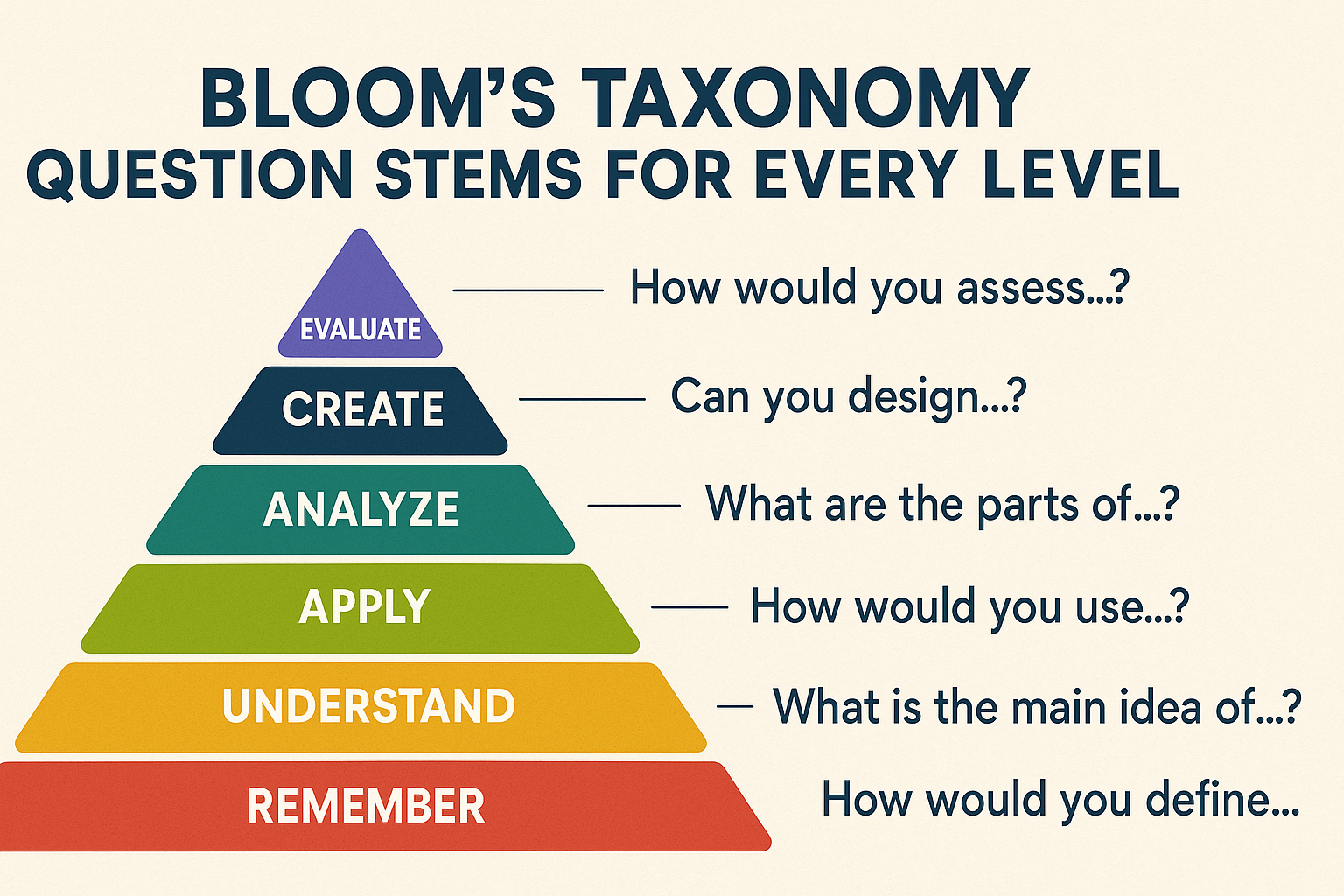
Within the cognitive domain, Bloom’s Taxonomy outlines six levels of cognitive processes, moving from lower-order thinking skills to higher-order thinking skills:
- Remembering: Recall of facts and basic concepts.
- Understanding: Explaining ideas or concepts.
- Applying: Using information in new situations.
- Analyzing: Drawing connections among ideas.
- Evaluating: Justifying a decision or course of action.
- Creating: Producing new or original work.
This hierarchy not only helps educators design effective assessments but also aligns instructional strategies with learning outcomes. By employing Bloom’s Taxonomy question stems, teachers can craft questions that correspond to these levels, facilitating a deeper engagement with the material.
Why Use Question Stems?
Utilizing question stems from Bloom’s Taxonomy has several benefits. Firstly, they encourage a shift from simple rote memorization to more complex thinking. When students are prompted with questions that require analysis, evaluation, or creation, they are more likely to engage critically with the content.
Another advantage of using Bloom’s Taxonomy question stems is consistency in questioning. Educators can maintain a clear and coherent questioning strategy across various lessons and topics. This consistency helps students become accustomed to the types of questions they will encounter, thus preparing them for assessments that measure higher-order thinking.
Furthermore, using these stems can enhance classroom discussions. By prompting students with well-structured questions, teachers can facilitate dialogues that deepen understanding and foster collaborative learning. In essence, question stems can transform a traditional question-and-answer format into a rich, interactive learning experience.
Bloom’s Levels and Corresponding Question Stems
To effectively implement Bloom’s Taxonomy question stems, it’s essential to understand the types of questions that correspond to each level of the taxonomy. Below is an overview of each level along with relevant question stems that educators can use:
1. Remembering
This foundational level focuses on the ability to recall basic facts and concepts. Here, questions aim to test students’ memory. Examples of question stems include: (See: Bloom's Taxonomy overview.)
- What is…?
- Can you list…?
- Who, what, when, where?
- Identify the…?
For instance, in a history class, a teacher might ask, “Who was the first president of the United States?” This simple recall question serves as a stepping stone for deeper exploration.
2. Understanding
At this level, students demonstrate comprehension of the material. Questions that facilitate this understanding may include:
- Can you explain…?
- How would you summarize…?
- What does this mean in your own words?
- Can you describe…?
For example, a teacher might ask, “Can you explain the significance of the Declaration of Independence?” Such questions require students to process and articulate their understanding.
3. Applying
This level focuses on using knowledge in new situations. Questions designed for application include:
- How would you use…?
- What examples can you find to…?
- Can you demonstrate…?
- How would you solve…?
An example might be, “How would you apply the concept of supply and demand to a real-world market situation?” Here, students are required to take what they have learned and use it in a practical context.
4. Analyzing
At the analyzing level, students are tasked with breaking down information into its components and making connections. Relevant question stems include:
- What are the parts of…?
- How is… related to…?
- Can you differentiate between…?
- What are the motives behind…?
For instance, a teacher might pose the question, “How does the author’s perspective influence the narrative in the text?” This encourages students to engage critically with the material and explore relationships between concepts.
5. Evaluating
This level involves making judgments based on criteria and standards. Effective question stems for evaluation include:
- What is your opinion on…?
- How would you justify…?
- What criteria would you use to assess…?
- What are the strengths and weaknesses of…?
For example, a teacher might ask, “What criteria would you use to evaluate the effectiveness of a public policy?” This pushes students to form their own opinions and provide evidence for their reasoning. For more on this, see teaching critical thinking tips.
6. Creating
At the pinnacle of Bloom’s Taxonomy, the creating level encourages students to put elements together to form a coherent or functional whole. Question stems might include:
- Can you design a…?
- What would you predict…?
- How would you construct a…?
- Can you formulate a plan to…?
An example question could be, “Can you create a marketing plan for a new product?” This level not only requires understanding but also significant original thought and creativity.
Practical Application in the Classroom
Integrating Bloom’s Taxonomy question stems into daily teaching practices can be straightforward yet impactful. Here are some practical strategies for teachers:
- Lesson Planning: When planning lessons, teachers can align their objectives with the appropriate level of Bloom’s Taxonomy. This alignment ensures that question stems used in assessments and discussions match the desired outcomes.
- Classroom Discussions: Encourage open discussions by posing questions from different levels of the taxonomy. Start with lower-order questions to gauge understanding, then progressively move to higher-order questions that promote deeper engagement.
- Student-Centered Learning: Empower students to create their own questions based on the stems. This approach not only fosters ownership of learning but also encourages students to engage with the material in a meaningful way.
- Assessment Design: Use question stems to construct assessments that measure a range of cognitive skills. This approach provides a comprehensive view of students’ understanding and abilities.
By applying these strategies, educators can create a dynamic learning environment where students thrive intellectually.
Current Relevance and Future Directions
In today’s rapidly changing educational landscape, the relevance of Bloom’s Taxonomy question stems remains significant. As the focus shifts towards critical thinking and problem-solving skills, educators are increasingly recognizing the need for strategies that promote higher-order thinking.
Moreover, with the rise of technology in education, there are innovative ways to implement these question stems. Digital tools and platforms can facilitate interactive questioning, enabling instant feedback and encouraging collaborative learning experiences.
For example, using online discussion boards or forums, teachers can pose Bloom’s questions and allow students to respond asynchronously. This not only accommodates diverse learning styles but also enables students to reflect more deeply on their responses before sharing them with their peers.
As we think about the future of education, integrating Bloom’s Taxonomy question stems with technology and student-centered approaches will likely play a pivotal role in shaping effective pedagogical practices. The emphasis will likely shift toward creating more engaging, inclusive, and adaptive learning environments that cater to the needs of all learners.
Examples of Bloom’s Taxonomy in Action
One effective way to understand the applicability of Bloom’s Taxonomy question stems is to look at real-world examples across various subjects. In a science class, a teacher might use the following approaches: Related reading: Dr. Matt Lynch's insights.
- Remembering: “What are the stages of the water cycle?” This simple recall questions students’ understanding of basic concepts.
- Understanding: “Can you summarize the process of photosynthesis?” This requires students to explain and show their grasp of a fundamental biological process.
- Applying: “How would you apply the concept of gravity in a situation where two objects are dropped from different heights?” This challenges students to take theoretical knowledge and apply it practically.
- Analyzing: “What factors affect the rate of photosynthesis?” This question prompts students to consider various components and their relationships.
- Evaluating: “How would you assess the impact of climate change on the water cycle?” Here, students must make judgments based on evidence.
- Creating: “Design an experiment to test how different light conditions impact plant growth.” This encourages innovative thinking and application of scientific methods.
These examples illustrate how educators can guide students through a comprehensive exploration of content, helping them to build a deeper understanding.
Frequently Asked Questions (FAQ)
What are Bloom’s Taxonomy question stems?
Bloom’s Taxonomy question stems are structured phrases or questions designed to align with the various levels of Bloom’s Taxonomy. They guide educators in crafting questions that promote critical thinking and deeper understanding.
How can I create my own question stems?
To create your own question stems, start by identifying the cognitive level you want to target. Use the verbs associated with that level (e.g., “analyze,” “evaluate,” “create”) to formulate questions that prompt students to think critically about the content.
Can Bloom’s Taxonomy be applied to all subjects?
Absolutely! Bloom’s Taxonomy is versatile and can be applied across all subjects, from mathematics to the sciences to the humanities. Its framework helps ensure that students engage with content at various cognitive levels regardless of the discipline.
How do I assess student responses based on Bloom’s question stems?
When assessing student responses, consider how well they demonstrate the targeted cognitive skill. For example, if using a question stem from the “Evaluating” level, look for evidence of judgment and reasoning in their answers.
What are some examples of practical applications for Bloom’s question stems in the classroom?
Some practical applications include using them in formative assessments, guiding class discussions, facilitating project-based learning, and encouraging peer evaluations. By consistently incorporating these stems, educators can create a rich learning environment that fosters critical thinking.
Conclusion
Incorporating Bloom’s Taxonomy question stems into teaching practices is not just about asking questions; it’s about developing a mindset that values inquiry and critical thinking. By leveraging these stems, educators can foster an environment that encourages exploration, debate, and creativity, ultimately leading to a deeper understanding of content. As we continue to evolve in our teaching methods, the principles behind Bloom’s Taxonomy will remain a cornerstone of effective education.
“`
Trending Now
Frequently Asked Questions
What are Bloom's Taxonomy question stems?
Bloom's Taxonomy question stems are prompts derived from the educational framework created by Benjamin Bloom. They help educators formulate questions that target different cognitive levels, promoting higher-order thinking skills such as analyzing, evaluating, and creating, thereby enhancing student engagement and understanding.
How can Bloom's Taxonomy improve classroom discussions?
By using Bloom's Taxonomy question stems, educators can craft questions that encourage deeper thinking and exploration of concepts. This structured approach fosters a culture of inquiry, prompting students to think critically and engage more fully in classroom discussions.
What are the levels of Bloom's Taxonomy?
Bloom's Taxonomy consists of six levels within the cognitive domain: Remembering, Understanding, Applying, Analyzing, Evaluating, and Creating. These levels range from basic recall of facts to the ability to produce new and original work, guiding educators in designing assessments and learning activities.
Why are question stems important in education?
Question stems are crucial in education as they shift focus from rote memorization to critical thinking. They encourage students to engage with content on a deeper level, fostering skills like analysis and evaluation, which are essential for comprehensive understanding and application of knowledge.
How can I use Bloom's Taxonomy in my teaching?
To use Bloom's Taxonomy in teaching, educators can start by identifying the cognitive level they want to target and then formulate questions using corresponding stems. This approach helps in designing lessons and assessments that promote critical thinking and deeper learning among students.
Agree or disagree? Drop a comment and tell us what you think.



