
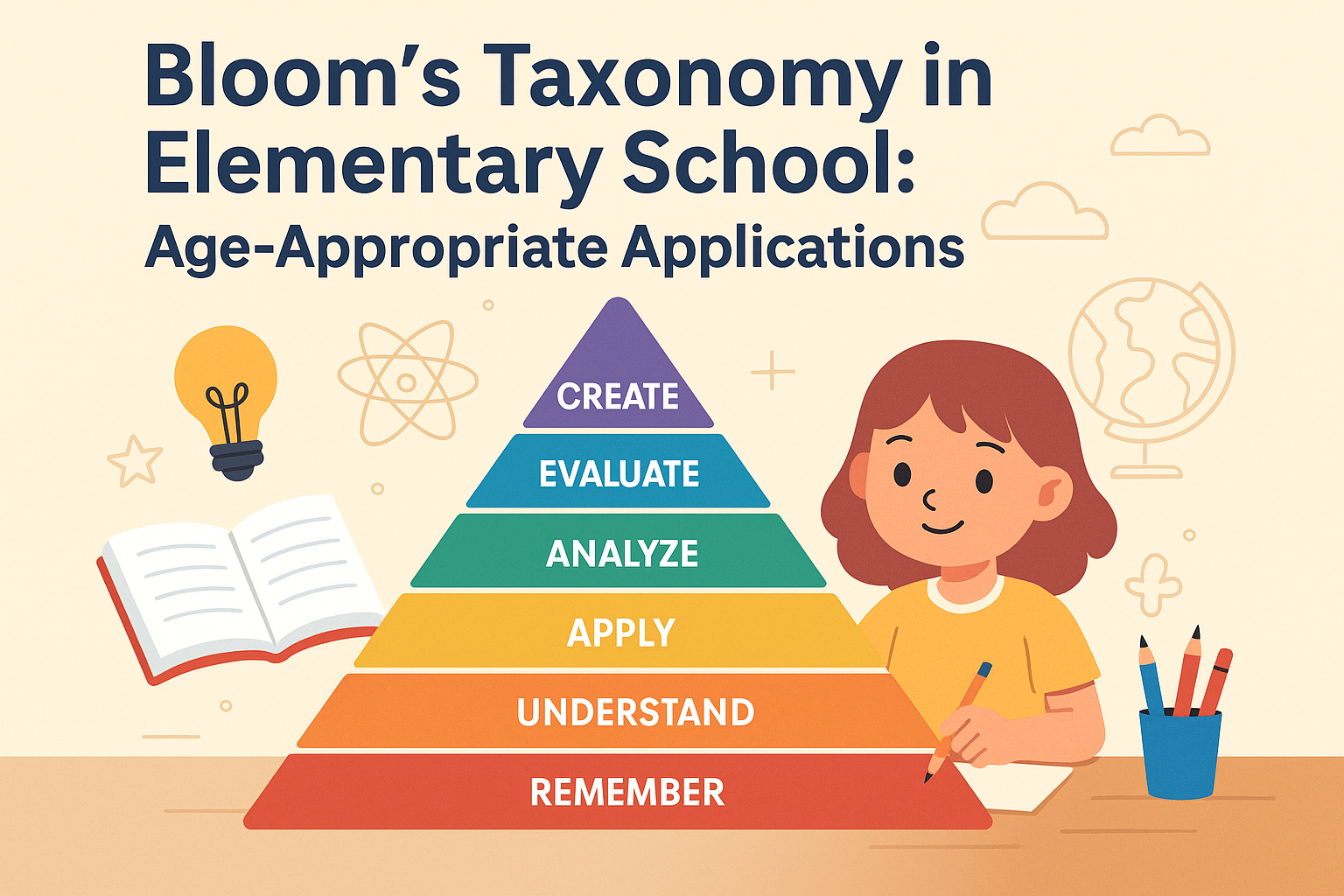

Understanding how children learn is a vital part of effective teaching, especially in elementary education. One powerful framework for educators is Bloom’s Taxonomy in Elementary Education, a classification system designed to promote higher-order thinking skills. Developed by Benjamin Bloom and his colleagues in the 1950s, this taxonomy has evolved to guide educators in creating learning objectives and assessments that resonate with young learners. This article will explore the foundations of Bloom’s Taxonomy, its key components, and practical age-appropriate applications that enhance learning experiences for elementary students.
What is Bloom’s Taxonomy?
Bloom’s Taxonomy consists of three domains: cognitive, affective, and psychomotor. However, the cognitive domain, which focuses on intellectual skills, is the most commonly referenced in educational settings. The original framework was divided into six levels: knowledge, comprehension, application, analysis, synthesis, and evaluation. In 2001, a revised version of Bloom’s Taxonomy was introduced, updating the levels to remember, understand, apply, analyze, evaluate, and create. This revision emphasizes not only the importance of recalling information but also the need for critical thinking and creativity in the learning process.
The Importance of Bloom’s Taxonomy in Elementary Education
For elementary educators, implementing Bloom’s Taxonomy in Elementary Education provides a structured approach to curriculum development and instructional design. It fosters a deeper understanding of material, encourages collaboration, and cultivates a passion for learning. By creating learning objectives based on Bloom’s framework, teachers can better assess the needs of their students and provide targeted instruction that supports their development.
Moreover, Bloom’s Taxonomy encourages teachers to push students beyond rote memorization. In a world where information is readily available, being able to apply knowledge critically is crucial. The taxonomy serves as a guide to help students engage with content at varying levels, which can lead to increased retention and a more meaningful educational experience.
Breaking Down the Levels of Bloom’s Taxonomy
To apply Bloom’s Taxonomy effectively, it’s essential to understand each level and how they translate into classroom activities that are developmentally appropriate for elementary students.
1. Remember
The first level of Bloom’s Taxonomy is all about recalling facts and basic concepts. For elementary students, this can include memorizing multiplication tables, historical dates, or vocabulary words. Tools like flashcards, matching games, or simple quizzes can reinforce this level of learning.
2. Understand
At this level, students demonstrate comprehension of the material. This might involve explaining a concept in their own words or summarizing a story they read. Teachers can encourage understanding through activities like group discussions, graphic organizers, or projects that require students to express their thoughts clearly.
3. Apply
Application involves using knowledge in new situations. For instance, if students learn about fractions, they might apply that knowledge by measuring ingredients for a recipe. Hands-on activities, role-playing, or real-world problem-solving scenarios are excellent ways to engage students at this level. (See: Bloom's Taxonomy overview.)
4. Analyze
Students reach the analysis level when they can break down information into parts and understand relationships. This could involve comparing and contrasting different stories or analyzing data from an experiment. Teachers can facilitate this through activities like Venn diagrams, group projects, or class debates. (ten tips for critical thinking)
5. Evaluate
Evaluation entails making judgments based on criteria and standards. For young learners, this could mean assessing the quality of their work or providing feedback to peers. Activities like peer assessments, reflective journals, or rubric-based evaluations can help students develop evaluative skills.
6. Create
The highest level of Bloom’s Taxonomy is creation, where students can generate new ideas or products. In an elementary setting, this could manifest in writing a story, designing an invention, or developing a presentation. Projects that encourage creativity, such as art integration or multimedia presentations, allow students to express their understanding in unique ways.
Practical Applications of Bloom’s Taxonomy in the Classroom
Now that we have a solid grasp of Bloom’s levels, let’s explore practical applications that teachers can integrate into their classrooms. These strategies not only engage students but also promote a deeper understanding of the material.
Project-Based Learning
Project-based learning (PBL) is an effective way to engage students across all levels of Bloom’s Taxonomy. In a PBL environment, students work on a project over an extended period, often addressing a real-world challenge. For example, a class might take on the project of creating a community garden. Students would research plant types (remember), create a plan (apply), analyze environmental factors (analyze), evaluate the viability of their project (evaluate), and finally, execute their plan by planting the garden (create).
Inquiry-Based Learning
Inquiry-based learning encourages students to ask questions and explore topics deeply. Teachers can start with a broad question related to the curriculum. For instance, in a science unit about ecosystems, a teacher might pose the question, “How do changes in the environment affect living organisms?” Students can research, conduct experiments, and collaborate with peers, allowing them to process information through multiple levels of Bloom’s Taxonomy.
Use of Technology
Technology can enhance learning at all levels of Bloom’s Taxonomy. For example, students might use educational apps that require them to remember facts or explore interactive simulations that allow them to apply knowledge in real-world scenarios. Additionally, tools such as blogs or digital portfolios enable students to evaluate and create content, fostering higher-order thinking and creativity.
Tailoring Bloom’s Taxonomy for Diverse Learning Needs
Every classroom is a melting pot of diverse learners, each with unique needs and learning styles. Bloom’s Taxonomy in Elementary Education can be adapted to ensure that every student has access to learning opportunities that match their abilities. (See: Health and academic success.)
Differentiated Instruction
Teachers can create tiered assignments that correspond to different levels of Bloom’s Taxonomy. For instance, while teaching a concept in math, some students might work on basic problem sets (remember), while others tackle word problems that require application and analysis. Differentiated instruction allows teachers to meet students where they are and guide them to higher levels of understanding.
Scaffolding Techniques
Scaffolding involves breaking learning into manageable chunks and providing support as students progress. For example, when teaching writing, a teacher might first explore sentence structure (remember and understand), then guide students to write paragraphs (apply), and finally, assist them in drafting a full essay (analyze and create). By gradually removing support as students gain confidence, teachers help them reach higher levels of Bloom’s Taxonomy.
Current Relevance and Trends in Education
As we progress into the digital age, the relevance of Bloom’s Taxonomy in elementary education continues to evolve. Educators are increasingly integrating social-emotional learning (SEL) and critical thinking into their curricula, aligning well with the higher levels of Bloom’s framework. SEL practices encourage students to evaluate their emotions and the emotions of others, fostering skills that are essential for collaboration and effective communication.
Furthermore, the rise of remote and hybrid learning environments has prompted educators to adapt Bloom’s Taxonomy for online platforms. Engaging students in virtual learning requires innovative approaches that maintain interactivity and critical thinking. Educators are using breakout rooms for collaborative discussions, online quizzes for assessment, and digital storytelling to allow students to create and share their work.
Challenges in Implementing Bloom’s Taxonomy
While Bloom’s Taxonomy offers a robust framework for educators, implementing it can come with its set of challenges. One of the most significant obstacles is the varying levels of student readiness. Teachers often find that students come into their classrooms with different backgrounds and experiences, making it difficult to design lessons that meet all learners at their respective levels. This variability can lead to frustrations for both teachers and students when some students progress faster than others, leaving some behind. There’s a fuller look at using choice boards effectively.
Another challenge is the pressure of standardized testing. In many educational settings, teachers feel compelled to teach to the test, focusing on lower-order thinking skills to ensure their students perform well on assessments. This focus on memorization and recall can undermine the original intent of Bloom’s Taxonomy, which is to promote critical thinking and higher-order skills. Finding a balance between meeting testing requirements and fostering deeper learning can be challenging for teachers.
Expert Perspectives on Bloom’s Taxonomy
Experts in education emphasize the importance of using Bloom’s Taxonomy as a living document. Dr. Patricia A. Alexander, a renowned educational psychologist, notes that while the framework provides a guideline, teachers should adapt it to fit their classroom needs. She advocates for a flexible approach where educators feel empowered to adjust the taxonomy to cater to the unique dynamics of their classrooms. This adaptability can make a significant difference in student engagement and learning outcomes.
Similarly, Dr. Robert Marzano, a prominent figure in education reform, stresses the necessity of integrating Bloom’s Taxonomy with other teaching strategies, such as formative assessments and feedback loops. He suggests that educators build a culture of continuous improvement by regularly assessing student understanding and adjusting instruction accordingly. This aligns well with the philosophy behind Bloom’s Taxonomy, where the goal is not just to teach students but to guide them toward becoming independent learners.
Frequently Asked Questions about Bloom’s Taxonomy
What age group is Bloom’s Taxonomy most suitable for?
While Bloom’s Taxonomy can be adapted for all ages, it is especially beneficial for elementary students. The framework helps educators design lessons that promote critical thinking and a deeper understanding of content, which is vital in these formative years.
How can Bloom’s Taxonomy be applied in different subjects?
Bloom’s Taxonomy is versatile and can be applied across all subjects. For example, in science, students might remember facts about the water cycle, understand its processes, apply their knowledge through experiments, analyze data collected, evaluate the importance of water conservation, and create projects that promote awareness.
Can Bloom’s Taxonomy be used for assessment?
Absolutely! Bloom’s Taxonomy serves as an excellent tool for creating assessments that evaluate students at varying levels of understanding. Teachers can craft questions and tasks that align with each level of the taxonomy, ensuring a comprehensive assessment of student learning.
How can educators ensure they are effectively using Bloom’s Taxonomy?
Educators can benefit from professional development and collaborative planning sessions focused on Bloom’s Taxonomy. Sharing successful strategies and resources with colleagues can enhance understanding and implementation, allowing teachers to support each other in applying the framework effectively in their classrooms.
Conclusion
Bloom’s Taxonomy in Elementary Education serves as an invaluable guide for teachers seeking to enhance student learning and engagement. By understanding the taxonomy’s levels and applying them through practical strategies, educators can create a rich learning environment that fosters critical thinking, creativity, and collaboration. As educational practices continue to adapt to meet the needs of diverse learners and the challenges of the modern world, Bloom’s framework remains a cornerstone for effective teaching and learning.
Trending Now
Frequently Asked Questions
What are the levels of Bloom's Taxonomy?
Bloom's Taxonomy consists of six levels in its revised version: remember, understand, apply, analyze, evaluate, and create. These levels represent a hierarchy of cognitive skills that educators can use to design learning objectives and assessments, promoting higher-order thinking in students.
How is Bloom's Taxonomy used in elementary education?
In elementary education, Bloom's Taxonomy provides a structured framework for curriculum development and instructional design. It helps teachers create age-appropriate learning objectives that foster critical thinking, collaboration, and a deeper understanding of material, moving beyond rote memorization.
Why is Bloom's Taxonomy important for teachers?
Bloom's Taxonomy is important for teachers because it offers a systematic approach to assessing student needs and guiding instruction. By utilizing this framework, educators can enhance learning experiences, encourage creativity, and better prepare students for complex problem-solving.
What are the three domains of Bloom's Taxonomy?
Bloom's Taxonomy includes three domains: cognitive, affective, and psychomotor. The cognitive domain, which focuses on intellectual skills, is the most referenced in education, while the affective and psychomotor domains address emotional and physical skills, respectively.
How can Bloom's Taxonomy enhance student learning?
Bloom's Taxonomy enhances student learning by encouraging higher-order thinking skills. This framework allows educators to design activities that promote analysis, evaluation, and creativity, helping students to engage with material more deeply and develop critical thinking abilities essential for lifelong learning.
Agree or disagree? Drop a comment and tell us what you think.



