

“`html
Understanding Conservation in Child Development
At the heart of child psychology lies a critical concept known as conservation in child development. This principle, rooted in Piaget’s theory of cognitive development, refers to a child’s ability to recognize that certain properties of objects, such as volume, mass, and number, remain unchanged despite alterations in their form or appearance. It’s a fundamental aspect of how children comprehend their world, demonstrating the maturation of their cognitive abilities.
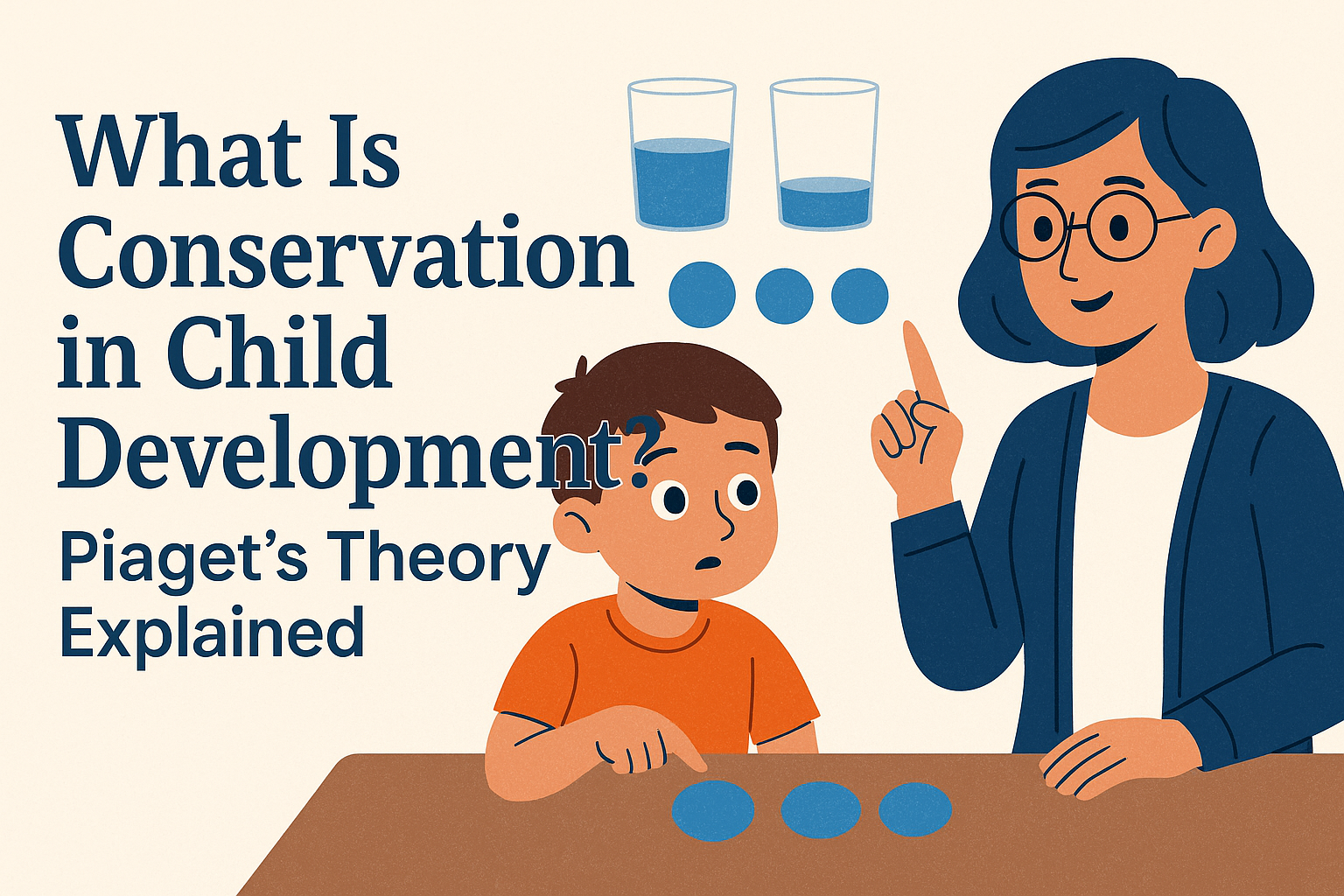
Conservation is most commonly assessed through experiments, where children are presented with two identical objects and then shown a transformation, such as pouring the same amount of liquid into two differently shaped containers. Understanding whether a child grasps that the amount of liquid remains constant despite the change in shape is a key indicator of their developmental stage.
Jean Piaget: The Architect of Cognitive Development
To fully appreciate the concept of conservation, it’s essential to explore the work of Jean Piaget, a Swiss psychologist whose theories have profoundly influenced developmental psychology. Piaget proposed that children progress through four stages of cognitive development:
- Sensorimotor Stage (0-2 years): Children experience the world through sensory exploration and physical interaction.
- Preoperational Stage (2-7 years): Marked by symbolic thinking and egocentrism, this stage lacks the ability to perform operations mentally.
- Concrete Operational Stage (7-11 years): Children begin to think logically about concrete events, gaining the ability to perform operations on tangible objects.
- Formal Operational Stage (12 years and up): Abstract thinking emerges, allowing for hypothetical and deductive reasoning.
Conservation is primarily observed during the transition from the preoperational to the concrete operational stage. At around ages 5 to 7, children begin to develop this ability. This is crucial for their overall cognitive development, as it signifies a move away from intuitive thinking towards logical reasoning.
The Essential Experiments: Testing Conservation
One of the most famous demonstrations of conservation is the liquid conservation task, conducted by Piaget himself. In this experiment, a child is presented with two identical glasses filled with the same amount of water. When one glass is poured into a taller, narrower glass, many young children believe the taller glass contains more water. This confusion showcases their inability to understand that the amount of liquid remains constant despite its shape. At around age 6 or 7, children start to grasp that the quantity remains the same, demonstrating an important cognitive leap.
Other types of conservation tasks include:
- Number Conservation: Involving two rows of coins spaced evenly apart. When one row is spread out, younger children often believe it now contains more coins.
- Mass Conservation: In this task, children are shown two equal balls of clay. When one ball is flattened, younger children may insist it has less clay than the other, illustrating their ongoing struggle with this concept.
- Length Conservation: This involves comparing two lines of blocks that are arranged differently. Younger children often misjudge the lengths based on arrangement rather than counting the blocks.
These tasks underscore the developmental milestones that children encounter as they grow. Piaget’s experiments highlighted that understanding conservation is a key indicator of a child’s cognitive maturity.
The Role of Language and Culture in Conservation
Language and cultural background also play a significant role in how children develop their understanding of conservation. Different cultures may emphasize various cognitive skills, affecting how children process information and understand concepts like conservation. For instance, children raised in cultures that prioritize quantitative reasoning might develop conservation skills earlier than those from cultures that focus more on qualitative assessments. (See: Jean Piaget's contributions to psychology.)
Furthermore, language can shape cognitive development. In cultures with rich numerical language, children might better grasp the concept of quantity and conservation. This suggests that while cognitive development stages are universal, the timing and experience can vary significantly based on environmental factors.
Current Relevance: Conservation in Education
Understanding conservation in child development has profound implications for educational practices. Educators can harness this knowledge to create age-appropriate learning experiences that facilitate cognitive growth. For example, incorporating hands-on activities that allow children to manipulate objects can help solidify their understanding of conservation. Activities such as measuring liquids, building with blocks, or using playdough to create different shapes can enhance their grasp of conservation principles. Related reading: exploring preoperational limitations.
Moreover, recognizing that children may not yet have developed conservation skills can guide teachers in crafting lessons that build on prior knowledge. It encourages patience and tailored approaches rather than expecting all children to meet developmental milestones simultaneously.
Practical Applications and Strategies
To foster conservation skills in children, parents and educators can employ various strategies:
- Engagement with Real Objects: Use daily experiences to discuss concepts of volume, mass, and number. Cooking, for instance, can be a practical way to explore volume by pouring different liquids into containers.
- Play-Based Learning: Engage children in play that requires them to sort, categorize, and compare objects. This can be as simple as playing with blocks or using toys of varying sizes.
- Ask Open-Ended Questions: Encourage children to explain their reasoning when they make judgments about quantities. Questions like “Why do you think this has more?” prompt them to reflect on their understanding and develop critical thinking.
- Modeling and Demonstration: Show children how to measure and compare through guided activities. Modeling behaviors helps children to internalize concepts more effectively.
These strategies can significantly enhance children’s understanding of conservation, further aiding their cognitive development.
Frequently Asked Questions About Conservation in Child Development
What age do children typically understand conservation?
Most children begin to grasp the concept of conservation between the ages of 5 and 7, transitioning from the preoperational stage to the concrete operational stage of cognitive development. However, this can vary based on individual development and environmental influences.
How can parents support their child’s understanding of conservation?
Parents can support their child’s understanding of conservation by engaging them in everyday activities that involve measuring, counting, and comparing. Simple games that require these skills, such as sorting fruits by size or counting objects, can reinforce these concepts.
Are there cultural differences in how children develop conservation skills?
Yes, cultural factors can influence how and when children develop conservation skills. Children from cultures that emphasize numerical literacy may develop these skills earlier compared to those from cultures that focus on qualitative aspects of learning. (See: Child development and learning resources.)
What is the significance of conservation for future learning?
Conservation skills are foundational for later learning, especially in subjects like math and science. They help children develop logical reasoning, critical thinking, and problem-solving abilities that are essential for academic success and everyday decision-making.
Can conservation skills be enhanced with specific activities?
Absolutely! Activities that promote exploration and manipulation of objects—such as building blocks, cooking, or arts and crafts—can effectively enhance a child’s understanding of conservation. These experiences provide practical applications of the concept, solidifying their learning through hands-on engagement.
The Lifelong Impact of Conservation Skills
Conservation skills are not just academic concepts; they lay the groundwork for logical reasoning and problem-solving abilities that children will need throughout their lives. Understanding conservation in child development is crucial not only for educators and parents but also for anyone involved in nurturing children’s growth. By fostering these skills, we prepare children to tackle more complex cognitive challenges as they progress through their educational journeys.
As we reflect on Piaget’s contributions, it becomes clear that the principles he established remain relevant today. Understanding how children perceive and interact with their world can guide effective teaching and parenting strategies, ensuring that every child has the opportunity to thrive cognitively. Ultimately, nurturing these skills can lead to a generation of thinkers who question, reason, and understand the complexities of their environment.
The Importance of Play in Developing Conservation Skills
Play is a crucial aspect of child development and contributes significantly to the acquisition of conservation skills. Through play, children engage with their environment, experiment with materials, and practice problem-solving. For instance, when children play with building blocks, they manipulate shapes and sizes, which helps them understand concepts related to volume and space.
Structured play activities, such as games that require measuring or sorting, also promote conservation skills. A study from the Journal of Educational Psychology found that children who participated in play-based learning programs showed significant improvements in their understanding of conservation compared to those engaged in traditional learning methods. This indicates that play is not just a leisure activity; it is a vital educational tool.
Statistics on Conservation Skills Development
Several studies have examined the importance of conservation skills in child development. For example, research from the American Psychological Association highlights that about 80% of children aged 6 to 7 demonstrate an understanding of basic conservation tasks, such as volume and number. However, only about 50% of 5-year-olds achieve similar results. This developmental gap emphasizes the significance of age-appropriate learning experiences that cater to children’s varying cognitive abilities.
Furthermore, longitudinal studies have shown that early mastery of conservation skills correlates with later academic success. Children who grasp these concepts early on tend to perform better in mathematics and science throughout their schooling, reinforcing the idea that foundational cognitive skills are essential for future learning.
Expert Perspectives on Conservation in Education
Experts in child development emphasize the critical role of understanding conservation in educational settings. Dr. Maria Montessori, for example, advocated for hands-on learning experiences that allow children to explore and discover concepts at their own pace. This philosophy aligns closely with Piaget’s theories, which suggest that active engagement is key to cognitive development.
Additionally, Dr. Howard Gardner’s theory of multiple intelligences suggests that children learn in various ways. Providing opportunities for children to engage with conservation tasks through different modalities—visual, auditory, and kinesthetic—can cater to their unique learning preferences and enhance their grasp of these vital concepts.
Enhancing Conservation Skills Through Family Activities
Parents can play an active role in developing their child’s conservation skills through family activities. Simple tasks such as measuring ingredients while cooking or gardening can provide practical applications of conservation. For instance, sorting seeds by size or volume can help children apply their understanding of mass and number in a real-world context.
Board games that involve counting, strategy, and logic, like Monopoly or Settlers of Catan, can also encourage children to think critically about conservation principles. Engaging in these activities not only helps reinforce cognitive skills but also fosters quality family time, creating a supportive environment for learning.
Conclusion: Fostering Future Thinkers
Understanding conservation in child development is more than a cognitive milestone; it’s a critical component of nurturing future thinkers. By recognizing the role of conservation skills in the broader context of cognitive development, parents, educators, and caregivers can create environments that support and enhance these abilities. As children learn to navigate their world through the lens of conservation, they become equipped with the tools needed for logical reasoning and innovative thinking throughout their lives.
“`
Trending Now We covered mastering cognitive milestones in more detail.
Frequently Asked Questions
What is the concept of conservation in child development?
Conservation in child development refers to a child's understanding that certain properties of objects, like volume or mass, remain unchanged despite changes in their form or appearance. This concept is crucial in cognitive development and indicates a child's maturity in understanding the world around them.
How did Piaget define the stages of cognitive development?
Jean Piaget proposed four stages of cognitive development: the Sensorimotor Stage (0-2 years), Preoperational Stage (2-7 years), Concrete Operational Stage (7-11 years), and Formal Operational Stage (12 years and up). Each stage reflects different abilities in thinking and understanding the world.
At what age do children start to understand conservation?
Children typically begin to understand conservation between the ages of 5 and 7, as they transition from the preoperational stage to the concrete operational stage of cognitive development. This is when they start recognizing that quantities remain the same despite changes in shape or appearance.
What experiments are used to assess conservation in children?
Conservation is often assessed through experiments where children are shown two identical objects and then see a transformation, such as pouring liquid into differently shaped containers. Observing whether they recognize that the amount remains constant is key to understanding their cognitive development.
Why is conservation important in child psychology?
Conservation is vital in child psychology as it reflects a child's cognitive development and understanding of the physical world. Mastering this concept indicates a child's ability to think logically and understand that certain properties remain constant despite changes, which is essential for their overall cognitive growth.
Agree or disagree? Drop a comment and tell us what you think.



