

“`html
The landscape of education is ever-evolving, with teaching strategies and curriculum frameworks continually adapting to better prepare students for higher learning. Among the many theoretical models that guide educational practices, Bloom’s Taxonomy in education stands out. Originally developed in 1956 by Benjamin Bloom and his colleagues, this classification system not only aids educators in structuring learning activities but also plays a pivotal role in preparing students for rigorous programs like Advanced Placement (AP). This article explores the intersection of Bloom’s Taxonomy and Advanced Placement, examining its importance in fostering critical thinking and analytical skills essential for success in college.
Understanding Bloom’s Taxonomy
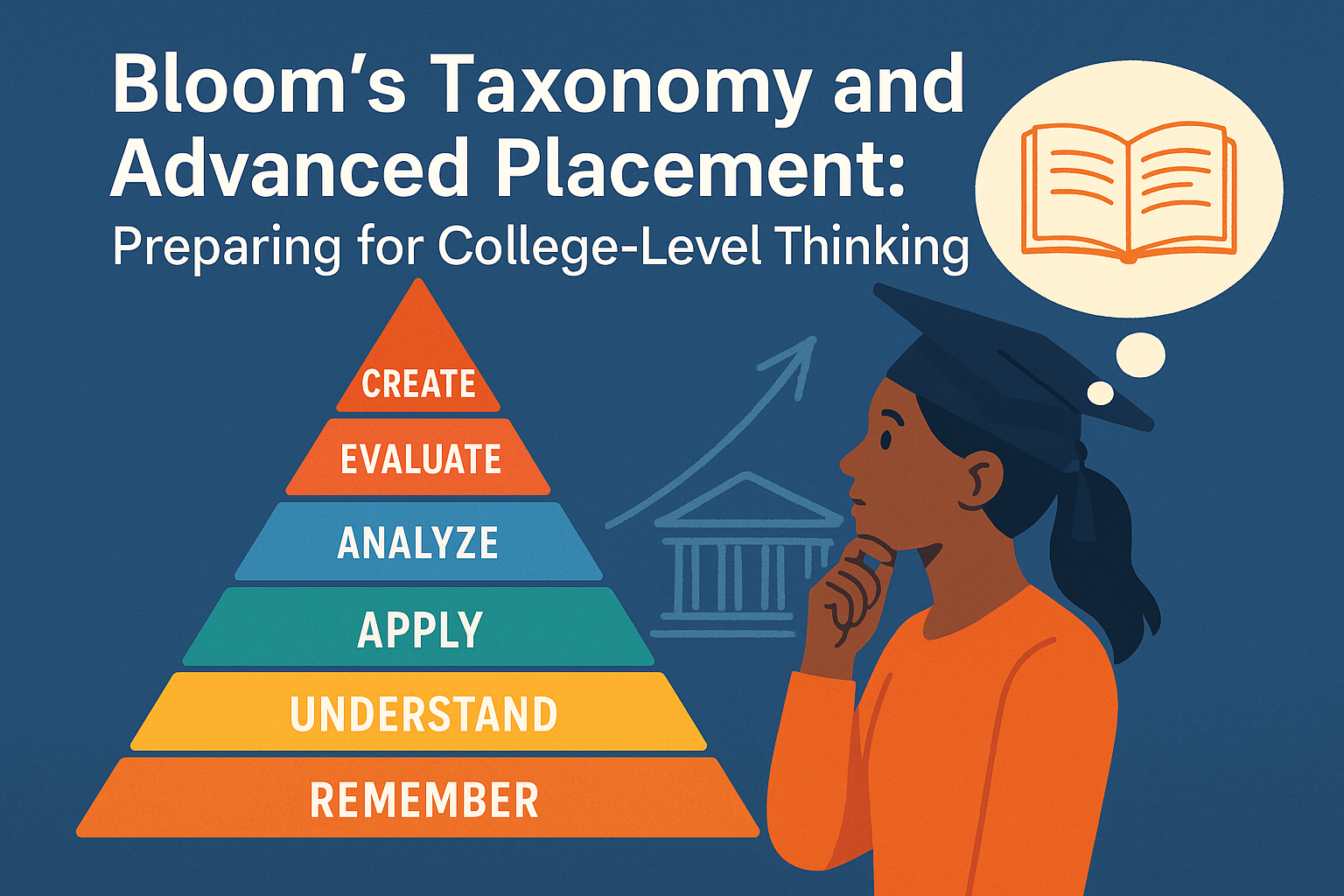
At its core, Bloom’s Taxonomy is a hierarchical framework that categorizes cognitive skills into six major levels, progressing from basic recall of facts to higher-order thinking skills. The original taxonomy included the following levels: Knowledge, Comprehension, Application, Analysis, Synthesis, and Evaluation. In 2001, a revised version was introduced by a group of cognitive psychologists, educators, and curriculum theorists, which modified some of the terminology and rearranged the categories: Remember, Understand, Apply, Analyze, Evaluate, and Create.
This model serves several key purposes in education. First and foremost, it provides a structured approach for educators to design their curricula and assessments. By understanding where a particular lesson or assessment fits within the taxonomy, teachers can ensure that they are fostering progressively deeper levels of understanding and skill development among their students.
Moreover, Bloom’s Taxonomy encourages educators to move beyond rote memorization. It emphasizes critical thinking and problem-solving, essential skills that students will need not only in AP courses but also in their future academic pursuits and professional careers.
The Role of Advanced Placement in Education
Advanced Placement programs offer students the opportunity to undertake college-level coursework while still in high school. These programs are designed to challenge students and prepare them for the rigors of higher education. With AP courses covering a wide range of subjects—including mathematics, science, humanities, and arts—students who enroll in these programs demonstrate a readiness to tackle complex material, as well as a commitment to their academic success.
One of the core benefits of AP courses is the potential for college credit. High school students who perform well on AP exams can earn college credits, allowing them to advance more quickly through their college education. This aspect alone can save students and families significant time and money. However, the benefits of AP extend beyond mere credit; they also develop essential skills that will aid students in their future academic endeavors.
Connecting Bloom’s Taxonomy and Advanced Placement
So how does Bloom’s Taxonomy fit into the picture of Advanced Placement? The answer lies in the very structure of AP courses and exams, which are designed not just to assess a student’s knowledge but also their ability to apply and synthesize that knowledge in complex ways. AP exams often include a mix of multiple-choice questions and free-response sections that require students to analyze information, evaluate arguments, and create coherent written responses. (See: Bloom's Taxonomy overview.)
For instance, consider an AP English Literature exam. Students are not merely asked to recall plot points or character names; they need to analyze themes, evaluate literary techniques, and create nuanced interpretations of texts. This embodies the higher levels of Bloom’s Taxonomy and aligns perfectly with the goals of fostering critical thinking and deep understanding.
Educators can leverage Bloom’s Taxonomy to structure their AP curriculum effectively. By aligning lessons with specific levels of the taxonomy, teachers can scaffold learning experiences that lead students through the different cognitive stages. For example, a lesson on Shakespeare might begin with students recalling key themes (Remember), then move to discussing the significance of those themes in context (Understand), and ultimately analyze how those themes are presented through various literary devices (Analyze). For more on this, see the silent threat of AI.
Practical Strategies for Implementing Bloom’s Taxonomy in AP Classes
Implementing Bloom’s Taxonomy in Advanced Placement courses requires thoughtful planning and a commitment to fostering an enriching learning environment. Here are some practical strategies for educators:
- Design Assessments Around Different Levels: Create assessments that require students to demonstrate understanding across all levels of Bloom’s Taxonomy. For instance, in a history class, students might be asked to recall specific dates (Remember), explain the significance of those events (Understand), and analyze the impact of those events on modern society (Analyze).
- Incorporate Group Work: Collaborative learning can encourage higher-level thinking. Group projects that require analysis and synthesis of information allow students to engage with their peers while developing critical thinking skills.
- Promote Open-Ended Questions: Encourage students to engage with material through open-ended questions that require analysis and evaluation. This can facilitate deeper discussions and promote a culture of inquiry.
- Use Technology as a Tool: Leverage educational technology to create interactive learning experiences. Tools like discussion forums, online quizzes, and multimedia presentations can help address multiple levels of Bloom’s Taxonomy.
By adopting these strategies, educators can create a learning experience that not only prepares students for AP exams but also equips them with the skills they will need in college and beyond.
Current Relevance of Bloom’s Taxonomy in Education
As we move further into the 21st century, the relevance of Bloom’s Taxonomy in education remains robust. With an increasing focus on critical thinking and problem-solving skills in higher education, many colleges and universities are looking for students who can think independently and engage thoughtfully with complex ideas.
Moreover, as educational standards evolve, Bloom’s Taxonomy provides a framework that aligns well with modern pedagogical approaches, including inquiry-based learning, project-based learning, and differentiated instruction. By focusing on higher-order thinking skills, educators can adapt their teaching methods to meet the diverse needs of their students.
Additionally, the emphasis on STEM (Science, Technology, Engineering, and Mathematics) education has highlighted the importance of analytical skills that Bloom’s Taxonomy nurtures. In STEM fields, the ability to analyze data, evaluate hypotheses, and create innovative solutions is paramount. Programs that integrate Bloom’s Taxonomy encourage students to develop these skills early, setting them up for success in their future academic and career pursuits.
Challenges in Applying Bloom’s Taxonomy
While Bloom’s Taxonomy is widely respected, educators may face challenges in its application. One significant issue is the disparity in student preparedness. Not all students enter AP classes with the same foundational knowledge. Teachers must find ways to ensure that all students can engage with higher-order thinking, which may involve differentiated instruction tailored to diverse learning needs. (See: CDC on education and academic success.)
Another challenge is assessment. Standardized testing often emphasizes lower-order thinking skills, which can lead educators to focus on rote memorization levels of Bloom’s Taxonomy. This can create a disconnect between teaching methodologies and evaluation methods, potentially limiting students’ exposure to deeper learning experiences.
Expert Perspectives on Bloom’s Taxonomy
Notable educators and researchers advocate for the continued use of Bloom’s Taxonomy in modern classrooms. Dr. Patricia O’Connor, an education consultant, emphasizes the importance of adapting the taxonomy to contemporary educational challenges. She suggests that teachers should view the taxonomy as a flexible guide rather than a strict framework. “It is essential to adjust the taxonomy to fit the needs of today’s learners,” she says. “We must encourage creativity and innovation while still grounding students in fundamental knowledge and comprehension.”
Furthermore, Dr. Richard Mayer, a cognitive psychologist, stresses the importance of using Bloom’s Taxonomy to design effective multimedia learning experiences. He argues that when educators utilize technology, they can create opportunities for students to engage with material at various levels of the taxonomy, thereby enhancing learning outcomes.
Examples of Bloom’s Taxonomy in Action
To illustrate how Bloom’s Taxonomy can be applied in real-world classroom settings, let’s take a look at a few examples across different subjects:
- Mathematics: In an AP Calculus class, a teacher might start with basic concepts, asking students to recall and understand derivatives (Remember and Understand). As the lesson progresses, students might apply these concepts to solve real-world problems (Apply), analyze different methods of solving the same problem (Analyze), evaluate which method is most efficient (Evaluate), and finally create their own complex problems for peers to solve (Create).
- History: In an AP U.S. History course, teachers might begin with students recalling significant events (Remember), helping them to understand the context behind those events (Understand). They might then analyze the causes and effects of the American Revolution (Analyze), evaluate the significance of different historical perspectives (Evaluate), and create a comprehensive presentation on an underrepresented historical figure (Create).
- Science: In an AP Biology class, students could start with recalling basic cell structures (Remember), discussing the functions of these structures (Understand), conducting experiments to apply their knowledge (Apply), analyzing the results to draw conclusions about cellular processes (Analyze), and even designing a new experiment to test a hypothesis related to cellular biology (Create).
FAQ About Bloom’s Taxonomy in Education
What is Bloom’s Taxonomy?
Bloom’s Taxonomy is a framework that categorizes cognitive skills into levels of complexity, helping educators design curricula that foster increasingly sophisticated understanding and skills.
How can Bloom’s Taxonomy benefit students in AP courses?
By engaging with the higher levels of Bloom’s Taxonomy, students develop critical thinking and analytical skills, which are essential for success in AP courses and future college work. We covered Innovation vs Memorization in more detail.
Are there any criticisms of Bloom’s Taxonomy?
Some critics argue that the taxonomy may oversimplify complex learning processes or that it doesn’t adequately address emotional or social learning. However, many educators still find it a valuable tool for structuring learning experiences.
How can technology enhance the use of Bloom’s Taxonomy?
Technology can provide interactive and engaging learning experiences, allowing students to explore concepts at various levels of the taxonomy through simulations, collaborative tools, and multimedia presentations.
Can Bloom’s Taxonomy be applied in non-AP courses?
Absolutely! Bloom’s Taxonomy is versatile and can be applied in any educational context, helping to promote critical thinking and skill development in a variety of subjects.
Conclusion: Bridging Education and Future Success
Bloom’s Taxonomy serves as an essential tool for educators aiming to prepare students for the demands of higher education, particularly through Advanced Placement programs. By emphasizing critical thinking and higher-order skills, educators not only enhance students’ learning experiences but also equip them with the necessary tools to thrive in college and beyond.
As students engage in AP classes structured around Bloom’s Taxonomy, they develop essential cognitive skills that foster a deeper understanding of subject matter and prepare them for the complexities of college-level coursework. The fusion of Bloom’s Taxonomy with Advanced Placement initiatives is not just a theoretical approach; it’s a practical strategy that can lead to profound educational outcomes, ensuring that students are not merely prepared for exams, but for life.
“`
Trending Now
Frequently Asked Questions
What is Bloom's Taxonomy in education?
Bloom's Taxonomy is a hierarchical framework that categorizes cognitive skills into six levels, ranging from basic recall of facts to higher-order thinking skills. It helps educators structure learning activities and assessments, promoting critical thinking and problem-solving abilities essential for student success.
How does Bloom's Taxonomy relate to Advanced Placement courses?
Bloom's Taxonomy is crucial for Advanced Placement (AP) courses as it encourages deeper cognitive engagement. By utilizing the taxonomy, educators can design lessons that foster critical thinking skills, preparing students for the rigor of AP subjects and their future academic endeavors.
What are the levels of Bloom's Taxonomy?
The levels of Bloom's Taxonomy include Remember, Understand, Apply, Analyze, Evaluate, and Create. These levels progress from basic knowledge acquisition to higher-order thinking, helping educators develop curricula that promote deeper understanding and skill mastery among students.
Why is critical thinking important in education?
Critical thinking is vital in education because it equips students with the ability to analyze information, solve problems, and make informed decisions. This skill set is particularly important in challenging courses like Advanced Placement, as well as in students' future academic and professional careers.
How can educators use Bloom's Taxonomy in lesson planning?
Educators can use Bloom's Taxonomy in lesson planning by aligning their objectives and assessments with its cognitive levels. This structured approach ensures that lessons progress from basic understanding to complex analysis, fostering an environment that encourages critical thinking and deeper learning.
Agree or disagree? Drop a comment and tell us what you think.



