
“`html
Child development theories have long fascinated educators, psychologists, and parents alike. Among these theories, the concepts of irreversibility and conservation stand out as critical components in understanding how children perceive the world around them. These concepts not only provide insight into cognitive development but also serve as practical tools for nurturing children’s learning processes. In this article, we will explore the key differences between irreversibility and conservation, their implications in child development, and how these theories can be applied effectively in everyday situations.
1. The Foundations of Child Development Theories
Child development theories offer frameworks that help us understand how children grow and learn. Renowned psychologist Jean Piaget was one of the pioneers in this field, introducing key concepts, including stages of cognitive development. His work emphasized that children actively construct their understanding of the world through experiences. Within this framework, the notions of irreversibility and conservation emerge as fundamental aspects of children’s cognitive growth.
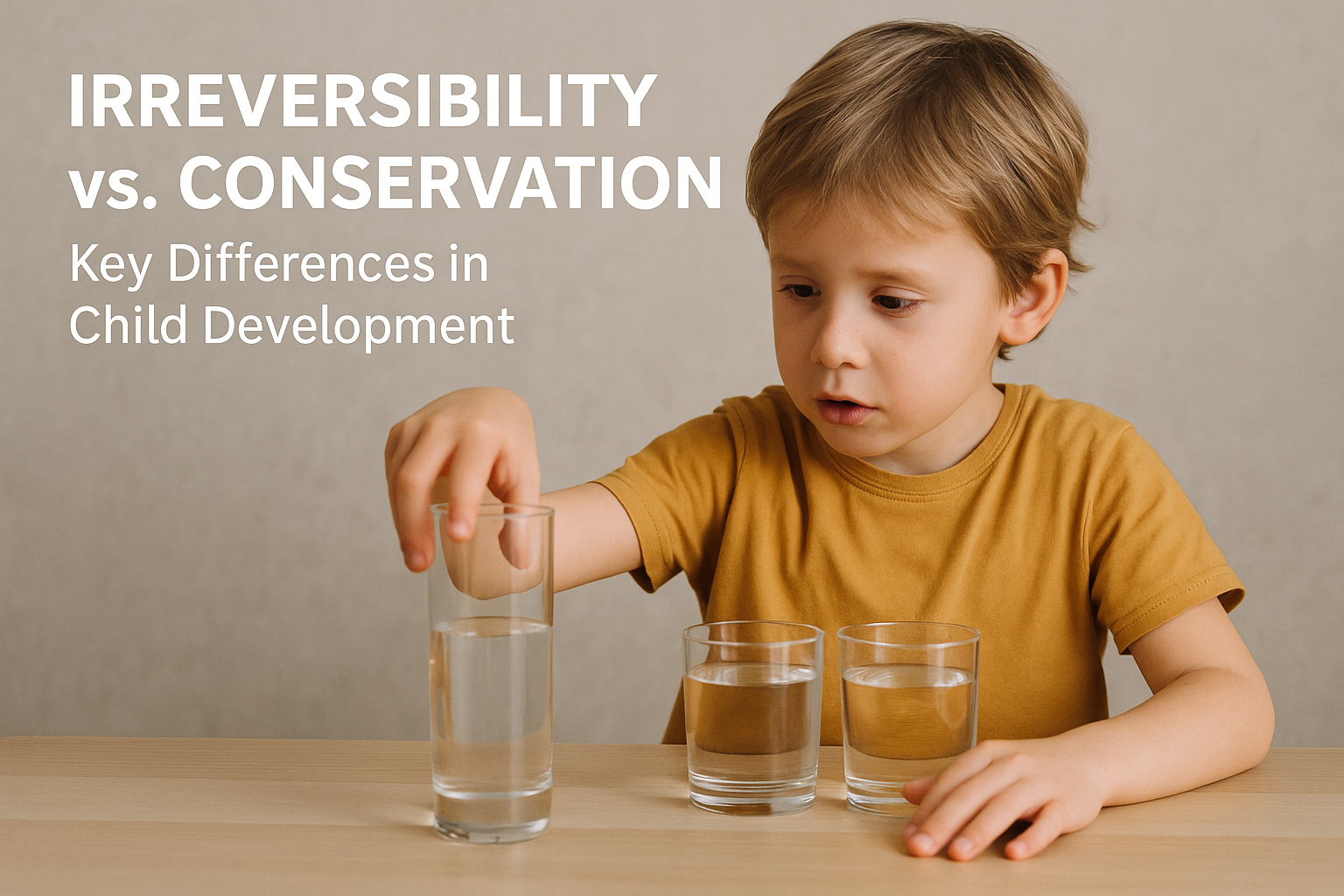
Irreversibility refers to a child’s inability to mentally reverse an action or sequence of events. For instance, if a child sees playdough flattened, they may struggle to understand that it can return to its original form. In contrast, conservation is the understanding that certain properties of objects remain constant despite changes in their form or appearance. For example, a child might think that a tall, narrow glass holds more liquid than a short, wide one, despite both glasses containing the same volume.
2. The Concept of Irreversibility
Irreversibility is a critical aspect of cognitive development that typically manifests in the preoperational stage, which spans ages two to seven. During this stage, children’s thinking is still intuitive and egocentric; they cannot easily grasp the idea that actions can be undone. This inability to reverse actions can lead to misunderstandings about physical properties and relationships.
For example, when children engage in activities like pouring water from one container to another, they may believe the amount of water has changed simply because its appearance has. This misunderstanding arises from their focus on the immediate visual cues rather than the underlying principles that govern liquid volume. It’s crucial for adults to recognize this limitation and guide children through discussions and activities that challenge their thought processes. Providing opportunities for hands-on experiences can help children slowly develop a more nuanced understanding of transformations.
3. Understanding Conservation
Conservation is generally achieved during the concrete operational stage, which occurs between ages seven and eleven. At this point, children begin to develop logical thinking, allowing them to understand that certain properties remain constant, even when their appearance changes. Conservation tasks might include understanding that the number of items remains the same regardless of their arrangement or recognizing that the volume of liquid stays the same when transferred between different-shaped containers.
This cognitive shift is significant, as it illustrates a child’s growing ability to think abstractly. For instance, when conducting a simple experiment where two rows of coins are presented — one spread out and the other clustered together — children who grasp conservation will recognize that the number of coins remains unchanged, despite their differing visual appearance. Teaching conservation is not just about making children memorize facts; it’s about fostering critical thinking that encourages them to explore, hypothesize, and come to their conclusions. (See: Cognitive development theories.)
4. The Role of Irreversibility in Education
Understanding the concept of irreversibility is crucial for educators and parents. It provides insight into the learning barriers that young children face. For instance, during lessons, educators can create activities that help children explore the idea of reversibility. Simple actions, like flipping a toy upside down, can be used to engage children in discussions about what happens during the process. By encouraging open-ended questions, children can practice articulating their thought processes and reasoning.
Moreover, incorporating play-based learning can effectively address the challenges posed by irreversibility. Learning through play allows children to experiment and test their hypotheses in a low-stakes environment. For example, using manipulatives like blocks can foster understanding of spatial relationships and reversibility, as children can build structures and later dismantle them to see the effects of their actions.
5. Encouraging Conservation Skills
Teaching conservation skills can significantly benefit children’s cognitive development. One effective way is through guided discovery, where children are encouraged to explore various materials and their properties. Activities such as measuring ingredients for a recipe or engaging in simple science experiments can help solidify these concepts. By allowing children to see the results of their actions, educators can foster a deeper understanding of the principles of conservation.
Discussion is also crucial. When children can articulate their thoughts and reasoning, they solidify their understanding. For example, after conducting an experiment with liquids, ask them to explain why two containers can hold the same amount. Encouraging dialogue nurtures critical thinking and reinforces the concept of conservation. It transforms learning into an interactive process, allowing children to connect theoretical knowledge with real-world experiences.
6. Current Relevance of Irreversibility and Conservation
The principles of irreversibility and conservation remain incredibly relevant in today’s educational landscape. With the rise of STEM (Science, Technology, Engineering, and Mathematics) education, these concepts can be integrated into various subjects, helping to create a well-rounded approach to learning. Understanding the limitations of children’s cognitive abilities allows educators to tailor their teaching methods accordingly and foster a more effective learning environment.
Furthermore, as parents, recognizing these developmental stages can inform how you approach learning at home. Encouraging exploration and playful learning can build a strong foundation for understanding more complex concepts. Engaging your child in discussions about their observations and conclusions can enhance cognitive development and critical thinking skills, setting the stage for future academic success.
7. The Interplay Between Irreversibility and Conservation
While irreversibility and conservation are distinct concepts, they are interconnected. Developing an understanding of conservation requires overcoming the challenges posed by irreversibility. Children must first grapple with the idea that actions can be reversed before they can understand that certain properties remain unchanged. This interplay highlights the importance of progression in cognitive development; it is not simply a series of milestones but rather a complex web of learning experiences.
As children move through different stages of cognitive development, they encounter challenges that help them build their understanding of the world. Educators and parents can facilitate this process by providing age-appropriate experiences that encourage exploration and critical thinking. By bridging these concepts, children can develop a more comprehensive understanding of their environment, laying the groundwork for advanced cognitive abilities in the future. (See: Child development facts from CDC.)
8. Supporting Children Through Transitions
Support is essential during transitions in cognitive development, particularly as children begin to grasp the concepts of irreversibility and conservation. Providing a nurturing environment that encourages exploration and inquiry can help children feel confident in their learning processes. It’s vital to celebrate their discoveries and encourage questions, making them feel valued as learners.
Moreover, patience is key. Children may struggle with these concepts, and it is essential to give them the time to explore and understand at their own pace. Providing consistent feedback and allowing for mistakes can help children learn from their experiences. Ultimately, fostering a growth mindset will enable them to approach challenges with resilience and curiosity.
9. Real-World Applications of Child Development Theories
Understanding child development theories, including irreversibility and conservation, has practical applications in daily life. For parents and educators, these theories can inform strategies to enhance children’s learning experiences. For instance, consider a scenario where a child is learning about cooking. Instead of merely following a recipe, engaging them in measuring ingredients not only teaches about quantities but also allows for hands-on experience with the concept of conservation. As they pour flour from one container to another, you can discuss how, despite the change in shape, the amount remains the same.
Additionally, during playtime, parents can incorporate games that require children to think critically about physical properties. For example, creating an obstacle course where items must be rearranged can challenge their understanding of irreversibility. Asking questions like “What happens if we move this block here?” encourages them to think about the outcomes of their actions.
Statistics show that children who engage in activities promoting these cognitive skills tend to perform better academically. A study conducted by the National Institute for Early Education Research found that children exposed to early experiential learning environments are 20% more likely to excel in math and science by the time they reach elementary school. This shows that applying child development theories in practical settings can yield significant educational benefits.
10. FAQs about Child Development Theories
What are the main child development theories?
Several prominent theories exist, including Piaget’s Cognitive Development Theory, Vygotsky’s Sociocultural Theory, and Erikson’s Psychosocial Development Theory. Each of these theories offers unique insights into various aspects of child growth and learning.
How do I apply these theories at home?
Parents can apply these theories by creating a rich learning environment that encourages exploration, discussion, and hands-on experience. Simple activities, such as measuring, sorting, and experimenting, can reinforce concepts of irreversibility and conservation.
At what age do children typically understand conservation?
Children generally begin to understand conservation between the ages of 7 and 11, during the concrete operational stage of cognitive development, as described by Piaget.
Can these concepts be taught to younger children?
While younger children may not fully grasp conservation, activities can still introduce them to the idea through play and guided discovery. Simple experiments can lay the groundwork for future understanding.
What role does play have in cognitive development?
Play is essential for cognitive development as it allows children to experiment, solve problems, and develop critical thinking skills in a safe environment. It fosters creativity, social skills, and an understanding of the world.
11. The Path Forward
Understanding the concepts of irreversibility and conservation is crucial in the realm of child development theories. These principles not only shed light on how children think and learn but also guide educators and parents in nurturing cognitive skills. By recognizing the distinct yet interconnected nature of these ideas, we can foster a supportive environment that encourages exploration, critical thinking, and resilience in children.
In today’s fast-paced educational landscape, it is essential to remain mindful of these foundational concepts. By integrating them into both home and school learning experiences, we can significantly enhance children’s cognitive development, preparing them for future academic challenges and lifelong learning journeys.
“`
Trending Now
- this guide on unlock your potential: a frontend developer course opportunity with quinncia inc
- Conscious Discipline vs. Traditional Classroom Management
- our breakdown of difficult temperament vs. adhd: how to tell the difference
- Object Permanence and Cognitive Development: Piaget’s…
Frequently Asked Questions
What is the difference between irreversibility and conservation in child development?
Irreversibility refers to a child's inability to mentally reverse an action, such as understanding that flattened playdough can return to its original shape. In contrast, conservation is the understanding that certain properties, like volume, remain constant despite changes in form or appearance, such as believing a tall glass holds more liquid than a short one, even when they contain the same amount.
What are the key concepts in child development theories?
Key concepts in child development theories include stages of cognitive development, as proposed by Jean Piaget. These concepts help explain how children actively construct their understanding of the world through experiences, with notions like irreversibility and conservation playing significant roles in cognitive growth.
At what age do children understand irreversibility?
Children typically exhibit an understanding of irreversibility during the preoperational stage of cognitive development, which spans ages two to seven. During this period, their thinking is intuitive and egocentric, making it challenging for them to grasp that actions can be reversed.
How does conservation develop in children?
Conservation develops as children progress through cognitive stages, particularly around the age of seven. They begin to understand that certain properties, such as volume and mass, remain constant despite changes in shape or appearance, which is crucial for their cognitive growth and understanding of the physical world.
Why are irreversibility and conservation important in education?
Irreversibility and conservation are important in education as they provide insights into children's cognitive development. Understanding these concepts helps educators and parents tailor learning experiences that nurture children's understanding of the world, promoting critical thinking and problem-solving skills.
Have you experienced this yourself? We’d love to hear your story in the comments.