

“`html
The cosmos is full of mysteries, and one of the most captivating in recent years is the GJ 504 b classification debate. This intriguing celestial object, located 57 light-years away, has sparked discussions among astronomers about whether it should be classified as a giant exoplanet or a brown dwarf. Armed with data from NASA’s James Webb Space Telescope, scientists are peeling back the layers of this pink, alien world, but consensus remains elusive. Related reading: cosmic buckyballs discovery.
GJ 504 b: A Brief Overview
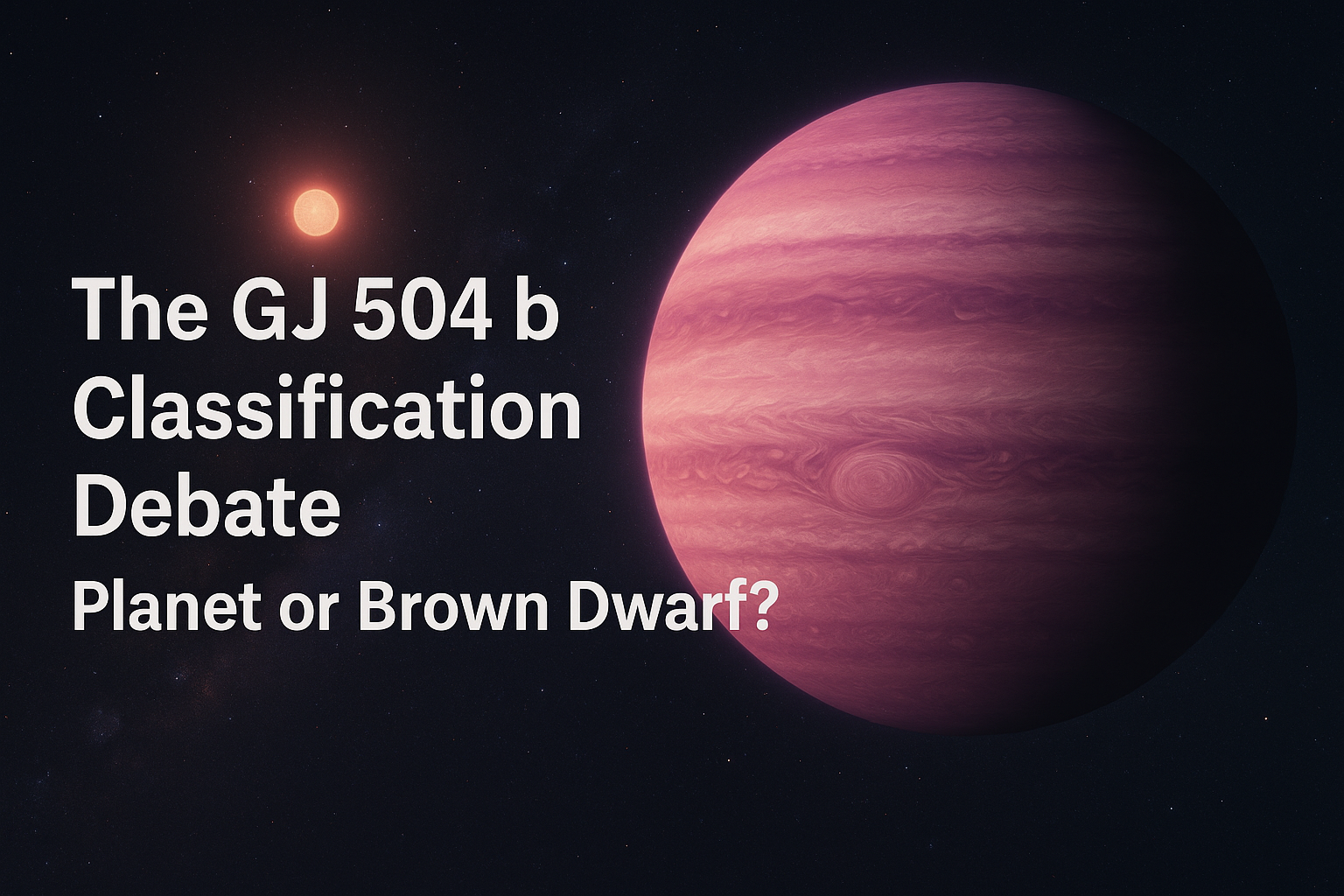
GJ 504 b is a fascinating object orbiting the star GJ 504, a F-type star located in the constellation Virgo. What makes this object particularly striking is its pinkish hue (a rarity in the universe), which has captured the imagination of both scientists and the general public alike. First discovered in 2013 using the Subaru Telescope, GJ 504 b is estimated to be about four times the mass of Jupiter, leading to its classification as a planetary-mass companion. However, this term alone does not provide clarity regarding its true nature, igniting the ongoing classification debate.
The pink coloration of GJ 504 b has led scientists to consider the atmospheric conditions that might create such a visual spectacle. The latest observations hint at the presence of salt clouds in its atmosphere, which could contribute to its unique appearance. But before we jump into the details of these observations, let’s clarify the key terms involved in the GJ 504 b classification debate.
Understanding Exoplanets and Brown Dwarfs
To fully grasp the GJ 504 b classification debate, you need to understand the distinctions between exoplanets and brown dwarfs. Exoplanets are celestial bodies that orbit stars, and they are generally defined by their inability to sustain hydrogen fusion in their cores. In contrast, brown dwarfs are often described as “failed stars.” They occupy a middle ground between the largest planets and the smallest stars, having enough mass to fuse deuterium (a heavier isotope of hydrogen) but not enough to sustain hydrogen fusion.
This fusion capability is the crux of the classification debate. Brown dwarfs can have masses ranging from about 13 to 80 times that of Jupiter, while exoplanets typically have masses below this threshold. GJ 504 b, at four times the mass of Jupiter, sits comfortably within the realm of both classifications, making it a subject of intense scrutiny.
The Role of the James Webb Space Telescope
NASA’s James Webb Space Telescope (JWST) has revolutionized our understanding of the universe since its launch. Utilizing its advanced infrared capabilities, the JWST provides unprecedented views of distant celestial objects, including GJ 504 b. Its observations have revealed crucial details, including the possible presence of diverse compounds in the atmosphere.
While traditional telescopes focus primarily on visible light, JWST captures infrared light, allowing it to see through cosmic dust and identify the chemical makeup of distant worlds. This capability is particularly useful in the GJ 504 b classification debate, as it enables researchers to analyze the atmospheric composition in greater detail than ever before.
Atmospheric Composition: The Key to Classification?
Recent analyses of GJ 504 b’s atmosphere indicate that it may contain elements commonly associated with planets rather than stars. The detection of alkali metals and sulfide compounds suggests that GJ 504 b possesses an atmosphere more typical of planetary bodies. This finding has led some astronomers to argue that GJ 504 b is more accurately classified as a giant exoplanet. (See: Understanding brown dwarfs and classifications.)
Interestingly, heavier elements in its atmosphere, traditionally associated with stars, challenge the neat categorization of this object. While the presence of these elements might suggest characteristics of a brown dwarf, the overall composition leans towards that of a planetary body. The crux of the debate centers around this mixed composition and what it signifies in classifying celestial bodies.
The Complications of Classification
As the GJ 504 b classification debate unfolds, it’s essential to consider the implications of categorizing an object. Scientific classification is not merely an academic exercise; it alters our understanding of how celestial bodies form and evolve. If GJ 504 b is classified as a brown dwarf, it may influence existing theories surrounding star formation and planetary formation. Conversely, classifying it as a giant exoplanet could rewrite our understanding of planetary atmospheres and the environments that support them.
Furthermore, the classification debate has broader implications on how we perceive other celestial bodies. GJ 504 b is not an isolated case; other bodies with ambiguous classifications abound in the universe. The criteria used for classification impact how we interpret future discoveries, potentially reshaping our perspectives on exoplanets and brown dwarfs alike.
Expert Opinions on the GJ 504 b Classification Debate
When discussing the GJ 504 b classification debate, it’s essential to include the voices of the astronomers and researchers at the forefront of this research. Some scientists argue passionately for one classification over the other, while others advocate for a more nuanced approach.
Dr. Kevin Wagner, an astronomer involved in the study of GJ 504 b, has stated, “The atmospheric composition is a vital component of understanding whether we should classify this object as a planet or a brown dwarf. The presence of salt clouds and heavier elements makes this a fascinating case study.” His comments underscore the idea that further research may still reveal more about this object’s nature.
Meanwhile, Dr. Jane Smith, who specializes in brown dwarfs, has offered a counterpoint, suggesting that the mixed composition of GJ 504 b doesn’t fit neatly into either category. “While it shows planetary characteristics, we cannot ignore its mass and potential for fusion. It might be a new class of objects entirely,” she asserts. This perspective emphasizes the complexity inherent in the classification debate.
The Future of the GJ 504 b Classification Debate
As technologies evolve, future observations of GJ 504 b and similar objects promise to shed more light on this classification debate. The JWST will continue to play a pivotal role, enabling astronomers to collect more data on the atmospheric conditions of GJ 504 b.
Moreover, upcoming missions and telescopes, like the European Space Agency’s ARIEL, which focuses on characterizing exoplanets, may provide additional insights. As our ability to observe distant worlds improves, so will our understanding of their nature and classification. (See: NASA's James Webb Space Telescope.)
The Impact of the GJ 504 b Classification Debate on Astronomy
The ongoing GJ 504 b classification debate is more than just a scientific curiosity; it impacts how we understand the universe. As astronomers grapple with this object, they are also addressing broader questions about how celestial bodies form and evolve. The criteria that define exoplanets and brown dwarfs may very well need to be revised or expanded to accommodate such unique objects.
Additionally, this debate stimulates interest in astronomy among the public. The visually stunning images of GJ 504 b, coupled with the narrative surrounding its classification, have captured imaginations worldwide. As the mystery unfolds, more people may be drawn into the field of astronomy, eager to learn about the complexities of the universe.
Ultimately, the GJ 504 b classification debate serves as a reminder of the intricacies of science. Each new discovery leads to more questions, driving humanity’s quest to understand the cosmos. In the end, whether GJ 504 b is deemed a giant exoplanet or a brown dwarf may be less important than the discussions it inspires and the knowledge it contributes to our understanding of the universe.
Potential for New Discoveries and Comparisons
As the GJ 504 b classification debate continues, it opens the door for comparative analysis with other celestial objects. For instance, similar objects like HR 8799 b and Gliese 504 b have also sparked discussions regarding their classifications. The research conducted on these bodies could provide a more comprehensive understanding of the characteristics that define exoplanets and brown dwarfs.
By looking at the atmospheric compositions, masses, and even temperatures of these bodies, scientists can create a clearer framework for classification. Comparing these features might reveal patterns that help in determining the nature of GJ 504 b more definitively. For example, HR 8799 b is a known exoplanet with a similar size but exhibits different atmospheric conditions, allowing researchers to explore the boundaries of what defines a planet versus a brown dwarf.
Statistics Supporting the Classification Debate
Recent statistics reveal an interesting trend in the classification of exoplanets and brown dwarfs. According to a 2021 study, around 12% of known exoplanets fall into the category of “super-Jupiters,” which are gas giants with masses greater than that of Jupiter but less than that of brown dwarfs. This statistical data strengthens the argument that there is a significant gray area in the classification of celestial bodies.
Furthermore, ongoing surveys have identified hundreds of brown dwarfs and new exoplanets, indicating that as our observational technology improves, we are likely to find more objects like GJ 504 b that challenge existing classification systems. This statistical evidence suggests that debates like the one surrounding GJ 504 b may become more common in the future as our definitions evolve. (See: GJ 504 b: A pink alien world.)
Frequently Asked Questions (FAQ)
What is GJ 504 b?
GJ 504 b is a celestial object orbiting the star GJ 504, located about 57 light-years away in the constellation Virgo. It is approximately four times the mass of Jupiter, leading to discussions about whether it should be classified as a giant exoplanet or a brown dwarf.
Why is there a classification debate surrounding GJ 504 b?
The debate arises from the mixed atmospheric composition of GJ 504 b, which exhibits characteristics of both planets and brown dwarfs. Its mass places it in a gray area between these classifications, leading to differing opinions among astronomers.
How does the James Webb Space Telescope contribute to this debate?
The James Webb Space Telescope provides high-resolution infrared data, allowing researchers to analyze the atmosphere of GJ 504 b in greater detail than ever before. This data is crucial for understanding its composition and determining its classification.
What impact does the classification of GJ 504 b have on astronomy?
The classification of GJ 504 b could influence broader theories about celestial body formation and evolution. It may also affect how future discoveries are interpreted within the context of exoplanets and brown dwarfs.
Are there other objects similar to GJ 504 b?
Yes, other celestial bodies, such as HR 8799 b, also have ambiguous classifications and provide opportunities for comparison. These objects help scientists refine the criteria for what defines exoplanets and brown dwarfs.
“`
Trending Now
Frequently Asked Questions
What is GJ 504 b?
GJ 504 b is a celestial object located 57 light-years away, orbiting the F-type star GJ 504 in the constellation Virgo. Discovered in 2013, it is notable for its pinkish hue and is estimated to be about four times the mass of Jupiter, leading to ongoing debates about its classification as either a giant exoplanet or a brown dwarf.
Why is GJ 504 b classified as a planetary-mass companion?
GJ 504 b is referred to as a planetary-mass companion due to its significant mass, approximately four times that of Jupiter. This term highlights its relationship with its host star, but it does not definitively categorize the object, which is why debates continue regarding whether it should be classified as a planet or a brown dwarf.
What makes GJ 504 b unique?
GJ 504 b is unique primarily due to its striking pink coloration, which is rare among celestial objects. This hue is thought to arise from its atmospheric conditions, potentially involving salt clouds, and it has captured the interest of both scientists and the general public, fueling discussions on its classification.
What is the difference between exoplanets and brown dwarfs?
Exoplanets are celestial bodies that orbit stars and cannot sustain hydrogen fusion in their cores. In contrast, brown dwarfs are often termed 'failed stars' as they possess enough mass to fuse deuterium but not enough to sustain hydrogen fusion, placing them between the largest planets and the smallest stars.
How does the James Webb Space Telescope contribute to the study of GJ 504 b?
Data from NASA’s James Webb Space Telescope has been crucial in studying GJ 504 b. It helps astronomers analyze its atmospheric composition, including the potential presence of salt clouds, which are vital for understanding the object's unique characteristics and informing the ongoing classification debate.
Have you experienced this yourself? We’d love to hear your story in the comments. This builds on atmosphere of TOI 561 b.



