
“`html
High school educators are always on the lookout for effective methods to enhance student learning. One approach that has garnered significant attention is the combination of Bloom’s Taxonomy in education and scaffolding. By integrating these two educational frameworks, teachers can create a structured learning environment that promotes deeper understanding and mastery of complex concepts.
Understanding Bloom’s Taxonomy in Education
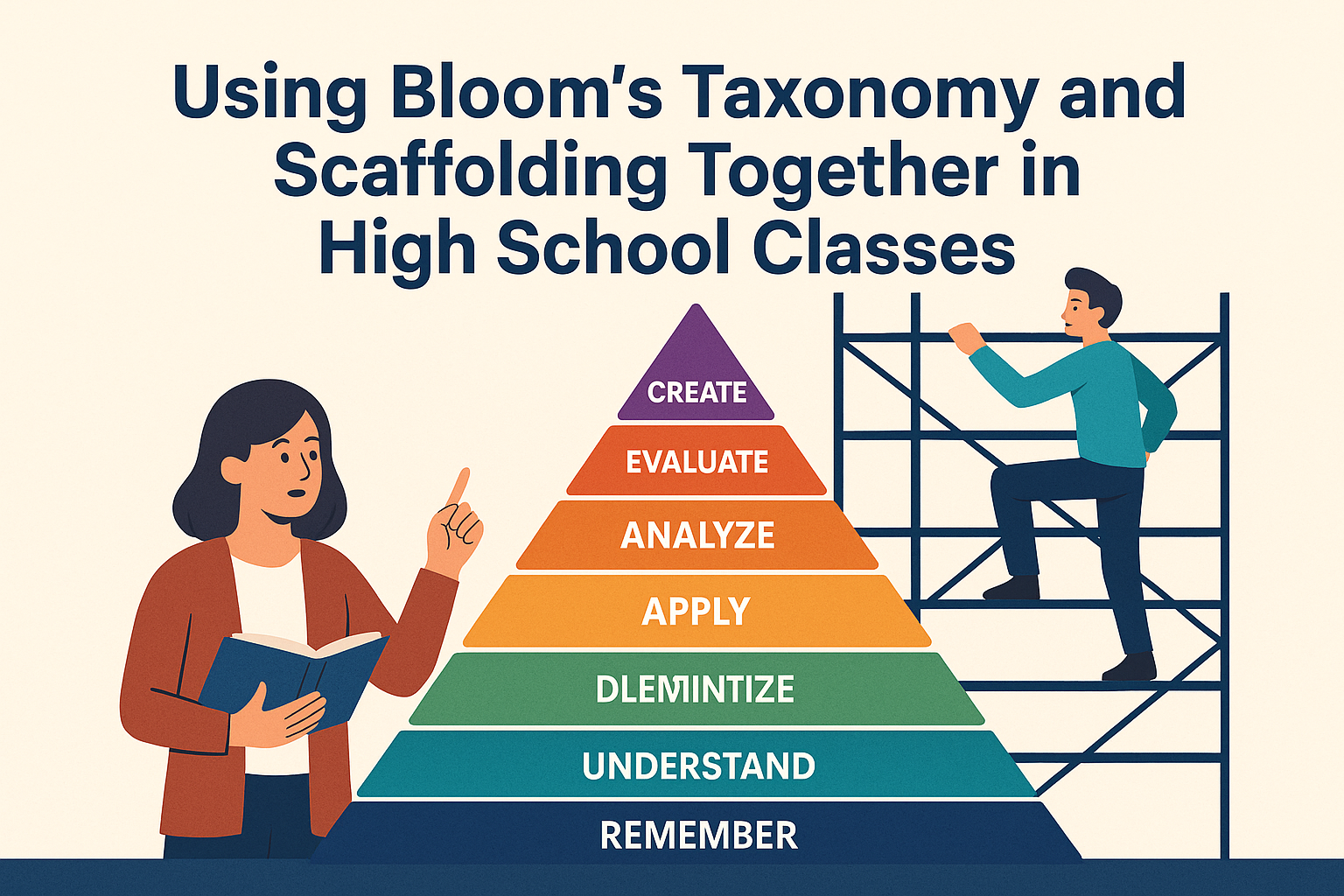
Developed by Benjamin Bloom and his collaborators in the mid-20th century, Bloom’s Taxonomy provides a hierarchical classification of cognitive skills. Initially, it was presented as a three-domain framework: cognitive, affective, and psychomotor. However, the most commonly referenced aspect is the cognitive domain, which is subdivided into six levels of learning objectives:
- Remembering: Recalling facts and basic concepts.
- Understanding: Explaining ideas or concepts.
- Applying: Using information in new situations.
- Analyzing: Breaking information into parts to explore understandings and relationships.
- Evaluating: Justifying a decision or course of action.
- Creating: Producing new or original work.
Each level builds on the previous one, with higher-order thinking skills requiring a foundation established by the lower levels. For example, before students can analyze a text, they must first understand its content and be able to remember and apply key concepts.
The Role of Scaffolding in Learning
Scaffolding refers to the instructional techniques used to support student learning. The idea stems from Vygotsky’s concept of the Zone of Proximal Development (ZPD), which emphasizes the difference between what learners can do independently versus what they can achieve with guidance. Scaffolding involves providing temporary support structures that help students move toward greater independence in their learning.
Effective scaffolding techniques include:
- Modeling: Demonstrating a process or concept for students to observe.
- Chunking: Breaking information into manageable pieces to avoid overwhelming students.
- Prompting: Offering cues or hints to guide students toward the correct answer.
- Collaborative learning: Encouraging peer interactions to facilitate knowledge sharing and problem-solving.
When implemented effectively, scaffolding not only helps students grasp new concepts but also fosters their ability to become self-regulated learners.
Integrating Bloom’s Taxonomy and Scaffolding in High School Classrooms
Combining Bloom’s Taxonomy with scaffolding strategies can create a powerful teaching approach in high school classes. Here’s how educators can effectively merge these frameworks:
Setting Clear Learning Objectives
When planning lessons, teachers can use Bloom’s Taxonomy to establish clear learning objectives. For instance, instead of stating, “Students will understand the concept of photosynthesis,” educators can specify, “Students will be able to analyze the process of photosynthesis and evaluate its impact on the ecosystem.” This clarity helps students understand what is expected of them and encourages them to engage with the material more deeply. (See: Bloom's Taxonomy in education.)
Designing Scaffolded Activities
Once learning objectives are set, scaffolded activities can be designed. These should align with the different levels of Bloom’s Taxonomy. For example:
- Remembering: Flashcards for key terms related to the subject matter.
- Understanding: Group discussions to explain concepts in their own words.
- Applying: Hands-on experiments where students can use theories in practice.
- Analyzing: Case studies that require students to break down complex scenarios.
- Evaluating: Debates where students must justify their opinions based on evidence.
- Creating: Projects that require students to synthesize information and produce original work.
By aligning activities with specific cognitive levels, teachers can ensure that students are not only receiving the support they need but are also challenged to stretch their thinking.
Case Study: Practical Application in a High School Science Class
To illustrate the impact of using Bloom’s Taxonomy and scaffolding, let’s consider a high school biology class focusing on ecosystems. The teacher begins by outlining the learning objectives, which draw directly from the taxonomy:
- Students will remember key terms related to ecosystems.
- Students will understand the interdependence of organisms.
- Students will apply their knowledge to real-world scenarios.
- Students will analyze a local ecosystem.
- Students will evaluate the effects of climate change on that ecosystem.
- Students will create a presentation proposing solutions to mitigate these effects.
Initially, the teacher introduces vocabulary through flashcards (remembering) and then holds a discussion to ensure students grasp the concepts (understanding). Next, students participate in a hands-on activity where they apply their knowledge by simulating an ecosystem using materials to represent different organisms (applying).
Moving forward, students analyze a case study of a local ecosystem, looking at how various elements interact (analyzing). They then engage in a debate on the impact of climate change, requiring them to evaluate different perspectives (evaluating). Finally, they create a multimedia presentation proposing their solutions to the identified problems, synthesizing their learning and demonstrating creativity (creating).
This structured journey not only enhances comprehension but also promotes collaboration, critical thinking, and practical application of knowledge.
Challenges of Implementation
While the integration of Bloom’s Taxonomy and scaffolding offers numerous benefits, educators may face challenges during implementation. Here are some potential obstacles:
- Time Constraints: Designing scaffolded activities aligned with Bloom’s levels requires time for planning, which can be difficult within the confines of a typical school schedule.
- Assessment Alignment: Traditional assessment methods may not capture the depth of understanding promoted by these frameworks, making it necessary for educators to develop new assessment strategies.
- Teacher Training: Educators may require additional training to effectively implement these strategies, especially if they are unfamiliar with the concepts of scaffolding or Bloom’s Taxonomy.
Despite these challenges, the benefits of enhancing student engagement and understanding make the effort worthwhile. Teachers can seek professional development opportunities to address these difficulties, ensuring they are equipped to implement these strategies effectively. strategies for scaffolding learning offers useful background here.
The Current Relevance of Bloom’s Taxonomy in Education
In today’s rapidly evolving educational landscape, the relevance of Bloom’s Taxonomy remains robust. As educators increasingly focus on critical thinking and problem-solving, this framework provides a valuable structure for developing higher-order thinking skills. Furthermore, its adaptability makes it suitable for various subjects and grade levels.
Moreover, the integration of technology in classrooms adds another layer of depth. Digital tools can facilitate scaffolding—offering interactive activities that engage students while allowing for differentiated learning experiences. For example, online platforms can provide personalized feedback based on student performance, helping them progress through the levels of Bloom’s Taxonomy. (See: Scaffolding in educational contexts.)
Real-World Applications of Bloom’s Taxonomy
Bloom’s Taxonomy isn’t confined to the classroom. Many professionals use the principles behind it to structure training sessions or workshops. For example, businesses often implement training programs that require employees to remember company policies (remembering), understand customer service principles (understanding), apply customer service techniques in role-playing scenarios (applying), analyze case studies of successful service (analyzing), evaluate their performance during service interactions (evaluating), and finally, create their own customer service strategies (creating).
In this way, Bloom’s Taxonomy can serve as a framework for continuous professional development, ensuring employees not only acquire knowledge but also apply and innovate based on that knowledge.
Expert Perspectives on Bloom’s Taxonomy
Many educational experts endorse the use of Bloom’s Taxonomy as a means to enhance teaching methodologies. Dr. Patricia Marzano, an education researcher, emphasizes the importance of aligning learning objectives with student activities. She notes that when teachers use Bloom’s Taxonomy to frame their lessons, it encourages deeper engagement from students and helps them take ownership of their learning process.
Dr. John Hattie, known for his work on visible learning, also supports the hierarchical structure of Bloom’s Taxonomy, stating, “When students are aware of the learning intentions and success criteria, they can engage in self-regulation.” This self-regulation is crucial in developing lifelong learners who can adapt to new challenges.
Frequently Asked Questions about Bloom’s Taxonomy in Education
What is the purpose of Bloom’s Taxonomy?
The primary purpose of Bloom’s Taxonomy is to provide educators with a framework for designing learning objectives and assessments that promote higher-order thinking skills in students. It helps teachers structure their lessons to encourage deeper learning and understanding.
How can I apply Bloom’s Taxonomy in my teaching practice?
You can apply Bloom’s Taxonomy by starting with clear objectives that align with its levels. Plan activities that correspond to each level, ensuring students progress through remembering, understanding, applying, analyzing, evaluating, and creating. Regularly assess their understanding to tailor support as needed.
Can Bloom’s Taxonomy be used in all subjects?
Yes, Bloom’s Taxonomy is versatile and can be adapted for use in various subjects, including mathematics, science, humanities, and the arts. Its principles encourage critical thinking and creativity across disciplines. (See: Harvard University educational resources.)
What are some examples of activities for each level of Bloom’s Taxonomy?
Examples include:
- Remembering: Quizzes on vocabulary.
- Understanding: Summarizing a chapter in your own words.
- Applying: Solving real-world math problems.
- Analyzing: Comparing two historical events.
- Evaluating: Writing a review of a book or film.
- Creating: Designing a new product or service.
Additional Insights on the Application of Bloom’s Taxonomy
One of the most compelling aspects of Bloom’s Taxonomy is its adaptability to various learning environments, including online education. As education shifts more towards digital platforms, teachers can leverage technology to create interactive and engaging activities that align with the taxonomy levels. For instance, platforms like Google Classroom or educational apps can host quizzes that assess students’ knowledge (remembering) or facilitate group projects that require students to collaborate and create (creating) in real time.
Additionally, educators can incorporate formative assessments that allow them to gauge student understanding throughout the learning process. This can include exit tickets, where students reflect on what they have learned at the end of a lesson. Such insights can help teachers adjust their instructional strategies to better meet the needs of their students.
Success Stories from Implementation
Across various schools and districts, there are numerous success stories that highlight the effective integration of Bloom’s Taxonomy in education. For example, a high school in California adopted a school-wide initiative to implement Bloom’s Taxonomy in their curriculum. Teachers collaboratively developed interdisciplinary projects where students needed to demonstrate understanding through various levels of the taxonomy. As a result, students not only showed improved academic performance but also enhanced critical thinking and problem-solving skills.
In another case, a group of teachers in a rural district created a professional learning community focused on Bloom’s Taxonomy. Through shared resources and strategies, they not only improved their teaching practices but also built a supportive network that led to increased student engagement and satisfaction. These success stories illustrate the practical benefits of using Bloom’s Taxonomy as a guiding framework.
Conclusion: A Pathway for Future Learning
Combining Bloom’s Taxonomy and scaffolding is not just a theoretical exercise; it’s a practical approach that can lead to significant improvements in student learning. By establishing clear objectives and designing scaffolded lessons that encourage students to progress through cognitive levels, educators can create a dynamic learning environment. This integration not only fosters academic growth but also equips students with the skills necessary to navigate a complex world. As educators continue to adapt and refine their teaching practices, the union of Bloom’s Taxonomy and scaffolding remains a powerful tool in their arsenal.
“`
Trending Now
Frequently Asked Questions
What is Bloom's Taxonomy and how is it used in education?
Bloom's Taxonomy is a hierarchical classification of cognitive skills developed by Benjamin Bloom. It consists of six levels: remembering, understanding, applying, analyzing, evaluating, and creating. In education, it helps teachers design learning objectives that promote higher-order thinking and deeper understanding of material.
What is scaffolding in education?
Scaffolding in education refers to instructional techniques that provide temporary support to learners. It is based on Vygotsky's Zone of Proximal Development, helping students achieve tasks they cannot do independently by gradually removing support as they gain confidence and skills.
How can teachers use Bloom's Taxonomy and scaffolding together?
Teachers can combine Bloom's Taxonomy and scaffolding by structuring lessons that align with the taxonomy's cognitive levels while providing appropriate support. This approach allows students to build foundational knowledge before tackling more complex tasks, enhancing their learning experience.
What are the levels of Bloom's Taxonomy?
The levels of Bloom's Taxonomy are: 1) Remembering, 2) Understanding, 3) Applying, 4) Analyzing, 5) Evaluating, and 6) Creating. Each level requires mastery of the previous one, promoting a progression from basic recall to higher-order thinking and creativity.
Why is scaffolding important in the classroom?
Scaffolding is crucial in the classroom because it helps students bridge the gap between their current abilities and the learning goals. By providing targeted support, teachers can facilitate student independence, enhance confidence, and improve overall learning outcomes.
Agree or disagree? Drop a comment and tell us what you think. See also effective ADHD teaching techniques.