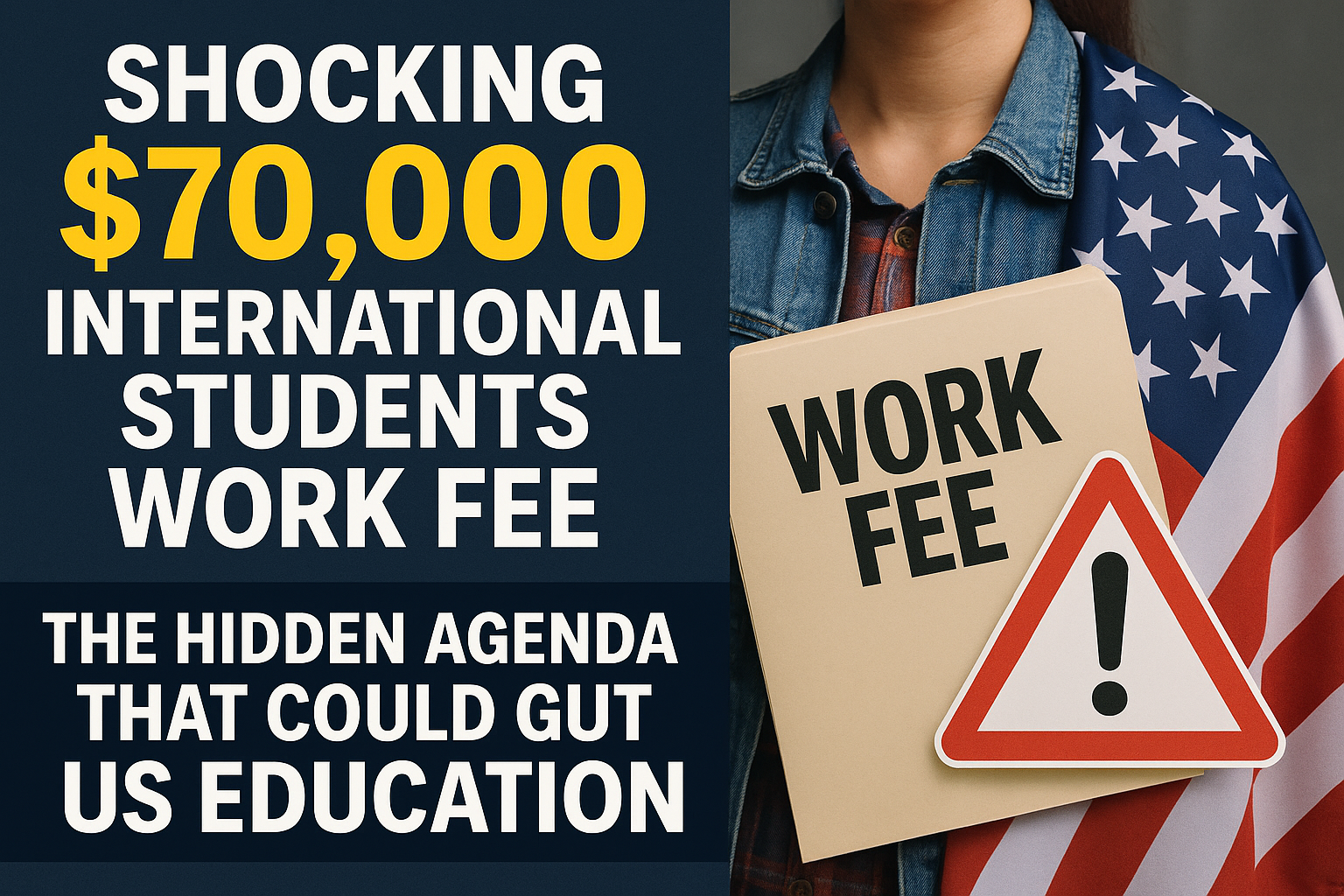

Imagine you’ve just spent years of your life, and likely tens, if not hundreds, of thousands of dollars, pursuing a degree in the United States. You’ve worked tirelessly, navigated a new culture, and finally, graduation day arrives. You’re ready to put your hard-earned skills to use, perhaps even contribute to the American economy, only to be hit with a staggering $70,000 fee for the privilege of working. This isn’t a hypothetical nightmare; it’s a very real, and frankly, alarming proposal put forth by the administration of former President Donald Trump, targeting international students seeking to participate in the Optional Practical Training (OPT) program. This proposed international students work fee, announced by the Department of Homeland Security on Wednesday, October 7, 2026, isn’t just a hurdle; it’s a potential brick wall for countless aspiring graduates and a seismic shift for American higher education.
The Optional Practical Training program has long served as a vital bridge for international students, allowing them to gain invaluable work experience directly related to their field of study for a period of 12 months, with STEM graduates often eligible for a 24-month extension. It’s designed to complement their academic journey, providing practical application of theoretical knowledge. For many, it’s the logical next step after graduation, a chance to apply what they’ve learned and, for some, a pathway to longer-term contributions to the U.S. workforce. But this proposal turns that bridge into a toll road with an astronomical price tag, signaling a clear intent to restrict not just foreign student enrollment but also their post-graduation employment opportunities.
The rhetoric surrounding this proposed international students work fee is equally troubling. The administration has cited nebulous concerns over “fraud and abuse” within the OPT program, going so far as to label it a “pipeline for cheap foreign labor.” These are charged accusations that, without robust evidence, feel more like political posturing than genuine policy concerns. Such language not only demonizes a program that has benefited both students and the U.S. economy but also casts a shadow of suspicion over the entire international student body. It’s a narrative designed to justify a drastic measure, one that could have far-reaching and unintended consequences for the very institutions that make up the backbone of America’s global academic prestige.
The Staggering Cost: Breaking Down the $70,000 International Students Work Fee
Let’s get specific about the numbers, because they are truly eye-watering. Under this proposed rule, the financial burden wouldn’t fall directly on the student initially, but rather on their educational institutions. Schools would be mandated to pay a colossal $70,000 for each international student’s initial OPT application. And if a student qualifies for an extension, say for a STEM-related field, that’s another $30,000 for each renewal. Think about that for a moment. This isn’t a small administrative fee; it’s an enormous levy that fundamentally redefines the cost structure of hosting international students. While the fee is technically levied on the schools, it’s naive to think these costs won’t eventually trickle down, either through increased tuition for international students, reduced scholarship opportunities, or a complete reevaluation of a school’s capacity to host foreign talent.
Consider the immediate impact on universities, particularly those that have robust international student populations. Many American colleges and universities, especially state-funded institutions facing budget cuts, have come to rely significantly on the higher tuition rates paid by international students. These students often pay out-of-state or full international tuition, which can be two or three times what in-state students pay. This revenue stream supports not only the international student offices but also various academic departments, research initiatives, and even the overall financial health of the university. Introducing a $70,000 international students work fee per student for OPT isn’t just a minor adjustment; it’s an existential threat to this financial model.
The sheer scale of this fee suggests an intent beyond merely addressing perceived fraud; it appears designed to act as a significant deterrent. If a university has, for example, 500 international students graduating and applying for OPT each year, that’s a potential additional cost of $35 million annually. Even for large, well-endowed institutions, that’s a staggering sum. For smaller or less financially robust colleges, it could be crippling. They would face an impossible choice: absorb these costs, pass them onto students (making the U.S. even less competitive globally), or drastically reduce their international student intake. None of these options are good for American higher education. (See: Centers for Disease Control and Prevention.)
A Direct Hit to American Colleges and Universities
The implications for American higher education are nothing short of devastating. For decades, the United States has been the undisputed global leader in attracting international talent. Our universities are renowned worldwide, drawing the brightest minds from every corner of the planet. These students don’t just bring tuition dollars; they bring diverse perspectives, contribute to cutting-edge research, boost local economies, and enrich the cultural fabric of campuses and communities alike. The proposed international students work fee threatens to dismantle this carefully built ecosystem.
Think about the competitive landscape. Other countries – Canada, the UK, Australia, Germany – are actively vying for international students, often offering more straightforward post-graduation work pathways. If the U.S. erects such a monumental financial barrier, where do you think those students will go? They’ll choose destinations where their contributions are valued and their post-study career prospects aren’t burdened by prohibitive fees. This isn’t just about losing tuition revenue; it’s about losing intellectual capital, future innovators, and global ambassadors for American values and ingenuity. It’s about ceding our competitive edge in a globalized world.
The reliance on international student tuition is not a hidden secret. Many universities openly acknowledge that these funds are crucial for maintaining academic programs, funding research, and keeping tuition costs lower for domestic students. A significant reduction in international enrollment, triggered by this exorbitant international students work fee, could lead to budget shortfalls, program cuts, faculty layoffs, and ultimately, a decline in the overall quality of education offered. This isn’t just an abstract concern; it’s a very real threat to the viability and excellence of many institutions.
The Claim of “Cheap Foreign Labor” and “Fraud and Abuse”
Let’s scrutinize the administration’s stated rationale: concerns over “fraud and abuse” and the program being a “pipeline for cheap foreign labor.” These are serious accusations, and if true, they warrant attention. However, simply leveling such charges without presenting compelling, widespread evidence leaves one questioning the true motivation behind such a drastic policy proposal. The OPT program, like any large-scale program, undoubtedly has instances of misuse, but to characterize the entire program as fundamentally flawed and a source of cheap labor seems like a gross oversimplification, if not an outright misrepresentation.
The accusation of “cheap foreign labor” is particularly contentious. International students participating in OPT are, by definition, recent graduates from American universities. They are often highly skilled, educated in fields like STEM, business, and healthcare, and command competitive salaries. They are not typically filling low-wage jobs; rather, they are often sought after for specialized roles where there may be domestic shortages or where their unique skills and international perspective add significant value. To paint them as simply “cheap labor” ignores their qualifications and the economic contributions they make.
Furthermore, the idea that the OPT program is a primary source of “fraud and abuse” deserves a deeper look. There are existing mechanisms and regulations in place to monitor the program and address violations. If there are indeed systemic issues, the logical approach would be to strengthen enforcement, increase oversight, or refine existing rules, rather than implementing a blanket, punitive fee that could cripple the entire system. This feels less like targeted problem-solving and more like a sledgehammer approach, designed to broadly curb international student employment rather than surgically address specific instances of misconduct. It raises the question: is this about genuine program integrity, or is it about restricting immigration under a different guise? (See: New York Times coverage on education policies.)
The Broader Economic and Societal Impact of This International Students Work Fee
The ripple effects of such a policy extend far beyond university campuses. International students and graduates contribute significantly to the U.S. economy in numerous ways. Beyond tuition, they spend money on housing, food, transportation, and other goods and services, supporting local businesses and creating jobs in communities around universities. Many also go on to work in critical sectors, contributing to innovation, research, and economic growth.
Consider the tech industry, for instance. A substantial percentage of STEM graduates from U.S. universities are international students. Many of these individuals, after gaining valuable experience through OPT, move on to H-1B visas and become integral parts of companies ranging from startups to tech giants. They invent, innovate, and drive economic prosperity. By making it prohibitively expensive for them to work post-graduation, the U.S. risks losing this talent to competitor nations. This isn’t just a loss for individual companies; it’s a loss for America’s global competitiveness in critical technological and scientific fields.
Moreover, the soft power of international education cannot be overstated. When students come to the U.S., they experience American culture, values, and institutions firsthand. They often return to their home countries as ambassadors of goodwill, fostering stronger diplomatic and economic ties. Severing these connections or making them financially punitive risks isolating the U.S. on the global stage, undermining decades of diplomatic efforts and cultural exchange. The proposed international students work fee isn’t just an economic policy; it’s a foreign policy statement, and not a particularly welcoming one.
The Looming Battle: Public Comment and Legal Challenges
Thankfully, this proposal isn’t a done deal. The public has a crucial 60-day window to comment on the proposed rule. This is a vital period for individuals, educational institutions, businesses, and advocacy groups to voice their concerns, submit data, and highlight the potential negative consequences of this international students work fee. This democratic process allows for a robust debate and provides an opportunity to push back against policies that are perceived as detrimental.
Furthermore, it’s almost a certainty that this proposal will face significant legal challenges. Higher education associations, business groups, and immigration advocacy organizations are already gearing up for what promises to be a protracted legal battle. Their arguments will likely center on several points: the arbitrary and capricious nature of such a high fee, the potential violation of existing immigration statutes, the discriminatory impact, and the lack of a clear, evidence-based justification for such a drastic measure. Legal challenges often focus on whether an agency has exceeded its authority or acted outside the bounds of established law. Given the scale and impact of this proposed fee, expect a vigorous fight in the courts. (See: Nature journal on education and workforce.)
The outcome of these challenges will be critical. A successful legal challenge could block or significantly alter the implementation of the fee, preserving access to post-graduation work opportunities for international students. However, if the rule were to withstand legal scrutiny, it would fundamentally reshape the landscape of international education and employment in the U.S., with consequences that would reverberate for years to come. The stakes, in other words, couldn’t be higher.
What This Means for the Future of International Talent in the US
The proposed international students work fee represents a troubling escalation in policies aimed at restricting immigration and, by extension, the flow of international talent into the United States. It signals a shift from a posture of welcoming the world’s brightest minds to one of erecting significant barriers. If implemented, this policy would not only deter future international students from choosing the U.S. but also likely push many current students and recent graduates to seek opportunities elsewhere.
Think about the message it sends: ‘We want your tuition dollars, but we don’t necessarily want you to stay and contribute your skills after you graduate.’ This is a short-sighted approach that undervalues the long-term benefits international students bring. It ignores the fact that many successful companies in the U.S. were founded or significantly advanced by immigrants and international talent. It’s a self-inflicted wound that could hobble America’s innovation engine and diminish its standing as a global leader in education and research.
The debate surrounding this international students work fee is more than just about a number; it’s about the kind of country America wants to be. Do we want to be an open, welcoming society that attracts and retains global talent, benefiting from their diverse skills and perspectives? Or do we want to close our doors, prioritize isolation, and risk losing our competitive edge in an increasingly interconnected world? The answer, for many of us, seems clear. The coming months will determine whether common sense and a recognition of the immense value of international students prevail over policies that appear designed to shut them out.
Trending Now
Frequently Asked Questions
What is the proposed $70,000 fee for international students?
The proposed $70,000 fee targets international students wishing to work in the U.S. after graduation through the Optional Practical Training (OPT) program. This fee, suggested by the Trump administration, could severely limit opportunities for international graduates to gain practical work experience in their fields.
How does the Optional Practical Training (OPT) program work?
The OPT program allows international students in the U.S. to work for up to 12 months after graduation, with STEM graduates eligible for a 24-month extension. It provides a crucial opportunity for students to apply their academic knowledge in real-world settings, enhancing their employability.
Why is there concern about the international students work fee?
The proposed work fee raises concerns as it may significantly restrict access to employment for international graduates. Critics argue that it could deter foreign students from enrolling in U.S. institutions, ultimately impacting the diversity and economic contributions of the student body.
What are the implications of the $70,000 fee on U.S. education?
Implementing a $70,000 fee for international students could gut U.S. education by reducing the number of foreign enrollments and limiting post-graduation work opportunities. This shift could undermine the value of U.S. degrees and diminish the contributions of international talent to the American economy.
What are the criticisms of the OPT program?
Critics of the OPT program, including the Trump administration, have raised concerns about potential 'fraud and abuse,' labeling it a 'pipeline for cheap foreign labor.' However, many argue that the program is vital for providing international students with necessary work experience and should not be penalized.
What did we miss? Let us know in the comments and join the conversation.