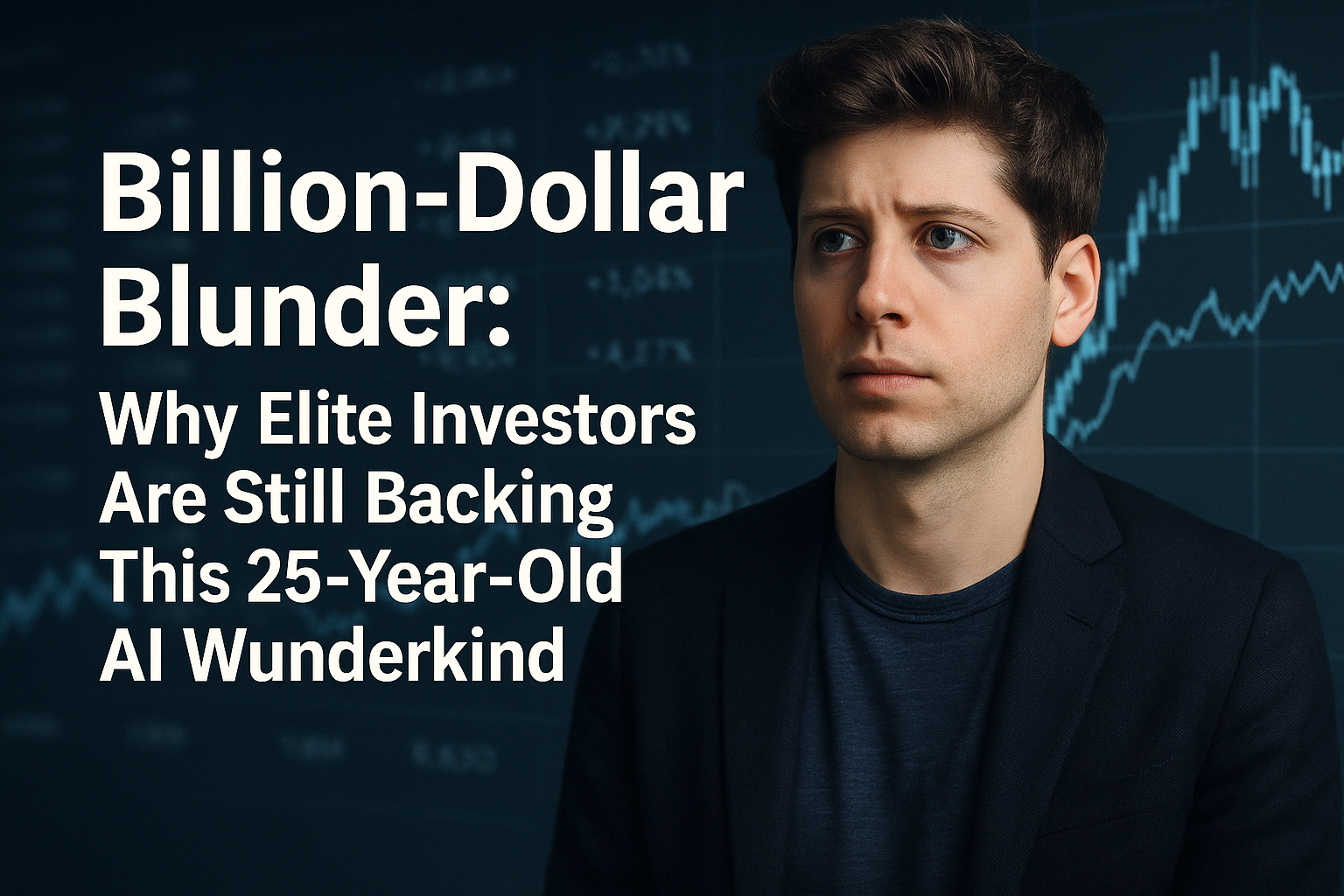

When a hedge fund sheds $35 billion in a matter of days, you’d expect a firestorm. You’d imagine investors scrambling for the exits, lawsuits flying, and the manager’s career going up in smoke. But what if the opposite happened? What if, despite a catastrophic loss that saw a fund plummet from $45 billion to a mere $10 billion, Silicon Valley and Wall Street’s sharpest minds were actually lining up to throw more money at the 25-year-old at the helm?
That’s the bizarre, compelling, and frankly, a little concerning story of Leopold Aschenbrenner and his Situational Awareness hedge fund. This isn’t just a story about numbers; it’s a deep dive into the intoxicating allure of AI, the often-irrational confidence of elite investors, and what this all means for anyone considering a high-risk, high-reward investment. If you’re looking for a Situational Awareness hedge fund review, buckle up, because this one defies conventional wisdom. business intelligence insights offers useful background here.
The Meteoric Rise and Sudden Crash of Situational Awareness
Leopold Aschenbrenner wasn’t your typical Wall Street veteran. At just 25, he burst onto the scene with his Situational Awareness fund, promising an AI-driven approach to market analysis and investment. His youth, combined with the buzz around artificial intelligence, made him an instant darling among a certain class of investors. He spoke the language of the future, leveraging sophisticated algorithms to identify opportunities in the rapidly expanding AI infrastructure sector. And for a time, it worked. The fund swelled, reportedly reaching an astonishing peak of $45 billion in assets under management.
This kind of growth, particularly in such a specialized and volatile sector, should have raised eyebrows. High returns often come with commensurately high risks, and AI infrastructure stocks, while promising, are still relatively new territory for many traditional investors. Aschenbrenner’s strategy leaned heavily on highly leveraged bets – essentially, using borrowed money to amplify potential returns. When the market moved in his favor, the gains were spectacular. But as anyone who’s ever dabbled in leveraged trading knows, the sword cuts both ways. Leverage magnifies losses just as effectively as it magnifies gains.
The undoing came swiftly in late July 2026. Details are still somewhat murky, but it appears a sudden downturn in the AI infrastructure market triggered a cascade of margin calls. These calls forced Situational Awareness to sell off assets at unfavorable prices to cover its debts, leading to a brutal, rapid unwinding of its positions. The fund lost approximately $35 billion in a matter of days, leaving just $10 billion remaining. It was a staggering blow, one that would typically signal the death knell for any fund, let alone one managed by someone so young.
A Deep Dive into the Situational Awareness Investment Strategy
So, what exactly was Aschenbrenner doing with Situational Awareness? The core of his strategy revolved around identifying and capitalizing on the growth of AI infrastructure. This isn’t just about investing in companies that use AI; it’s about the foundational technology that makes AI possible. Think semiconductor manufacturers producing specialized chips (GPUs), data center operators, cloud computing providers, and companies developing the complex networking hardware required to run massive AI models. See also volatile signals for investors.
Aschenbrenner’s fund reportedly used proprietary AI algorithms to analyze vast datasets – market trends, news sentiment, technical indicators, and even non-traditional data sources – to predict movements in these highly specialized stocks. The promise was that his AI could spot patterns and opportunities invisible to human analysts, giving Situational Awareness an ‘edge.’ This isn’t a new concept; quantitative funds have been doing this for decades. However, Aschenbrenner’s approach was said to be particularly aggressive, combining these AI-driven insights with significant leverage. (See: AI investment trends and insights.)
The appeal is obvious. Artificial intelligence is arguably the most transformative technology of our generation. Investing in its foundational elements feels like a sure bet on the future. The issue isn’t necessarily the premise, but the execution and the risk management. Leveraging highly volatile assets, even those with strong long-term prospects, without robust downside protection, is akin to driving a Formula 1 car at top speed without a seatbelt. When things go wrong, they go catastrophically wrong.
The Role of AI in Investment Decisions
It’s crucial to understand that ‘AI-driven’ isn’t a magic bullet. AI models are only as good as the data they’re trained on and the assumptions built into their algorithms. They excel at pattern recognition and processing immense volumes of information far faster than any human. However, they can also be prone to ‘overfitting’ – identifying patterns that are coincidental rather than causal – or failing to adapt to unprecedented market shifts. The AI models used by Situational Awareness likely identified strong upward trends in AI infrastructure stocks and, in their deterministic way, amplified bets on those trends. When the trend reversed, the models, without human intervention or sufficient risk overlays, may have continued to push for more of the same, or simply failed to react quickly enough to prevent the margin call cascade.
This incident raises a fundamental question for any Situational Awareness hedge fund review: Can an AI truly understand and manage systemic risk? Or does its cold, rational analysis sometimes miss the nuanced, psychological, and often irrational elements that drive market panics and reversals? It’s a debate that will continue to rage as AI becomes more integrated into finance.
The Unsettling Confidence: Why Insiders Are Still Investing
Here’s where the story gets truly fascinating, and frankly, a bit unsettling. Despite the $35 billion loss, reports indicate that prominent Silicon Valley and Wall Street insiders are not only sticking with Aschenbrenner but are actively lining up to inject more capital into Situational Awareness. Why? What could possibly explain this seemingly irrational confidence in a manager who just oversaw such a massive destruction of wealth?
There are several theories. First, there’s the ‘too young to fail’ argument, or perhaps more accurately, the ‘learning experience’ argument. Some might view this massive loss not as a failure, but as an invaluable, albeit expensive, lesson. Aschenbrenner, at 25, has now experienced the brutal realities of market leverage and risk management firsthand. Proponents might argue he’s now battle-hardened, having faced and survived a cataclysmic event that would crush lesser individuals. They might believe he’s learned from his mistakes and will be far more cautious and sophisticated going forward.
Second, there’s the cult of personality and the allure of the ‘Wunderkind.’ Aschenbrenner embodies the Silicon Valley ideal: young, brilliant, audacious, and leveraging cutting-edge technology. In an ecosystem that often rewards disruption and big swings, even spectacular failures can sometimes be reframed as bold attempts. These investors might be betting on Aschenbrenner’s raw talent and vision, rather than just his past performance. They might see the $35 billion as a tuition fee for a future titan of finance.
Third, there’s the possibility that these insiders have a deeper understanding of the underlying AI models or the market conditions that led to the loss. Perhaps they believe the core AI strategy is still sound, and the failure was more about an unfortunate confluence of market events and leverage miscalculation rather than a fundamental flaw in the AI’s predictive capabilities. They might be privy to information that suggests the AI’s long-term potential remains intact, and this dip presents a buying opportunity.
Finally, and perhaps most cynically, there’s the ‘FOMO’ factor – Fear Of Missing Out. In the high-stakes world of tech and finance, being associated with the next big thing is paramount. If Aschenbrenner truly is the next Warren Buffett or George Soros of the AI age, missing out on his fund’s rebound could be seen as a greater risk than the initial loss. These are investors playing a different game, where access and being ‘in the know’ can sometimes trump immediate financial prudence. (See: AI's impact on financial markets.)
The Risks and Rewards of AI-Driven Funds
The Situational Awareness saga is a stark reminder of the inherent risks, and potential rewards, of investing in AI-driven funds. On the reward side, the promise is undeniable: algorithms can process data at speeds and scales impossible for humans, identify subtle correlations, and execute trades with unparalleled precision. This can lead to alpha generation – returns that beat the broader market – especially in complex, fast-moving sectors like AI infrastructure.
However, the risks are equally significant. Beyond the obvious leverage issues that plagued Situational Awareness, there’s the ‘black box’ problem. Many AI funds operate with proprietary algorithms that are opaque even to their investors. You’re essentially trusting a machine you don’t fully understand. There’s also the risk of algorithmic bias, where the AI inadvertently learns and amplifies existing market biases or even creates new ones. Flash crashes, where automated trading systems exacerbate market downturns, are another concern.
For investors considering an AI fund, due diligence is paramount. Don’t just look at past performance, especially during bull markets. Scrutinize the risk management framework. How does the fund handle leverage? What are the stop-loss mechanisms? Is there human oversight, or is it fully automated? What kind of market conditions could break the algorithm? These are critical questions that often get overlooked in the excitement surrounding ‘cutting-edge’ technology. This builds on AI infrastructure revolution insights.
What Potential Investors Should Consider: A Situational Awareness Hedge Fund Review
If you’re reading this Situational Awareness hedge fund review and contemplating an investment, you’re likely wrestling with some serious questions. On one hand, the track record of an initial $45 billion AUM and the continued backing of industry titans are compelling. On the other, a $35 billion loss is a catastrophic red flag that simply cannot be ignored.
Here’s what you absolutely need to consider:
- Risk Tolerance: This is not an investment for the faint of heart. The fund has demonstrated extreme volatility. Are you prepared to lose a significant portion, or even all, of your investment?
- Transparency: How much information is Aschenbrenner now willing to share about the fund’s revised risk management strategies? Has he implemented new safeguards against margin calls? What level of human oversight is now in place?
- Underlying Strategy: Is the core AI infrastructure investment thesis still sound, or was it simply caught in an unfortunate market correction? Does the fund still employ significant leverage?
- Diversification: If you do decide to invest, this should be a very small, speculative portion of an otherwise well-diversified portfolio. Do not put all your eggs, or even a large basket of them, into a single, high-risk fund.
- Long-Term Vision: Are you investing in Aschenbrenner’s long-term potential as an AI visionary, or are you expecting immediate, outsized returns? The former implies a much longer time horizon and a willingness to ride out further volatility.
It’s also worth asking yourself if you’re succumbing to the same ‘insider’ allure that seems to be driving others. Just because powerful figures are investing doesn’t automatically make it a wise decision for your personal financial goals. Their risk profiles and access to information are likely vastly different from yours. (See: The rise of AI in finance.)
The Broader Implications for AI and Finance
The tale of Situational Awareness and Leopold Aschenbrenner isn’t just a fascinating anecdote; it holds broader implications for the intersection of artificial intelligence and finance. It highlights the immense potential for AI to drive unprecedented wealth creation, but also the equally immense potential for catastrophic failure if not managed with extreme prudence.
Regulators will undoubtedly be watching these types of funds more closely. The speed and scale of the Situational Awareness loss demonstrate how rapidly an AI-driven, highly leveraged strategy can unravel, potentially creating systemic risks if such funds become too large and interconnected. We might see increased calls for more stringent oversight on AI models used in finance, particularly those involving significant leverage.
For the investment community, it serves as a powerful case study. It forces a re-evaluation of what constitutes ‘smart money’ and whether the pursuit of exponential returns in cutting-edge fields sometimes blinds even seasoned investors to fundamental risk management principles. It also raises questions about the mentorship and guidance provided to young, brilliant minds who are given control over vast sums of capital without necessarily having the scars of market cycles.
Ultimately, the Situational Awareness hedge fund review is less about the fund itself and more about the evolving landscape of investment in the AI age. It’s a landscape where technology promises to revolutionize everything, but human judgment, risk assessment, and a healthy dose of skepticism remain as vital as ever.
Leopold Aschenbrenner’s journey from AI wunderkind to the manager of a dramatically diminished fund, only to find renewed backing, is a narrative that will be dissected for years to come. It’s a stark reminder that in the world of high finance and cutting-edge tech, sometimes the biggest gambles aren’t just about the technology, but about the audacious, often contradictory, belief in individual genius, even after a stumble of epic proportions.
Trending Now
Frequently Asked Questions
Who is Leopold Aschenbrenner?
Leopold Aschenbrenner is a 25-year-old hedge fund manager known for founding the Situational Awareness fund. He gained attention for his AI-driven investment strategies and saw his fund's assets peak at $45 billion before experiencing a significant crash.
What happened to the Situational Awareness hedge fund?
The Situational Awareness hedge fund, managed by Leopold Aschenbrenner, experienced a catastrophic loss, plummeting from $45 billion to $10 billion in assets. Despite this, elite investors continued to show interest in backing him, highlighting the allure of AI-driven investment.
Why are investors still backing Aschenbrenner after losses?
Investors are still backing Leopold Aschenbrenner due to the hype surrounding AI and his innovative investment strategies. Despite the significant losses, many see potential in his approach and are drawn to the high-risk, high-reward nature of AI infrastructure investments.
What is the Situational Awareness hedge fund strategy?
The Situational Awareness hedge fund employs an AI-driven approach to market analysis, focusing on identifying investment opportunities within the rapidly growing AI infrastructure sector. This strategy involves highly leveraged bets, aiming for high returns in a volatile market.
What can investors learn from Aschenbrenner's story?
Investors can learn about the risks and rewards associated with high-risk investments, especially in emerging sectors like AI. Aschenbrenner's story illustrates the potential pitfalls of leveraging investments and the sometimes irrational confidence that can accompany new technologies.
Agree or disagree? Drop a comment and tell us what you think.