A new NCAA requirement that governs if a college or university’s athletic teams will have the ability to compete in the postseason is hitting some HBCU’s pretty hard.
The Academic Progress Rate, or APR, is the rule that the NCAA uses to “hold institutions accountable for the academic progress of their student-athletes through a team-based metric that accounts for the eligibility and retention of each student-athlete for each academic term,” according to diverseeducation.com.
This new rule makes it so that all Division 1 schools would be judged by the same APR.
That’s a mouthful.
But APR is judged in four-year periods, so some of the HBCU’s facing expulsion from postseason play are being judged on academic performance starting in the 2013-14 school year.
According to diverseeducation.com, some of the schools that may be on the outs are Florida A&M University, Savannah State University, and Prairie View A&M University. There are 7 HBCU’s with teams facing penalties.
In an effort to comply, those HBCUs, and other schools, are seeking a deferment of at least one year so that they may show improvement in “their performance in the classroom.”
Also–the NCAA gave “limited-resource institutions” “more flexibility to meet the APR standards.”
Still, with HBCU’s already low funding and state legislatures slashing money that goes towards higher education, some of them were bound to struggle.
Hopefully the NCAA grants the APR extension that will allow these HBCU’s to comply with the order. Disrupting athletic programs could mean some serious financial and morale consequences on the HBCUs involved.
**The Edvocate is pleased to publish guest posts as way to fuel important conversations surrounding P-20 education in America. The opinions contained within guest posts are those of the authors and do not necessarily reflect the official opinion of The Edvocate or Dr. Matthew Lynch.**
Children love to sing songs. Think about the time when you were a child. What was your favorite song? What songs did you learn at home and at school?
Traditional children’s songs introduce children to the world around them. They do this in a fun and developmentally appropriate way. In the US, preschool age kids learn about farm animals like cows, ducks and sheep as well as their sounds, like moo moo, quack quack, and baa baa through the popular, traditional song Old MacDonald Had a Farm.
Without realizing it, children learn language and content simultaneously. Songs build skillsthat help children distinguish the sounds of a language, and connect sound to script and assist with vocabulary building.
Even when teaching children English in other countries, teachers typically use traditional songs from the US and the UK. However, English is the world’s lingua franca, a global language shared by many cultures. It is not solely connected to American and British cultures.
So, do kids around the world always have to sing about Old MacDonald to learn about farm animals in English? Or is there another way?
Global perspective on songs
Since 2004, I have been providing professional development to thousands of English teachers in over 100 countries through online courses and in-person workshops. This experience, primarily with teachers of young learners, has given me a global perspective on English language teaching around the world.
It also inspired me to search for a new approach for teaching English through songs.
Based on my own passion for using songs to teach children language and my interest in other cultures, I began collecting children’s songs in different languages through my global network of teachers.
Although distinctive in their language and melodies, the songs I collected from over 50 countries had much in common. The songs were all short, repetitive, catchy and easy to remember. They played with the sounds of the language through rhyme and rhythm and often had corresponding body movements. They also had common topics interesting to kids, like animals, nature, toys and family.
All the songs shared certain qualities that made them attractive to children. This led me to consider the possibility of using these songs as an interesting and compelling source of cultural material for the classroom.
International children’s song approach
The approach I developed is simple. It combines my research in using songs to teach children with my search for appropriate cultural materials for teaching English as a global language.
 Teaching kids through songs from the world.

Murat Yilmaz, CC BY
It is called the “international children’s song approach” and uses songs from around the world to teach English to kids. Children can learn a version of the song their peers are learning around the world. Examples can be found in the English language program I coauthored, Welcome to Our World.
Instead of singing “Old MacDonald Had a Farm” to learn about farm animals, children can sing a song in English that originally comes from another country or culture.
For example, children in Turkey learn a song about farm animals through a similar song in Turkish, called Ali Babanın Çiftliği or Ali Baba Has a Farm.
See the original song and a translation in English below.
Ali Babanın bir çiftliği var (Ali Baba has a big farm.)
Çiftliğinde inekleri var (On his farm, there are cows.)
Mö, möö diye bağırır (Moo moo, they go.)
Çiftliğinde Ali Babanın (On Ali Baba’s big farm.)
The melody for Ali Baba Has a Farm is completely different from Old MacDonald; but similar to its American counterpart, the Turkish song has a catchy, rhythmic tune that is repeated with other animals and their corresponding sounds.
Using the international children’s song approach, teachers from around the world can use an English adaptation of Ali Baba Has a Farm in their English language curriculum.
Welcome to Our World. This series for three- to five-year-old learners of English includes 24 songs that originated from 18 countries, such as I Have a Ball from Tunisia, Three Bears from Korea, and Tiny Little Boat from Spain, to name a few.
Of course, they continue to learn English through the typical children’s songs from American and British culture, but they also learn through English adaptations of their own as well as other international songs.
English is a global language
English is the most commonly taught foreign language worldwide. Statistics show that there is a “wave of English” building up in this century. This is hardly surprising considering English is the language of science, technology, commerce, diplomacy, tourism and the internet.
An estimated two billion people are learning English — that is, almost a third of the world’s population. In many countries where English is not widely spoken, there are government mandatesto teach English as a foreign language in primary schools.
In countries such as South Korea, Turkey and Brazil, many children begin learning English in addition to their native language as early as three years of age.
Whether children are learning English as a second language, or even a third or fourth language, they are being exposed to it at earlier and earlier ages worldwide.
Using international children’s songs from around the world is an effective approach for teaching English as a global language to kids.
Language is a carrier of culture, and English is uniquely positioned to communicate across cultures around the world. Materials to teach it should embrace all cultures.
Why only sing about Old MacDonald and his farm? Why not sing about Ali Baba and his farm too?
**The Edvocate is pleased to publish guest posts as way to fuel important conversations surrounding P-20 education in America. The opinions contained within guest posts are those of the authors and do not necessarily reflect the official opinion of The Edvocate or Dr. Matthew Lynch.**
A guest post by Catlin Tucker
In 1964, Bob Dylan sang, “The times they are a changin’.” This is as true today as it was then. Technology is playing a major role in the changes happening now. This can be exciting or scary depending on your perspective.
When I work with teachers, it’s clear that many are resistant to the changes happening in education. I believe this resistance has more to do with fear than a reluctance to continue learning and evolving in their practice. Most teachers enter this profession because they genuinely love to learn; however, many of us get into the classroom and feel isolated in our work. Even though we are on a campus full of colleagues, we rarely have time to walk down the hall to ask questions or share best practices. However, in this time of unprecedented change in education, it is critical that teachers feel supported.
Here are some ideas for how schools and administrative teams can support their teachers and encourage them to experiment with technology in their classrooms:
1. Create a school culture where teachers know it’s okay to take risks and fail.
First and foremost, remind your teachers it is okay to fail. Failure is part of learning. Teachers must feel confident that their administrative teams will celebrate their attempts to use technology in the classroom. Not every lesson is a smashing success. That’s okay. We can learn from those moments and improve on them. If teachers worry that they will be criticized for trying something new, then they are less likely to experiment.
2. Leverage your students as tech support.
Students are the most underutilized tech support on a school campus. Our students are being raised with technology, so why not use their expertise to support teachers?
There are several ways to approach this, but I suggest encouraging your most tech-savvy teacher to start a “Tech Team” on your campus that is comprised entirely of students. This can be a club or an extra-curricular class where students work directly with teachers to solve tech problems on campus. The tech team can collect teacher requests using a Google Form, then visit classrooms to assist teachers and/or create video tutorials for the staff that are available online.
3. Build time into the schedule for tech-savvy teachers to mentor/coach their peers.
Most school campuses have at least a couple of teachers who are tech-savvy and eager to try new tools and teaching strategies. These teachers can be an incredible on-site resource for their peers. Why not ask these teachers to spend one or two periods in their teaching schedule working with teachers instead of students? This would allow time for the teacher mentors and coaches to work with other teachers on their campus helping them to design technology infused lessons, co-teach, and provide meaningful feedback.
Teachers on a campus are keenly aware of the challenges that their peers face, so they may be in the best position to support one another.
Dylan’s song famously says, “You better start swimming or you’ll sink like a stone
For the times they are a-changin’.” For educators who are unwilling to change, they will find that they are increasingly out of step with the younger generations of students entering the classroom. Each year that goes by our students are more immersed in technology. This requires teachers to rethink their approach and explore how technology can be used to place students at the center of learning. It also requires that schools and administrative teams think outside the box when it comes to supporting their teachers and encouraging them to continue learning and evolving.
Catlin Tucker is a Google Certified Teacher and CUE Lead Learner. She teaches 9th and 10th grade English language arts at Windsor High School in Sonoma County, where she was named Teacher of the Year in 2010. She has also taught online college level writing courses, which led to her interest in blended learning.
**The Edvocate is pleased to publish guest posts as way to fuel important conversations surrounding P-20 education in America. The opinions contained within guest posts are those of the authors and do not necessarily reflect the official opinion of The Edvocate or Dr. Matthew Lynch.**
A guest post by Audrey Amrein-Beardsley
The District of Columbia Public Schools (DCPS) is soon to vote on yet another dramatic new educational policy that, as described in an email/letter to all members of the American Federation of Teachers (AFT) by AFT President Randi Weingarten, “would make it impossible for educators, parents and the general public to judge whether some of DCPS’ core instructional strategies and policies are really helping District children succeed.”
As per Weingarten: “Over a year ago, the Washington [DC] Teachers’ Union filed a Freedom of Information Act (FOIA) request to see the data from the school district’s IMPACT [teacher] evaluation system—a system that’s used for big choices, like the firing of 563 teachers in just the past four years, curriculum decisions, school closures and more [see prior posts about this as related to the IMPACT program here]. The FOIA request was filed because DCPS refused to provide the data….[data that are]…essential to understanding and addressing the DCPS policies and practices that impact” teachers and education in general.
Not only are such data crucial to build understandings, as noted, but they are also crucial in support of a functioning democracy, to allow others within a population concerned with a public institution test the mandates and policies they collectively support, in theory or concept (perhaps) but also via public taxes.
Regardless, soon after the DC union filed the FOIA, DCPS (retaliated, perhaps, and) began looking to override FOIA laws through “a radical new secrecy provision to hide the information that’s being used to make big decisions” like those associated with the aforementioned IMPACT teacher evaluation system.
Sound familiar? See prior posts about other extreme governmental moves in the name of secrecy, or rather educational policies at all costs, namely in New Mexico here and here.
You can send a letter to those in D.C. to vote NO on their “Educator Evaluation Data Protection” provisions by clicking here.
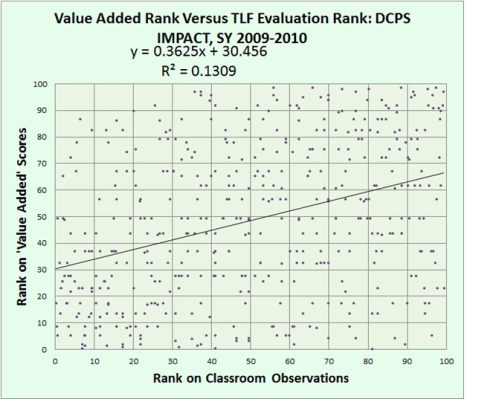
As per another post on this topic, in GFBrandenburg’s Blog — that is “Just a blog by a guy who’s a retired math teacher” — Brandenburg did leak some of the data now deemed “secret.” Namely, he “was leaked,” by an undisclosed source, “the 2009-10 IMPACT sub-scores from the Value-Added Monstrosity (VAM) nonsense and the Teaching and Learning Framework (TLF), with the names removed. [He] plotted the two [sets of] scores and showed that the correlation was very, very low, in fact about 0.33 [r-squared=0.13], or nearly random, as you [can] see here:”
In the world of correlation, this is atrocious, IF high-stakes (e.g., teacher termination, tenure, merit pay) are to be attached to such output. No wonder DCPS does not want people checking in to see if that which they are selling is true to what is being sold.
In Brandenburg’s words: “Value-Added scores for any given teacher jumped around like crazy from year to year. For all practical purposes, there is no reliability or consistency to VAM whatsoever. Not even for elementary teachers who teach both English and math to the same group of children and are ‘awarded’ a VAM score in both subjects. Nor for teachers who taught, say, both 7th and 8th grade students in, say, math, and were ‘awarded’ VAM scores for both grade levels: it’s as if someone was to throw darts at a large chart, blindfolded, and wherever the dart lands, that’s your score.”
**The Edvocate is pleased to publish guest posts as way to fuel important conversations surrounding P-20 education in America. The opinions contained within guest posts are those of the authors and do not necessarily reflect the official opinion of The Edvocate or Dr. Matthew Lynch.**
A guest post by Derek Black
Yesterday, thirty six civil rights groups released a letter to the Senate on ESEA reauthorization. The signatories included all the major organizations, including the Leadership Conference on Civil and Human Rights, the NAACP, NAACP LDF, MALDEF, Lawyers’ Committee for Civil Rights, National Urban League, and Ed Trust. This is not the first time civil rights organizations have weighed in on reauthorization in the past year or so, but it may be the most significant.
That they penned the letter yesterday is probably indicative of the growing sense that we could be on the verge of reauthorization. As noted earlier this week, the House has revived their earlier bill. The letter is also significant in the poignancy and substance of its recommendations. Overall, the letter reflects a fear of erosion of the federal role in education, which is the general effect in the current bills before the House and Senate.
The letter makes four points: keep accountability for all schools, keep disaggregated demographic data, ensure resource equity, and maintain the Secretary’s authority to enforce the law. Keeping accountability and disaggregated data are really just requests that Congress not throw the baby out with the bathwater in reauthorization. Mend it, don’t end it. The last two points, however, have a lot of depth to them.
When reauthorization was being seriously debated in 2007 to 2008–the time it should have been reauthorized to begin with–a tremendous amount of focus was on how irrationally Title I dollars are distributed and how little current standards do to actually ensure comparability in resources across schools. Most notable is the fact that teacher salaries are about 80% of schools’ budgets, but are exempted from any real dollar comparability. It is an enormous loophole. While we can and will debate substantive theories about how to improve educational outcomes for decades to come, equity is reality simple and should not require debate. Racial and socioeconomic equity of resources was one of the founding pillars of the Elementary and Secondary Education Act. Yet, it has been increasingly lost in recent reauthorizations. The current conversation suggests it will happen again this time. See here for more on this point.
The last point about the Secretary’s authority is an outgrowth of the legal and political contests surrounding NCLB waivers. As I explain here, the conditions that the Secretary imposed on NCLB waivers were either beyond his statutory authority or unconstitutional. And legalities aside, the authority the Secretary exercised during the waiver process enraged many. The backlash has prompted a legislative move to strip the Secretary of much of his or her power. It has also prompted what I would call a minimization of the federal role in education, which appears to be more of an overreaction than a reasoned reaction.
One can only hope this messages do not fall on deaf ears.
Derek Black is a Professor of Law at the University of South Carolina School of Law. His areas of expertise include education law and policy, constitutional law, civil rights, evidence, and torts.
**The Edvocate is pleased to publish guest posts as way to fuel important conversations surrounding P-20 education in America. The opinions contained within guest posts are those of the authors and do not necessarily reflect the official opinion of The Edvocate or Dr. Matthew Lynch.**
A guest post by Mike Gorman
Welcome to a post and the summer of 2015… at least in the USA. I have a real treat for you in the coming weeks. I will be sharing some of those websites I feel should be in every teacher’s toolbox! I have forty… maybe more… and I am sending out ten new ones in each post. Remember I am picking these from thousands and I am trying to find those sites that are up and coming and might just be the next big edtech hit. You might also notice I am also including a few sites that have been around for awhile. They include ones that I feel educators might want to be a little more aware of. I hope you enjoy and try some of these out durring the summer months. It is my way of saying happy summer! First, to ensure you do not miss one of these valuable posts or other resources covering PBL, Digital Curriculum, Web 2.0, STEM, 21st century learning, and technology integration please sign up for 21centuryedtech by email or RSS. As always, I invite you to follow me on twitter (@mjgormans). Please give this post a retweet and pass it on. Have a great week – Michael Gorman (21centuryedtech)
3-D Gallery Generator
Build a museum with 10 exhibits.
Upload your own images or enter URLs.
Downloadable Help sheet can be used as student storyboard.
Mike joins you in sharing what websites you believe should make the list and they might be part of what follows after 40!He invites you to follow him on twitter (@mjgormans). Please give this post a retweet and pass it on to someone who will benefit. To ensure you do not miss a future valuable post or other resource covering PBL,Digital Curriculum, STEM, 21st century learning, and technology integration please sign up for 21centuryedtech by email or RSS. Have a great week… enjoy the Websites! – Mike (https://21centuryedtech.wordpress.com/)
Florida International University received some good news this week as the United State Department of Education will bestow the university with a new grant aimed towards training more teachers certified to work with students who have autism.
According to fiu.edu, the grant is worth $1.25 million and will be used to pay for the tuition of students who attend the school to attain their Master’s of Science in Special Education.
“Beginning in the fall semester, the $1.25 million grant, Project OPERATE, will pay for the tuition of nine students who are accepted into the accelerated master’s program every year through 2020.”
The program is just 12-months but is targetedat “educators who already teach students on the autism spectrum.”
Information posted in FIU’s articleportends that more students will continue to be identified as autistic, so the need for more educators who work in this discipline will increase as well.
Not only is this great news for FIU, it is a positive for those who work in education. Hopefully by graduating more students through this program, we will see an increase in attention paid to special education and autism. With the rapid rate at which children are being diagnosed with spectrum issues, this next generation of students must know how to help students with autism succeed. I hope it is only a matter of time before more colleges have robust autism-in-education training programs, too.
For any students who may want to apply for the program, the deadline to do so is August 3rd. The deadline to receive consideration for Project OPERATE is July 15th, and details may be found by e-mailing [email protected].
There is a fascinating interview byeSchoolnews.com with Hans Renman, the CEO of Scandinavian Education, a think tank that has the aim of using pointed strategy to properly manage development “to help the school take the next step.”
In the talk, Renman speaks of trouble with the testing culture in the United States, problems with technology and teaching, and how equalityhas aided the growth of education in Noridic countries.
“In every single class you can find students from any social background. How people live in Finland is not as extreme as in other countries, like England or the United States. You can see research on the effectiveness of school systems that says that if the education system is equal and democratic, it’s a good thing for every student, not just the top five percent, like say in Singapore or China.”
An interesting distinction to the argument for equality are the living conditions of some Americans. In Finland, schools are publicly funded, so there is no discrepancy on which schools receive more money. There are also “no rankings, no comparisons or competition between students, schools or regions.”
That leads to equality as every student may be measured on the same level, sort of, and each individual will receive the same quality education.
Obviously America’s approach is a little different. We thrive on competition, think that comparisons are healthy, and use rankings as a way to show what’s good and bad. Doing away with these footnotes would likely remove a level of stress from educators and students here but there is no way to tell if it would make a significant difference in how students learn. Our economy isn’t necessarily based on equality either, so to insert fairness into how we educate students would mean that America has changed its capitalistic philosophy.
Outside of equality, we can probably learn from the Finnish on why testing may hinder a student’s ability succeed. Students in Finland are given just one exam prior to graduating high school. According to Renman, it is a key difference in how students are education in America versus say Finland or Sweden.
“In Scandinavia, the results of the national tests are more the business of the school officials. For a single student, it doesn’t matter. It doesn’t affect your grade.”
The research surrounding the success of schools in Scandinavia and Finland is worth continued exploration. America may surely cherry pick certain policies from the education model in Northern Europe to improve the education system here. But there are also certain practices that wouldn’t fit and would fail if implemented.
Still–copying the steps success will usually yield good results.
U.S. News and World Report recently sat down with Senator Lamar Alexander, chair of the Health, Education, Labor, and Pensions (HELP) Committee to talk about the re-authorization of No Child Left Behind (NCLB) and higher education.
In the interview, Alexander talks of slicing the FAFSA application down to just two questions in an effort to encourage more students to apply, and he wants to expand school choice so that more students have the ability to exercise variety in their education.
But perhaps one of the more interesting antecedents of the interviewwas Alexander’s grade on how Congress has performed on NCLB.
“We’ve been stuck for seven years. We should’ve reauthorized it. If students were this late on homework, they’d get an “F.””
If we could go lower on a grading scale, I’m sure many would give Congress something much worse. NCLB expired nearly ten years ago and many states are still operating under waivers because Congress can’t seem to agree on how to move forward.
Luckily, Alexander, who’s a Republican, has taken a bipartisan approach to getting the law reauthorized. He said that Senator Patty Murray, the Democratic ranking member of the committee, has worked well with him to push the bipartisan effort through.
Nothing earth shattering regarding the future of education, or Congress’ attitude towards it, was revealed. There is still a lot of work left and there is no guarantee that the reauthorized will pass through this time around. Meanwhile as time passes, more and more students are suffering the repercussions of Congress and its slow pace.
**The Edvocate is pleased to publish guest posts as way to fuel important conversations surrounding P-20 education in America. The opinions contained within guest posts are those of the authors and do not necessarily reflect the official opinion of The Edvocate or Dr. Matthew Lynch.**
A guest post by Batool Ali
Being a teacher gives you the opportunity to inspire learning in your students. You have the extraordinary chance of changing your students for the better. Many often teachers devote so much for students – their time and resources – that they tend to neglect their own selves. I am sure there is at least one teacher we all can name who really affected our lives positively.
While your students are important and you are doing a great job touching so many lives you should not fail to look at your own needs too. If you are a teacher, it is extremely important that you have a plan for a secure retirement. Teachers are not usually paid well and someone who wants to be rich would not venture into this profession, but that does not mean that teachers should not retire with dignity after having given so much to the society. If you have already thought about it and started working on saving for retirement, then it’s well and good. If not, you need to do that right away. The earlier you start saving for retirement, the better it is.
Yes, you may be eligible for a state pension plan that could possibly keep you covered and the amount would probably be determined by how many years you have served and your last salary. However, teacher pension plans are now underfunded and states have had to cut benefits for teachers. The new retirees are no longer eligible to the same pension and benefits that previously teachers enjoyed. So, the pension may not always be enough and you would probably require additional money to live comfortably after retirement. Always have a backup and look for alternatives and additional sources of income.
Since pension is not adequate you need to have a proper retirement plan. Being a teacher you might have vast knowledge regarding history or physics or whatever your subject is. But you probably do not have enough know-how regarding retirement planning. In such a situation it would be best to consult an expert to help you speed up the planning. You can look for financial planning firms that assist teachers in planning for retirement or you have the option of financial advisers who, although do not particularly specialize in this area, but know enough to give you some valuable advice. If you look around you may even be able to get some free help; for example state retirement counselors or state benefits counselors.
Your retirement plan would definitely include starting to save up now for later. No matter how little you earn you should set aside a certain portion of your salary and forget about it. Even a little amount matters. If you are unable to do that you seriously need to cut back on your expenses. Keep a track of where you are spending your money so you would know how much of the purchases you made were not out of necessity and to what extent you need to control your impulse buying behavior. Or if you do not think you are responsible enough for that you could have a percentage of your salary automatically transferred to your savings account each month. Over time the money would build up through compound interest and you would be surprised at how much your saved money earned you.
Another way you might be wasting your money could be through unpaid balances on your credit cards. Pay them off starting with the card charging you the highest interest rate. Try to pay it off as early as you possibly can. If you add up the interest you are required to pay on unpaid balances you will be surprised at how much you can save by simply paying off your cards on time. Same goes with other debts you might have such as mortgages and student loans. In fact, you may even be eligible for the Teacher Loan Forgiveness program, a special provision under the Obama Student Loan Forgiveness Act. Considering that teachers are the backbone of a society, the US government is seeking ways to keep them happy and help them in their position. This program, although coming with certain conditions, is a great way to relieve the financial situation of teachers.
__________
Batool Ali is a passionate blogger who loves to write on finance and education. Her writings are inclined towards student welfare making students self-reliant.



 ___________