Uncategorized

How genetics could help future learners unlock hidden potential

This article was written by Darya Gaysina

Salman Rushdie recently caused controversy by bemoaning the lack of “rote learning” in schools. He spoke about the benefits of learning poetry by heart – a method many see as archaic and outdated in today’s classroom.

Despite the criticisms of Rushdie’s comments, the debate around the effectiveness of different learning strategies in modern education is as active as ever – with many recognising that each pupil prefers a different learning style and technique.

This can of course make it hard for teachers to gear classes up for each individual’s preferred style of learning. Especially given that one style, such as social learning, can appear to be the exact opposite of another style, such as those who prefer a more solitary style of education.

Research shows that when it comes to learning strategy preferences or even A-level choice, they are pretty hard wired in each individual – with genes playing a large part in the process. And we know that genes can also shape our relationships with other people – whether they be parents, teachers or peers.

Why genes matter

“Educational genomics” is a relatively new field, which has been expanding rapidly in the recent years because of advances in technology. It involves using detailed information about the human genome – DNA variants – to identify their contribution to particular traits that are related to education.

And it is thought that one day, educational genomics could enable educational organisations to create tailor-made curriculum programmes based on a pupil’s DNA profile.

A number of recent large-scale genetic studies on education-related traits – such as memory, reaction time, learning ability and academic achievement – have identified genetic variants that contribute to these traits. And studies using even more advanced technologies are also currently underway, promising to add to our growing knowledge of what helps us to learn.

This information could then be used to find out what DNA variants contribute to reading and mathematical ability, or school achievement. And then used to predict whether or not a pupil is likely to be gifted in a particular field such as music or mathematics, for example. These “traits” could then be nurtured in the classroom.

A personalised approach

But despite all the existing evidence for individual differences in learning, genetics is rarely a consideration when it comes to education. Though, recent years have seen a rise in funding and research into personalised medicine. This involves “mapping” genetic differences among people to predict and target potential health issues in later life, which has allowed doctors to adjust treatment and prevention approaches to try and stave off risks before they even begin to develop.

So it wouldn’t be a great leap to use these same databases – and research funding – to advance the field of educational genomics. Meaning that every child in the future could be given the opportunity to achieve their maximum potential.

It is well-known that hundreds or even thousands DNA variants are involved in complex human traits. Shutterstock

But it is also important to bear in mind that our genes do not work in isolation. The human genome is a dynamic system that reacts to the environment. And the role of the environment in education is just as important to the development of a child.

For example, musical talent can be inherited, but can only be developed as a skill in the presence of specific environmental conditions – such as the availability of musical instrument and hard practice.

And educational genomics aims to uncover this complex relationship – to look at how the genome works in different environments. This information will then help researchers to understand how this interplay affects brain and behaviour across the life of a person.

By considering DNA differences among people in the future, educational genomics could provide the basis for a more personalised approach to education. This would most likely be a much more effective way of educating pupils because educational genomics could enable schools to accommodate a variety of different learning styles – both well-worn and modern – suited to the individual needs of the learner.

And in time, this could help society to take a decisive step towards the creation of an education system that plays on the advantages of genetic background. Rather than the current system, that penalises those individuals who do not fit the educational mould.

Darya Gaysina, Lecturer in Psychology, University of Sussex

This article was originally published on The Conversation. Read the original article.

New partnerships are needed to arrest economic malaise in South Africa

This article was written by Steve Koch

South Africa’s Finance Minister Pravin Gordhan presented his 2016 mid-term budget on the back of a crisis in higher education funding characterised by widespread national student protests. The Conversation Africa’s business and economy editor Sibonelo Radebe asked Steve Koch to weigh the minister’s speech.

What is your reaction to the minister’s statements on funding higher education? Could he have done better?

The minister’s statements were well calculated, measured, and responsible in the current climate. The additional increase in National Student Aid Financial Scheme funds should go quite some way towards improving access to post-school education.

Assuming “better” means finding money to fund “free education for all, immediately”, the answer is no. Despite what student activists would like to believe, free education for all is pro-rich. This is because, disproportionately, students who qualify for post-school education come from richer households.

The answer is a more nuanced “maybe” if “better” means finding more money to help poor students fund their tertiary education. There are options, not necessarily palatable to all, such as privatisation of state-owned enterprises, which might raise revenue and reduce pressure on the fiscus. But changes of that nature would not be made in a medium-term budget. They would more likely feature in the State of the Union Address.

What should be done to address the higher education crisis in the long term?

There appear to be two components to this crisis. The one that appears to have driven the initial #FeesMustFall movement is that post-school education is relatively expensive and, even though funding for post-school education is one of the fastest rising budget items, student numbers have risen faster.

The bigger problem is that the economy has not grown fast enough to absorb workers for far too long. Students or their parents are left with potentially crippling debt and yet limited prospects to repay. Dealing with this will require some creativity, and a willingness to experiment to engender positive change in the economy. In my view, positive change requires opening up space and creating funding opportunities for entrepreneurs and businesspeople, while working to limit “rent-seeking”. Corruption, bribery and collusion are common forms of rent-seeking, which is the use of a position of power (political, economic or otherwise) to further your one’s own interests.

But one of the undercurrents of the current crisis is political, not economic. There is a desire for change, period. Thus, we see the rejection of democratically elected student council representatives, the rejection of current curricula and the rejection of socially accepted rules of engagement, among other things. Dealing with this will have to go far beyond the structures of a medium term budget.

What do you think credit rating agencies are taking out of this budget?

The medium term budget did not signal any big changes in policy associated with either large increases in budget deficits or long-term debt. And the minister was adamant that South Africa was able to control its own destiny.

These were important pronouncements because they underscored a commitment to budget sustainability.

The credit rating agencies are likely to take solace from this. But the minister is not capable of changing the economy overnight. And there are international risks, as well as local economic and political risks, beyond his control that remain important factors in credit rating decisions. Politically, uncertainty surrounding the minister’s continued appointment, as well as any potential replacement’s commitment to sound fiscal management, remains. Similarly, uncertainty surrounding the US Presidential elections, and the US’s continuing commitment to either free trade or Africa cannot be discounted. Economically, Brexit and the resultant relationship between Europe, the UK and Africa create further uncertainties about South Africa’s growth potential.

Given the prevailing political environment do you think the finance minister will achieve what he has set out to do?

One way to define the minister’s job description is that he has the responsibility to pay – sustainably – for activities that government would like to fund. He spoke about the realities of the local and international economic situation. He also restated the importance of creating a South Africa that was different (and far better) than the one inherited in 1994.

The reality is that government’s ability to directly fund new activities has decreased. But if business and civil society become more involved, government’s need to directly fund new activities will decrease.

For me one of the key takeaways was the message that the country’s full potential requires not just the government, but also the efforts of the private sector and civil society. If I’m reading this correctly it could herald the beginning of positive change in the economy and society.

It remains to be seen whether this theme permeates future government policy actions, or whether business and civil society begin to work with government and each other to achieve positive change. But the minister’s efforts are likely to open fiscal space, and, therefore, could help achieve what is required.

The Conversation

Steve Koch, Professor of Economics, University of Pretoria

This article was originally published on The Conversation. Read the original article.

The Key to STEM Achievement: Answering the Question

‘When Am I Going to Use This?’

In Maureen Foelkl’s classroom at Chapman Hill Elementary School in Salem, Oregon, second and third grade students designed solutions to seasonal flooding and erosion in their community with the help of actual engineers in the field.

The project won Foelkl the Presidential Award of Excellence in Math and Science Teaching. While working on it her students learned about complicated concepts such as how a flood plain works, how structures can keep water out, and what kinds of materials can hold water in.

Foelkl invited civil engineers to talk with her students about these topics either in person or through interactive conversations that took place online. Her students then designed and tested their own prototype structures for mitigating the effects of or for withstanding a flood.

Foelkl, who is now an independent contractor writing science, technology, engineering, and math (STEM) curriculum for multiple organizations, says her students were highly engaged throughout the project. Having outside experts speak with them “brought authenticity to the lesson,” she says. “My students asked questions that I could not begin to answer.”

She adds: “No textbook I know can come close to interacting with students in that fashion.”

Making It Real

Research suggests the No. 1 reason students avoid STEM-related courses or careers is because they don’t see the relevance of what they are learning. In other words, there is a huge gap between what is happening in the classroom and in the real world.

Clearly, it’s time for a new approach—and Foelkl and many others have found that connecting students with actual STEM professionals helps make these subjects come alive in ways that a textbook just can’t replicate.

In Oregon, the state has created nearly a dozen STEM Partnerships, or regional hubs in which leaders from the education, business, and nonprofit communities come together to design community-based solutions to their STEM workforce challenges.

The South Metro-Salem STEM Partnership is one such hub, which serves districts in the Salem and Portland areas—accounting for about 25 percent of the state’s students. A key element of their effort is Oregon Connections, which is connecting students (and teachers) with industry experts. These STEM-related professionals come into the classroom either in-person or virtually to make science and math more meaningful for students.

“To me, the most important thing is making it real,” says Melissa Dubois, director of the South Metro Salem STEM Partnership. “We don’t get the innovations we get by magic. You don’t get an iPhone because it just materialized from nowhere; there are people with skills and expertise who have a really great time trying to dream up and build these kinds of products.”

Through Oregon Connections, teachers can request scientists, engineers, and other STEM-related experts to visit their classrooms in person or through an online conversation to talk about the work they do and why it’s important. The online conversations are powered by Nepris, which matches teachers with STEM experts from anywhere in the country and also hosts the video conferences.

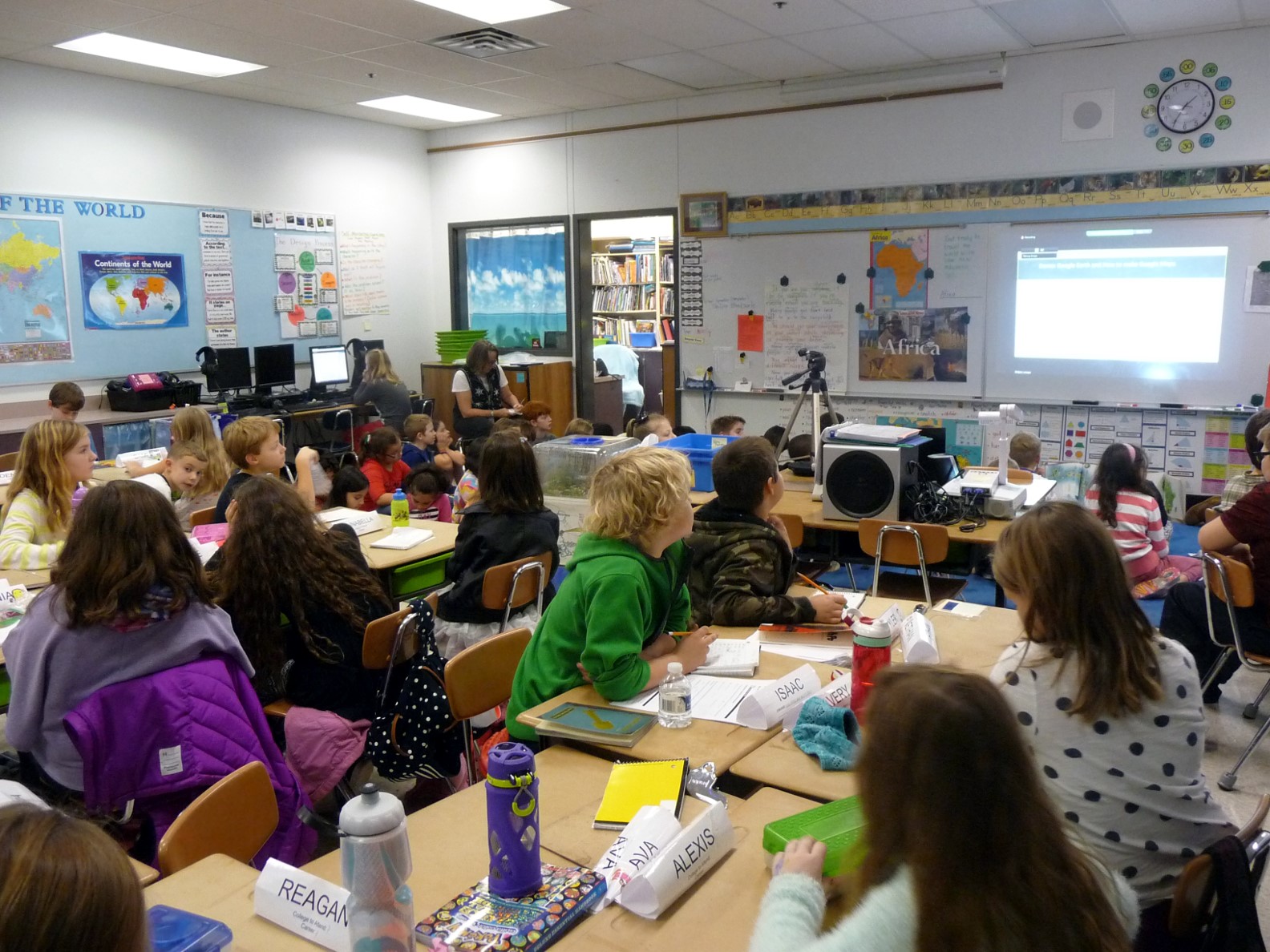
Teacher, Maureen Foelkl, guides her third graders from Chapman Hill Elementary School in Salem, Oregon through a STEM lesson and brings in industry experts to her class virtually using Nepris or for in-class visits using Oregon Connections.

“I have been using Oregon Connections extensively over the past three years,” says Dylan McCann, a sixth grade math and science teacher at Twality Middle School in Tigard, Oregon. “We’ve met virtually with programmers, military defense engineers, naval architects, and pilots. My students have had the opportunity to see actual professionals using concepts we have been learning in the classroom—and that gives them an answer to the age-old question: ‘When am I ever going to use this?’”

Opening Students’ Eyes to New Possibilities

Besides making STEM topics more engaging and relevant for students, bringing industry experts into the classroom also opens students’ eyes to new career choices they might never have considered before. And, having the entire world of professionals at their fingertips through Nepris means there are virtually no limits on whom they can talk to.

Dubois says it’s important for students to know that the things they love to do could lead directly to a career: “If you’re an outdoor kind of kid, there’s a role for you. Do you love exploring the woods after school? There are people who do this for a living, and it’s a really important job, because it helps us manage our resources and be good stewards of the environment.”

That personal connection, now fulfilled by Oregon Connections, seems to be missing in many classrooms, she adds. And even though it might only be 30 minutes with somebody on a giant screen through the Nepris connection or a short in-person visit arranged by the partnership, “it’s far more impactful than the teacher saying, ‘You could be an engineer when you grow up.’” When students are exposed to actual professionals who are doing this work on a daily basis, those are the things they remember. They remember the people, not the words.”

The Oregon Connections program has “opened doors to occupations that hone in on students’ interests,” Foelkl says. “I have my students tell me at the beginning of the year what they might want to do after high school. The most frequent answers used to be a veterinarian, a zookeeper, a teacher, or someone in the military. These are all grand occupations, but somewhat limiting.” After hearing from STEM professionals, she says, “I had students tell me they want to work on plane engines, become a chemical engineer, become an inventor and open their own business, teach others about how to stay safe, lead environmental causes, write their own code—and still care for animals.”

Students in Maureen Foelkl’s third-grade class at Chapman Hill Elementary School in Salem, Oregon designed solutions to flooding and erosion with help from professionals linked to their class through Oregon Connections.

Seeing STEM professionals who look like them also helps address a lack of equity in these fields.

“I purposely try to bring in professionals who can personally connect with my young girls and students of color,” McCann says. “I think it is extremely important to give students in the underrepresented demographics (role models) they can look up to and have conversations with. For instance, last year my students were learning about thermal energy transference, and I had a young African American woman talk to my students about what it’s like to design, build, and test rockets—and what it’s like to get to blow things up for a living. She spoke about her journey as an African American woman (in a STEM-related field), and she showed my students that with perseverance and a great attitude, they can achieve anything they ever want.”

He concludes: “Giving my students the opportunity to connect with real people using what we are learning in class every day is invaluable. Without this real-world exposure, there is no context to what we are doing in the classroom. I have seen my students remember concepts and maintain excitement for careers they never thought possible, years after a visit with a professional. Bringing professionals into my classroom will continue to be a part of my teaching strategy for years to come.”


What Parents Really Think about Parent-Teacher Communication Apps

Three parents­ share how a mobile app helps them stay connected to their children’s education.

By Tracy Everard, Kim Valley, and Shannon LeFevre

In this digital, mobile age, almost 90% of parents own a smartphone. When it comes to parent-teacher communication, though, many schools still rely on paper notes (which may not make it home) and periodic parent-teacher conferences (which happen so seldom that they may give a minor issue the time to develop into a major problem). Plus, when events happen at school, parents often hear about them last minute and may miss opportunities to participate or even provide some needed help.

With the help of apps created to help them stay in touch at the speed of texting, teachers and parents are adapting to new ways of communicating. Here, three parents at Southern Door Elementary School in Wisconsin reveal how connecting in real time with 1st-grade teacher Jessica Meacham has improved their peace of mind—and their kids’ education.

Tracy Everard

At the beginning of the year, Mrs. Meacham asked the parents what was the best way to communicate with them. Most of us said email or texting. This is why, when Mrs. Meacham announced she was implementing the parent-teacher communication app, Bloomz, I was thrilled. My first thoughts were “This is going to be great! I shouldn’t miss anything now. We are finally going to use the technology that is available.”

With the app, you have everything in one spot. I’ve used it to sign up for parent-teacher conferences and to communicate directly with Mrs. Meacham; and whenever she needs volunteers or classroom supplies, she just posts it on the app and all the parents get a notification.

I remember if we got in trouble when I was in school, we were sent to the office or a note was sent home. I think Bloomz is a low-stress way for teachers to address any issues as they come up so that they do not build up. Whenever there is an issue, or even a positive experience with a child, it only takes a second to send an individual message.

Kim Valley

Bloomz is similar to Facebook in some ways, so most parents were pretty comfortable with it. I use it every day to check my son’s schedule. He likes to know what specials are scheduled for the day. It’s so fast and easy. I wish all teachers would use it.

I love getting updates during the day. For example, one day a butterfly emerged in the classroom terrarium, and Mrs. Meacham took pictures of all the students with the butterfly and share them with us. I feel like I know exactly what my son is doing at school. I love watching his short videos. It also helps to open up communication between me and my son at home. I can ask him specific questions instead of the vague, “What did you do at school today?”

Communication between parents and teachers is so easy with the app. Another example: My son turned in his book order but forgot the check in his folder. A quick message from Mrs. Meacham, and we quickly tracked the check down and turned it in. In the same way, I know that if I have any questions they will be answered just as easily.

My parents talked to my teacher once a year, during a face-to-face meeting. Bloomz has really opened up communication between parents and teachers.

Shannon LeFevre

I welcomed the idea of a parent-teacher communication app because I was familiar with a past teacher who blogged, and I liked to be able to peek at what my child was doing in school and what I need to prepare for. For example, Mrs. Meacham sent parents a message the week of homecoming so that we could remember to encourage the children to dress up for the theme days.

The app means less paper floating around in backpacks, possibly getting crumpled or lost. With the app, I know that if Mrs. Meacham has something important to communicate to me (or vice versa) the message will get through.

The app was a big help when my son was stung by a bee on a Sunday afternoon, resulting in him having to carry an Epi-pen. I was able to contact Mrs. Meacham that night and get going on his medication plan. It made me feel a lot better knowing she knew what was going on and was prepared to get his plan in place.

Better Communication Means Better Education

Parent-teacher communication apps like Bloomz take the guess work out of helping kids progress at school. Parents know what their kids are working on and what areas they need to improve in, so they can help teachers guide students towards specific academic and behavioral goals. Teachers also know if parents have any thoughts or concerns about their kids’ education, and don’t need to wait for conference time to hear about it. This sort of open, real-time communication creates a team environment where everyone’s goal is to ensure that each student has the best learning experience possible.

Tracy Everard, Kim Valley, and Shannon LeFevre are parents of students in Jessica Meacham’s 1st-grade class at Southern Door Elementary School in Brussels, WI.

To see more go to https://www.bloomz.net.

Want to follow Bloomz on Twitter? Follow them @BloomzApp

Are wealthy donors influencing the public school agenda?

This article was written by Rebecca Jacobsen,  Jeffrey Henig, and Sarah Reckhow

School boards have often been portrayed as old-fashioned and dysfunctional, so much so that some school reform leaders have advocated for eliminating school boards altogether.

It is no surprise then that school board elections have mostly been known as being sleepy affairs. Most candidates in the past have been known to spend less than US$1,000 toward campaign expenses such as campaign literature and name recognition efforts. In 2010, for example, less than 3 percent of candidates reported spending more than $25,000.

However, this reality, as we have known it, is changing. Of late, out-of-state donors are writing very large checks to support candidates and political action committees (PACs) in local school board elections. Yes, there are PACs now involved in local school board elections.

Recent school board elections in places such as Denver, Indianapolis, Los Angeles, Minneapolis and New Orleans have seen candidates routinely raising at least 50 times as much money as the 2010 national average.

Why is this happening? And how might the involvement of these large wealthy donors change our local schools?

We are scholars of politics and education. Our research shows that such large donations have the potential to change who is elected to govern and, as a result, how our schools are reformed.

Why do school boards matter?

First, let’s look at the unique arrangement of power in the U.S. education system to understanding why this new infusion of funding is significant.

The U.S. education system is highly decentralized, with control of schools spread across over 13,000 independent, local school districts. Most boards, comprising five to eight members, enjoy considerable power over many areas, including whom to hire, what to teach, when to hold school and how to allocate budgets.

State of Maryland school board meeting. Maryland GovPics, CC BY

It is true that of late, the decision-making power of school boards has been curtailed by recent national (e.g., No Child Left Behind and Every Student Succeeds Act) and state (e.g., state takeover laws) policies. For example, when NCLB came up with its own guidelines for “highly qualified teachers,” school boards had to ensure that their definition for teachers’ qualifications aligned with federal standards and not only with local priorities and standards. Ignoring these federal guidelines was accompanied by the potential loss of federal funding.

Even with these recent limitations, however, school boards nonetheless remain important. They can modify, regulate, innovate and resist state and federal policy demands.

This ability to resist or modify policy guidelines was evident recently after the Obama administration released its “Letter on Transgender Students,” which advised school districts to treat transgender students based on their expressed gender identity rather than their sex assignment at birth.

School boards across the country were called upon by local citizens to resist this policy. In some cases, local school boards voted to not comply with the Obama administrations guidelines.

Thus despite their relatively low profile, school boards have the power to dramatically shape local educational experiences by modifying, or even at times ignoring, state and federal rules and regulations.

How widespread is outside money?

This ability to alter or resist state and national policy may be the motivating force behind the recent investment by wealthy, national donors.

To examine this rise in donations to local school board candidates, we investigated over 18,000 campaign contributions in local education elections between 2008 and 2013 in five cities (Bridgeport, Denver, Indianapolis, Los Angeles and New Orleans). We selected these five sites for examination because they were geographically and politically diverse and yet all five had school board elections where national donors became involved.

We found that donations from outside donors were widespread and significant. In the 2012-2013 elections, for example, we found that large outside donors gave over $2.8 million to school board candidates and committees, comprising 44 percent of all funds contributed by individuals. This represents a significant increase from 2009-2010, when large outside donors comprised only 4 percent of donations in the cities we examined.

The figure below shows the growth of out-of-state donations by individuals in each city.

In-state vs. out-of-state individual donations by city and by year. Data Source: Authors’ Data, CC BY

Who’s making the contributions?

By examining publicly available campaign finance disclosure reports, which are filed by all candidates, including school board candidates, and list each donor and the amount donated, we were able to track a list of wealthy donors who contributed at least $1,000 in one election cycle (see here for an example of how to access these data). In total, we found 96 large national donors involved in education philanthropy and education reform. These donors included, for example:

Reed Hastings, CEO of Netflix, who donated in Los Angeles in 2011 ($150,000) and 2013 ($100,000) and in New Orleans in 2013 ($2,500). The high-tech billionaire is active in supporting the development of new charter schools and founded educational organizations such as NewSchools.org and Aspire Public Schools.

Reed Hastings. re:publica, CC BY

Alan and Jennifer Fournier, who donated in Indianapolis in 2012 ($4,000), Los Angeles in 2013 ($2,000) and New Orleans in 2012 ($2,200). Alan Fournier is founder of Pennant Capital Management, which manages $6 billion in assets. Alan Fournier cofounded (with David Tepper, a hedge funds manager), Better Education for Kids, which advocates for tenure reform and greater teacher accountability.

Katherine Bradley, the president of CityBridge Foundation, which “finds, incubates and invests in the most promising practices in public education,” who donated in Denver in 2009 ($500) and 2013 ($6,500), New Orleans in 2012 ($2,500) and Los Angeles in 2013 ($2,000).

Laurene Powell Jobs, wife to the late Steve Jobs and founder of Emerson Collective, who donated to Los Angeles in 2009 ($1,000) and 2013 ($103,000), New Orleans in 2012 ($2,500) and Denver in 2009 ($2,525). She is active in school reform and is a board member for several education nonprofits including Teach for America, the New Schools Venture Fund, and Stand for Children.

Could the top 0.01 percent change local schools?

Outside money may not be a bad thing if the values and interests of donors align with residents in the communities. It might even be a good thing if outside donations raise the visibility of school board elections, so often plagued by disengagement.

Perhaps bigger campaign war chests and close election battles will fuel engagement in school board elections, increase voter turnout and increase awareness of education issues. But these presumed benefits rest on the assumption that these elite donors share the same values and interests of the local community.

Research suggests that this assumption is unlikely to hold because policy preferences among the very wealthy differ from most Americans. Research by prominent academics working on economic inequality, Benjamin I. Page, Larry M. Bartels and Jason Seawright, captures these differences. These scholars found that,

“[o]n many important issues, the preferences of the wealthy appear to differ markedly from those of the general public.”

These different preferences are borne out in our data as well. We found that national donors favored “reform” candidates, or, put simply, those who supported policies such as school choice, performance-based accountability and adoption of the Common Core of State Standards.

School choice offers parents the ability to choose a their child’s public school rather than being assigned one based on one’s home location. Performance-based accountability plans generally require that school or teacher performance evaluations be based upon student standardized test scores. Schools or teachers may face sanctions if these targets are not met. The Common Core of State Standards (CCSS), adopted voluntarily by states, outline what students should know and be able to do at the end of each grade.

We found that candidates who received union support received almost no support from large, national donors. This targeted funding ultimately shaped, at least in some cases, the focus of the election debate.

Here is why it matters

The concentration of funds on candidates with particular policy agendas can squeeze out other policy issues. For example, a candidate we interviewed who was very interested in restoring adult education programs for immigrant parents noted,

“It [money] changes the discourse…their [the reform candidates] message is the only message. Not just the dominant message anymore. It’s the only message that people are hearing.”

While this candidates wanted to focus on the importance of providing adult education programs for immigrant parents, he felt his message about the importance of this issue was unable to compete with the messages being put forth by the reform candidates because he lacked funding to promote his policy agenda.

What changes in public schools when wealthy donors get involved? woodleywonderworks, CC BY

In our interviews, candidates who received outside funds noted that additional funding enabled them to reach voters more often and through multiple strategies. One candidate supported by large, national donors explained that in addition to mailings and yard signs, more traditional forms of reaching voters, the additional funds enabled him to hire a professional videographer who filmed and edited three vignettes that were shown on TV: one at his home with his family, one in a local library in the community and one in a classroom.

Even traditional forms of contact were given an upgrade. For example, a candidate noted that her materials were “more polished” with “nice photos,” something other candidates were unable to do because of a lack of funds.

Some candidates we interviewed felt voters benefited from this, whereas others worried that voters were “inundated” with information from just a few candidates. One candidate described how a friend received seven mailers from a candidate supported by outside funding in a single day. Candidates without this level of funding repeatedly noted that their message couldn’t compete.

Increasing polarization

As with state and national elections, we heard from several candidates that outside donations were also leading to increased conflict during campaigns and less willingness to compromise once elected.

One candidate described the polarization of the local board as being “very much like our federal government” where board members were either “a charter school candidate or a union backed candidate” and when on the board, “nobody can cross the line.”

As a result, some expressed concern that voters were becoming more cynical and less confident in their local public schools.

One candidate shared that she heard from voters on several occasions to “please stop calling” because “I’ve already gotten 10 calls this week about the election.” This candidate was concerned that disengagement in the form of low voter turnout was a direct result of citizens being turned off by the election.

What does this mean for public schools?

We certainly support greater attention to improving our public education system. But reform takes time. It takes compromise. It takes understanding of the day-to-day realities of local schools.

The old fashioned school boards, with all of their faults, were often slow and pragmatic, a force that could shield school leaders, teachers and students from broader political forces that whip the local agenda back and forth.

It remains to be seen whether school boards are strengthened by the nationalization of local school board elections or whether the injection of national funds will hinder the ability of schools to improve.

The Conversation

Rebecca Jacobsen, Associate Professor of Teacher Education, Michigan State University; Jeffrey Henig, Professor of Political Science and Education, Teachers College, Columbia University, and Sarah Reckhow, Assistant Professor of Political Science , Michigan State University

This article was originally published on The Conversation. Read the original article.

Why the TEF could change the way students think about a university education

This article was written by Chris Husbands

It is one of the remarkable transformations of our time: the world is going to university, and participation in higher education is increasing. On every continent, more young people are going to university than ever before, and increasing numbers are graduating. In the UK, over a third of 18-year-olds go to university – and that figure is higher in the US, Canada and Korea, and rising fast in China and Africa.

As a result, around the world, governments are challenging their university systems to play an ever greater part in generating knowledge, educating highly skilled workforces and building more cohesive societies.

At the same time, they are puzzling about how to afford mass higher education. And that situation opens up a potential gap, between the world of higher education providers and the world of stakeholders – who are demanding more, and demanding it more accessibly.

Teaching excellence

Universities are unique institutions – not just because they undertake research or because they teach – but because, uniquely, they do both. And great teaching matters – it matters to universities as much as it matters to schools and colleges. And for the first time the quality of teaching at English universities will be assessed as part of the introduction of the teaching excellence framework (TEF).

Of course, identifying and recognising high quality teaching is both simple and complex. Excellence in teaching is something we all know when we see it, but specifying what exactly it is turns out to be a more complex exercise.

The TEF addresses this in a sensible way. It does not set out to assess teaching quality directly, but to look for those features which are the consequence of high quality teaching and student engagement, such as strong student responses, high levels of progression and retention.

The TEF begins from a common sense position – that teaching quality, learning environment and student outcomes are the right places to look for evidence of the impact universities have. It then derives “core metrics” from the annual National Student Survey and HESA data on student initial employment – and uses these to develop initial theories about the work universities are doing.

All of this will be overseen by a panel drawn from across and beyond the sector, applying its judgement and expertise – and I am the chair of the panel.

High stakes

The TEF brings the opportunity to create a structure to celebrate excellence, provide clearer market signals and enhance quality across the sector. And if we get it right, to give yet stronger signals to international students about the sheer quality to be found across UK higher education.

The UK government is clear that it wants to create a link between funding and teaching quality, which will provide opportunities to reinforce and celebrate quality. And this is an opportunity to enhance understanding of higher education and of the way teaching is developing in a responsive and fast-changing sector.

Of course there are potential risks, both for individual institutions and also to UK higher education as a global brand. That means that the panel has to get the process right, and navigate a route through a complicated mass of data on a diverse sector.

Much of the initial work has been focused on understanding and responding to sector concerns, and these matter a lot. But there are other interests, too, which is why there is student representation on the TEF panel – because we need to be alert to student concerns about the overall quality of provision. So although it is important to reflect sector concerns, it is also necessary for the sector to recognise that universities matter to others, too.

There is no denying that the stakes in the TEF are high – high for government, high for universities and high for UK higher education. But if it is designed properly, and managed effectively, the TEF can give us the opportunity to celebrate excellence and provide a common way to think about how it develops.

And with more and more young people going to university, it becomes all the more important to develop a framework we can use to communicate clearly what is going on in university teaching.

The Conversation

Chris Husbands, Vice Chancellor, Sheffield Hallam University

This article was originally published on The Conversation. Read the original article.

How male teachers can help to challenge gender roles in nursery school education

This article was written by Jo Warin

Recent figures show that there is still a large gender gap in recruitment to the teaching profession – only 38% of secondary school teachers are male, and 26% in primaries. In preschools – or nursery – it’s even worse. Here, men make up just 2% of the workforce.

This gender divide can be found all across the globe, and not just in the UK. We even see it in Scandinavian countries which have made gender equality a national priority. In Norway, for example, there has been an ambitious target set to try and have 20% of men working in childcare, with 10% achieved in 2008. But that figure is now falling. The reasons for this are unclear but are likely to be due to persisting and deeply held gendered attitudes.

But to understand what we can learn from the men who do make this unusual career choice, I have been undertaking research in Swedish and UK nurseries. I have also been listening to their ideas about what puts most men off.

I was particularly struck by the story of Craig, an experienced nursery classroom leader in England, who was forced to relocate to a new town.

I used to live in quite a rough area. It wasn’t seen as a manly thing to do. I lost contact with my partner at the time because it wasn’t a socially admired job, and her friends would take the mick. I lost contact with my dad who would have nothing to do with me and questioned my sexuality. It’s one of the biggest reasons I moved away.

When it comes to nursery work, men may also have to confront suspicion from children’s parents about their motives, working hard to establish trust and demonstrate that they are not dangerous to children. Sometimes we get a sharp reminder about society’s strong prejudices against men doing what’s seen as “women’s work”.

For example, Andrea Leadsom, a short lived contender for PM, said it would be “cautious and very sensible” not to make men nannies because the “odds” mean they could be paedophiles.

And it’s not as if these disincentives are compensated for by a good salary either. Starter salaries for nursery workers are £10,000 to £14,000. So given these economic and emotional obstacles, why would any man choose a career caring for young children?

Everyone as equal

A good place to find the answer is a rather unusual English nursery called Oaktrees. It employs five men who work with the three- to four-year-olds, and the two- to three-year-olds. The men I spoke to at this nursery expressed a tremendous enthusiasm for their work and described their pleasure in “making a difference” to children’s lives and witnessing their development.

Breaking down gender norms from a young age. Shutterstock

It was clear their presence was especially helpful in engaging more fathers to come into the nursery and talk with staff. And parents were appreciative of the gender balanced workforce – pointing out that this represents wider society. They also liked how it helps children to understand that “both genders can be carers” and that “everyone is equal in terms of the jobs they can grow up and do”.

The nursery’s management also gave strong support to the male practitioners – and occasionally they had to intervene and explain to suspicious parents the men’s rights and abilities to take on intimate care jobs such as nappy changing.

Changing norms

The men thought they had particular value in helping children engage in outdoor activities and take risks in adventurous play on climbing frames and balancing beams – as they felt their female colleagues were more cautious. However, most of the female staff I spoke to insisted that men did not bring any extra special contribution to the job – but they did very much appreciate the high morale of the gender balanced staff team.

In this way, the men’s presence created a unique opportunity to challenge children’s gender stereotypical ideas. And occasionally the men made a deliberate choice to wear pink, put on a Tutu, or let children plait their hair.

Because childcare is not just a woman’s job. Shutterstock

However, they made an interesting contrast with the Swedish male preschool teachers that I interviewed in an earlier study. The Swedish men were much more sensitive to gender issues, and had received training on this. They were more conscious about the need to counteract young children’s gender stereotypes because it is clearly stated in their early years’ national curriculum.

What all this research shows is that the gender gap does matter. We need to recruit, train and retain more men to care for and educate our youngest children. Because this is one easy way to break down gender stereotypes and work towards a more gender equal society.

The Conversation

Jo Warin, Senior lecturer in Education, Lancaster University

This article was originally published on The Conversation. Read the original article.

The HBCU Advantage, Part II: Or How to Win When the Competition is Tough

HBCUs came into existence in vastly different times, when they were necessary for black students to attend college. Today, they have to be savvy if they want to stick around. Let’s take a look at the shift HBCUs are making to become prominent in today’s integrated culture.

There are many different business models out there, but in general, some serve the mass market and some appeal to niches. When it comes to today’s colleges, it’s easy to see PWIs (or predominantly white institutions) as “mass market” and HBCUs as “niche” schools.

HBCUs have also had long histories, were created to give a healthy university experience to specific populations of students, and are facing closures today as more and more students choose to attend mainstream colleges.

The question stands. How will HBCUs compete against PWIs that now accept and actively recruit minority students and have more resources to serve them? To stick around, HBCUs need to find solutions.

We’re seeing a lot of these solutions in action today. Here is how they are handling situations where the deck is stacked against them.

A solution for when affordability is no longer a good selling point

Presidential hopeful Bernie Sanders wants to help students by giving them a free ride to college. Sanders’ plan calls for making public colleges and universities tuition free. It is, to him at least, a way to make American students the most educated in the world by making the way to college easier.

But some are criticizing Sanders for his plan because it would force states to pick up the extra tab; something that many states are struggling with currently. State legislatures have cut k-12 and higher education for years and don’t seem to be slowing down, even with improvements in the economy.

Another criticism being levied towards Sanders and his plan for college is that it will potentially destroy HBCUs. Representative James Clyburn (D-S.C.), who is supporting former Secretary of State Hillary Clinton for president, has taken issue with Sanders’ free college plan.

Talking to the press earlier this week, Clyburn said that private HBCUs will begin to shut down because states will start to offer free tuition to public colleges. He continued his hits on Senator Sanders by saying that nothing in life is free including college.

For what it’s worth, Clyburn said that he believes in making college more affordable for anyone who wants to attend, just not free.

Clyburn’s assessment of Sanders and his plan for college was devoid of what it will cost as he is attempting to bolster Clinton’s stock with black voters.

To the point of what it may cost to make college free, Sanders has said that he will have to raise taxes to pay for covering college tuition. He wants to place a larger tax on Wall Street speculators which is likely to be a tough sell.

But for what he’s at least attempting to do, it’s not a bad idea. The cost of college has spiraled out of control, and many students have been priced out of even thinking of going to college. But he’ll have to deal with the potential consequences of what this may do to private colleges, including HBCUs.

A solution for when the state isn’t on your side

Issues with Historically Black Colleges and Universities (HBCU) in Maryland continue as the Maryland HBCU faculty caucus put forth a protest at the state’s capitol in March 2016.

The group is demanding equality for HBCUs in the state as they claim that PWIs (Predominately White Institutions) receive better treatment from the state’s lawmakers.

From academic programs to funding, the caucus believes that the state is mistreating its HBCUs and demands better.

The divide runs so deep that a group of former students who attended the state’s four HBCUs filed a lawsuit that claimed that the state gave cover for Maryland PWI’s to commit academic segregation.

In essence, the state allowed for duplicate program offerings at Maryland PWIs when the state’s HBCUs already offered the same coursework.

A judge sided with the former students in their claim that segregation had indeed taken place.

Although the legal wrangling continues as neither side has been able to compromise on a solution that will satisfy either party, the protest leads its way back to the merits of the lawsuit: HBCUs receive improper treatment from the state.

To gain equal footing with Maryland’s PWIs, the caucus wants to eradicate all duplicate programs that are already offered at HBCUs within the state. Secondly, the group wants programs that are in high demand to be offered at Maryland’s HBCUs.

This will partially satisfy its needs, but there is still work to be done.

No resolution has been found, and there is no word on if the group’s suggestions, or demands, will be acted upon.

If anything, this shows just how fragile the relationship may be between state lawmakers and leaders at HBCUs. Some struggle financially, and because of that, those issues may show up in how the schools perform academically.

Hopefully, both sides may soon find a solution to an almost decade-old legal issue.

A solution that may lead to mixed results

In 2015, Historically Black College and University (HBCU) Albany State University (ASU) was forced to merge with Darton State College, a predominately white institution.

The merger was presented as ASU faced mounting financial issues. The school’s enrollment was declining as it dropped nearly 11 percentage points last year, and 15 academic programs were canceled due to money and enrollment issues.

Albany State had problems, and one way to fix them was to merge the HBCU with another school.

That’s where we find Darton State College; a predominately white institution (PWI) of higher education that focuses on two-year degrees.

But no matter, this move was seen as a way to eventually save a struggling ASU from itself. Bleeding money and students, the merger gave some students and leaders hope for the future.

That was until the school’s new mission statement was released. Operating under the banner of Albany State University, students were under the impression that the school would still be considered an HBCU and have that distinction noted in the mission statement.

Darton State’s student body is more diverse as just 45 percent of its student body is black. To accommodate, the state Board of Regents of the University System of Georgia proposed, and approved, a new mission statement that does not include Albany State University as an HBCU.

The old statement notes ASU’s status as an HBCU in the first sentence, while the new one only mentions that the school has historical roots.

Upset over the missing nomenclature, more than 300 ASU students protested the altered mission statement and walked out of the school’s Honor’s Day festivities as ASU President Dr. Art Dunning prepared to speak.

He promised those remaining that while HBCU is missing from the mission statement that ASU will remain an HBCU. Dunning was careful to note that ASU isn’t the only HBCU that doesn’t explicitly note that in its mission statement as seven other HBCUs fail to do so as well.

Dr. Dunning makes good points, but students there are likely feeling that their school is being taken away from them. Many black students choose to attend HBCUs because of the rich history and cultural significance that cannot be found on the campuses of PWIs.

Some probably feel that that experience may be taken away from them if even the smallest things–like a mission statement–is changed.

On the one hand, it’s great that ASU is here to stay. On the other hand, will moves such as the new mission statement dilute the HBCU experience and message? Could this school’s roots and purpose be forgotten in the long run now that its mission statement does not explicitly state that it is an HBCU?

A solution that fills a desperate need

Actor Nate Parker, best known for his work in movies Red Tails, The Great Debaters, and The Birth of a Nation, has started a new film school at Wiley College, a Historically Black College, and University.

The name of the program will be the Nate Parker School of Film and Drama and will open this fall.

Parker launched the school to increase opportunities for persons of color, specifically black people, who are interested in working in film. Parker said that that he wants the new school to cover everything involved in the filmmaking process including sound and lighting.

Familiar with Wiley College, Parker filmed the move The Great Debaters with actors Denzel Washington and Jurnee Smollett-Bell there nearly ten years ago.

In addition to creating the new school, Parker recently sold his newest and latest independent project, The Birth of a Nation, to Fox Searchlight for nearly $18 million.

The movie is based on Nate Turner’s slave rebellion in Southampton County, Virginia in 1831. Parker directs and stars in the film about Turner. Still, in production, The Birth of a Nation has a scheduled release date of October 7th, 2016.

The good news continues for Wiley as the state of Texas honored the school with three historical markers. Professor H.B. Pemberton, Matthew W. Dogan, and the man responsible for coaching the debate team known as the Great Debaters, Professor Melvin B. Tolson.

Between Parker starting a new film school at Wiley, and three figures that were vital to the success of the school, history continues to be made at Wiley College.

With varying news about the health and viability of HBCUs, Wiley College’s ability to remain innovative while attracting new talent is important and worth celebrating. This shows just how much America, and black students, needs HBCUs — for new opportunities like the new one that Nate Parker is creating on the campus of Wiley College.

A solution that promotes an interdisciplinary experience

North Carolina Central University (NCCU) is set to offer a new minor in the fall of 2016. Women and Gender Studies will make its debut at NCCU, and the school will be the first historically black college and university (HBCU) in North Carolina to introduce such a minor.

Dean of the College of Arts and Sciences Carlton Wilson believes that the minor will allow students new chances to research how events– current and in the past — are identified with women and gender.

In essence, this minor may be viewed as a subtopic of intersectionality where as one theory or subject may not be properly studied without the other. While the two words women and gender are certainly separate, it is tough to dismember each because of the power structures that are connected to them.

For example, we cannot gain context of what it is to be a woman without examining how hyper-masculinity, or just masculinity in general, has affected women. The same goes for gender.

The minor will delve deeper than what I just mentioned as African diaspora, women and their global experiences, equality, and more will also be studied by students who choose to select Women and Gender Studies as a minor.

Women and Gender Studies will be available to all students to select, and hopefully many will choose to do so. Courses attached to minors like this will teach students to think critically about issues and areas that impact them or their social structures directly. Race, class, sexism, religion, and so much more will be better understood once students successfully move through the coursework associated with Women and Gender Studies.

It will also give men who take the course a better understanding of just how privilege and masculinity create avenues of opportunities for them that may not be the same for women. I look forward to hearing more about the program once it launches.

A solution where companies are created just to serve HBCUs

Four former Historically Black College and University administrators have partnered with the Thurgood Marshall College Fund to start a new executive search firm.

Titled TM2 Executive Search, the goal of the new company is to pair candidates with administrative jobs at HBCUs.

Former president of Howard University, Sidney Ribeau; Dorothy Yancy, former president of Shaw University; John Garland, former president of Central State University; and Wayne Watson, former president of Chicago State University have all come together to form the aforementioned TM2.

What’s interesting and intuitive about the new venture is that it is the first of its kind for HBCUs. No other company will focus on the needs of HBCUs by searching for prospective employees to fill positions at these schools.

Getting into an arena that will surely help HBCU graduates, and help HBCU schools in the process, is a plus for those who support HBCUs and would like to continue that support post-graduation.

But one reason the effort was started was because many search firms that help colleges find administrators rarely focus on the need of HBCUs. There was an opening in the marketplace to address a specific need, and TM2 did just that.

Because HBCUs are steeped in history and have a deep culture that some may find intimidating or hard to read, the positions may be hard to fill through a traditional head hunting firm.

That may no longer be the case as TM2 gets started.

While the company is certainly focused on servicing HBCUs, one does not have to be a graduate of a Historically Black College and University to be considered for a position found through TM2.

More companies of this nature will hopefully be created in the future as the needs of HBCUs can be vastly different than those of predominately white institutions of higher learning.

A solution where HBCUs diversify their student bodies

Institutions of higher education have the felt the sting of budget cuts due to cramped state budgets. None more so than Historically Black Colleges and Universities as many black schools have turned to creative means to remain viable.

Some HBCUs are looking to their student bodies as a means to find new revenue. Recruiting students that aren’t traditional may eventually save some of the nation’s HBCUs.

Non-black students are starting to litter many HBCU campuses due to educational opportunities but also because so many schools are strapped for cash.

From students who are white to Asian, to Latino, HBCUs have to recruit non-traditional students to keep its doors open.

While this isn’t necessarily a discovery as HBCUs have always welcomed students who aren’t black, the number of non-black students on HBCU campuses is starting to rise.

As recent as 2014, the University of Pennsylvania reported that the non-black population of students at HBCUs is at least 20 percent.

It’s also worth noting that many colleges that have a traditional student population of white students have stepped up efforts to diversify its campuses with black students, which has decreased the enrollment at many HBCUs.

Of course, without a steady flow of students, schools are unable to keep its doors open, and with state legislatures continuing to cut money from education, HBCUs have to find new avenues of revenue.

But this news hasn’t come without controversy or concern. Some alumni at HBCUs that are turning its focus to welcome more non-traditional students on campus are concerned that their school’s changing demographic will upset the history and culture that many alumni and black students enjoy about HBCUs.

It is unlikely that HBCU campuses will be so overrun with non-black students that some will have to drop the HBCU moniker, but without a diversifying campus population and new ways to make money, HBCUs will be unable to remain open if the trend of tightening state budgets continues.

When you look for solutions, others notice

Take Presidential hopeful Bernie Sanders, for instance.

Senator Bernie Sanders (I-VT) has kicked off a tour of Historically Black Colleges, and Universities called “Feel the Bern.”

The presidential candidate will tour a host of HBCUs including Howard University, South Carolina State University, Jackson State University, Alabama State University, Florida A&M University, and many more.

Sanders is attempting to connect with young black voters by talking about issues that matter to them, such as income inequality and criminal justice reform.

According to nbcnews.com, Sanders, and his team face an uphill battle in states where black voters will be crucial, such as South Carolina.

“A recent Monmouth University poll showed Hillary Clinton’s lead at 69 to 21 percent over Sanders and other major polls show Clinton with a sizable lead over the Vermont senator.”

Sanders will need to ensure that his reach goes farther than just black students, but he also understands that the youth vote helped to welcome President Barack Obama to the Oval Office.

But Sanders has a radical message that resonates with college students. He has a plan to make college free for anyone who wants to attend and also wants to change America’s healthcare system over to single-payer.

That’s radical enough to bend the ear of any first-year political science major. While most believe Sanders isn’t a true contender for President, his messages are stirring up a lot of debate, particularly what some feel is a socialist view on what American life should be. His free college plan isn’t so radical, though, as President Obama has proposed the same for the first two years of community college for students who can keep their grades up.

It will be interesting to see how the young vote, and the minority vote, stacks up for Sanders. Will it be enough to elect him to the highest office in the land?

HBCUs are in the business of looking for solutions

There are many ways to react to the fact that PWIs are taking over. Giving up is one way, and as I’ve discussed on my website, some schools have. Fortunately, many schools are finding ways to serve the students of today. The HBCU advantage in 2016 is finding and providing the “missing link” for its students—and it’s different from what students needed in 1956.



University transformation: the wrong research questions are being asked

This article was written by Anné H. Verhoef

“Transformation” is a word regularly in global higher education research. It normally implies deep change in knowledge and curriculum. It often entails questions about inclusion, identity, diversity, power, intellectual traditions and intellectual justice.

In South Africa, the word means something quite different in higher education. Its definition is rooted in the country’s apartheid history. The transition to democracy in 1994 gave impetus to transform the higher education system into one that was open, relevant and non-discriminatory.

The problem is that transformation is often loosely defined. There’s no clear consensus about its scope and aims. This lack of clarity means that research in South Africa about a wide variety of themes under the umbrella term of “transformation” may not actually be asking the right questions.

And asking the wrong questions means getting the wrong and irrelevant answers. It also sets back policy changes. Eventually this may discourage much needed transformation in higher education.

To understand what questions are and are not being asked, two of my colleagues and I analysed 1050 articles published in the South African Journal of Higher Education between 2005 and 2015.

We found four main patterns in how authors engaged with issues of transformation. We also identified a few shortcomings in their engagements. If these are addressed, it could help ensure that this crucial topic is properly understood. This can then be translated into solid, realistic policy and changes.

Research trends in South Africa

Only 30 of the 1050 articles we examined used the words “transformation”, “transformative” or “transforming” in their titles. We then analysed the 30 in more depth. Four quite distinct approaches to understanding transformation emerged.

These were transformation through curriculum; transformation through structures; transformation through redressing equity; and transformation through access.

1. Transformation through curriculum

Twelve articles positioned transformation in the higher education curriculum. They suggested that transformation takes place through what is taught and how it is taught, how results are measured and, for instance, how technology is integrated into teaching.

The articles in this pattern also presented a curriculum as something that’s flexible and constantly evolving. The authors explored the ways that professional development and student feedback could be used to test, critique and apply curricular reforms.

Some of the articles in this pattern presented teacher education as a space in which to start transforming the curriculum.

2. Transformation through structures

Nine articles related transformation to structures in higher education. There were three key aspects in these articles: ideas, practices and the role of structure in nation building; broader national trends such as higher education policy evaluation and reform; and the structures within institutions that influence transformation.

These structures include institutional culture underpinned by hegemonic forces that shape institutional transformation. That is: university education with whom, by whom and for whom. The research in this pattern explored how an institution’s leaders can emerge as sceptics or advocates for transformation. It also looked at transformation emanating from the institutional mergers of the mid 2000s.

3. Transformation through redressing equity

Six of the articles viewed transformation as redressing equity in higher education. In a post-apartheid South African context the expectation – as outlined in the Education White Paper of 1997 – is that

the higher education system must be transformed to redress past inequalities, to serve a new social order, to meet pressing national needs … to overcome the fragmentation, inequality and inefficiency which are the legacy of the past.

These articles viewed equity redress as being embedded in race, gender and class. They took the view that once universities open up access across class, race and gender – for students and staff – they’re on the road to transformation. These researchers referred specifically to the inclusion and exclusion of academic staff within institutions, including through recruitment policies.

So transformation was viewed as occurring through employment equity, the reconfiguration of power structures and alternative ways of conceptualising an institution’s staff diversity profiles.

4. Transformation through access

Three of the articles argued that access is a prerequisite for successful transformation in higher education. These articles contended that access was shaped by contextual and personal forces. In these arguments, specific reference was made to the access of black women academics. The articles also discussed the access to tertiary education of underprepared students.

These students struggled with language barriers or literacy challenges. They often battled to read and write in the language of instruction.

Shortcomings in research

These national research trends give close attention to the structural and ideological dimensions that shape transformation. This focus echoes the issues articulated in national policy.

The research trends we uncovered address some crucial aspects of transformation. But they fall short in three critical ways: internationalisation, interdisciplinary contributions and embracing transformation’s inherent complexity.

In higher education, internationalisation refers to universities crossing borders to attain certain academic, economic, political and cultural aims. It is the process of integrating an international and intercultural dimension into the core activities of higher education – teaching, learning, research and community engagement.

Internationalisation is necessary to broaden the discourse around transformation.

It’s also crucial that research in higher education should look beyond the education discipline alone. It needs to include input from other disciplines. The value of interdisciplinary research and education is that it increases competitiveness: knowledge creation and innovation frequently occur at the interface of disciplines. It also helps to ensure better educational programmes, which then improves students’ ability to work in a problem-oriented way.

Finally, embracing the complexity of transformation – understanding it as as a fluid open-ended construct rather than a static notion that is only focused on demographic changes – would help to bring about profound changes in the higher education domain.

If these approaches are given more attention in future research, South Africa’s policies can be greatly improved. This could make transformation in higher education tangible rather than just a pipe dream.

The Conversation

Anné H. Verhoef, Associate Professor in Philosophy, North-West University

This article was originally published on The Conversation. Read the original article.

Scholarly collaboration: it’s time for the global South to call the shots

This article was written by Clive Kronenberg

Collaboration is, without a doubt, a positive and important part of academic life. Scholars benefit enormously when they’re able to develop teamwork skills for conducting research jointly or in partnerships.

Scholarly alliances can lighten the heavy burden of publishing in high-class international journals. It makes investigative ground work and funding procedures far less intense. It enables more scholars to share in successes. It is also crucial to identifying and grasping seemingly intractable social problems. All of this can benefit entire regions and even nations.

But there are also pitfalls and problems. Scholars from the global north still tend to dominate such “partnerships”. With more capital in hand, they often call the shots. Over the past decade or so, there have been some attempts to change these power dynamics.

The South-South Educational Scholarly Collaboration and Knowledge Interchange Initiative – or S-S Initiative – fits into this mould.

I am among those who initiated this endeavour. Over the past 18 months or so, its work has yielded some valuable lessons, insights and results. We’re a small group of academics with a shared focus on rural education. We all come from areas in the global South: Africa, the Caribbean and Latin America. Together, we’ve set up good, effective working engagements.

A history of oppression

In 2014 I started developing a national data base of rural education researchers. My goal was to boost general awareness of, and possibly create linkages between, local scholars dedicated to producing new and improved knowledge of a globally neglected yet crucial area of public schooling.

This culminated in the S-S Initiative. Current participants and collaborators are from Cuba, Zimbabwe, Democratic Republic of Congo, Argentina, Mozambique, Rwanda, and South Africa. Scholars from Colombia, Mexico, Kenya, Malawi and the Ivory Coast have also expressed interest in getting involved. It’s clear, then, that participants have something in common beyond their interest in rural education: they all come from countries that have historically been the victims of acute colonial oppression, marginalisation and underdevelopment.

This history continues to negatively impact on the provision of good, quality education, particularly in the realm of rural schooling.

There are many potential approaches to the global problem of rural education. There currently exists a range of secluded, often insulated remedial measures and strategies concerning this sector. These must be shared to develop and increase knowledge that ultimately is mutually beneficial. It is important to create suitable spaces where such prospects can be presented, engaged, and eventually applied where feasible.

Broad goals

The initiative has several key aims. With appropriate interest and support, these will be expanded and developed over time.

First, we’re reaching out to rural education scholars from the global South to join the membership data base. This provides opportunities for the exchange of ideas and experiences, as well as the possibility of launching partnerships in future.

It also sets the groundwork for conference presentations as well as the constitution of review boards. The selection of postgraduate supervisors and external examiners are further opportunities under consideration. In this way, experts can come together and apply their insights and work in a collective manner. Such a course, we hope, will offer suitable prospects to initiate and advance meaningful change in the broader S-S educational field.

We have launched a call for book chapters on the topic of rural education. It is hoped this will eventually lead to the formal establishment of a South-South Educational Journal, with a duly-appointed international review board. There is a dearth of academic journals collectively or especially devoted to learning and teaching practices in the global South as a whole.

It is not a question of expertise: scholars in this initiative have deep knowledge and experience of academic publishing. While some occupy leading positions on editorial boards, others have played key roles in actually establishing and administering academic and scientific journals.

We also hope to merge DVD documentary production with educational field research. This has the potential to reach a wider audience, thereby bringing parents and communities more decisively into the research fold. Schools and children thrive more when parents are more engaged in education.

Together with a dedicated, supportive team, I have already produced one DVD of this nature. A second is close to completion. And, with a colleague in the S-S Initiative, plans are underway for a documentary about rural schooling in the Republic of Cuba.

Small, steady steps

Funding will always be an issue for academics, particularly those from less developed territories. Fortunately, the S-S Initiative was enriched and boosted with funding I received from South Africa’s National Research Foundation. This allowed us to organise a symposium hosted at the Cape Peninsula University of Technology’s Education Faculty.

This gathering brought together a range of educational research scholars from the global South. Established, emerging and postgraduate scholars presented their work with special attention devoted to rural education. It was, as such spaces can be, fertile ground for the exchange of ideas and knowledge. It also allowed us to discuss possible future collaborations.

At their best, these kinds of initiatives don’t just benefit individual academics. Our hope is that by drawing together experts from the neglected global South, rurally-based school children’s educational development can take centre stage.

The Conversation

Clive Kronenberg, NRF Accredited & Senior Researcher; Lead Coordinator of the South-South Educational Collaboration & Knowlede Interchange Initiative, Cape Peninsula University of Technology

This article was originally published on The Conversation. Read the original article.