Uncategorized

2023 Best Colleges and Universities in America that are Test Optional

Did you know that there are plenty of colleges of universities that don’t require an ACT/SAT score to gain admission? Yes, it’s true. If you want to go to college, but don’t want to take a test to gain admission, below you will find a list of the best colleges and universities in America that are test optional.

Bates College – This private liberal arts college provides students with a well-rounded education designed to prepare them for their careers, and many students participate in the school’s program for studying abroad. Students can take advantage of many outdoor activities, including canoeing and skiing. Most students live on campus in one of many Victorian homes located on the 133 acres of the school. Tuition here averages $53,794 a year.

Bryn Mawr College – This all-female school offers unique opportunities for co-ed activities. This school promotes intellectual inquiry and has a high number of students who pursue their doctorates. Bryn Mawr is known for its innovation, best-value, and best undergraduate teaching. Only 38% of applicants are admitted to the school. Annual tuition and fees are approximately $52,360.

Whitman College – This college allows students to earn credits in wilderness activities. Whitman is recognized for its undergraduate teaching, and the college is a best-value choice. The annual tuition and fees cost $51,764.
Drake University. With 87% of graduates employed within two years of graduation, this small university is a sure bet for future success. Parties and Greek life are a large component of social life.

Loyola University Maryland – If you’re looking for one of the best schools in the northern United States, this Jesuit school is ranked at #5. Loyola is well-known for its engineering and business programs, and it’s also considered a best-value school. There are three schools within this university: education, arts and sciences, and business and management. More than half the students receive financial aid, with an average award of $21,247. Annual tuition and fees at Loyola cost $49,085.

Saint Mary’s College. This private, Catholic women’s college is known for a strong sense of community and a welcoming, friendly atmosphere. The supportive environment is ideal for helping young women find their unique voice in the world.

Sarah Lawrence College – Students at this private liberal arts college located just outside New York City pay $55,900 for tuition and another $15,370 for room and board. The school is small, with an undergraduate enrollment of 1,399 students. The acceptance rate here is 53%. The school is known for having top-notch faculty members.

University of Maine – Farmington – This institute of higher education offers a rigorous liberal arts education in a residential setting that encourages students to focus on their studies. The school also teaches community service and prides itself on hiring inspirational faculty to help students learn and grow. This college was the first school of higher education in Maine. The university is a best-value school, recognized as a great school for veterans, and is #4 among top public schools. Annual tuition here is approximately $9,616.

Click here to learn more about the ranking methodology that we used to compile this list.

Congratulations! If you represent a college or university that is included in this list, please collect your seal below.

How to Talk to Your Children about Racism and Social Injustice, Part 1

Like other Americans, I was disheartened and moved to tears on August 12, 2017 after awaking to images of hate groups carrying torches in Charlottesville, Virginia as a part of a “Unite the Right” rally, which was comprised of white nationalists and other right-wing groups. They were gathered in Charlottesville, Virginia to protest the city’s plan to remove symbols and statues linked to its Confederate past.

As the day waged on, the protesters clashed with counter-protestors and 32-year-old Heather Heyer was killed, and 19 others were injured, when a car deliberately crashed into a group of peaceful counter-protestors.

Since that day in August, all of America has been dealing with the trauma of that violent weekend in Charlottesville, Virginia. We know that these events left adults dazed and perplexed — so imagine how our children feel. It’s moments like those that children need their parents to have a crucial conversation with them about an uncomfortable topic: racial tension and violence in America.

As an African American man and father of a nine-month-old boy, I was relieved to know that I didn’t have to facilitate this crucial conversation with him just yet, but I know that one day I will. Research shows that kids as young as two-years old are keenly aware of racial injustice, so that day is quickly approaching for me.

What about parents with school-aged children, though? They don’t have the luxury of putting these types of discussions off. How do they explain to their children that we live in an imperfect world, where tragedies like this happen quite frequently? How do they protect their children’s innocence and sense of safety while empowering them to stay safe?

Though I’m new to parenting, I’m not new to working with children. At this point, I realized that my background in child development and PreK-12 education was needed. I decided to pen a 2-part series that guides parents through the steps of helping their children to process traumatic events that involve the themes of race and social justice. In Part 1, I will discuss how to prep for and have the conservation.

Prepping for the Conversation

Before you talk to your kids about traumatic events involving race and social justice, make sure that you have conversations with people of different races and perspectives to gain a fuller understanding of the issue. By doing this, you will gain greater insight into the big picture of it all, and as a result, frame the discussion appropriately. There is no way that you can educate your children about something that you don’t fully understand yourself. Trust me, your kids will have plenty of questions, and they are expecting you to provide the answers.

If your own circle of friends includes people who are like you, look online for resources. Read a few articles from a different perspective or visit the Twitter feeds of people who represent a different background than you and see what things they share.

If you are initiating the conversation in response to a situation that your child may have faced directly, you need to be prepared. Make sure that you are ready to share resources that they can use for support when they are in a crisis. This includes providing them with strategies that they can use to navigate their environment safely. This is an especially poignant point for parents of color.

Having the Conversation

Make sure that you initiate the conversation in an environment that is free from distractions. When having crucial conversations about controversial topics with kids, you want to start off by finding out what they already know. A simple question such as, “What have you heard about what happened?” should suffice. Based on what they say, you can correct any misinformation, and supplement what they already know with additional details.

Help them activate their higher-order thinking skills by asking them questions like, “Do you have any idea why this occurred?” and “What are your thoughts on the matter?” Don’t forget to allow them to ask their own questions, as they are sure to have plenty. Allow them to express their thoughts openly and validate their feelings. It’s also acceptable to tell them how you feel and what your reaction is to an event or issue. However, when doing so, remain calm. Children are less likely to overact if you convey a mood of tranquility and security.

Well, that’s it for Part 1. In Part 2, I will discuss specific strategies that you can use to discuss racism and social justice with your children.

Click here to access both parts of the series.

How to Talk to Your Children about Racism and Social Injustice, Part 2

In this 2-part series, we are discussing how to discuss racism and social justice with your children. In Part 1, we discussed how to prep for and have the conversation. In Part 2, I will discuss specific strategies that you can use to discuss racism and social justice with your children. Below I have listed some age-based suggestions for shaping your discussion.

Younger Children (4-9)

When talking to children about topics such as race and social justice, make sure that the language that you use is simple and easily digestible. Don’t fall into the trap of saying “We don’t see color.” That’s too vague, and just an excuse to avoid an uncomfortable conversation. All parents should tell their children that sometimes people are mistreated because of the color of their skin and that this type of behavior is wrong. They should be taught to never engage in this kind of activity.

Children should be taught that they should not be bystanders to bullying and racism and that if they observe it, they should tell an adult. Encourage young children, and all children for that matter, to be empathetic to people of all racial and ethnic backgrounds. You must be a role model for them by practicing what you preach and having a diverse group of friends.

If you are still struggling, there are several children’s books that cover themes such as anti-Racism, anti-Semitism, and things like the Nazi movement. You can read these books with your kids and then have a discussion afterward. I have listed several below.

Come With Me by Holly M. McGhee; Illustrated by Pascal Lamaitre (ages 4 and up)

The Whispering Town by Jennifer Elvgren; Illustrated by Fabio Santomauro (ages 5-8)

The Youngest Marcher by Cynthia Levinson; Illustrated Vanessa Brantley Newton (ages 5-9)

Older Children (10-18)

With older children, you can have in-depth conversations about the KKK, white supremacy, homophobia, and anti-Zionism. While discussing these issues with them, bear in mind that although they may understand most of what they are exposed to, they may not understand the historical themes at play.

If older children feel helpless after your talk, there’s an opportunity to help them understand how to be active citizens, and become the change that they want to see in the world. They can join a social justice organization at school or even start their own. They can engage with activists and policymakers to influence legislation. The possibilities are endless.

If you need additional help, there are several young adult books that cover themes such as anti-racism, anti-Semitism and other anti-discrimination. You can give them a week to read the book at their own pace, and then schedule a time to have a book club style discussion with them. I have listed several options below.

Stella By Starlight by Sharon Draper (ages 10-13)

March Trilogy by John Lewis, Andrew Aydin and Nate Powell (ages 10 and up)

We Will Not Be Silent by Russell Freedman (ages 10-14)

Other Considerations

One of the primary problems that white parents face when it comes to talking about racism and intolerance to their children is the psychological impact of such teaching.  With the knowledge of racism and the role played by people who look like them in perpetuating it, your kids could experience feelings of guilt and shame, especially if they have a diverse group of friends.

Since these are undesirable emotions, it is far easier for parents to avoid teaching their kids about racism and social justice, instead of dealing with the feelings that accompany a topic that will always be difficult to discuss. The key is to help your children fully understand racism and its societal implications and to promote feelings of allied relations as white, and minority groups fight racism hand in hand. This will offset the feelings of guilt and shame that accompany the realization of the fact that racism continues to exist.

Conclusion

Events like those that took place in Charlottesville are not isolated, and the conversation should not be either. Crucial conversations about race and social justice are bound to be awkward, but nonetheless, they must be had. We can’t pretend that racism, violence, or our country’s history don’t exist.

The goal of parents must be to help their children become respectful of other races, cultures, and people that they’ll interact with during their lifetimes. This can be a daunting task for parents, given that the world is infinitely more complex and diverse than the community that their kids inhabit. All we can do is prepare our children for the present and the future, and hope that our efforts are enough. If we all work together, we can shape the future into an era of inclusion and acceptance. And it starts with what we teach our children now. In the immortal words of George Santayana, “Those who do not learn from history are doomed to repeat it.”

Click here to access both parts of the series.


Why is the U.S. Education System Still Failing?

A couple of years ago, I wrote a piece for my “Education Futures” blog entitled 10 Reasons the U.S. Education System Is Failing (Lynch, 2015). In it, I listed ten problems and issues that prevent the U.S. education system from living up to its potential. Even years later, this post still periodically shows up as one of the top-read blog posts of the day on www.edweek.org.

Because of this, Education Week thought it would be interesting to revisit this list in some way, and I wholeheartedly agreed. Since most of the reasons that I listed in the original piece still ring true, I decided not to rehash them. Instead, I decided to create a new list that discusses newly emerging problems and issues with the U.S. Education system. Without further ado, let’s get started.

  1. In this digital age, we need to rethink literacy. Historically, literacy referred to print texts, but it’s becoming increasingly complex as we transition to a digital age. To accommodate this generational shift, educators need to start incorporating curriculum that covers digital literacy. Beyond basic reading and writing, students should be able to use technology to conduct research and make their own judgments about what they read. Without these skills, students will be left behind in our digital age.
  2. The way we currently assess students is not working. The current testing system does not accurately measure the progress of individual students. In our digital age, we should be searching for testing options that can implement technology, gather information, and account for the differences among students who take the assessments. The initial cost outlay could be substantial, but we owe it to our students to create a fair testing system to help deliver brighter minds for the future.
  3. We do a poor job of educating boys of color. Black and Latino boys have consistently been a misunderstood demographic in America’s schools. Their behavior, learning styles, and social skills are often misconstrued as problems. Until this situation is remedied, boys of color will continue to slip through the cracks. They have higher dropout rates, poverty, and incarceration compared to their peers, and perhaps the education system is partly to blame (The Sentencing Project, n.d.).
  4. We continue to retain and socially promote students. The U.S. education system retains students at astronomical rates. The cost is outlandish at approximately $20 billion annually (Williams, 2007), even though research shows that holding children back has little effect on their academic achievement. Social promotion also poses a problem, as students will struggle to meet academic standards without extraordinary intervention (Hong and Yu, 2008).
  5. Anti-intellectualism and academic disengagement are running rampant. In this digital age, students are accustomed to instant gratification. In response, school districts water down academic standards to keep students on an equal footing, but the result is academic disengagement. Traditional education is undermined by this growing anti-intellectualism. Today’s students are less inclined to pursue academic achievement if it bears no direct effect on their daily lives.
  6. Why aren’t there more year-round schools? Most schools in America maintain the antiquated system of granting students the summer off, even though the economic reason no longer exists (Morin 2016). Unfortunately, the solid evidence that a switch to year-round schooling would improve our academic system is ignored because it’s too challenging make a change. Teachers and policymakers alike would have to agree to switch up the status quo to accommodate this drastic shift in scheduling.
  7. We are not able to consistently produce quality teachers. A child’s education is highly dependent upon the instruction they receive. The reality is straightforward: not all teachers entering the classroom have enough training and experience to foster student learning. A strong teacher is an invaluable classroom tool, but we have yet to discover what it takes to produce strong educators with any degree of consistency.
  8. We are not doing enough to foster digital equity. In the modern age, technology is an essential part of the world and academics. Students from wealthier backgrounds have greater access to the internet and technology in general than their impoverished counterparts. The result is that wealthy students end up ahead and another barrier is constructed for schools with high poverty rates. Digital equity could eliminate this gap and provide a more level playing field.
  9. We are not doing enough to get girls involved with STEM. Even with Beyoncé’s famous statement that “girls run the world,” there are still plenty of academic fields where females are under-represented. The booming STEM industry is primarily male-dominated with few opportunities for young girls to join. The issue is not a lack of interest but a lack of encouragement for girls to enter these fields or study the subjects at school. We must find new ways to promote STEM subjects to girls and help them foster a love for the mechanical and chemical.
  10. Teacher preparation programs don’t teach neuroscience. Most teacher preparation programs focus exclusively on education instead of providing a more holistic view. Truly great educators need to understand neuroscience to grasp how the brain and nervous system work fully. It can help educators to better understand how the brain learns new information and how stronger neural pathways are formed. Even the most basic understanding of neuroscience could influence and improve the way teachers perform in the classroom.

Conclusion

The underachievement of the U.S. education system is not the result of one problem. It is the confluence of issues that undercut the cultural importance of education equity and broad-based intellect. To achieve better results, we must put aside partisan politics and petty policy disagreements and try to improve the U.S. education system, no matter what. I am overjoyed that my last piece has resonated with my readers, and I hope this installment will also strike a chord. Now, let’s get to work.

References

Hong, G. & B. Yu. (2008). Effects of Kindergarten Retention on Children’s Social-Emotional Development: An Application of Propensity Score Method to Multivariate Multi-Level Data. Special Section on New Methods in Developmental Psychology, 44(2), 407–421.

Lynch, M. (2015, August 27). 10 Reasons the U.S. Education System Is Failing. Education Week. Retrieved from

http://blogs.edweek.org/edweek/education_futures/2015/08/10_reasons_the_us_education_system_is_failing.html

Morin, Amanda. (2017, October 19). The Pros and Cons of Year-Round Schooling. Child Parenting. Retrieved from http://childparenting.about.com/od/schoollearning/a/year-round-school-pros-cons.htm

The Sentencing Project. (n.d.). Racial Disparity. Retrieved from http://www.sentencingproject.org/template/page.cfm?id=122

Williams, D. L. (2007). Perspectives of Urban Parents Towards Student Grade Retention in Schools. Doctoral dissertation, The University of Wisconsin-Milwaukee. Dissertation Abstracts International, 69, 59–60.


Dyscalculia, Dysgraphia, Dysnomia, Dyslexia, and Dyspraxia: What are the Differences?

In my past life as a special education teacher, I worked with a variety of special needs students. These students were all unique, and so were their learning disabilities. As experts in the field, special education teachers are charged with providing classroom teachers and education administrators with information about the disabilities that their students were faced with. Among my favorite learning disabilities to discuss were dyscalculia, dysgraphia, dysnomia, dyslexia, and dyspraxia. Why? Because they are the hardest disabilities to explain, and since I loved a challenge, I enjoyed taking these complex disabilities and making it easy for people to understand them. In this piece, I will discuss the learning disabilities of dyscalculia, dysgraphia, dysnomia, dyslexia, and dyspraxia.

What is Dyscalculia?

Dyscalculia is a learning disorder that is marked by an inability to learn foundational math skills. Many people with this disability can learn very advanced mathematics concepts and principles, but it is hard for them to process formulas or do elementary math computations. Many people with this disorder also struggle with visual-spatial relationships or processing what they hear. Dyscalculia can differ from person to person.

What is Dysgraphia?

Dysgraphia is a learning disability that is marked by difficulty in performing handwriting in addition to having issues with fine motor skills. People who suffer from dysgraphia have problems forming letters correctly, putting thoughts on paper, zipping a jack, tying their shoes, etc. Many students who suffer from dysgraphia often develop solid verbal skills to compensate for their handwriting issues. Because little research has been conducted on this learning disability, it is often misdiagnosed.

What is Dysnomia?

Dysnomia is a learning disability that is marked by difficulty in recalling words, names, numbers, etc. from memory. The real problem stems from the fact that the words that they can not remember are essential, as they are needed for oral or written expressive language. The person may provide a detailed description of the word in question but is unable to recall its exact name. Dysnomia is often misdiagnosed as expressive language disorder. If your child is exhibiting any of these symptoms, take them to see a neurologist as soon as you can.

What is Dyslexia?

Dyslexia is a reading disorder in which a learner has difficulty recognizing letters and learning letter sounds, despite normal intelligence. It decreases the processing of graphic symbols, especially those related to language. Children who have dyslexia may experience late language development and have problems learning how to write and spell when they enter formal schooling. Symptoms include poor literacy skills, reversed letter and word sequences, and poor handwriting. The good news is that if the student is diagnosed with dyslexia early enough, more than likely they will learn to read.

What is Dyspraxia?

Dyspraxia, which is also known as Apraxia, is a learning disability that is marked by difficulty in carrying out routines that require the use of balance, fine-motor skills, and coordination. Usually, we think of these children as merely being “clumsy” or “awkward.” Children with dyspraxia need to treated by an occupational therapist to strengthen their fine and gross motor skills. Verbal Dyspraxia describes a lowered ability to use speech sounds, which is usually the sign of a developmental delay. Verbal Dyspraxia can be separate from or accompany dyspraxia. Children with dyspraxia may also suffer from slightly slurred speech and short-term memory loss.

What did I miss?


Expressive and Receptive Language Disorders: What are They?

Children all learn language and speech using the same acquisition methods, but they do not always learn at the same pace. Some children pick up language early and mimic and understand everything you say. Others may not express themselves through speech and have trouble understanding. This is called a language disorder. There are two main types of language disorders, expressive and receptive. In this piece, we will discuss them both.

Expressive Language is the ability to wield vocabulary and weave words together into sentences to get your point across. It covers literacy and communication (asking for things, making comments, getting people’s attention). People with expressive language disorder have difficulty expressing their thoughts and ideas.

Receptive Language is the ability to understand what is being said to you. In childhood development, understanding usually happens before expressive language. People with receptive language disorder have difficulty understanding what other people are saying.

To help you better understand expressive and receptive language disorders, we have included an informational video below.

What You Need to Know About the School to Prison Pipeline

When one student is causing a classroom disruption, the traditional way to address the issue has been removal – whether the removal is for five minutes, five days or permanently. Separating the “good” students and the “bad” ones has always seemed the fair, judicious approach. On an individual level this form of discipline may seem necessary to preserve the educational experience for others.

If all children came from homes that implemented a cause-and-effect approach to discipline, this might be the right answer. Unfortunately, an increasing number of students come from broken homes, or ones where parents have not the desire or time to discipline. For these students, removal from education is simply another form of abandonment and leads to the phenomenon called the “school-to-prison pipeline.”

When if comes to the school to prison pipeline, there are a lot of myths that surround it. Because of this, I decided to pen an article that discuss everything that you need to know this phenomenon. This will help you in your efforts to close the school to prison pipeline for good.

  1. Zero tolerance does not work. The term “zero tolerance” may sound like the best way to handle all offenses in public schools, but it really does a disservice to students. Not every infraction is a black and white issue and not every misstep by a student is a result of direct defiance. Often students with legitimate learning disabilities or social impairment are labeled as “disruptions” and removed from classroom settings under the guise of preserving the learning experience for other, “better” students. I suppose there is an argument to be made for protecting straight-and-narrow students from the sins of others, but at what cost?
  2. The numbers represent a modern-day segregation. An estimated 40 percent of all students that are expelled from U.S. schools are black, making black students over three times more likely to face suspension than their white peers. When you add in Latino numbers, 70 percent of all in-school arrests are black or Latino students. If you want to see the correlation between these school-age statistics and lifetime numbers, consider this: 61 percent of the incarcerated population are black or Latino – despite the fact that these groups only represent 30 percent of the U.S. population. Nearly 68 percent of all men in federal prison never earned a high school diploma. The fact that the U.S. has the highest
  3. School resource officers exacerbate the problem. High profile instances of school violence in recent years have led to a higher presence of law enforcement officers in public schools, often politely labeled as “resource officers” or a similarly vague term. Of course the presence of guns and other immediate danger items in schools are cause for arrest, or at least temporary removal of the student, but the American Civil Liberties Union reports that children as young as 5 throwing tantrums have been removed in handcuffs by these officers. Rather than addressing the heart of the individual problems, it is easier for public schools to weed out troublesome students under the umbrella of protecting the greater good. Convenience triumphs over finding actual solutions.
  4. The school to prison pipeline costs a lot of money. People who fall outside this fringe group of perceived misfits may wonder why the school-to-prison pipeline should matter to them. Outside of caring about the quality of life for other individuals, it matters in more tangible ways. Each federal prisoner costs taxpayers $28,284 per year, which is about $77 per day. That’s a measurable cost. What isn’t measurable is the indirect impact those incarcerations have on the economy in terms of those prisoners not contributing to the work force.
  5. Children often model what they see. In cases when they grow up watching criminal behavior, the odds are stacked against them when it comes to breaking out of the family mold. While parents have an extreme influence children, so does the K-12 education experience. More and more educators are getting behind the idea that removal from classroom settings because of discipline issues is an antiquated practice and one that does more harm than good to students.
  6. The school-to-prison pipeline has a long way to go to resemble any sort of improvement. It is estimated that black K-12 students are three times more likely to face suspension from school than their white peers. When that fact is linked to the statistics listed above, it becomes clear that removal as a form of “teaching a lesson” does not actually educate anyone. Only in homes where parents hold their children accountable can a suspension actually make a positive difference.

Did we miss any? Let us know in the comments section below.

Defined STEM Releases Full Curriculum in Spanish at TCEA 2018

The project-based learning materials demonstrate the importance STEM subjects have on students’ college and career aspirations

(CHICAGO, IL) January 31, 2018 — Education technology company Defined Learning, today announced that it is releasing its Defined STEM project-based learning materials in Spanish. The web-based curriculum resource will be available in Spanish for grades K-8 by February 15, 2018.

“The feedback we have received on the English version of Defined STEM has been phenomenal,” stated Joel Jacobson, co-founder and chief operating officer of Defined Learning. “Based on feedback from our clients, we recognized the need for a Spanish version of Defined STEM. We are excited at the potential impact that our Spanish content can have for both educators and students.”

Defined STEM makes project-based learning easy for educators to implement by providing all of the essential project-design elements, including lessons, videos, and research resources for pre-K–12. Each performance task is based on a situation in a real-world STEM career and provides students the opportunity to apply their knowledge in a real-world context.

With the Spanish versions complete, Jacobson said, the company is reviewing other language opportunities. “Our goal is to impact all students by demonstrating the importance STEM subjects will have on their college and career aspirations,” said Jacobson. “We feel strongly that offering Defined STEM in Spanish will bring us closer to achieving that goal.

At the TCEA conference on February 7th and 8th, Defined Learning will discuss its Spanish resources and share its client’s success stories at the PR with Panache! Storytelling Suite. To make an appointment, please contact Susan Hanson.

About Defined Learning
Defined Learning is a K–12 educational media company that combines technology, creativity, and curriculum expertise to provide useful and relevant products to schools. Defined Learning’s flagship service, Defined STEM, is a platform that enables teachers to provide application of knowledge to students through the use of project-based learning, real-world careers, and meaningful reading and writing activities. To learn more, visit DefinedLearning.com.

Press Contact
Sue Hanson
PR with Panache!
[email protected]


Student phones become a solution rather than a problem at Del Valle High School

By Derek Newton

“Kids don’t leave their phones at home,” knows Dan Wheeler, the Instructional Technology Specialist at Del Valle High School near Austin, Texas.

And at Del Valle, kids with phones aren’t the problem.

The school actually requires students to bring their phones every day because Del Valle has embraced a phone-based student ID system. Using the Hero K12 app, Del Valle switched to digital IDs, and Wheeler says it has made a significant difference for the school, students, parents, and teachers.

“We’ve saved thousands of dollars, maybe $6,000 overall, by just having to physically make fewer IDs for students,” he says. “There are significant costs of printing and delivering thousands of IDs plus continually replacing them because keeping track of IDs is, let’s face it, not really a high priority for students.”

In addition to mobile IDs, Del Valle uses the positive reinforcement tools in Hero to reward students when they are engaged in positive school actions, such as signing up for tutoring, making academic improvement, returning a lost item, or simply being a good school citizen.

“Instead of just issuing rules and handing out consequences,” Wheeler says, “with Hero, we award points for doing good, doing the things that lead to scholastic success.”

This approach came after some growing pains. When Del Valle started using Hero four years ago, Wheeler explains, “we only used it for tardiness and other negative behavior tracking because we didn’t have a full understanding of what it could be and why we should want to do more with it,” he said. “We tracked kids, ran reports but the policies skewed too negative. That was pretty unfair to the students since there was no way to earn points, only lose points. And the reports looked bad – like we had a ton of bad kids. The students hated it and the staff quickly burned out on only having a stick.”

Instructional technology specialist Dan Wheeler saved his school $6K by switching to digital ID system from Hero K12 which also ties into a behavior management system to encourage and reward positive behavior.

But now, with the new digital ID and behavior management system, administrators and teachers can debit or dispense points for a host of behavior and citizenship issues – points the students can redeem at the school store for school supplies, school t-shirts, tickets to events, or other items.

And rewarding the positive – instead of just tracking the negative – has made a big impact. “Once we changed our methods and limited the negative  behaviors we tracked and gave kids easy ways to earn back points, we started seeing a big shift,” Wheeler said. “One freshman English teacher who had a tough class, for example, relied heavily on Hero to incentivize things like being on time and having materials out. She said it was a godsend for changing her class dynamics. It’s really cool to hear those stories,” he said.

Now that they have the hang of it, Wheeler says, Del Valle uses the integrated student ID and behavior platform to do other things too. Teachers can assign academic interventions and tutoring through the system and award points to the students who attend. Students use their new mobile IDs to scan out their lunches, and parents can access the system to get reports on their children’s progress and then provide further reinforcement around the behaviors the school is highlighting.

A further benefit of collecting and being able to analyze student conduct, both good and bad, is that administrators have a more complete and accurate view of the school environment. The reports aren’t singularly focused on infractions any longer. And with those detailed reports, administrators can now focus on the people and places where their resources will do the most good.

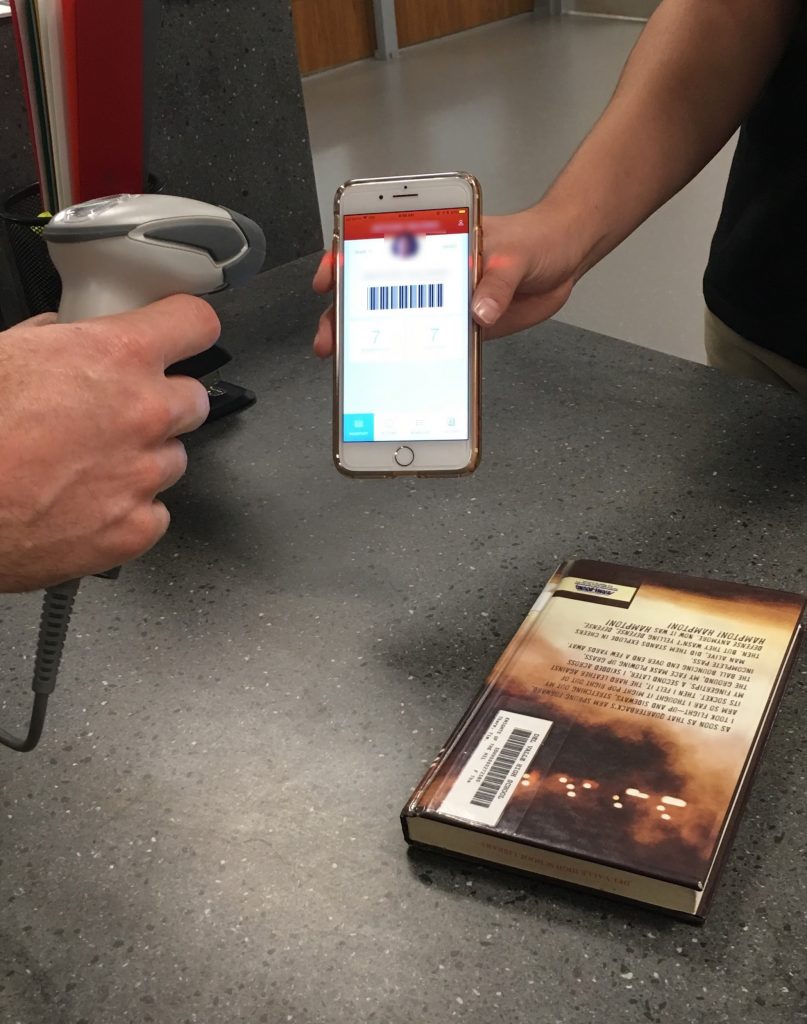
Students are never without their cell phones. A student ID is scanned from their phone. Del Valle High School in Austin Texas eliminated printed ID badges.

“We can see the five to ten percent of kids that can really benefit from our intervention,” Wheeler said. “The vast majority have good behavior and Hero has helped us not waste resources on the kids who don’t need them.”

Even with all the added benefits of this new system, shifting to a digital student ID and citizenship philosophy has required planning and consistency. According to Wheeler, “We work with freshman parents as part of our Freshman Academy, and then with students for a week straight through our homeroom teachers. We walk students through how-to videos, we verify the app is downloaded on each phone and that it’s working,” he said. “And we’re clear with our students – this is the ID you need to get lunch so you do need it.”

Del Valle is now averaging more than 14,000 tracked student activities and actions every four weeks. Time and financial savings are significant, as is the change that has happened with the school’s culture. With such a rich volume of student information now available to policy makers, administrators, teachers, and parents – all tied to something that students never neglect, their phones – it’s easy to see how the Hero integration at Del Valle could be a model for other schools.


About the Author

Derek Newton is a writer based in New York City who’s written about education for The Atlantic, Huffington Post and other publications. He attended Columbia University and served as Vice-President of the progressive think tank, The Century Foundation.  


6 Habits of Tech Savvy Students

To survive in the digital age, students must be digitally literate. This begs the question, what does it mean to be tech savvy? What are the characteristics of tech savvy students? Keep reading to find out. In this piece, we will discuss the 6 habits of tech savvy students.

  1. They know how to code. Parents and educators across the country understand the importance of teaching kids how to code. Not only can it help them learn valuable skills that they can use into their technology-driver future, but it also helps them learn to approach problems differently. Instead of trying to force information in the minds of children, let’s explore everything games have to offer when used properly. Not only will kids become tech savvy and learn new skills, but they’ll enjoy themselves while doing it. And, ultimately, that might help keep curiosity alive as they progress through school, into college, and into the working world.
  2. They recognize their digital footprints. One of the most important things to teach students is the concept of a digital footprint. Students need to understand that whatever they put online will stay there; therefore, they must be mindful about the material they post on social media about themselves or others. As Common Sense Education explains, “Our digital world is permanent, and with each post, students are building a digital footprint. By encouraging students to self-reflect before they self-reveal, they will consider how what they share online can impact themselves and others. Awareness about one’s own digital footprint can also help to support digital literacy.” Tech savvy students know this.
  3. They understand the importance of giving credit. With the culture of online sharing, plagiarism is now running rampant. If you want your students to become tech savvy, they must learn the importance of giving credit to the author or creator of online content. ISTE’s Citizenship in the Digital Age infographic highlights the issue of stealing digital work and explains how good digital citizenship includes recognizing copyright laws and giving credit to the creator. Students often copy and paste materials or download content without paying because they do not realize this is wrong. By explaining the value of one’s work and how not giving credit is a type of theft, students will gain an understanding of their responsibility to credit their sources.
  4. They have excellent information literacy skills. With statistics showing students struggle to differentiate between real news and fake news online, it is important for teachers to work on improving students’ information literacy skills. Common Sense Education suggests, “Information literacy includes the ability to identify, find, evaluate, and use information effectively.” Teaching students to evaluate content for reliability is an essential skill they will carry with them outside of the classroom. Teachers should also focus on helping students learn to use the right keywords in their searches, as well as how to recognize credible websites and authors. Information literacy is necessary in a world with rampant online content that is misleading and false. But not to tech savvy students.
  5. They have digital marketing skills. Yes, tech savvy students should have digital marking skills. Digital Marketing deals with the promotion and sale of services and products through digital means. It is the wave of the future and businesses that are not tapping into this global market are really missing out. Teaching students in this field is different from in the past. The new students are “tech savvy.” They grew up using technology, so when it comes to teaching digital marketing, it is a good idea to use the tools of the trade to teach them about the internet and how to make campaigns that work well with it.
  6. They are digital leaders. Tech savvy students are digital leaders who do more than consume information. They synthesize learning and use it in collaborative environments. Digital leaders are dynamic change agents who transform the status quo, facilitate better communication and understanding, and integrate a variety of technology tools in their lives. Also, digital leaders improve technology experiences not just for themselves, but for others as well. They look out for the greater good.

That’s our list. Can you think of any additional habits of tech savvy students?