Uncategorized

Renaissance Acquires myON to Expand Digital Literacy Solutions

Renaissance and myON come together to deliver a shared vision of literacy growth for all students

WISCONSIN RAPIDS, Wis. (March 19, 2018) – Renaissance®, a leader in pre-K–12 learning analytics, today announced the acquisition of myON®, a leading provider of digital literacy solutions, from Francisco Partners.

myON’s expansive digital content library and literacy tools, paired with Renaissance’s complementary reading practice and assessment offerings, enables Renaissance to deliver a comprehensive, innovative suite of reading solutions to educators and students worldwide. myON provides students with unlimited, simultaneous access to a personalized library of more than 13,000 digital books at home or in the classroom. myON also provides daily news articles written for students with myON News™, including French and Spanish content.

“myON and Renaissance are coming together to accelerate the realization of our shared vision of instilling the love of reading in students around the world,” said Daniel Hamburger, CEO of Renaissance. “We look forward to working with the talented team at myON to deliver on this vision by providing students with unlimited access to literature that is relevant and timely. We have long admired myON and see it as the perfect accompaniment to Renaissance Accelerated Reader®.”

“Renaissance and myON are truly connected by our history of providing literacy solutions that encourage kids to experience the joy of reading while developing their literacy skills at the same time,” said Todd Brekhus, president of myON at Renaissance. “We are thrilled to work alongside the team at Renaissance to evolve our products and provide children with ‘just right’ books that foster a passion for reading and continued academic growth. We also look forward to leveraging the best-in-class Renaissance Star Assessments® to further deepen and enhance our measurement capabilities, giving teachers robust data and insights to improve student literacy outcomes.”

Together, Renaissance and myON serve more than 20 million students worldwide. In addition to the organizations’ alignment on providing students with unlimited access to texts, Renaissance and myON are focused on providing districts with real-time data to measure students’ reading achievement and growth. myON and Renaissance will initially roll out solution packages that include Accelerated Reader and myON, while continuing to offer products on a standalone basis.

“It has been a privilege to support myON’s growth. We love meeting passionate advocates for myON in schools around the world, and we wish the team well in its next chapter with Renaissance,” said Jason Brein, Partner at Francisco Partners.

myON was previously a division of Capstone, a publisher of children’s books and digital reading products and services. Capstone has also worked with Renaissance as a content publisher for Accelerated Reader. The myON platform will continue to provide over 6,000 quality titles from Capstone.

Bob Coughlan, principal and co-owner of Capstone shares in the excitement of the news, saying, “Capstone is proud to be an integral partner for myON and Renaissance. We are excited to see these two great, complementary organizations come together. We look forward to seeing how together we will impact literacy for children worldwide.”

As part of the organizations’ integration, Renaissance welcomes Todd Brekhus to its executive leadership team. Todd will report to Daniel Hamburger as the president of myON at Renaissance and will be focused on product development and the integration of the two organizations.

About Renaissance
Renaissance® is a leader in pre-K-12 learning analytics, enabling educators to drive phenomenal student growth. Renaissance’s solutions facilitate the ability to analyze, customize, and plan personalized learning paths for students, allowing time for what matters—creating energizing learning experiences in the classroom. Founded by parents, upheld by educators, and enriched by data scientists, Renaissance knows learning is a continual journey—from year to year and throughout a lifetime. Our data-driven, personalized solutions are currently used in over one-third of U.S. schools and more than 70 countries around the world. For more information, visit www.renaissance.com.

2023 Best Traditional and Online Bachelor’s in Math Education Programs in America

Click here to learn more about the ranking methodology that we used to compile this list.

Congratulations! If you represent a college or university that is included in this list, please collect your seal below.
Math teachers lay the foundation for a student’s success in school and well into the future. They teach the core concepts that are necessary for basic daily living, such as handling money, compounding interest, and simple formulas like area and volume. It takes an extremely talented and special group of people to make this often-dreaded subject into an enjoyable experience for students.

A mathematics education degree gives you a pretty narrow field of job opportunities. Depending on the college you attend and your specific degree, you might be able to choose from either a middle-school or high-school teaching position.

The number of high school teachers needed in the country is slated to continue rising, according to the United States Bureau of Labor Statistics. You might want to jump aboard this steady source of employment by enrolling in one of these top programs.

Best Traditional Bachelor’s in Math Education Programs

  1. University of Michigan – Ann Arbor

Established as one of the top-ranked schools in the nation, the University of Michigan at Ann Arbor has a rather extensive education program. Students can apply to the college of education in their junior year, but some might choose to take the preferred admission route their freshman year. This allows you to earn acceptance immediately and transfer to the school of education when you complete enough credits. A few of the required courses for math education include:

  • Calculus
  • Linear Algebra
  • Probability
  • Geometry for Teachers

In order to gain preferred admission status, you must have a 3.0 GPA and continue to accumulate the credits and grades to keep your status. You must have either two teaching majors or a major and minor at this school. This gives you plenty of flexibility to choose mathematics and a second area of interest. You will need 120 credit hours to graduate.

The University of Michigan’s School of Education and its Secondary Teacher Education Program are accredited by the Council for the Accreditation for Educator Preparation.

  1. University of Wisconsin – Madison

Attend one of the leading schools for secondary education at University of Wisconsin-Madison. You can study secondary education with a minor in mathematics that covers higher-level math such as matrices, calculus, modern algebra, statistics, and more. The mathematics minor will require 28 credits in addition to your core classes and secondary education courses (120 credit hours total).

You must be a current student to apply for the School of Education, so you will need to consider the University of Wisconsin’s general admissions requirements. Most students who are accepted will have a high school GPA between 3.8 and 4.0, as well as a 28 to 32 on the ACT (1330 to 1460 on the SAT).

The University of Wisconsin-Madison is accredited by the Higher Learning Commission. 

  1. Stanford University

Stanford University presents a unique path to receiving a bachelor’s in math education. At this school, you will major in your area of interest (mathematics) and receive a minor in education. Their mathematics major includes topics such as mathematical reasoning, data analysis, linear algebra, and mathematics of knots, tangles, and braids. The mathematics department and the education department both offer a more rigorous honors program.

Admission can be challenging at this school, with most students having an average GPA that exceeds 4.0. Many applicants have SAT scores that range from 1430 to almost 1600. Students should be prepared for the fact that Stanford is an extremely selective school.

Graduation requires 49 credits from the math department and 15 other electives, in addition to their basic core requirements (64 units total). You must have 180 credits total. Stanford University is accredited by the Accrediting Commission for Senior Colleges and Universities of the Western Association of Schools and Colleges. The School of Education is accredited by the National Council for Accreditation of Teachers of Education and the California Commission on Teacher Credentialing.

  1. University of Georgia

In addition to learning higher level math skills, you can tap into plenty of educational resources at the University of Georgia’s College of Education. The curriculum at this southern school focuses on the specific topics you will teach for grades six through twelve, as well as different instruction methods and tips to incorporate technology into the classroom. Alternatively, you could select a double-major in education and mathematics. For the full mathematics education program, you will need to be admitted to UGA before applying to the College of Education.

General university requirements include a GPA that typically ranges from 3.88 to 4.13 and SAT scores between 1220 to 1360.

The entire program requires 120 credit hours, including the core classes required of every student at the University. The University of Georgia’s College of Education and its Bachelor’s Degree in Mathematics Education are accredited by the National Council on Teacher Education and the Georgia Professional Standards Commission.

  1. University of Virginia

Join the second-best university in the nation at University of Virginia’s Curry School of Education. They have the ninth-best education program in the country, including a five-year academic track that gives you a bachelor’s degree in education and a master’s of teaching in one fell swoop. You should plan on getting your bachelor’s degree in mathematics while receiving your master’s in teaching.

Most students who apply to this school have an ACT score between 31 and 34, or the SAT equivalent. You must earn 120 credit hours to at least receive your bachelor’s degree.

The University of Virginia is accredited by the National Council for Accreditation of Teacher Education.

Best Online Bachelor’s in Math Education Programs

  1. Western Governors University

Western Governors University gives students a unique education that allows them to choose whether they want to pursue middle school or high school education. The program caters specifically to which age group and curriculum you will choose. In the end, you will receive a teaching certification that is accepted in all fifty states. Students will study human growth and development, classroom management, and mathematics courses.

Admission requires a high school diploma or GED, transcripts from your previous school, an interview with an enrollment counselor, and proof of a C or better in a college-level pre-calculus course (for admission to the Teachers College). Graduation requires the 44 courses including general education requirements and specialized education classes.

The bachelor’s in math education at Western Governors University is accredited by the National Council for Accreditation of Teacher Education.

  1. Granite State College

Students can become math teachers at Granite State College with their initial teacher certification program. You can choose from mathematics for grades five through eight or grades seven through twelve. Areas of study include calculus, linear algebra, history of math, and managing student behavior in the classroom.

Admission requirements include a high school diploma or GED for consideration. Students who graduate from this school must take all fifteen courses in their area of study, as well as pass the Praxis Core Academic Skills for Educators Exam and the Praxis II for math content knowledge exam. You will need 120 credit hours in order to graduate with your bachelor’s degree.

Granite State College is accredited by the Teacher Education Accreditation Council.

  1. Midway University

Take advantage of the flexibility offered by Midway University’s online bachelor’s in math education program. Here, you will learn the foundational skills you need to teach effectively in a multicultural classroom and relay higher math concepts such as calculus, college geometry, and more.

The admission department recommends a GPA of 2.5 and an SAT score of 860 (ACT score of 18) before applying. The teacher education program requires separate admission with a 2.75 minimum GPA, professional recommendations, district paperwork completed, and a passing Praxis Core score. Students are expected to complete 34 general education course hours, 30 secondary math course hours, and 45 education course hours for graduation.

Midway University is accredited by the Southern Association of Colleges and Schools Commission on Colleges. The Education Program has accreditation through the Kentucky Educational and Professional Standards Board.

  1. Mayville State University

Are you ready to create a flexible environment so you can earn your bachelor’s in math education? Mayville State University offers one of the premier online programs that teach students the basics of child psychology, classroom management, and higher mathematics to give them a well-rounded education that prepares them for the future.

Before applying, you should have a high school GPA of 2.0 and an ACT score of 18 for the best chances of admission. You must have 125 credit hours to graduate with this degree, including 36 hours of their essential core classes. The majority of your areas will be spent learning secondary professional education, followed closely by higher level math courses.

Mayville State University is accredited by the Council for the Accreditation of Educator Preparation.

  1. Indian River State College

You can select from either middle school mathematics or high school mathematics using the online degree program available from Indian River State College. In addition to their general course requirements (60 hours), you must also have 60 hours within your major field of secondary mathematics. These courses can include human development, instructional strategies, number theory, and more.

First-time college students can find easy admission at Indian River State College. Just your high school diploma is enough to qualify you for admission and guarantees you a spot at this online school.

Indian River State College is accredited by the Southern Association of Colleges and Schools Commission on Colleges.

How to Choose the Right Program

You can choose the perfect program based on your future career aspirations and the academic course load each school provides. Some will focus more specifically on mathematics while others will primarily teach you how to become a better educator. After this, you can rank schools by convenience, price, and accreditation.

Who accredits a bachelor’s degree in mathematics education program?

Understanding the accreditation schools possess is the key to ensuring that you receive a top-notch education that will prepare you for a future in teaching. Every school, including online programs, will have to maintain some type of accreditation with a state, regional, or national accrediting agencies.

Beyond this accreditation, many will opt to maintain voluntary status with the National Council on Teacher Education or the Accreditation for Educator Preparation. This helps to hold the schools accountable for offering a well-rounded curriculum that adequately prepares students for the future. Not all of the top schools hold this accreditation but it should be considered before you make a choice.

How long does it typically take to get a degree in mathematics education?

Most colleges and universities allow you obtain your degree in four years, just as with a standard bachelor’s degree from other programs. Some course loads will require five years depending on the timing of the courses offered and your enrollment date.

What does the curriculum include?

The curriculum for mathematics education will really vary based on the university. Some schools will require mostly higher-level math courses with only a handful of education classes to teach you basic classroom management. The opposite may also be true, where you will focus primarily on teaching techniques instead of mathematics.

In schools where you will graduate with your bachelor’s degree in mathematics and obtain your teaching certification, you can expect to find far more math classes than teaching courses. At some universities, you may be able to choose a double major that allows you to learn more higher-level math and teaching concepts at the same time.

How can I finance my education?

Obtaining your bachelor’s degree can be an expensive endeavor. You can finance this dream by applying for financial aid and grants through the Free Application for Student Aid (FAFSA). Grants offered by the federal government do not need to be repaid upon graduation.

Some of these top universities will also have scholarships available to eligible students on a first-come-first-served basis. These scholarships will not need to be repaid but might be based on your grades, test scores, and other criteria. Similar to a scholarship, some colleges will offer work-study programs that allow you to work off your debt in various positions around campus.

For the remaining amount, you might consider taking out a student loan that can be paid back upon graduation. Look for loans that have a low interest rate and don’t impose a penalty for prepayment. The federal government tends to offer more advantageous loan programs compared to private lenders.

What are the employment prospects for a bachelor’s in math education graduate?

In order to understand the employment prospects for a bachelor’s in math education graduate, you need to first determine whether you will be working in a middle school or a high school setting. In both cases, there is a slight growth needed among positions available in this field. All data is based on the United States Bureau of Labor and Statistics with projects ranging from 2016 to 2026.

High School Teacher: A high school math teacher can expect to make an annual salary of $58,030. Jobs in this area are expected to increase by eight percent over the coming years, creating 76,800 more jobs.

Middle School Teacher: Much like the high school teacher, the need for a middle school teacher is also expected to increase between now and 2026. It is estimated that 47,300 more jobs will be created. Middle school teachers do make slightly less than high school teachers, with an average annual salary of $56,720.

2023 Best JD Programs in Civil Rights Law in America

Click here to learn more about the ranking methodology that we used to compile this list.

Congratulations! If you represent a college or university that is included in this list, please collect your seal below.

Attorneys are more than people who argue in a courtroom or advertise their services on billboards. This group of individuals seeks to help people who have legal issues get the justice they deserve. You might choose to pursue a law degree major simply because you love the idea of understanding the complexities of the law. Others might prefer to specialize in more specific topics such as corporate, environmental, or civil rights law (sometimes called human rights law). To practice law in the US, an individual must obtain their juris doctor (JD) from an accredited law school as well as sit for the state bar examination.

The choices available for those who hold a JD are almost endless. You can consider searching for jobs in any of these fields:

  • Federal government attorney
  • Civil rights attorney
  • International law attorney
  • Legal services

A graduate with a JD is estimated to earn $118,160 annually, according to the United States Bureau of Labor Statistics. Availability for these positions is currently slated to increase according to the same data.

Best JD Programs in Civil Rights Law

  1. New York University College of Law (NYU Law)

Located in the heart of New York City, NYU Law allows law students the chance to learn civil rights law in one of the top programs in the country. Students focus on legal theory and practice, legal research and writing, as well as a host of specialized course that ensure a well-rounded legal education. Additionally, students can take part in the various workshops, seminars, and student organizations available that emphasize facets of civil rights litigation. Students can also participate in the school’s Law Students for Human Rights group. NYU Law also hosts civil rights events led by noted legal scholars and attorneys. The civil rights curriculum includes critical race theory, civil rights narratives, political theory, and capstone courses for upper-level students.

For consideration for admissions, applicants must have taken the Law School Admission Test (LSAT) within the past five years; scores of admitted students ranged from 166 to 170 for the Fall 2017 class at NYU Law. In addition to a valid LSAT score, applicants must submit their undergraduate transcripts, two letters of recommendation, a personal statement, résumé, and any other relevant information. NYU Law does not offer a part-time JD program, and all admitted students must take a minimum of 12 credits per semester. To be eligible for graduation, students must successfully complete 83 credits.

  1. Yale University Law School

Located in New Haven, Connecticut, Yale University Law School is home to an impressive civil rights program and individuals interested in this legal specialty have access to the Orville H. Schell, Jr. Center for International Human Rights. The Center immerses law students in local and international human rights initiatives. Also, Yale Law’s Human Rights Law Clinic gives students practical experience in this area of law guided by knowledgeable professor-attorneys. Yale Law also publishes the Yale Human Rights and Development Law Journal, which gives students the opportunity to publish research that serves to expand upon issues relevant to human rights law. Human rights coursework at Yale Law emphasizes advocacy and students who participate in the Allard K. Lowenstein International Human Rights Law Clinic complete projects each term on behalf of human rights organizations and individual victims of human rights abuse.

For consideration for admissions, applicants must have taken the Law School Admission Test (LSAT) within the past five years; scores of admitted students ranged from 156 to 180 for the Fall 2017 class at Yale Law. In addition to a valid LSAT score, applicants must submit their undergraduate transcripts, two letters of recommendation, a personal statement, résumé, and any other relevant information. Applicants will be notified of their admission status via email. To be eligible for graduation, students must successfully complete 83 units, which includes Substantial Paper and Supervised Analytic Writing (SAW) writing requirements.

  1. Columbia Law School

Renowned for its rigorous curriculum and intensive programs, Columbia Law Schools offers one of the best civil rights-focused law degrees in the nation. The Columbia Law community prepares students for a legal career center on human rights through its Human Rights Institute. Founded in 1998, the Human Rights Institute at Columbia Law includes courses on the topics of immigration law, genocide law, and seminars that explore the rights of minority groups. Also, students can practical experience via legal clinics including the Human Rights Clinic and the Child Advocacy Clinic. Students at Columbia Law can also earn credit for publishing in the school’s Human Rights Law Review.

For consideration for admissions, applicants must have taken the Law School Admission Test (LSAT) within the past five years; scores of admitted students ranged from 169 to 173 for the Fall 2017 class at Columbia Law. In addition to a valid LSAT score, applicants must submit their undergraduate transcripts, two letters of recommendation, a dean’s letter (if applicable) a personal statement, résumé, and any other relevant information. Applicants may be required to complete an in-person interview. However, interview requests will not be considered. To be eligible for graduation, students must successfully complete 83 academic points, which includes applicable ABA writing requirements. To demonstrate their commitment to human rights law, all students must also complete a professional responsibility course and 40 hours of mandatory pro bono service following their first academic year (1L).

  1. University of Virginia Law School (UVA Law)

UVA Law features a thorough human rights program that aims to prepare students for future careers upholding the rights of others. Courses taken during the program include Racial Justice and the Law, Civil Rights Litigation, Advanced Topics in Public Service, and a Human Rights Study Project, to name a few.

For consideration for admissions, applicants must have taken the Law School Admission Test (LSAT) within the past five years; scores of admitted students ranged from 169 to 170 for the Fall 2017 class at UVA Law. In addition to a valid LSAT score, applicants must submit their undergraduate transcripts, two letters of recommendation, a personal statement, résumé, and any other relevant information. Students must maintain a minimum 2.7 GPA during all academic years of enrollment and must successfully earn 86 semester credits to be eligible for graduation. Students are required to complete upper-level writing requirements as defined by the ABA.

  1. University of Michigan Law School

Located in Ann Arbor, Michigan, University of Michigan Law school has an abundance of opportunities for students interested in pursuing civil rights law. Course offerings include a wide range of topics including women’s rights, use of the law for reduction of global poverty, and the law of armed conflict, and many more. Students work closely with faculty and staff to define their career objectives and take the relevant courses that will adequately prepare them for the legal profession.

For consideration for admissions, applicants must have taken the Law School Admission Test (LSAT) within the past five years; scores of admitted students ranged from 164 to 170 for the Fall 2017 class at University of Michigan Law. In addition to a valid LSAT score, applicants must submit their undergraduate transcripts, one to three letters of recommendation, a personal statement, résumé, and any other relevant information. All aspects of the application are considered, ensuring that students are evaluated beyond their academic accomplishments. Students must maintain a cumulative 2.3 GPA and must successfully earn 83 credits to be eligible for graduation. Students are required to complete upper-level writing requirements as defined by the ABA.

How to Choose the Right Program

You can choose the perfect program based on your future career aspirations and the academic course load each school provides. Some law schools will focus more specifically on domestic civil rights issues while others give you a greater opportunity to study outside of the US by exploring human rights on a global scale field. After these considerations, you can rank schools by convenience, price, and accreditation.

Who accredits a JD with a civil rights concentration program?

Understanding the accreditation schools possess is the key to ensuring that you receive a top-notch education that will prepare you for a future in the legal profession. Every school, including online programs, will have to maintain some type of accreditation with state, regional or national accrediting agencies. The American Bar Association (ABA) is the main accrediting body for the law schools in the United States. All states, with the exception of California, will not permit an individual to take the bar exam if their JD was not issued by an ABA-accredited institution.

Beyond this accreditation, many will opt to maintain voluntary status with Distance Education Accrediting Commission. This accreditation mainly applies to online or correspondence programs and serves to hold the schools accountable for offering a well-rounded curriculum that adequately prepares students for the future. The top schools listed here offer traditional, in-person programs but it should be considered before you make a choice.

How long does it typically take to get a JD?

Most US law schools allow you obtain your juris doctor in three or four years but the top law schools for civil rights law do not offer part-time programs. Some law schools allow students to take more time to complete their degree depending on the timing of the courses offered and your enrollment date.

What does the curriculum include?

The modern JD curriculum should include a brief history of the law, including common law and in-depth study of the United States Constitution. Classes then go on to the present and future with coursework focused on current digital topics in the law and how they are affected by modern trends, professional ethics, and detailed legal research.

Law students will also learn how to communicate more effectively through writing and speaking. Ideally, you should be required to take a variety of courses designed to enhance your communication skills. Well-Rounded legal education should also include various electives that provide in-depth instruction on specific legal topics, including civil rights law.

How can I finance my education?

Obtaining your JD can be an expensive endeavor. You can finance this dream by applying for financial aid and grants through the Free Application for Student Aid (FAFSA). Grants offered by the federal government do not need to be repaid upon graduation.

Some of these top law schools will also have scholarships available to eligible students on a first-come-first-served basis. These scholarships will not need to be repaid but might be based on your grades, test scores, and other criteria. Similar to a scholarship, some colleges will offer work-study programs that allow you to work off your debt in various positions both on and off campus.

For the remaining amount, you might consider taking out a student loan that can be paid back upon graduation. Look for loans that have a low-interest rate and don’t impose a penalty for prepayment. The federal government tends to offer more advantageous loan programs compared to private lenders.

What are the employment prospects for a JD with a concentration in civil rights graduates?

Understanding the employment prospects for those who receive their juris doctor can vary based on the unique career path you decide to take. To give you an idea of what is expected for this field in the coming years, we will take a look at the most popular careers that many people with this degree choose to pursue. All data is based on the figures available from the United State Department of Labor based on projections made from 2016 to 2026.

Lawyers: Individuals with a JD should see an eight percent increase in the number of jobs available over the coming decade. It is growing roughly the same as the average employment rates in the country. There are currently 65,000 positions with this title.

2023 Best Traditional and Online Bachelor’s in Early Childhood Education Programs in America

Click here to learn more about the ranking methodology that we used to compile this list.

Congratulations! If you represent a college or university that is included in this list, please collect your seal below.

Early childhood educators set the stage for all of the learning a child will do in the future. They teach the basic essentials of reading, writing, and early math skills that are necessary for daily living. During this time, teachers hold great sway in the lives of their students and can make a major impact on their overall growth and development.

A degree in early childhood education gives you plenty of opportunities to influence children at this impressionable age. Beyond teaching in a traditional classroom, you could also work in a daycare or tutor young children. You might even decide to become a nanny as you nurture just a handful of children instead of an entire classroom.

According to the United States Bureau of Labor and Statistics, there is expected to be tremendous growth over the coming years for teachers who hold these degrees. Consider enrolling in one of these leading programs if you’re ready to learn more.

Best Traditional Bachelor’s in Early Childhood Education

  1. University of Georgia

Leading the way among traditional early childhood education programs, the University of Georgia is a great choice for dedicated teachers. During their 120 required credit hours, you’ll learn how to design your own curriculum, examine how cultural issues influence the classroom, and learn how to develop relationships with students.

In order to receive acceptance into their undergraduate program, you must have standardized test scores from the SAT or ACT and a rigorous academic course load from high school.

The University of Georgia’s College of Education is accredited by the National Council on Teacher Education and the Georgia Professional Standards Commission.

  1. Mercer University

Get a more flexible degree with one of the leading Early Childhood Education programs in the nation. Unlike other schools that only approve you to teach up to age eight, Mercer University’s degree program allows you to teach from kindergarten through grade five. Spend time learning about health and safety, science, and the importance of connections between home and school during your 128 required credit hours.

Applicants should have standardized test scores from the SAT or ACT, extracurricular activities, an application essay, a letter of recommendation, and a rigorous high school curriculum. Transfer students must have a minimum of a 2.5 GPA.

The Tift School of Education at Mercer University is accredited by the Georgia Professional Standards Commission.

  1. Arizona State University

Get ready to soak up the sun while you earn your Bachelor’s in Early Childhood Education at Arizona State University. This school has been named The Most Innovative School in America, making it a top candidate for you to pursue higher learning regarding childhood development and education. You will have 120 credit hours to graduate with your degree from this program.

Requirements for admission include an SAT score of at least 1120 for residents (ACT score of 22 for residents) and a 3.0 GPA in competency courses.

This school is accredited only by the Higher Learning Commission.

  1. Indiana University – Bloomington

In just four years, you can be the proud new owner of a full Bachelor’s in Early Childhood Education from Indiana University – Bloomington that allows you to teach grades kindergarten through third. You’ll learn how to work with young children, develop your own curriculum, and work with early intervention programs over the course of your 120 credit hours.

In order to be accepted directly into their School of Education, students must have a minimum SAT score of 1170 or a minimum ACT score of 24. You must also have a minimum GPA of 3.5 on a 4.0 scale for the Direct Admit Scholars Program.

The program at Indiana University Bloomington is accredited by the Council for the Accreditation of Educator Preparation, and they are also members of the American Association of Colleges for Teacher Education.

  1. New York University

Get ready for some excitement as you earn a degree in early childhood education in the Big Apple at New York University. When you leave this program, you will be certified to work with children from birth all the way to age two in a variety of unique settings. You will have a firm grip on human development, how the environment influences learning, and how to maximize your environments.

First-year applicants must have a high school diploma or GED and your official transcripts, along with your standardized test scores.

You will be required to have 128 to 131 credit hours in order to graduate with your Bachelor’s in Early Childhood Education from NYU. All teacher education programs are accredited by the Council for the Accreditation of Educator Preparation.

Best Online Bachelor’s in Early Childhood Education

  1. Liberty University

Students who want a very flexible online program for early childhood education can start almost immediately with Liberty University. They offer a full-time and part-time program, along with the recommended practicum of 300 hours at a local school in your own community. Full-time students can complete all 120 required credits in just four years.

In order to be admitted to Liberty University, you must have standardized test scores from either the SAT or ACT.

Liberty University possesses accreditation by the National Council for Accreditation of Teacher Education through the Council for the Accreditation of Educator Preparation. Their bachelor’s in early childhood education is approved by the Virginia Department of Education and the Association of Christian Schools International.

  1. Florida International University

Learn everything you need to know about instruction techniques, growing literacy, and special needs students with the Bachelor’s in Early Childhood Education available from Florida International University. It will take four years to earn the 120 credits necessary to graduate from this program. You may also need to find a local school who can work with you to complete your field education requirements.

This university has a rolling admission for both spring and fall. You must have a minimum GPA of 2.5 in your lower division coursework to apply, along with standardized test scores from the SAT or ACT.

Florida International University’s Bachelor’s in Early Childhood Education is accredited by the National Council for Accreditation of Teacher Education.

  1. Brandman University

You won’t have to travel to sunny California to take advantage of the education offered online by Brandman University’s Bachelor’s in Early Childhood Education program. During your 120 required course hours, you will learn better methodology, knowledge on how children develop, and two practicums in a local school district. You must finish a short six-month program with twelve credits before you can be admitted into the education program.

Admission requires standardized test scores and a minimum GPA of 2.0.

Their early childhood education program is accredited by the National Council for Accreditation of Teacher Education.

  1. University of Alabama

Students who want to learn more about early childhood development will want to pursue their Bachelor’s in Early Childhood Education at the University of Alabama. Here, you will receive 120 credit hours of instruction on maintaining children’s health and community supports for childhood development. The program wraps up with an internship at a childcare facility in your local area, even though your learning will be done online.

You may transfer up to 24 credit hours toward your Bachelor’s in Early Childhood Education from another accredited university. Students who wish to apply here should have a 2.5 high school GPA. Transfer students must have a 2.0 GPA and current ACT or SAT scores from the last four years.

This program will be accredited by the National Council for Accreditation of Teacher Education.

  1. University of Nebraska-Lincoln

The University of Nebraska-Lincoln takes a unique approach to their Bachelor’s in Early Childhood Education. One of the primary tenets of their online program is training educators to work in urban populations where children make frequent moves for one reason or another. You will be required to complete 120 credit hours in this four-year program., including three local practicum experiences.

New students must submit their SAT or ACT scores for consideration on admission. Transfer students should have a 2.5 GPA minimum for acceptance into the University of Nebraska-Lincoln’s program.

You will receive a fully accredited education at the University of Nebraska-Lincoln with their Teacher Education Accreditation Council approval.

How to Choose the Right Program

You can choose the perfect program based on your future career aspirations and the academic course load each school provides. Some will focus more specifically on older children or younger children, as well as different aspects of their development. After this, you can rank schools by convenience, price, and accreditation.

Who accredits a bachelor’s degree in early childhood education program?

Understanding the accreditation schools possess is the key to ensuring that you receive a top-notch education that will prepare you for a future in teaching. Every school, including online programs, will have to maintain some type of accreditation with a state, regional, or national accrediting agencies.

Beyond this accreditation, many will opt to maintain voluntary status with the National Council on Teacher Education or the Accreditation for Educator Preparation. This helps to hold the schools accountable for offering a well-rounded curriculum that adequately prepares students for the future. Not all of the top schools hold this accreditation but it should be considered before you make a choice.

How long does it typically take to get a degree in early childhood education?

Most colleges and universities allow you obtain your degree in four years, just as with a standard bachelor’s degree from other programs. Some course loads will require five years depending on the timing of the courses offered and your enrollment date.

What does the curriculum include?

The curriculum for early childhood education will really vary based on the university. Most schools focus on the overall development of children at this age. You might be expected to take psychology courses and science courses that detail the anticipated changes that children in this age group will undergo. This will likely comprise a significant portion of your credit hours.

You should also learn more effective teaching methods to develop curriculum and teach the content your students will need to learn. You might take some classes that cover the expected curriculum for a given age group.

All early childhood education programs should give you an opportunity to practice your skills in a real-world setting through a local school district or childcare center.

How can I finance my education?

Obtaining your bachelor’s degree can be an expensive endeavor. You can finance this dream by applying for financial aid and grants through the Free Application for Student Aid (FAFSA). Grants offered by the federal government do not need to be repaid upon graduation.

Some of these top universities will also have scholarships available to eligible students on a first-come-first-served basis. These scholarships will not need to be repaid but might be based on your grades, test scores, and other criteria. Similar to a scholarship, some colleges will offer work-study programs that allow you to work off your debt in various positions around campus.

For the remaining amount, you might consider taking out a student loan that can be paid back upon graduation. Look for loans that have a low interest rate and don’t impose a penalty for prepayment. The federal government tends to offer more advantageous loan programs compared to private lenders.

What are the employment prospects for a bachelor’s in early childhood education graduate?

A Bachelor’s in Early Childhood Education opens the door for a lot of professional opportunities you should be aware of. Beyond teaching at a local elementary school, you can also work at a daycare, preschool, or as a nanny. Think about what career path suits you the best based on some of these statistics from the United States Bureau of Labor Statistics.

Kindergarten and Elementary School Teachers: Educators who choose to work in a public or private school should expect relatively stable job security upon graduation. Employment opportunities are continuing to increase with another 116,300 jobs being created over the next few years. The average annual salary is $55,490 per year.

Preschool Teachers: Preschool teachers will also enjoy great job opportunities with an additional 50,100 jobs estimated to become available between now and 2026. They will make substantially less than elementary school teachers at just $28,790 per year.

Childcare Worker: A childcare worker makes the least amount of money among these three categories. There is still expected to be a fair amount of jobs available over the coming years, but you will only make an average annual salary of $21,170. A degree in early childhood education is not a requirement for this position.

Course Review: Staying Present: Mindfulness for Better Teaching and Learning

Have you ever thought about the kinds of things that you accomplish before the school bell rings to signal the end of the day? In all probability, you would have run from one end of the playground to another some fifteen times if not more, handled disputes and power struggles and shouted louder than the football coach on the field. Unfortunately, a teacher does not have the luxury of checking into a spa for a few weeks to remove all the stress that is causing them to grow old faster. So, what can the modern teacher do to stay calm, while so much chaos is happening around them? One word. Mindfulness. Yes, mindfulness.

What exactly is mindfulness? Mindfulness is a set of strategies that have been used for several millennia to help people be “present” and in the moment, instead of focusing on distractions and stressors. Mindfulness is accomplished by calming the mind and becoming more aware of your emotions, cognitions, and body. Staying “present” helps you to increase your focus, improve your socio-emotional intelligence, and enhance your physical health. Studies have shown that incorporating mindfulness techniques and strategies in the classroom provides several teaching and learning benefits. Students and teachers are calm, at peace, and become in full control of their mind, body, and soul, which allows them to have more success in the classroom.

Recently, I had the pleasure of demoing an online professional development course entitled “Staying Present: Mindfulness for Better Teaching and Learning,” which teaches the practice of mindfulness to educators. The class was created by Advancement Courses, an innovative education development company that provides continuing education to educators. In this course, I learned a plethora of tips and strategies for implementing mindfulness in the classroom. I was able to work at my own pace and felt at ease as I participated in activities that are designed to help educators center their body, mind, and spirit, and handle stressful moments.

I appreciate the care and attention that was put into developing this course. Advancement Courses only employs authors who are expert teachers with extensive classroom experience. They design each course to be meaningful, engaging, and classroom applicable. Classes are not just filled with innovative techniques and perspectives, but also show what these tools look like in practice.

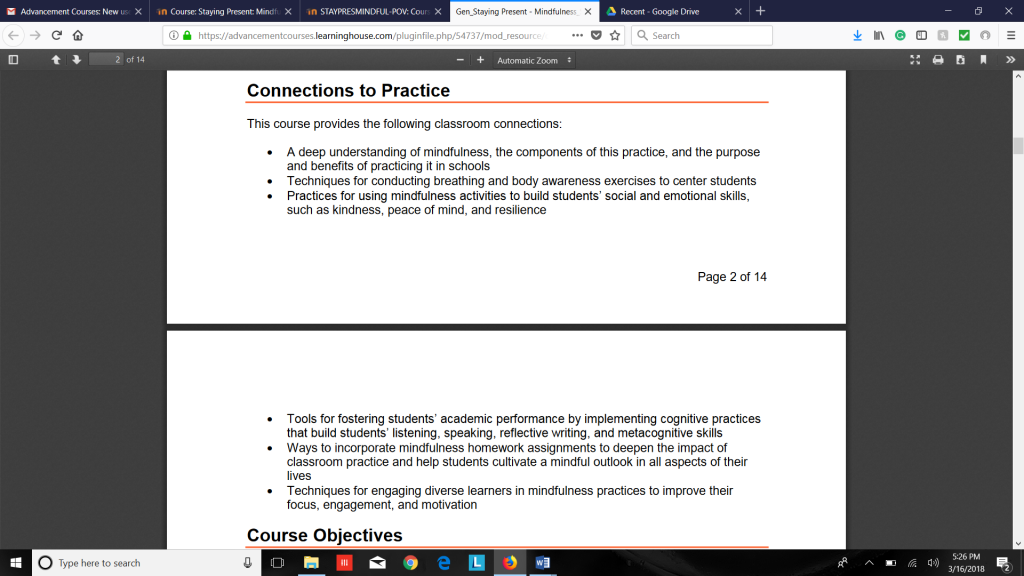
I love how the syllabus includes a section entitled “Connections to the Classroom” that explains how the course plans to help you turn theories of mindfulness into sound professional practices. Also, the “Course Objectives” section was a standout, as it does a superb job of stating the skills that educators will attain by taking the course. This is standard information that all online courses have, but you wouldn’t believe how many education companies do a horrible job of writing course objectives.

Another bonus is that all courses are led by facilitators with a proven track record of supporting teachers across content areas and grade levels. Facilitators help guide you through your course by answering questions, offering detailed feedback on assignments, and more. They have a deep understanding of national standards like the Common Core and Next Generation Science Standards, and I do not doubt that their feedback is constructive, research-based, and thorough. If you have technical or course-related questions, your facilitator and the support team are available to help.

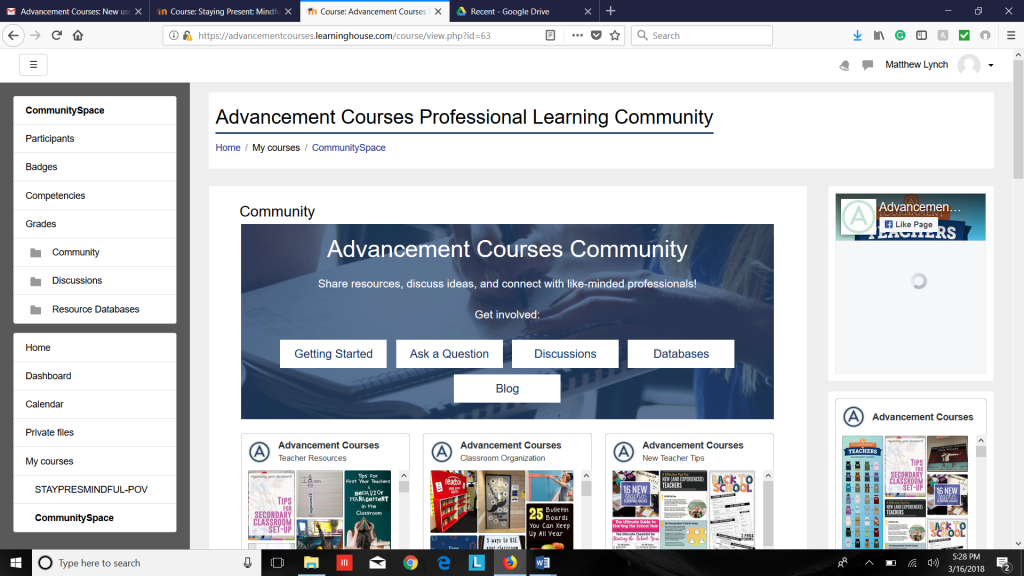
The coolest feature of the course was the community space, which gives you access to a professional learning community comprised of like-minded professionals across the world. It’s a place for you to share resources, explore innovative ideas, and connect with other educators. Whether you’re looking to incorporate new teaching strategies, problem solve or enhance your lesson plans; it’s your chance to interact and learn from your peers. You can access this space via the “Community” link at the top of the eclassroom in any course.

The community space includes discussion forums where you can engage with other educators in ongoing conversations, share and get feedback on ideas, and post questions. It also has a searchable database of articles, blogs, websites, videos and other contributed content and includes integrated sharing and social tools to make participating and extending the conversation easy. The community space also provides social networking opportunities via Facebook, Pinterest, etc.

I love the fact that the course is not tied to a semester, and can be taken anytime, anywhere – with up to six months to complete. This gives busy educators the opportunity to expand their knowledge at a pace that works for them. Also, you can complete the course in two formats, online and print. If you choose to take an online course, you’ll analyze real classroom footage of best practices in mindfulness and engage in interactive tasks. You can complete your online coursework on a variety of digital devices, even smartphones, and tablets. If you choose a print course, you’ll delve deeply into a selection of texts and multi-media to gain a greater understanding and learn new mindfulness strategies. No matter what format you choose, I know you’ll enjoy the course and be able to start implementing what you have learned immediately into your practice. The courses are available in non-credit or grad-level credit versions, and even come with a transcript.

After I completed my demo of the course, I felt empowered. I was confident that I had the tools that I needed to create an energized, interconnected, and kind classroom culture where every student is engaged, motivated, and passionate about learning and can stay present even in stressful situations. Thanks, Advancement Courses. I wholeheartedly recommend this course to all classroom teachers, administrators, paraprofessionals, etc. who are striving to live a stress-free personal and professional life. You won’t be disappointed.


2019 Best Traditional and Online Special Education Programs in America

Click here to learn more about the ranking methodology that we used to compile this list.

Congratulations! If you represent a college or university that is included in this list, please collect your seal below.

Becoming an educator will give you the opportunity to shape the development of younger generations. Special education is particularly in need of educators, as it can be mentally and emotionally strenuous for educators to interact closely with students who may have a range of mental, emotional, learning, or physical disabilities. If you are considering becoming an educator and believe that you would be well-suited to interact with students requiring special education, there are many educational opportunities available in this field.

Most people who major in special education go on to be K-12 educators in public or private school systems, however, there are a few other potential career paths that lead off these programs:

  • Special Education Non-Profit Administrator
  • Private/Home-Schooling Educator
  • Special Education Curriculum Developer
  • Special Education Policy Advocate

A teacher with a degree in Special Education earns an estimated $56,800 annually. Teachers with training in special education are typically difficult to come by, and job opportunities in special education are projected to grow by 8% annually.

Best Traditional Bachelor’s in Special Education Programs

  1. Arizona State University

Arizona State University offers a dual certification degree program that allows you to graduate with both a certification in general elementary education and in mild-moderate disabilities special education, widening the range of potential career options you would be able to pursue after graduation. The program collaborates heavily with area public schools, giving students the opportunity to work in special education settings with certified special education teachers.

This program requires that you maintain at least a 2.5 GPA overall, and you will complete extensive coursework in both educational topics to be taught in the classroom and child psychology as it relates to special education.

  1. Indiana University, Bloomington

Indiana University at Bloomington offers two degree programs in Special Education: one that focuses on primary education, and another that focuses on secondary education. In addition, you can become certified in both special education and general education through the Teaching All Learners Dual Degree program, which may be a good opportunity if you are not completely sure you want to work in special education.

Both programs include intensive field experience in educational settings that fit your interest, giving you work experience that you can leverage to find a job after graduation. The program requires that you maintain a 2.5 GPA within Education and a 2.0 Overall GPA, and that you complete at least 124 credits in order to graduate.

  1. University of Minnesota, Twin Cities

The University of Minnesota in Twin Cities has a well-known and highly ranked program in Special Education that includes the attainment of a teaching license for the state of Minnesota. This program also provides opportunities for you to go into educational settings and work with special needs students, giving you a chance to apply the knowledge you’ve gained in the program and acquire valuable teaching experience.

This program requires that you keep a 2.75 or higher GPA and complete 120 credits to graduate. In addition, you will take foundational courses in education and child psychology, as well as your choice of electives to supplement your knowledge.

  1. Ohio State University

The Ohio State University, already a well-known and respected university, offers a B. Education degree program in Special Education. This program allows you to choose the age group and disability severity group that you would like to specialize in, allowing you to tailor your degree to your specific interests.

In order to take part in this program, you must apply in late September to start in the following spring semester. You must also have and maintain a 3.0 GPA or higher and complete 120 semester hours at minimum.

  1. The University of Texas at Austin

The University of Texas at Austin offers a special program that allows students to become certified to work with children at all levels, from early childhood to 12th grade. If you are unsure of which age group you’d like to work with, this may be the program for you! The All-Levels Special Education program falls under the B.S. program in Applied Learning and Development, which also offers other concentrations in the event that you are interested in focusing on more than one area of education. This program also certifies you to teach in Texas.

To participate in the special education program, you must apply by March 1st the spring before the fall semester you’d begin. The program can only be started during the fall semester, and requires a minimum 2.5 GPA.

Best Online Bachelor’s in Special Education Programs

  1. Central Methodist University

Central Methodist University has a degree program in Special Education that gives you both the knowledge foundation needed to teach in the K-12 educational system and the child psychology knowledge needed to tailor that education to special needs students. Applicants to this program must pass Missouri’s basic skills test and maintain a 2.75 GPA before applying to the Education program at CMU.

  1. Western Governors University

Western Governors University offers a special education degree program with flexible timing that allows students to complete the degree in anywhere between 1.5 and 4 years. The program prepares you to become licensed anywhere in the US, although it does not provide a route to attain the certification within the program. It also includes observation hours, where you can experience a special education classroom setting to prepare for future career paths in the classroom.

This program requires that you pass a state-specific basic skills test and a criminal background check in order to be admitted into the program, in addition to the general admissions requirements. In order to graduate, you must pass 45 courses.

  1. Chadron State College

Chadron State College offers a special education degree program that can be completed completely online, with the option of focusing on special education alone or also becoming certified in early childhood education. In order to attend this program, you must apply with your high school transcripts or official GED certification and your ACT scores to be considered. Once admitted to the program, you must maintain a 2.0 GPA and complete the relevant core coursework in order to graduate.

  1. Petersburg College

St. Petersburg College offers a degree program in Exceptional Student Education online through their distance learning program. This program is offered full and part-time, and gives options for completion either fully online or partially online and partially in person. They also offer school-based experiences for distance learners in order for you to acquire real work experience.

This program requires all applicants to have an Associate’s degree, a minimum 2.5 GPA, and passing scores on Florida’s general knowledge test. In addition, it requires you to maintain a 2.5 GPA throughout the program, to take courses in cultural diversity, and to take courses in a foreign language.

  1. Mayville State University

Mayville State University offers a Bachelor of Science in Education degree in Special Education that can be completed in four years online with required in-person sessions during the summers. If you are already a licensed teacher and are interested in becoming licensed in special education, this program facilitates that by only requiring in-person attendance over breaks in the academic calendar. If you are not a licensed teacher, you can also pursue a degree in Education online concurrently, which will allow you to get both licenses at once.

Regardless of which program you plan to enter, you must maintain a 2.75 GPA throughout the program, and must have had at least a 2.75 in any previous degree programs. The program takes approximately four years to complete, with approximately 150 credits needed to graduate, depending on your specialization.

How to Choose the Right Program

You can choose the perfect program based on your future career aspirations and the academic course load each school provides. Some will focus more specifically on Early Childhood Education while others give you a greater opportunity to study Secondary Education. After this, you can rank schools by convenience, price, and accreditation.

Who accredits a bachelor’s degree in special education program?

Understanding the accreditation schools possess is the key to ensuring that you receive a top-notch education that will prepare you for a future in special education. Every school, including online programs, will have to maintain some type of accreditation with a state, regional or national accrediting agencies.

Beyond this accreditation, many will opt to maintain voluntary status with the Council for Exceptional Children (CEC). This helps to hold the schools accountable for offering a well-rounded curriculum that adequately prepares students for the future. Not all of the top schools hold this accreditation, but it should be considered before you make a choice.

How long does it typically take to get a degree in special education?

Most colleges and universities allow you obtain your degree in special education in four years, just as with a standard bachelor’s degree from other programs. Some course loads will require five years depending on the timing of the courses offered and your enrollment date.

What does the curriculum include?

The modern curriculum should include coursework in child psychology and teaching pedagogy, including classes on subjects that you may be asked to teach once hired. Classes should now start looking toward the future with coursework focused on new research on educational approaches to special education, required fieldwork with participating nearly school systems, and classes explaining the disabilities commonly found in special needs students.

Students should also learn how to communicate with students with a range of learning or communicative disabilities. You should be required to take a variety of courses designed to enhance your communication skills.

A well-rounded special education program should also include plenty of liberal arts core classes and potentially even a minor or double-major in another subject.

How can I finance my education?

Obtaining your bachelor’s degree can be an expensive endeavor. You can finance this dream by applying for financial aid and grants through the Free Application for Student Aid (FAFSA). Grants offered by the federal government do not need to be repaid upon graduation.

Some of these top universities will also have scholarships available to eligible students on a first-come-first-served basis. These scholarships will not need to be repaid but might be based on your grades, test scores, and other criteria. Similar to a scholarship, some colleges will offer work-study programs that allow you to work off your debt in various positions around campus.

For the remaining amount, you might consider taking out a student loan that can be paid back upon graduation. Look for loans that have a low interest rate and don’t impose a penalty for prepayment. The federal government tends to offer more advantageous loan programs compared to private lenders.

What are the employment prospects for a bachelor’s in special education graduate?

Understanding the employment prospects for those who receive their bachelor’s degree in journalism can vary based on the unique career path you decide to take. To give you an idea of what is expected for this field in the coming years, we will take a look at the most popular careers that many people with this degree choose to pursue. All data is based on the figures available from the United State Department of Labor based on projects made from 2016 to 2026.

Pre-School Special Education Teachers: Teachers with a special education degree who are interested in working with very young children should see an eleven percent increase in the number of jobs available over the coming decade. It is growing at a slightly faster rate than the average employment rates in the country. There are currently 29,200 positions with this title.

Kindergarten and Elementary School Special Education Teachers: Those interested in working with slightly older children can expect a seven percent increase in the number of jobs available over the coming decade. 188,900 jobs were available in 2016 with another 9,700 set to be created by the year 2026.

Secondary School Special Education Teachers:  This position also is expected to continue to grow by about seven percent over the coming years. There are currently 131,900 positions available in this field, giving you plenty of options.

2023 Best Traditional and Online Programs Bachelor’s in Child Development in America

Click here to learn more about the ranking methodology that we used to compile this list.

Congratulations! If you represent a college or university that is included in this list, please collect your seal below.

Children are the future. Child development is crucial to ensuring positive change in society. These individuals love to spend their time at daycare, school, an after-school program, or youth development program. You may be interested in this major because you love children. You care about their future and want to mold them to reach their potential. Some people may be interested in teaching, special needs children, or certain age groups.

There are many options for students interested in child development. You might get a job in one of these areas:

  • Child Life Specialist
  • Special Education
  • Parent Educator
  • Early Childhood Education
  • Social Worker

According to the United State Bureau of Labor Statistics, child development bachelor’s degrees earn different salaries depending on the field. As a child care worker, you can earn $21,170 annually. Preschool teachers make a little more at $28,790 per year. While Kindergarten and Elementary School Teachers make $55,490. You can look forward to as fast as average growth per the bureau.

Best Traditional Bachelor’s in Childhood Development Programs

  1. Vanderbilt University

Vanderbilt University is a leader in child development with high-quality programs and resources. The school provides 49% of its student’s financial aid. You can gain firsthand experience with their experimental program, the Susan Gray School, which is responsible for helping over 200 kids each year with development problems and poverty. Your participation in their child development honors program can also help you get more of out of your experience if you maintain a GPA of 3.2 or higher. On top of all the options, you can specialize with a five-year child development and nursing program. Upon degree completion, students can apply for competitive graduate and Ph.D. programs.

First-year applicants undergo rigorous requirements including acceptable SAT score and letters of recommendation from your counselor and two academic teachers. Completion of the degree requires 120 credit hours, including psychology and education courses. Vanderbilt is accredited by the Southern Association of Colleges and Schools Commission on Colleges.

  1. Appalachian State University

The Department of Family and Child Studies provides students with community engagement and advancing knowledge at Appalachian State University. You can get a licensed degree in child development or non-licensed degree depending on your needs. Topics you take include child development from birth to toddler, nutrition, and psychology. Academic acceptance requires SAT test scores and official high school transcripts.

The licensed degree requires 150+ hours of hands-on experience with kids of different ages and a 10-week teaching internship. Appalachian State University is accredited by the Southern Association of Colleges and Schools, Commission on Colleges.

  1. University of Illinois

The University of Illinois’s award-winning faculty has a child development program with comprehensive resources. You can go on a faculty-led study abroad to experience different cultures. The Child Development Laboratory gives students a unique opportunity to gain real world experience with kids as they grow and evolve. First-year students are expected to be involved with extracurricular activities, passing test scores, and complete relevant high school coursework.

You must take 120 credit hours of child development courses and electives to graduate. The North Central Association of Colleges and Schools accredited the University of Illinois at Urbana-Champaign.

  1. Michigan State University

Michigan State University offers a bachelor’s in child development with a focus on education certification. You have the option of taking child development with a concentration in elementary or preschool education. Courses include infant development and program planning, a child interaction laboratory, and child growth and development.

You can get into the school as a freshman by showing your leadership, talents, diverse experiences, a good SAT or ACT test score, and adequate academic performance in high school. Michigan State University is accredited by the National Academy of Early Childhood Programs (NAECP) and the Higher Learning Commission.

  1. Iowa State University

Iowa State University is located in the small-town Dwarfs Ames and offers a program emphasizing child, adult, and family development. Iowa is an affordable option for in-state tuition, only costing $8,420 per year. Your admission requires a passing GPA, test score, and high school transcript. Courses in the child specialization will teach you how to help kids in an emergency, teach multicultural students, and the lifecycle of a child.

Graduation is achieved with 120 credits and completed core specialization electives. Iowa State University is accredited by the specialized agency of the National Association for the Education of Young Children for their child development program.

Best Online Bachelor’s in Child Development Programs

  1. University of Alabama

The University of Alabama offers an online program designed for teachers working full time. Formed to help children grow and develop from birth to the age of eight. Required courses include child growth, children’s safety, preschool development, and development perspectives of young children with disabilities. You can graduate by reaching 120 credits including satisfying your general education requirements. The school’s flexibility allows you to transfer up to 24 semester hours of college coursework.

You can attend the school by reaching a minimum 2.5 GPA and sending your high school transcripts. If you apply within four years of high school, you should have a minimum 3.0 GPA. The university is accredited by the Middle States Commission on Higher Education.

  1. University of Massachusetts Amherst

Children’s learning and development are at the forefront of the University of Massachusetts Amherst program. The university focuses on impacting the community and creating positive change. You craft your concentration in the bachelor’s program based on your career plans. Earning your bachelor’s degree in Children’s Learning and Development, you must complete 120 total credits of education, psychology, sociology, and social development

You will be admitted with 12 college credits and a 2.0 GPA or higher. The program is generous with transfer students, allowing you to transfer up to 105 credits. The University of Massachusetts is accredited by New England Association of Schools and Colleges (NEASC).

  1. Oregon State University

Oregon State University is an accommodating online program with a focus on problem-solving and human development. You will have access to library services, free online tutoring, career guidance, and world-class faculty. Topics will include family violence, psychology, nutrition, and epidemiology. The program is rigorous requiring 60 upper-level courses and totaling 180 credits to graduate. You can transfer credits, but they will be reviewed before acceptance of Oregon State University requirements.

Your admission to the school involves a minimum 3.0 GPA, and qualifying SAT score, and specific high school course requirements. The school is accredited by the Northwest Commission on Colleges and Universities.

  1. Washington State University

The Bachelor’s program in Human Development is about working with people of all ages. While attending Washington State University, you are provided access to 24/7 technical support, global webinars, and life-stream events. The courses span the family lifespan and include difficult topics like mistreatment, death, and poverty. You will be admitted as a freshman with high school transcripts and acceptable SAT or ACT scores.

To graduate, you are required to attend the school for 21 credits hours and achieve a 2.6 GPA or better. Washington State University is accredited by the Northwest Commission on Colleges and Universities.

  1. Pennsylvania State University

Otherwise known as Penn State, the university has a flexible and comprehensive online bachelors program. Your online bachelors program will have career counseling, tutorials, and technical support for the students. Your graduation involves 120 credits of courses on topics such as infant development, development to adulthood, and an internship. If you’re interested in applying, you should provide your high school transcripts and submit your application online.

Pennsylvania State University boasts the largest alumni association in the world with 673,000 and is accredited by the Middle States Commission on Higher Education.

How to Choose the Right Program

You can choose the perfect program based on your future career aspirations and the academic course load each school provides. Some will focus more specifically on education while others give you a greater opportunity to study outside of the teaching field. After this, you can rank schools by convenience, price, and accreditation.

Who accredits a bachelor’s degree in child development program?

Understanding the accreditation schools possess is the key to ensuring that you receive a top-notch education that will prepare you for a future in child development. Every school, including online programs, will have to maintain some type of accreditation with a state, regional or national accrediting agencies.

Beyond this accreditation, many will opt to maintain voluntary status with the Accrediting Council on Education in Child Development. This helps to hold the schools accountable for offering a well-rounded curriculum that adequately prepares students for the future. Not all of the top schools hold this accreditation, but it should be considered before you make a choice.

How long does it typically take to get a degree in child development?

Most colleges and universities allow you obtain your degree in child development in four years, just as with a standard bachelor’s degree from other programs. Some course loads will require five years depending on the timing of the courses offered and your enrollment date.

What does the curriculum include?

The curriculum will have courses through the development of the child from infant to young adult. These courses will teach you how to help kids with different problems including physical, emotional, or mental problems.

You will learn the best methods to work with children of multicultural backgrounds and varying ages. Your courses will encourage you to learn the risk factors associated with development, which could include obesity, malnutrition, poverty, or depression.

You will likely gain experiences working with children through internships, classrooms, or volunteer opportunities. To round out the education, the program will require core courses in liberal arts such as math and science.

How can I finance my education?

Obtaining your bachelor’s degree can be an expensive endeavor. You can finance this dream by applying for financial aid and grants through the Free Application for Student Aid (FAFSA). Grants offered by the federal government do not need to be repaid upon graduation.

Some of these top universities will also have scholarships available to eligible students on a first-come-first-served basis. These scholarships will not need to be repaid but might be based on your grades, test scores, and other criteria. Similar to a scholarship, some colleges will offer work-study programs that allow you to work off your debt in various positions around campus.

For the remaining amount, you might consider taking out a student loan that can be paid back upon graduation. Look for loans that have a low interest rate and don’t impose a penalty for prepayment. The federal government tends to offer more advantageous loan programs compared to private lenders.

What are the employment prospects for a bachelor’s in child development graduate?

Understanding the employment prospects for those who receive their bachelor’s degree in journalism can vary based on the unique career path you decide to take. To give you an idea of what is expected for this field in the coming years, we will take a look at the most popular careers that many people with this degree choose to pursue. All data is based on the figures available from the United State Department of Labor based on projects made from 2016 to 2026.

Kindergarten and Elementary School Teachers: Although they are often underpaid, teachers are expected to see an increase as fast as average with a seven percent growth. There are currently 1,565,300 jobs available to future teachers. Despite the average job growth, there are plenty of opportunities for job seekers.

Preschool Teachers: Young kids can be difficult to handle, which is why careers as preschool teachers are growing faster than average. The growth over the next decade is predicted to be as large as ten percent. This field currently has 478,500 jobs available and is expected an expansion of 50,100 more. If you can handle children, this is a field looking for job seekers.

Special Education Teachers: Teaching for special needs students is expected to grow at eight percent over the next decade. There are 439,300 jobs available in this sector and has a small barrier to entry with just a bachelor’s degree required. The average annual salary is great at $57,910 per year. This is a great field for teacher’s looking to help kids with disabilities.

2023 Best JD Programs in Education Law

Click here to learn more about the ranking methodology that we used to compile this list.

Congratulations! If you represent a college or university that is included in this list, please collect your seal below.

Lawyers do much more than argue cases in court; many play a major role in shaping law and policy throughout the United States. From private clients to the general public, attorneys essentially serve the people and many enter the profession with a desire to help others. You may be interested in law because of the potential impact you can make on the world or you may have a desire to learn something new and take on a challenging yet rewarding occupation. Either way, if you want to become an attorney, you must first obtain a juris doctor (JD from an accredited law school. Following graduation, you must also pass the bar in the state you wish to practice in.

If you could see yourself handling legal issues that arise in the field of education, then maybe education law is the right specialty for you. There are plenty of job opportunities available for those who have earned a JD in Education Law including the following:

  • Judge or hearing officer
  • Policy Maker or lobbyist
  • Child Advocacy Attorney
  • Post-secondary Educational Administrator

A graduate with a JD is estimated to earn $118,160 annually, according to the United States Bureau of Labor Statistics. According to the same statistics, availability for these positions is expected to increase over the next decade.

Best JD Programs in Education Law

  1. University of Houston Law Center

The University of Houston law center has earned a reputation as one of the top law schools in the nation for earning a JD with an education law concentration. Specifically focused on higher education law and policy, the University of Houston Institute for Higher Education Law and Governance (IHELG) serves the primary goal of analysis key legal issues in higher education. Coursework focuses on education in the United States as well as internationally with the goal of stimulating dialogue and policy reform. The IHELG also provides JD students with an abundance of resources, including the higher education law library, higher education law research projects, the Houston Roundtable on Higher Education Law, study opportunities, and much more.

For consideration for admissions, applicants must have taken the Law School Admission Test (LSAT) within the past five years; scores of admitted students ranged from 166 to 170 for the Fall 2017 class at University of Houston Law. In addition to a valid LSAT score, applicants must submit their undergraduate transcripts, at least two letters of recommendation, a personal statement of three pages or less, résumé, and any other relevant information. The University of Houston Law offers a full-time JD program that can be completed in three years and a part-time JD program that can be completed in four years. To be eligible for graduation, students must successfully complete 88 credits. 

  1. Duke Law

Duke Law has one of the most rigorous JD programs in the country and highly respected all over the world. The courses at Duke Law are designed to prepare students for outstanding legal careers by providing a focused curriculum. One Duke Law’s standout programs is the Children’s Law Clinic, which provides students with specialized knowledge pertaining to special education law and school discipline law. Students will learn about a variety of topics related to education law and policy such as the law as it relates to public school suspension, public education for disabled students, and students’ right to receive an appropriate education. Duke Law also hosts several clinics for students in which they can learn practical skills that can be used once they enter the legal profession. Duke Law also offers online resources for students interested in education law, including information on the school-to-prison pipeline, information for attorneys and parents, as well as sample forms.

For consideration for admissions, applicants must have taken the Law School Admission Test (LSAT) within the past five years; scores of admitted students ranged from 166 to 170 for the Fall 2017 class at Duke Law. In addition to a valid LSAT score, applicants must submit their undergraduate transcripts, two letters of recommendation, a personal statement, résumé, and any other relevant information. Students must attend full-time and can earn their JD from Duke Law in three years; Duke Law does not offer a part-time JD program. To be eligible for graduation, students must successfully complete 87 credits and maintain a cumulative GPA of 2.3 or higher. 

  1. Stetson University College of Law

Ranked highly for trial advocacy, legal writing, and higher education law, Stetson University College of Law focuses on providing JD students with all the resources and knowledge need to excel in a specific law concentration. Stetson Law offers over 60 skills electives including coursework relevant to education law. Coursework offered includes a two or three-credit course on education law designed to give students a foundation on current legal issues in primary and secondary education in public and private schools. Topics within the course range from state regulation of education to student and teacher freedom of expression. Law & Higher Education Policy is yet another relevant course that focuses on postsecondary education law, federal and state statutes and the impact on the administration of higher education institutions.

For consideration for admissions, applicants must have taken the Law School Admission Test (LSAT) within the past five years; scores of admitted students ranged from 166 to 170 for the Fall 2017 class at Stetson Law. In addition to a valid LSAT score, applicants must submit their undergraduate transcripts, one to three letters of recommendation, a personal statement, résumé, and any other relevant information. Stetson Law offers a full-time JD program that can be completed in three years as well as a part-time program that can be completed in four years. Stetson Law does not conduct admissions interviews and all applications will be notified of their admissions status via email. To be eligible for graduation, students must successfully complete 88 units and have a cumulative GPA of 2.25 or higher, and satisfy ABA upper-level writing requirements. 

  1. University of Miami College of Law (Miami Law)

University of Miami College of Law (Miami Law) stands out as a law school that is highly focused on student success. This is evidenced by its smaller class sizes and specialized courses offered for JD students. All first-year (1L) students take Elements of Law and Communications and Research Skills courses, both of which are designed to give students a deeper understanding of the learning process and how the law has evolved. For those interested in coursework specific to education law, Miami Law offers courses like Race and Class in American Public Education: Access, Equity, And Reform as well as the American Public Education Law Seminar.

For consideration for admissions, applicants must have taken the Law School Admission Test (LSAT) within the past five years; scores of admitted students ranged from 155 to 160 for the Fall 2017 class at Miami Law. In addition to a valid LSAT score, applicants must submit their undergraduate transcripts, two letters of recommendation, a personal statement, an optional résumé, and any other relevant information. Students must attend full-time and can earn their JD from Miami Law in three years; Miami Law does not offer a part-time JD program. To be eligible for graduation, students must successfully complete 88 units and have a cumulative GPA of 2.0 or higher, and satisfy ABA upper-level writing requirements.

  1. Golden Gate University School of Law

Located in San Francisco, Golden Gate University School of Law offers a comprehensive education law curriculum intended to give JD students a solid foundation to build upon once they graduate and begin practicing. Golden Gate Law’s education law seminar assists students in exploring the relevant policy issues and the legal framework that characterizes public education. In addition, students learn how education law currently functions, how policy decisions are made, how the law is related to the public school system, s well as the policy goals of public education and how lawyers can advance these goals.

For consideration for admissions, applicants must have taken the Law School Admission Test (LSAT) within the past five years; scores of admitted students ranged from 166 to 170 for the Fall 2017 class at Golden Gate Law. In addition to a valid LSAT score, applicants must submit their undergraduate transcripts, two to four letters of recommendation, a personal statement, résumé, and an optional application addendum. Golden Gate Law offers a full-time JD program that can be completed in three years as well as a part-time program that can be completed in four years. Students must maintain a cumulative GPA of 2.75 or higher and satisfy ABA upper-level writing requirements to be eligible for graduation.

How to Choose the Right Program

You can choose the JD program based on your future career aspirations and the academic course load each school provides. Some will focus more specifically on secondary public and private education, while others give you a greater opportunity to study higher education law. After this, you can rank schools by convenience, price, and accreditation.

Who accredits a JD with a concentration in education law program?

Understanding the accreditation schools possess is the key to ensuring that you receive a top-notch education that will prepare you for a future in the legal profession. Every school, including online programs, will have to maintain some type of accreditation with state, regional or national accrediting agencies. The American Bar Association (ABA) is the main accrediting body for the law schools in the United States. All states, with the exception of California, will not permit an individual to take the bar exam if their JD was not issued by an ABA-accredited institution.

Beyond this accreditation, many will opt to maintain voluntary status with Distance Education Accrediting Commission. This accreditation mainly applies to online or correspondence programs and serves to hold the schools accountable for offering a well-rounded curriculum that adequately prepares students for the future. The top schools listed here offer traditional, in-person programs but it should be considered before you make a choice.

How long does it typically take to get a JD?

Most US law schools allow you obtain your juris doctor in three years for full-time students or four years for part-time students. Some law schools allow students to take more time to complete their degree depending on the timing of the courses offered and your enrollment date.

What does the curriculum include?

The modern JD curriculum typically includes an overview of the law, which includes law derived from precedent rather than statutes (also known as common law) as well as how the law has advanced as we know it today. Common first-year courses include Constitutional Law, Torts, Property, Contracts, Legal Writing and Research, and Civil Procedure.

Most law school curriculums also focus on effective communication, both written and verbal. These skills are critical to success as a law student and as a practicing attorney. In addition to required courses, law schools offer elective courses designed to facilitate a thorough legal education. Electives provide specific instruction in a variety of legal sub-specialties, including education law.

How can I finance my education?

Obtaining your JD can be an expensive endeavor. You can finance this dream by applying for financial aid and grants through the Free Application for Student Aid (FAFSA). Grants offered by the federal government do not need to be repaid upon graduation.

Some of these top law schools will also have scholarships available to eligible students on a first-come-first-served basis. These scholarships will not need to be repaid but might be based on your grades, test scores, and other criteria. Similar to a scholarship, some colleges will offer work-study programs that allow you to work off your debt in various positions both on and off campus.

For the remaining amount, you might consider taking out a student loan that can be paid back upon graduation. Look for loans that have a low interest rate and don’t impose a penalty for prepayment. The federal government tends to offer more advantageous loan programs compared to private lenders.

What are the employment prospects for a JD with a concentration in education law graduate?

Understanding the employment prospects for those who receive their juris doctor can vary based on the unique career path you decide to tke. To give you an idea of what is expected for this field in the coming years, we will take a look at the most popular careers that many people with this degree choose to pursue. All data is based on the figures available from the United State Department of Labor based on projections made from 2016 to 2026.

Lawyers: Individuals with a JD should see an eight percent increase in the number of jobs available over the coming decade. It is growing roughly the same as the average employment rates in the country. There are currently 65,000 positions with this title and the median pay for attorneys is $118,160.

Judges and Hearing Officers: Judges and hearing officers overseeing the legal process in courts, conduct hearings, resolve administrative disputes and issue legal decisions. Individuals who pursue this occupation should expect to see a five percent increase in the number of jobs available over the coming decade. It is growing slightly slower than the average employment rates in the country because many of these positions require an election process. There are currently 43,800 positions with this title. If you are able to secure a position with the federal government, you can expect to earn approximately $123,060 annually.

Education administrators, postsecondary: JD graduates can expect to see a 10 percent increase in the number of these positions by the year 2026. There are currently 180,100 positions with this title and the expected annual salary is $93,270 for positions at colleges, universities, professional schools and $84,090 for positions at junior and community colleges.

2023 Best Master’s in Educational Leadership and Administration Programs in America

Click here to learn more about the ranking methodology that we used to compile this list.

Congratulations! If you represent a college or university that is included in this list, please collect your seal below.

Graduates with a master’s degree in educational leadership and administration will be able to work in a variety of positions. Schools which offer programs in educational leadership and administration usually have several specializations. Students can go on to work in K-12 schools, higher education, government, public policy, and non-profits.  Some choices for graduates include:

  • Principal
  • Assistant principal
  • District administrator
  • Instructional coordinator
  • Director or supervisor
  • Dean of students or faculty
  • College Provost
  • University registrar

Based on the position, salaries for graduates can vary. The average salary for a K-12 school principal, one of the most common jobs for educational leadership master’s degree holders was $92,510 in 2016. The average salary for a college administrator, another common career option for educational leadership master’s degree holders, was $90,760 in 2016. It is important to note that there are many positions available for graduates and salaries will generally increase as the master’s degree holders advance in their career.

Best Traditional Master’s for Educational Leadership and Administration Programs

  1. Harvard University

The Harvard University Graduate School of Education offers several specialties for educational leadership and administration. The Education Policy and Management program is the most open-ended. Most students have worked in education, government, and nonprofits and want to make an impact in education policy and practice. The one year program requires 32 credits to graduate and students can take classes in other graduate schools at Harvard. Graduates of the program pursue careers in a variety of places including the state and federal government, think tanks, and school districts. Harvard University is accredited by the New England Association of Schools and Colleges’ (NEASC) Commission on Institutions of Higher Education.

  1. Stanford University

The Stanford University Master of Arts program in Policy, Organization, and Leadership Studies (POLS) is a 9 month program that provides students leadership and policy skills to solve a real-life educational program in their capstone project. The program requires 45 units (12-15 courses) and an internship in an education related organization. Graduates of the program have gone on to work in public and private postsecondary schools, run for public office, and start their own nonprofits. Stanford University’s masters in education program is accredited by the National Council for Accreditation of Teacher Education (NCATE)

  1. University of California – Los Angeles

University of California – Los Angeles offers a masters in education from their Graduate School of Education & Information Studies Higher Education and Organizational Change division. The program is usually completed in one or two years and requires completion of 36 units (9 courses), field experience in a relevant area, and the passing of a comprehensive examination. Graduates have gone on to work in community colleges and four year universities, public and private schools, and educational associations. UCLA GSEIS is accredited by the California Commission on Teacher Credentialing (CTC).

  1. University of Pennsylvania

The University of Pennsylvania offers a one year Education Policy degree in their Graduate School of Education. The program requires the completion of 10 courses and an education policy research practicum. The practicum partners students with leaders in the education field to create a plan which solves an issue in the organization. Graduates have obtained work in the federal or local departments of education, educational policy research, and postsecondary education. University of Pennsylvania’s GSE is accredited by the National Council for Accreditation of Teacher Education (NCATE).

  1. Teachers College, Columbia University

The Teachers College at Columbia University offers a master of education degree in higher and postsecondary education. The program offers two tracks: professional practices in higher education for mid-career professionals and practices of research in higher education for students seeking to learn about social forces that affect educational policy. Both tracks require the completion of 60 units (15 courses), an independent study based on a professional experience, and a paper on an area of interest. Graduates from the program often go on to a doctorate of education in the Teachers College, or return to their careers in higher education. Teachers College, Columbia University is accredited by the National Council for Accreditation of Teacher Education (NCATE).

Best Online Master’s in Education Leadership and Administration Programs

  1. Michigan State University

Michigan State University offers a master’s of arts degree in education (MAED) that can be completed completely online. The program is designed for mid-career professionals working as teachers, principals, or adult educators who want to build on their existing professional skills and learn from world class faculty members and their cohort. Students are able to specialize in six concentrations: Literacy Education, P-16 School Leadership, Science and Mathematics Education, Special Education, Technology and Learning, and Sport Leadership and Coaching. Michigan State University’s education leadership program is accredited by the Council for the Accreditation of Educator Preparation (CAEP).

  1. Indiana University

Indiana University offers an online masters degree in educational leadership. Many of the students are teachers looking to move into administrative roles. The degree will prepare graduates for a building-level administrator license. The M.S.Ed. degree requires 36 credits to be completed over three years and is completely online so students can work full-time while going to school. Indiana University’s masters in education program is accredited by the National Council for Accreditation of Teacher Education (NCATE).

  1. Arizona State University

Arizona State University’s masters in educational leadership is designed for teachers and administrators interested in becoming leaders in their school district. The 36 credit course prepares students for the principal certification in the state of Arizona. The degree can be completed based on the student’s schedule with each of the eleven courses lasting approximately 7.5 weeks. Graduates of the program have gone on to careers as principals, guidance counselors, and educational directors. Arizona State University’s online education degree is accredited by the Council for the Accreditation of Educator Preparation (CAEP).

  1. Penn State World Campus

Penn State World Campus masters in educational leadership is designed for current teachers seeking a leadership role. Students choose from two concentrations: teacher leader or school leader. The school leader specialization requires the completion of an year-long internship under the mentorship of a current principal. The program requires the completion of 30 online credits; students usually take 3-4 classes per year. The degree requires online participation with a cohort for a collaborative experience. Penn State World Campus masters in education program is accredited by the National Council for Accreditation of Teacher Education (NCATE).

  1. University of Florida

University of Florida’s educational leadership online master’s degree is a two year, 36 credit program designed for current teachers who want to work full time while preparing for a principal certification. Students must complete 150 hours of practicum experience under the supervision of a principal approved by the university. Teacher certification or experience is not required for admission but the degree does not offer teacher certification. Students develop a plan for graduation with their supervisor and can take classes as their schedule allows. University of Florida’s online master’s degree in educational leadership program is accredited by the Council for the Accreditation of Educator Preparation (CAEP).

How to Choose the Right Program

You can choose the perfect program based on your future career aspirations and the academic course load each school provides. Some programs focus specifically on the classroom while others allow experience outside of the traditional education field. After this, you can rank schools by convenience, price, and accreditation.

Who accredits a master’s degree in educational leadership and administration?

Understanding the accreditation schools possess is the key to ensuring that you receive a top-notch education that will prepare you for a future in education leadership. Every school, including online programs, will have to maintain some type of accreditation with a state, regional or national accrediting agencies.

This helps to hold the schools accountable for offering a well-rounded curriculum that adequately prepares students for the future. Not all of the top schools hold this accreditation, but it should be considered before you make a choice.

How long does it typically take to get a master’s degree in educational leadership and administration?

The length of master’s degrees in educational leadership and administration vary by university. Many programs are designed for students to work full-time and attend school so students are able to take courses at their own pace.  Programs usually last from one to three years.

What does the curriculum include?

The modern curriculum should prepare students for a career in educational leadership in a variety of organizations, including public and private universities, public and private schools, charter schools, nonprofits, etc. Subjects can range from racial and economic hardships, governmental education reform, innovations in technology, school finance, human resources, and the use of data to improve teaching. Many programs require an internship or capstone where students partner with leaders in the field to complete a study and make recommendations for an issue affecting education today.

How can I finance my education?

Obtaining your master’s degree can be an expensive endeavor. You can finance this dream by applying for financial aid and grants through the Free Application for Student Aid (FAFSA). Grants offered by the federal government do not need to be repaid upon graduation.

Some of these top universities will also have scholarships available to eligible students on a first-come-first-served basis. These scholarships will not need to be repaid but might be based on your grades, test scores, and other criteria. Similar to a scholarship, some colleges will offer work-study programs that allow you to work off your debt in various positions around campus.

For the remaining amount, you might consider taking out a student loan that can be paid back upon graduation. Look for loans that have a low interest rate and don’t impose a penalty for prepayment. The federal government tends to offer more advantageous loan programs compared to private lenders.

What are the employment prospects for a master’s in educational leadership and administration graduate?

Many students who choose to pursue a master’s in educational leadership and administration have experience teaching and are seeking to move into leadership positions.

To give you an idea of what is expected for this field in the coming years, we will take a look at the most popular careers that many people with this degree choose to pursue. All data is based on the figures available from the United State Department of Labor based on projects made from 2016 to 2026.

  • Principal
  • Postsecondary teacher
  • Postsecondary administrator

Elementary, Middle and High School Principal: School principals are expected to see an increase of 8% in the next ten years (2016-2026), roughly the same as the average employment rates in the country. There are currently 251,300 principal jobs as of 2016 with a median salary of $92,501.

Postsecondary Teacher: Postsecondary teachers can work in a public or private college teaching students and conducting research. The field is growing at a rate of 15%, much higher than the national average as the number of students enrolled in postsecondary institutions grow. Most of this growth will be for part-time positions. There are currently 1,314,000 post secondary teachers in the country in 2016 with a median pay of $75,430.

Postsecondary Education Administrator: Postsecondary administrators can work in public or private colleges overseeing student services, academics, research, etc. Postsecondary education administrators are expected to see a growth of 10% in the next ten years. There are currently 180,100 jobs in the field with an median salary of $90,760.

2023 Best Traditional and Online Bachelor’s in Science Education Programs

Click here to learn more about the ranking methodology that we used to compile this list.

Congratulations! If you represent a college or university that is included in this list, please collect your seal below.

The best way to strengthen our society is through development and innovation. Science educators pave the way for this future innovation, teaching students how to think critically and understand the science behind issues ranging from climate change to medicine. Unfortunately, a 2009 survey revealed that the United States ranked just 17th out of 34 developed countries in terms of science literacy among fifteen-year-old students. These poor numbers reveal one thing: we need more committed, talented science educators.

A science education degree may provide a narrow selection of careers, but it is an integral degree that allows you to teach at the elementary, middle, high school, or postsecondary level. Jobs for science educators are expecting to rise, according to the United States Bureau of Labor Statistics. Consider enrolling in one of these top ten on-campus and online programs to advance your knowledge and experience as a science teacher of tomorrow.

Best Traditional Bachelor’s in Science Education Programs

  1. Princeton University

The program in teacher preparation at Princeton allows students to serve as teachers, educational leaders, and researchers. The science education program partners with a range of local schools to provide hands-on student teaching experiences, and enables students to obtain New Jersey State teaching licensure. This licensure is usually transferable to other states.

Princeton’s unique program, accredited by the Teacher Education Accreditation Council, is small and flexible, allowing each student to obtain his or her bachelor’s degree in a separate area while pursuing teacher certification. The program includes a strong liberal arts core so that students are well prepared to enter into the field as experienced professionals. Required classes include material in teaching strategies, classroom management, and educational psychology.

To be eligible to apply, interested applicants must have a minimum grade point of average of 2.5. They must also submit letters of recommendation and personal statements. Most students will apply to a general undergraduate program of study, such as Biology, and then indicate interest and apply separately for the teacher preparation program within their freshman or sophomore years. 120 total credit hours are required.

  1. Brown University

Brown University prepares students for teacher certification in the state of Rhode Island. This program is top-ranked because Rhode Island has Interstate Certification Compact approval, meaning that once students obtain teacher certification upon graduation, they can receive certification in forty-four other states.

Any student can be in this teacher education program, accredited by the National Council for Accreditation for Teacher Education, so long as they complete course requirements for certification in science along with a few education courses. A total of one hundred and twenty credit hours are required, including Literacy across the Curriculum, Methods of Teaching, and the Psychology of Teaching and Learning. A field practicum experience is also required. Certifications for prospective Chemistry, Engineering, Physics, or Biology students are available.

To apply, students must submit a personal statement, resume, and transcript, along with two letters of recommendation. In most cases, an interview is also required.

  1. Rice University

The teacher education program at Rice University is offered through the Glasscock School of Continuing Studies. This thirty-hour program fulfills all state requirements for a Texas Standard Teaching Certificate and provides students with an unparalleled amount of personal coaching, mentoring, field experience, and course content.

Each student in this program is granted his or her own field supervisor, mentor, and cooperating teacher for several semesters of student teaching experiences. Other classes expose students to curriculum development, psychology, and school culture. Science students may pursue certification in Biology, Chemistry, Physics, Earth Science, Environmental Science, or Astronomy. This program is accredited by the National Council for Accreditation for Teacher Education.

To apply, students must have already earned twenty-four credit hours of content area courses. They should submit SAT or ACT scores and evidence of at least a 2.5 grade point average.

  1. Duke University

Duke’s education programs explore a wide range of issues that affect schools and children, including social, psychological, historical, cultural, and economic issues. This program is accredited by the Council for the Accreditation of Educator Preparation as well as the North Carolina Department of Public Instruction.

Students in this program take a core set of seven education courses, along with one psychology course and twenty-four credit hours in science. An additional set of credits are required in education. Each student will also complete a teaching internship to give him or her the opportunity to apply his or her knowledge in a hands-on setting.

Duke is well-known for the academic rigor of its programs, but it is also affordable. In addition to state and federal aid offered to all students, the education department also hosts a range of teacher-specific awards, such as the Continuing Studies Scholarship, which covers up to ninety percent of the tuition needed to fulfill teaching licensure requirements.

  1. Vanderbilt University

This program prepares students to teach at grades 6-12 in a variety of curriculum areas, including Chemistry, Biology, Earth Science, or Physics. It can be completed in one or two years, in addition to core content coursework leading to one hundred and twenty credit hours.

Students work closely with faculty to collaborate on research and engage in field placements. This program emphasizes education of diverse, historically marginalized students. Core courses include:

  • Advanced Social and Philosophical Aspects of Education
  • Classroom Ecology
  • Introduction to Literacies in Science

To apply, students must include transcripts and a personal statement indicating reasoning for pursuing this program. It is highly successful in producing successful teachers: 98% of secondary education graduates were employed or attending graduate school within just four months of graduation. This program is accredited by the National Council for Accreditation of Teacher Education.

Best Online Bachelor’s in Science Education Programs

  1. University of North Texas

This interdisciplinary, online program prepares teaching candidates for grades 4-8 certification in science education. It requires two days per week of coursework and two days spent in an internship at a nearby school, with a full fifteen-week student teaching placement later on in the course of study. It is accredited by the National Council for Accreditation of Teacher Education (NCATE).

While most of this program can be completed online, some elements do need to be completed on campus. One hundred and twenty credit hours are required. Required classes include:

  • Biology for Educators
  • Family, School, and Community
  • Environmental Processes and Assessment
  • Environmental Science

This institution is accredited by the Southern Association of Colleges and Schools Commission, as well as the Council for Accreditation of Counseling and Related Educational Programs.

  1. University of Northern Iowa

The University of Northern Iowa offers science education programs in Biology, Chemistry, Earth Science, General Science, and Physics at grade 5-12 levels. Most are available in 2+2 online settings, allowing students to earn Associate’s degrees from other institutions before attempting online education courses. Graduates of these programs become leaders in the field and receive practical, hands-on experience. These programs, each of which require one hundred and twenty credit hours, are accredited by the Council for the Accreditation of Educator Preparation.

Developing teachers will take have access to a variety of opportunities, including clinical experiences, internships in partner schools, collaborative and project-based classwork, workshops, and professional development experiences. To apply, students must complete the Common Application. Students are ranked and admitted based on a combination of their high school grade point averages, ranks, core courses taken, and ACT composite test scores.

  1. Western Governors University

Western Governors University offers teaching degrees that are recognized for certification requirements in all fifty states. Its science education programs have been ranked as the top online programs in the country, helping the university rise to the top ten percent in teacher preparation. Western Governors’ degrees are based on competencies, not credit hours, but most students will complete around one hundred or more credit hours in core courses.

These programs are accredited by the National Council for the Accreditation of Teacher Education, making them highly respected. For students who are interested in continuing their studies to receive the credentials for permanent certification in some states, Western Governors also offers a Master of Arts in Science Education for grades 5-9 as well. These programs are affordable and can be completed at a flexible pace.

  1. University of Nebraska-Kearney

The University of Nebraska-Kearney has educated teachers for over a hundred years, making it a leader in the field of teacher education. It offers a range of online and on-campus programs that lead to certification in science education at a variety of grade levels.

Students in this program will take core coursework in their content area, as well as foundational courses such as:

  • Teaching in a Democratic Society
  • Inclusive Practices for Students with Exceptionalities in PreK-8 Classrooms
  • Partnerships with Families
  • Methods in Secondary Science Teaching

The program is accredited by both the Higher Learning Commission (HLC) and by the National Council for Accreditation of Teacher Education (NCATE). 120 credit hours are required.

To apply, interested students must complete an application for admission and pay a nonrefundable $45 application fee. They should send ACT or SAT test scores along with high school grades, and also supply college transcripts if any previous college credits have been attempted.

  1. University of North Carolina-Wilmington

The University of North Carolina at Wilmington offers several on-campus and online programs in science education. The online program, requiring one hundred and twenty credit hours, is taught through a unique combination of on-site, two-way interactive video and Internet courses. To be eligible for this version of the program, each student must have at least an associate’s degree. Required coursework for this program covers topics in curriculum design, learning assessment, and relativity to a global society. It is accredited by the National Council for Accreditation of Teacher Education.

Students must submit a specific application to the teacher education program. These applications are reviewed under three admission cycles per year, with requirements including passing Praxis scores, several prerequisite courses, and submission of background questions.

How to Choose the Right Program

A bachelor’s degree in science education can prepare you for a range of jobs. These programs prepare students for rewarding careers helping students acquire the scientific research, inquiry, and study methods needed to make a real difference in the world. Many states are experiencing severe teaching shortages, meaning it’s important to increase enrollment in science education programs.

However, it can be tough to choose the right degree. While searching for a program, you should examine how it is accredited and approved by that state’s board of education, as well as how it is ranked by the state in which you intend to pursue certification. Not every bachelor’s degree is approved for teacher licensure, nor is it approved for the grade level you might want to teach. You should also examine factors such as tuition cost and program flexibility.

Who accredits a bachelor’s degree in science education program?

Accreditation for bachelor’s degrees in science education varies depending on the state. Since each state has individual licensure requirements and regulations, each will rely on a different set of standards when determining program competency. The most common accrediting agency is the Council for the Accreditation of Educator Preparation (formerly the National Council for Accreditation of Teacher Education).

How long does it typically take to get a degree in science education?

Although a bachelor’s degree in science education generally only takes about four years, this can vary depending on a number of factors. Many universities require that students first complete a related set of courses in the content area before pursuing teacher education. Therefore, you might have to take several semesters of courses in a subject like Biology or Chemistry before pursuing teacher-preparation classes. Then, many states might also require you to pursue an additional graduate degree in education or science to be eligible for a full-time career.

What does the curriculum include?

A science education curriculum will include a range of courses that will increase your proficiency in the subject area (Biology, Chemistry, Earth Science, etc) as well as in teaching strategies and methodology. You might take courses that cover developmental psychology, learning strategies and behaviors, disabilities, classroom management, and professional behavior.

How can I finance my education?

Obtaining a degree in science education can be a daunting task, not only because it takes up to six years to complete the full pathway as an educator in some states, but also because there are other associated fees with this program. As an education student, you will be expected to engage in lengthy field experience placements. These placements are conducted during school hours, meaning you can’t work an outside job during those times to help make ends meet.

Therefore, it’s important that you consider all financial aid options that may be available to you. File your FAFSA on January 1st of each year so that you can be eligible for scholarships, grants, work study, and student loans. Some states have special programs or tuition discounts for educators. For example, in New York State you may be eligible to apply for the TEACH Grant, which awards up to $4,000 a year to students planning to become teachers in a high-need field. Other awards are available to specifically fund teachers who are planning to work in a STEM-related field.

What are the employment prospects for a bachelor’s in science education graduate?

While these figures vary from state to state, employment prospects are relatively good for graduates. Jobs are expected to grow by 8% from 2016 to 2026, which is slightly faster than average. Students’ enrollment is only expected to grow in most districts, and with a national demand for STEM-educated graduates, science teachers will find themselves with a steady supply of eager new students to educate.

As a science educator, you will likely work in the middle or high school setting. Some will go on, with additional education, to become university instructors.