
Uncategorized

OPINION: The four ways we can train teachers to use technology that hasn’t been invented yet

Education critics often see technology as unnecessary bells and whistles to a curriculum that has sufficed for decades. But the reality is that technological innovation today is opening the door to entirely new methods of teaching that have never before been feasible.

New tools have changed how teachers interact with their students, and how the students interact with the materials being taught. More than 100 years ago, the chalkboard was a great teaching tool. It’s since been replaced by interactive whiteboards, document cameras, tablets and virtual reality headsets, each slightly more functional than its predecessor.

Changes today are not just incremental improvements of old tools. They are helping us move to a new paradigm, and teachers need to be prepared not only for the tools available today, but for the tools that we can’t fathom are coming in the next 10, 15 or 20 years.

Without a roadmap, how can we be sure our teachers are prepared to handle the coming tidal wave of educational technology that only shows signs of getting larger?

Saint Leo University’s education department began making the use of technology in classroom environments a priority in our teaching program in 2008, in response to feedback from recent alumni. Now, our students don’t graduate without being exposed to, and expected to use, a vast array of technology tool.

It’s not enough to simply provide access to new tools. Certainly, it’s impossible to incorporate the use of virtual reality goggles or headsets if you don’t know how to use them, but knowing what each button does is only the beginning. Teachers must also be able to see the potential in a given object and how it can be tapped to unlock greater learning opportunities.

Every new device or new piece of software that is used in the classroom varies in the impact it will have on learning.

The most basic level is substitution. An online version of Jeopardy to review course material may be more visually appealing but is similarly as functional as any kind of review game that teachers have used in the past.

The second level is augmentation, where technology acts as a direct tool substitution, but also provides functional improvement. Perhaps this makes learning or grading slightly simpler or more proficient, but it doesn’t lead to new horizons.

These two levels are largely dependent on the tool itself, rather than the teacher’s ability to use and innovate with it. Conversely, maximizing the tool requires teachers to see potential in them, and find ways to unlock it.

When this is possible, teachers reach the third level of modification, where technology allows for projects and tasks to be redesigned. Online polling platforms such as Socrative and Kahoot! not only make quizzing more fun, but they provide students and teachers with immediate feedback. These real-time analytics illustrate if there are gaps in student understanding that require additional time, or if it’s time to move on to new concepts.

Finally, the greatest level of impact that teachers can unlock is redefinition. Assignments and tasks are now possible that were previously inconceivable. Instead of written reports, perhaps students can now produce a research project as a video or an interactive digital timeline.

The demands for research and learning are the same, but these additional avenues provide new opportunities to foster student engagement, allow students to create, and  require students to “own” their own understandings. These four levels of technology integration — Substitution, Augmentation, Modification and Redefinition — are known as the SAMR Model. Developed by Ruben Puentedura, the model provides teachers a framework for determining the efficacy of various technology options

Unlocking the coveted redefinition impact through education technology frequently requires teachers to stretch outside of their comfort zone. Often, they’re more than willing to do so, provided they’ve also been given the necessary tools, training, teams and time to succeed. Trial and error is key, and is something that current and future teachers should embrace.

It’s why our department has also reached out to veteran teachers in the surrounding community through events such as the Teacher Technology Summer Institute, where  teachers join together to learn tools they’ll then take back to their classrooms and use every day. The tools are theirs to keep, so long as they engage in a yearlong action research project and report back on what worked and what didn’t.

The goal is to determine new best practices for devices that are ever-changing. The sooner we unlock the full potential of the tools, the sooner we can unlock the full potential of the teachers to use them, and ultimately redefine the role education plays in student development.

Candace Roberts is a professor of education at Saint Leo University in Saint Leo, Florida.

This story was produced by The Hechinger Report, a nonprofit, independent news website focused on inequality and innovation in education. Read more about blended learning.

The Brains of K-12 Students Come Prewired for EdTech

Forget the books. Save your paper and pencils for Art Projects.

Generation Z students, born in the late 1990s to the present, have grown up with Laptops, iPads, and smartphones. Their brains have evolved to process more information at faster speeds than previous generations of learners. Getting and keeping their attention presents a challenge, yet we tend to ignore what triggers their motivation. We talk at them and hand them a thick textbook full of words.

What differentiates the human brain is its neocortex, the frontal lobe which can absorb and store more bits of information than the brains of any other species. An effective teacher will motivate their students to absorb what is taught into their cortex.

The technology used in education (EdTech) provides a powerful means by which to do this. When used appropriately, EdTech engages Gen Z students because it feeds directly into what their brains enjoy doing — learning.

Recently, there has been lots of interest in brain-based instruction. Supported by current research, neuroscience emphasizes how the human brain learns naturally and how it functions at varying developmental stages. For example, a beginning reader learns by connecting letters and letter strings to sounds. Graphogame is a technology-based game that attempts to address this basic first step in learning to read. It combines neuroscience with education. In Graphogame, a child’s efforts are analyzed by online algorithms and lessons are modified to match the learner’s ability. Studies have shown that practice with the type of game can initiate print-sensitive activation in regions that later become critical for mature reading.

There are other such neuroscience-based EdTech applications. One of these is Earobics, a computer-assisted training program which aims to improve reading skills by improving children’s sound perception, memory, and phonological awareness. Another, still in development by Lifestyle Learning, is called “Career Readiness Application.” This interactive program engages the neocortex by taking advantage of the fascination Generation Z has with playing online with avatars and tying motivation and course selection to career aspiration.

Another characteristic of human beings is that we are a social species. It has been shown that social learning experiences, as well as independent ones, can be informed by neuroscience. A study by Judy Willis in 2011 found that students who worked on a project in groups experienced a surge in dopamine, the chemical that is released during pleasurable situations and stimulates students to remember information better. So how can we combine what neuroscience tells us about collaboration among Gen Z students with learning through technology?

Jon S., an elementary teacher in California, did it this way. He provided a virtual workbench and blog format that enabled his students to create online portfolios.  As Jon describes it, “The kids anonymously publish their writing and art and share it online with an authentic audience. … As soon as the student publishes a new article, I get an instant email on my mobile device, enabling me to review and moderate the work. The parents can also get this instant email. Other readers (including other students in my class) comment too, but they won’t show up on the blog or be seen by the author until the comment has been deemed appropriate.” You can contact Jon for more detail.

ePals is commercial program for online communities of writers, that promotes teamwork and student collaboration and provides a collaborative writing space for kids to use during class. These products operate like Jon’s creation but do so on a global level. Students from around the world can send each other email (via a secure system that teachers can monitor), and where they can work together on projects that engage them in real-time video chats.

Such interactions involve Generation Z students partly because the part of the brain that is responsible for visual ability is more developed in generation Z than in other generations. Their brains of are physically different from earlier generations. Some researchers contend that because of these differences, the preferred use of technology for communication can be an indicator of a particular generation’s identity. For instance, baby boomers prefer communicating face-to-face. Generation X folks are fine with talking on the phone or using email. Millennials hang out in social media networks.

Generation Z would rather communicate in ways that don’t leave a paper trail. They prefer apps where communications are sent, and then users move on to the next stream of conversation. As a result, most Generation Z students prefer visual learning over kinesthetic or auditory.

Bottom line: rather than fighting the prewired preferences of Gen Z students, teachers can incorporate the findings of neuroscience into EdTech decisions and provide students with technology that sets their dopamine flowing and kicks up their motivation to learn.

Oh, and as for forgetting books, paper, and pencils – of course not. They are earlier EdTech implements, and the Gen Z brain can still appropriately and creatively use them.


STEM to STEAM: More Than Just a Good Idea

Why Should Schools Transition from STEM to STEAM? The answer is a ‘no brainer.’

Sure, Science, Technology, Engineering, and Mathematics (STEM) are basic academic subjects and are important aspects of many careers, but they are subjects that favor the left, or analytical, side of the brain. It is the brain’s right side that adds the ‘A,’ or Arts to STEAM. This is the side of the brain that deals with spatial awareness, visual imagery, art, music, and creativity – all attributes that support and enhance the application of STEM in the real world.

We talk about the importance of teaching “the whole child” and like to think that we are doing so. But neuroscientific research tells us that the typical practice today of devotes more time to teaching “the basics” (i.e., STEM) to the detriment of the visual and performing arts, is flawed. It is only a part of an educational experience.

Both sides of the brain function together through the corpus callosum that connects its two hemispheres through neuronal fibers that allow the two hemispheres to talk to one another. Allen McConnell, in an article in Psychology Today, contends that “creation of strong and effective neural networks is a product of more than just [left brain] focused … lessons.”

The arts help students build confidence, develop motor and visualization skills, and hone decision-making and problem-solving – all valuable aspects of the “A’ in STEAM that are necessary to support and enhance the application of the other STEM elements. The ability to apply STEM effectively isn’t the only value of involvement in the arts. According to PBS, what students learn from the arts spill over into academic achievement.

So why should schools transition from STEM to STEAM? A STEM program without the ‘A’ is a “half-brained” program. It focuses on just one part of a child’s education. What our children need is STEAM, a well-rounded, quality education that enables them to make informed decisions that will impact the world and the way they live. It’s about making every student a fully-literate 21st-century citizen.

Using Smartphones in the Classroom

Today’s students are hard wired with innate abilities to network using technology. By far, their current ‘technology of choice’ is the mobile phone.

According to Cell Phone City Advocacy, “on average, an American receives his/her first cell phone at the age of 12.1 years old, just as he/she is starting middle school. In addition, 73% of teens, roughly 14.3 million, own a smartphone.” A recent study by Young Canadians in a Wired World, reveals that not only do 25% of Grade 4 students have their own mobile phone, but also, more than one-third of teens and pre-teens even sleep with their cellphone.

So how can classrooms take advantage of this ubiquitous affinity with technology and effectively incorporate smartphones into the learning environment? Some Teachers who do so point out that the smartphone ‘s array of functions and apps provides students in the classroom with a handy tool to do research, use as an e-reader alternative, share blogs, keep mobile diaries, and even allows them to track students’ behavior.

One such teacher, John Hardison, a blended learning specialist at East Hall High School in Gainesville, Georgia, groups the ways he and his students use the smartphone into what he calls “The Five C’s.”

  1. Collaborate, communicate, create and coordinate/curate. He uses smartphones to:
  2. Collaborate by having students peer-assess their classmates’ essays through a Google Form embedded on his teacher page, and allows them to view real-time constructive criticism.
  3. Communicate by having students use FaceTime to add students, both in the classroom as well as others, even those from other schools, during class discussions or learning activities.
  4. Create by writing with apps such as My Writing Spot and Evernote and using dictionary and thesaurus apps.
  5. Coordinate/Curate by having students access their peers’ blogs by sharing a Symbaloo webmix on his teacher page. He even provides a sample.

Looks like this teacher is on to something. So is the use of the smartphone in the classroom warranted? Is doing so a help or hindrance to learning?

How Virtual Reality is Changing Education

We all know how wildly popular Pokémon GO was when it first launched (and continues to be). With as many as $5.7 million spent daily on in-app purchase and 21 million active users, it’d be an understatement to say it is an overwhelming success. Augmented and virtual reality (VR) are the technologies behind Pokémon GO. It’s estimated that over the next several years the growth in VR will surpass that of smartphones. Up until now, virtual reality has been largely used for entertainment purposes. However, the applications extend to other facets, including that of education.

Virtual Reality in Educational Settings

VR allows for high-impact learning experiences and as this new age of affordable VR tech presents itself, the opportunities for improving education abound. Educators are well aware of the positive impact out of classroom experiences have on learning. From K-12 classrooms, to college internships, to undergrad research and studying abroad, high-impact experiences provide increased learning and retention. Unfortunately, these types of programs have traditionally involved a good deal of time, money and personnel. With both the availability and affordability of VR, students nationwide will have access to high-impact educational experiences.

From taking a guided tour of the Great Wall of China, to examining world-renowned art in a museum halfway around the globe, these micro experiences are able to shape student learning far more than an in-class lecture. Imagine biology students exploring the Great Barrier Reef firsthand or students in a history class having that ability to observe an ancient Mongolian tribe. Beyond travel, VR also supports training experiences via virtual labs in chemistry, biology and engineering. These sort of high-impact micro experiences will become standard practice with VR. Not every student can travel abroad, yet anyone is able to venture to the library, put on a VR headset and begin virtual exploration. By using VR, student experiences transform critical thinking.

Best Practices for Virtual Reality

As the potential for an educational revolution begins, it will be necessary for research to be completed in order to determine best practices and the most meaningful applications of VR for education. Students will need to learn the technical side of VR and how to navigate the relationship of virtual and real life. With the users being thrust into the subject matter, research and exploration into multi-sensory learning will be key. Educators need to know how the immersive learning environments are impacting students – for good or bad – and be able to adjust how the technology is used based on those answers.

In an effort to harness the potential of VR, institutions will need to think beyond the initial “wow” factor for students and determine how to capitalize on building knowledge.  Standards will also need to be determined in managing how students navigate between the physical and virtual world in relationship to coursework and communication via instructors and fellow students. The applications of VR outside education will progress and inevitably bring up additional considerations for instruction and learning. Like all technology, as it evolves so will the need for regulation and best practices by the educators who implement it.

VR presents a bounteous and untapped future for education. Learning will morph into something that becomes a full sensory experience available to all students, regardless of background. Students who may not have the means to travel the world may be able to get an up-close look at it anyway with virtual reality technology. Everything that is taught will be interwoven and embedded into their world. Real and virtual realities will melt together to offer high-impact experiences that immerse students in a way that no other educational resource previously has.

Internet addiction and online gaming disorder on the rise

By The Australian Psychological Society
In our modern world, the internet has become an integral part of our daily lives, enabling us to be more connected and efficient than ever before. But our move online has also resulted in the serious and growing global phenomenon of internet addiction.

What is internet addiction?

Internet addiction manifests when excessive internet use starts to affect someone’s life, causing impairment or distress. There are various types of internet addiction, from social networking and gambling to pornography and gaming.

Internet gaming addiction, also known as Internet Gaming Disorder (IGD), is now recognised as a mental health condition that can have major consequences for an individual’s wellbeing.

Dr Vasileios Stavropoulos, a senior lecturer in clinical psychology and coordinator of the Gaming Research Group at Federation University Australia, says six criteria must be met in order for excessive internet gaming to be classed as an addiction.

That criteria includes a frequent preoccupation or obsession with internet gaming, progressively higher doses of gaming to achieve the same outcome, using gaming to modify mood or feelings, conflict with others due to dysfunction in the gamer’s other roles, failing in attempts to curb or stop gaming, and withdrawal symptoms when not gaming online.

“Anyone who presents with all six of these characteristics gets a diagnosis but if some do not present with all six and present with some of them, we tend to think that they are at high risk of Internet Gaming Disorder,” he says.

While the incidence of online addiction has grown in the past decade, it’s still an emerging area of research. Dr Stavropoulos says a 2010 Tasmanian study of more than 1300 students indicated 4.6% met the six criteria for internet addiction but little is known about the national prevalence of the condition.

Who is most at risk?

Dr Stavropoulos, who has studied the impact of internet addiction and excessive online gaming on adolescents, says studies show male adolescents, particularly those aged 16 to 18, are generally at higher risk than female adolescents. But new research has shown that female students who are struggling at school and who experience hostility in the classroom are vulnerable to addiction, turning to the internet as a refuge and a place to find acceptance and connection that they are not finding at school.

“What makes people addicted to the use of online games has been found to be mainly the online socialisation aspect, so they get in contact with other gamers. It’s what we call internet paradox because this medium, which has been designed to advance communication between individuals, ends up making them more isolated in real life,” he says.

“Gamers compensate the lack of relationships in real life with online relationships, and what makes online relationships more attractive to individuals has to do with three things – anonymity, escapism and convenience.”

What makes internet gaming addictive?

Research shows Massively Multiplayer Online Role-Playing Games (MMORPGs) can increase the symptoms of internet addiction.

Dr Stavropoulos says the games create ‘online flow’, where gamers are absorbed by the game action, coupled with the psychological state of telepresence, where gamers’ perceptions fail to accurately acknowledge the role of technology in their experience.

MMORPGs also enable gamers to create and develop a character, known as an avatar, that reflects who they would like to be in the real world.

“This virtual identity often reflects their idealised self – you can choose who you are and you can choose the way other people see you. You can be who you want to be and that’s the power of the game,” he says.

“It’s what we call augmented reality. It’s a part of reality but it’s also augmented with fantastic elements that make it very absorbing and attractive – it’s like living your fantasy in many ways.”

Dr Stavropoulos says MMORPGs feature constant development and rewards, enabling gamers to develop skills to achieve higher levels, which provides an immediate sense of satisfaction.

Despite the games often being played in isolation in the real world, they drive communication online, enabling gamers to socialise in gaming groups, called guilds or clans.

How is Internet Gaming Disorder treated?

The evidence-based psychological talk therapy Cognitive Behaviour Therapy (CBT) is used to treat internet addiction.

Dr Stavropoulos says group therapy is crucial in helping gamers to develop relationships and improve how they relate to others while individual therapy assists gamers to address gaps between their virtual identity and their real self.

Dr Stavropoulos also urges caution against using medication, such as mood modification-related medication, to treat internet addiction.

“The gamers’ main driver is to change the way they feel, and if they find that there is a chemical way of modifying their feelings, we may address the behaviour form of addiction, transforming it into a substance-related form of addiction.”

Disconnecting problem gamers

Dr Stavropoulos says it’s imperative we move to protect adolescents at risk of internet addiction with the introduction of measures, similar to responsible gambling legislation and regulations.

“In terms of prevention, there needs to be a legal framework that will oblige the companies making these games to protect gamers,” he says.

The Secret to Building Great EdTech Products? Getting Teachers Involved

From as early as calculators and laptops, to as current as SmartBoards and virtual classrooms, EdTech’s entire purpose is to serve students in the best way possible. Technology is put in place to make tasks that were once complicated or time-consuming more efficient and effective. The calculator computes calculations that would take much longer by hand. The SmartBoard takes the chalkboard experience and makes it more interactive between teacher and student.

With each EdTech product that is dreamt up and put into production, there must be some need in the classroom that it’s looking to fill. Who would be more qualified to identify these requirements and propose possible EdTech solutions than teachers themselves? They are the ones that spend time in the classroom, day in and day out, trying to help their students succeed. Teachers may not have the specific skills to get a new education app or product off the ground, but they would be the single greatest resource in creating the concepts.

The next great EdTech app or product could be birthed by simply sitting down with a veteran teacher and asking the question, “What is your classroom’s biggest need?” That question alone will begin a brainstorming process that could change the landscape of not just their classroom, but all classrooms.

EdTech companies and startups may have the brainpower to bring it from idea to product, but they can’t bring the factual educational knowledge to the table that a teacher can. It would be in their best interest to partner with a teacher, a school, or a district to create a pool of ideas, then use that to move forward. Having a teacher as a consultant throughout their creation of the product could greatly determine their success or failure in the market. With each significant step of the process, getting feedback can steer their process in the right direction.

Aside from the creation of a product, EdTech companies also need to keep in mind who is going to decide whether their products to succeed or fail: teachers. At the end of the day, these companies are making products, apps, and gadgets in hopes that teachers will use them to help their students excel each day. If an EdTech company thinks that they can create a product for teachers to use, without consulting a teacher on whether or not it’s a good idea, they’re taking an enormous gamble on the success of their creation.

Teachers and EdTech companies need to work together to create the products that will create permanent change in classrooms across the globe. Teachers need EdTech companies to build great products to serve their students more effectively. EdTech companies need schools and teachers to buy into their creations so that they can find a successful home for their products. It needs to be a two-way street of communication and production. The authentic insight a teacher can provide, paired with the manpower and brainpower and EdTech company can bring to the table, the world of education could be changed massively, and for the better.

Imagine when the calculator was introduced into the classroom. A multiplication or division problem that used to take a few minutes to compute now only took seconds. This increased efficiency then opened up more time in the day to learn about larger, more complex math concepts. It minimized trivial calculations and gave teachers more time to focus on the big picture.

With each new product that EdTech companies come up with, that should be the goal. It needs to be a product that not only makes learning more efficient but creates more space for bigger and better things.

Who are the most qualified individuals to think up these products? Teachers. The more they are a part of the production process, the better served the educational community will be.


Children prefer to read books on paper rather than screens

Margaret Kristin Merga, Murdoch University and Saiyidi Mat Roni, Edith Cowan University

There is a common perception that children are more likely to read if it is on a device such as an iPad or Kindles. But new research shows that this is not necessarily the case.

In a study of children in Year 4 and 6, those who had regular access to devices with eReading capability (such as Kindles, iPads and mobile phones) did not tend to use their devices for reading – and this was the case even when they were daily book readers.

Research also found that the more devices a child had access to, the less they read in general.

It suggests that providing children with eReading devices can actually inhibit their reading, and that paper books are often still preferred by young people.

These findings match previous research which looked at how teenagers prefer to read. This research found that while some students enjoyed reading books on devices, the majority of students with access to these technologies did not use them regularly for this purpose. Importantly, the most avid book readers did not frequently read books on screens.

Why do we think children prefer to read on screens?

There is a popular assumption that young people prefer to read on screens. This was mainly driven by education writer Marc Prensky who in 2001 coined the term “digital natives”. This term characterises young people as having high digital literacy and a uniform preference for screen-based reading.

But young people do not have a uniform set of skills, and the contention that screens are preferred is not backed up by research.

Despite this, the myth has already had an impact on book resourcing decisions at school and public libraries, both in Australia and in the US, with some libraries choosing to remove all paper books in response to a perceived greater preference for eBooks.

But by doing this, libraries are actually limiting young people’s access to their preferred reading mode, which in turn could have a detrimental impact on how often they choose to read.

Young people are gaining increasing access to devices through school-promoted programs, and parents face aggressive marketing to stay abreast of educational technologies at home.

Schools are motivated to increase device use, with Information and Communication Technology being marked as a general capability to be demonstrated across every subject area in the Australian Curriculum.

The drivers toward screen-based recreational book reading are strong, but they are not well-founded.

Why are students more likely to prefer paper books?

Reading on devices through an application leaves more room to be distracted, allowing the user to switch between applications.

For students who already experience difficulty with attention, the immediate rewards of playing a game may easily outweigh the potentially longer-term benefits of reading.

Digital literacy could also be an issue. In order to use a device to read books, children need to know how to use their devices for the purpose of reading books.

They need to know how to access free reading material legally through applications such as Overdrive or websites such as Project Gutenburg.

Tips for encouraging your child to read

Research shows that reading books is a more effective way to both improve and retain literacy skills, as opposed to simply reading other types of text. Yet international research suggests that young people are reading fewer and fewer books.

While equipping children with devices that have eReading capability is unlikely to encourage them to read, there are a number of strategies, supported by research, that can help encourage children to pick up a book. These include:

  • Be seen to enjoy reading. This study found that a number of students did not know if their literacy teachers actually liked reading. Teachers who were keen readers inspired some students to read more often and take an interest in a broader range of books.
  • Create (and regularly access) reading-friendly spaces at home and at school. Loud noises, poor lighting and numerous distractions will not help provide an enjoyable reading experience, and are likely to lead to frustration.
  • Encourage regular silent reading of books at school and at home. Giving children time to read at school not only encourages a routine of reading, but it also may be the only opportunity a child has to read self-selected books for pleasure.
  • Teachers and parents should talk about books, sharing ideas and recommendations.
  • Continue to encourage your child and students to read for pleasure. While we know that children tend to become disengaged with books over time, in some cases this can be due to withdrawal of encouragement once children can read on their own. This leads children to falsely assume that reading is no longer important for them. Yet reading remains important for both children an adults to build and retain literacy skills.
  • The ConversationFind out what your child enjoys reading, and support their access to books at school and at home.

Margaret Kristin Merga, Lecturer and Researcher in Adolescent Literacy, Health Promotion and Education, Murdoch University and Saiyidi Mat Roni, Lecturer, Edith Cowan University

This article was originally published on The Conversation. Read the original article.

Do students lose depth in digital reading?

Naomi Baron, American University

Do students learn as much when they read digitally as they do in print?

For both parents and teachers, knowing whether computer-based media are improving or compromising education is a question of concern. With the surge in popularity of e-books, online learning and open educational resources, investigators have been trying to determine whether students do as well when reading an assigned text on digital screens as on paper.

The answer to the question, however, needs far more than a yes-no response.

Reading in print versus digitally

In my research, I have compared the ways in which we read in print and onscreen. Between 2013 and 2015, I gathered data from 429 university students drawn from five countries (the U.S., Japan, Germany, Slovenia and India).

The students in my study reported that print was aesthetically more enjoyable, saying things such as “I like the smell of paper” or that reading in print is “real reading.” What’s more, print gave them a sense of where they were in the book – they could “see” and “feel” where they were in the text.

Print is easier on the eyes.
H. Moon, CC BY-NC-ND

Print was also judged to be easier on the eyes and less likely to encourage multitasking. Almost half the participants complained about eyestrain from reading digitally (“my eyes burn”), and 67 percent indicated they were likely to multitask while reading digitally (compared with 41 percent when reading print).

At the same time, respondents praised digital reading on a number of counts, including the ability to read in the dark, ease of finding material (“plenty of quick information”), saving paper and even the fact they could multitask while reading.

Measuring learning

But the bigger question is whether students are learning as much when they read onscreen.

A number of researchers have sought to measure learning by asking people to read a passage of text, either in print or on a digital device, and then testing for comprehension.

Most studies have found that participants scored about the same when reading in each medium, though a few have indicated that students performed better on tests when they read in print.

The problem, however, with learning-measurement studies is that their notion of “learning” has tended to be simplistic. Reading passages and answering questions afterwards may be a familiar tool in standardized testing, but tells us little about any deeper level of understanding.

Some researchers are beginning to pose more nuanced questions, including one scholar who has considered what happens when people read a story in print or on a digital device and are then asked to reconstruct the plot sequence. The answer: Print yielded better results.

Another aspect of learning is to see how outcomes differ when students are doing their reading in less prescriptive experimental conditions. One study let students choose how much time to spend when reading on each platform. The researchers found that participants devoted less time to reading the passage onscreen – and performed less well on the subsequent comprehension test.

This finding is hardly surprising, given the tendency so many of us have to skim and search when going online, rather than reading slowly and carefully. In my study, one student commented,

“It takes more time to read the same number of pages in print comparing to digital.”

Another complained,

“It takes me longer because I read more carefully.”

Critical thinking and reading

How does the learning question relate to educational goals? There is much buzz today about wanting students to be good at critical thinking. Definitions of that goal are elusive, but it’s pretty clear they involve being able to understand complex ideas, evaluate evidence, weigh alternative perspectives and construct justifiable arguments.

To become proficient in critical thinking – at least in a literate society – students need to be able to handle text. The text may be long, complex or both. To make sense of it, students cannot skim, rush ahead or continually get distracted.

So, does reading in print versus onscreen build critical thinking skills?

Reading helps develop critical thinking skills.
mrskradz, CC BY-ND

The comprehension studies we talked about earlier tell us little about the kind of reading we recognize as necessary for serious contemplation or analysis. An alternative approach, at least for starters, is asking students about their digital and paper-based reading patterns – much as physicians ask for histories (along with physicals and lab tests) to figure out what ails their patients.

While my own study didn’t directly measure learning, it did query students about their reading patterns and preferences. The responses to some of my questions were particularly revealing.

When asked on which medium they felt they concentrated best, 92 percent replied “print.” For long academic readings, 86 percent favored print. Participants also reported being more likely to reread academic materials if they were in print.

What’s more, a number of students indicated they believed print was a better medium for learning. One said,

“It’s easier to focus.”

Others stated,

“[I] feel like the content sticks in the head more easily” and

“I feel like I understand it more.”

By contrast, in talking about digital screens, students noted “danger of distraction” and “no concentration.”

Obviously, student perceptions are not the same thing as measurable learning outcomes. And my research didn’t probe connections between reading platforms and critical thinking.

However, a pattern did emerge: Print stood out as the medium for doing serious work.

Digital is convenient and cheaper

At the same time, we cannot ignore other factors impacting students’ decisions about what reading platform to chose for school work.

Convenience is one big consideration: More than 40 percent of participants in my study mentioned convenience (including easy access to materials) as what they liked most about reading onscreen.

Money is another variable. Students were highly conscious about differential prices for print and digital versions of reading materials, with cost often driving choice. As one student put it,

“Cost rules everything around me.”

Many students revealed a mismatch between finances and learning. When queried about which reading platform they would choose if cost were the same, 87 percent said “print” for academic work.

Adapting to digital learning

We also need to keep in mind the growing trend for universities to adapt their curricula to fit the proverbial “procrustean” bed of a digital world – a world tailor-made for skimming, scanning and using the “find” function rather than reading slowly and thoughtfully.

How can digital be adapted?
ITU Pictures, CC BY

Professors now toy with ditching long or complex reading assignments in favor of short (or more straightforward) ones, moving closer to digital reading patterns in the nonacademic world. This world hypes condensed versions of texts and shorter reading material that is bite-sized to begin with.

The question then is how can universities help students read text thoughtfully, reflectively, and without distraction on digital devices?

One key could be adaptation. Research suggests students may be overconfident about what they are understanding when they read digitally. Teaching them to be mindful in their digital reading (for instance, by writing down key words from the reading) may help in learning.

Another form of adaptation is happening in the realm of digital hardware and software. Modern screens cause less eyestrain, and annotation programs continue to improve. Some digital reading devices now come with tools enabling them to digitally approximate physical page flipping and multiple place-marking.

The ConversationHowever, in my view, while short-and-to-the-point may be a good fit for digital consumption, it’s not the sort of reading likely to nurture the critical thinking we still talk about as a hallmark of university education.

Naomi Baron, Executive Director, Center for Teaching, Research, and Learning, American University

This article was originally published on The Conversation. Read the original article.

Creating the Tech Leaders of Tomorrow: How to Inspire Your Students to Lead in the Digital Age

There’s no denying that the digital age has transformed education. However, education in this time of technological transformation needs to extend beyond the question of “How can we incorporate technology and digital tools into the classroom?” and into the realm of “How can we better prepare today’s students to be leaders in technology tomorrow?”
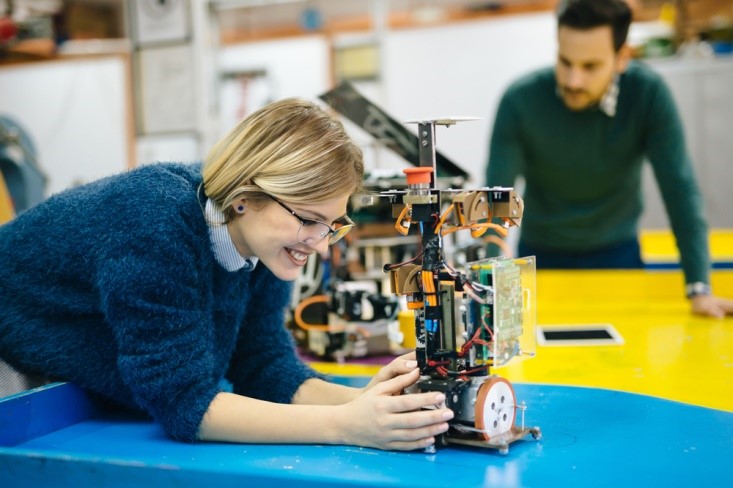
Successfully preparing students to become future technology leaders requires a good deal more than simply equipping students to go off to college to study engineering, computer science, mathematics, or another technology-related field. It requires fostering curiosity, collaborative skills, and a willingness to try — and fail — in their quest to find new solutions and explore new ideas. Teachers, Ed techs, and other educators can support this effort by inspiring their students in a variety of ways.

1. Introduce Them to Current Leaders

Bringing inspirational speakers into the classroom is one of the most effective ways to inspire your students’ thinking and spark new ideas — and new dreams. Listening to stories and advice from current technology leaders will give your students new perspectives on what they can do with their own lives, and help guide them toward decisions that will put them on a path toward leadership. Guest speakers in the classroom can also add new dimensions to your lessons and inspire students to explore new ideas and different directions.

2. Incorporate Technology Into the Classroom

Students today are more connected than ever before, and classrooms are quickly following suit. To truly foster a new generation of leaders, though, teachers need to actively incorporate technology into learning, facilitating their use of new technologies like online streaming and collaboration. Encouraging students to collaborate with each other using online tools like Google Classroom, for example, helps them develop the leadership skills like communication and problem-solving that are in high demand moving into the next decade, while also helping students learn from each other. Using online streaming technologies, you can open a whole new world to your students, connecting them with leaders in different fields, while also giving them the hands-on skills that they’ll need to be competitive in the new world.

3. Support Curiosity

Current leaders in technology note that one of the key components to success in software development and related fields is unrelenting curiosity. A willingness to not only ask questions, but find the answers, is vital to uncovering the new ideas that will change our world. Teachers have a responsibility to foster this curiosity and encourage students to observe the world around them and develop empathy for others, so that they can better understand problems and what’s required to solve them. Give students space to play, to experiment, and test out their ideas, and support them as they search for answers to their questions.

Above all, support students as they uncover their passions. Success in technology requires being passionate about some aspect of the process, whether it’s writing code, improving user experience, or analyzing data or something else entirely. When students are passionate, they will find reasons to explore every aspect of that interest, and it’s your job as an educator to help them determine what that “thing” will be. When you’re successful, you’re setting your students on the path to success in technology leadership.

4. Make It Real

Learning experiences are almost always more effective when they are hands-on, real-world experiences. Learning about technology in a theoretical sense is important, but real-world experience is invaluable when it comes to applying and testing knowledge. Assign projects that require students to solve real problems, and give them the tools they need to test their ideas. As Design Thinking becomes more firmly intertwined in both the classroom and in technology development labs, skills in identifying problems and testing new ways of solving them are going to become more important. Not to mention, giving your students to opportunity to apply their learning in a meaningful, tangible way also helps them to build their portfolios and better represent their knowledge, which will help them down the road as they pursue new opportunities.

Creating the technology leaders of tomorrow requires more than just giving students technical skills. By fostering the qualities that make excellent leaders, you can set your students on the right track and give them a solid foundation that will take them — and our digital world — to new heights.
