Uncategorized

The Edvocate’s List of the 20 Best Education Systems in the World

*The Edvocate is pleased to produce its “Best of the Best” resource lists. These lists provide our readers with rankings for education-related blogs, twitter accounts, influencers, products, etc. These lists are meant to be fluid, and for that reason, they are regularly updated to provide up to the moment information.*

This list is particularly tricky because not only is best a relative term, it depends on a number of different aspects. For example, you have to look at how students perform both in school and after graduation, how competitive the students are, the different subjects that are taught, overall merits, and academic level, to name just a few of the points to consider. This article attempts to rank schools based on overall performance, with the mention of school systems that excel in a particular area. The list is based on geographical location, not any particular rank.

  1. Japan

As one of the leaders in numerous fields, it is no surprise that Japan has an exceptional educational system. In l world rankings they are in the top for science, math, and literacy for all grade levels. Even though students do not have to attend high school, Japan has an enrollment rate of nearly 98%.

Ministry of Education, Culture, Sports, Science, and Technology – +81-(0)3-5253-4111 (Reception)

  1. South Korea

Education is taken incredibly seriously in South Korea, sometimes sending children to school seven days a week. As a result, the literacy rate is nearly 98%, and the country continues to rank high in science and math assessments. Often vying for the top spot in education with Japan, the focus is on learning over student satisfaction.

Ministry of Education – [email protected]

  1. Hong Kong

Because it has been under European influence for so long, Hong Kong is one of the few Asian schools that follow a European model (specifically the UK). Despite teaching in two primary languages (Cantonese and English), the literacy rate is nearly 95%. They also have a high rate of bilingual students as a result of the dual language use in schools.

Education Bureau – [email protected]

  1. Singapore

There is no question that Singapore performs very well when compared to other school systems around the world. Students are expected to continue to push the boundaries so that they can overtake the top ranked spot usually held by either Japan or South Korea. However, it has been faulted for placing too much pressure on students too soon.

Ministry of Education – [email protected]

  1. New Zealand

Students begin school at 5 years old and continue until they are 19, but education is only required for students between ages 6 and 16. Ranked 7th in the world for science and literacy and 13th for math, New Zealand spends a considerable sum on the education of its students. There are two primary languages as well, Maori and English.

Ministry of Education – [email protected]

  1. Australia

With a literacy rate of nearly 99%, Australia enjoys very favorable rankings compared with other countries. While it does not place in the top 10, the country has a 75% secondary graduation rate, and more than a third of the population has completed post-secondary schooling. In terms of the three key areas, Australia ranks 6th (reading), 7th (science), and 9th (math).

Department of Education, Employment, and Workplace Relations – Contact info not readily available.

  1. Netherlands

Not only are the students of the Netherlands competitive in all three key areas (math, science, and literacy), they are usually among the happiest. That’s because the Netherlands focuses on improving the mind and the students’ wellbeing. With less homework in primary school than most countries, students endure less pressure and stress so that school is something they get acclimated to, making it a more positive early experience.

Ministry of Education, Culture, and Science – online contact form

  1. Finland

Finland consistently ranks high in terms of overall accomplishments and student satisfaction. Students are not separated based on their intelligence or abilities, meaning there are no advanced or remedial classes. As a result, there is a far smaller gap between the strong and weak students than in nearly any other country.

Ministry of Education and Culture – [email protected]

  1. Estonia

Spending nearly 4% of the country’s GDP on education, Estonia has a slightly different take on what education should be. In 1992, the country passed the Education Act with the explicit goal of creating “favorable conditions for the development of personality, family and the Estonian nation…” It also seeks to ensure the development of minorities within its borders. Schools are treated not only as a way to educate children in reading, math, and science; they are a way of making students better Estonian citizens.

Ministry of Education and Research – [email protected]

  1. UK

The UK has an internationally famous school system, from the beginning grades to some of the most prestigious universities in the world (Oxford and Cambridge). However, each country controls their own school system (Wales, England, Scotland, and North Ireland). Despite the divided approach, each of the countries manages to help put the UK near the top of the international rankings annually. If you look at the different systems within the UK, Scotland tends to have an edge in international competitiveness.

Department for Education – online contact form

  1. Denmark

The Danish school structure is complex, going from pre-school through higher education, with five different types of secondary schooling. Students can choose the education that best suits their chosen career path, or they can opt out of secondary school. Considering the fact that secondary schooling is not a requirement, it is incredibly impressive that Denmark has an enrollment rate of 82%. This speaks highly of the education system that students choose to stay in school.

Danish Ministry of Education – [email protected]

  1. Poland

There is a close tie between education and business in Poland because the Ministry of Education is also the head of business. The country has been ranked as having the fourth best school system in Europe, an area known for being highly competitive when it comes to education. It has a tiered secondary school system (like several other European schools) so that students can focus on their primary areas of interest for their future career.

Ministry of National Education – [email protected]

  1. Germany

Germany takes education very seriously, which is why it often ranks near the top of school system assessments. All schooling is managed by the state governments (not the federal). The country also takes a different approach to mandatory schooling; the first year (Kindergarten) is not required, but completion of secondary schooling is. Secondary schooling is tiered with five different types. Post-secondary schooling is also among some of the best in the world in terms of science and innovation, and many international students seek a degree from German universities.

Federal Ministry of Education and Research – [email protected]

  1. Belgium

While primary school is set up as it is in many other countries, secondary school is completely different. Once students reach an age when their talents have been established, they can enroll in one of four types of secondary schools: general, technical, vocational, and art. Education is considered a critical aspect of preparing children to be productive and satisfied citizens. That is also why students are able to go to school for free (or nearly free if they go to a private school).

Ministry of Education and Special Needs – online form

  1. Switzerland

The vast majority (95%) of students attend public schools, and they get many of the lessons that are taught more often in private schools in other countries. There are three major languages in the country (German, French, and Italian), and students from the different regions of the country are taught based on the main language used in that region. Students attend different secondary schools based on their strengths and desired profession.

Federal Department of Economic Affairs, Education, and Research – [email protected]

  1. Ireland

Unlike many of the schools on this list, Ireland has a large percentage of privately run secondary schools (although they are funded by the government). The school is free from beginning to end (including higher education).

Department of Education and Skills – email contact list

  1. Qatar

Qatar has been growing its education without a lot of the fanfare and news coverage seen in other nations. Instead, the country has focused on innovating and developing a grassroots approach to ensuring literacy for all citizens. To ensure that it continues to develop and innovate, the country has implemented a Vision 2030 Program. The school is free for all citizens.

Ministry of Education and Higher Education – online form

  1. Israel

With an impressive literacy rate of nearly 100%, Israel is a small country that manages to make education a high priority. Both Hebrew and Arabic are used in the classroom, depending on the area of the country. Their education system includes primary, middle, and secondary schooling. In 2012, Israel was called the world’s second most educated country.

Ministry of Education – contact list

  1. Barbados

A small country in the Caribbean, Barbados actually invests heavily in the education of its students. With one of the highest literacy rates in the world (98%), education is a top priority and is run by the government.

Ministry of Education, Science, Technology and Innovation – [email protected]

  1. Canada

Both English and French are used in school in Canada, based on the province. The country has one of the highest literacy ratings (just over 99%). It also has the highest number of college graduates of any country in the world.

Council of Ministers of Education – mailing list

Conclusion

Education is something that every nation manages in its own way, but there are some countries that are far more efficient than the rest. Exceptional education is not restricted to large countries or even to those countries that are well known for their educational systems. Some of the top 20 education systems are actually in very small countries where governments are able to place an emphasis on education. Ultimately, the best school systems are those that understand how best to reach their students, highlighting the best in their own cultures, instead of focusing solely on international competitiveness.

Reading Horizons Webcast Offers Best Practices for Dyslexia Instruction and Intervention

Dyslexia expert Donell Pons, M.Ed., MAT, will explain the process of evaluating for dyslexia and appropriate instruction and accommodations for students with print-based disabilities

(SALT LAKE CITY) January 10, 2017 — Reading Horizons, a multisensory curriculum used to rapidly increase reading skills, today announced its upcoming webcast, Dyslexia: Best Practices for Instruction and Intervention.

The webcast will take place on Wednesday, January 25, 2017, at 6:00 p.m. ET and will be hosted by Donell Pons, M.Ed., MAT. Pons is currently the Literacy Coordinator at American International School of Utah, sits on the board of Decoding Dyslexia Utah, and is a tutor at the University of Utah Reading Clinic. She became a dyslexia expert and advocate after her husband and two of her four children were diagnosed with the learning disability.

“My mission is to identify, screen, and remediate every student who struggles with reading and engage every K-12 teacher in the reading process,” said Pons.

In the 60-minute webcast, Pons will address the details of dyslexia evaluations as well as how to serve students with dyslexia through individualized education programs and 504 plans. Pons will also share assistive technologies and instructional strategies for struggling readers and those who meet the profile for dyslexia. The webcast will include a live Q&A to answer questions submitted by viewers.

“We’re committed to raising awareness of dyslexia and providing resources that can be useful for educators and families,” said Tyson Smith, the President of Reading Horizons. “We want to empower them with information that will provide support for students with dyslexia.”

Educators interested in taking part in the webcast can register at ReadingHorizons.com/webcast to receive updates and a link to access the free presentation. Following the broadcast, educators may download a certificate of attendance.

This is the third webcast in a professional learning series for educators offered by Reading Horizons and hosted by Pons. The first webcast, Teaching Reading: The Number One Job of Every Educator, can be accessed here. The second installment, Dyslexia: What Every Educator Should Know, can be viewed here.

About Reading Horizons
For more than 30 years, Reading Horizons has been dedicated to perfecting a reading method that has proven successful for beginning readers, struggling readers, and students learning English. Reading Horizons products are research-based and use a multisensory system that provides explicit, systematic, and sequential decoding instruction. For more information, please visit ReadingHorizons.com.

Press Contact
Jacob Hanson
PR with Panache!
[email protected]

How an App Helped Me Build a Classroom Community

A 1st-grade teacher shares her secret to keeping parents connected to their students’ learning.

By Laura Briggs

At Back-to-School Night this year, a parent from my class last year came up to say thank you several times to me. I asked why she was thanking me. With a great big smile, she pointed to her phone and said “Bloomz.” She wasn’t the only parent with positive things to say, either. I had sent a survey to parents in Bloomz at the end of last year to get their feedback and they all responded that using the app helped them feel more connected to school and school activities and that it helped improve communication between home and school. One parent commented, “I downloaded all of the pictures for later and I was able to be at school with our son through the app and share his days.”

I teach first grade at an elementary school in Ashburn, VA. Early last year I was teaching full-day kindergarten, and I kept running into challenges where papers would not make it home or would get left in backpacks. I learned about Bloomz from a colleague while at the ISTE Conference in 2015, and I’ve been using it ever since.

Bloomz provides an easy way for me to communicate with parents, and also lets them communicate privately with me. They all have at least one connected device – whether a phone, computer or tablet, and using my own phone during school allows me to share photos or video, resources, and personal messages with all of my parents. I can send school flyers and announcements, as well as schedule school and classroom events using the calendar. I am completely paperless with my communication, while still keeping parents happy and knowledgeable about what is happening in our class. This additional communication has helped me build a classroom community where parents are engaged and interested in seeing the activities in which their child is participating at school.

Speaking Their Language

One of the features that has made communicating with parents much easier is the language translation feature. Last year, I had 14 different languages in my classroom and as you can imagine, that created some issues in my communication with parents. With the language translation feature, parents were able to choose their preferred language and my posts were translated automatically so they could understand me.

This made parents who did not speak English feel comfortable responding and participating in their child’s education—often for the first time. Using Bloomz even encouraged some parents to learn how to read and write in English. At the beginning of the year, several parents wrote to me in their native languages, but by the end of the year, they were communicating in English and participating more in the app as the year progressed.

Keeping Parents Connected

My students are enthusiastic about Bloomz, too. They use Center Time to upload their work and projects into their Bloomz timelines, which gives me more instructional time. Students can work with a variety of apps for curriculum concepts and then take snapshots of their screens or create short videos to add to their individual student timelines.

As parents see my comments on items, they are kept up-to-date on how their child is doing and can know which skills to continue practicing at home. I am also able to use the work submitted in the student timelines as assessments. And when it comes time to talk with parents face-to-face, I use Bloomz to manage sign-ups for parent-teacher conferences, where I can show examples of each child’s performance using that student’s timeline.

Back at Back-to-School Night, as we got to the Bloomz part of my presentation, I gave a short explanation about how the app works and how I would be using it throughout the year. I asked the parent who had been thanking me if she could come up and say a few words about how the app helped her last year. She told the other parents that everyone needed to have it so they would not miss all of the helpful and fun items that I’d be sending. The 25 parents in the room all immediately pulled out their phones and downloaded the app right away.

By the end of the night, I had all but three parents signed up, and many spouses joined as well. This night really showed me how eager parents are to be involved in their children’s learning, and how willing they are to help create a classroom community.

Laura Briggs is a 1st -grade teacher at Cedar Lane Elementary in Ashburn, VA. You can reach her at [email protected] or follow her on twitter at @LauraBTRT

What cyber charter schools are and why their growth should worry us

This article was written by Bryan Mann and David Baker

What President-elect Donald Trump and the Republican sweep of government will mean for K-12 education priorities over the next four years is not entirely clear yet. However, policy statements and administration selections so far indicate “school choice” will top the agenda.

Betsy DeVos, Trump’s nominee for education secretary, has been known to be an advocate of school choice initiatives: DeVos has supported voucher programs that allow families to use taxpayer money to enroll in private and religious schools. She also promoted charter school legislation that offers students choices outside of traditional public schools.

Vice President-elect Mike Pence too has a history as governor of Indiana of promoting school choice policy. Indiana not only is ranked as having the most favorable policy provisions for charter schools by a prominent charter schooling advocacy group, but it is among the 25 states employing a type of charter school unfamiliar to many folks across the United States: the cyber charter school.

Unlike the usual charter school, the cyber version is typically delivered to students online wherever they may live, so long as they are residents of the state in which the cyber charter school operates. Cyber charter schools have been growing in states that have school choice policy.

Our research, along with a body of academic work, suggests that the public should be concerned about an expansion of the cyber charter schooling model.

Here’s why.

What is a cyber charter school?

Charter schools are privately managed K-12 schools that utilize public money. The funds for charter schools are removed from regular public schooling budgets and paid to various private firms and organizations (and sometimes other parts of a state’s education system) to provide a wider choice of schools.

In the cyber version of the charter school, instruction is typically delivered to the students online wherever they may live, so long as they are residents of the state in which the cyber charter school operates. The model of these schools could vary – some use a hybrid delivery model (online and in person), although most are entirely online. Students receive course material, lessons and tests on their computer at home (usually the computer is also provided with state funds).

As with traditional charter schools, the general idea behind cyber charter schools is to allow families and students to have a choice other than their local public school.

A 2015 annual report prepared by a consulting group that tracks online school practice and is often cited by scholars to describe cyber charter school enrollment shows that in 2014-2015 there were 275,000 students in cyber charter schools across 25 states. In some states, tens of thousands of students enroll in cyber charter schools. In Pennsylvania, for example, more than 36,000 students enrolled in cyber charter schools during 2014-2015.

Where do the students come from?

One of the goals of recent scholarship has been to understand who are the students who enroll in these schools and why do they do so.

http://www.thetechedvocate.org/wp-admin/post-new.php

Pupils from the Einstein Academy Charter School rally in the State Capitol rotunda in Harrisburg, Pennsylvania to protest state policies. AP Photos/ Paul Vathis

The National Education Policy Center (NEPC) conducts an analysis of cyber charter school students every year. The most recent report shows that in 2013-2014, cyber charter schools, compared to the national average, had higher percentages of white students and lower percentages of free and reduced lunch students.

However, since these numbers are nationally aggregated and not every state has a cyber charter school, we believe comparing national cyber charter school averages to all students nationally may be problematic. Our research at Penn State on cyber charter schools has examined enrollments within Pennsylvania and shows that the picture is more complicated.

In our study of enrollments in Pennsylvania, we found that the majority of students in cyber charter schools are indeed white, but they match the racial demographics of the state. Similar results have been seen in Ohio.

Furthermore, in a another study in Pennsylvania we found that it was the economically disadvantaged students who were more likely to enroll in a cyber charter school.

An obvious question to ask is whether parents would have homeschooled their children had the cyber charter school option not existed. The best estimate comes from an internal report of one of the largest national providers of cyber charter schools: The report found that a small percent – 13.6 percent of cyber school students in those schools – were previously homeschooled.

So, what motivates a majority of parents to enroll their children in these schools?

Penn State researchers who interviewed parents who enrolled their children into cyber charter schools found that parents thought these schools were better customized to their children’s needs, carried little financial risk and were possibly the last hope for their child to succeed in school.

Concerns about cyber charters

Despite the hope that many parents hold out for this new educational option, the performance of cyber charter schools has consistently, and often drastically, lagged behind the performance of their brick-and-mortar school counterparts.

Research about cyber charter school performance outcomes paints a dismal picture linked to test-based outcomes. For example, a recent report from the Center for Research on Education Outcomes (CREDO), a policy analysis center based in Stanford University, used a technique to match cyber students to an academic and demographic “twin.”

Researchers have been concerned about the learning in cyber charter schools. Wesley Fryer, CC BY

They did this matching twice, once to compare individual gains of cyber charter students to their statistical twin in brick-and-mortar charter schools and once to compare them to their statistical twin in a brick-and-mortar district school.

Across all racial and poverty status groups of students in the study, the majority of cyber charter school students showed poor learning growth when compared to their matched twin. This was true in both math and reading when students were compared to charter and traditional students.

Researchers found these trends across almost all states that they studied: They found lower learning growth in reading in 14 out of the 17 states, and 17 out of 17 states in math. In their report they noted that improved academic outcomes for a student in a cyber charter school was “the exception rather than the rule.”

This research is consistent with others that examine the academic outcomes of cyber charter schools. Studies have looked at cyber charter school outcomes in Pennsylvania and in Ohio. These studies provide similar results about extremely lower learning growth in cyber charter schools in these state contexts when compared to other schools.

What is of further concern as one legal scholar, Susan DeJarnatt, has shown is that cyber charter schools may not have all the safeguards needed to protect the sector from fraud. Already federal authorities have indicted two of the five “mega-cyber” providers (a school that enrolls more than 2,000 students) in Pennsylvania of fraud.

Outside of the scholarship conducted about fraud in Pennsylvania, a review of hundreds of news stories revealed dozens of state audits across 20-plus states. These news stories repeatedly and overwhelmingly raise concerns about funding and academic accountability across all state contexts, matching the concerns that have emerged in the academic literature.

Looking forward

Following such reports of poor academic outcomes and questionable ethical practices, our research team at Penn State has decided to continue to study the cyber charter school movement in Pennsylvania to find out more.

Our current research examines how cyber charter schools have influenced the entire education system in Pennsylvania.

However, based on the body of academic work that is currently available, we believe while it may be logical to allow online learning in certain circumstances, the cyber charter model is not the appropriate model. And the new education secretary Betsy DeVos might want to exercise caution.

The Conversation

Bryan Mann, Ph.D. Candidate, Pennsylvania State University and David Baker, Professor of Sociology, Education, Demography, Pennsylvania State University

This article was originally published on The Conversation. Read the original article.

Apps to keep kids thinking and learning even during school holidays

This article was written by Craig Blewett

As the summer holidays draw near in many parts of the world, parents shouldn’t be surprised if kids choose to fill their days with technology. After all, teens and tweens are now spending more hours on their devices – iPads, phones and computers – than they are asleep.

Anxious parents will point out how bad this technology obsession is for young people. Too much screen time has been linked to falling grades, impeded social interaction and a lack of exercise.

But there’s a flip side. Several studies support technology’s positive influence on young users. It offers exciting opportunities for learning and can strengthen interpersonal relationships.

In the same way that some food is healthy and some has no nutritional benefits, some apps are low in mental fibre. Based on my own research into how students learn with technology, here’s a guide to getting rid of “junk” apps and ensuring your tweens and teens develop healthy tech habits both in term time and during the school holidays.

From passive to active

The key lies in shifting kids from using apps that make them passive content consumers to those where they are active content producers. Encouraging the use of activating apps can help children to develop a wide range of 21st century skills like collaboration, creativity, critical thinking, and problem solving.

Before I look at apps that will actively engage kids during school holidays, here are the “apps” you should immediately delete from their lives.

  • APPrehension: feelings of inadequacy caused by social media
  • APProval: the dangerous pursuit of digital validation through “likes” and “followers”
  • APathy: the increasing desire to passively consume content
  • APartness: the isolating danger that technology can cause

Once these “apps” are deleted, here’s a selection of apps that will not only engage your kids, but help them develop important skills. I’ve selected a few iOS, Android, and Web-based apps (accessible through a browser on any device). The full list is available here. I’ve grouped these according to the skills they will develop.

Activating apps

Curation:
Curation apps help kids to develop key skills such as reading, categorising and organising.

  • Pinterest (iOS, Android, Web): This popular visual pinboard is great for creating collections of images. How about a pinboard of Disney characters?
  • Learning Lab (Web): This site, created by the Smithsonian museum, allows kids to curate museum artefacts.
  • List.ly (Web): Create fun, shareable lists of websites, videos and more from the web. How about starting with a list of all of the places you want to visit?

Conversation:
There’s a shift from learning through content consumption to learning through conversation around content in online spaces. Conversation-based apps provide opportunities to debate, discuss and enrich relationships.

  • Maily (iOS/Android): A parent-controlled app that allows kids to create fun messages with drawings and text.
  • Playkids Talk (Android): This instant messaging app is for primary school kids. With parental permission kids can send instant messages including photos, voice recordings and graphics to one another.

Correction:
Research shows that one of the most effective ways to learn is through mistakes. Technology allows us to easily experiment, make mistakes and learn through correction.

  • Scribblenauts (iOS/Android): Lets kids bring any object to life simply by typing its name. These objects are then used to solve fun problems.
  • Kahoot! (Web/iOS/Android): A gamified take on quizzes that makes learning – and mistakes – lots of fun. You can create your own quiz or try one of the thousands already created. This is a great way to get a group of kids (and adults) learning and laughing together.

Creation:
Creating content develops key skills such as logic, creative thinking and problem solving.

  • Book Creator (Android and iOS) allows kids to create their own books using their own photos, videos and so on. The final book can even be published to the Google Play store or iBooks.
  • Monster Physics (iOS): Lets kids build working contraptions using a range of parts like wheels, rockets and magnets. Once the contraption is built kids can test it to see how it works.
  • Scratch (Web, iOS, Android): One of the most powerful ways to teach kids creative thinking and logic is through programming. MIT’s Scratch environment is designed to let kids learn to programme in an easy, fun way.

Chaos:
Learning to make sense of too much information, missing information, and conflicting information is a skill children increasingly need to develop in our content-excessive world.

  • Word clouds (Web) are a great way to distil large amounts of text into fascinating visual representations. Worditout allows kids to easily create a word cloud from any piece of text. How about creating a word cloud of the news, or a famous speech?
  • Mindmaps are useful to help organise your thinking. Corkulous (iOS provides a fun corkboard spin on this concept for kids.
  • Sometimes kids can be overwhelmed or bored by content but always enjoy cartoons. Rather than reading or watching them, let your kids create cartoons with toondoo.com or animations with Powtoon.com. How about asking them to create a cartoon that summarises their year?

Keeping track

No matter which apps your kids choose, it’s important to keep track of their use. Research suggests that screen time should be limited, whether young users are consuming “junk” apps or learning while they swipe. OurPact is a great tool to automate this process. It allows parents to set usage schedules or turn off a device at any time.

Craig Blewett, Senior Lecturer in Education & Technology, University of KwaZulu-Natal

This article was originally published on The Conversation. Read the original article.

What these teens learned about the Internet may shock you!

Can digital media literacy contend with bogus news?
Northport, N.Y., High School seniors (left to right) Hayley Striegel, Olivia Poplawski, Cheri Zheng-Fredericks and Julie Pignataro look for ways to verify information they’ve encountered on social media. Photo: Janis Shachter

When the AP United States history students at Aragon High School in San Mateo California, scanned the professionally designed pages of www.minimumwage.com, most concluded that it was a solid, unbiased source of facts and analysis. They noted the menu of research reports, graphics and videos, and the “About” page describing the site as a project of a “nonprofit research organization” called the Employment Policies Institute.

But then their teacher, Will Colglazier, demonstrated how a couple more exploratory clicks—critically, beyond the site itself—revealed that the Employment Policies Institute is considered by the Center for Media and Democracy to be a front group created by lobbyists for the restaurant and hotel industries.

“I have some bright students, and a lot of them felt chagrined that they weren’t able to deduce this,” said Colglazier, who videotaped the episode last January. “They got duped.”

Or, as one student put it, loudly, “fudge nuggets!”

The exercise was part of “Civic Online Reasoning,” a series of news-literacy lessons being developed by Stanford researchers and piloted by teachers at a few dozen schools. The Stanford initiative launched in 2015, joining a handful of recent efforts to help students contend with misinformation and fake news online—a problem as old as dial-up modems, but now supercharged by social media and partisan news bubbles. The backers of these efforts warn that despite young people’s reputation as “digital natives,” they are woefully unprepared to sort online fact from fiction, and the danger isn’t just to scholarship but to citizenship.

Stanford’s myth busters, led by education professor Sam Wineburg and doctoral student Sarah Cotcamp McGrew, have field-tested 15 news-literacy tasks of varying difficulty, with about 50 more in the works. Can middle-school students spot “native advertising” (ads masquerading as articles) on a crowded news website? Can high-school kids check the authenticity of an alarming image posted on Facebook? Will students investigate the sources of controversial claims? Will they seek corroboration? By and large, according to a report the group published last month, the answer in each case is no.

“Overall,” the report concluded, “young people’s ability to reason about the information on the Internet can be summed up in one word: bleak.”

The news literacy initiative is based in the Stanford History Education Group that Wineburg founded in 2002 to train teachers how to use primary sources and help students critically evaluate historical claims. The group also created a free, digital curriculum called “Reading Like a Historian” that’s been downloaded more than three million times, according to Wineburg.

“We live in a world where our library begins with G,” Wineburg said, for Google, and the Common Core’s push for evidence-based reasoning falls flat if students trust everything that pops up in their Google search results.

Even before a deluge of fibs and fakery swamped our recent election cycle, Wineburg and company realized that readers of online news need many of the same skills used by a good historian, such as identifying the sources of claims and asking questions about their evidence. After all, what shows up in your Twitter or Facebook feed can come from anywhere, and a post-election BuzzFeed analysis suggested the fake stuff spreads faster than real news, thanks to hyper-partisan readers blindly sharing sensational headlines.

“This isn’t just a problem with kids,” said Wineburg. “Reliable information is to democratic functioning what clean air and water are to public health.”

Fortunately, long-neglected civics education seems to be on the rebound in many states, which has helped groups like the Center for News Literacy at Stony Brook University get their message into K-12 classrooms. The Center has run a course for undergraduates since 2007 and has since expanded into secondary schools by hosting summer teacher-training workshops and making course materials available online through its Digital Resource Center. In January, they plan to launch a massive online open course (aka a MOOC) called Making Sense of the News: News Literacy Lessons for Digital Citizens.

One early K-12 adopter of the Center’s news-literacy lessons was Janis Schachter, a social studies teacher at Northport High School on Long Island. Schachter took one of the Center’s first summer trainings and has taught Northport’s news-literacy course since 2011 as an elective that meets New York State’s “participation in government” graduation requirement.

“My students are all about social media. They’ve never known life without it, and it’s where they get all their information,” said Schachter. “Whether that information is from a news organization or from your uncle, it all looks the same to them.”

Gradually, Schachter’s students learn how to sort through it all—to check for multiple, informed and named sources, and for claims backed by evidence they can independently verify.

“I tell the kids, it’s not fair that we have to do all this work, but the reality of the Internet is that we do,” said Schachter, who also stresses that students only need to verify news they plan to act on, whether by voting, protesting or just spreading the story by sharing it.

Still, learning news literacy skills is one thing, and the motivation to use those skills is another. If that tantalizing headline in our Facebook newsfeed fits our political outlook, why do the digging that might undermine it?

The fact that so many of us now get our news in partisan online echo chambers sets up “a perfect storm for fake news,” according to Joe Kahne, an education professor at the University of California, Riverside.

In some good news, a new study Kahne co-authored, based on a national survey of young people ages 15 to 27, found that self-reported media-literacy training did make people significantly less likely to believe a factually inaccurate claim, even if it aligned with their political point of view.

Kahne plans to study news-literacy efforts to discover what specific strategies get young people to value facts, whether they bolster their existing beliefs or contradict them. For now, one popular suggestion by news-literacy educators is to tap teenagers’ instinctive aversion to people telling them what to think.

“One of the messages we’ve tried to stress more and more lately with the rise of fake news is this: Do you want to be fooled?” said Jonathan Anzalone, assistant director of the Center for News Literacy. “Wouldn’t you rather make up your own mind?”

This story was produced by The Hechinger Report, a nonprofit, independent news organization focused on inequality and innovation in education. Sign up for our newsletter to get a weekly update on blended learning.

Student Success in Any Path, College or Career, Involves Letting Students Take Responsibility

When teachers are given top-notch learning materials, methods, and professional support, then student success should follow. And, who better for educators to learn from than AP instructors, who have been preparing students to succeed on the College Board’s Advanced Placement exams for much of their careers. After all, AP courses are the gold standard for a highly rigorous curriculum that readies students for the challenges they will face in college or a career.

SpringBoard is a curriculum developed by the not-for-profit College Board with the help of veteran AP teachers to help not only college-bound students, but all students, to excel, even those planning to attend vocational schools or to directly start their careers. SpringBoard includes a variety of tasks students can choose from that will help them master key skills –like reading, writing, critical thinking, and advanced computational skills. These are skills every student needs regardless of their path to college or to a vocational career.

These instructional components in SpringBoard begin with the end in mind. Based on the Understanding by Design model, SpringBoard instruction is built around performance tasks that have been back-mapped from AP and college and career readiness standards. Teachers and students see clear learning targets at the beginning of set of activities. The College Board says that when students understand why the skills they’re developing matter, they take ownership.

The College Board reports that their approach is proving effective in many schools—resulting in higher test scores and greater numbers of students taking higher-level courses.

High schools using the program for at least three years have had significantly more students taking AP courses, particularly among underrepresented students. For example, SpringBoard users have seen a 109-percent gain in the number of African-American students taking AP courses and a 52-percent gain in the number of Hispanic students taking AP courses, the College Board says.

Using SpringBoard also improves students’ actual API scores. At Tetzlaff Middle School, a magnet school in Los Angeles County’s ABC Unified School District, students have gained more than 60 points, on average, on California’s Academic Performance Index (API) measurement since SpringBoard was introduced. The school’s average API score jumped from 796 before using the program to 858 two years later—well above the state’s API goal of 800.

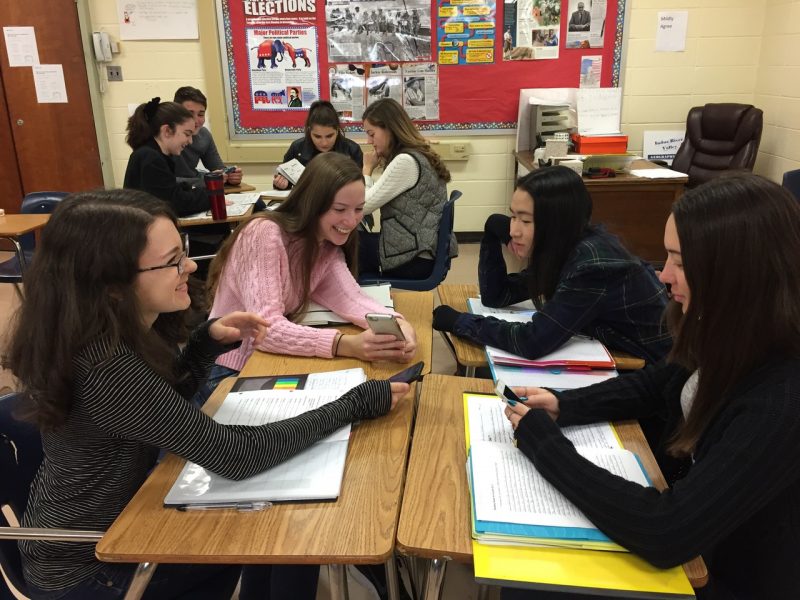
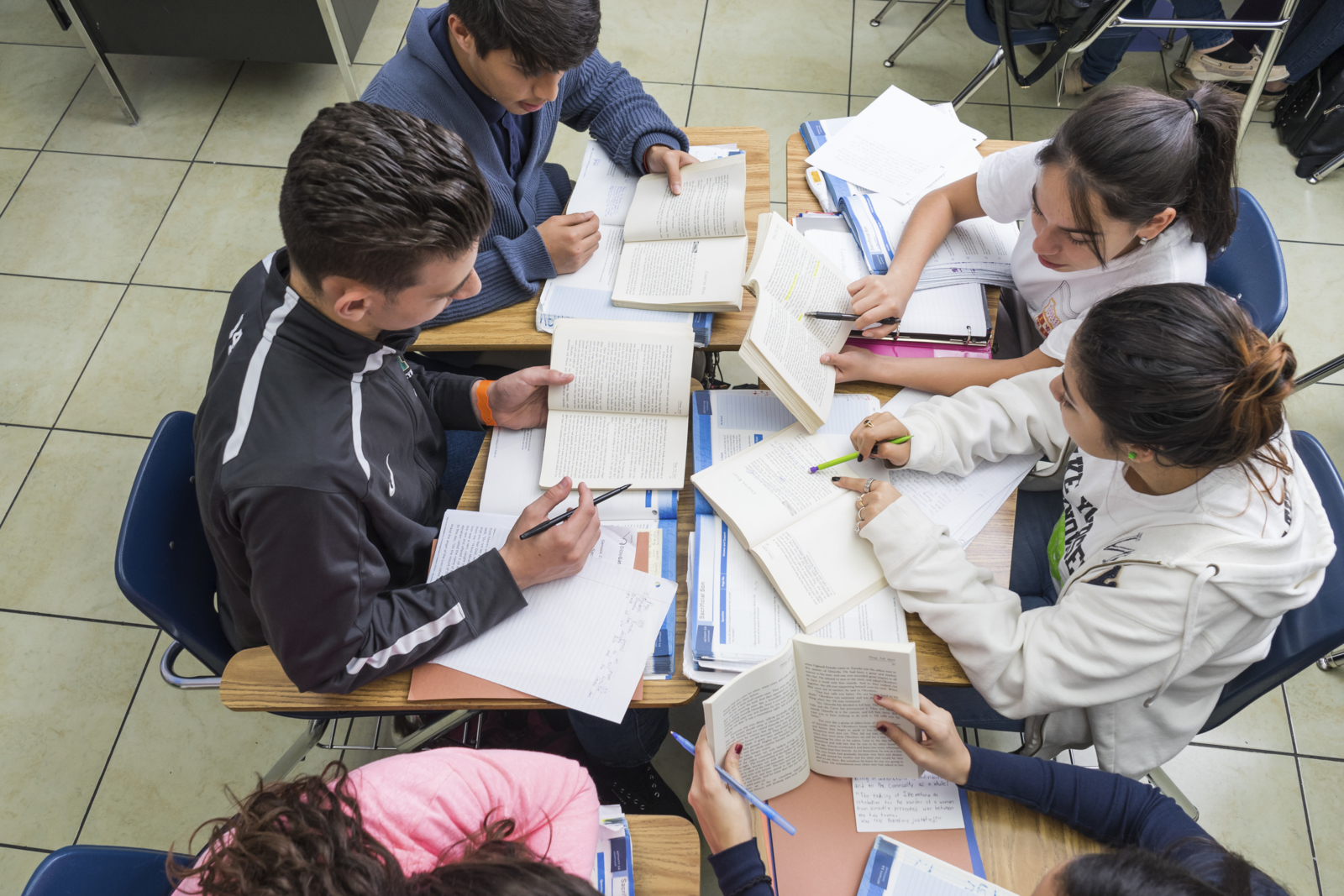
Collaborative learning is encouraged in SpringBoard. Here, students work together on an ELA assignment, comparing notes and impressions on a selected reading.

In Charles County, Maryland, where 52 percent of students are African-American, district leaders credit SpringBoard with helping to close achievement gaps among African-American students and their white peers. What’s more, SpringBoard’s AP connection is helping more students score a 3 or higher on the AP Literature and Composition Exam.

Much of the success in both Tetzlaff and Charles County can be traced to the fact that students are writing more often. SpringBoard incorporates writing into every unit, and as a result, students in schools that are using the product are writing more frequently across the curriculum. With SpringBoard’s emphasis on close reading, there is also a strong connection between gathering evidence within a text, and using that evidence in writing.

To facilitate this focus on writing, SpringBoard has embedded Turnitin’s Revision Assistant into its digital platform. Revision Assistant provides students with automated feedback on their writing. Teachers can embed a performance task into a lesson, such as having students write a letter to the editor about a topic they are currently studying—and Revision Assistant generates immediate, rubric-aligned feedback whenever students call for a “signal check.” The ability to get immediate feedback actually encourages students to make multiple revisions; in fact, Turnitin’s pilot study found that students revised their assignments an average of ten times for middle schoolers and six times for high schoolers.

Teachers appreciate this heavy focus on writing. “This is the first program that I’ve taught in which writing is valued and incorporated continuously throughout each activity,” one Charles County teacher says. “What’s fascinating is how the kids can’t wait to share their writing and insights about the stories we’ve read.”

A Tetzlaff teacher says: “The emphasis on frequent writing in a variety of modes … prepares my students for the rigors of AP.”

Ultimately, many factors affect how well educators prepare students for college and a career. Setting high expectations for students as early as middle school, and then providing a rigorous, student-centered curriculum, is at the top of the list for school leaders.

“Preparing all students for success in college and careers is a major challenge in a district this size,” says Judy Estep, assistant superintendent for instruction in Charles County. “SpringBoard is a perfect fit, (because) it builds in all the elements to support both teachers and students. The program has caused teachers to reconsider how they are delivering instruction as they improve their craft—and as students become more engaged and responsible for their own learning.”

At Mater Academy in Hialeah Gardens, FL, students work with SpringBoard to better prepare for college and career.

Assuming responsibility for their own success: That’s one lesson every student can benefit from, as it will carry them through every facet of their lives—regardless of what path they take.

Diversity in Higher Education: What MLK Would Say About?

Rev. Dr. Martin Luther King Jr. is recognized as one of the greatest speakers of the 20th century. He championed for equality by focusing on how nonviolent action could bring change, an end to racial injustice, and a movement toward racial equality. One of the areas needing improvement was higher education. If Dr. King were alive today, what would he have to say about diversity in higher education? Continue reading to find out.

In his June 11, 1967, speech, King spoke of the limited roads offered to minorities on the economic highway. Often, education is considered a method for bringing people out of poverty. Higher levels of education provide individuals with more opportunities, and people can build stronger communities through their support and compassion.

So, as we reach the 50th anniversary of that speech, we are left to wonder what King would have to say about our progress in equalizing opportunities in higher education through diversity initiatives and other efforts. While we may not know for certain, here are some points that would likely have him talking.

Diversity Initiatives in the Early 1970s to Now

A study conducted by Peter L. Hinrichs, a Georgetown University Assistant Professor of Public Policy, looked to determine the measures of segregation in higher education as based on comparisons of the number of white and black individuals in the student body. Not surprisingly, Hinrichs found that desegregation efforts increased diversity the most notably in the early 1970s.

During that time, it wasn’t uncommon for colleges and universities to openly recruit minority students as part of the larger segregation efforts associated with the progress made by the civil rights movement. However, over time, many of these practices fell out of favor. This has led to many institutions of higher learning to become less diverse over time incidentally.

While King may find these statistics disheartening, it is important to interject some key points. First, many college students choose to attend schools near their homes. Since populations aren’t evenly dispersed through the country, some regions will show college student bodies with makeup similar to the surrounding area regardless of other efforts.

Second, some schools, such as those labeled as historically black colleges and universities, will also show less diversity. The institution’s original mission attract specific portions of the population based on their history and not necessarily their current actions.

Affirmative Action and College Enrollment

The affirmative action movement has been controversial since its inception, though more so for the way it is used than the underlying concept. The intent of these programs is to allow race to be a factor in choosing which applicants are admitted, giving preference to minorities under certain circumstances. And that was an idea that King actually supported.

In fact, in his book Where Do We Go from Here: Chaos of Community?, King explicitly stated, “[a] society that has done something special against the Negro for hundreds of years must now do something special for the Negro.”

However, his thoughts on the affirmative action concept weren’t so much guided by racial motives, but issues of need. His goal focused more on finding support for members of the poor regardless of any other characteristic, a sentiment well expressed in this quote from his Nobel Prize acceptance speech in 1964:

“I have the audacity to believe that peoples everywhere can have three meals a day for their bodies, education and culture for their minds, and dignity, equality, and freedom for their spirits.”

So, maybe the larger question shouldn’t be what King would think of diversity in higher education. Perhaps, it should be about what King would think of our world today.


Improving College Diversity in 2018

Many Americans are surprised by the 2016 election results, but at this point, the results will stand and later this month, a new U.S. President will be inaugurated. It remains to be seen what the Trump presidency will mean for diversity – and that’s true at the college level too.

If we want to make a positive difference for the future of America, change begins with education. Emphasis must be placed on the inclusion of all students, regardless of gender, ethnicity or economic status. Diversifying our nation’s elite colleges would be a step in the right direction. An increased number of college graduates from top universities equates to a more educated, skilled and productive workforce for our country.

Reaching the Working-Class Student

Though many colleges and universities enroll students with diverse ethnicities from all over the globe, disadvantaged students do not typically enjoy the same inclusion. Overall, college just isn’t as accessible to working-class students. What’s more, troubling is that many low and middle-class students could thrive at a top university if only given a chance. Often, financially disadvantaged students who obtain top test scores and grades, don’t even bother applying to these schools.

Case in point: According to a study conducted by education researchers from Harvard and Stanford, just 34 percent of high school seniors who excelled academically and were in the bottom income distribution bracket, attended one of the nation’s selective colleges. For students in the highest income category, the figure was 78 percent. Although public and private universities have expressed a desire to recruit economically diverse students, it’s just not happening.

Unfortunately, of the low-income students who do choose to pursue higher education, many select community colleges or institutions based primarily on their proximity to home. The outcome of attending these schools is that fewer resources tend to be offered and many formerly high-achieving high school students, wind up not even graduating college.

Early Encouragement

Paving the way early on can set the tone for a child’s entire educational career. If programs and services can be tailored to the students who are most often overlooked, we may be able to influence the number of diverse college students positively. By identifying and targeting disadvantaged children as young as middle school age, schools may be able to, at the very minimum, provide information on the importance of quality higher education.

Resources and dedicated staff should be made available during the school day for students to access throughout their education. Delivering financial aid information and materials to interested students would also go a long way in establishing awareness for available assistance. It’s crucial that top ranked universities play their part, as well. Offering community outreach programs and forging public school partnerships in poor areas, is a good place to start.

If institutions become more accessible to students via programming and recruitment endeavors, the odds that students will be fully informed when it comes time to consider higher education are increased.

Beyond Test Scores

In addition to an emphasis on better targeting and programming throughout schooling, colleges may also want to examine their traditional means of determining and selecting candidates. Less focus on grades and SAT/ACT scores and more attention placed on student portfolios and potential should be in order. How a student will fare in college, and in the working world, aren’t always made evident by test scores. The option of taking other qualifications into account allows institutions the opportunity to diversify their student population greatly.

Another issue worth touching on is retention of diverse students and what can be done to ensure their collegiate success. Programs and support for non-traditional students would be ideal, even being offered before classes beginning, to aid in easing the transition. Resources specific to first-generation students, full-time working students, and students who are parents, are just a few examples of the specifically targeted assistance that could make a positive impact.

The bottom line is, higher education opportunities need to be equally available to all. If we are to correct the inequality running rampant at colleges nationwide, special focus must be made to assist underprivileged students in their quest for higher education.


The Edvocate’s List of 20 Must-Follow Higher Education Twitter Feeds

*The Edvocate is pleased to produce its “Best of the Best” resource lists. These lists provide our readers with rankings for education-related blogs, twitter accounts, influencers, products, etc. These lists are meant to be fluid, and for that reason, they are regularly updated to provide up to the moment information.*

Twitter is often waved off by academics as a way to pass the time when you have nothing better to do. However, there are some who understand just how useful Twitter can be a tool for reaching the younger generations. If you want to spread the word about higher education policies, critiques, or ideas, Twitter is a brilliant way to share ideas. And sometimes some individuals are so entrenched in higher education that they understand what people really need is a good laugh about the whole thing.

The following 20 accounts provide insight not only into the world of academia but into the right way to manage a Twitter account. Some of the accounts are run by individuals who have a lot to say about higher education, the cost, the lifestyle, and the pains, while other focus on making people laugh. All of them can help you keep things in perspective while teaching you a thing or two about how to wield Twitter in a way that is beneficial, entertaining, or both.

Our list has been compiled with the following four key qualities in mind:

  1. Activity. The account sends out tweets regularly to disseminate the very latest news and trends in higher education.
  2. Originality. The tweets add value with content that’s different from all the other higher education focused Twitter accounts out there.
  3. Helpfulness. A good higher education Twitter account should teach you something new, direct you to a useful resource, or at least get you to think in a new way about something.
  4. Authority. The author/authors have the authority and credentials to tweet about the topic of higher education.
  1. @AcademicsSay

This blog can help you keep things in perspective when you are frustrated or tired after a long day in the higher education realm. Constantly poking fun at some of the absurdities and taking a new perspective on the things that get under your skin, this feed can make you laugh despite everything else happening. It reminds you to take things less seriously because sometimes the things that seem normal in the academic world are shown to be just as silly or complicated as you thought they were.

  1. @thesiswhisperer

Managed by Dr. Mewburn of the Australian national University, this Twitter feed takes a look at many different aspects of dealing with that final thesis. It covers the basics, such as font and spacing, and more complicated and difficult questions, such as getting the right flow. No field is off limits either, making it a great feed if you are writing or deal with a thesis on a regular basis. There is nothing quite like feeling like someone understands your pain.

  1. @studentactivism

Written and managed by Angus Johnston, this blog will keep you updated on the latest news and events in the student activism realm. There are few places where activism has so much passion and dedication. This feed can help you understand the latest movements and events that matter to students.

  1. @TheLitCritGuy

This is not a feed for just English and Literature. Every field has their own literary needs and rules. The Lit Crit guy helps professors get a grasp on all of the complaints and problems with dealing with student work. It also manages to sympathize with students when it comes to meeting hard deadlines and keeping an open mind when it comes to criticism.

  1. @dynarski

One of the biggest criticisms (and complaints) about higher education in the US is the cost and access for the vast majority of students. Due Dynarski covers many of the commercial areas of the industry, although her feed is not limited to it. There is a good bit of politics and academic stories mixed into the feed as both can affect numerous aspects of higher education.

  1. @hashtagoras

Managed by Joseph a Howley, this feed is full of humor and academic/nerdy references that can help you laugh on the roughest of days. Naturally, there is no particular field or area of focus. It is free.

  1. @Chemjobber

If you are in chemistry (or any science field), this particular Twitter feed can be incredibly helpful in keeping current with changes and news. Naturally, there is a bit of humor cooked into the feed as well.

  1. @OED

While not technically a blog just for higher education, it is certainly a Twitter feed that everyone in academia should be following. The Oxford English Dictionary feed provides a daily look at the language one word at a time. They also celebrate certain events, such as the birthdate of a famous person who helped change the field (J.R.R. Tolkien was honored on January 3 with the word he created, Orchish), as well as taking a look at the world through the words chosen.

  1. @AcademiaObscura

You can get a look at some of the most obscure and bizarre things in the academic world by following this Twitter feed. For example, if you can check out the most often googled ideas by entering “Why are professors” or “Why are academics” into Goggle. It can help you see just what people think of the profession. Many of the posts are funny, largely because of how much you will identify with them.

  1. @raulpacheco

This feed is for those who are in the academic world for the long haul. It details what it is like living the life of an academic, especially the amount of writing required to stay in the field. It covers a wide range of topics, from school and government politics to policy to the daily grind.

  1. @academicpain

If you prefer a visual, every post on this feed contains a GIF. That makes it easy to process each point without having to engage your brain too much. A quick look at the page will help you destress and laugh when things just aren’t going the way you planned. The posts are usually generic, so you are almost guaranteed to find something familiar from a new (and more interesting) light.

  1. @Jessifer

Jesse Stommel manages this feed, and it is the ultimate place for pedagogy on a different level. The feeds often remind you that no matter how far you make it, there is always some way to improve. It is a great reminder that everyone can do better, so never sit back and be complacent.

  1. @AlexUsherHESA

This particular Twitter feed focuses on higher education in Toronto, but many of the points are absolutely universal. Through the healthy dose of policies and politics, you can find things that are similar to what you have to deal with regularly.

  1. @bonstewart

Managed by Bonnie Stewart, this feed looks at many of the different issues with being an educator in higher education. She offers advice and anecdotes on class methodology and dealing with online classes.

  1. @ubcprez

The only feed to make the list run by a higher education president, this feed goes beyond the usual college feed. Santa J. Ono offers students information about the school, as well as providing information on a wide range of areas, such as dealing with Twitter and the problems that are universal on any campus.

  1. @saragoldrickrab

This is another Twitter feed that provides details on being an activist in academia. It is not limited to being just a student activists either so that anyone who wants to start making a difference can find ways to join or assist in the areas that matter to them.

  1. @chronicle

Chronicle is based in Washington, DC and it focuses on many of the different aspects of higher education. It publishes news stories from around the US about policies, reports, and findings related to higher education. It also posts information that will help students with college life and the transition into a career.

  1. @GdnHigherEd

The Higher Education Twitter account was created to give everyone within the higher education arena a place to find news, post ideas and opinions, and to hold professional debates. It is a part of The Guardian, a UK news agency, but many of the posts are relevant regardless of where you live.

  1. @rkelchen

Whenever a big story breaks about higher education, you are likely to find information on it here. Managed by Robert Kelchen, this feed posts congratulations, information, news, and trends happening in the US.

  1. @MalindaSmith

Malinda Smith works at the University of Alberta as a professor in political science. Her Twitter feed is full of information and news about equality, civil rights, diversity, and bias within higher education. Nor are her posts restricted to the news in Canada, as there are about as many posts on US higher education as on Canadian news.

Conclusion

It is easy to think of Twitter as a shallow method of communicating when used right; Twitter can actually be a highly effective way of reaching thousands or millions of people. For those in higher education, it is a boon to ensure that you are keeping current with all of the latest changes, trends, and information. It also provides the perfect outlet to step back and laugh.