When Barack Obama assumed the presidency, he was confronted by a nasty set of problems in P-20 education. High student loan debt, lack of affordable early-childhood education options, and everything in between were put in the President’s lap and have been issues he’s addressed in both terms. Given the nature and sheer number of challenges, his administration has done a great deal to foster positive change and progress.
In a previous article, I outlinedBarack Obama’s Top Ten P-20 Education Accomplishments. In this article, I decided to write an assessment of Obama’s overall P-20 education record, issuing a letter grade (A-F) to make my position abundantly clear. I will use a selection of his most impactful initiatives to assess his record.
STEM Education Reform. The President was not only vocal about the need for stronger programs in science, technology, engineering, and math but he put some money behind his words. His 2014 budget included $3.1 billion in investments in federal STEM programs – an increase of nearly 7 percent over the budget from the previous two years. Of that $3.1 billion, too, Obama designated some $80 million to recruit 100,000 qualified educators. He also earmarked another $35 million to launch a pilot STEM Master Teacher Corps. The rest of the money went to supporting undergraduate STEM education programs and investment in breakthrough research on best teaching practices for STEM subjects, helping to prepare today’s students for the worldwide workforce.
Obama administration released a testing action plan for K-12. President Obama was determined not to allow the moniker of “lame duck” to stick to him. In 2015, Obama and the Department of Education released their Testing Action Plan, which aimed to reduce the burden of tests that many students are tasked with taking.
While Obama has little recourse in scaling back how often States tests its students, his administration can at least provide an outline. Part of thatoutline included having schools “send parents written notice” if students exceed a two-percent cap on classroom time that they may spend taking tests.
The whole point of this initiative is to utilize additional ways to measure student success as opposed to just testing. Included in theaction plan are ways that schools may determine “how well students are learning and schools are functioning” by using “portfolios, projects, technology-supported assessments, students surveys,” etc. It’s still assessment, though, instead of just teaching and letting students learn—something that critics argue is sorely lacking in P-12 classrooms today.
In addition to the cap on testing and student measuring tools, the administration stated that it would be more flexible with federal standards when it comes to teacher evaluations. On his way out of the White House, Obama is attempting to untangle the legacy of No Child Left Behind and create a new path and perhaps leave a presidential legacy on education.
Expansion of Community Colleges. In July 2012, President Obama proposed the American Graduation Initiative, intended to put more money and planning into community colleges, helping to promote more affordable options and high levels of training for all prospective college students. As part of this initiative, the Health Care and Education Reconciliation Act poured $2 billion over the course of four years into an expansion of career training at community colleges, focusing on the high-demand health care field.
Enforcement of the DREAM Act. The Development, Relief and Education for Alien Minors, or DREAM, Act provided an estimated 2.1 million young people in the U.S. with access to an education and amnesty from deportation. While Obama’s administration stressed the ethical points of this act, rightfully so, it offers may economic benefits for America as well.
Higher College Tax Credits. The Obama-Biden administration tripled the tax credits available to students and parents of students paying college expenses, too. The American Opportunity Tax Credit gives a $2,500 tax credit maximum per student and students can claim it for four years.
According to the IRS, up to 40 percent of the credit is refundable, up to $1,000, to people that file even if no taxes are owed. In addition to courses and fees, the new tax credit also covers related costs like books, supplies, and required class materials.
Income-Based Loan Repayment. President Obama has often said that he believes that paying for college should not overwhelm graduates. As a reflection of this, he has pledged to expand income-based repayment options to keep the bills from college from becoming unmanageable. Around two-thirds of college students have a debt of over $23,000 upon graduation. This can be especially difficult for students that want to enter public service jobs and those who face unexpected financial hardships like unemployment or serious illness.
Students can limit payments to 10 percent of income – a reduction from 15 percent in the previous law – which means a reduction of $110 per month for unmarried borrowers that owe $20,000 and make $30,000 per year. An estimated 1 million borrowers will be positively impacted by this change in repayment options. Also, borrowers that make monthly payments will be allowed debt forgiveness after 20 years. Public service workers like nurses, teachers, and military employees will receive debt forgiveness after just ten years.
Promise Neighborhoods. In 2010, President Obama another important educational initiative known as the Promise Neighborhood Grants emerged. The Promise Neighborhoods Grants supported cradle-to-career services intended to improve the educational attainment and healthy development of children. The program aimed to provide students in Promise Neighborhoods with access to effective schools and well-built networks of parental and community support, preparing them to receive an exceptional education and effectively transition to college and a career. Patterned after Geoffrey Canada’s Harlem Children’s Zone, Promise Neighborhoods are a “promising” reinvention of an existing educational innovation.
When Obama assumed the presidency, a nasty set of problems confronted him in K-12 education. Given the nature and sheer number of challenges, his administration did a great deal to foster positive change and progress with education reforms like Race to the Top and Promise Neighborhoods. Overall, therefore, I think the president deserves an A, which reflects his solid P-20 education record as Commander-in-Chief. I am sure many will disagree with this assessment, but it is my opinion in light of the policies mentioned above. I am looking forward to reading your comments, and I encourage you to use this article as a springboard for discussion.
After spending a decade and a half in the field of education, and much to my chagrin, not much has changed. K-12 schools are still underperforming, losing the global war for intellectual supremacy year after year. The power to counteract this is within our grasp, but we are too busy fighting political battles over state and parental rights. Our kids deserve better.
The bottom line is that most valuable commodity that we have is our children, and the future of the United States is inextricably tied to them. Unless we provide our children with a world-class education now, we will suffer later, when they are unable to lead or compete in the global economy.
Let’s stop fighting these petty turf wars. Who cares if Common Core is tied to President Obama or not? Flawed as it may be, it has the potential to ensure that all children graduate with the skills that they need to become productive citizens. It could be a game changer, but many of us reject it because it feels too much like a nationalized curriculum, or because we simply don’t understand the potential benefits. I brought up Common Core because it’s a divisive issue, driven more by politics than practicality.
It’s funny how we say that it is all about the kids, but at the end of the day, education policy makers create laws based on what is best for stakeholders. They don’t want to upset educators, teachers unions, parents, business, etc. Who cares about what upsets kids?
Take ten minutes out of your day and talk to a high school dropout. Ask them why they dropped out? The answers that you get will give you valuable insight into what is wrong with U.S. Education system. Instead of listening to the feedback from students, we would rather do a deep dive into the data, or pay a consultant six figures.
Our kids deserve better. They deserve access a quality education regardless of where they live in this country. The only thing standing in our way is us. If we could learn to focus on what matters most, our children, then and only then will we be able to reform the U.S. education system and secure our children’s future.
NEW ORLEANS — Nov. 30, 2016 — After implementing the Kickboard school culture system in five schools and seeing dramatic reductions in suspensions and discipline referrals — and sizable increases in positive behaviors — St. Louis Public Schools(SLPS) is expanding the use of Kickboard to 25 schools this fall.
Carver Elementary, Farragut Elementary, Lyon Academy at Blow Elementary, Patrick Henry Downtown Academy, and Sigel Elementary began using the Kickboard school culture systemto help teachers and administrators establish consistent behavior expectations; collect, analyze and act on real-time behavior data; address behavior issues; conduct responsive interventions; and create a more proactive, positive learning environment. The schools also participated in Kickboard’s Leadership Coaching to help leadership teams drive school-wide improvement.
“To maximize learning for every child, it’s essential to focus on academic rigor and school climate and culture,” said David Hardy, deputy superintendent of academics for SLPS. “Before we began working with Kickboard, we couldn’t pinpoint some of the key challenges our schools faced. Kickboard identified these missing data points to show our schools where they were struggling, and support them in creating action plans to transform their cultures. The Kickboard software and coaching are pushing our schools to think differently about what makes students and teachers successful, how they can create stronger cultures, and how they can sustain this improvement over time.”
During the 2015-16 school year, the pilot schools saw substantial improvements. For example, at Carver Elementary, the number of office referrals dropped from 250 per week to only 35 per week — an 86 percent decrease. Farragut Elementary recorded an 84 percent decline in recess detentions, and a 64 percent drop in suspensions. Lyon Academy saw a 79 percent decrease in referrals to the school’s reflection room. At Patrick Henry Downtown Academy, the number of suspensions fell from 48 in 2015 to only seven in 2016.
“Kickboard allows us to dive deeper to see what’s behind the numbers, so we can intervene before small problems become large. Our use of school culture data is changing the way we’re supporting our students to be successful,” said Hardy.
In addition, Kickboard enables school leaders to accurately measure the impact of positive culture programs, such as Positive Behavior Interventions and Supports (PBIS). For example, in 2015-16, Patrick Henry Downtown Academy recorded a 149 percent increase in the number of occurrences of “active learning” taking place in the classroom.
“With Kickboard, we have much greater insight into how to effectively use school culture data to improve student outcomes,” said Hardy. “Instead of looking only at suspension rates and attendance, we’re now looking at data such as the ratio of positive to negative behaviors in the classroom or in a school. Having that data available helps us align our thinking around the culture and the behaviors we want to see in our classrooms. It allows us to look at each child holistically, so we can provide targeted support to meet the needs of our students, teachers, leaders and schools. Our students and staff are truly invested in our partnership with Kickboard and in the results we’re achieving.”
About Kickboard
The Kickboard school culture system is a configurable, web-based platform used by K-12 educators to improve school culture through positive behavior reinforcement, intervention management, classroom management, and district-wide school culture analysis. This unique combination of features allows schools and districts to directly impact student achievement, attendance, discipline, and more. For information or to sign up for a free school trial, visithttps://www.kickboardforschools.com.
As we celebrate Barack Obama’s Presidency, I have been thinking more and more about his record on education. More specifically, what was his greatest accomplishment when it comes to P-20 education? Personally, I consider Race to the Top to be his greatest P-20 accomplishment. After much reflection, I decided to write an opinion piece, assessing it on its merits. Toward the end of the piece, I will issue a letter grade (A-F) denoting the results of my evaluation.
Touted as Obama’s education reform magnum opus, Race to the Top aimed to sustain successful teachers and principals in school districts across the nation. It was also responsible for the adoption of common K-12 teaching standards. Per the competitive component of this ‘race,’ states received points for fulfilling certain criteria, such as performance-based standards for teachers and principals, showing fidelity to nationwide standards, encouraging charter schools, and the like.
At least, this is how it works in theory. Generally speaking, though, the Race to the Top initiative has raised standards for learning and emphasized college and career readiness. Each year, the program gave even more in federal funding to states that prepare plans for reforming their student offerings. The program has allocated more than $4 billion among 19 states for developing plans to improve learning standards, teacher effectiveness, and struggling schools. The states granted the funds represent 42 percent of all low-income students in the nation, too, making the initiative an effective way to close the achievement gap and equalize funding in areas where schools may struggle based on their geographical location.
It all sounds good in a condensed summary, but upon closer review, Race to the Top has not had the intended impact. Critics of Race to the Top argue that its emphasis on high-stakes testing is untrustworthy – and I am inclined to agree. As the grant period comes to a close, it is clear that reform has fallen short – particularly when it comes to student performance. A few areas that have not lived up to Race to the Top goals include:
College enrollment. While graduation rates are above target, the number of high school graduates enrolling in college or some other form of post-secondary learning has actually decreased. Proficiency on standardized testing nationwide did not rise as quickly as promised, either.
Unused vouchers. To attract better teachers, Race to the Top grantees were allowed to be used for vouchers created to lure high-performing teachers to low-performing schools. These vouchers have a relative amount of freedom-for-use attached, with vouchers being allowed to pay students loans, tuition, housing, and other options. Unfortunately, many of these vouchers went unused by the districts. In 2012, only 35 of 106 schools eligible to get bonuses for improved student performance received the extra $1,500 per teacher.
Poverty still too big a player. Many of the states receiving funding were targeted that way because of higher-than-average low-income students, or those living in poverty conditions that impacted their educations. The fact that Race to the Top did not address overemphasis on standardized testing and teacher accountability is a problem, according to people like Elaine Weiss of Broader, Bolder Approach to Education. Weiss’ group calls for better focus on poverty and the issues that accompany it, especially in urban classrooms.
To be fair, the biggest grant-funded Race to the Top changes are largely unseen. They are invisible to the general public. Some things are simply not cut-and-dry, or able to be seen in the short term. Some of the grant money that was distributed paid for summer institutes for teachers and principals where they were trained in the new Common Core standards. Technology improvements like building Cloud infrastructures are still in their infancy and have not truly been realized just yet. It is also too soon to see what positive changes recruiting high-quality personnel will have.
Although it is not the silver bullet that many believed it would be, Race to the Top was definitely a step in the right direction when it comes to education policy reform. Under President Obama’s watch, the U. S. education system is experienced something that it hasn’t experienced in ages — genuine progress. Although we have many more miles to go, we have to remember that Rome was not built in a day. The issues that continuously plague our public education system took decades to get that way and will probably take several more decades to fix. Again, my opinions are just that, my opinions.
Solely on its merits, I will have to give Race to the Top a solid B-. Race to the Top is not a failure; it just has not turned out to be the golden child its intentions promised. There is room for improvement, especially when students are still tested using antiquated assessment measures. Although Race to the Top has not lived up to the hype, what President Obama has been able to accomplish in eight years is nothing short of amazing.
What do you think? Has Race to the Top been a success? What grade would you give it?
Derrick Fields, 9, works on his assignment during a Spanish-language history lesson at Sherman Elementary School in San Diego, California. Photo: Lillian Mongeau
Californians voted yes on that state’s Proposition 58, known as the Multilingual Education Act.
Based on a measure proposed by State Sen. Ricardo Lara (D), the new law largely eliminates the red tape involved in creating a bilingual education program. The vote signals a major shift in thinking for a state that effectively outlawed bilingual education in 1998. The evolution in thinking on the value of bilingual education and the specifics of the voter proposition was covered in depth by The Hechinger Report in this story from our archives.
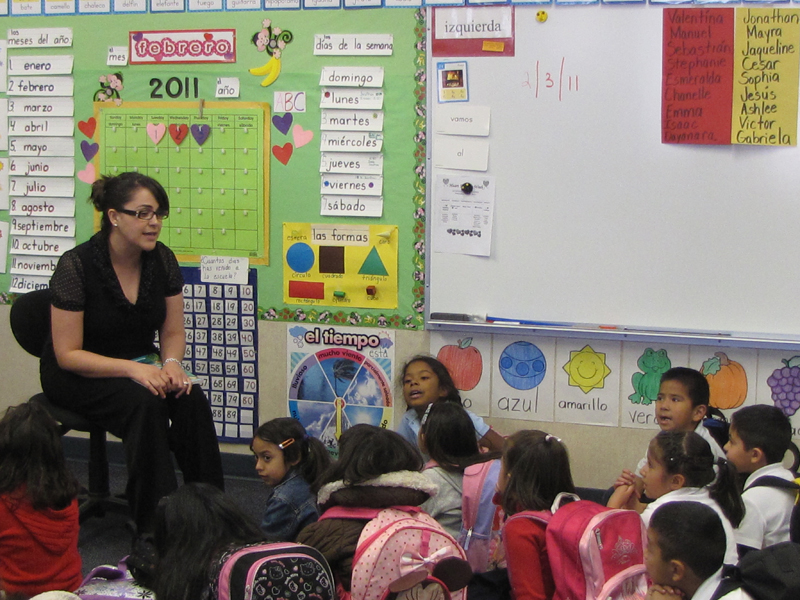
SAN DIEGO, Calif. — Last spring, Derrick Fields, 9, sat in his social studies classroom at Sherman Elementary School, learning about the creation of the telegraph. The machine was invented so that “someone can connect to someone who is far away,” he said.
This was pretty normal stuff for a fourth grade history lesson, except for one thing: The entire lesson — from the textbooks to the teacher’s instructions to the students’ short essays — was in Spanish.
In fact, half of Derrick’s time is spent learning in Spanish and the other half in English in what’s known as a dual language immersion program.
Unz’s argument won the day. Proposition 227 was voted into law with 61 percent of the vote. Now part of California’s extensive education code, the law holds that “all children in California public schools shall be taught English by being taught in English.”
For the most part, that has been interpreted as: Don’t teach in Spanish.
“I am in the camp that says it’s just a terrible waste,” said Patricia Gandara, an education professor at the University of California, Los Angeles. “There are all kinds of social, cognitive and tangible benefits that accrue to those with more than one language. It’s a terrible loss.”
Most schools did away with their long-term bilingual programs, even though Prop 227 didn’t actually outlaw learning in a foreign language. It just made it much harder. But the parents at Derrick’s school were willing to sign annual parental waivers and school leaders were willing to pull together documentation that a dual language program would meet the “special needs” of their students and submit an application for such a program to the state.
It’s “kinda weird” and “kinda” hard, to learn in two languages, said Derrick, who speaks English and some Spanish at home. But his parents wanted him to try the dual language program and he likes it “fine.” While other students were more enthusiastic about the dual language set-up at Sherman, they were all too young to understand exactly what their school represents.
Programs like Sherman’s will be far easier to justify and create if voters decide to support Senate Bill 1174, known as the Multilingual Education Act, which will appear on the ballot this fall and would substantially revise Prop. 227. If the bill passes, kids like Derrick and his classmates — who are a mix of native Spanish speakers and native English speakers with family backgrounds ranging from African American to Hispanic to Middle Eastern — could be the new faces of bilingual education in the state.
Teachers-to-be participate in a master’s seminar on their way to earning a bilingual certification from San Diego State University in San Diego, California. Photo: Lillian Mongeau
“The primary factor behind this sudden decision on my part was the current effort by the California Democrats and their (totally worthless) Republican allies to repeal my 1998 Prop. 227 ‘English for the Children’ initiative,” Unz wrote in the announcement published on his website, the Unz Review.
Statewide however, experts say public opinion has begun to shift towards the idea that being multilingual could be an advantage. And though official numbers are hard to come by — California stopped tracking dual language programs in 2011 — the growing popularity of dual language immersion programs like the one at Derrick’s school indicates multilingualism is an advantage more and more parents wish their children to possess.
Moreover, a growing body of research now shows that high-quality dual language immersion programs benefit both native English speakers and English language learners. Since 22 percent of California’s students are English language learners and since they’re some of the lowest performing students in the state, such programs could provide a possible solution to an urgent problem.
And yet, the state faces a major obstacle to significantly increasing the number of such programs available to students: a severe lack of teachers qualified for the work.
While nearly 1.4 million children are classified as English Language Learners, only 693 new bilingual teachers were certified in the 2014-15 school year. That’s fewer than any year since 1994-95, when the state certified 835 bilingual teachers.
Given the numbers, even if every teacher who has received a bilingual certification since 1994-95 was leading a bilingual classroom today (many are not), the state would have only one bilingual teacher for every 52 English language learners, or one for every 232 California students. That math isn’t perfect. Neither the California Department of Education nor the California Commission on Teacher Credentialing has a record of how many bilingually certified teachers are currently employed in the public schools. Nor is there a reliable record of bilingual certification rates prior to 1994-95. Still, the ratios provide a rough idea of how far away California is from having a robust supply of bilingual teachers.
And such programs are becoming more common, even without legislative support. The Glendale Unified School District, just outside Los Angeles, now offers seven dual language immersion programs in languages as disparate as Vietnamese, Armenian and French. InLakeside Union School District, inland of San Diego, the Riverview and Winter Garden elementary schools offer a trilingual program in English, Spanish and Mandarin. And the San Francisco Unified School District offers dual language education at 15 of its elementary and K-8 schools (nine in Spanish, three in Cantonese, two in Mandarin and one in Korean), nine of its middle schools and three of its high schools. Several of these programs are actively growing.
Research that was not available when Prop 227 first passed now shows that the effort involved in offering such programs could have a big payoff. One study, out of Stanford University, found that it took children learning English in dual language programs longer to master the language than those who learned English in an English immersion program. However, by the end of middle school, the students from the dual language immersion programs were doing better in English and earning higher grades in other subjects, while graduates of English immersion programs often reached a plateau in English and performed consistently worse in other subject areas.
But the public school system in California has not caught up with such findings. English language learners as a group continue to perform worse than their English-fluent peers on every measure of academic success. On the 2015 state assessments only 5 percent of eighth grade English language learners met English standards for their grade level and none exceeded those standards. Statewide, 45 percent of students met or exceeded the eighth grade English standards. In math, merely 6 percent of English learner eighth graders met or exceed standards compared with 33 percent statewide.
Scores for California fourth graders were similarly poor. Twelve percent of English language learners met or exceeded standards in English and 11 percent did so in math.
Overall, Sherman students, who are 84 percent low-income and 74 percent English learners, performed on par with their peers in the San Diego district, including English-fluent children. English language learners in third, fourth and fifth grade at Sherman did as well as (third grade) or better than (fourth and fifth grade) English language learners in the rest of the city on the English portion of the exam.
A student essay on the transcontinental railroad, in Spanish, is projected on a Smart Board in a fourth grade classroom at Sherman Elementary School in San Diego, California. Photo: Lillian Mongeau
In Sherman’s front office, there is a sign that reads, “To have a second language, is to have a second soul.”
But speaking a second language is not enough to make a strong bilingual teacher, said Edward Caballero, the school’s principal. Caballero remembers being certified to teach Spanish in the late 1990s after a “two-minute conversation” with the Spanish department head at the University of San Diego. (There are bilingual certification tests now, and several prescribed courses teachers must take.)
“I grew up speaking Spanish from birth, but I didn’t learn how to read and write [in Spanish] until high school and college,” he said. “For the whole grammar piece that I was supposed to teach, I was behind.”
That’s a common situation. Many bilingual teachers today grew up speaking Spanish, or another native language, at home, but spent the vast majority of their school years reading, speaking and writing in English. For most, earning their teaching degrees was no different. Nearly every teaching course offered in the Cal State system is taught in English. And early literacy courses focus on teaching children to read English. That can be a bit of a disaster when translated to a class on how to read in another language.
“They try to teach Spanish with English strategies,” said Francisco Perez-Duque, the language coordinator at Sherman, who is from Spain. “It’s like if you wanted to teach Chinese with English strategies. It’s not the same. It doesn’t work.”
Caballero and Perez-Duque met when Caballero was a fifth grade teacher at a bilingual charter school just outside San Diego called Chula Vista Learning Community Charter School. At the time, the staff was teaching reading using sight words, patterns, and other English-based strategies. When Perez-Duque arrived, he convinced the school’s leadership to shift to teaching Spanish using phonetics, the same way it’s taught in Spain. He also started teaching the teachers Spanish grammar.
“The success came in the first year after the change,” Caballero said. The experience convinced him that teaching Spanish the Spanish way was the only way to ensure his students would the develop the strong early literacy skills he knew would benefit them — in both Spanish and English — later on. When he started Sherman’s program, in the face of some skepticism from the district, Caballero knew there was no room for failure. So he didn’t waste any time. He hired Perez-Duque and after school Spanish grammar sessions for teachers started immediately.
WestEd’s Spycher said Caballero was right to invest in Spanish-language training for teachers and to use teaching methods proven to work for Spanish. In the 1990s, she said, “there was a myth that bilingual education failed. It’s not that bilingual education failed. It’s just that what people implemented failed.”
In many cases, poorly trained teachers ended up with groups of English language learners who weren’t taught academic Spanish, weren’t taught math, history, or other subjects in Spanish and who never transitioned into the English classes in which such subjects were taught. Unz pointed to this state of affairs, which he said was unfair to the Spanish-speaking students, repeatedly during his 1998 campaign to eliminate bilingual education in the state.
And despite the new requirements for bilingual certification, there is still some concern about whether California’s current certification standards are high enough to prepare teachers for success in the classroom. Though most aspiring bilingual teachers do take courses on how to teach English language learners, only a few schools offer such classes in Spanish. In part, that’s because it’s very difficult to find qualified university faculty.
When Cristina Alfaro, chair of the San Diego State University Department of Dual Language and English Learner Education, conducted a faculty search a few years back, she had 20 applicants, only six of whom she felt met the basic job requirements. Of those, only two had both the language skills and the content knowledge she felt her prospective teachers needed.
San Diego State University has one of the most productive and highly regarded bilingual teacher programs in the state. “Right now, in the state of California, I don’t think there’s another program that credentials as many teachers as we do,” Alfaro said. “I want our program to be nationally recognized.”
It has been a fight to keep the program open, though. With budget cuts constantly threatening the California State University system, which prepares the majority of the state’s new bilingual teachers, and bilingual teaching rendered a risky field under Prop 227, such programs aren’t exactly university darlings, Alfaro said.
Plus, the quality of bilingual prep programs varies greatly.
“There are pockets of excellence—places that are doing a beautiful job in some aspects of preparing teachers,” said Spycher, who taught bilingual education in the 1990s and later served on the education school faculty at University of California Davis. “But systemically, there needs to be a major shift.”
The state has taken some steps towards creating policies that better address the needs of English language learners. Funding aimed at improving services for these students increased in 2013 for the first time in years under the state’s Local Control Funding Formula, which allocates districts extra money per English learner student. The California Department of Education also adopted new standards for English language development and wrote guidebooks for teachers, describing best practices for teaching English language learners.
However, little has been done to attract young, new teachers to the field
“We’re wasting a whole generation of potential there,” she said.
Even without widespread support, many California students do graduate in full command of two languages. In 2015, 31,816 graduating seniors earned the State Seal of Biliteracy, which was adopted in 2011 and requires students to prove a thorough command of writing, speaking and understanding a second language at a 12th grade academic level. Spycher and others think there should be incentives offered to such students to convince them to pursue a career in teaching.
California faces a statewide teacher shortage, not just a bilingual teacher shortage. And many of the challenges to hiring and keeping great people in these jobs are the same: low pay, high turnover, large classes and needy students from struggling families. But bilingual teaching is a particularly demanding version of the job. Bilingual teachers often end up with the (usually unpaid) extra duty of translator when other teachers or school administrators want to meet with students’ families. And for those teaching in a foreign language as part of a dual language program, the extra work that comes with planning lessons for a wide range of language abilities can be significant.
“A lot of people did it because they were committed,” Gandara said. “A lot of other people said, ‘Hey, this is too much.’”
On top of the extra responsibilities, bilingual teachers also have to overcome decades of prejudice against foreign language speakers, said Alfaro, who remembers being made to wear donkey ears at age five when she came to kindergarten speaking only Spanish. As an adult, Alfaro sought out her former teacher to ask why she’d been put through such a humiliating experience. “I really believed the only way children in this community could be successful was if they learned their English and forgot their Spanish,” Alfaro said the teacher told her.
At Chula Vista Learning Community Charter, a dual language K-12 school near the Mexican border, that idea is anathema to both teachers and students. Here, speaking multiple languages is prized. In addition to Spanish and English, students can also take classes in Mandarin. Jazmin Rodriguez, a junior, said learning multiple languages allows her to read literature from other cultures. Victor Gomez, a senior, said speaking three languages (Spanish, English and now Mandarin) makes him feel he’s going to have a real advantage in the job market. And several students pointed out, proudly, that it is far harder to learn two languages well than to just learn one.
“When you take a class in Spanish, it makes you learn a whole lot more Spanish,” said Cherish Miranda, a junior who spoke only a little Spanish at home before starting classes at the Chula Vista charter school. “It makes the homework harder. I cried the first time I took a test. But it makes you smarter if you challenge yourself.”
To achieve any of these benefits for more of its students, California educators must first find a way to better train far more bilingual teachers. And if the ballot measure revising Prop 227 passes in November, they’d better do it fast.
This story was written by The Hechinger Report, a nonprofit, independent news organization focused on inequality and innovation in education. Read more about California schools.
Kindergarten classes at Ernest R. Geddes Elementary School in Baldwin Park, Calif., are taught primarily in Spanish as part of the school’s bilingual program. Photo: Sarah Garland)
As the election results were rolling in across the country signaling that Donald Trump would become the 45th president of the United States, nearly three-quarters of Californians had voted to restore bilingual education in California.
The Trump campaign had been overtly anti-immigrant, while the restoration of bilingual education was an affirmation of the valuing of the children of immigrants. How could California and the nation be at such great odds?
In 1976, California was one of the first states in the nation to pass legislation making it a requirement for schools to provide bilingual education to its English learners (ELs). The rationale for these programs was that such instruction would combat discrimination against immigrant children and support development of a stronger self- concept, in addition to providing instruction in a language the children could understand, thereby avoiding school failure.
While there wasn’t a large body of research on any of this, it made intuitive as well as logical sense. This remained the policy in California until the passage of a voter initiative in 1998 entitled Proposition 227, or “English for the Children,” effectively prohibited bilingual instruction in most cases.
The seemingly slow acquisition of English and the low achievement of EL kids were blamed on bilingual education, even though no more than 30 percent of ELs were ever provided bilingual instruction, mostly because of a lack of credentialed bilingual teachers.
The solution was to immerse the students in a cold bath of English, eschewing instruction in a language they could actually understand.
The snake-oil salesman who convinced the voters in 1998 that with English-only instruction ELs would become proficient in English in one year and raise their academic performance at the same time was not unlike Donald Trump. Even at the time, there was sufficient research to suggest that the first of these promises was unlikely, and the second simply impossible.
Ron Unz manufactured statistics that could never be verified: “The majority of English learners are in bilingual programs,” “hundreds of thousands of these students languish in classes where only Spanish is taught, not English.”
These remarks aren’t dissimilar to the claims of Donald Trump that Mexican immigrants are “rapists and criminals,” that he will build a wall to shut out our neighbors to the south, or that he will rescind the program that allows young “Dreamers” (young people brought to the U.S. as children) to go to college or work without fear of deportation — no verifiable facts, no specificity about how the proposals would actually work.
The ban on bilingual instruction passed with more than 60 percent of the vote – mostly by voters who had never seen a bilingual program (as was the case with Unz) or even understood how they worked. After five years, the state’s commissioned evaluation of the impact of Proposition 227 found no significant difference in outcomes for English learners as a result of the new law, but it did “conclude that Proposition 227 focused on the wrong issue.”
Bilingual education was not the problem. Nonetheless, California, home of more children of immigrants than any other state, continued to live with the virtual ban on bilingual instruction until this year.
Proposition 58, “The Multilingual Education Initiative,” lifted the ban and expands access to bilingual (usually targeted to English learners) and dual-language programs (that incorporate both English learners and English speakers wanting to learn a second language).
During the last 18 years, research has been conducted that shows significant benefits to multilingual instruction. Canadians have long been researching the cognitive benefits and concluding that learning in more than one language effectively made students “smarter” – they demonstrated a greater capacity for focused attention and avoidance of distractions. However, this research never had a major impact on policy in the U.S., perhaps because we have always considered our situation to be very different from Canada’s.
In recent years, longitudinal research – following the same children over their entire school career, from kindergarten to high school — comparing those in bilingual and dual-language programs to those in English-only classrooms, has concluded that while the bilinguals start slower, they end with superior outcomes in English, and Latino students perform better in both English and math when enrolled in bilingual programs.
Other research has shown that the children of immigrants who attain literacy in their home language actually earn more once in the workforce, and, again, in the case of Latinos go on to four-year universities at higher rates than those who lose that language ability.
Over the last two decades, too many children have been denied an education that could have conferred real benefits, and too many have been left behind. But perhaps equally important, California’s classrooms have been emptied of bilingual teachers. Although the demand for these programs continues to grow, less than one-third as many young people prepare to become bilingual teachers today as did in 1998. Why prepare for a job that doesn’t exist?
The dearth of prepared teachers will be a significant impediment to mounting these highly desired programs even as they have become once again legal.
Meantime, we have to hope that false promises and unverifiable claims made by presidential candidates do not tear at the fabric of this nation, a nation of immigrants.
Patricia Gándara is Research Professor and Co-Director of the Civil Rights Project at UCLA. She is also Chair of the Working Group on Education for the University of California-Mexico Initiative.
Since the 1970s, a “doom loop” has pervaded higher education, writes Christopher Newfield in his new bookThe Great Mistake: How We Wrecked Public Universities and How We Can Fix Them. Newfield, a professor of American Studies at the University of California, Santa Barbara, calls this loop “privatization” – the hidden and overt ways that “business practices restructure teaching and research.”
It’s a cycle in which colleges spend more and more money chasing research projects, building luxury dorms and academic centers to attract wealthy students, and engaging in activities that compel them to compete against each other, rather than focus on their own students. Newfield says he saw this first-hand while serving on the University of California’s planning and budget committee.
One consequence, according to Newfield: After decades of public universities raising tuition, legislatures have learned to rely even more on tuition increases to enable them to cut funding for public higher education.
Families suffer, of course, but the long-term impact transcends that. “The converting of public funding into higher tuition focuses the student on assuring her future income to cover higher costs and debt,” he writes. At stake, he believes, is a citizenry that sees college not as a place for in-depth learning and inquiry, but as a means to economic security, forcing colleges to conduct themselves more like a business, and less like a public good that all students can afford.
The Hechinger Report spoke with Newfield to learn more.
Society – culturally, economically and socially – gets the majority of the benefits. Here I’m using the work of some economists, particularly Walter McMahon, who has actually tried to count up all of the non-market benefits that universities generate.
My parents are first-generation college people, and they probably wouldn’t have gone if it hadn’t been free for them. The benefit of that was that society got two more productive, also politically more thoughtful, more complex people that had better health, people that were able to make contributions to their community, because they had incomes that allowed them to work only one job.
What’s happened since is, it’s just kind of an arrangement of convenience for state governments, for taxpayers, for business taxpayers, who’ve gotten a cheaper deal. But, it’s economically and socially less efficient to save money this way [by reducing state funding and relying on tuition plus businesslike revenue from research]. It’s also philosophically and economically incorrect.
Q: What’s one example of the way colleges have been behaving like businesses at the expense of students?
A: They had to look for multiple revenue streams really starting in the 1980s, and some of those were very high-value and glamorous … like technology-transfer revenues through patenting, increasing contracts and grants revenues, and increasing fundraising.
The national statistic is that universities have to put in 19 cents of institutional funds to make up, to get to a full dollar of their research expenditures. [And] this number is higher at public universities than it is at private universities. The last numbers that I saw are about 25 cents on the dollar of overall research expenditures at publics, and something like half that at privates. So there’s a public subsidy that’s going on at these institutions, through ongoing general fund contributions, that means that they’re just paying more of their own money … and not paying for what the public thinks it’s paying for, which is instruction, and some other kinds of core things.
There’s actually one article that was published on this in the general press that said on $3.5 billion in gross contract and grant revenues [at the University of California], they lose $720 million [in one year].
Q: Why were states increasing tuition – your book notes public colleges raised tuition by about 50 percent in the 1980s and 38 percent in the 1990s – even though, as you point out, state funding was growing slightly?
Because they were adding prestigious activities. And after U.S. News came in with [college] rankings in the late 1980s, it just really took off. Because they were having to compete for revenue, for overall amount of R&D expenditures, for selectivity rates, which were tied to the prestige of the faculty. … Bayh-Dole [legislation], in 1980, which is the door opening [for universities] to keep patenting revenues, was a driver that we haven’t talked about enough.
But I think some of it is just that it was more important to have a kind of a national profile than it was to do really good regional service. Shifting from regional service to national profile created competitive costs; you just tend to duplicate a lot of things that other people have. Then later, in the 1990s and 2000s, when you’re starting to compete for blue chip out-of-state students, the arms race in facilities accelerates, and just re-accelerates after 2008.
Q: What’s the most glaring example of privatization at work that you saw on the UC planning and budget committee?
A .We just started prioritizing private revenue streams, and energy and brains and additional positions were created in order to go after that other stuff. The Regents were pitched fundraising statistics and contracts and grants, gross statistics – always with the gross numbers, never with net. Undergraduates and academic graduates students became more of an afterthought at the senior management level. They were kind of the revenue source, in terms of tuition and general funds per capita, but then, after that, they were not at the center of policy. We really lost our focus.
Q:Let’s say there’s a reformer who’s sympathetic to the arguments in this book. Does she sit down with President-elect Trump? Or with her state’s governor? And what will that elevator pitch sound like?
She would say to Trump, you ran on making America great again. And to make America great again, you have to make the economy great again. And to make the economy great again, you have to bring all the non-college workers of the country into it. And to do that, to include the non-college, you have to rebuild open-access, high-quality, public universities. There is no other way. It can’t be job training. It can’t be political rhetoric. It can’t be browbeating a few companies to not off-shore their workers.
This has to be liberal arts and sciences. Rebuild high-end cognitive skills, so that these folks don’t just go down the street to the machinist shop that’s still open if they lost their factory job. They can be eligible for a whole range of jobs, or build jobs and businesses on their own with these skills.
This interview was conducted by telephone and lightly edited for length and clarity.
This story was produced by The Hechinger Report, a nonprofit, independent news organization focused on inequality and innovation in education. Read more about higher education.
Generation Citizen students present their political work.
“I hate politics so much.”
That’s what a 10th grader in the Bronx had to say recently while struggling to comprehend the election of Donald Trump as president, articulating the thoughts of many students, especially young people of color, at schools across the country. “Why would you want a racist, sexist man as president?” the student asked, adding, “Minorities have been fighting for our rights for the past 200 years and now all of that is going to waste.”
It is vital that we seize on these moments to teach our young people valuable lessons about government and democracy. As a national nonprofit dedicated to teaching young people to be active citizens, we neither endorse this student’s comments nor suggest that all young people share the same views. Instead, we acknowledge that the presidential election’s aftermath has been emotional for all, creating despair in some parts, ecstasy in others.
While many Americans attempt to figure out the ramifications of a Trump presidency, no constituency matters more than young people. Teachers are struggling to talk about the election with their students. Some are avoiding the topic altogether, knowing that it will bring up charged emotions for both students and parents.
Although we are expanding to Oklahoma and Central Texas, we currently predominantly work in liberal corridors.
This reality, and the election’s result, has made us reflect on our own work, asking whether we should make a more intentional effort to ensure that civics education is a subject that is actively pursued beyond just the coastal areas.
Beyond our immediate work to address how teachers can address the election in their classes, our organization is using the election’s results to better determine how civics education may be a necessary antidote to the unprecedented vitriol that took place during the election.
There are no simple answers. But we will provide some suggestions that have come out of our recent work.
First, students need to be able to talk about the election in class.
It is challenging but necessary for educators to address these weighty topics. As one of our 8th grade students said, “You will feel better after hearing how others feel, realizing that you’re not alone, and that there are people supporting you.”
Classroom discussion about the election allow students to voice the enormity of emotions that they feel and provides an opportunity to air and rectify the inaccurate information surrounding the results. Most importantly, conversation can help to clarify that the political trajectory is a long one. Whether or not the students agree or disagree with Trump, they still need to engage — now, perhaps more than ever.
In order to actually engage, students need a space to express themselves without being judged by educators or their peers. While this may be difficult for an educator, it is important to not “fact check” emotions.
Civic engagement requires personal investment, and all emotions — whether students feel like the country is ending or being saved — are valid.
After emotions are on the table, educators have an opportunity to answer student questions about the nuts and bolts of the election.
Students may not understand how Trump was actually elected; some do not understand how the Electoral College works, the demographic makeup of the country, or philosophical differences between rural and urban communities. Students have expressed the desire to better understand the motivations of Trump supporters.
Teachers should consider maintaining a safe space for students who differ in their opinion on the election. Students should be encouraged to ask questions, use “I” statements to express personal feelings and practice respectful dialogue. This is behavior adults could seek to emulate, regardless of political affiliation.
Many Generation Citizen students were shocked to learn that only 55 percent of all eligible Americans voted, the lowest rate in nearly 25 years.
As one of our students expressed, “This is a lesson learned. If more people voted, things could have been different.”
Finally, and perhaps most important, students should be encouraged to act, now and in the future. We have emphasized that a President Trump will not have complete control over their lives because of the explicit balance of power that our founders created. If students care about issues like teen jobs, public transit or violence in their communities, they have the opportunity to address these challenges through local government or state legislature.
Generation Citizen has created a two-lesson curriculum, Beyond the Ballot, which explicitly focuses on the importance of engaging local officials and helping students forge the tools to take action on issues they care about.
Teaching about this unprecedented election is challenging, and we are not claiming that a few conversations will make all student concerns disappear. The emotions are real and raw. But providing a space for reflection, explaining the facts of Trump’s election and focusing on the importance of local activism are vital. If nothing else, this election has demonstrated the importance of an engaged and educated citizenry. The only road to such an outcome is giving students the chance to become civically engaged early on.
Students will seize that opportunity. At the end of one of our discussions, two students planned their own presidential runs, figuring out what year they would be eligible. They agreed that whoever won would tap the other for the vice presidential spot.
The student quoted at the beginning of this piece closed class with the following reflection: “In the end we are on one team. We can’t give up and stop fighting for what is right. We have to keep pushing forward and stay encouraged. We have worked hard for what is right and can’t give up now.”
Nora Howe is a New York Program Associate with Generation Citizen.
St. Rita’s Catholic School in New Orleans, Monday, Aug. 24, 2015. Photo: Cheryl Gerber for The Hechinger Report
Equity in education is more important than ever.
Although the divide between the haves and the have-nots in this country has been widening for years, the 2016 presidential race and, in particular, the surprising victory by Donald Trump underscored the growing discontent caused by unequal access to the American Dream.
The outcry we heard on both sides of the political spectrum should make clear the extraordinary burden and risk created by income inequality, which is now at its highest level since the Great Depression. While the new economy has brought opportunity to many Americans, it’s undoubtedly left others behind.
Historically, education has been the primary vehicle that drives upward mobility. At a time when high-level skills are in demand, the stakes have never been greater for individual and societal success in a competitive global economy.
The lack of attention to education during the run-up to the presidential election left many to wonder just how much of a priority quality educational opportunity is for most Americans.
We didn’t hear much in the way of education policy from either Donald Trump or Hillary Clinton along the campaign trail. At this point, it’s unclear what, if any, specific policy agenda a Trump administration may have for education.
Once the inauguration is over, it is foreseeable that education could become lost in the partisan politics of immigration, international trade and healthcare. And yet, education is the lynchpin to our shared American dream. And if we fail to act, if we lose focus on the inextricable link between education and access to a good life, our shared American Dream will indeed devolve into our shared — and it will be shared —American nightmare.
However, by taking it upon ourselves to create a more inclusive and equitable education experience for students regardless of where they start in life, we can help reduce poverty over the long term by helping poor children become more productive during adulthood and creating economic growth in the process.
If the goal of the Trump administration is to expand economic opportunity for everyone, it should start by encouraging a more equitable education system. What does educational equity look like? I believe there are six components.
First, educational equity is diverse. We can’t achieve equity in education without diversity — broadly defined in terms of socioeconomics and race, as well as by cultural and gender identity. We should see an inclusive snapshot of our changing America in every classroom. Anyone who studied the electoral maps on election night might think this is out of reach. But it is possible and it should be a priority.
Second, it’s governed by high expectations and high standards, grounded in the belief that all children can (and do) learn regardless of who they are or where they live. The focus should be on what they are learning and how well they learn it. Further, it requires high expectations and high standards from teachers, administrators, students, parents and anyone else who touches the learning community. All students, including those who are historically our least well-served, should acquire relevant and meaningful knowledge, skills and the ability to think and learn so that they can be successful in college and beyond.
Third, it aligns school achievement with student and teacher success. The Trump administration should take steps to prioritize real-time assessment of our learners, continuous on-the-job professional development for our teachers and post-graduation performance over teacher tenure and high-stakes testing.
Fifth, it provides adequate and sustained funding and financial support. To cultivate a high-performance learning community academically, nutritionally, emotionally and physically, the Trump administration should ensure that financial support is available where, when and how it is needed. Starving the public education system will only further exacerbate the opportunity gap that currently exists.
Finally, educational equity cultivates graduates who possess relevant skills. There are clearly large swaths of American workers who are struggling significantly to adjust to the new global economy. Our goal for education should be for individuals to have relevant and globally competitive capabilities that will help them not just to survive but to thrive in the global marketplace. We want graduates who can confidently secure gainful employment, create and lead new innovative organizations, and pursue post-graduate degrees.
If there’s one thing most people can agree on following this historic 2016 election, it’s that we are a nation that is increasingly divided. Inequality, and the anxiety and discontent that it engenders, can no longer be ignored. We all want the best for future generations. To achieve that, we must take steps now to ensure equal educational opportunity that can help all children rise to their full abilities, no matter where they come from, where they learn or where they live. Only with their success should we be able to sleep soundly, and keep the American Dream alive.
Jessie Woolley-Wilson is the president and CEO of DreamBox Learning, an online software provider that focuses on K-8 math education.
The signature issue for Betsy DeVos, nominated to be the next U.S. Secretary of Education, is giving parents freedom of choice, either to choose charter schools or to use vouchers to buy an education at any school they like, public or private. The logical extension of such policies – permitting students to take individual courses wherever they wish, by using online options – has already begun to take root in about a dozen states.
It’s called “Course Access” or “Course Choice.” Under such plans, the funding for a course taken by an individual student goes to the school or online company offering the course, often away from the student’s local district. In Nevada, in fact, parents can spend state education dollars any way they please — on private, public, online, part-time and full-time schools, on tutoring and extra books — through education savings accounts, which an advocate for them calls “the purest form of educational freedom.”
As they have emerged in some states, these programs have been assisted by conservative groups such as Jeb Bush’s Chiefs for Change and the Koch Industries-backed American Legislative Exchange Council (ALEC). It remains to be seen whether a Trump Administration will boost them further, using federal policy.
The growth of “Course Choice” initiatives in various states was chronicled in depth by The Hechinger Report last year, in this story from our archives.
— The editors
Thanks to a relatively new state policy, all spring Clarke went to the school library during second period for an online sociology class.
“It was very cool,” said Clarke, noting it lived up to his psychology teacher’s description: “It was a very interesting topic with some things that will tie back to psychology.”
This initiative, often called “Course Choice” or “Course Access,” is, as one proponent described it, like “school choice on steroids.”
Proponents count at least 10 states that have adopted a collection of policies they began promoting as Course Access — policies that allow students to take classes part-time online (and sometimes in other off-campus classrooms) by choosing from a variety of providers, including charter schools and other districts, instead of being limited to their local course offerings or to one state virtual school. And the Course Access movement is gaining momentum as it expands across the country, with eight states adopting or considering such laws in just the last four years, according to a comprehensive report on Course Access sponsored by the conservative group the Foundation for Excellence in Education and the lobbying firm EducationCounsel.
For Clarke and other students, online schools mean options, but for school district officials, they can mean less revenue, as education dollars flow toward charter schools or other districts that offer the online courses.
And, not unlike what often happens with charter schools and vouchers, the Course Access policies can set up a competition for limited education dollars.
States generally allocate money per student to districts, but in states with Course Access, districts have to share that funding based on the number of courses a student takes elsewhere. Much of the money can end up in the hands of for-profit companies that supply the curriculum, directly provide the classes or run the online schools in which students enroll part time.
“What is possible is the exploding wiring — if you will — of money across district lines or even state lines,” said Patricia Burch, associate professor of education and policy at the University of Southern California. “That can have a very immediate funding implication for a district.”
“It is a significant cost,” said Randy Paulson, Chatfield High’s principal. His school, with 400 students, can manage it partly because no more than 40 students a year are taking an online class. In Chatfield’s case, nearly all the classes are provided by the Minnesota Virtual Academy, run by the Houston Public School District about 40 miles away, with help from the for-profit company K12 Inc.
“What we want to do is serve our own students the best we can,” said Paulson, noting that adding an online class or two sometimes helps keep students in school. “We don’t want to lose students. If we lose students, we’re not able to provide students those opportunities.”
Similar to efforts to open charter schools or offer vouchers for private schools, Course Access aims to allow students (usually in high school) and their families to make choices — in this case, about where to go for individual classes. Advocates believe that the programs have the potential to appeal to all students, even those who would never consider leaving their local schools or don’t have the option of a charter school.
“We think the market is infinite,” said Mary Gifford, senior vice president of education policy and academic affairs at K12 Inc., the nation’s largest virtual school operator, which provides the curriculum and some management for the school where Clarke and his classmates enrolled. She said that although no more than 1 or 2 percent of U.S. students will ever enroll in virtual schools full-time, the company is now working closely with districts to help them start online programs as part of Course Access policies.
So far, only a tiny fraction of eligible students have enrolled for online classes. For example, in Minnesota, which began allowing part-time online enrollment in 2006, roughly 1 percent (5,520) of the state’s secondary school students enrolled during the 2013-14 school year, according to the Minnesota Department of Education.
But the policy has powerful backers, including at least three Republican presidential candidates — former Florida Governor Jeb Bush, Louisiana Governor Bobby Jindal and Wisconsin Governor Scott Walker — along with conservative groups such as the American Legislative Exchange Council (ALEC, the Koch Industries-backed association of state legislators and businesses), not to mention allies in the for-profit education business.
“If you rewind and go back to the last election cycle, you had at least two governors campaigning on Course Access,” said John Bailey, vice president of policy at the Jeb Bush-founded Foundation for Excellence in Education, referring to governors Bruce Rauner of Illinois and Greg Abbott of Texas.
And the reform-minded group Chiefs for Change, also founded by Jeb Bush, is pushing to include a provision in the update to the federal No Child Left Behind Act to set aside 5 percent of Title I dollars to be used, among other things, for Course Access. (The House version of the bill already sets aside 3 percent, or roughly $410 million, mostly for outside tutoring services; changes could be made when the House and Senate versions are reconciled in conference committee.)
Many of these backers prefer the term Course Access to Course Choice, to distinguish it from school choice and the controversies surrounding it, and also as a way of indicating its focus on addressing many schools’ lack of course offerings.
As states around the country try to prepare more students for college and careers, they are working to provide more students with access to advanced classes, particularly in science, technology, engineering and math (STEM). The widespread lack of access to some key courses — only half of all high schools nationwide offer calculus and just 63 percent have physics — has become a rallying cry for Course Access supporters.
“Having a high-quality education must no longer depend on location,” wrote Jeb Bush in the introduction to last year’s Course Access policy brief. “For the next generation of students, the international stakes are too high to restrict access to great courses based on ZIP code.”
Yet at least so far, the program may not be living up to its promise of creating greater access for the very kids who might need it most. The students using the program in Texas are wealthier and whiter overall than the public school population as a whole, suggesting that gaps in access persist online. Data on the Florida Virtual School show a similar trend; in Utah, a stunningly low 6.15 percent of students participating in the state’s Course Access program are officially listed as poor enough to qualify for a fee waiver, though officials said course providers might not be filling out the information correctly.
Utah — the model legislation and its aftermath
When Utah passed the law creating a Course Access program in 2011, school districts panicked over what it would do to their budgets.
“We were fearful because those who were pushing it were pretty intense,” said Ken Grover, now the principal of Innovations Early College High School in Salt Lake City, describing billboards that advertised free online courses.
The program — officially called the Statewide Online Education Program — has been phased in over time. High school students this fall will be able to take up to five classes online during the school year while remaining enrolled in their local high school. This past school year, when students could take four classes online, it cost districts up to $366 per student per semester, according to the Utah State Office of Education.
In the fall of 2016, students will be able to take up to six online classes (usually considered a full load of coursework) while remaining enrolled.
Utah’s Course Access legislation also allows kids in private schools and home-schooled kids to participate through a separate funding stream.
The Utah policy was the model for what conservative backers of the program had imagined. In fact, Utah’s legislation is one of two officially approved by the Koch-backed ALEC. (The other, which contains two possible funding options, is based on a law passed in Louisiana, though later overturned by its state court, and on the law passed in Texas.)
The disaster that public school districts in Utah anticipated never materialized — partly because, within a few months, many districts in the state had established online schools to compete for dollars with the online charter schools.
Canyons School District, for example, went from having no online students in 2011 to 1,900 this past year. They are all enrolled part time, and all but 400 come from within the district, said Darren Draper, who runs what he’s been told is the largest of the district’s part-time schools, the Canyons Virtual High School.
“That’s huge,” said Draper. “If we didn’t build CVHS, we would have many students going elsewhere, without question.”
In fact, just 1,367 students in the entire state took an online class outside their district in 2014-15, according to preliminary state figures, meaning district budgets were largely spared.
In the end, advocates of the change and public school officials who balked at the measure can both claim victory in Utah — at least so far.
Course Access backers, however, claim credit for creating the competition that spurred the public schools to change.
“We changed the landscape in the state entirely,” said Robyn Bagley, board chair for Parents for Choice in Education, a Utah group that advocated for the law locally. “The amount of options skyrocketed in some form or another.”
Bagley maintains that the program has already grown dramatically in its first four years and will expand further.
But Grover said he doesn’t expect to see a spike in numbers. “Most parents want their kids to go to school,” he said. “They want them at school learning. It’s their identity.”
(In perhaps a reflection of where online learning is headed, both Bagley and Grover now run blended-learning schools that they say offer the best of both worlds — the personalization of an online school with the in-person interactions of a traditional school.)
Although rural Texas districts depend on Course Access, statewide its enrollments have dropped
Rural school districts across the state of Texas are using its version of Course Access to offer courses to fulfill basic high school requirements and even to save money.
In the tiny Dell City Independent School District, with fewer than 100 children enrolled in kindergarten through 12th grade, every single middle and high school student was enrolled in an online social studies class after the district’s teacher left mid-year. Algebra II and Spanish classes were also offered virtually, said Veronica Gomez, a physical education teacher who doubles as the liaison to the Texas Virtual Academy Network, as the statewide program is officially called.
“We live in a rural area; it’s out in the middle of nowhere,” she said. “We don’t have the staff. Because we don’t have the staff, we have to go online.” The district hadn’t found a good candidate to teach Spanish, she said, but added that the online program has other advantages: “It’s cheaper for us. We don’t have to pay benefits or anything like that.”
Most Texas districts, however, appear to be taking a different route — they are opting to spend money on their own schools and teachers instead of paying for online classes.
When the state originally started up the Texas Virtual School Network Course Catalog, in 2009, students could take courses online without the districts having to cover the costs; the state had allocated a separate pool of money for the program.
But after the state stopped covering the cost, the number of spots filled in the semester-long online classes dropped precipitously, from 22,899 in 2010-11 to 5,757 in 2013-14. The wording of the state law may have been a major factor.
The law says that districts can turn down a student’s request for a state-vetted online class only if their school offers a “substantially similar” class. Backers of Course Access said they think many districts are using a generous interpretation of that concept (they tried unsuccessfully this spring to get the legislature to close that loophole).
Louisiana’s new source of funding for college and career classes
In a striking innovation, Louisiana adopted a program, officially called Course Choice, that includes not just online courses but off-campus classes as well. As the law was originally written in Louisiana, for-profit companies and other outside groups could compete to directly provide the online or in-person classes, with parents and students choosing among them and funding going to the winners.
The political opposition to the program was initially fierce, and the law was challenged successfully. The state Supreme Court ruled that the funding approach was unconstitutional because it didn’t provide local school boards a say. Lawmakers revamped the program, removing the competition for resources, allowing schools to control what classes their students enrolled in and adding additional money — in essence, guaranteeing extra funding for the extra classes.
The revised program has expanded rapidly, according to the Louisiana Department of Education, with 19,068 semester-long Course Choice enrollments in 2014-15, just its second year. While the state has been championed as the model for Course Access policies, state superintendent John White said the program hasn’t lived up to his original vision.
The program was originally conceived as a way to bring new and inspiring classes to high school students preparing for life after graduation, White said, with “things that would not have existed without Course Choice.”
Although a welding program, an elite private college’s associates degree program and an ACT-preparation program have successfully flourished as prime examples of innovation under the revised program, schools across the state are most commonly using the program to prepare high school students for life after graduation, specifically allowing students to earn college credit through the state’s four-year universities, technical and community colleges. More than two-thirds (13,000) of the course enrollments have been in these so-called dual-enrollment classes.
“That’s an important thing,” White said, but added, “much of that would exist — not all of it, but much of it would exist without Course Choice.” (Significant numbers of students already took dual-enrollment classes before Course Choice ever started.) He had also hoped, with the initial bill, to put decision-making control in the hands of parents instead of school boards, and argues that the program now has less innovation as a result.
White, who heads the Chiefs for Change group, said federal funding of Course Access, if changes are made to the No Child Left Behind Act, could drive further innovation, with outside groups essentially guaranteed a chance at significant funds. “You’re going to attract a lot of actors that you wouldn’t otherwise attract — creative actors,” he said.
Despite the wide consensus that the program is now working, critics still aren’t happy about how it was originally conceived in Louisiana. “I think it was an ALEC-driven, an American Legislative Exchange-driven, initiative that Superintendent White felt would work in Louisiana,” said the Louisiana School Boards Association executive director, Scott Richard, who helped launch a lawsuit against the state program as it was initially conceived.
“I think it’s all part of the national reform, so-called reform, from the national think tanks,” he added, arguing that the new form of Course Choice had provided districts with resources to make important changes.
White said his inspiration was the online experience in Louisiana and with charter schools and school choice generally, but acknowledged that, because schools are happier with the revised version of the program, principals and teachers are collaborating with the state on everything from scheduling problems to reaching students who hadn’t had access to courses in the past.
Some proponents of Course Access now say that a program that doesn’t start off as competitive for funding may be best.
“I don’t see one system as better than the other; they’re just very different,” White said.
Other options besides Course Access
Of course, for many advocates of Course Access, the program represents just one possibility for changing the public education system — their goal is to put more power in the hands of students and parents to decide where state education dollars are spent.
Nevada passed a law in June that allows parents to spend state education dollars any way they please — on private, public, online, part-time and full-time schools, on tutoring and extra books — through education savings accounts, or “vouchers on steroids,” as they were called in one news story about the legislation. (Four other states have similar laws, but they limit the savings accounts significantly — to students with special needs, in foster care and/or from high-poverty households.)
“I think Course Choice is sort of evolving, just as a policy area, into what you may know as an educational savings account,” said Lindsay Russell, the director of the ALEC Task Force on Education and Workforce Development. “We’re evolving as a country, and I think students continue to need to be competitive, not only within the United States, but globally as we continue to slip. I think educational savings accounts are the purest form of educational freedom.”
Course Access in its current form, while seemingly less radical than Nevada’s approach, appeals to some of its more conservative backers because it can be set up to pay schools and other course providers only when students complete a course (or potentially pass an outside exam).
Proponents call this a step toward accountability and paying for the right thing — results, instead of student attendance, especially given the dismal completion rates for online classes. (In Louisiana and Utah, providers of courses receive half on enrollment and half when the course is completed, for example.)
“Nevada is the poster child for seeing a different way to approach this,” said Michael Horn, co-founder and executive director of the Clayton Christensen Institute. “We need to step back and start learning what policy environments work in terms of incentivizing the right behavior. Course Access is this intriguing place to play with a lot of policies that move away from seat time toward competency-based learning and measuring individual student growth and things like that.”
This story was produced by The Hechinger Report, a nonprofit, independent news organization focused on inequality and innovation in education. Read more about blended learning.