

“`html
When it comes to understanding the intricacies of cognitive development in children, especially in elementary school, one term often stands out: conservation tasks. These activities, designed to help kids grasp the concept of quantity and volume regardless of the arrangement or appearance of objects, play a significant role in their cognitive growth. But why are elementary school conservation activities so vital?
Understanding Conservation in Cognitive Development
Conservation is the understanding that certain properties of objects remain constant despite changes in their form or arrangement. This concept is crucial in the realm of cognitive development, particularly as outlined by French psychologist Jean Piaget. He identified conservation as a key milestone in the development of logical thinking.
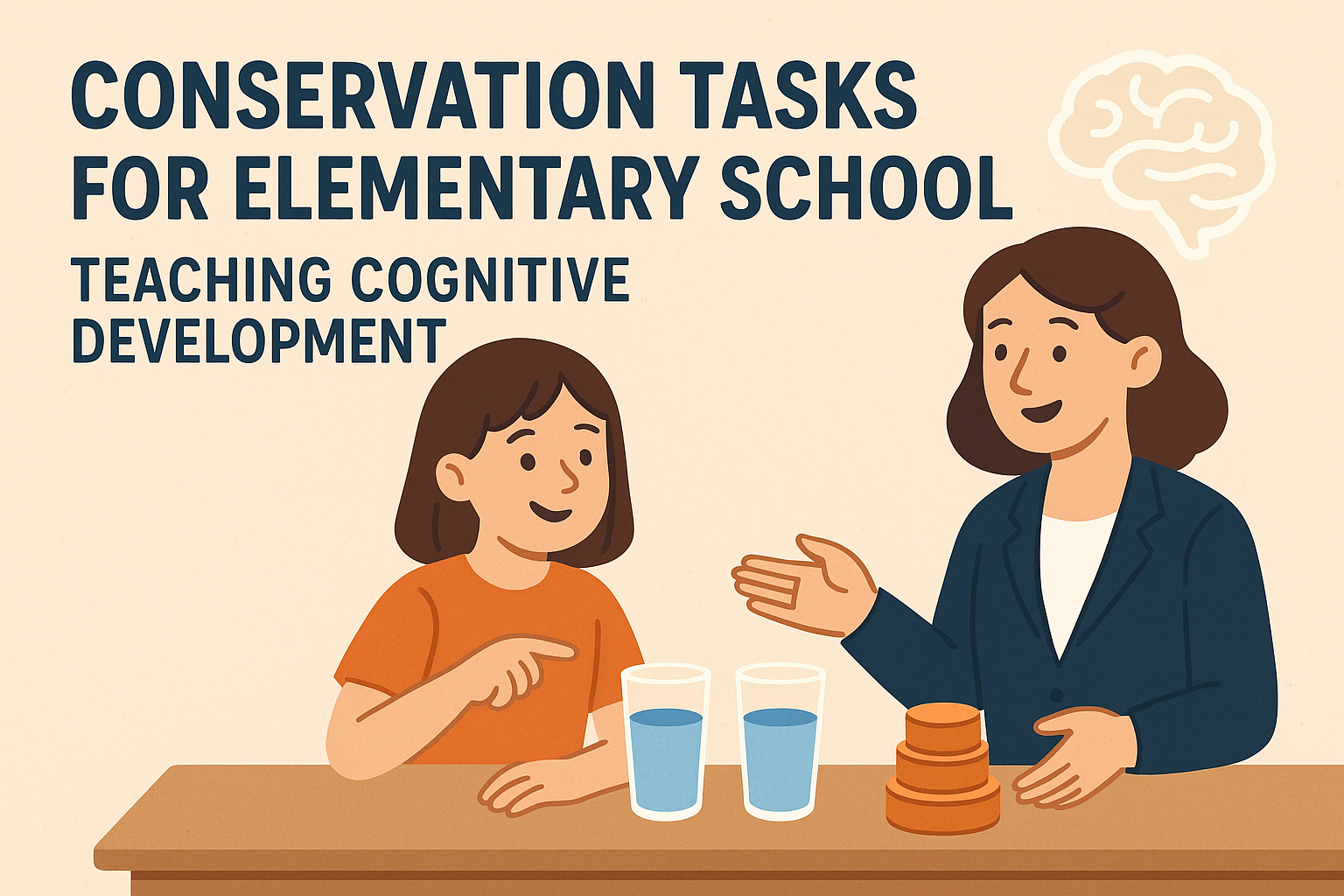
Children typically struggle with conservation tasks until they reach the concrete operational stage, usually between the ages of 7 and 11. In this stage, they begin to understand that the quantity of a substance doesn’t change even when its shape does. For example, if you pour water from a short, wide glass into a tall, thin glass, a child who hasn’t mastered conservation might think the taller glass contains more water simply because it looks different.
The Importance of Elementary School Conservation Activities
Elementary school conservation activities serve multiple purposes. They not only enhance logical reasoning but also encourage critical thinking and problem-solving skills. Engaging young learners in these activities fosters a deeper understanding of mathematical concepts, enhances their ability to classify objects, and supports overall cognitive development.
Research indicates that children who participate in hands-on conservation tasks tend to demonstrate improved performance in standardized tests and other assessments of cognitive skills. In a classroom setting, these activities can energize the learning environment, making abstract concepts more tangible.
Examples of Effective Conservation Activities
Creating effective conservation tasks doesn’t require elaborate setups. Here are a few engaging activities that teachers can implement in elementary school classrooms: See also social learning in classrooms.
- Water Pouring: Use two containers of different shapes to teach about volume. Have students pour water from one container to the other, asking them to predict which will hold more and why.
- Play-Dough Shapes: Roll out play-dough into a ball, then flatten it into a pancake. Engage students by discussing whether they have the same amount of play-dough before and after the transformation.
- Counting Objects: Use a set of blocks or counters. Ask children to arrange them in different patterns and discuss whether the quantity has changed.
- Classifying and Sorting: Provide various objects and encourage students to group them based on different criteria, such as size or color. This activity builds their understanding of conservation through classification.
These activities do not merely teach conservation; they encourage children to articulate their thought processes, fostering a dialogue about their observations and conclusions.
Linking Conservation Tasks to Real-Life Applications
One of the most significant benefits of elementary school conservation activities is their connection to real-world scenarios. Children can relate these tasks to everyday experiences, enhancing their learning and retention.
Consider the water pouring activity, for example. This simple task can be tied to cooking, where measuring liquids accurately is essential. It also opens discussions about conservation of resources — how we can manage water more efficiently. Connecting these abstract concepts to practical applications helps reinforce what students learn in the classroom. (See: Conservation in psychology.)
Addressing Challenges in Implementing Conservation Activities
Implementing elementary school conservation activities does come with its challenges. Teachers might encounter varying levels of understanding among students, with some grasping the concepts quicker than others. It’s crucial to tailor these activities to meet diverse learning needs.
To address this, teachers can utilize differentiated instruction strategies. For instance, while a child may struggle with the concept of liquid conservation, they might excel in understanding mass conservation through play-dough activities. Teachers may group students based on their current understanding and provide targeted support that will help advance their cognitive skills.
The Role of Parents and Guardians
While teachers play a crucial role in executing conservation tasks, parents and guardians can extend this learning at home. Engaging children in conservation-related activities outside of school can reinforce these concepts. Simple household tasks, like cooking or organizing belongings, provide excellent opportunities for conservation learning.
Parents can encourage their children to think critically about quantity and volume. For example, when participating in grocery shopping, parents can ask questions such as, “If we buy a bigger box of cereal, how much more do we get compared to a smaller box?” This kind of dialogue fosters a home environment rich in cognitive development.
The Current Relevance of Conservation Tasks in Education
In an age where educational standards are continuously evolving, the importance of cognitive development continues to be crucial. Schools are designing curricula that promote critical thinking and problem-solving skills, and conservation tasks align perfectly with these objectives.
Moreover, with the rise of STEM (Science, Technology, Engineering, and Mathematics) education, incorporating conservation tasks into the curriculum can bridge gaps in student understanding, paving the way for more complex mathematical and scientific concepts later on. The hands-on approach employed in these activities prepares students to tackle real-world problems with confidence.
Innovative Conservation Strategies for Teachers
As the educational landscape evolves, teachers are continuously developing innovative methods to engage students in conservation tasks. Interactive technology can greatly enhance these activities. For example, using tablets or smartboards, educators can showcase dynamic visualizations that illustrate conservation concepts. Interactive applications allow students to manipulate virtual objects, deepening their understanding of volume and quantity in a controlled environment.
Incorporating storytelling into conservation tasks can also be effective. By weaving narratives around the activities, teachers can captivate students’ imaginations while teaching them essential concepts. For instance, a story about a character who needs to measure ingredients for a cake could engage students as they learn about volume through the context of the character’s experience.
Statistics Supporting the Effectiveness of Conservation Activities
Numerous studies highlight the benefits of engaging students in conservation tasks. A study conducted by the National Center for Education Statistics found that students who regularly participate in hands-on learning experiences, such as conservation activities, score 15-20% higher in math assessments compared to their peers who do not. (See: Child development stages.)
Another recent study published in the Journal of Educational Psychology revealed that children who engage in conservation tasks show a 25% increase in their problem-solving abilities. These statistics underscore the vital role that conservation activities play in enhancing cognitive skills and academic performance.
The Impact of Classroom Environment on Learning
The classroom environment can significantly affect how well children engage with conservation tasks. A supportive and stimulating classroom fosters curiosity and encourages active participation. Teachers can utilize flexible seating arrangements, allowing students to work in groups or independently, which can enhance their learning experience.
Creating a space that is rich in resources, such as charts, manipulatives, and technology, can make a considerable difference. Visual aids that represent conservation concepts can help students visualize and understand the principles they are learning. Additionally, a classroom that celebrates mistakes as part of the learning journey encourages students to experiment with conservation tasks without fear of failure.
Integration with Other Subjects
Conservation activities can seamlessly integrate into other subject areas, enhancing interdisciplinary learning. For example, linking conservation tasks with science can help students understand concepts like mass, density, and the physical properties of materials. In art class, students can explore the conservation of shapes and colors while creating projects, reinforcing their understanding of these concepts in a fun way.
By bridging subjects, teachers can provide a holistic learning experience that demonstrates the interconnectedness of knowledge. This not only keeps students engaged but also helps them appreciate the relevance of what they are learning in the real world.
Frequently Asked Questions about Elementary School Conservation Activities
What age should children start learning about conservation?
Children typically begin to grasp the basics of conservation between ages 5 and 7. However, the most significant understanding develops during the concrete operational stage, around ages 7 to 11, when they can manipulate and understand these concepts more logically.
How can I reinforce conservation concepts at home?
Parents can reinforce these concepts through everyday activities such as cooking, measuring ingredients, or organizing household items. Ask children questions about quantity and volume during these tasks to encourage critical thinking.
Are there online resources for teachers to implement conservation tasks?
Yes! Many educational websites and platforms provide resources, lesson plans, and interactive tools aimed at teaching conservation concepts. Websites like Teachers Pay Teachers, Education.com, and National Geographic Education offer a range of materials that can be adapted for classroom use.
What are some signs that my child understands conservation tasks?
Signs that your child understands conservation tasks include their ability to articulate thoughts about quantity and volume, accurately predict outcomes in conservation experiments, and apply these concepts to real-life situations, such as discussing quantities when sharing snacks with friends.
How can conservation tasks be adapted for students with special needs?
Adapting conservation tasks for students with special needs can involve simplifying the task, using more concrete materials, or offering one-on-one support. Visual aids, hands-on manipulatives, and verbal prompts can also help reinforce understanding and make the activities more accessible.
Can conservation activities be conducted virtually?
Absolutely! With the rise of online learning, conservation activities can be adapted for virtual classrooms. Teachers can use digital tools to conduct experiments, such as online simulations that allow students to manipulate objects and explore conservation concepts from home.
What are some creative ways to assess children’s understanding of conservation?
Creative assessments can include project-based learning, where students demonstrate their understanding through presentations or models, or using digital portfolios to showcase their work. Interactive quizzes and games can also serve as fun assessment tools, allowing students to engage while reinforcing their learning.
Conclusion: Building a Foundation for Lifelong Learning
Elementary school conservation activities are more than simple tasks; they are vital components in the cognitive development of children. As students engage with these activities, they develop critical thinking, problem-solving skills, and a deeper understanding of the world around them. There’s a fuller look at kinetic sand ideas for kids.
By embracing conservation tasks in the classroom and at home, we empower children to understand the principles of quantity and volume, equipping them with the foundational skills needed for future learning. As educators and parents, fostering these skills early on ensures that we build a foundation for lifelong learning and curiosity — an invaluable gift for any child.
“`
Trending Now
- Unlock Your Potential: A Frontend Developer Course Opportunity with Quinncia Inc
- Conscious Discipline vs. Traditional Classroom Management…
- this guide on difficult temperament vs. adhd: how to tell the difference
- How to Parent According to Your…
- our breakdown of object permanence and cognitive development: piaget’s theory explained
Frequently Asked Questions
What are conservation tasks in cognitive development?
Conservation tasks are activities designed to help children understand that certain properties, such as quantity and volume, remain constant despite changes in shape or arrangement. These tasks are essential in cognitive development, particularly during the concrete operational stage, typically between ages 7 and 11.
Why are conservation activities important in elementary school?
Elementary school conservation activities are vital as they enhance logical reasoning, critical thinking, and problem-solving skills. They help children grasp mathematical concepts and improve their ability to classify objects, thereby supporting overall cognitive development.
At what age do children understand conservation?
Children typically begin to understand conservation during the concrete operational stage, which occurs between the ages of 7 and 11. During this period, they learn that the quantity of a substance remains the same even when its shape changes.
How do conservation tasks affect children's learning?
Engaging in hands-on conservation tasks has been shown to improve children's performance on standardized tests and cognitive skill assessments. These activities create an energizing classroom environment and make abstract concepts more tangible for young learners.
Who introduced the concept of conservation in cognitive development?
The concept of conservation was introduced by French psychologist Jean Piaget, who identified it as a key milestone in the development of logical thinking during childhood. Piaget's work emphasizes the importance of understanding conservation for cognitive growth.
What’s your take on this? Share your thoughts in the comments below — we read every one.



