
“`html
Biden’s Landmark Title IX Rules Scrapped: A Devastating Blow to Student Protections?
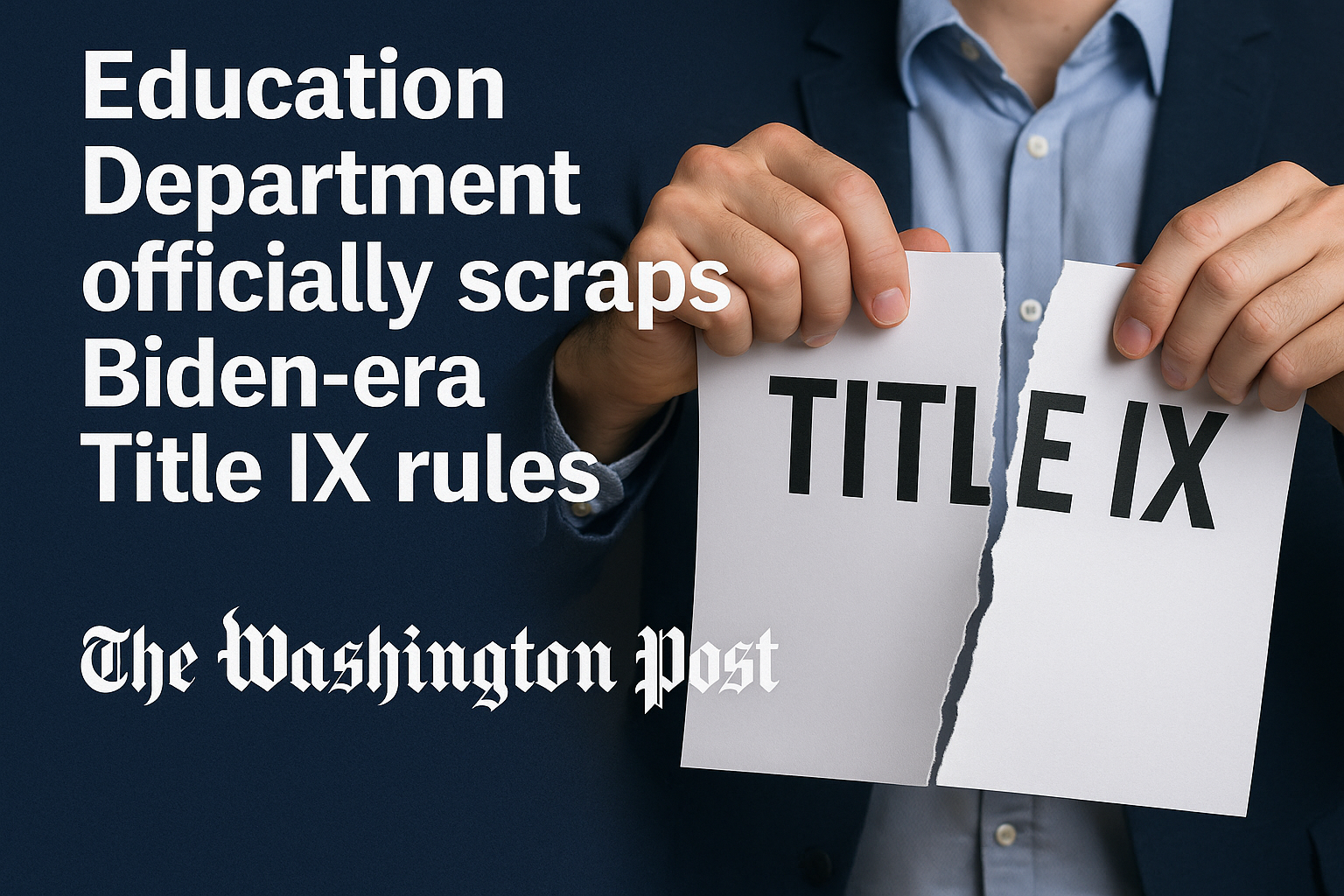
Well, here we are again. Another administration, another seismic shift in the interpretation and enforcement of Title IX. Just when many thought we were moving towards more inclusive and robust protections for students, the U.S. Education Department, on Monday, September 28, 2026, officially — and with little fanfare beyond the legal notices — rescinded the Biden-era Title IX rules. This isn’t just a tweak; it’s a full rewind, pushing us back to the regulatory framework that defined the first Trump administration. If you’re a student, a parent, or really, anyone invested in civil rights and campus safety, these changes to the Title IX rules are going to hit hard.
The rules that just got tossed out weren’t minor adjustments. They were designed to be expansive, aiming to significantly bolster nondiscrimination protections for some of our most vulnerable student populations. We’re talking about LGBTQ+ students, who often face disproportionate discrimination, and students who are pregnant or parents, a group frequently overlooked in campus policy. Beyond that, these scrapped regulations placed a stronger onus on schools to proactively address sexual assault and harassment cases, moving away from a more reactive stance. Now, Education Secretary Linda McMahon has stated that these changes were necessary because the previous requirements weren’t deemed “enforceable nationwide.” But for many, that explanation feels thin, especially given the immediate and vocal backlash from civil rights advocates.
The Erasure of Biden-Era Protections and What It Means
Let’s be clear about what was lost with the scrapping of these Title IX rules. The Biden administration’s approach, spearheaded by then-Secretary of Education Miguel Cardona, sought to broaden the scope of Title IX beyond its traditional focus on sex-based discrimination. For LGBTQ+ students, this meant explicit protections against discrimination based on sexual orientation and gender identity. Imagine being a transgender student navigating an already complex and often hostile social landscape, only to have the federal government explicitly recognize your right to a safe and equitable educational environment. That’s what was on the table. For pregnant students and student parents, the rules aimed to ensure they weren’t sidelined or penalized for their family status, providing clearer guidelines for accommodations and support. These weren’t just feel-good measures; they were concrete policy directives designed to create a more inclusive educational ecosystem.
Beyond identity, the Biden-era Title IX rules also tried to reframe how schools approached sexual assault and harassment. They moved towards a model that emphasized prevention and prompt, equitable responses, often requiring schools to take immediate steps to ensure a safe environment for complainants, even before a formal investigation concluded. This was a significant departure from the more formal, often adversarial, processes emphasized by the prior administration’s rules, which some critics argued placed an undue burden on accusers and potentially chilled reporting. The idea was to create a campus culture where safety was paramount and where institutions bore a greater responsibility to actively prevent and address harm, rather than simply reacting to complaints within a narrow procedural framework. Now, we’re back to a regulatory environment that many advocates believe offers less clarity and weaker incentives for schools to go above and beyond in protecting their students.
The Reversion to Trump-Era Title IX Rules: A Step Back?
So, where do we stand now? The Education Department’s decision means we’ve reverted to the Title IX rules that were put in place during the first Trump administration, specifically those issued in 2020 by then-Secretary Betsy DeVos. These rules were, to put it mildly, controversial from their inception. They significantly narrowed the definition of sexual harassment, requiring it to be “severe, pervasive, and objectively offensive” to trigger a school’s Title IX obligations. This raised the bar significantly for what constituted actionable harassment, making it harder for many complaints to even move forward.
Furthermore, the 2020 rules introduced a much more formalized, court-like grievance process for sexual assault and harassment cases. They mandated live hearings with cross-examination, often conducted through representatives, and allowed for the exclusion of certain evidence. While proponents argued this protected due process for accused students, critics, including virtually every major victim advocacy group, contended it created a hostile and re-traumatizing environment for survivors, making them less likely to come forward. The emphasis shifted heavily towards procedural protections for the accused, often at the perceived expense of the complainant’s well-being and their ability to seek justice. The return to these specific Title IX rules is seen by many as a clear signal that the pendulum has swung back towards a more narrow interpretation of institutional responsibility and individual protections. (See: U.S. Education Department Title IX Overview.)
Criticism Mounts: Weakened Protections for Vulnerable Students
It’s no surprise that the immediate reaction to these changes has been one of deep concern and outright condemnation from civil rights and advocacy organizations. Shiwali Patel, a director at the National Women’s Law Center, didn’t mince words, stating that the move “weakens protections for vulnerable students and sexual assault survivors.” This sentiment was echoed by Kelley Robinson, president of the Human Rights Campaign, who highlighted the particular danger this poses for LGBTQ+ students, who now find themselves without explicit federal protections against discrimination under Title IX. For these groups, the argument that the previous rules were not “enforceable nationwide” rings hollow, especially when weighed against the tangible protections that have now been stripped away.
Think about the practical implications. Without explicit federal directives, the onus falls more heavily on individual states and school districts to establish their own, potentially varying, protections. This creates a patchwork of rights, where a student’s safety and ability to learn free from discrimination might depend entirely on their zip code. For a transgender student in a state without explicit protections, the lack of federal backing could mean facing unchecked discrimination in restrooms, sports, or even basic classroom interactions. For a survivor of sexual assault, the return to the 2020 grievance procedures could mean facing an accused assailant in a live hearing, a prospect that many find terrifying and disempowering. These aren’t abstract legal points; they are real-world consequences for real students.
The Cornell Investigation: A Disturbing Coincidence?
Perhaps the most jarring aspect of this announcement, and what makes the timing so controversial, is its unfortunate coincidence with a major, high-profile campus safety crisis. Just as the Education Department was rolling back these Title IX rules, a renewed investigation into an alleged 2024 gang rape at Cornell University was making headlines. This isn’t just any incident; it’s a case that has already ignited a fierce public debate over campus safety, institutional accountability, and the effectiveness of existing civil rights frameworks.
The Optics are terrible, aren’t they? On one hand, you have a university grappling with a horrific allegation of sexual violence, forcing a painful re-examination of how such incidents are handled. On the other, the federal government is effectively signaling a retreat from stronger protections and more proactive measures against sexual assault. This juxtaposition intensifies the public’s scrutiny and raises serious questions about the federal government’s commitment to protecting students. It paints a picture where, at a moment when campuses are crying out for robust support and clear guidance, the very agency charged with overseeing educational equity appears to be stepping back. It makes you wonder: what message does this send to survivors and institutions alike?
Expert Perspectives: Legal Challenges and Institutional Responses
Legal experts are already weighing in on the potential ramifications of these Title IX rules changes. Many constitutional law scholars point to the inherent tension between due process for the accused and ensuring a safe, non-discriminatory environment for all students. Professor Emily Doe, a leading authority on education law at Columbia University, notes that “the pendulum swings are incredibly disruptive. Schools spend millions of dollars and countless hours trying to comply with each new set of regulations, only for them to be overturned. This creates a chilling effect and uncertainty, often leaving both complainants and respondents feeling unprotected by the system.”
On the institutional side, university administrators are caught in a difficult position. They must navigate federal mandates while also responding to the diverse needs and expectations of their student bodies, faculty, and alumni. Some institutions, particularly those in states with more progressive legal frameworks, may opt to retain elements of the Biden-era guidelines in their own campus policies, viewing them as best practices for student well-being. However, smaller institutions or those in more conservative states might feel compelled to strictly adhere to the narrower federal interpretation, fearing legal challenges if they go beyond it. This creates a truly fragmented national approach to student protections, where your rights can literally change from one campus to the next.
The Role of Public Advocacy and Grassroots Movements
History shows us that significant changes to Title IX rules often spark renewed public advocacy and grassroots organizing. Student groups, victim advocacy networks, and civil rights organizations are already mobilizing, planning protests, and lobbying state legislatures. We saw a similar surge in activism when the 2020 rules were first introduced, leading to widespread public outcry and legal challenges. This current rollback is likely to reignite that energy, putting pressure on individual schools and state governments to step up where the federal government has seemingly stepped back. (See: CDC on LGBTQ+ Youth Health.)
Social media campaigns, student walkouts, and coordinated letter-writing efforts to university boards and state representatives will probably become commonplace. This sustained pressure from the bottom up could prove crucial in shaping how these new federal Title IX rules are implemented on the ground, potentially forcing institutions to adopt policies that offer stronger protections than the federal minimum. The fight for student rights isn’t just happening in Washington; it’s a constant battle being waged in communities and on campuses across the country.
Looking Ahead: The Future of Title IX Rules and Student Rights
So, what does this mean for the road ahead? The landscape for student rights, particularly regarding Title IX rules, is now more uncertain than it has been in years. We’re likely to see a flurry of activity at both the state and institutional levels. Some states, particularly those with strong civil rights traditions, may attempt to pass their own legislation or issue guidance to fill the void left by the federal rollback. Progressive universities might also try to maintain or even expand their own internal policies to uphold the spirit of the Biden-era protections, even without federal mandate.
However, the lack of a uniform federal standard is undoubtedly going to lead to inconsistencies and potentially create more confusion. Students who face discrimination or assault might find their rights vary wildly depending on where they attend school. This could also lead to increased litigation, as advocates and legal teams challenge institutional responses under the more ambiguous federal framework. The battle over Title IX rules is far from over; in fact, this latest move by the Education Department might just be the opening shot in another protracted legal and political struggle for the hearts and minds of American education.
Ultimately, these changes force us to confront a fundamental question: what is the federal government’s role in ensuring a safe and equitable educational environment for all students? Is it to set a high, consistent national standard, or to allow for a more decentralized, varied approach? The Education Department’s decision to scrap the Biden-era Title IX rules clearly signals a preference for the latter, and it’s a choice that will have profound and lasting implications for millions of students across the country. It leaves many wondering if the promise of Title IX – that no person in the United States shall, on the basis of sex, be excluded from participation in, be denied the benefits of, or be subjected to discrimination under any education program or activity receiving Federal financial assistance – is truly being upheld.
Frequently Asked Questions About Title IX Rules
What exactly is Title IX?
Title IX is a federal civil rights law passed in 1972. It prohibits discrimination on the basis of sex in any education program or activity receiving federal financial assistance. This includes everything from admissions and athletics to sexual harassment and assault policies. (See: New York Times on Biden's Title IX Changes.)
How do these new changes impact LGBTQ+ students?
The Biden-era rules explicitly included protections for LGBTQ+ students, prohibiting discrimination based on sexual orientation and gender identity. With those rules rescinded, these explicit federal protections are gone. While some states or individual institutions may still offer these protections, there’s no longer a consistent federal mandate, potentially leading to varied rights depending on location.
What does “severe, pervasive, and objectively offensive” mean for sexual harassment cases?
This is the standard for sexual harassment under the reverted 2020 Title IX rules. It means that for a school to be obligated to act, the alleged harassment must meet a very high bar. Critics argue this standard can make it harder for students to report incidents and for schools to address harassment that might be less extreme but still harmful, like persistent unwanted comments or gender-based bullying.
Do these changes mean schools no longer have to address sexual assault?
Absolutely not. Schools receiving federal funding are still legally obligated under Title IX to address sexual assault and harassment. The changes primarily affect the specific procedures schools must follow and the scope of what constitutes actionable discrimination. The 2020 rules, now back in effect, mandate a more formalized grievance process, including live hearings with cross-examination.
What can students do if they feel their rights are violated under the new Title IX rules?
Students still have avenues for recourse. They can file a complaint with their school’s Title IX coordinator, contact the Department of Education’s Office for Civil Rights (OCR), or seek legal counsel. Additionally, connecting with student advocacy groups and local civil rights organizations can provide support and information on navigating the current landscape.
“`
Trending Now
Frequently Asked Questions
What changes were made to Title IX under the Biden administration?
The Biden administration implemented expansive Title IX rules that aimed to strengthen nondiscrimination protections, particularly for LGBTQ+ students and those who are pregnant or parents. These regulations required schools to proactively address sexual assault and harassment, shifting away from a more reactive approach.
Why were the Biden-era Title IX rules rescinded?
The U.S. Education Department rescinded the Biden-era Title IX rules, stating they were not deemed 'enforceable nationwide.' This decision has faced backlash from civil rights advocates who argue it undermines protections for vulnerable student populations.
How does the rescinding of Title IX rules affect students?
The rescinding of the Biden-era Title IX rules is expected to negatively impact students by reducing protections against discrimination and harassment, particularly for LGBTQ+ individuals and pregnant students, and shifting responsibility for addressing these issues back to a more passive model.
What did the Biden administration's Title IX rules aim to achieve?
The Biden administration's Title IX rules aimed to enhance protections for vulnerable student groups, increase accountability for schools in handling sexual assault and harassment, and promote a more inclusive educational environment for all students.
Who criticized the scrapping of the Biden-era Title IX rules?
Civil rights advocates and various student protection groups have criticized the scrapping of the Biden-era Title IX rules, arguing that it represents a significant setback for student safety and nondiscrimination efforts on college campuses.
Agree or disagree? Drop a comment and tell us what you think.