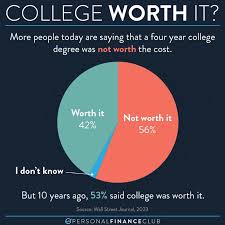

A recent study has revealed a startling trend in American attitudes towards higher education: a majority of Americans no longer believe that a college degree is worth the financial burden. The survey, conducted by a leading research firm, found that 57% of respondents think that the cost of a college education outweighs its benefits.
This shift in public opinion is a significant departure from the long-held notion that a college degree is a key factor in securing a successful and lucrative career. For decades, Americans have been told that a degree from a reputable institution is essential for getting ahead in the job market. However, with the rising cost of tuition, increasing student debt, and stagnant wages, many are beginning to question the value of a college education.
The study’s findings are particularly striking among younger Americans, with 63% of millennials (born between 1981 and 1996) expressing skepticism about the value of a college degree. This demographic is likely to be influenced by the fact that they are shouldering a disproportionate amount of student debt, with many struggling to make ends meet despite having a degree.
The survey also found that Americans are increasingly concerned about the return on investment (ROI) of a college education. With the average student debt load now exceeding $30,000, many are wondering whether the financial burden is worth the potential benefits. Furthermore, the study revealed that only 45% of respondents believe that a college degree guarantees a good job, highlighting the growing perception that a degree is no longer a guarantee of success.
The implications of this study are far-reaching, with potential consequences for the higher education sector, policymakers, and the economy as a whole. As Americans become increasingly disillusioned with the cost and value of a college education, institutions may need to rethink their pricing models and focus on providing more affordable and relevant programs. Additionally, policymakers may need to consider alternative paths to education and employment, such as vocational training and apprenticeships, to provide opportunities for those who cannot afford or do not want to pursue a traditional college degree.